Showing posts with label vukodlak. Show all posts

Friday, January 03, 2020

The Witcher: Betrayer’s Moon – review

Director: Alex Garcia Lopez

First aired: 2019

Contains spoilers

2019 saw a Netflix original series of the Witcher. Probably best known in the UK due to the games, here on TMtV we have previously looked at the Last Wish, the first book, which contains the story that has led to this review. The story was also included in the Polish TV Show Wiedźmin, which I reviewed a while ago.

The world of the Witcher is full of vampire types. In this case the vampire type might not seem that vampiric within the episode, but as it is a vampire type (no matter how it acted) I’m looking at the episode. Note I am concentrating on the episode's Geralt (Henry Cavill, Blood Creek & Justice League) storyline. There are three arcs running through the series, all interconnected but all in different timelines. Episode 3 was the first that actually expressed the difference in timelines and, if I had a complaint about the show, I think it should have made the fact that there were different timelines more explicit for the more casual viewer.

Henry Cavil as Geralt
So, in Geralt’s timeline things start with another Witcher, Remus (Gudmundur Thorvaldsson), who visits a group of miners who are being plagued by a monster. One of them is mortally injured and suggests that the creature is a vukodlak – the undead child of a pregnant girl who died before her time. Remus is paid 3000 orens in advance and goes to find the creature but meets his end. Geralt hears of Remus passing through at an inn, from a prostitute. Short of coin he leaves Roach, his horse, as a deposit and heads to Temeria, the kingdom in which the attacks take place.

hand of the monster
The miners are close to revolt as they believe their king, Foltest (Shaun Dooley), is not doing anything to protect them from the monster. When Geralt arrives, the reception is not good as they believe Remus took their money. Geralt apologises for his guild, tells them he takes the payment after the monster is killed and he’ll do the job for a third of the price. This is going well until the King’s man, Ostrit (Jason Thorpe), arrives with troops, breaks up the crowd and has Geralt escorted from the kingdom.

Remus' corpse
However, in the forest, his escorts all fall asleep and the King’s sorceress, Triss Merrigold (Anna Shaffer), takes Geralt back in secret. She has Remus’ body and, when discovering that the body is missing heart and liver, Geralt realises that it is a striga. Similar to the vukodlak – in that it is the unborn daughter of the dead Princess Adda – the difference is that the striga is cursed (indeed was cursed in the womb and it was this that killed her mother) and can be restored to humanity if Geralt can break the curse. Of course, with it being part of the royal family things are not going to be simple.

face to face
The striga is portrayed as monstrous, and large – pretty much sticking to a bipedal creature feature style – but with a long prehensile umbilical cord. The creature is night time active only and slumbers in her tomb during the day. Other than that, we are offered very little lore. However, what we get is a nice little watcher monster hunt, with a view to breaking the curse rather than kill the monster. There is a nice atmosphere to this and the episode is primarily shared with a story set in a timeline when Foltest and Adda were still children.

Shaun Dooley as Foltest
This version of the Witcher works really well, Cavill is excellent in the role and the stories capturing the grey morality of the books/games. Unfortunately, I’m struggling to score this as I don’t think the episode would work out of the season whole, with the arcs all being equally important. So unusually the score is for the season as a whole, despite only this episode having a vampiric element (and then that aspect is played down). Nevertheless 8 out of 10.

The episode’s imdb page is here.

Monday, July 14, 2014

London After Midnight – review

Author: Marie Coolidge-Rask

First Published: 1928

Contains spoilers

The Blurb: "It was the old man… with the long cloak and the fiendish grin!"

The most successful of all the collaborations of director Tod Browning and legendary Lon Chaney, ~ "The Man of a Thousand Faces" ~ was London After Midnight, their long-lost silent "Mystery-Thriller."

But now the novelization based on Browning's original screenplay is back for the first time since its original publication, in its entirety!

Once more mystery haunts the old Balfour House …and Lon Chaney’s gonna get you if you don’t watch out!

Complete with the original photo-illustrations plus additional features exclusive to this edition, including "Transylvania to Prague via London ~ After Midnight" and introduced by your Thriller Theatre host Margali Morwentari.

The review: London after Midnight is for many (including me) one of the most lamented of the lost films, probably more so because we have the remake, Mark of the Vampire, and the bravely constituted reconstruction to hint at what we are missing. That hint is greater still with the re-release of the original novelisation. The story is based on an early draft of Browning’s script and so contains aspects not in the final film, primarily heroine Lucy’s brother Harry Balfour – murdered early on and actually filmed by Browning but cut out of the final edit that made Lucy an only child.

I assume, as you read this, that you are aware of the storyline of London After Midnight (or have seen the reconstruction). At the very least I assume that you have seen Mark of the Vampire and thus it is not a spoiler too far to tell you that the vampires in this story are not actually real. Indeed the logic of having them there at all, whilst wonderful for the atmosphere of the film, demanded a twisted logic that was quite torturous. But, you know what, it doesn’t matter.

The vampires are connected with bats and can turn into mist. As well as being cited as vampires, they are referred to in text by the genus names Vukodlak and Murony (according to Bane’s Encyclopedia of Vampire Mythology a Murony is both a variation of the Romanian Muroni and is a vampiric spirit or a Walachian/Moldavian variant of living vampire).

The writing is very melodramatic and certainly of an age – you couldn’t mistake this for a more modern written volume. But hey, you know what… it’s London After Midnight and that should be all the encouragement you need. 8 out of 10 for its historical value in the genre. The re-release of this volume was notified to me by a blog reader, Fenris, and so my thanks for the heads up.

Monday, January 28, 2013

Troublesome Corpses: Vampires & Revenants from Antiquity to the Present – review

Author: David Keyworth

First Published: 2007

The Blurb: Since earliest times man has feared troublesome corpses – the bodies of the dead which do not lie still and decompose, but rise again to revisit the living. European folklore is particularly rich in tales of vampires and reanimated cadavers. The Undead take many forms, as do precautions to avert an attack and methods of destruction should precautions fail.

What distinguishes vampires from other revenants? What metaphysical agencies empower the Undead and how do theological contortions help explain them? And why did popular belief in the existence of the undead wane during the eighteenth Century? These and other vampiric questions are addressed in David Keyworth’s encyclopaedic survey of troublesome corpses.

The Review: It is difficult to review this book without using words such as seminal, wonderful and necessary: so there you go, I got them out of the way.

Heyworth’s book explores the concept of corpses who just won’t stay still and the main question within the book is, “what is the difference between a vampire and the other types of undead?” This is not an etymological question and the simple answer seems to be blood. The vampire panics of the eighteenth century had revenants that were not only called ‘vampire’ for the first time (in print at least) but drank the blood of victims. Blood did come into earlier folklore but it was not as central as it was in the eighteenth century vampire reports/folklore.

To take us on this journey Keyworth takes us from Antiquity, through Medieval writing all the way to the Eighteenth century and beyond that, touching onto the twenty-first century. However, keep in mind that this is an exploration of the vampire of folklore, media vampires need not apply except in passing. I found the discussions around the revenants of medieval England and the Scandinavian draugrs particularly fascinating.

It has to be said, however, that the book is so much more than the above. It looks deeply into all aspects of the vampire reports and folklore with impressive referencing and useful indexing.This book has been either the source of, or has informed, several threads on the Facebook Vampire Lore and Legend page and is, in itself, invaluable to all students of the vampire. 10 out of 10.

Thursday, July 29, 2010

Leptirica – review

cover
Director: Djordje Kadijevic

Release date: 1973

Contains spoilers

Leptirica (the she-butterfly) is another one of the great sins of vampire cinema, in that it is begging for a fully restored DVD release – possibly as a double set with Kadijevic’s 1990 reworking of Viy, Sveto Mesto.

This film is fascinating because of the very pure Slavic lore the film taps into. It is based on the story “Posle Devedeset Godina” or “90 Years Later” by Milovan Glišić. The story features a folkloric vampire who goes by the name Sava Savanović. The film is so rich in lore that I will, with genuine glee, spoil the story completely.

Slobodan Perovic as Zivan
It begins with a man, Zivan (Slobodan Perovic) leading his horse to a mill. He calls for the miller, Vule (Toma Kuruzovic), and when he gets no response he carries his grain in. Vule has been napping, lulled to sleep by the sound of the mill. There are the uncanny cries of an owl, which Vule shoos to, and Zivan asks whether the miller sleeps there at night, he does, and whether he is afraid. Outside the mill we see Radojka (Mirjana Nikolic) on a hillside, identified by Vule as Zivan’s daughter and, as he puts it, as pretty as a butterfly.
teeth aplenty
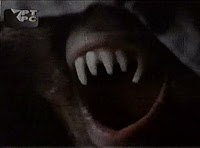
He enters the mill again and, after a while, the eerie owl calls begin again. He exclaims ‘drop dead’ before falling asleep. We see the mill stop. A pair of eyes appear, monstrous, looking in at Vule through the boards of the wall and then we see a dark, hirsute and clawed hand touch the flour – poetically contrasting the white and black. A hooded creature is seen, its teeth sharp are monstrous and it bites at Vule’s neck. When it leaves the mill restarts but Vule is dead.

Petar Bizivic as Strahinja
He is found the next day by one of the villagers and we discover that he is the third or fourth miller killed in the last year. Vampires are mentioned as is the word vukodlak – a particular Slavic name for a vampire, indeed Sava Savanović himself is mentioned; but all of these are dismissed as silly folklore. Meanwhile a young man, Strahinja (Petar Bozovic), has gone to Radojka. It is clear that they are in love but she says that Zivan has invited suitors for her hand. When Zevan appears she tells Strahinja to run and is subsequently told off by Zevan for being where she is.

evil eyes
Strahinja asks Zevan for Radojka’s hand in marriage but is given short shrift as he is poor. He decides he will leave the area as he cannot stand watching her marry another. However the men of the village see him and suggest he becomes the new miller, something he agrees to. Again, on his first night in the mill, the mill stops and again the eyes look into the mill. Strahinja falls, pulling bags of flour with him, and somehow – through luck and clumsiness, it seems – manages to survive the night, though at first the men fear the white apparition (he is covered in flour) they see.

The men decide to find the grave of Sava Savanović. They question an old woman, Mirjanicka, and eventually get an idea of where the alleged vampire’s grave should be. The search seems futile until one of the men decides to get hold of Zivan’s stallion. We have come across using a horse to find the grave of a vampire before and at this point I would like to start referencing the book The Vampire: A Casebook edited by Alan Dundes – for the sake of this review I have used the edition on Google Books. In the chapter “In Defence of Vampires” by John V A Fine Jr we find a quote by Vuk Karadžić, “they take a black stallion without any spots or marks to the graveyard and lead it among the graves where it is suspected there are vukodlaks, for they say that such a stallion does not dare to step over a vukodlak.”.

Radojka in the forest
Whilst they are getting the stallion we see Radojka in the woods, she listens to the sound of the owls and it seems that there is almost a sexual tension in the air. Meanwhile the men have found the grave and start to dig until they find a coffin and they hammer a stake through the unopened lid as the priest prays. This, again, has a folkloric root but, of course, one we are more familiar with. However more interesting is the appearance of a butterfly from the coffin (through the hole in the lid). The men try to catch it but fail. Returning to The Vampire: A Casebook and South Slavic Countermeasures against Vampires by Friedrich S Krauss we read, “the others present watch for the appearance of a moth (or butterfly) flying away from the grave. If one does fly out of the grave, everyone runs after it in order to capture it. If it is caught, it is thrown onto a bonfire so that it will die. Only then is the vampire completely destroyed. If the butterfly escapes, however, then, alas, woe to the village…”

priest in prayer
The men obviously haven’t read Krauss and are somewhat happier in disposition then they should be. They are quite taken with Strahinja and suggest that he should simply take Radojka as his wife – something the priest concurs with. Someone also, interestingly, suggests that Zivan is not her father but an uncle, maybe. They go get her and an angry Zivan watches from a distance. He catches the butterfly and vows vengeance. Tradition states that Radojka must stay in a house guarded by a woman for one night but Strahinja tells her that he will go to her.

wound in the torso
He sneaks into the house and is undressing her when he discovers that she has a gaping wound in her abdomen – perhaps as though a stake had pierced her stomach. She starts to transform before him, becoming fanged and then hirsute. You should remember that there is little difference, traditionally, between the werewolf and the vampire and thus her appearance is not so unusual.
hagridden
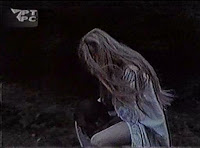
She leaps on his back, but she is not attacking him – not at this point. She grabs his mouth and, if we look forward in time to Kadijevic’s Sveto Mesto, the actions are identical to the hag coming to Toma. She is hag-riding him and she directs him straight to the grave. When she lets go she continues to push him forwards, towards the grave. Strahinja starts to pull at the stake that still protrudes from the coffin and Radojka reacts as though the stake is being pulled from her. He retrieves the stake and she falls, all we see is her white nightdress and the coffin opens. In a moment of duality the vukodlak Radojka emerges from the coffin, in black, she turns and runs at Strahinja who lifts the stake before him.

The film ends in the morning with Strahinja led motionless in the meadow and the butterfly sat upon his temple. So the film has ended, but what a film. It packs in such a lot of traditional Slavic lore that for the dedicated fan of the genre it is a must see film. I liked the use of the butterfly, which was much more dignified than the use of moths in the Blood Beast Terror. We should remember that Stoker himself mentioned a vampiric affinity with moths in Dracula when he suggested “he can command all the meaner things, the rat, and the owl, and the bat, the moth, and the fox, and the wolf”. In this however, I think the butterfly was representative of the vampire’s soul or spirit.

changing on the wedding night
The film is creepy and rather atmospheric, the mill being a great location. This fits in with tradition. Returning to the Vuk Karadžić quote, he tells us that, “in times of hunger vampires often gather near mills and around granaries.” It seems a little dreamlike in places though I suspect that the film showed its hand too early with the attack on Vule being so explicit – the argument that it wasn’t something supernatural, that the men have, seems half-hearted at best at that point, especially as they take little convincing to use traditional detection methods thereafter.

That aside an important film begging for a full re-mastered international release. 7.5 out of 10. The imdb page is here.