Showing posts with label revenants. Show all posts

Friday, February 27, 2026

Talamasca: The Secret Order – season 1 – review


Directors: John Lee Hancock, Louise Hooper & Eva Sørhaug

First aired: 2025

Contains spoilers

I’ve already looked at Interview With the Vampire (Season 1 & Season 2), which opened AMC’s The Immortal Universe. In truth I have yet to watch through the Mayfair Witches but have taken the opportunity, with the UK Blu-Ray release, to catch up with the Talamasca series. This series is based on the series of novels entitled “The Vampire Chronicles” and “The Lives of the Mayfair Witches”, rather than being versions of those novels.

Elizabeth McGovern as Helen

It follows Guy Anatole (Nicholas Denton) newly qualified from law school and a telepath, who manages to snag a job at a top law firm when he is approached by Helen (Elizabeth McGovern), a Talamasca agent. The lure of money to hear her out (he’s financially embarrassed) is her hook and he discovers that they have been watching over his life (presumably, at first, due to his gift but later we discover that his missing mother was a Talamasca agent who went rogue).

Nicholas Denton as Guy

He, of course, doesn’t believe her when she mentions the immortal world but she then introduces him to Burton (Jason Schwartzman), a vampire. He also goes to a book signing by Daniel Malloy (Eric Bogosian, Blade Trinity), who interviewed Louis in the Interview series. The fact that his book has been published puts this after the Interview seasons thus released but (if the various series will go this far) before the events in the book Queen of the Damned as there are plenty of younger end vampires around.

William Fichtner as Jasper

Guy accepts his role as spy and gets one week’s condensed training – and this is where this series is that little weaker than those (I’ve seen thus far) based on Rice’s storylines. Ok, Helen is desperate for an off-books agent, but Guy is so green he should be dead (probably by the end of the first episode, certainly not far into the series). He is told to watch the London Talamasca motherhouse, and it becomes apparent that it has been taken over by a vampire named Jasper (William Fichtner) who is searching for an artefact called the 752 – a receptacle of all the Talamasca’s library that backed up their central library prior to a catastrophic fire in the 70s. Jasper has created revenants – the feral vampires seen in the Romanian sequence of Interview, but Jasper has worked out how to make them obedient.

a revenant

Time to mention a vampire gift, from memory not in the books, though used within the Interview TV series, but which stood out to me here. Some vampires apparently have a time stopping gift. One might argue that it shows them observing time relatively, when fast moving, but Jasper stops time (including a pour of whisky hanging in the air) but converses with Guy and so it appears that time has stopped but he can choose who is affected. How this works is unknown and feels overpowered – when, with Louis and Lestat, it added to the atmosphere. 

iron mask

Another thing introduced is iron to control a vampire (which, of course, is a fae trait). This is in Rice’s books (introduced in Blood Canticle) but it subdues the mind and fire gifts, it does not rob them of other powers as it seems to in this. I will mention a little irk that many will not catch – unless they use UK rail – in the final episode they go to Waterloo Station, which was clearly not Waterloo (the series was filmed in Manchester and it looked suspiciously like Manchester Piccadilly station) and get on a Northern Train, which don’t run from Waterloo – not major, as most viewers won’t realise, but it knocked my immersion for a moment. Nevertheless, despite the fact that it was difficult to buy Guy, as he was way too green, the story was interesting, with plenty of twists and turns, and all the acting solid. 6 out of 10.

The imdb page is here.

On Blu-Ray @ Amazon US

On Blu-Ray @ Amazon UK

Wednesday, August 29, 2018

Vitaortus Book 2 – review

Author: Dea Schofield

First Published: 2014

Contains spoilers


The Blurb: This supernatural fusion tale twists and twines along as Devi Trevathan, the world's only Prime Channel (and herb-growing, immortal horticulturist), comes to grips with her critical new role.

Nefarious forces and dueling romantic distractions vine around her, causing plenty of trouble and strife. New revelations about the tricky vampires she helps sheds light on their ancient mysterious ways as well as the special relationships with their human ‘bonded’.

Can Lord Alec Gregory, Devi’s 'Champion' and facilitator, keep her safe and on track after horrifying events? And what of the magical wild card, Demetrios? Can the strange new friends Devi makes along the way help save them all from the looming mysterious apocalyptic plans of 'The Brotherhood'? From Washington DC, to New Orleans, to Crete, Devi and The Vitaortus are in for a tasty, tangled, dangerous ride!

The review: is hosted at Vamped.

In Paperback @ Amazon US

In Paperback @ Amazon UK

Saturday, September 30, 2017

The Last Revenants – review


Director: Jim DeVault

Release Date: 2017

Contains spoilers


Director Jim DeVault steps away from his Blood Reunion trilogy and enters a new world of lore. If there is one thing I can say about DeVault it is that he has some really interesting ideas sometimes and this film epitomises that “interesting” ethos. It is unfortunate, therefore, that budget denies those ideas to some degree and that good ideas can be a tad embryonic at times rather than expanded and issues ironed out.

So this begins with a woman, Tiffany (Elissa Dowling, Live Evil & Dracula’s Curse), giving a man a massage. He eventually asks for her to finish him off, she begins to give him some hand relief and then attacks. The attack is quite brutal – the vampires tear into the flesh of their victim and whilst the filming here was a tad indistinct due to darkness it allowed the wound to appear rather well done and visceral. She eventually ends up taking pleasure from the man’s corpse, The vampires (or this one at least) tend to growl in an animalistic way a lot.

Katherine King as Dr Wilson
Mel (Sheri Davis) is a tattooist and tells her latest client off as he stares at her boobs. She gets a message and leaves the man in the chair as she exits the parlour. Dr Ashley Wilson (Katherine King) knocks on a door. It is opened by the silent Karl (Matt Gulbranson, Ninjas Vs Vampires) who gestures for her to come in. We later discover that Karl is essentially the zombified (it would appear, though in a brain sense not necessarily the living dead) husband of Rachel (Amanda Durbin), one of our vampires. Suddenly she is attacked and pinned to the floor by Mel who is with Tiffany. The doctor calmly asks where the other two are.

Elissa Dowling as Tiffany
The other two eventually do come in, there is Rachel who I’ve already mentioned and Suzi (Suzi Lorraine). Suzi faints and we see a flashback to her with her husband and the attack that turned her into a vampire. Wilson uses smelling salts to bring her round. She explains that there was a virus (RCV1) in medieval Romania that destroyed half the population. This was defeated by humans through their bodies processing sunlight but now it is attacking vampires as humans carry the virus and they can’t defeat it through sunlight (for obvious reasons). She has been working on a cure and the girls (drawn together for reasons they don’t understand) are the last four vampires.

Suzi Lorraine as Suzi
So this was where ideas needed fleshing out and thrashing out more. It isn’t the first film to have the vampires threatened by a disease (though why it has taken almost a millennium to get to this stage is not answered). How a virus attacks the dead (if the vampires are the dead, that isn’t quite established, though Suzi’s state may touch on that) is not considered and how the Doctor knows what she knows is not nearly pursued enough. Her plan for the cure is to treat Suzi (who still has some human aspect as her maker used self-control when turning her, indicating that she wasn’t killed where perhaps another might have died and returned during the turning process).

attack
So, what is this treatment. It will raise her up to more of a human temperature and her organs will work for about a week – giving her a window to get pregnant. The hybrid child will then, she hopes, provide a cure. Given it is established that Rachel was pregnant when turned and the baby was killed as she became vampire, one wonders how the foetus will survive after the week is up. The disease itself makes the vampire more and more thirsty (which makes them imbibe more and more virus – there is a scientific issue here that could quickly have been answered in dialogue) and so they become more and more out of control – Tiffany is at this stage.

Mel feeds
As things progress a detective (it was unclear as to whether he was a private detective, as it sounded, or a cop as suggested) looks into Tiffany’s killing spree (which are all tied to her massage business – the house they are living in also housing the massage parlour, the tattoo parlour and serving as a B&B) and he becomes Suzi’s object of desire. This is all being manipulated from a third person but none of them see it and there are unanswered moments – such as why the Doctor chants an incantation over a bowl of blood and drinks it.

Suzi and Dr Wilson
This was then the biggest issue. The general principle of the hybrid child and a search for a cure was under-explored (and thus had plot issues) but was a good idea generally. However the film failed to answer all the plot points and was frustrating because of it. The character reactions seemed off, for instance Wilson’s involvement is explained in the narrative but not challenged with nearly enough vigour by the characters, and I think this was more down to the script than delivery, though the acting wasn’t necessarily the best ever. Like the Blood reunion series this suffers and yet there is a kernel that makes it worthwhile – so long as you persevere through the negatives. 3.5 out of 10.

The imdb page is here.

Monday, May 25, 2015

Dead but Dreaming – review

Director: Jac Avila

Release date: 2013

Contains spoilers

Dead but Dreaming is from the same team who would later bring us Olalla, with Jac Avila at the helm, rather than Amy Hesketh, but with some of the same primary players (including Avila and Hesketh).

This is a period piece, rather than primarily contemporary, and is Bolivian in origin but set in Peru. There are some earlier scenes (Greek and earlier again), which underlines the ambition of the film.

Jac Avila plays Asar
Indeed we begin in the earliest time frame (I assumed South American but that isn’t revealed) with a traveller called Asar (Jac Avila). We also see, in the primary timeframe, an Irish traveller called Moira (Amy Hesketh). As she rides she seems unaware of the cloaked figure, Nahara (Veronica Paintoux), who follows her. Moira gets to town after nightfall and searches for an innkeeper and Nahara isn’t far behind – we see she has fangs. A second vampire, Aphrodisia (Mila Joya, also Olalla), feeds on a passing stranger leaving him for dead.

Veronica Paintoux as Nahara
If we look at the stories within the three time frames then, in the earliest time frame, Asar has been adopted (as a God, it appears) and sacrifices are made to him. A girl is to be sacrificed when Nahara appears through a stone portal and takes her place. The killing blow does not kill her and she feeds on Asar, turning him into a vampire before leaving him. The second time frame, in Greece, shows us Aphrodisia’s turning story, at Asar’s hand.

Amy Hesketh as Moira
The last time frame has Moira working with the Peruvian rebels, trying to defy Spain. A priest is concerned about the intrusion into the town of a Lamiae but his niece (who may be a novice nun but who hasn’t taken her vows) does not believe in such supernatural creatures. He offers several names for the Lamiae, most familiar being empousa and Lilith. His niece is more interested in helping Moira and the rebels than searching for what she assumes to be a fantastical creature.

Aphrodisia feeds
The actual vampire who is killing people is Aphrodisia. Asar is also in the town, hunting down Nahara – to gain powers from her. Nahara has chosen Moira to be a vampire but Moira gets accused of the murders (and being a traitor) and is sentenced to flogging and execution. The film draws parallels between Aphrodisia and Moira, intercutting between the two either to see their execution and subsequent turning or to witness their degradation (scenes of Aphrodisia being punished by Asar whilst Moira is being gang raped by soldiers are intercut).

share and share alike
The vampire lore is sparse. There has to be an exchange of blood for turning, Nahara cannot die, they have mind control powers and they can walk in daylight. Asar can cause Aphrodisia to go into a “sleep” where she is dead but dreaming. They can raise victims as, I am guessing, revenants, move with superhuman speed and heal with their blood to hide fang marks. That was about all we got.

Asar searches for Nahara
If I had a criticism it is around the ambition the film shows. The Greek sections perhaps felt less convincing (and could have been curtailed a tad) and perhaps (as director/writer) Jac Avila bit off a little more than could be comfortably chewed. That is not to say it wasn’t worthwhile – it was – but the story felt sparse, despite characterisation and detail, and it felt more like a prologue to a larger narrative at times.

attack
This was also reflected in a tendency for scenes to be dragged out. The flogging of Moira, for instance, and the scene depicting her rape were perhaps longer than they needed to be. That said I could also see what Avila was doing with these scenes. I have seen a comment suggesting that this is the first of three vampire movies that Jac Avila intends making and, assuming they are related, that might reveal why the film felt as it did; that it was, indeed, an opening gambit of a larger story. The locations, incidentally, were sumptuous.

6 out of 10.

The film can be purchased via Amazon (link below) but can also be found at Vermeer Works and rented to stream from Vimeo

On Demand @ Amazon US

On DvD @ Amazon UK

Sunday, August 31, 2014

Realm of the Vampire: History and the Undead – review

Author: Daniel J Wood

First published: 2009

The Blurb: Do vampires exist? Our ancestors certainly believed they did.

We are forced to rely on ancient records and eyewitness testimony, and absolute proof remains in the shadows, just out of reach.

Vampire research has fallen into a pattern of debunking, with academic writers chasing after trendy theories to explain away the vampire.

The review: I came across this book through Anthony Hogg and purchased it via kindle as this seems to be the only way to get the book currently.

After a foreword by David A Sattman, which seems to garble the Arnold Paole story, we move onto Wood’s work. He briefly introduces English Tradition and then the New England vampire scares before going into the work proper. This concentrates primarily on Polish vampirism.

There is debate as to whether the restless dead of the English tradition, revenants, can rightly be called vampires. Wood answers that by laying down the concept that whilst, “More and more modern authors, frustrated by this linguistic looseness, have attempted to restrict the use of the term ‘vampire’ by imposing an artificial dichotomy between the vampire-as-living-corpses and other unquiet dead. The folkloric sources of many nations, many realms of the undead, do not support this dichotomy, which itself is based upon a unique set of eighteenth-century cases.” Pretty much espousing, therefore, the Montague Summers broad view of the folklore.

Wood seems to almost take the view point of accepting the existence of vampires as reported. To me, accepting the theories of (say) Barber does not lessen the power of the original belief and thus I can, at least, accept a (mistaken) genuine belief by those who laid down the stories and unearthed the corpses, and the impact this had culturally, psychologically and politically thereafter.

Wood is right in his assertion that less is known of the Polish traditions, compared to those of the more Southern Slavs, and draws a fairly vivid picture of a Poland at the height of its power. He introduces us to concepts such as the zmory, living vampires that fulfilled a night hag role but tended to be shown as young and beautiful (interestingly the zmory only appear in Bane's Encyclopedia of Vampire Mythology, under zmora, as an alternative for incubus and do not have their own section). He also contemplates whether the occult activities in Poland (and Czech) led to the large numbers of restless dead reported through the post-Renaissance period – a position that seems sustainable only if one agrees that the outbreaks were real.

One thing not mentioned, but that did strike me whilst reading the book, was around the thought that victims of vampiric attack often speak of strangulation and not blood drinking, the blood drinking apparently assumed because of the state of the corpse when exhumed. However, if the vampire strangled a victim and then drank the blood post mortem, then surviving victims would only have reported strangulation.

One frustrating part of the book was that whilst it has a large sources section, there was a tendency to not cite within text and one feels that a scholarly work should do so. There is no index, though this might have just been missed from the kindle version as redundant (kindle's having a search capacity). Beyond this it was an enjoyable read and, whilst I disagree with some of Wood's assertions, an interesting tome. 7 out of 10.

Friday, August 29, 2014

Honourable Mention: La Herencia Valdemar

I picked up the Spanish Blu-Ray of La Herencia Valdemar, or the Valdemar Inheritance, not thinking that there would be a post here. The set has this 2010 film and the sequel. La Sombra Prohibida (the Forbidden Shadow), in it and my reason for getting it was that it was a known Lovecraft orientated film and the films were amongst the last that Paul Naschy made. The films haven’t been released in the UK as of yet, but the Spanish set has English subtitles. Because it is Blu-ray I couldn’t get a screen capture and so the screenshots below are the best I could muster from the trailer.

The José Luis Alemán directed film is set in the present and the nineteenth century, the modern storyline follows Luisa Llorente (Silvia Abascal) as she goes to value a decaying Gothic mansion in the Montenegro region, and the subsequent attempts to find her when she goes missing. The story flows over the two films making them a part one and part two more properly (though the “previously on” actually didn’t seem to accurately match what had happened!)

the Dunwich Rite
It is the story in the past that interests us. It follows the couple Lázaro Valdemar (Daniele Liotti) and his wife Leonor (Laia Marull). She runs an orphanage, he conducts séances and takes spirit photography. It is, however, a scam and he is arrested after refusing to bribe a newspaper reporter. His release is achieved by Aleister Crowley (Francisco Maestre), who then uses the house to perform the Dunwich Rite – which goes wrong.

Bram Stoker on the left
At the rite are various personages, including the reason for the Honourable Mention. Bram Stoker (Lino Braxe) is there. All the attendees have asked for a boon from the rite. Bram’s is inspiration for his literary affairs. I should also mention that the rite allows a demonic force to escape its dimension and inhabit a corpse. It uses the lifeforce of the worms to recompose the body, eats flesh and looks ghoulish. More revenant, perhaps, than anything else – in the next film it is referred to as an incubus.

The mention, though, is for the appearance of Bram Stoker. The imdb page is here.

Wednesday, July 16, 2014

Lost Girl: Season 4 – review

Director: Various

Release date: 2014

Contains spoilers

When I watched Season 3 of Lost Girl I felt it was a little bit disjointed and perhaps a tad meandering, with no real big bad point. It did, however, reposition the main characters. This would either work or otherwise in the next season’s favour.

As we enter season 4 Tamsin (Rachel Skarsten), the Valkyrie, is dead and 18 months have passed. Bo (Anna Silk) is literally a Lost Girl as she was taken by the mysterious Wanderer (Kyle Schmid, Blood Ties & Being Human (US)), unfortunately none of those left behind remember her. Somehow Vex (Paul Amos) has taken control of the Dark Fae and Kenzie (Ksenia Solo) is masquerading as a fae and in a clandestine relationship with Dyson (Kris Holden-Ried, Underworld: Awakening & The Death of Alice Blue).

Oh My
They all begin to realise that their memories have been altered and their lives are false (in terms of the fact that they interact in ways they would never would have done if their memories had been unaltered). So the opening concentrates on getting their memories back (and has a welcome cameo by the fabulous George Takaii). When they manage to break the spell that has them all missing the memories of Bo then Bo awakens, on a train (which is an other-dimension construct), remembering her friends. Their rescue attempt and her escape narrowly miss each other.

Kyle Schmid as the Wanderer
With Bo back we face the Una Mens – a group of mind linked Fae, tasked with keeping order and Fae law with extreme prejudice. It seems that they are after Bo until they tell her that they were searching for the unaligned succubus – she has become aligned… with the Dark Fae and here we have the nub of the season. Yes there is an overarch, with the wanderer and (as, despite hints otherwise, the Wanderer isn’t) Bo’s father what we get is a really nice character exploration where Bo has been placed in a faction (by her own hand, not that she can remember doing it) and it isn’t the one she would naturally sit in. However we saw her go somewhat dark before and it makes for some nice character dynamics.

Bo's escape
Whilst we do get the return of Tamsin – Valkyrie rebirth and rapidly grow from childhood to their adult state – in the main the season is about loss and it works fabulously. The storyline is probably the strongest they’ve had and they really use the characters well. There was a particularly good episode around Krampus (and it’s rare that I’ll enjoy a Groundhog Day style episode) and we get revenants that are – in effect – simple zombies.

All in all the season wasn’t just back on form, I’d say it was the best so far. 7 out of 10.

The imdb page is here.

Monday, September 30, 2013

Byzantium – review

Director: Neil Jordan

Release date: 2013

Contains spoilers

When I go to the cinema to see a vampire film I am in the habit of recording my first impressions here on the blog – the first impressions for Byzantium are here - but I developed the further habit of not reviewing the DVD, just editing the first impression by adding a score.

As you can see, by dint of the fact that you are reading this, I have decided to look at Byzantium afresh. The First Impression did say much of what I felt about the film but, like all good stories, I enjoyed watching it again even more. That said, this will tread an awful lot of ground that had been covered in the first article.

Saoirse Ronan as Eleanor
Starting with the fact that this is very much a story, Neil Jordan is a storyteller as much as a director and he creates characters within his stories who are storytellers also. In this case our storyteller is Eleanor (Saoirse Ronan) and the film begins with her telling her story, writing it on paper that is not intended to be read. Elsewhere Clara (Gemma Arterton) is in a lap dancing club with a client (David Heap) who is getting rough, she manages to bust his nose – earning herself the sack. Eleanor and Clara are the focus of the film, our two vampires or soucriants.

the Soucriant
The name soucriant is a derivative of Soucayant, a vampire type from the island of Trinidad. The film takes the spelling from a mention in Jean Rhys’ Wide Sargasso Sea. However the name is about all the lore that the film takes from this vampire type. According to Bane (Encyclopedia of Vampire Mythology, 2010) the Soucayant appears as an old woman who sleeps all day, however at night it sheds its skin and ventures forth as a ball of light. Victims will have two small bite marks but the Soucayant is compulsive and if you throw seeds for it, at a crossroads, it will stop and count them and (interestingly) be destroyed by the rising sun. Our Soucriants are not affected by the sun nor do they bite – they grow a long sharp talon-like nail with which to puncture.

the nail
Getting back to Eleanor and Clara, we watch Eleanor connect with an old man who has found pages of her story. He tells her that there comes a time in life when secrets should be told and then explains that the priests used to tell them stories of the neamh-mhairbh – revenants neither alive nor dead. According to Bane, in mythology, these are created by magic. He is tired and it is time; this is how Eleanor feeds, she takes those who are ready, her feeding is an act of mercy (later described as having a certain grace).

Clara kills her captor
Meanwhile a man searching for Clara has found her in the club, she smashes a bottle over his head and runs. He chases her through the night, through stores and over rooftops. Eventually he captures her and makes her take him to the squat where the two women live. Clara manages to trick him and, with cheese wire, takes his head off. When Eleanor gets home Clara makes the girl pack and, burning the flat behind them, they leave.

walking with the past
The town they reach – a dilapidated seaside town is full circle. Clara, who ever faces forward, doesn’t realise it but Eleanor – holder of the story – see the ghosts of her past walking along the beach. This was the beach where Clara (played young by Caroline Johns), as an innocent girl, was approached by two military officers. Darvell (Sam Riley) is kindly, he even gives her a pearl, however she accedes to ride with Ruthven (Jonny Lee Miller, Dracula 2001 and Dark Shadows) who takes her to a brothel and makes her a whore. If you think the names of the officers are familiar then that is because Ruthven (correctly pronounced in film as Riven) is the vampire in Polidori’s The Vampyre and Darvell shares the antagonist’s name from Byron’s Fragment of a Novel, which was the building block for the Vampyre.

Ruthven accompanied Darvell
Now I am missing a lot of the plot out because the joy of the film is that there is so much plot and characterisation. It is also a fault as many aspects could have withstood more scrutiny and the rounded characters and interesting story/lore could have been opened to a wider series of films. What I do need to cover is the turning method. The prospective vampire is given an ornate box that contains a map. The map shows the way to an island (off the coast of Ireland). The passing of the map is almost ritualistic. As such Ruthven has been to the island but is still given the map when he is invited to turn, and perhaps the island is out of reach without the map as having lost the map Ruthven is condemned to a slow agonising death by syphilis.

meeting the nameless saint
The island is almost nothing but a rock jutting out of the sea, the steep climb up the rock leading to a cairn-like structure. The prospective vampire enters the cairn, causing birds to flock out, and meets the thing inside. What is it? We don’t know. It takes the form of the one facing it but perhaps it is an old Celtic God (Darvell suggests that the vampires’ God is older than the Christian God but also calls it the nameless saint). The prospective vampire is attacked and the waterfalls that cascade down the island turn red. The vampire then emerges, dead and then reborn. What is the full meaning of the ritual? What is its source?

Clara steals immortality
Clara steals immortality from Ruthven only to discover that all the soucriants are male and members of an order that call themselves “the pointed nails of justice”. Clara and Eleanor are on the run from the order as Clara took Eleanor (the daughter she gave up when a harlot) to the island after Ruthven raped the girl (revenge against Clara). It is in breach of the misogynistic order’s rules for a woman to create a soucriant. However Eleanor does not know this secret (and is oblivious to the fact that they are hunted) and it is one that must come out for the story to finally be told – something that will allow Eleanor to move forwards rather than look back.

Frank and Eleanor
Impetus for this comes from Frank (Caleb Landry Jones), an awkward young man who is low on social graces as he has spent his life fighting leukaemia and, due to the anti-coagulants he takes, is a haemophiliac. The scenes between Eleanor and Frank are especially touching due to this awkwardness. She is over two hundred but has never grown due to looking back, he has never had opportunity to grow and thus they complement each other, bringing each other forward. As much as I mention them, however, it has to be said that there isn’t a bad performance in the film.

Sam Riley  as Darvell
The film is steeped in the vampire genre, recognising its roots. It connects the modern – vampire strippers/hookers or the awkward vampire teen haunting colleges – with the old – be that 19th century vampire literature or Hammer, with Dracula, Prince of Darkness playing on a TV, the classic vampire imagery of the blood bath (or shower under a bleeding waterfall) is also done in the most stylish of ways. The storytelling is excellent, though there is almost too much story, as would be expected from a Neil Jordan film. When I gave my first impression I said it was not the best film by Jordan – though even lesser Jordan films are very good. Having rewatched it I have grown to like the film even more and would say it starts off as a great film but then grows on you still further. 8 out of 10.

The imdb page is here.

Tuesday, August 06, 2013

Honourable Mention: Les Revenants

Let’s make it clear from the first sentence, Les Revenants (marketed in the English market as They Came Back and then the Returned) is not a vampire film. Nor is it a zombie movie, at least not in the Romero mould. Why then look at it on Taliesin Meets the Vampires?

Well, this 2004 Robin Campillo film is certainly of genre interest – especially in view of some of the discussions I have had on the folklore that led to the media genre. It goes to the question of “What is a Vampire?” and the answer to that is quite difficult. We know that the name came through the vampire panics of the eighteenth century and it is argued that this form of restless dead are identifiable because of their need to imbibe blood. However restless dead types had previously imbibed human blood, examples are extant of both Scandinavian draugr and medieval revenants who partook of human blood although most examples of both types do not refer to blood at all.

Géraldine Pailhas as Rachel
The debate is larger than this article has room for, so let me say I fall to the camp, in respect of folklore, that the vampire is a type of restless dead, a subset if you like. This subset had a particular link to blood drinking but to ignore the other types of folkloric restless dead is to miss a huge chunk of the puzzle. Now, I said these aren’t zombies nor are they vampires. I think that the original French title sums it up. They are Revenants. Now the film itself was on my radar when it was first released but I never got around to watching it. More recently it has been made into a TV series and I really wanted to watch it, but I felt I should watch the original film first. My aim was not to post about it on the blog but, following the viewing, I felt that it is of genre interest – especially from a folklore point of view.

leaving the cemetery
That said, much is unexplained in the film – and I am going to spoil the ending, so please take that into account if you haven’t seen the film. One day the dead return. We open with them walking from the cemetery. These are not decaying ghouls, but seem whole and healthy even if their march is dreamlike in their light coloured clothing. The film tells us that there are 70 million in total (whether that is in France or across the world is not explained) and they all died in the last ten years. Now note here that none of them look like they just crawled out of the earth. This is important in respect of the ending, though none of the authorities comment on this during the film. In fact, I’d be opening up the graves and seeing what (if anything) is in there.

treated like refugees
The returned are placed in refugee camp-like centres and brought together with their families. There has to be a census of the dead and they are guaranteed their former jobs back (though most are over 60 and so retired). This brings in an economic burden as their jobs will have gone to others and the retirees require pension etc. What is not explored is the tricky issue of probate and to whom property belongs nor is the issue of partners who have moved on and found new love tackled. The dead take time to regain their memories but what if one was murdered? Perhaps these themes will be explored in the series? At the time of this article I am to yet watch it.

Jonathan Zaccaï as Mathieu
We see the impact that this has on the living through three main people. Rachel (Géraldine Pailhas) is reluctant to discover if her husband Mathieu (Jonathan Zaccaï) has returned but eventually reunites with him. The mayor (Victor Garrivier) has to run the town and reunite with his wife (Catherine Samie). Finally Rachel’s co-worker Isham (Djemel Barek) and his wife Véronique (Marie Matheron) are reunited with their young son Sylvain (Saady Delas) but the dead are not the same as they were. They have a form of aphasia and cannot create new memories. Later it is discovered that their speech is a form of echo and memory, rather than being innovative. They offer a semblance of life. This otherness forms the main crux of the film in that we are looking at the impact on the living, much in the way that a good zombie movie looks at the impact on human survivors, but in this case we look at a much subtler, emotional range.

the returned are cooler
Their bodies are a few degrees cooler than the living. They seem to not need sleep or food so much and they tend to wander. They also start having meetings – here is where the spoilers really are. They are planning escape. Why, we do not know for sure but we know it is back somewhere beyond, because one of the living has a heart attack and the spouse suggests that if they want to come with them then they just have to let go. However the distractions they have arranged cause the living to assume aggression and “fight back”. They have developed a drug that can put the returned into a permanent coma and deploy it in grenades; beyond these grenades the returned appear – through limited evidence – to be fairly indestructible.

back to the grave
The night after “the escape” the dead who have been put in comas are collected and then taken to their graves. They are placed atop them and seem to become hazy, insubstantial, before vanishing. This is where the folklore bit really comes in for me. The question has been asked, how did the folklore vampire leave its grave without disturbing it? This is not just a modern question, philosophers and thinkers during the eighteenth century panics asked the same thing.

a tad creepy
One theory was that it was an "astral" form that left the grave that then, somehow, became substantial. Is this the case here? It certainly looks like a possibility by the little clue we are offered. The film asks more questions than it answers, certainly in terms of the supernatural element. However that is fine as the film is about the reaction of the living rather than the story’s own rationale that explains the returned. The newly rereleased UK DVD suggests that this is “The original terrifying film”. To me that is misleading because I don’t believe there is anything terrifying about it. It could be described as melancholy and full of pathos, as an exploration of emotional reaction and (alright) a tad creepy at times, certainly it could be described as excellent cinema but ultimately not terrifying.

The imdb page is here.

Sunday, June 09, 2013

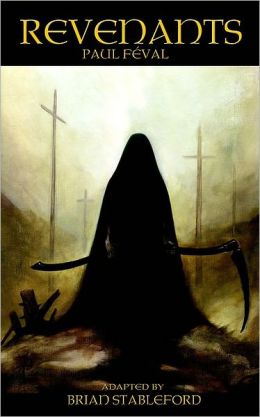
Honourable Mentions: Revenants

The Blurb: “When the damned calls out to the avenger;
“When the Stone missing from the Tomb of Tanneguy is found again;
“Treguern, three times dead, will be resurrected.

“The Prophecy of Treguern.”

1800, On the windswept moors of Brittany, renegade priest Gabriel Le Brec and Fihol de Treguern embark on a scheme to defraud an insurance company by faking the death of the latter. This sets in motion a danse macabre of murders, betrayals, people who change their names, lost birth certificates, false testimonies an Ann Radcliffe romance, a Miltonian struggle between Good and Evil and an impossible phantasmagoria of living men who pretend to be dead and dead men who return to claim vengeance.

The Mention: This is a novel, originally printed piecemeal in 1852, by French author Paul Féval, who is a favourite of Taliesin Meets the Vampires. Other works by Féval that we have looked at are The Vampire Countess, Knightshade and Vampire City . Now, all those books had (at least the belief in) vampires.

Revenants are the restless dead. Arguably they are another form of vampire (or the vampire is a sub-group of revenant), however the primary trait of the vampire (from the 18th century Vampire Panics) was the sucking of blood – an assumption as many of the attacks actually focused on asphyxiation but the presence of blood at the mouth etcetera, when the vampire was exhumed, was taken as proof of blood drinking. Conversely revenant myths would often not mention blood drinking (though there are exceptions where blood is mentioned in myth).

In this case the revenant seems to be simply restless dead, indeed the first occurrence in text is actually one who was still alive but had faked his death. Later in the book (as the time frame jumps to the 1820s) there are several revenants who may be fakes or may be the restless dead. Translator Brian Stableford, in his notes, suggests that there is only one instance of a definitely (or probably) real revenant.

The revenant aspect might be of genre interest enough to earn a honourable mention in its own right. However vampires are mentioned in passing as well. Commander Malo, a warrior priest, is said to be familiar with vampires from Poland, Hungary, Moravia and Silesia.

Also interesting is a discussion about the play The Vampire, referring to the play by Nodier based on Polidori’s The Vampyre. It was a runaway success in 1820, as the story suggests, but Stableford points out that it was having revived success in 1852 too. The character Gabriel de Feuillans is likened in text to the vampire of the play. In truth he is a man who will kill for money, rather than blood.

I enjoyed the book, despite some holes born out of the piecemeal writing style, and it deserves to be looked at as, at least, something of genre interest.