Showing posts with label lilim. Show all posts

Saturday, March 30, 2024

Use of Tropes: Lullaby


Or, should I say, the use of a single trope and the trope in this 2022 release, directed by John R. Leonetti, is the use of the figure of Lilith (Kira Guloien). However, despite the entwinement of Lilith into the vampire genre, this film does not touch on the vampiric aspects, though it rightly sets itself within a Jewish community.

After an opening with parent Vivian (Liane Balaban) and her husband desperately breaking mirrors in their home as their infant son Zachary is stalked (in his cot) by Lilim. These are Lilith's demon children and are drawn in cgi as twisted infants (one twin-headed another half wolf, for instance). One scratches Zachary’s cheek, a mirror explodes outwards killing dad and Vivian finds an infant-corpse in the cot, where her baby should be.
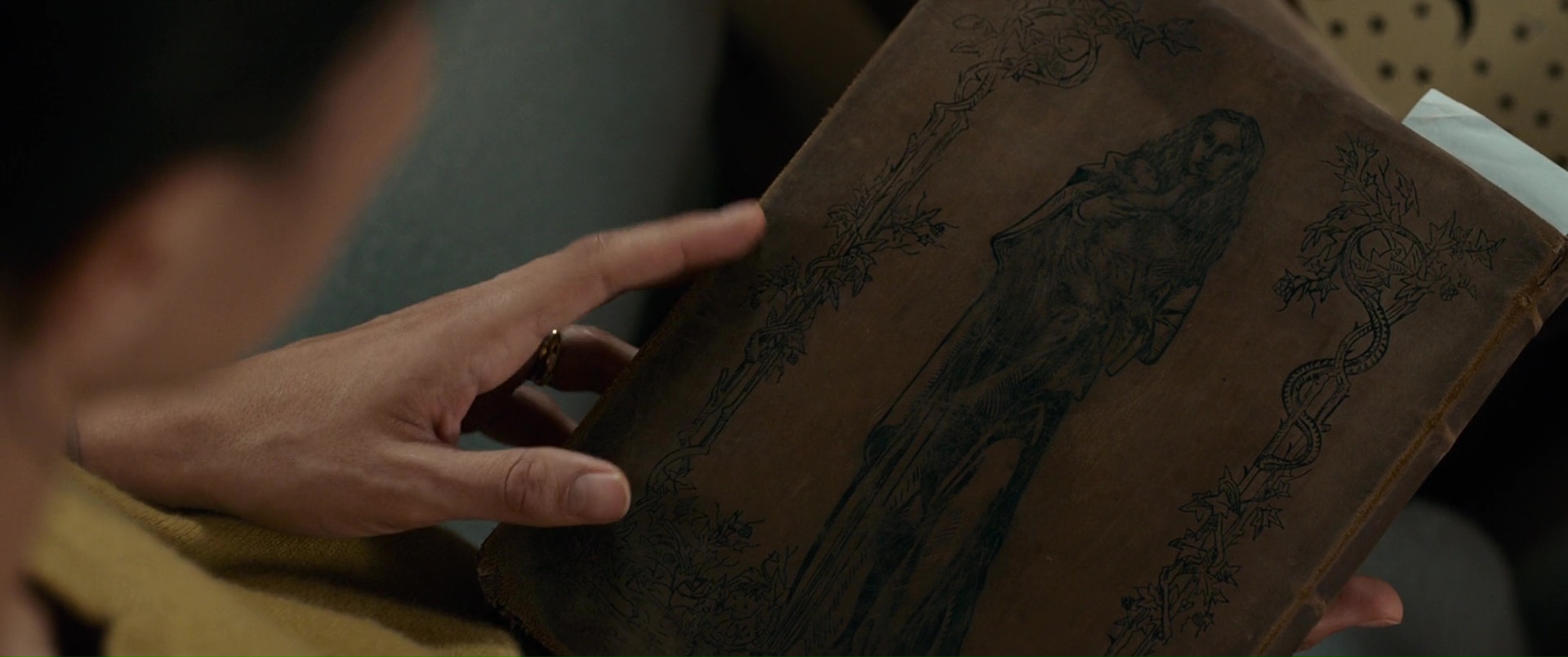
the book

So, to the film proper and we see Rachel (Oona Chaplin) and husband John (Ramón Rodríguez) returning home with their new-born son Eli. We later discover that John has converted to Judaism for his wife. As they get home a box is delivered, from Rachel’s mother, containing baby things that belonged to Vivien (Rachel’s sister), who now resides in a psych-hospital (the authorities think that the golem baby in the cot was Zachary who had been dead for a fortnight). In the box is an old-looking illustrated book in Hebrew. It is John who starts to translate some of the script, learning Hebrew as he is (though the Hebrew used in the book is not a modern variant).

Lilim

The film cuts forward and Eli is a bit of a crier. Ma and Pa are getting little sleep, Rachel’s career is on hold and she feels like she’s going nuts. She happens to come across the book again and there is music for a lullaby in it, along with John’s translation. She sings it, Eli calms but the lullaby is a trap. Lilith used the song that Adam sang for her to construct it and allow her to be summoned into our world (as part of a larger ritual). The lullaby allows the Lilim and her crone servant (Mary Ann Stevens) to haunt the parents and get the ritual finished.

the crone

The couple start seeing things (often the crone) and we get lots of jump-scare friendly happenings (such as the electrics blowing). They investigate in their own ways. She goes to Vivian, he goes to synagogue and speaks to the Rabbi (Julie Khaner) who tells him the folkloric aspect of this, not actually believing but, as she remembers Vivien reporting similar, gets him in touch with Rabbi Cohen (Alex Karzis, Lost Girl, the Strain & What We Do in the Shadows). Cohen is a Rabbi with a mystical leaning – a Shomrim patroller calls him the Dybbuk Man (though there is no further reference to this).

Kira Guloien as Lilith

Cohen tells him the rest of the ritual, the sacrifice of an unclean animal (John was tricked into killing his pet macaw) and the spilling of the child’s blood, and then gives John the means to fight Lilith. Rachel, on the other hand, ends up actually in Lilith’s realm and it is here that Lilith became a trope used and not a central vampiric figure in the film. Lilith is stealing babies, jealous that the children of Adam and Eve (and their descendants) are perfect, where the Lilim are twisted. However, she is not drinking their blood (or draining energy or eating flesh, for that matter), rather all the babies are swaddled, collected together in a pocket of her realm – taken, frozen in age but alive. The entrance to her realm was full of blackened infant bodies, which didn’t gel with this, but it did seem the thrust of her actions was taking the babies for herself rather than to devour.

The imdb page is here.

On Demand @ Amazon US

On Demand @ Amazon UK

Monday, May 24, 2021

Lilin’s Brood – Review


Directors: P.W. Simon & Artii Smith

Release date: 2016

Contains spoilers

The Lilin were a form of Jewish demon that became tied into the Lilith myth and are known as the offspring of Lilith and Samael, they are more often called Lilim. So, having said that it is clear that, with this film, we are looking at the Lilith mythology as a basis for the story.

We are also in the world of found footage again. Though, as the main characters are a group of camera wearing Investigative journalists called “W.H.I.S.T.L.E.”, an anacronym for the cumbersome “We Hear In Silence The Lies Everywhere”, the pov style feels more natural than in some films.

interview

The film starts with interviews with various women who have had a man vanish (be it boyfriend, husband, son etc.) They are all being interviewed by de facto leader of the crew Vanessa (Maxine Goynes) and little breadcrumb clues start to emerge, be it sexual websites (on a son’s computer) or finding a strange business card. It also seems that the police are uninterested in the disappearances. Wolf (Martin Sensmeier) goes to see someone about the card and discovers the symbol on it is tied to a brothel (or perhaps a chain of them). Vanessa also suggests that the symbol is tied to organ trafficking.

Brent King as Danny

Vanessa contacts their boss, Ron, through a secure link via laptop. Just to stop here a moment, the professional image developed by them having corporate logoed laptops and state of the art camera equipment is then undermined by the actions of the crew who seem more your standard horror frat boys than serious investigators. Nevertheless Ron gives the green light on the next stage of the investigation after ascertaining that Vanessa is ok to go ahead, given what happened to her father and brother – this is not returned to and later Vanessa says she has no siblings but wishes she had (rather than suggest she lost one). Given the primary role Vanessa plays one would have wanted more exploration of this and clear consistency in the dialogue…

fitting the pendant camera

So the rest of the crew are made up of tech guy Danny (Brent King) and new hire Art (Artii Smith), who Danny seems to be giving a hard time to, Thomas (Alberto Barros Jr.), and the driver of their mobile HQ RV Nate (Stephen Heard). They intend to infiltrate the brothel with Wolf (wearing glasses with a camera built in) and Thomas (with a chest mounted hidden camera) posing as customers and Vanessa gaining entrance as a distraught woman (and wearing a pendant with a camera). However, Nate’s GPS keeps dropping – then he hits something.

meeting Madam Plu

They exit the RV (which is apparently disabled in the crash) and a man, Cabal (James Wellington, Buffy the Vampire Slayer), is stood there. He suggests he thought they were stopping to pick him up, there is blood and fur (they hope, rather than hair) on the front grill of the RV but no sign of what they hit and no phone signal to phone roadside assistance. Cabal offers to take them to a nearby building with a land line (if they then give him a ride). Thomas and Art go with him (and soon Thomas’ camera is out of signal range) and when they don’t return the rest (bar Nate) go after them. They find the building, the brothel they were looking for, and Thomas has a couple of ladies with him and a drink, whilst Art is with another lady. They meet the mistress Madam Plu (Melinda Miamor).

bite marks on neck

So, we then get a mix of voodoo – Plu is from New Orleans and Vanessa Baton Rouge and, on hearing that Vanessa’s surname is Laveau, suggests she knew a Marie Laveau, which if she means *the* Marie Laveau puts Plu at a remarkable age (the historic Laveau died in 1881) – including zombified men, immaculate conception of Lilith and Samael’s children, and general peril for the crew. We get a couple of bites by women (who are the Lilin presumably) and on Wolf we see such a bite leaving two punctures in his neck. So, this is off into vampire territory. We also get some of the women there in bandages during a birthing ritual and they are named mummies in the credits. There is no clear lore offered though the line, “Wherever man hungers for flesh, there too Lilith shall repose.” is repeated.

split mouth

Indeed, later, we get to see briefly one of them split her mouth open in a computer-generated moment that actually looked quite good. Unfortunately, the found footage style – whilst logical as three are wearing cameras and Thomas has planted cameras in key locations – conspires with poor characterisation to hamstring the film. It also means that much is done off-camera, great for budget not so great for the viewer, and even when events happen on camera the frenetic nature of the filming tends to confuse the action. This would have been better properly filmed in third person and supplemented with point of view camera footage, but then again I’m not particularly a found footage fan.

blooded mouth

I’m not saying that this would have been the only thing they needed to do to improve the film, we needed more characterisation, more background and a clear view of what was happening (we can put the rough chops together but a clearer exposition would have been welcomed). None of the acting is necessarily poor, but nothing sparkles particularly (bar perhaps Melinda Miamor as Plu, who she infuses with a neat over-the-top style). This could have been so much better than it was and it is a shame. 4 out of 10 is generous, I think, but anything less feels churlish.

The imdb page is here.

On Demand @ Amazon US

On Demand @ Amazon UK

Monday, April 02, 2012

The Revenants – review

Author: Geoffrey Farrington

First Published: 1983

Contains spoilers

The Blurb: A family curse reaches through time to damn a young man in Victorian England. John LePerrowne is possessed with supernatural life and power, yet haunted by the restless ghost of his human soul. Amidst chilling evils he must seek and finally confront the dark truth of his being.

The Revenants is a tale both strikingly modern and seductively traditional, this narrative explores the psychology of repression and pays homage to the great works of nineteenth-century terror.

The review: As I started reading the Revenants I was struck by the Gothic feel, as in a 19th Century atmosphere, which Farrington was able to infuse into his prose. Following the misfortunes of John LePerrowne we meet a young man who was brought up in such a way that he never developed any form of social confidence – smothered by his elderly parents. As he grew up he became haunted by a singular dream – a prophetic vision of the curse that was to befall him.

This was to become a revenant, turned by an ancestor who was the figure haunting his dreams. When his condition is described she tells him, “Lamia. Lilim. Incubus and succubus. The Undead. Vampires. Hybrid demons and walking corpses. The names and forms attributed to us by men are numerous…” Of course, if I tell you that he was born in the early 1830s, the sharp eyed will spot the anachronistic use of the word undead – a name that hadn’t been coined in the timescale we are looking at. Later in the book another name for the revenants is offered, which is the Irish Dearg-dul. We hear little in the way of lore, though we discover that they can exert a kind of control over victims, when feeding, and a metal spike through the heart kills one Revenant we meet.

The story itself follows John through the ages and is all in his own words. It is therefore interesting that worldwide events – such as the first and second world wars – are glossed over by a narrator who feels himself removed and aloof, though he is struck by the presentation to him of a white feather from a woman who might have otherwise been his victim.

The climax of the story is, in many respects, self-realisation for the narrator though he (and thus we) does not understand the event that leads to it – a mysterious supernatural happening. The book holds onto a pre-Stoker feel (I got an ever-so-slight echo of Varney the Vampire in the character) but explores the ‘spirit of the age’ for changeless beings that Rice highlighted within her Chronicles. This may not be everyone’s cup of tea, but I really enjoyed the book. 7.5 out of 10.