Tuesday, December 02, 2025
Carmilla Volume 2: The Last Vampire Hunter – review
Author: Amy Chu
Illustrations: Soo Lee
First published: 2024
Contains spoilers
The Blurb: Before Dracula, before Nosferatu, there was...CARMILLA.
In the second volume of this feminist tale of murder, monsters, and mystery layered with dark Chinese folklore, social worker turned vampire hunter Athena Lo has just lost everyone she loves—and it's all her fault.
Hoping to put her life back together, Athena travels to San Francisco’s Chinatown on a quest to uncover the secrets of her mysterious family history. But her journey escalates into a nightmare when she‘s violently introduced to a new, ruthless gang of Asian American vampires and its unlikely leader, who hold shocking truths. As she navigates this dangerous territory, Athena can't escape the ghost of Carmilla...and neither can the vampires. Athena must decide—whose side is she on?
Inspired by the gothic novel that started the vampire genre, this queer, feminist murder mystery graphic novel is a tale of identity, obsession and fateful family secrets.
The review: It would have been easy for this sequel to Carmilla: The First Vampire to have ignored the titular vampire as vampire hunter Athena Lo destroys her in the first volume – but, as we know, you can’t keep a good vampire down. Though, her presence in the book is fleeting (and she seems to have taken the form of a monk). Primarily it follows Athena to San Francisco, where she hopes to piece together her family history.
There she discovers a whole bunch of Asian vampires (and a werewolf), we get Nukekubi (a Japanese Yokai that the book identifies as a Filippino vampire), the Indian Brahmarakshaa (a type of rakshasa), Korean Dokkeabi Goblin (which I have not seen connected with vampirism before) and the Japanese Nure-Omna (another Yokai). Without identifying it, we see a penanggalan and Taki who is a Geungshi (which is the Korean variant spelling of Jiangshi or Kyonsi). The leader is Wing, a young boy who had been attacked by a vampire and was saved by Taki – causing Wing to become a hybrid of western vampire and Jiangshi – Wing happens to be Athena’s older brother though she doesn’t remember him. He tells her of their parents, and their deaths, the Jiangshi hunter heritage and that a Taoist priest had taken her and protected her – the man she knew as her grandfather Yeh Yeh. Unfortunately, Wing has plans for Athena.
Of course, the first volume used Athena’s queerness and Asian identity as lenses for othering. This volume concentrates on the American historic, and more modern, treatment of Asians, and the Chinese specifically through Taki. The redemptive element around him was really rather well done and moving. The story is neat, the appearance of Carmilla fleeting but it was a good, solid little volume. 7 out of 10.
In Paperback @ Amazon US
In Paperback @ Amazon UK
Posted by
Taliesin_ttlg
at
1:09 PM
0
comments
Labels: Carmilla, kyonsi, nukekubi, penanggalan, rakshasa, vampire, werewolf
Sunday, March 09, 2025
The Route of Ice and Salt – review
Author: José Luis Zárate
Translation: David Bowles
First published: 1998 (2021, English translation)
Contains spoilers
The Blurb: A reimagining of Dracula's voyage to England, filled with Gothic imagery and queer desire.
It's an ordinary assignment, nothing more. The cargo? Fifty boxes filled with Transylvanian soil. The route? From Varna to Whitby. The Demeter has made many trips like this. The captain has handled dozens of crews.
He dreams familiar dreams: to taste the salt on the skin of his men, to run his hands across their chests. He longs for the warmth of a lover he cannot have, fantasizes about flesh and frenzied embraces. All this he's done before, it's routine, a constant, like the tides.
Yet there's something different, something wrong. There are odd nightmares, unsettling omens and fear. For there is something in the air, something in the night, someone stalking the ship.
The review: We have looked at vehicles focused entirely on the doomed voyage of the Demeter before. There has been the novel Dracula’s Demeter by Doug Lamoreux and, in graphic form, Bram Stoker’s Death Ship. On the small screen the second (feature length) episode of Dracula (2020) was entirely about the voyage and, of course, the voyage finally got feature film treatment with the Last Voyage of the Demeter. This is another recounting of the fateful voyage, but one that actually pre-dates all the above (in the original Spanish), and can I just say wow.
The book is in three parts. Firstly, and noted immediately in the blurb, this is a retelling through a queer lens, entitled Before the Storm and the largest section of the novel. The Captain is gay, closeted from his crew (and haunted by the death of a lover). This section explores this and the view of the voyage as things begin to go wrong, with beautifully composed, evocative prose. It is a queer fever dream, both a distraction from and communication of the evil taking the ship. The book then moves into the Log of the Demeter, taking Stoker and expanding upon the original logs in the novel, and, finally, the catastrophic denouement.
There are several vampire descriptions used, names from around the globe as befits a ship where crews come and go from an international pool. Mention is made of the vrykolakas from Thera, delicately hanging above their victim, causing a deep sleep as they steal their breath. His Romanian mate has told the Captain of strigoi, described as demonic birds in the night – which brought the idea of the deathbird from Nosferatu to mind. The wieszcy are mentioned, dead devouring themselves in Wallachia (Bane associates them with Poland and auto-vampirism is not mentioned in her description). The book also mentions the Indian rakshasa, Ghanian monsters and Bulgarian obours. It is a cornucopia of references that works well.
One scene I particularly liked described the dead sailors clinging to the hull of the ship – unable to let go and look for other ships as the water hurts – for a sailor it is a consecrated thing – and yet the pull of blood might be more than the pain of the water. I also liked, in a vampire sense, the way the rats of the Demeter hid, starved and tried to flee the Demeter, replaced by the Count’s familiar rats.
This was a marvellous book, lyrical and haunting. The queer aspect added a layer that was welcomed and added depth to the primary story. 9 out of 10. My thanks to Sarah, who bought me this for Christmas.
In Paperback @ Amazon US
In Paperback @ Amazon UK
Posted by
Taliesin_ttlg
at
4:15 AM
0
comments
Labels: Dracula, obours, rakshasa, strigoï, vampire, vrykolakas, wieszczys
Wednesday, January 27, 2021
These Savage Shores Vol. 1 – review
Author: Ram V
Artist: Sumit Kumar
First published: 2019 (TPB)
Contains spoilers
The Blurb: Two centuries after the first European ship sailed to the Malabar Coast and made landfall at Calicut, the East India Company seeks to secure its future along the lucrative Silk Route, in the year 1766.
An old evil now sails aboard a company ship, hoping to make a home in this new found land. But he will soon find that the ground along the Indus is an ancient one with daemons and legends far older than himself.
Along These Savage Shores, where the days are scorched and the nights are full of teeth.
![]() |
| art sample |
The review: A beautifully drawn tragedy, I guess one could call it, focused on the exploitation of India by the East India Company and the British, this starts in England (after we very briefly meet the characters Bishan and Kori in India) with vampire Alain Pierrefont caught in toothsome activity by vampire hunter Zachariah Sturn. Though he escapes, he is badly burnt and his secret exposed and so his maker has no choice but to exile him to India.
What Alain doesn’t realise is that there are creatures older and more deadly in India and the masked advisor of the boy Prince of Calicut, and the paramour of Kori, is no mere man but a raakshas (an alternate version of rakshasa, I guess). When asked by Kori how he came to be made, Bishan tells a tale highlighting an all-consuming hunger. Taking the form of a man, mostly, he can also become a horned creature.
What happens with Alain, and subsequently the political and warfare machinations, will impact them all, and draw in Alain’s creator Count Jurre Grano (I assume an allusion to Jure Grando, promoted to Count). Whilst characters in the novel wonder at who is truly the monster, it is fair to say that the true vampire of the tale is British colonialism and the greed (which is, of course, a capitalist greed) which threatens to consume all and, as one character alludes to, “put a price on its soul”.
This was a really good graphic, the art suited it perfectly and the story was interesting and kept you hooked. I’d like to say there is an adventure there but, as I said at the head, it is more a tragedy. That said, there are some great action sequences – especially standout was an epic battle of primordial supernatural forces at the end of the book. Really worthwhile – 8 out of 10. My thanks to Sarah who got me this for Christmas.
In Paperback @ Amazon US
In Paperback @ Amazon UK
Posted by
Taliesin_ttlg
at
9:24 AM
0
comments
Labels: capitalism, Jure Grando, rakshasa, vampire
Wednesday, May 27, 2015
Vampire Wars – review
First published: 2014
Contains spoilers
The Blurb: For thousands of years, ancient vampire lords ruled the Night. Their queen, the coldly beautiful, immortal, and all-powerful Lilith, ruled them distantly, ignoring their squabbles over territory and victims. Then came Vlad the Impaler, once history's most bloodthirsty fiend, now reanimated as an undead creature of the Night. Facing the vampire legions of the brutish Vardalekos, the loathsome Viy, the diabolical Jhiang-Shi, the monstrous Mmbyu, the cunning Erlik, and the seductive Nycea, Vlad Dracula seeks out allies, be they undead or lycanthropic or mortal.
You've read Bram Stoker's “Dracula”. Now see how Vlad the Impaler fought and struggled to become Dracula, the King-Vampire. A part of THE LEGEND OF DRACULA trilogy, this book is a collection of twenty short stories about the infamous Count and his undead legions as he strives for the ultimate goal—the throne of the supreme King of the Vampires!
The Review: It’s frustrating when I read a book like Perry Lake’s Vampire Wars. In the first instance I have to say it was filled with fantastic ideas but I also felt it a little lacking in the prose style – though I trust my criticisms are constructive.
The book itself is made up of vignettes, shorts if you will, which cover an expanse of time from Dracula’s resurrection through to the nineteenth century. Being shorts (and the book being one of three, which I am assured can be read in any order) there is some degree of narrative repetition but that is to be expected.
It runs on the ‘Vlad Ţepeş was Count Dracula’ premise (calling the castle “Castelui de Vlad Ţepeş” jarred as the man wouldn’t have referred to himself by the sobriquet Ţepeş) but how did he become a vampire? The beginning of the book suggests he was resurrected by Faust and held as a slave for over a decade until he seduced Gretchen, turned her and became dominant over Faust who was turned also. I liked the idea, and I do like drawing Faust into the vampire realm – a trend (I believe) begun by Paul Féval in the book the Vampire Countess. Then a later story mentioned he was turned in the Scholomance and these separate origin stories appeared to jar until I realised that he was killed post the Scholomance and it was his vampiric form that was brought back by Faust – the full story isn’t within this volume.
The vampires in this are burnt by the sun (mostly) though they can stand some exposure as they age. I liked the fact that they died during the daylight hours. There was an interesting lore around reflections, that the true state of the vampire was seen – Gretchen seeing a decaying corpse, Vlad seeing a ghostly skeleton and the reflection fading to nothing as their true form completely decayed. The invitation rule is deemed not to hold true if the house bears the vampire’s blood (ie if it is held by their mortal family). The ability to transform is not something all vampires can do and also relies on their true form to be sufficiently decayed to allow the dissolution of their body.
Holy items burn but it is not denominational – the Ganges, being a sacred river, would burn a vampire. Vampiric resurrection is achieved by applying human blood (preferably virginal and certainly not undead) to the remains under the light of the full moon. If a victim is preyed upon by a vampire and that vampire is destroyed, an occult law prevents the victim being further predated by another undead for seven years.
As well as these ideas – all of which I was impressed with – there are a cornucopia of vampires from myth, legend, literature and movies. Mostly this extended cast works, some of whom are active characters and others who are mentioned in passing. We get Ruthven, Carmilla, Erzsébet Báthory, Viy and Lilith (who is the vampire Goddess Strigoica, also called Kali). In passing we get such characters as Angelus (from Angel) and Mamuwalde (from Blacula). We get different vampire types mentioned including a vampire horse, vetal, and penanggalen. Most of the cornucopia worked well – though the tying in of Lord of the Rings was perhaps a conceit too far.
However, I said I had issues. Firstly it was within some of the language used. Lake deliberately chose to use thee and thou’s in the dialogue and, to be honest, they didn’t work, were inconsistent with the other language used for dialogue and just felt forced. Better to have avoided them in my opinion. I think the greatest failing of the book was, however, based within the short story style.
It was clear that many of the stories could and, more importantly, should have been expanded on. There was, because of the brevity of the prose, a dearth of descriptive prose and even more so a lack of characterisation. Some characters appeared to only die again in the same vignette, unfortunately still two dimensional. Others died off page (such as Faust). But there was an inability to really care as there was never a connection built with the characters. Of course they are all villains (the vampires are not good guys) but expanding the story and characterisation within the vignettes, indeed expanding the book to several volumes, would have made the reader care. At times I felt I was reading an extended summary rather than the final prose.
This is unfortunate because, as I said, there are fantastic ideas in volume and Perry Lake has a lot of story to tell… I just think he needs to take his time and tell those stories more fully. 5 out of 10 balances great ideas with a need for expansion (and the need for the loss of the cod-archaic dialogue). The homepage with an excerpt is here.
Posted by
Taliesin_ttlg
at
9:24 AM
2
comments
Labels: Carmilla, Dracula, Erzsébet Báthory, kali, Lilith, penanggalan, rakshasa, Ruthven, undead, vampire, vampire horse, vetal, werewolf
Wednesday, August 09, 2006
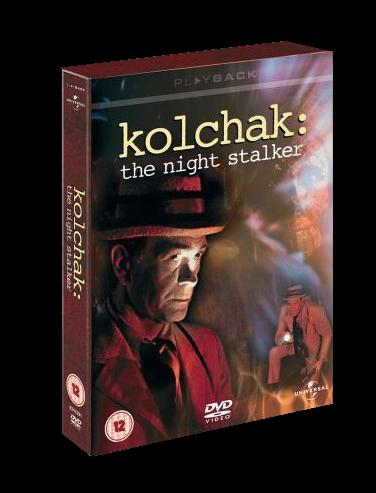
Kolchak: The Night Stalker - “The Vampire” - review (TV Episode)
Director: Don Weis
Season 1, released 1974
Contains spoilers
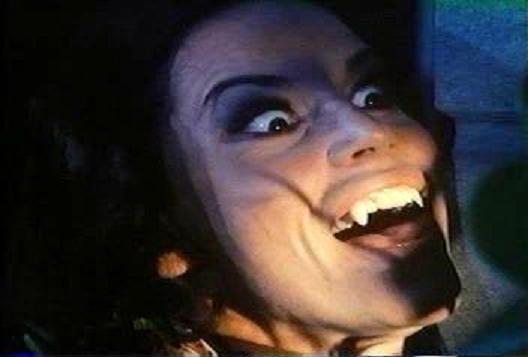
Following the success of The Night Stalker (1972) and The Night Strangler (1973), reporter Carl Kolchak (Darren McGavin) received his own TV series. This, the fourth episode, saw Kolchak again face a vampire – although, this time, it was a female one. The series had moved to Chicago, but this episode takes place in Los Angeles, where Vincenzo (Simon Oakland) has, in a brilliant piece of manipulation by Kolchak, sent the reporter to do a piece on a guru. This sub-story provides much of the comedy of the episode as Kolchak misses his appointment for his interview, as he tracks down what he knows to be a vampire, and tries to get realtor Faye Kruger (Kathleen Nolan) to write his story.
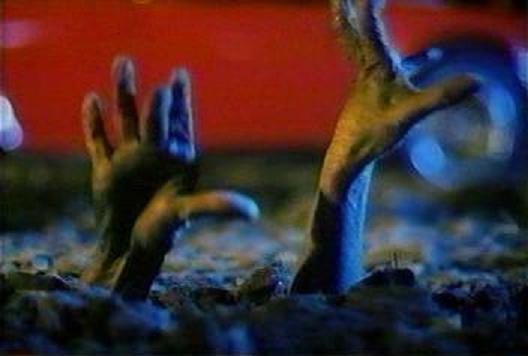
The story starts with an air-stewardess getting a flat tyre somewhere in the Nevada region. She freaks as she sees a pair of hands shoot out of the floor, as you would. It is an excellent opening to the story and, perhaps, indicates that our vampire, Catherine Rawlins (Suzanne Charney) has been buried three years before she became active. It is certainly stated that whatever occurred to her to make her a vampire happened in Los Vegas, where she was working as a high class hooker, some three years earlier. I would have liked to have seen this tied firmly with the first film but that never happened, it was only intimated.
She has killed on her way to LA and Kolchak has his first run in with the law as he investigates one of these murders. The officer will not confirm puncture wounds on the throat of a victim found in his car but Kolchak certainly notices that the car windows have been taped, on the inside.
Catherine meets a man she has not seen for three years and goes back to his apartment and feeds on him. This is disturbed by his wife who happens to be her sister and she is despatched also. Kolchak goes to a press conference in the apartment where Lt. Jack Matteo (William Daniels) states that they have two suspects in custody, members of the Dark Star Satanist cult. When Kolchak goes back to the room later he finds the Lieutenant alone in there and tries to convince him that there is a vampire loose – to no avail. I actually thought it would be nice, in this episode, to have the police perhaps believe and co-operate with Kolchak and, unfortunately, the constant battle with the police gives this too much of a feel of the original film.
Kolchak realises that Catherine must be working as a hooker again, through a front company that poses as a catering firm. This leads to the nice line, when describing her pimp, that “in his parlance what he'd just hired was known as a fox. What he couldn't know is what he'd actually acquired had far more in common with the bat."
He tries to hire Catherine, drawing a cross on his hotel room door in lipstick and getting his personal cross and wooden stake out ready. The girl that turns up is not Catherine, however. She has been sent to a football player’s home. Kolchak arrives at the same time as his team-mates; Catherine is feeding and attacks the footballers, dispatching them with ease.
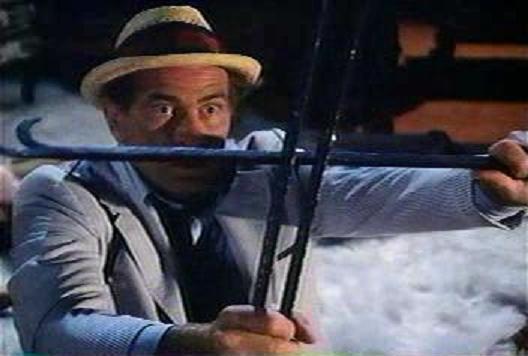
Kolchak holds her off, until the police burst through the door and she escapes, by going DIY Van Helsing and making a cross out of a couple of pokers.
The police are not happy with Kolchak, what a surprise, and tell him to get out of town. Something he intends to comply with until he realises he can use Kruger to find out where Catherine lives. By the time they work it out it is night. He goes to the house anyway and is trying to break in when Catherine attacks. Holding her at bay with his cross he manages to run away and leads her to a most spectacular ending.
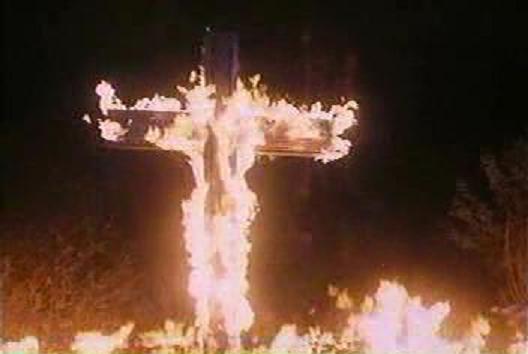
He has soaked a giant, hillside, wooden cross with gasoline, and made a circle of gasoline. When she reaches it he lights the fuel. The fire stops her escaping and the burning cross paralysis her. Before a stunned Lt Matteo he pounds a stake through her heart.
In the coda we discover that he has to pay for the cross to be replaced, it was a landmark, and had been charged with murder. Mysteriously he was released twelve hours later, perhaps down to the fact that the coroner’s report on Catherine stated that she had the cell structure of a human female who had been dead three years.
McGavin is excellent as Kolchak, though to a degree this episode misses out on the interaction with Vincenzo, which is so good. There are some telephone conversations between the pair, with Kolchak trying to make a bad line with a towel and electric razor but they’re not quite the same. The episode feels a tad too much like the original film, obviously because they are going over the same subject matter, and I would have liked to see a little more of a departure.
As for the vampire, whilst Charney looked good, I have to say that I was a little disappointed. Our vampire from the first film, Skorzeny, had a kind of cool that was severely lacking here. Catherine was much more frantic and was replete with a severe case of bad hissing. It was a shame as, especially given she was posing as a hooker, a much more seductive vampire could have been portrayed.
However, this is a great episode with a fabulous and spectacular finale. 7 out of 10.
The imdb page for the episode is here.
Bonus
Other episodes in the series that are not vampire episodes and yet have some degree (to a greater or lesser extent) of genre interest are as follows:
Episode 3 “They Have Been, They Are, They Will Be” – primarily a UFO episode where to avoid the problem of monster suits the alien is out of the range of human visual perception and therefore invisible. Worth noting, however, as the alien feeds on bone marrow sucked from its victim, thus a very vague genre connection.
Episode 10 “The Energy Eater” - again an invisible foe, though this time a Native American bear god which devours energy. Whilst primarily sucking the energy from electrical equipment as well as radioactive material, the creature does devour the proteins in plasma of a few humans, reducing the blood to almost nothing and killing the victim.
Episode 11 “Horror in the Heights” – co-starring the wonderful Phil Silvers, this is the tale of a Rakshasa. A Hindu evil spirit that, in this, took on the appearance of someone the victim trusted before killing them and eating the flesh from their body. Mentioned because sources such as The Vampire Encyclopedia list the Rakshasa as a type of vampire, though to my way of thinking it is more demonic in nature. The only way, in the episode, to kill one of these is by a crossbow bolt blessed by a priest of Brahma. Whilst it is not necessary to pierce the heart this carries a degree of the stake as well as the holy icon. Interestingly this was written by Jimmy Sangster, who penned the Horror of Dracula (1958) amongst others.
Episode 16 “Demon in Lace” - a succubus is killing young men by possessing the bodies of dead girls. I mention this episode due to the close connection between the succubi and vampire legends. Also rather interesting is the concept that the succubus in this is tied to an ancient tablet and can be destroyed by destroying the tablet. When Kolchak does this the succubus turns to dust, a method of destruction (turning to dust not breaking tablets) common, of course, within the genre.
Episode 19 “The Youth Killer” – victims are found drained of youth. The killer is Helen of Troy who uses sorcery, by sacrificing a person’s youth and beauty to Hecate in order that she might supplement her own, rather than an innate (super)natural ability but the concept of a vampire that drains youth, as opposed to life, has been explored in films such as Captain Kronos Vampire Hunter (1974). It must be said that this episode is criticized as being a rather poor one and, unfortunately, it is.
Posted by
Taliesin_ttlg
at
7:46 AM
5
comments
Labels: energy vampire, rakshasa, succubus, vampire, youth stealer