Showing posts with label rusalka. Show all posts

Wednesday, March 11, 2026

Guest Blog – Rusalka, A key to Early Vampire Film – TMtV 20th anniversary


It’s with great pleasure I welcome David Anwnn Jones to the blog. Whereas with other guest bloggers for this 20th anniversary celebration I have put a little forward of how I met the guest, with David he wrote something on that himself and so I’ll hand straight to him:

It is a great pleasure to be asked to write a post for Andy Boylan’s ‘Taliesin meets The Vampires’ twentieth anniversary year. I have long admired this vampire film expert’s writing with its wide knowledge of vampire lore and cinematics. In 2016, I convened the World Vampire Congress, Whitby where Andy delivered his fascinating talk on Stoker and vampire bat iconography. Since then, I have followed his blogs which spread an awareness of film vampires over a wide range of transnational environments, often remote from Hollywood. I have also enjoyed our extensive correspondence.

In his appreciation of Svyatoslav Podgaevskiy’s The Mermaid: Lake of the Dead (2018) from 9 Sept 2019, Andy writes:
 
Now mermaid is a misnomer here and it is what the title has been translated to from the Russian title Rusalka: Ozero myortvykh. The rusalka is from Slavic lore and is a form of restless dead. Zelenin (in Russian Folk Belief) suggests it is a suicide or murder victim who, in either case, was drowned. There is an entry in Bane’s Encyclopedia of Vampire Mythology that has it as a type of fae created when a child dies before baptism or an adolescent dies a virgin.

The foundation myth here is that of the malefic underwater female who lures handsome men beneath the surface to enjoy them sexually and then drains them of life. Andy certainly reads the Rusalka as an energy vampire. Bane goes on to write she’s a ‘vampiric fae’ and member of the Unseelie Court. Vladimir Propp and Linda Ivanits called the rusalka one of the ‘unclean dead’, a revenant. Thomas J. Garza in The Vampire in Slavic Cultures writes that the boundary between vampires and the rusalka as predatory outsider was porous in village lore. Such links reveal that the Rusalka is the oldest surviving vampire figure in cinema history in an extant film, predating F W Murnau’s Nosferatu by over a decade and Lugosi’s Dracula by 21 years.

The rusalka myth is perennially fascinating. galvanising directors and writers today. Podgaevskiy’s film is surrounded by other cinematic she-vampires of the deep: Petr Weigl and Václav Kaslik’s respective versions of Dvorak’s opera, 1963 and 77, Aleksandr Petrov’s animated Mermaid Rusalka 1996, Gary Whitson’s Destiny: Vampire Mermaid 1999, Sebastian Gutierrez’s She Creature 2001, François Rousillon’s Rusalka 2002 TV movie, Anna Melikyan’s Mermaid/ Rusalka 2007, Don E. Fauntleroy’s Bering Sea Beast / Beast of the Bering Sea 2013. Milan Todorovic’s Mamula /Nymph/ Dark Sea /Killer Mermaid 2014 and Agnieszka Smoczyńska’s The Lure, 2015. Nearer to the present, Perry Blackshear, Lona Fontane, Dale Thomas Cizmadia and Claudiu Mitcu’s have all made Rusalka films. Though the primary means of predation in these films is drowning, there is no shortage either of feeding, directly and by osmosis, strangulation, sharp fangs, blood-letting and sucking, and other vampiric depredation

I wish to make a bridge from these films, stretching back to the early dawn of Russian horror cinema. Vasili Goncharov’s foundational Rusalka film of 1910 is based on the play by Alexander Pushkin and stars Andrey Gromov as The Prince, Vasili Stepanov as The Miller and Aleksandra Goncharova as Natalya, the miller’s daughter and subsequently the Rusalka queen.


The film starts with Natalya, visibly longing for her lover, the Prince, who, when he arrives, throws her aside to marry a woman of royal blood. Distraught. Natalya drowns herself in the river. Yet, at the wedding feast, her ghost appears accusing the Prince, even within the nuptial bedroom. For eight years, the Prince obsesses over the dead working-class girl and finally rides back to mill, encountering her father who, driven mad with grief, imagines that he is now a raven. Led by Natalya, the rusalka spirits appear, amongst them a young girl who could be Natalya’s unbaptised daughter (unborn when her mother committed suicide). Natalya and the young girl and others lure the prince into the Dnieper river. His present wife arrives later only to find his clothes. On the riverbed, in what initially seems to be a Mélièsan tableau, Natalya, now queen of the Rusalka, caresses his corpse while other her maidens perform a swaying dance. For 1910, the same year as Frankenstein, the film, (which can be viewed here) is a considerable achievement, more indebted to the structure and rhythms of Pathé early films than Edison.

The cinematic Rusalka has survived perhaps because, whatever the seismic pull from Western horror cinema, it has proved difficult to Dracularize a Slavic female water-fiend. (Yet, the ‘feeding of the beast’ in Luc Besson’s Dracula (2025), whereby a feral mer-maiden rises to threaten horrified fairground visitors might hint that pressure is now being exerted in the opposite direction), The rusalka’s miraculous survival from a fractured and decimated Russian film industry also opens the gate for an awareness of the first female age of vampire films. She was originally part of a constellation of film’s female vampires, a whole distinctive age 1901-21: the Lilith of Lilith and Ly, Vera in Afterlife Wanderer (1915) the Pannochka of Goncharov’s Viy (1909) and the cat vampire of Nabeshima (1912), all notorious female monsters in their time but starring in films now lost. Yet their early dominance is still attested in surviving stills, scripts, reviews and posters.

I do not wish to be politically glib, but the story of a young woman mis-used by a prince and who subsequently commits suicide but takes her revenge from beyond the grave is not without strong resonance in 2026. Like any vivid revenant of the screen, even after 115 years and against all the odds, Aleksandra Goncharov’s vampiric mer-demon still rises towards us from the shadows of pre-Soviet cinema with a flickering intensity. She points at the feckless prince over his wedding feast. She follows her faithless lover right into his marital bedroom accusingly. She and her daughter stalk the shores of the Dnieper. They lure the royal philanderer into the river-depths. In her underwater apotheosis, she will instate her revenge and caress her man’s prone body, absorbing all his former strength. She will not lie down. Happy Anniversary ‘Taliesin meets the Vampires.’ Long may you run. The first age of vampire cinema was female.
David Annwn


David Annwn is author of Gothic Machine, Sex and the Gothic Magic Lantern and Gothic Effigy. He is also author of the first book on vampires in early film: Vampires on the Silent Screen, Re-envisaging the First Age of Cinematic Horror and essays in each volume of The Palgrave Handbook of Gothic series. A magic lanternist, David is a recognised authority on E-G Robertson’s Phantasmagoria show, being the first to locate its original site. Sir Christopher Frayling called David’s work ‘fascinating materials and connections: Vampire archaeology.’ Nobel Prize-winner Seamus Heaney has called his writing: ‘wonderfully sympathetic and accurate.

Monday, September 09, 2019

The Mermaid: Lake of the Dead – review

Director: Svyatoslav Podgaevskiy

Release date: 2018

Contains spoilers

I was in correspondence with Simon Bacon recently when he asked me if I knew of any mermaid/vampire crossover. This does happen occasionally but, as it happens, literally a few days later I came across this.

Now mermaid is a misnomer here and it is what the film title has been translated to from the Russian title Rusalka: Ozero myortvykh. The rusalka is from Slavic lore and is a form of restless dead. Zelenin (in Russian Folk Belief) suggests it is a suicide or murder victim who, in either case, was drowned. There is an entry in Bane’s Encyclopedia of Vampire Mythology that has it as a type of fae created when a child dies before baptism or an adolescent dies a virgin and then says: “If it sees a handsome man, it will lure him into the water with it, as it is looking for someone to pass the night in pleasure with. However, the man seldom survives the experience; the rusalka ends up draining him of his youth and life”.

Sofia Shidlovskaya as the rusalka
So, what we have is a form of energy vampire and an opening narration over simple, but effective, graphics says much the same. They demand to be told that they are loved – this is something we also get in succubae tales sometimes – at which point they drag the victim into the waters but if they are not told this they will not forgive and torture the victim through life. It also suggests the rusalka will tickle the victim as they drown – something Bane also mentions.

eyes red
Following the introduction, we see a jetty and a man, Mishka (Igor Khripunov), on it talking to the water as a woman, Tanya (Nadezhda Igoshina), approaches him. He turns to face her and his eyes are red – he then jumps backwards into the lake. She offers to sacrifice herself for him and he emerges from the water and clambers to the jetty. Something pulls Tanya off, into the water where she drowns…

spooky summer house
Cut forward and swimmer Roma (Efim Petrunin) is giving his fiancé Marina (Viktoriya Agalakova) swimming lessons – but she is lacking confidence and really cannot swim yet (much too little is done with this later in the film). His swimming team mate Ilya (Nikita Elenev) challenges him to a race. He leaves her at the side of the pool and they race, but she gets in trouble and, though he rescues her, she is angry with him. He and Ilya later go to the summer house that his father has given him as a wedding present – his dad suggesting he sells it.

in the lake
Roma is estranged from his father and has not been to the house since his mother drowned (yes, it’s the couple from the opening). When he gets there the house is looking ramshackle (though it still has electricity) and he is annoyed when “the lads” show up – as Ilya has arranged – to throw a stag night… with girls… he leaves them to it and goes swimming (one questions whether he would go swimming in the lake he knows his mother drowned in?)

the kiss
Anyway, he gets out and a girl (Sofia Shidlovskaya) is on the jetty, wearing his shirt and combing her hair. He approaches and they kiss and she asks if he loves her… In the morning the lads find him out cold on the ground, the comb nearby (Ilya takes it, later it ends up in Roma's possessions though there is never an explanation as to whether Ilya put it there or it mystically moved to him). Roma starts acting oddly, he becomes ill (coughing and with a fever) and starts hallucinating. Eventually, in swimming trials, he believes himself to have been transported to the lake whilst, in reality, he almost drowns in the pool…

ill
So, the race is on to free him from the rusalka and, given its blurb that suggests that his illness is making him losing health and vigour I have read this as energy vampirism (though the narrative is not explicit about this). It is suggested she is a suicide as her grave is in the lake. The logic is that a suicide may not be buried in a graveyard and that the lake has expanded since her burial and submerged the unhallowed grave. In flashback we see that she is (as a woman scorned) both a murderer and a suicide who drowned herself. Religious aspects are not included (Bane suggests both crosses and prayers are apotropaic) rather there is an aspect around her hair.

like a pike
There are dead men guarding her submerged grave who are animate but do not leave the waters – presumably other victims. She can change her face to look like other people and her teeth are sharp and her face can transform into something reminiscent of a pike’s face. Her element is, of course, water and therefore this seems to be a medium she can use to mystically travel great distances through. Feeding is mentioned and it is suggested that she feeds on love (though this can be read as metaphorical as well as read as literal as it then goes on to suggest that she transforms it into hatred and suffering).

Viktoriya Agalakova as Marina
The film itself was ok. For disclosure I saw the English dub of the film rather than watch a subtitled version with original dialogue and that probably didn’t help. I struggled to develop a sympathy for Marina and Roma – the film gave us characters pretty much by the numbers but their relationship felt flawed due to the strife shown early on. It is, essentially, an average (or just below) horror and doesn’t stand out that much – except with the fact that it uses an unusual Slavic creature. 4 out of 10.

The imdb page is here.

On DVD @ Amazon US

On DVD @ Amazon UK

Tuesday, September 03, 2019

Gogol: Season 1 – review

Director: Egor Baranov

First aired: 2019

Contains spoilers

I reviewed the film Gogol: Viy last year. The series of films that Baranov was producing was unusual as the aim was to release them and then cut them into a TV series comprised of a season of eight episodes. This happened and, as luck would have it, Amazon hosted the series, in Russian with English subs.

The parts of the series that came from the Viy release were identical as far as I could tell – nothing seemed cut for the TV market – and the whole piece worked in terms of explaining aspects that were to do with the overriding arc.

investigators
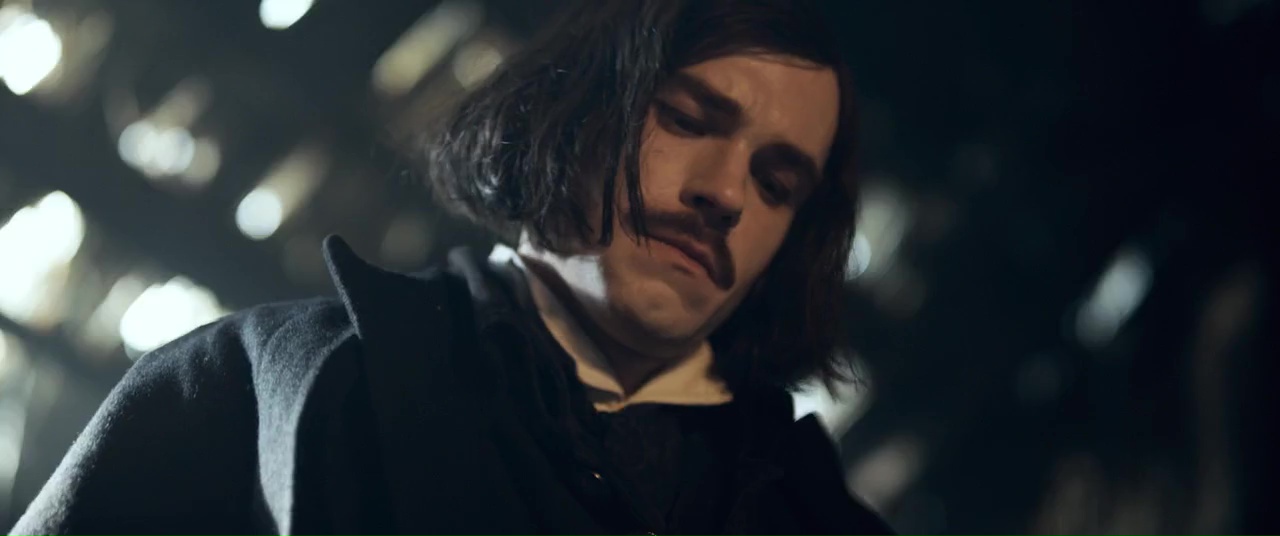
It is that overriding arc that has led to the review of the series as a whole. Nikolai Gogol (Alexander Petrov) is an aspiring writer with lack of confidence in his own work – indeed we see him buy the copies of one of his own books (released under a pseudonym) in order that he might burn the books (and spare the world). He is also working as a clerk for the secret police but has an unfortunate habit of having fits at crime scenes (during which he has visions that he transcribes through automatic writing). An inspector – Guro – realises the value of the visions and quickly catches a murderer by interpreting them and following them.

killing the peasant girl
Guro is called out of St Petersburg to investigate a murder in a small village and Gogol goes with him. We have seen the murder and it is the murder – or manner of it – that leads to the review. Two Cossacks are by a campfire when a third arrives with a naked girl he has kidnapped. Before they can do anything to her a hooded horseman appears and kills them – the hood of the horseman’s outfit is blackness (and, we discover later, empty) and horns seem to emerge from their back. The horseman kills the girl by slitting her throat and then her blood is sucked from her body, flowing supernaturally into the hood.

the horseman
When the investigators arrive, they discover this is actually the third killing. The murders continue and Guro is missing, presumed killed. Gogol takes it on himself to become the investigator and finish the other man’s work. He deduces that the horseman kills on feast days and it is some form of ritual. Guro has left a note that indicates that there will be 12 plus 1 victims. At the end of the series we discover this is 12 maidens and 1 person who has been resurrected.

syphon from a victim
The reason for the killings is that the horseman has been cursed. They are immortal – but to maintain that immortality and their vitality they must perform this blood ritual every thirty years. So we have maintaining their life through a ritual based on death and absorbing (as we see no mouth) the blood of the victim. I also mentioned, in the Viy review, the presence of a water nymph, Oksana (Julia Frantz). Having thought about it there is a good chance that she is actually a rusalka but she does nothing vampiric that we see. That said she is very jealous of Gogol’s love for the married Lisa (Taisiya Vilkova).

Alexander Petrov as Gogol
This was a really enjoyable series, with a nice dark edge to the gothic storytelling. The performances are consistently strong and Petrov is especially good as the conflicted writer – he even looks like Gogol if the pictures of the real-life writer are anything to go by. There is a strange (and yet entertaining) moment when one of the episodes ends and cuts into a short, set in a modern day theatre where Viy is being staged. 7.5 out of 10.

The imdb page is here.

On Demand @ Amazon US

On Demand @ Amazon UK