Director: John Llewellyn Moxie
Release Date: 1972
Contains spoilers
Based on a, then, unpublished novel by Jeff Rice, “The Kolchak Tapes” released in 1973 as “The Night Stalker”, the film The Night Stalker was a made for TV movie written by Richard Matheson (author of I am Legend). The film would spawn a sequel, The Night Strangler in 1973 – for which I have written a bonus “Vamp or Not?” at the bottom of this review - and two series: Kolchak: The Night Stalker which ran between 1974 and 1975 and the ill fated Night Stalker, starring Stuart Townsend in 2005. The first series contained a vampire story in its run, the second, disappointingly, did not.
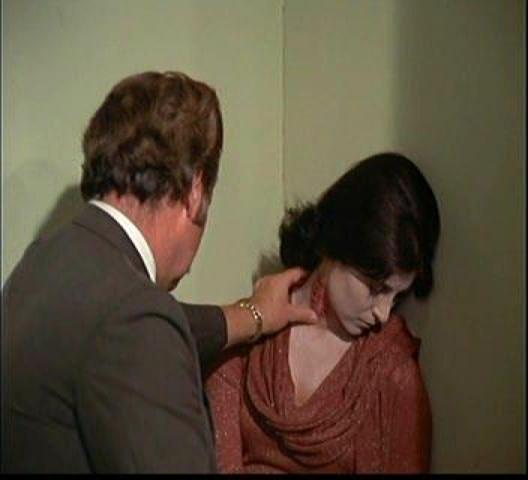
The story begins with Kolchak listening to a tape of the story we are about to see, a story that was buried by the authorities. We begin with the murder, in Los Vegas, of Cheryl Hughes and move to her autopsy where it is clear that something is odd. Kolchak’s editor,  Tony Vincenzo (Simon Oakland) recalls Kolchak from his vacation to cover the story. Checking his sources Kolchak discovers that she had lost a lot of blood. Victims come in quick succession, one found in a sandpit, loss of blood again apparent and no footprints leading to her body. Then another murdered in her house as her roommate slept. All had marks on their necks.
Kolchak starts calling in favours. He speaks to Bernie Jenks (Ralph Meeker) of the FBI and asks him to look into other murders with similar modus operandi, he also asks him to check with mental hospitals to see if there has been a release of any one who thinks they’re Count Dracula. Bernie tells him of a special report being presented by a Dr Makurji (Larry Linville), a pathologist who has been flown in. Kolchak then discovers that a hospital has had its blood supplies stolen.
Makurji states that the bites are almost dog like and that all the blood seems to have been siphoned within a minute. Kolchak asks whether the killer drank the blood, much to the disgust of Police Chief Ed Masterson (Charles McGraw) and District Attorney Tom Paine (Kent Smith) 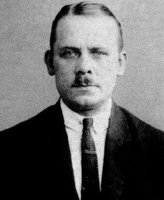 but Makurji says that it is possible and begins to mention a case in the 1920s in Germany, before being cut off by the DA. The case that I believe this was likely referring to was the real life case of Fritz Haarmann (pictured), known as the Hanover Vampire due to his cannibalism and habit of biting victims on the neck. Haarmann was executed for his crimes in April 1925. Makurji tells them not to dismiss Kolchak’s theories but the DA makes it clear that nothing concerning vampires should be printed. He also, privately, threatens Kolchak off the story. We find out later that Kolchak has been fired in several major cities.
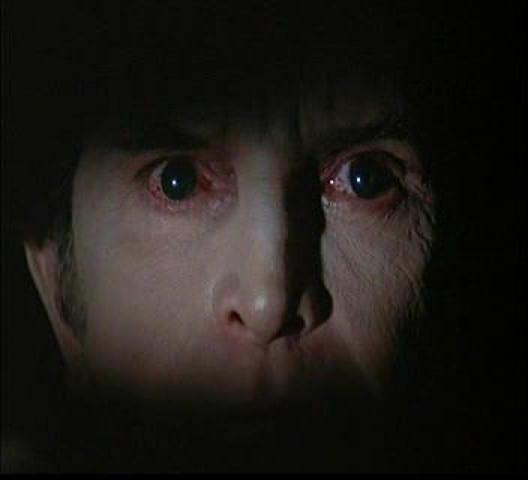
Another victim is killed, but this time there is a witness, the girl’s mother. During this scene Kolchak says, “Looks like Bela Lugosi has struck again.” Kolchak’s paper prints a sketch of the attacker.  Up until now we have not seen the attacker, but with the next victim we see his eyes. This victim, Shelly Forbes, releases a Doberman from her car which the attacker kills with ease. She is not classed as a victim, however, as she simply goes missing – only Kolchak makes the connection.
Kolchak’s girlfriend, Gail Foster (Carol Lynley), is becoming worried, fearing it is really a vampire and gives Kolchak a book on the subject. Another hospital is raided for blood, this time the raider is caught red handed and fights his way out. Kolchak arrives in time to get pictures and see the man shot without apparent injury.
Another press conference is called and Bernie reveals that they have identified the man. He is Janos Skorzeny (Barry Atwater) and, according to Interpol and Scotland Yard, he is a millionaire born in 1899. Wherever he has been there have been mysterious deaths and he is an international fugitive. Kolchak asks how a seventy year old man could outrun a police car, survive being shot and bleed clear liquid from a head wound – suggesting he is a real vampire, but is shouted down by the DA.
 The police find Skorzeny, the attempted arrest is witnessed by Kolchak, but Skorzeny escapes, surviving several shootings and killing at least two officers. Kolchak has an idea of how the authorities might stop him, so long as they give him the exclusive story. They have to hunt him as a vampire rather than a fugitive and all the police should be issued crosses and stakes. The DA agrees to his suggestion with the caveat that, should he be wrong, Kolchak leave town within twelve hours. In the meantime one of the reporter’s sources has come through and discovered where Skorzeny lives.
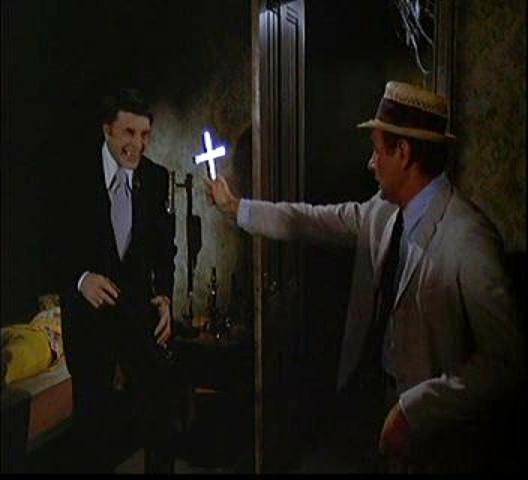
Kolchak goes to the house, with a delay in telling the police the location. He finds blood in the fridge, broken mirrors and a dirt filled coffin upstairs. He also finds Shelly Forbes, tied to a bed and hooked to blood. This was slightly confusing to me as Kolchak intimates that she is being used as a blood farm, for want of a better term, but the vampire seems to hook new blood to her when he arrives home. (Edit, perhaps the vampire needs blood fresh from a victim and he is using the hospital blood to keep her alive and then draining straight from her?) He discovers the reporter and Kolchak uses a cross to try to escape but, eventually, falls and drops the cross. The vampire leaps on him, trying to bite him. Bernie rushes in and pulls the vampire away. A big fight occurs which ends when Kolchak pulls a curtain.
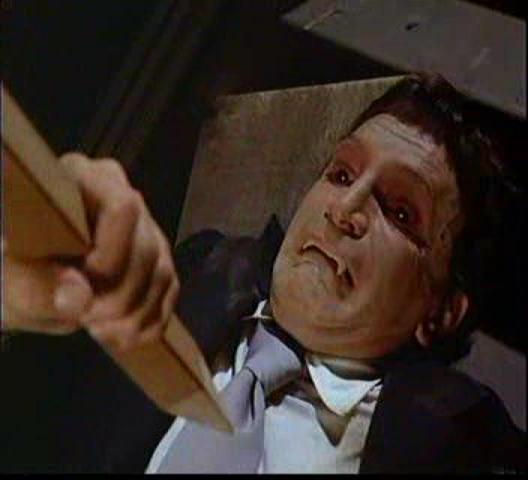
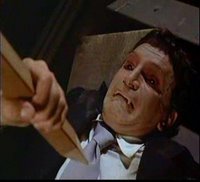 The vampire retreats from the sun and is herded by Kolchak, with his cross, until he is able to stake the vampire – just as the police come in. As a result his story is buried and he is ordered to leave town or he will be arrested for murder.
We cut back to Kolchak in his motel room, his tape still playing as he notes that Skorzeny, and all his victims, were quickly cremated, plus the evidence was buried.
The film is great, and McGavin is fantastic as the wise-cracking, overly passionate reporter. He really comes across as irritating and yet someone you’d want on the side of the truth. Given the way he is played it is not hard to imagine that he would have every authority figure in the city against him. The interaction between him and Vincenzo is brilliantly done, the editor dismayed to the point of explosive anger at the stories Kolchak is producing. That said, I feel that the Kolchak character developed over the other instalments and this is perhaps, with hindsight, Kolchak as his weakest as a character.
The point of view of the reporter made, for the time, a refreshing angle. It is an intelligent story that cleverly looks at what the reaction would be should a murderer really be a vampire. It seems clear to me that such an event would really be buried by the authorities for "our own good" and there really would be a Kolchak trying to reveal the truth. I do wonder, however, if Kolchak wants the truth for himself or for the greater good, it is clear that he believes the story will get him back on a major New York paper. That cynicism is washed away when he puts himself on the line to defeat the vampire, however.
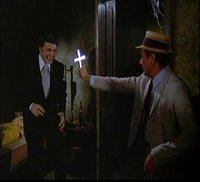 The vampire himself seems an interesting character but we never see that much of him, this is all from Kolchak’s point of view. What we learn is through observation and second-hand anecdotes such as the car seller who said that he would not take the asking price for a car. He is also cool as a cucumber, despatching Shelly Forbes’ dog without breaking a sweat (with moments of explosive violence when cornered). To a degree I would have liked to find out a little more about this vampire, but the Kolchak point of view was so good that it doesn’t seem to matter as you watch the movie. I do like the way that, despite standard fangs, the neck wounds on the victims are full teeth sets.
Looking at the film now it is clearly very 1970s in style and feel, but that actually adds to its charm.
I’ll happily give this 7.5 out of 10.
Exclamation Mark has also reviewed this film, and his thoughts can be found here. Mark, in his personal observations notes that, despite being an ace reporter, Kolchak seems unable to find Gail who is run out of town separately to him. I have to say that it is something that struck me also. Further I have to wonder what happened to his new girl in Seattle, in the Night Strangler, after she left town with him and Vincenzo at the end of the movie, she certainly wasn’t in the subsequent series.
The imdb page is here.
Bonus Vamp or Not? The Night Strangler
The sequel sees Kolchak in Seattle, where Vincenzo is now editor of a paper. The editor gives him a job and puts him onto a murder case.
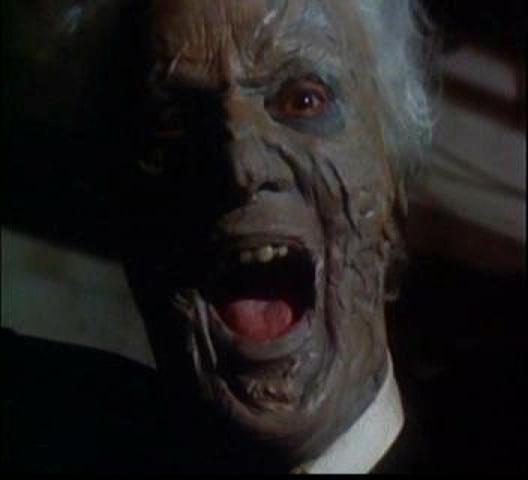
 Again things are strange. The victims are strangled, a needle mark is found in the base of the skull and a small amount of blood removed. As Kolchak investigates, and as more victims appear, he discovers that there have been 6 murdered women, with the same MO, every 21 years since 1889.
An eyewitness describes a corpse like face and rotting flesh is found on the ligature marks. The killer must be incredibly strong as the necks are broken, the bones crushed.
Much like the first film Kolchak fights disbelieving police as well as a disbelieving publisher (played by John Carradine).
The killer, it turns out, is an alchemist named Dr Richard Malcolm (Richard Anderson). He has discovered an elixir of life, that also bestows massive strength, but its effects must be replenished every twenty one years. The ingredients are many but it must contain some blood (six victims worth) drawn from a woman’s brain within seven seconds of her death.
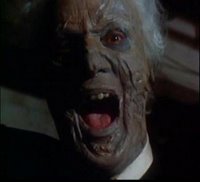 If the elixir is not taken within the prescribed time the user will massively age and die, in fact this is why rotting flesh is found on the early victims as Malcolm is rotting from the moment the previous elixir runs out of power and the more doses he takes the more restored he becomes.
It is very tempting, given the use of blood and the preternatural strength of the elixir user, to say vampire. However I have shied away from this as blood is only one small ingredient of the alchemical formula and it is only needed every 21 years. Also, there is a distinct lack of other vampire like motifs in the film, save rapid aging on death – except, of course, in this case it is the rapid aging causing death not the other way around. This, however, is a great film with a script that I would say is probably tighter than its predecessor.
The imdb page for Night Strangler is here.