Showing posts with label vampire dog. Show all posts

Saturday, February 01, 2025

Immortal Gifts – review


Author: Katherine Villyard

Release date: 2025

Contains spoilers

The blurb: He lied about his identity. Two hundred years later, he’s still paying the price…

Prussia, 1841. Abraham only ever wanted to play violin. Hiding his Jewish status so he can study at the prestigious Berlin Academy of Music, the eager young man is delighted to find a patron who believes in him. But he’s mortified when his new friend turns him into a vampire… and Abraham earns the fury of an ancient antisemite who vows to see him permanently dead.

Fleeing the hate-mongering fiend across the decades, the sensitive violinist at last settles in twenty-first-century New Jersey with a mortal woman. But when he discovers his relentless tormentor has tracked him down yet again, Abraham despairs he’ll never find true happiness.

With everyone he’s ever loved at risk, can he escape the rage of a ruthless bigot?

In a complex tale woven through history, Katherine Villyard delivers a fresh and insightful twist on the vampire novel. Infusing the narrative with profound themes of love, betrayal, and the nature of monsters, she crafts an unforgettable saga of surviving prejudice that will keep readers turning pages deep into the night.

The review: Abraham is a Jewish vampire married to a wiccan mortal in this first-person narrative novel, which moves both through time periods and between narrators. Of course, one of the issues for a Jew turned is the fact that drinking blood is expressly forbidden in the Torah and one thing I did like about this was Abraham struggling, despite his long life, with reconciling his vampirism (and undead status – if he is indeed undead) with his faith. As a mortal he lied about his faith to get a place in the Berlin Academy of Music and gained a patron in the form of Ludwig – a vampire. When he contracted consumption Ludwig turned him, without permission, so that the world would not lose his gift. Unfortunately, Ludwig’s maker, Thomas, is fervently antisemitic who was a part of the Inquisition and later would become a Nazi (the evil of the Shoah is explored, with Thomas and Ludwig able to, at least, get some young relatives of Abraham to America) and later still a popularist right-wing rabble rouser in the USA.

Destiny, Abraham’s mortal wife is a veterinarian and vegetarian but does know about her husband’s condition – after all standard tropes such as sunlight hold true here. She has expressly stated she doesn’t want to turn. Abraham also seems to have some degree of impulse control – a lover of cats, he manages to end up with vampire pets as he can’t let them go. Of course, Thomas will enter their lives again.

I mentioned the sunlight trope and a vampire can also control those they turn. This gives Abraham some assurance with the vampire pets and the turning seems to have made them more intelligent also. There is an interesting meeting of science and vampire physiology when it comes to the ability to reproduce through IVF. There is a great bit around the gifts that vampirism bestows that I won’t spoil as it is integral to the climax.

The characters were given distinct voices, and, on occasion, the author would revisit scenes through another perception that worked well. The story paced well and the Jewish lens brought an interesting direction to the prose and narrative. I did enjoy this. 7.5 out of 10.

On Kindle @ Amazon US

On Kindle @ Amazon UK

Tuesday, May 24, 2022

The Magic Kids: Three Unlikely Heroes – review


Director: Tim Trageser

Release date: 2020

Contains spoilers

With its original German title of Die Wolf-Gäng I was (and still am) going to wax lyrical about how this is (in essence) a Harry Potter clone. However, when I opened up the IMDb page, I was shocked to see it is actually based on a Young Adult Book series by Wolfgang Hohlbein. I can’t say how accurate this is to the book, but if it is accurate then it is the book series that is the Potter clone.

It starts with a bit of a background that suggests that the world was once ruled by creatures of the night but, as centuries passed, they became good and there was peace between them and humans with the night creatures eventually living among us in secret.

moving to town

There are, however, still places where the night creatures live openly, hidden towns often sheltered behind magical forests. It is to one of these places that the young vampire Vlad Tepes (Aaron Kissiov) is moving to with his father Barnabas (Rick Kavanian) – a pair of vampires, moving as Vlad has been invited to join a magical school there. So, whilst not an orphan (totally, his mother is dead), he is a young teen moving to a magical school by invitation a bit like a certain wizard, Harry.

nodding vampire dog

They are stopped on the bridge into town by a troll (Waldemar Kobus), who is the town gatekeeper and who reads out a prophecy to Vlad that suggests that he will meet friends, become a trio of companions and save the world (to us, at least, it makes no sense to Vlad). When they get into town a crystal pendant Vlad wears (bequeathed by his mother) glows and a modern bike becomes a penny farthing and a policeman’s hat becomes an old-fashioned helmet. Vlad doesn’t realise the connection with his pendent.

Vlad's fang

That first night his father is visited and charged taxes that he cannot yet afford and has to go to the town hall to protest, in the morning. The mayor offers him the opportunity to sell Vlad’s pendant to stave off the debt (refused as it isn’t the father’s to sell). Meanwhile Vlad goes to school and there is a ceremony which reveals the new children’s true faces (for instance a ghost becomes incorporeal). There is a fae called Faye (Johanna Schraml) who flies, and soon discovers a fear of heights, a ginger werewolf, Wolf (Arsseni Bultmann), who transforms and discovers he has a fur allergy and then Vlad’s hair slicks and fangs appear. However Faye crashes into him, he cuts himself on his fangs, sees blood and vomits (a blue goo) as he is scared of blood.

the gang

So these are our heroes – the all-round good Faye (Hermione, essentially), the ginger Wolf (very obviously in look and actions Ron) and Vlad is our Harry imitation. They get help from the school caretaker, Hannappel (Axel Stein), who is a bearded (though not wildly so) person who shouldn’t do magic (due to ineptitude). There is some bullying from the blonde Draco Malfoy clone and his two bully-boy friends. I mean it is so obviously lifting from Potter it is painful.

Rick Kavanian as Barnabas

As for the film itself (and the sneaking into the forbidden library, through a set of underground tests after getting past the - one-headed, to be fair - guard dog). Well, it seems competent enough, though that competence is then undermined by some average to poor dubbing. Perhaps it would work better in the original German. Nevertheless I couldn’t actually get past the blatant Potterness – was that from the book or added in by the filmmakers? I don’t know, but the film had neither the charm, the magical quality or the slickness of those films. I think 4 out of 10 is more than fair, perhaps too fair to be truthful.

The imdb page is here.

Saturday, January 11, 2020

Sacred Blood – review

Director: Christopher Coppola

Release date: 2015

Contains spoilers

Christopher Coppola is no stranger to the vampire genre, directing the 1988 film Dracula’s Widow. This film suffers for lack of budget and some spotty performances but makes up for it in vision and a sense of hankering back to Italian horror of yore.

I felt the narrative could be tightened up also, but I’ll cover that as we go along and so, after the opening credits, we see images of the ocean, hear a storm until the scene calms into the safe haven of San Francisco harbour.

Natia arrives
Out from under the Harbour sign walks a woman; pale, pained and almost ill looking – Natia (Anna Luca Biani). As she walks past the window of a coffee shop/art gallery she is seen by resident struggling artist Luke (Bailey Coppola) who chases after her and then follows her on his pushbike until eventually losing her. Elsewhere a woman called Lilly (Bai Ling, The Breed, Three Extremes & Dumplings) is in an eatery when she too spots Natia.

Lily and Natia
She also follows her, but keeps much closer than Luke did. When Natia confronts her, Lilly reveals that she knows what she is, suggests that Chinatown is her turf and she won’t be so nice if Natia returns. However, the girl seems vulnerable, new to being the vampire that Lilly recognises, and so Lilly then offers her pointers for money. Natia has none and Lilly suggests she attend to some business with her. They go to a bar where a business man (Steven Wiig) drinks alone. Lilly takes the casually racist man back to a room – with Natia – where it soon descends to a feed.

eurohorror
What struck me here was the use of off-kilter camera work – especially when Lilly and Natia meet, which had a nice feel but was perhaps sparingly used through the full film. Also the lighting/filters in Lilly’s room was highly effective, giving a Eurohorror, perhaps more specifically an Italian feel. When Natia attacks she sounds and looks feral, a sense we don’t get from Lilly who feels under control.

circus act
The film then moves to the country of Georgia and we get a little of Natia’s past – however I felt the narrative structure failed to distinguish the geography and the time-gap as well as it might. This is perhaps amplified by Anna Luca Biani whose Natia feels like a different person in these scenes, a fact that speaks highly of their acting ability but doesn’t help the narrative. Natia is running the family circus and performing as a sharp shooter but the circus is failing. In desperation she gives a job to Sasha (Konstantin Kryukov, Vurdalaki), a dog trainer with a single dog.

sisters
What we then get is, in flashback, a backstory of a family in crisis – the father is an alcoholic after the death of the mother in an accident. This has a nice symmetry with a primary storyline as I’ll mention but, symmetry aside, adds little to the primary narrative. Sasha is a vampire and his dog is too – able to jump unnaturally high. He is on the verge of turning Natia’s sister, Dedika (Natalia Diasamibze), when Natia bursts in with a gun and the dog, protectively, bites her. Natia turns, her sister does not but the Georgia story ends there with Natia fleeing to protect her family.

Michael Madsen A bRENNAN
In the States we discover that Luke followed her as he was inspired to paint her portrait and, of course, they fall in love. Natia manages to slaughter a pimp and his brother (plus heavies) so that she can both protect some prostitutes and get money (to send home). She also slaughters a couple of muggers. The mayhem brings her to the attention of detective Brennan (Michael Madsen, the Bleeding, Vampires Anonymous, 42, the Tomb & Bloodrayne) – Luke’s alcoholic father who turned to the bottle after his wife developed dementia and who is disconnected from his son, not understanding his desire to be an artist. This is the symmetry I mentioned.

Rob Nilsson as Ruthven
She also comes to the attention of the top vampire, Ruthven (Rob Nilsson), who insists she works for him. There is an odd moment that suggests a psychic attack when she resists but is not spelt out and Ruthven (pronounced incorrectly, as normally happens to be fair) is apparently Scottish (he’s lost his accent) and obsessed with wine making. This then leads to the film’s tagline “From the Vine to the Vein”, which is not explored in any meaningful way but a vampire’s obsession with wine does riff nicely on “I do not drink… wine”.

Bailey Coppola as Luke
There are issues as this becomes a mood and character piece (which are the strength of the film) but doesn’t quite pick up on any horror (despite the feral growling and butchering of villains) and the storylines fail in the main to go anywhere. That is not true of the central romance but the police investigation and the winery (even the circus to a great degree) just feel like they are hanging. The acting seems uneven. I mentioned Anna Luca Biani being very different before and after turning and Bailey Coppola is great in the role. Madsen and Bai Ling have their moments, as one would absolutely expect, but much of the supporting cast are less impressive and I thought Nilsson miscast.

blooded
The action, I think, is lost in budget and more could have been done around the gore (the first feed is impressive due to filters/lighting but perhaps other attacks are lacking). I did think the guns sound lost and hollow in the soundscape and whilst we know shooting at a vampire will have no impact it will impact the clothes at least. The character studies/mood could have been a massive plus to a strong narrative, but the narrative needed tightening up. Yet it isn’t all bad, far from it – aspects like the symmetry between Bailey and Natia worked well, the mood was there and there were good performances and the visual atmosphere worked. 6 out of 10.

The imdb page is here.

Monday, July 20, 2015

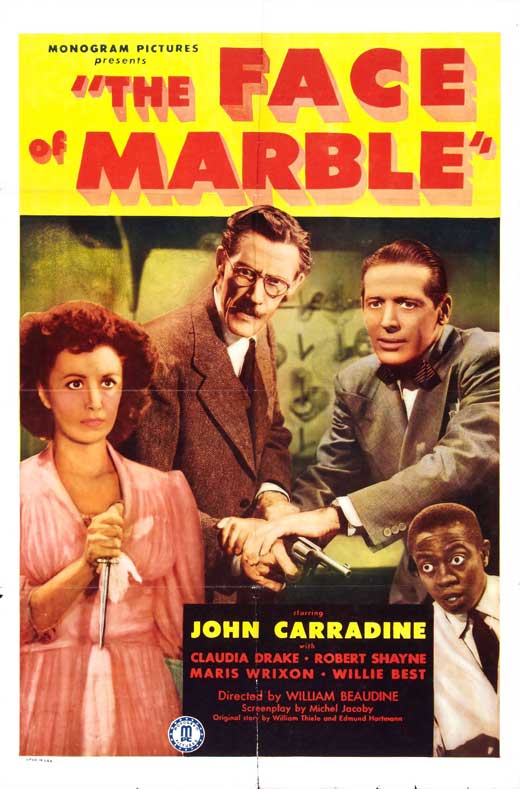
The Face of Marble – review


Director: William Beaudine

Release date: 1946

Contains spoilers


I need to start this with a thanks to Doug Lamoreux and the vampire trivia game he was playing on Facebook. Had it not been for that I would have been in the dark about this strange movie. Why strange? Well despite the pseudo-science on view and the disturbing stereotyping (from a 21st Century perspective), it actually has quite a compelling aspect, an unusual premise and what I found to be a cracking ending (which I am going to have to spoil).

Apologies in advance for the screenshots accompanying this review. I found the film on Daily Motion and it is both low res and an horrendous print – this is one that could be nicely cleaned up and put out on a special ed DVD, methinks. It could also stand a remake…

uncomfortable stereotyping
The film starts off with Elaine Randolph (Claudia Drake) sleeping on a couch, a blanket is draped over her by the maid Maria (Rosa Rey), waking her and rousing her large dog, Brutus. Elaine asks about the Doctor and is told that he left the house to go to the shore some time ago. Worried that he is sailing in a storm Maria declares that the Great Spirit Tonga will protect him. Elaine is dismissive and Maria starts to speak about the jungle but her beliefs are disparaged. Suddenly the other servant, Shadrach (Willie Best) comes in babbling about the devil bringing a dead body into the lab. The scene was uncomfortable, mainly because of the way Shadrach is portrayed – a servant with no sense and almost irrelevant (the film actually turns this on its head at the end, though whether intentionally I don’t know).

reviving
In the lab is Dr. Charles Randolph (John Carradine) and his assistant Dr. David Cochran (Robert Shayne). They found a drowned sailor on the beach and have brought him back to the house. Elaine comes in but is stopped by David and sent away like a good girl (ahem). The doctors have been working on a way to bring the dead back to life and a chance to experiment on a human is too good to miss. The technique uses a formula invented by David and electrical equipment ala Frankenstein. They try to revive the guy, who develops a face like marble, awakens, stands but then falls dead.

Elaine and David
He is quite dead, suggests Charles, beyond our help. Later they talk about the man being quite deranged (we didn’t see that) and his altered face being an indicator of being trapped between life and death – it is to draw aspects like this out that makes me think of a remake (where the man can act deranged for instance). David is worried about the fact that they took the body but, not to worry, they take it back and call the coastguard. After they go to their respective bedrooms, Elaine goes to David to ask him what was going on and confesses that she believes something sinister is afoot. Charles finds his wife speaking to David but shows no level of jealousy.

fetish
I liked this about the film. There is a love triangle but only one person in said triangle knows and she is in denial. It seems that Elaine had an accident that left her with a brain injury, only sorted when Charles operated on her. They then married. She has fallen for David – though he doesn’t realise, obsessed with work and his fiancé back home, Linda (Maris Wrixon). Maria knows, however. Hence leaving a fetish under his pillow that Charles identifies as a Quandrava , a jungle fetish designed to make you fall in love.

Thomas E Jackson as Norton
All is not good, however. David destroys a fetish (in acid apparently) and Maria swears that the act will bring a curse and death. Charles’ old cop friend Inspector Norton (Thomas E. Jackson, Valley of the Zombies) comes visiting. The dead man on the beach showed signs of massive electrocution and Charles has bought a replacement electrical component because one burnt out. Putting two and two together… no one mentions the fact that there was a storm that night, thus his drowned body might have been electrocuted through lightning nor the obvious signs of drowning. This was ill thought through and was expedient to bringing the cop in only.

shooting at Brutus
Charles wants to complete his work and… kills Elaine’s dog. They put Brutus on the slab and go to resurrect the pooch but the attempt fails… they think. As they leave the lab they hear barking, rush back and Rufus is up and about and… not the mild mannered pooch from before. Charles shoots the dog at point blank but the bullets just go through it. The dog eventually leaves, becoming insubstantial and walking through the wall and closed window! So as to finish the set up, I also need to mention that Charles arranges for Linda to visit for David’s birthday. Finally, I need to mention that Maria is a wonderfully casually evil character – happy to kill if that means Elaine is happy.


insubstantial dog
So, vampire… The Inspector shows up asking about the dog. Charles is caught within a lie he told Elaine of the dog going to the vets and so tells the cop the same. However the dog has been seen (and recognised) attacking livestock, ripping out the throats and draining the blood. Charles never admits it’s his dog but calls its actions a hemomania, suggesting that there is something missing from the blood that it needs to replenish. However Elaine is accidentally murdered by Maria (she thinks she is getting Linda) and she is revived. Whilst we see her become insubstantial we do not see (or hear) of her drinking blood. I like to think that it is only a matter of time.

will they be back?
To the ending... as I mentioned I liked it. Charles realises that Maria killed Elaine and is incensed. Maria uses her voodoo to summon Brutus and take control of Elaine, making the oblivious woman kill her husband. The inspector, of course, believes it is David who did it but David gets away from him – worried for Linda who is being attacked by the pair. In the turnaround I mentioned, even Maria discounted Shadrach and he tells the inspector what really happened (and so saves the day). The inspector bursts in as Elaine strangles Linda and David wrestles with Brutus. When he switches the light on the pair vanish – not because of the light but because Maria has committed suicide it seems. We later see the footprints of the woman and her dog heading in to the sea and I liked that, it gave hope of them returning.

before the terrible deed
The film had problems, don’t get me wrong, it threw too much in, it had racial and gender stereotypes that are frankly cringe worthy, its logic was flawed in places, a lot. But it had nice bits. It had a vampire dog, it had the use of voodoo and it had atmosphere. It had Carradine being… well Carradine, erudite and gentlemanly so that even when he killed the dog you kind of didn’t lose your empathy for him. It could be taken, expanded in certain areas (gore and madness), have the extraneous parts removed and make a fine little film. For this flawed version though, 5 out of 10.

The imdb page is here.

Sunday, December 28, 2014

Mostly Dead – review

Director: Hernan Caraballo

Release date: 2014

Contains spoilers

Whilst many of the vampire movies featured on TMtV are bought, sometimes I'm contacted by production companies and asked if I would like to review their film and at other times I actually contact the production company to see if a screener is available for review. In the case of Mostly Dead it was the latter.

CGI vampire death
It is always tough, in either of those scenarios, when the film proves to be not one of the best. Clearly the filmmakers are proud of their effort, but my first loyalty is to the reader of this blog. Mostly Dead has genuine problems, many of which I suspect are born of a combination of the issues of budget filmmaking combined with a genuinely (overly) ambitious vision. I will cover these issues within the review, and it will of course affect the final score. However, there are some really good ideas in Mostly Dead as well and I also hope to persuade you that the final film is actually worth your time viewing.

a vampire attack
We are in the town of Fairlawn and things are distinctly odd. The cars stopped running, no trains or buses arrive in the town and no planes fly overhead. Somehow the electricity and water are still available but no communications can escape the town. They assume that similar phenomena has impacted the rest of the world. Oh yeah... they also have vampires. As the film starts we see a girl walking down the street with baby, more importantly we hear a song being sung. Unaccompanied vocal, this original track for the film is truly excellent and works towards building an atmosphere.

like an undead Fagin
As she walks the sky darkens. We see in an alley a vampire feed on a Goth. She passes a vampire, Vasili (Christopher Brechtel), dressed in Victorian garments with a group of children vampires all dressed in fancy dress capes. She runs and they chase. She reaches the doors of a church and has time to bang on the door, multiple times, for entrance. It takes a while but the door is opened, and she gets inside before the out of breath vampire reaches her. And here we can start seeing the problems. I'll get to the changing weather/days in a second but it was difficult to understand why 1) Vasili couldn't catch a girl holding a baby, and 2) why a vampire seemed out of breath? (After all, later in the film a vampire says that they do not get tired.)

in the snow
So, a good number of the town residents are hiding out in the church, under the care of Father Giovanni (Ryan Trost). These residents emerge during daylight hours scavenging for food. I said I'd mention the weather, it flips between summer and winter. When preparing for a review I make notes on the film I'm watching, and made a note of the extreme changing weather – snow in one scene, summer in the next. Suddenly this was answered in the dialogue when one woman asks whether it is the vampires causing such drastic day by day changes. Kudos to the filmmakers for tackling this, though I suspect the ever changing climate may have had more to do with an extended filming window. I would, however, tend to avoid filtered day for night shots – they can jar generally, especially when internal shots appear duller than faux-night shots, and they weren't used consistently.

Lynn Lowry as The Lady
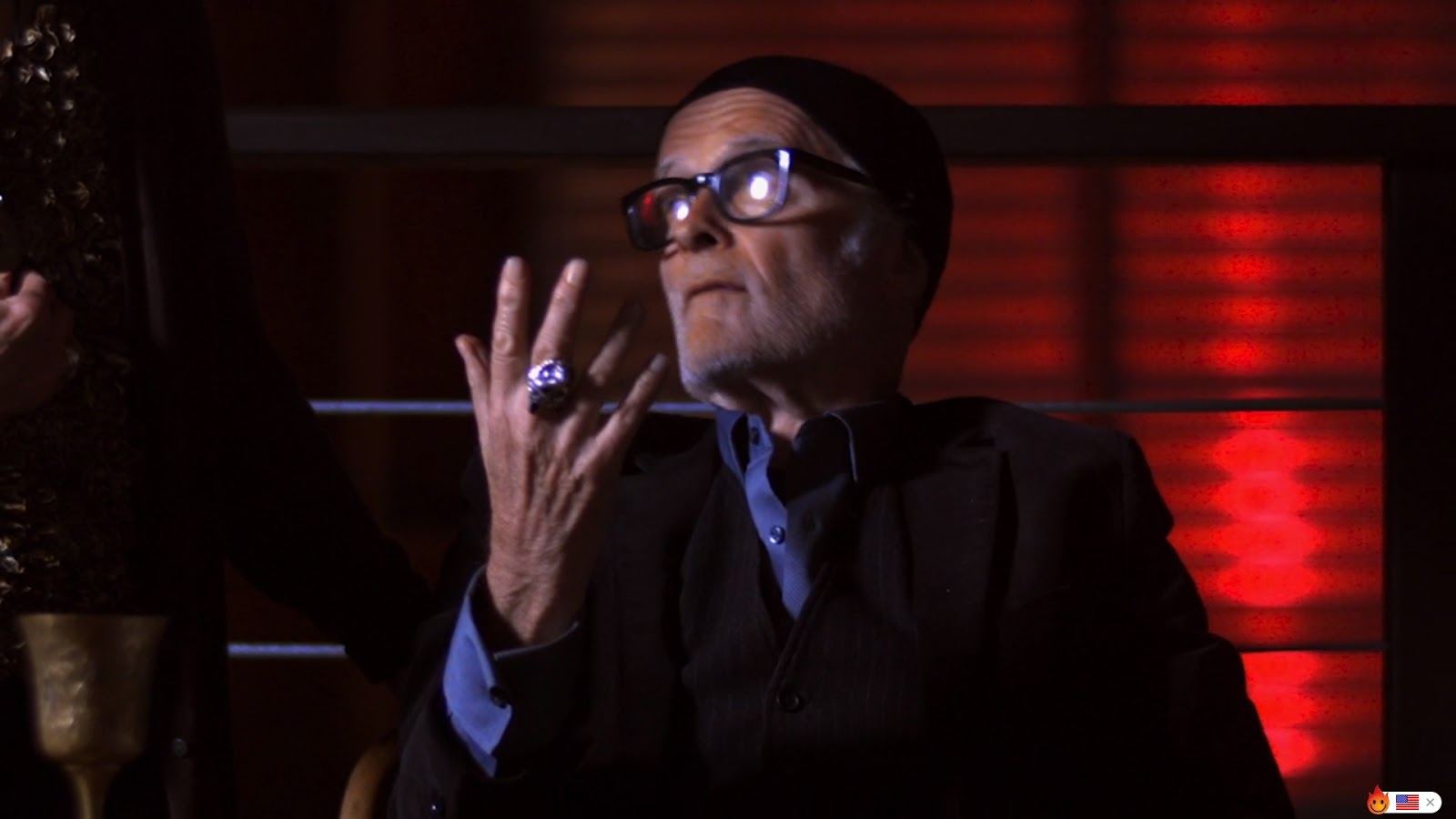
When the town residents find a vampire, they dispatch it. The vampires explode in a fireball, the CGI for this (and for a house explosion the residents set off) jarred as well and I would have been tempted to avoid using such effects. The main story was the thing that kept me hooked into the film. This was, of course, the question of what exactly was happening? We get additional mysteries that feed into this, such as why it appears that certain vampires can go out in daylight, why the man with learning difficulties, Michael (Dean Puleo), seems to be able to sense vampires, and why one of the vampire leaders, The Lady (Lynn Lowry, My Stepbrother Is a Vampire!?!), can sense something amiss in the church.

under-explored as a character
Unfortunately they did throw a lot more story at the viewer and some of this was too much, and never got fully explored. Vasili feeds on children, walking with a gang of vampire kids like a toothsome Fagin, but we never see deeply into his character. That was a mistake. 30 years before he preyed on a young girl; as he fed on her the cross she wore, beneath her nightdress, seemed to burn into her chest. In the present day with faced with a cross the one in her chest glows. She hasn’t stayed with him, despite his perchance for gangs of vampire kids, we don’t know why. She appears to actually be growing, something a vampire shouldn't do, and this is put down to the cross. It’s a great kernel of an idea but is frustratingly not explored.

Flunky and The Lady
Similarly, early on we see a young woman contemplate suicide and later in the film it appears that Vasili is invading her dreams to push her towards such an act. But that is all we get, much more might have been done with it but the incidental nature of the scenes make it extraneous. I mentioned The Lady, she has a lackey (Michael O'Hear, Red Scream Nosferatu) but precious little is done with these characters. A young man who turns with his leg severed was perhaps a story too many and could have been left out. Frustratingly there is a character called Maria (Tara Rae Hark) who was concentrated on a little, but cutting away some of the extraneous storylines could have seen this important character concentrated on even more.

spotted - a daywalker
So that was some of the problem with too much story but in some respects I did feel that the actual piecing together of the main narrative could have been smoother as well. None of this, however, is able to take away from the fact that the core story kept me intrigued. I admit that I did guess exactly what the vampires sensed as being off in the church, but not straight away. Let’s be honest, a town taken by vampires was always going to be an ambitious project but concentrating on the core mystery would have made it a little more manageable.

vampire dog
So we come to the score, and is not an easy thing. I was entertained, and there were some great ideas (and a vampire dog). However the cinematic narrative was somewhat clumsy, the CGI obtrusive and there was a feeling that the filmmakers had bitten off more than they could chew. I also understand that they were working with a budget and a cast who were mostly in their first film. I don't want to give the film too low a score, which in itself would be unfair. Because I was taken with the film I'm going to give this 4 out of 10. The score reflects the issues but also the fact that I did actually sit and enjoy the central mystery within the film. Hernan Caraballo should take heart as there is much to build on.

The imdb page is here.

Tuesday, June 10, 2014

I, Vampire: Volume 3 Wave of Mutilation – review

Writer: Joshua Hale Fialkov

Artists: Various

First Published: 2013 (Trade Paperback)

Contains spoilers

The blurb: Andrew Bennett is a very unusual vampire. For hundreds of years, he’s avoided feeding on humans and has attempted to use his powers to stop those vampires who prey on humanity, including a monster of his own creation – his former love Mary, Queen of Blood.

But now everything is changed. To stop Mary, Andrew took the power of all the vampires into himself, turning them all mortal… but in the process, turning himself into the most powerful, most evil vampire to walk the earth.

Now, as Andrew begins building a team of new vampires, Mary will have to unite with Andrew’s former allies – many of whom have a good reason to despise her – to stop him before its too late. But more than Andrew’s soul lies in the balance. If Mary fails, the entire world will fall to the mad vampire who once protected it.

detail
The review: The first two volumes of the New 52 reboot of I, Vampire (Volume 1 & Volume 2) were consistently good graphic novels, though I felt the Justice League Dark sections of volume 2 were weaker art-wise. The story of volume 1 was perhaps a tad simplistic but the breakneck speed of volume 2 made up for that.

Volume 3 was fabulous, the artwork was produced by several artists but was more consistent and suited the story and atmosphere. We get Andrew Bennett’s turning story, we meet both Cain and Lilith (Lilith is Cain’s wife in this universe), we get a brick from the tower of Babel and Constantine is in the story (though the other DC crossover characters from earlier volumes are missing). The switch around in characters was really nice, Bennett becomes thoroughly evil (and not too bright, to be fair, having relied on the wisdom of others before) and Mary becomes… well not good as such, but on good’s side at least.

The volume neatly ends the story (I understand that it was meant to run for some 5 more comics but Fialkov was given enough notice of the early series cancellation to be able to draw everything in neatly). 8 out of 10.

Tuesday, October 02, 2012

Vampire Dog – review

Director: Geoff Anderson

Release date: 2012

Contains spoilers

All bark and no bite!” Well that’s what the DVD cover says and my god they weren’t kidding. A vampire dog, fangless (bar the name) and a script with the masticatory prowess of a toothless person faced with a tough steak.

It doesn’t help when the tagline gives the game away and the game is so very lame, but let us start at the beginning and see where it takes us. For the idea of vampire dogs are not new and, of course, most famously we saw them in the film Zoltan, Hound of Dracula.

So we begin in Transylvania (though I was struck by how much it didn’t look or feel like said country) and a peasant woman is making jelly. Quick as a flash, through a window, a dog, Fang (Norm MacDonald), appears and eats the jelly. When she brings a second bowl he is back and she sees the vampire dog… for he eats jelly – preferably red jelly (bear in mind that this film uses the UK version of jelly, which most Americans would refer to as Jell-O I believe). In a castle an old man, Sylvester (Alan Bratt), paces. He asks where have you been and Fang appears. We see pictures in which a dog should have been (he doesn’t show in photos) and when the camera has panned across the fireplace and returned to the gentleman we see that the old man has died (though his chest still rises and falls in shot… too picky… maybe).

Collin MacKechnie as Ace
America, Lugosi County (groan) and Ace Cunningham (Collin MacKechnie) and his mom Susan (Jodi Sadowsky) are moving in their new home. He’s not happy about being the new kid but she has taken a job as music teacher at Lugosi’s public school. If she can’t get its music programme up and running it will close down. He is carrying part of his drum kit in when he sees neighbourhood girl Skylar (Julia Sarah Stone) go past on her bike and literally falls for her over a packing case.

travel case
Ace has problems though. Whilst he is a talented drummer he cannot perform in front of anyone. This leads, when forced to play in school, to him falling off his drumming stool, captured on every camera phone and becoming a laughing stock. His mother doesn’t help by writing 'mummy loves you' and similar on his lunch bags. A letter arrives at home notifying them of Sylvester’s death (he was Ace’s fraternal grandfather) and saying that Ace has been bequeathed the dog Fang. Clearly animal control no longer works at US borders as the dog is delivered right on queue – in a wooden chest-like carry case. At first it seems like the dog won’t get out, because of the sun, but eventually he does.

the villains
We then meet Dr Warhol (Amy Matysio) and her side kick Frank (Ron Pederson). She is trying to make an anti-aging cream (without success, it burns Frank’s skin) and is conspiring with the school’s Principle (Mark D. Claxton) to make sure the school closes so she can convert it to a health resort. When she sees a news report from Transylvania she realises the vampire dog is the key to her cream and Frank discovers that it now lives in the same town. After that initial brilliant detective work they are totally inept through the remainder of the film.

Amy Matysio as Dr Warhol
Will Ace get the nerve up to drum in public, save the school, get the girl and keep his dog safe? Hmmm… let’s just get on to lore. Firstly, given the fact I put an actor with Fang’s name, I’m sure you’ll have guessed that Fang can talk. He became a vampire when one of Ace’s ancestors rose up against the vampire Vlad Ţepeş. Vlad was going to bite him, the dog took the bite (and became a vampire) and the ancestor killed the last human vampire – the family have been the dog’s caretaker ever since.

wrong, just very wrong
The dog cannot stand direct sunlight but is fine in the shade. Later he gets a little doggy suit to keep the sun off him (that would have had Zoltan howling with shame) and Skylar develops an anti-allergy medicine that lets him go in the sun (but does not cure vampirism)… did I mention that the kids are meant to be about twelve… no… well they are. Now the dog can’t even say the word blood, never mind drink it, but craves jelly. Of course this isn’t a vegetarian vampire as jelly is not a vegetarian food stuff. It is the gelatine he craves (and he used to eat hooves etc in centuries past).

eye mojo
Other than that he has a little coffin that he sleeps in (when not sleeping on the bed) can run super-fast (and tidy a bedroom), has enough strength to drag a twelve year old upstairs when fainted and has a line in eye mojo. And that’s all folks… The film never goes into how he might die (bar direct sunlight) and we don’t get Fang showing a fang.

gelatine addict
The acting was at best average – though the voice work for Fang was ok and the actual dog outperformed the humans with ease – but the script was generally terrible and managed to slip in a couple of fart gags, a dog peeing on electrical equipment gag and a poop bag gag (none of the above were funny). The entire thing was schmaltzy from the get go but almost insincerely so especially the hallmark looks of insincere love cast from mother to son. Too many stereotypes crowded for attention and sloppy writing abounded. There was no sense of peril as the villains were just so inept. Truthfully, immediately after viewing the movie, I mailed a person who knew I was watching the film (indeed he had dared me to, forgetting that I do this sort of thing anyway, in an endless cycle of vampire related masochism) with the message “My eyes are melting out of my head and I think I hear Zoltan turning in his doggy grave”. 2 out of 10 is generous given how I imagine Zoltan’s centrifugal response.

The imdb page is here.

Tuesday, July 24, 2012

The Romance of Dracula – review

Author: Charles E Butler

First published: 2011

Contains spoilers

The blurb: A review of the fourteen Major film adaptations of Bram Stoker's novel Dracula. Complete with illustrations of the fourteen major Counts.

From Max Schreck to Marc Warren, The Romance of Dracula is the most concise account of the Count on screen.

The Epilogue concentrates on the Count's further/major appearances in fantasy horror films and the book takes interesting side-roads into the exploration of the myth through The Fearless Vampire Killers (1967), the original Fright Night (1985) and The Shadow of the Vampire (2000). An engrossing must-have read for the casual onlooker and the ardent aficionado.

The review: What we have, with the Romance of Dracula, is one fan's look at the major films about the Count, with a blow by blow synopsis of each flick, his views on the quality (or otherwise) and some interesting interpretations of character motivation.

Bar the last aspect (potentially), therefore, the book is kind of like this blog and therefore the question becomes, what’s not to like! It is, actually, a serious question. Butler is clearly a fan of the Count and thus, even when I found myself disagreeing with his viewpoint on a film (we would definitely debate the relative merits of the various Hammer films, methinks) or (the rare) moments when I questioned accuracy (for the record, in Dracula 2001, Van Helsing is the Van Helsing and the suggestion that he “curiously bleeds himself with leeches on a regular basis to keep his immortality” misses the actuality that, rather, he uses the leeches to bleed Dracula’s blood, thus purifying the blood in some way, which he draws from the leech by syringe and injects into himself, thus making him immortal but not vampire - sorry, that one needed correcting), I still thoroughly enjoyed reading the book. The language conveyed Butler’s love of the genre and my main frustration was that it wasn’t a conversation as I am sure I could while away many an hour talking vampires generally and Dracula specifically with the gentleman.

Each chapter is illustrated with a picture of that incarnation of the Count, drawn by Butler, and I would say the main weakness of the book is that the many facts that Butler adds into his reviews are not referenced.

Butler suggests “Once you have read the text I hope that it prompts you to re-view these films yourself in a different light than you've ever watched them before.” Whether I’ll watch them in a different light or not, I don’t know, but there is nothing like someone’s enthusiasm for movies you love (sometimes despite themselves) to make you want to go back and revisit them yet again.

For the book 7.5 out of 10, with a suggestion that, should it be revised, referencing is included.

Saturday, February 02, 2008

Zoltan... Hound of Dracula – review


Author: Ken Johnson

First published: 1977

Contains spoilers

The Blurb: “When the dust of the explosion died down, the soldiers realised they had uncovered an ancient grave.

“The dreadful thing that escaped from the damaged coffin looked like a dog.

“Its search for a master took it from Central Europe to California – and an ordinary couple on a camping holiday with their children and their beautiful puppy dogs.

“There was nothing special about the couple, except that Paul’s grandmother had changed the family name to Drake from Dracula…”

The Review: First of all can I just wax lyrical about the cover, how 70s, how groovy… I like that cover. The book, itself, is the novelisation of the Film. This is a novelisation, rather than the film based on the book, as the author bio clearly states that Johnson “adapted Zoltan… Hound of Dracula as a novel from the EMI film production of the same name.”

So we are definitively within the world of vampire dogs and, unfortunately, vampire puppies. I will admit that it does add a little extra to the wafer-thin plot of the film, an insight into the character minds that the film never really allowed. Do not get too excited, however, Johnson doesn’t expand that much. This is a light pulp read, fairly large font and 160 pages do not normally make for an in-depth novel in my experience.

We still have the concept of the fractional lamia, which is “someone only part vampire” and that “can function in the daytime. They can be trusted to find victims. And most important, they have no craving for blood.” This concept is the crux of the story as Smit, said fractional lamia, can only survive with a master. Nice concept, crap monster name.

The film fails to raise chills, a vampire puppy crawling out of the earth looked pathetic not horrifying. The book succeeds a little more as the visuals (and the awful soundtrack) are not killing off the concept – don’t get me wrong this isn’t scary but it works better than the movie. That said the prose are light, this is not high literature but low-level tie in material.

One of the nicest parts of the book were the quotes from various sources, Dracula, Dracula’s Guest, various reference materials and even Christopher Lee, which headed each chapter. It is worrying, however, that a quote could dominate my impression of a novel so much.

If you are a completist collector this is a necessity, but then borderline OCD works like that! If you love 70s pulp, it will sit well in a collection. If you are a casual reader looking for a vampire horror, with an interesting twist, avoid this like the plague. 3 out of 10.