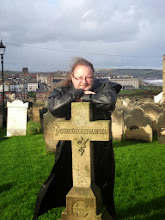
It’s with great pleasure that I welcome Dan Klefstad and Eva Vertrice to the blog. I met them individually through reviewing their books, A Fury by Eva and Fiona’s Guardians by Dan. But as well as authors, Dan and Eva are co-hosts of Vamp Chat with Dan & Eva and they have been as good as to invite me on the podcast not once but twice. Without further ado, here’s their blog.
When you hear the word “vampire” you might envision centuries-old revenants from Romania or other eastern European countries. They might have a Slavic accent similar to Béla Lugosi or perhaps Count von Count of Sesame Street. They might wear a long black cape and have a gentlemanly air about them. But what if this perception was changing? What if modern vampires had an origin story more Celtic than Slavic?
In recent years pop culture brought us Angel, the title character in the Buffy the Vampire Slayer spinoff which ran from 1999-2004. In 2016, AMC adapted the comic book series Preacher that casted Joseph Gilgun as the vampire Cassidy, best friend of the main character, a pastor with a criminal history. From 2011-2014, the vampire Aidan Waite roomed with a ghost and werewolf in the BBC series Being Human. And then there’s Remmick, the banjo picking, jig dancing vampire from the film Sinners, played brilliantly by Jack O’Connell.
What do these vampires have in common? They all hailed from The Emerald Isle.

But Ireland is not a new hotspot for vampires. In fact, it has a rich history of undead lore.
The 1870 book, The Origins and History of Irish Names and Places, by Patrick Weston Joyce, introduced 19th Century readers to Abhartach, a chieftain Joyce describes as a “dwarf” who lived in Londonderry:
This dwarf was a magician, and a dreadful tyrant, and after having perpetrated great cruelties on the people he was at last vanquished and slain by a neighbouring chieftain; some say by Fionn Mac Cumhail.
They buried Abhartach in a standing position, but the next day he returned to his haunt. The chieftain who slew him the first time, did so again and buried him as before. Abhartach again rose and terror spread throughout the county. Joyce continues:
The chief then consulted a druid, and according to his directions, he slew the dwarf a third time, and buried him in the same place, with his head downwards; which subdued his magical power, so that he never again appeared on earth. The laght raised over the dwarf is still there, and you may hear the legend with much detail from the natives of the place, one of whom told it to me.
Some modern versions have Abhartach rise from his grave to drink the blood of his subjects {Ed – Abhartach is at the centre of the Irish film the Boys From County Hell}. In Bob Curran’s book, Was Dracula an Irishman?, the chieftain who slays the revenant consults an early Christian saint instead of a druid, and is told that Abhartach is one of the neamh-mairbh, or walking dead, and that he can only be killed with a sword made of yew wood. Then he must be buried upside down with thorns surrounding his grave and a large stone placed on top.
The Dearg Due is another vampiric entity in Irish folklore. Pronounced DAH-ruhg DU-ah, it means “red bloodsucker,” and refers to a female demon that seduces men and drinks their blood.
According to this legend, a beautiful young woman fell in love with a local peasant, which was unacceptable to her father. A greedy man, her father forced her to marry a rich chieftain who imprisoned her and treated her terribly. The only path out of such abuse, she reasoned, was death, so she killed herself and was buried near Strongbow’s Tree in Waterford. On the anniversary of her death, she rose from her grave to seek revenge. She attacked her evil husband first, then her father, sinking her teeth into their necks and draining them dry. Now with an unquenchable thirst for human blood, she continued to prey on young men, enchanting them with her beauty, and luring them to her grave, sparing none.
Dracula author Bram Stoker, an Irishman, would’ve been familiar with these tales. So why did he decide to take his story down a different path instead of relying on this known local lore? Instead, he set much of his story in Transylvania, a place he had never visited. He leaned heavily on Emily Gerard’s 1885 essay, “Transylvanian Superstitions” and its expanded book form, The Land Beyond the Forest to introduce us to Vlad Dracula, aka Vlad III or Vlad Tepes which means “Vlad the Impaler.” Stoker was intrigued with the name “Dracula” which meant “son of Dracul” but also translated to “devil.” Blend these two, “Son of the Devil,” and you have the perfect name for a monster.
Still, there’s no evidence that Stoker based his character on the Wallachian warlord. In her essay, “Filing for Divorce: Count Dracula vs Vlad Tepes,” Professor Elizabeth Miller points out that Stoker’s research notes for Dracula fail to indicate that he had detailed biographical knowledge of Vlad III. Miller adds there’s no current evidence that Stoker had knowledge of Vlad III’s reputation for cruelty, his use of impalement as a punishment, or even his full name. This absence of a direct connection between Count Dracula and Vlad III makes it easier to conclude that the world’s most famous vampire may be more Irish than we thought.
Perhaps Bram Stoker did draw on his Irish roots a bit more than originally believed, and that Count Dracula hailed from a lush, green glade, surrounded by fairies & leprechauns with pots of gold.
Dan Klefstad & Eva Vertrice

Dan & Eva will moderate a panel discussion titled, “Has Ireland become the New Transylvania?” This will take place at The Imaginarium Convention, July 17-19, 2026, at the Holiday Inn Louisville East in Kentucky. They are excited to welcome Dacre Stoker, great grand-nephew of Bram Stoker, to the panel along with several other authors and vampire creatives. For more information visit entertheimaginarium.com or vampchatwithdanandeva.com or reach out to Dan & Eva at vampchatwithdanandeva@gmail.com. It’s going to be an exciting discussion.