Showing posts with label fae. Show all posts
Thursday, October 13, 2022
Blood & Sand: The First Book of Rue – review
Author: Aisling Wilder
First Published: 2020
Contains spoilers
The Blurb: Ancient vampire Rue keeps to herself. It makes it easier to fight the constant hunger that plagues her. That is, until the night she catches Grace-a not very good vampire hunter-stalking her through the streets of Dublin. Something about Grace is achingly familiar. And strangely irresistible.
Rue soon learns that Grace is herself being hunted, and is thrown into a battle she never wanted, to save a woman who wants her dead. As Rue unravels the horrifying and treacherous plot, she also uncovers a secret about Grace that could change everything. Along the way, Rue finds herself drawn to the girl, and is forced to choose: Continue her solitary life of safety, or risk it all for love?
Through it all, Rue recalls her creation and formative nights in an ancient world far from the rainy streets of Dublin, a world where she learned to live, love, hunt and kill.
The review: This book by Aisling Wilder is a book of two halves, intertwined together, with one chapter set in modern Dublin followed by one in ancient Ur and then Babylon. Rue, the vampire, was Asharru, a temple priestess in Ur who is chosen by Lilitu (whose name, of course, is thought to have been linked to the later Lilith figure) and turned when the city is sacked. The book then follows her development as a vampire in ancient times and, through this thread, we discover the source of vampirism in this mythology, which is similar to that employed by Anne Rice in the Vampire Chronicles, though the story is unique to this volume and the vampires quite different to that older series.
In the modern day we follow Rue as she becomes entwined with Grace. Though primarily a story of vampires, demons and Nephilim in this volume, we do get an interaction with the fae and, through them, another form of vampirism in the shape of the drinking of dreams. We discover that whilst the more advanced fae can control their feeding, more primitive fae, like sprites, will go too far, drinking a person’s dreams dry and leaving them an “aimless shell”.
The setting of modern Dublin is well realised and gives an evocative setting – we also travel into the dimension the fae inhabit, with realities layered on top of each other. The modern story thread is urban fantasy in style and works nicely, contrasting well with the ancient thread. The characters are nicely drawn, with Rue shown as a vampire trying to eschew feeding on people and struggling with the bagged diet (when we meet her in modern days she has awakened after a black out period that saw her pouring her blood stock literally down the drain). Vampire blood is addictive and will make the mortal drinker slavishly devoted to the vampire, turning is much more involved than simply blood exchange and I liked the idea that damage to the individual whilst mortal will impact the turn – for instance a wound may spend eternity opening, healing and opening again, and mental health damage might cause the turned vampire to lose their mind. We also get information on Nephilim blood, that will allow a vampire to daywalk temporarily, causes much quicker healing but is addictive for the vampire. Blood generally will heal the vampire though more slowly than angelic blood, and the vampire can be damaged quite badly (a substantial fall is going to break bones, for instance), but the vampire cannot heal during daylight hours no matter the amount of blood they imbibe. So, despite her great age, Rue can be vulnerable to danger.
I enjoyed this – it was a well envisioned story, the past and present mapping well together not only in tone and plot reveal but in story impact, but mostly because Rue was a great character, not perfect, she had issues but was rounded well and came across all the better for that. 7.5 out of 10.
In Paperback @ Amazon US
In Paperback @ Amazon UK
Posted by
Taliesin_ttlg
at
8:51 AM
0
comments
Labels: dream drinking, fae, Lilith, lilitu, nephilim, vampire
Friday, September 03, 2021
Vamp or Not? The Village in the Woods
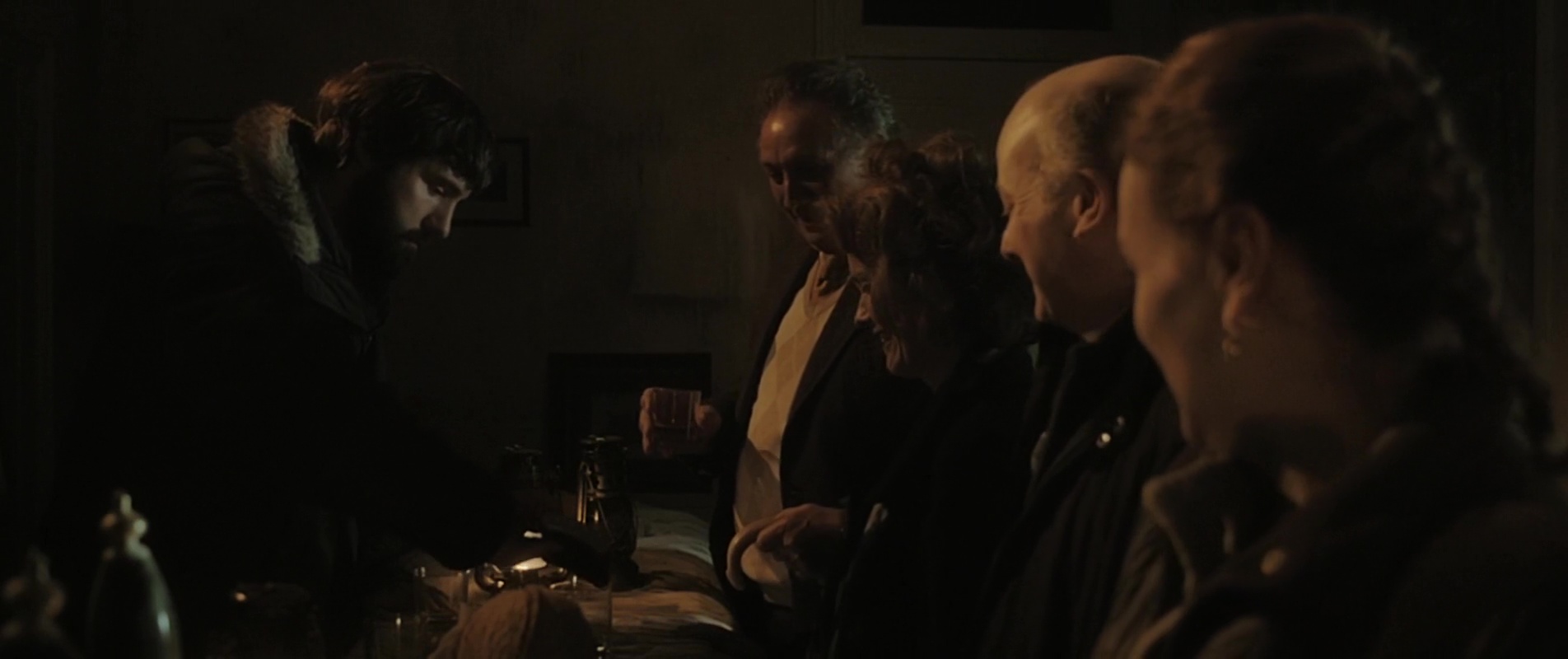
This is a British folk horror directed by Raine McCormack and released in 2019. It captures, really well, that sense of Uncanny with the protagonists kept off kilter by the familiar feeling distinctly unfamiliar, a sense of decay and the feeling that they have stepped into the past. It plays with the idea of faerie – in the mist shrouded village that defies escape. There are elements, like the little “corn” dolls, which might tie into a deeper lore, unexplored, but are window dressing for the folk horror fan also.
As you can guess, given this article, there was also something about this that tweaked the “vampire radar”. Not your traditional undead bloodsucker, to be fair, but there are vampire stories that touch into faerie and the inhabitants of that realm.
![]() |
| slept in the car |
After a moment where we see character Nikki (Beth Park) on a bed, outlandish lipstick on her face and fear in her eyes, the film proper starts with Jason (Robert Vernon) and Nikki driving and looking for the village Coopers Cross. They are in the woods and referring to, what appears to be, a hand drawn map. They drive past the sign for the village and then come across it again (this looping suggesting that they have already passed into a place they cannot leave) and then the car dies. Jason tries to get a phone signal, there isn’t one, and they are forced to sleep in the car. In the morning they walk down the road and reach the abandoned inn they were looking for almost immediately.
![]() |
| the inn |
Now the inn is interesting, the sign calling it the Harbour Inn, the sign has twin deer heads (not something normally associated with harbours) and, of course, harbours are a shoreside thing, not normally associated with the centre of woodland. But harbours are also a place on a borderland. They are greeted by passing local Maddy (Therese Bradley), who calls Nikki by Rebecca, which she responds to, and notices the “family ring” Nikki wears. She gets them petrol – but when Jason fills the car it still won’t start. So, what’s going on?
![]() |
| meeting the locals |
Nikki and Jason are down on their luck and have been talked into a scam where Nikki poses as Rebecca – long missing – and picks up the inheritance she won’t collect – the Harbour Inn. The inn is long abandoned and decrepit inside, and has an unwanted squatter in the flat, Arthur (Sidney Kean, Lifeforce) – but the idea is simply to sell it on. The ring Nikki is wearing was said to be one Rebecca would wear but, as the film progresses it causes a rash-like reaction and she can’t remove it. Most of the film is about atmosphere. It is at the end that we get the reason for the ‘Vamp or Not’ and beware massive spoilers.
![]() |
| the satyr |
The couple have been lured to the village and once there they cannot leave. There are four locals we primarily see – and one suspects that, along with the one who lured them, that is that. The ring marks Nikki and the locals claim lineage to a satyr (Phill Martin). Once every three hundred moons they are fertile and can plant their seed in a human. They do this to ensure their immortality. If the vessel (Nikki) can be impregnated and carry the baby (something that failed with Arthur’s deceased wife, as they were the previously lured couple) then, on the sixth hour of the sixth week from its birth, they will “drink its blood, consume its tender flesh and devour its heart”. Doing so will sustain them for 100 years, failing to do so sees them wither.
![]() |
| face morphed |
And that is it. Arthur is sacrificed to the satyr – they call it a demon at one point, which I disliked as it seems off that the descendants of the satyr would think of it in such Judeo-Christian terms. The sacrifice is given for fertility to be granted – Jason is clearly going to be trapped and treated the same way in the future. It is local Charles (Richard Hope) who will actually do the deed (though a dream sequence of the satyr shows it in action) and he takes on satyr facial features to do so – to me indicating that the association of not being human but descended from the satyr is accurate, rather than him being possessed by the satyr. There is a sepia picture in the bar of a man who “looks like” Charles and holds twins proudly, suggesting he is the primary impregnator.
![]() |
| inn sign |
And it all comes down to being immortal so long as they devour an infant every so often. It has to be a human infant conceived using their seed and the fact that they have to devour it early after birth (clearly the sixth hour of the sixth day is meant to bring the Judeo-Christian 666 into the viewer's mind) is reminiscent of the rules in The Guardian. This was great fun, piles of atmosphere and off-kilter in all the right places. It also felt quintessentially British. It really didn’t need those couple of Christianity nodding moments as it works as a pure fae inspired piece. And for me, I think we can say “Vamp”.
The imdb page is here.
On DVD @ Amazon US
On DVD @ Amazon UK
Posted by
Taliesin_ttlg
at
8:39 AM
0
comments
Thursday, November 26, 2020
Dead Man Tells His Own Tale – review
Director: Fabián Forte
Release date: 2016
Contains spoilers
Release date: 2016
Contains spoilers
If it looks like a vampire, and it acts like a vampire, is it a vampire? In this case I’ll say yes even though the film makes a distinction between the creatures and vampires (but also has the attempted use of stakes as they act just like vampires). In this case the creatures are actually Baobhan Sith (also termed in film as bloodsucking fairies from Scottish Mythology and ‘the White Women of the Scottish Highlands’), which feels a somewhat weird choice for an Argentinean film.
Some choice descriptors from Bane suggests they are, “a type of REVENANT vampiric fay…” that will “lure young men, particularly shepherds who are up in the highlands, to a secluded place and offer to dance with them... …until the man is exhausted, then it will attack, draining him of his blood.” They can shift into the form of a crow.
So, in this we see a body in the morgue. The narration we hear is from the dead man who says he is Angel Barrios (Diego Gentile), when we see his neck it is clearly messed up. After the credits we go back in time and see a little girl, Antonella (Fiorela Duranda), who runs upstairs as we see a shuffling, groaning figure come towards the house. She hides in a closet. The figure paints black under his eyes and ‘gets’ her – It is Angel and Antonella is his daughter. His wife, Lucila (Mariana Anghileri), is working and so he bathes and feeds Antonella. It seems like marital bliss.
However, when they talk later, we hear her talking about fulfilling his fantasies by him pointing out a woman and her seducing her – and his negative reaction fuelled by the idea that it might lead to a tryst with another man and his jealousy. He is an advert director and gets a call from his business partner Eddie (Damián Dreizik). Eddie has lined up a casting couch for him but, with Lucila in the room he responds about editing and makes an excuse to go out. It turns out that Angel is a serial cheater.
The film builds this world of casting couches and misogyny and then we see Eddie sneak an amulet into Angel's jacket. Almost straight afterwards his car breaks down outside a bar. Inside is a beautiful woman, so he goes in and tries to seduce her. The bar is playing the rushes of his advert (which shouldn't be public), the women in the bar whispering Macha (as in the Irish Goddess). He awakens still sat in the car and the bar is shut. At home he finds the amulet in his pocket. He wakes in bed to see a crow perched on the bedstead and goes downstairs… the amulet is glowing green…
Suddenly he is in a therapist’s office (who is the woman from the bar). She tells him that he has been hypnotised and that he should tell her about the dream. He sees two women flanking her but she says that he is hallucinating them and they can’t hurt him. He says he is scared of their fangs and, as they come close, they rip at his neck with talons and start to feed. The therapist puts out her hand and it has his blood on it and her long tongue flicks out and licks it. The next morning his body is found in a ditch by police and taken to the morgue as a John Doe – where he awakens.
So, he is dead but not dead, as is Eddie. He can no longer use misogynistic language and Eddie says they get in your head – indeed they will put the enslaved men into trances and draw them to a place to dig a giant hole (to free the goddess). He can’t stomach cooked food any longer (though he can eat raw meat and drink blood) and sunlight is painfully bright. But he, and the other men he meets, are rather zombie like. They decide to try and use stakes against the Baobhan Sith, tipped with iron presumably due to their fae nature – though a suicidal man (zombie) tries one on himself and it fails to kill him. The Fae are looking to resurrect the goddess and bring about a worldwide matriarchy.
This was great fun. It felt a little like Witching and Bitching (2013) in tone – though the story was different. The anti-misogynistic aspect was perhaps a tad lost by the fact that the fae are portrayed as monsters and the men/zombies as victims – and the fact that Angel was drawn to be likable despite the fact that he was a serial cheat and exploitative. The vampire fae looked good but were, I would say, under-used in the film. Nevertheless, worth a look. 6 out of 10.
The imdb page is here.
![]() |
| fangs |
Some choice descriptors from Bane suggests they are, “a type of REVENANT vampiric fay…” that will “lure young men, particularly shepherds who are up in the highlands, to a secluded place and offer to dance with them... …until the man is exhausted, then it will attack, draining him of his blood.” They can shift into the form of a crow.
![]() |
| in the morgue |
So, in this we see a body in the morgue. The narration we hear is from the dead man who says he is Angel Barrios (Diego Gentile), when we see his neck it is clearly messed up. After the credits we go back in time and see a little girl, Antonella (Fiorela Duranda), who runs upstairs as we see a shuffling, groaning figure come towards the house. She hides in a closet. The figure paints black under his eyes and ‘gets’ her – It is Angel and Antonella is his daughter. His wife, Lucila (Mariana Anghileri), is working and so he bathes and feeds Antonella. It seems like marital bliss.
![]() |
| Damián Dreizik as Eddie |
However, when they talk later, we hear her talking about fulfilling his fantasies by him pointing out a woman and her seducing her – and his negative reaction fuelled by the idea that it might lead to a tryst with another man and his jealousy. He is an advert director and gets a call from his business partner Eddie (Damián Dreizik). Eddie has lined up a casting couch for him but, with Lucila in the room he responds about editing and makes an excuse to go out. It turns out that Angel is a serial cheater.
![]() |
| woman in the bar |
The film builds this world of casting couches and misogyny and then we see Eddie sneak an amulet into Angel's jacket. Almost straight afterwards his car breaks down outside a bar. Inside is a beautiful woman, so he goes in and tries to seduce her. The bar is playing the rushes of his advert (which shouldn't be public), the women in the bar whispering Macha (as in the Irish Goddess). He awakens still sat in the car and the bar is shut. At home he finds the amulet in his pocket. He wakes in bed to see a crow perched on the bedstead and goes downstairs… the amulet is glowing green…
![]() |
| feeding |
Suddenly he is in a therapist’s office (who is the woman from the bar). She tells him that he has been hypnotised and that he should tell her about the dream. He sees two women flanking her but she says that he is hallucinating them and they can’t hurt him. He says he is scared of their fangs and, as they come close, they rip at his neck with talons and start to feed. The therapist puts out her hand and it has his blood on it and her long tongue flicks out and licks it. The next morning his body is found in a ditch by police and taken to the morgue as a John Doe – where he awakens.
![]() |
| zombie-like men |
So, he is dead but not dead, as is Eddie. He can no longer use misogynistic language and Eddie says they get in your head – indeed they will put the enslaved men into trances and draw them to a place to dig a giant hole (to free the goddess). He can’t stomach cooked food any longer (though he can eat raw meat and drink blood) and sunlight is painfully bright. But he, and the other men he meets, are rather zombie like. They decide to try and use stakes against the Baobhan Sith, tipped with iron presumably due to their fae nature – though a suicidal man (zombie) tries one on himself and it fails to kill him. The Fae are looking to resurrect the goddess and bring about a worldwide matriarchy.
![]() |
| tongue |
This was great fun. It felt a little like Witching and Bitching (2013) in tone – though the story was different. The anti-misogynistic aspect was perhaps a tad lost by the fact that the fae are portrayed as monsters and the men/zombies as victims – and the fact that Angel was drawn to be likable despite the fact that he was a serial cheat and exploitative. The vampire fae looked good but were, I would say, under-used in the film. Nevertheless, worth a look. 6 out of 10.
The imdb page is here.
Posted by
Taliesin_ttlg
at
11:19 AM
0
comments
Labels: Baobhan Sith, fae, use of tropes, vampire, White Women of the Scottish Highlands, zombie
Tuesday, November 24, 2020
Vamp or Not? I Am Not a Serial Killer
This was a film that had been on my radar and then I lost sight of, that is until Simon Bacon contacted me and asked if I had seen it. He suggested that there might be a vampiric element to this.
Directed by Billy O'Brien, and released in 2016, the film is an Irish/US production, set in the US and clearly on a budget. It is based on a young adult novel by Dan Wells (which I haven’t read) and does some really interesting things during its running length.
Things start on a street; in the distance we can see an ambulance and a cop who walks towards his car (and therefore towards the camera). Once in we hear him say that he has never seen anything like it. In the distance we see a body, covered and on a gurney, being taken to the ambulance. Guts fall off the gurney and onto the floor. The crowd disperses and we see a young lad, John Wayne Cleaver (Max Records), approach the taped off alley on his bike. A passing cop asks for his prognosis and he replies that the victim is dead for sure.
He rides his bike back to the funeral parlour his family runs and helps his mother (Laura Fraser) and Aunty (Christina Baldwin) prepare a body. When asked if he has made friends in a new school year his response is sarcastic. So let’s look at John a second. Obsessed with serial killers, he is under the care of a therapist (Karl Geary, Nadja) who takes him bird spotting (and tells John’s mother way too much I felt – though I admit I don’t know what the rules would be for confidentiality around a minor).
John recognises that he fits the McDonald Triad – the triad of sociopathy that, should there be two or more traits present, is said to be a predictor of later violent tendencies. John knows he is a sociopath, knows he could develop into a serial killer and has a set of rules to try and avoid the tendencies. For instance, if someone says something that makes him want to hurt them (something that happens as he is bullied) his rule is to smile and say something nice – actor Max Record doing a fine line in fake smiles with a dangerous edge. He also misses emotional clues – such as the interest fellow pupil Brooke (Lucy Lawton) offers him.
So, John shows an interest in the grisly murder – finding a strange oil at the scene and discovering that a kidney was missing. As more murders are committed, with the same oil and other missing organs, John soon discovers the killer’s identity – this is not so much a spoiler as it occurs fairly early into the film. Suspecting the wrong guy, he follows as his suspect goes ice fishing with kindly neighbour Mr Crowley (Christopher Lloyd, The Haunting Hour: Grampires & House of Monsters). What he witnesses causes him to wet himself – Crowley's arm converts into something branch like, he kills the man, rips the victim’s lungs out and then his own and replaces them. His discarded organs dissolve into the black oil.
The film then has John trying to prevent Crowley from murdering others – though given his sociopathic nature one might wonder why – whilst trying to keep his own rules in check. So, what is Crowley. I suspect some kind of fae (Wikipedia suggests that the novel calls him a demon). As Crowley’s limbs/organs fail he is stealing new ones – having stayed in one place due to love. At the end we see him vacate the Crowley body (which the film implies he stole in one whole go) but as he needs to replace failing parts one might suggest that the creature form needs the outer human body (and its organs) working to survive.
The stealing of parts to maintain life could be argued to have a vampiric aspect. He isn’t consuming them, of course, literally stealing them instead. Presumably, if he took a whole body – as we can assume he did with his current form, originally – that he can literally become younger (on the outside). It was also telling, at the end (and this is a spoiler), that his chest is stabbed (by a mortician’s suction tube) and this is almost analogous to staking. His ichor like blood is then drained out of him and his fae body (and the Crowley outer body) rapidly decay into the oil-like substance.
So, 'vamp?' – it depends, I guess, on how liberal you want to be with the description but what is certain that the film (knowingly or otherwise) played with certain genre tropes. The other thing to mention was that I found this really entertaining. Lloyd is as great as always but it was Max Record who really shone – making us care for a kid who absolutely lacked empathy and was haunted by his own demons, including an absentee father and family strife (his mother and sister (Anna Sundberg) at loggerheads) beyond his fear of himself. It was low budget but it played with character rather than gore/sfx.
The imdb page is here.
On Demand @ Amazon US
On Demand @ Amazon UK
Directed by Billy O'Brien, and released in 2016, the film is an Irish/US production, set in the US and clearly on a budget. It is based on a young adult novel by Dan Wells (which I haven’t read) and does some really interesting things during its running length.
![]() |
| John on his bike |
Things start on a street; in the distance we can see an ambulance and a cop who walks towards his car (and therefore towards the camera). Once in we hear him say that he has never seen anything like it. In the distance we see a body, covered and on a gurney, being taken to the ambulance. Guts fall off the gurney and onto the floor. The crowd disperses and we see a young lad, John Wayne Cleaver (Max Records), approach the taped off alley on his bike. A passing cop asks for his prognosis and he replies that the victim is dead for sure.
![]() |
| helping in the Mortuary |
He rides his bike back to the funeral parlour his family runs and helps his mother (Laura Fraser) and Aunty (Christina Baldwin) prepare a body. When asked if he has made friends in a new school year his response is sarcastic. So let’s look at John a second. Obsessed with serial killers, he is under the care of a therapist (Karl Geary, Nadja) who takes him bird spotting (and tells John’s mother way too much I felt – though I admit I don’t know what the rules would be for confidentiality around a minor).
![]() |
| smile |
John recognises that he fits the McDonald Triad – the triad of sociopathy that, should there be two or more traits present, is said to be a predictor of later violent tendencies. John knows he is a sociopath, knows he could develop into a serial killer and has a set of rules to try and avoid the tendencies. For instance, if someone says something that makes him want to hurt them (something that happens as he is bullied) his rule is to smile and say something nice – actor Max Record doing a fine line in fake smiles with a dangerous edge. He also misses emotional clues – such as the interest fellow pupil Brooke (Lucy Lawton) offers him.
![]() |
| attack |
So, John shows an interest in the grisly murder – finding a strange oil at the scene and discovering that a kidney was missing. As more murders are committed, with the same oil and other missing organs, John soon discovers the killer’s identity – this is not so much a spoiler as it occurs fairly early into the film. Suspecting the wrong guy, he follows as his suspect goes ice fishing with kindly neighbour Mr Crowley (Christopher Lloyd, The Haunting Hour: Grampires & House of Monsters). What he witnesses causes him to wet himself – Crowley's arm converts into something branch like, he kills the man, rips the victim’s lungs out and then his own and replaces them. His discarded organs dissolve into the black oil.
![]() |
| full form |
The film then has John trying to prevent Crowley from murdering others – though given his sociopathic nature one might wonder why – whilst trying to keep his own rules in check. So, what is Crowley. I suspect some kind of fae (Wikipedia suggests that the novel calls him a demon). As Crowley’s limbs/organs fail he is stealing new ones – having stayed in one place due to love. At the end we see him vacate the Crowley body (which the film implies he stole in one whole go) but as he needs to replace failing parts one might suggest that the creature form needs the outer human body (and its organs) working to survive.
![]() |
| John and his mom |
The stealing of parts to maintain life could be argued to have a vampiric aspect. He isn’t consuming them, of course, literally stealing them instead. Presumably, if he took a whole body – as we can assume he did with his current form, originally – that he can literally become younger (on the outside). It was also telling, at the end (and this is a spoiler), that his chest is stabbed (by a mortician’s suction tube) and this is almost analogous to staking. His ichor like blood is then drained out of him and his fae body (and the Crowley outer body) rapidly decay into the oil-like substance.
![]() |
| Max Record as John |
So, 'vamp?' – it depends, I guess, on how liberal you want to be with the description but what is certain that the film (knowingly or otherwise) played with certain genre tropes. The other thing to mention was that I found this really entertaining. Lloyd is as great as always but it was Max Record who really shone – making us care for a kid who absolutely lacked empathy and was haunted by his own demons, including an absentee father and family strife (his mother and sister (Anna Sundberg) at loggerheads) beyond his fear of himself. It was low budget but it played with character rather than gore/sfx.
The imdb page is here.
On Demand @ Amazon US
On Demand @ Amazon UK
Posted by
Taliesin_ttlg
at
8:26 AM
0
comments
Labels: fae, serial killer, use of tropes, vampire
Subscribe to:
Posts (Atom)