Showing posts with label cat vampire. Show all posts

Sunday, February 15, 2026

Short Film: Gothic Tales of Terror


It seems strange to put an anthology film down as a short but this comes in at just over 37-minutes. It is a series of shorts by Tony Laudati and was released in this format in 2025. We have looked at the short Dracula’s Daughter by Laudati previously and it makes up the first segment of this. The anthology has a sequel to that later as well as a werewolf and a Frankenstein’s monster facing piece. There is also a piece that is made up of stills of three women in cat woman makeup/costumes (as per the film poster with this article) that is worth mentioning as you could read them as cat vampires.

seduction

You can read my write up on Dracula’s Daughter but it was essentially a reimagining of the scene from the Universal feature where a young woman is convinced to pose for cash for the artist who also happens to be a vampire. Dracula’s Daughter 2 sees Lili (now played by Rosa Singerman), the victim in the first part, return to the apartment owned by Countess Marya Zaleska (Ausma Fiame) having picked up a young woman, Chloe (Brooke Gorman), at a club. There is conversation, flirtation and an admission that she and the Countess live together but the Countess is away.

Ausma Fiame as the Countess

The film uses the same focus on bringing a glass of wine and the vampire, for that is all Lili could be, not partaking of it before she gets Chloe to lie on the couch and seduction turns into attack. As she bites the Countess returns early and pulls Lili from her victim, allowing the woman to flee. The Countess does not allow drinking from the living (she has plenty of plasma available) but Lili is quick to point out that she certainly didn’t follow that rule with her. How this is resolved and what happens to Chloe – well you can watch the short to find out – at the time of writing it is available on Fawesome.

The imdb page is here.

Thursday, May 22, 2025

Scooby-Doo: Return to Zombie Island – review


Directors: Cecilia Aranovich & Ethan Spaulding

Release date: 2019

Contains spoilers

Scooby-Doo On Zombie Island was a bit of a gem for being a well animated, acted and scripted piece and also for being one of the Scooby-Doo properties where the monsters are real. The vampires were cat people who drained lifeforce from their victims to maintain the longevity of life and the zombies (and ghosts) were the victims of the cat people (and were trying to warn the gang).

a bat

The first thing to note with this sequel is that the filmmakers tried to retrofit this and betrayed the integrity of the first film. The main ways they did this was firstly by having the gang be high school kids who have been warned off mysteries by the sheriff (David Herman). In the previous film they were portrayed as young adults with Daphne (Grey Griffin) having her own syndicated TV show. This is devolved down to it being a high school project.

cat people

The other retcon aspects include Velma (Kate Micucci) having a blog where she lists the mystery in the unsolved section as she is not happy that the answer was supernatural. Yes, they actually try to take away the supernatural element from the previous film and, despite the gang having their energy drained and seeing cat people disintegrate, the disappointing resolution is that Velma thinks it was swamp gas that made them think it all real… The film does leave a breadcrumb of, perhaps, a real monster.

vampire

Anyway, the opening sees them capturing a werewolf who turns out to be Young Man Withers (the son of the villain character Old Man Withers, from a Cartoon Network version of Scooby Doo and connected in with Wayne’s World and the Powerpuff Girls). They go out and capture a host of classic monsters, including a vampire/Dracula who does turn into a bat. They are all the Withers family members, but it all turns out to be a dream that turns nightmare for Fred (Frank Welker) and connected to him selling the Mystery Machine as they have quit mystery solving.

Cassandra Peterson voices Elvira

Shaggy (Matthew Lillard) and Scooby (also Frank Welker) make the gang swear a solemn oath to resist mysteries and then watch their favourite horror host Elvira (Cassandra Peterson) and she announces a competition win for Shaggy, 3 friends and a pet to go on a tropical vacation. Despite the boat taking them down the Bayou and the palm trees on Moonstar (rather than Moonscar) island – which are soon revealed to be plastic trees – the gang steadfastly ignore what might be a mystery – that is until zombies appear.

Shaggy and Scooby

Unfortunately Fred catches them and reveals them to be hotel staff, who are really actors directed by Alan Smithee (John Michael Higgins, Blade Trinity). He is making a zombie feature, based loosely on Velma’s blog and tricked them there to star in it (found footage style) without telling them. Unfortunately, cat people start appearing, unconnected to Alan’s film and apparently with the ability to control ordinary cats. They aren’t, of course, real and are trying to scare people off whilst they search for the pirate Moonscar’s treasure. There is an unconnected cat person who may or may not be a real monster and is dangled to the viewer at the end with the gang ignoring it.

the gang and stunt double

And it is a no from me. The contrivances to wring out a sequel are awful, the retrofitting worse. Despite the animation being fine and the voice acting as good as one would expect, I just can’t let the film lie. I think 3 out of 10 is maybe harsh, but don’t actively spoil one of the best loved Scooby films. Of course the vampires in this are people acting as such.

The imdb page is here.

On Blu-Ray (with the better film) @ Amazon US

On DVD @ Amazon UK

Wednesday, April 23, 2025

The Cat Creature – review


Director: Curtis Harrington

Release date: 1973

Contains spoilers

A made for TV film, I wish I had seen this before submitting a chapter for a forthcoming book as it would have fit right in. It isn’t a bakeneko film, in that it isn’t based on the rough story that underlines that Japanese genre, but it is certainly one for the bakeneko fan. It does suffer for being quite 70s US police procedural but it has some fab ideas – and a devilishly queer subtext even though the studio made Harrington remove the references to lesbianism.

Kent Smith as Frank Lucas

It starts with a car approaching a mansion. It is night and when the driver, Frank Lucas (Kent Smith, the Night Stalker), enters the building he discovers the electric is off. He goes to an office and starts a recording. He is an appraiser brought to the Drake estate by the attorneys and is working at night to meet their deadlines. He just has the special collection to do. He goes there and it is all Egyptian artifacts.

the amulet

He makes a beeline for a sarcophagus and pries it open. There is a mummy inside and he notes the golden amulet she wears, with the likeness of a cat and emeralds for eyes. He puts the lid back on and seems to leave. Out of the shadows comes another man, Joe Sung (Keye Luke, Gremlins 2: The New Batch), who steals the amulet and sneaks off as Lucas returns. Lucas starts to record about the newest part of the collection (the sarcophagus) describing the amulet. He then notices that the sarcophagus is empty, there is the shadow of a cat and cat noises as he screams.

Gale Sondergaard as Hestor

We see Joe in the city, and he enters an occult establishment called the Sorcerer’s Shop. The proprietor, Hester Black (Gale Sondergaard) speaks to him as he tries to sell the amulet as a family heirloom. We discover later that she was a fence and she smells trouble and refuses him – he leaves with the amulet but leaves the briefcase. Hester’s assistant, Sherry (Renne Jarrett), comes through to get paid and she gives her the briefcase. The viewer sees a cat shadow at the window, the shrewder viewer will see a lesbian subtext to the conversation on the part of Hester, who suggests a meal with her assistant. It was after watching the film that I picked up, on IMDb, that the studio had ordered the removal of lesbian aspects from the character, but they certainly are still there in the inferences in the dialogue.
cat eye mojo

Sherry refuses the meal and the offer of a lift home. As she walks down an alley there is a noise but it is a cat knocking over a trash can. Sherry speaks to the animal and then picks it up as a stray she intends to feed. She gets to her apartment and gets the cat a saucer of milk and then notices blood in its fur. The cat stares at her and starts making growling noises. The girl, blank eyed, responds with nods and then walks in a trance to her balcony and throws herself off.

Meredith Baxter as Rena

A woman, Rena (Meredith Baxter), goes to the Sorcerer’s Shop and gets offered Sherry’s job. Meanwhile the police, in the guise of Lt. Marco (Stuart Whitman, Ghost Story: Concrete Captain) has the university send someone who knows about Egyptology to the Blake Estate. That is Prof Roger Edmonds (David Hedison) and he notes that the sarcophagus was for a worshipper of Bast. Marco takes him round pawnshops, looking for the amulet, and they end up in the Sorcerer’s Shop speaking to Rena. Hester comes through and Marco knows her as a fence. When she protests that she has gone straight he responds “Straight eh? .Why you could sleep on a corkscrew.” The double meaning is strong with this one.
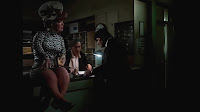
John Carradine as the clerk

So, the police manage to track down Joe at a flophouse (run by John Carradine) but are too late, hearing his screams and then finding him dead. So far we have a missing mummy and a cat (apparently) killing people. However, the coroner (Milton Parsons) says the bodies have been drained of blood and this leads to a determination that the worship of Bast was outlawed because the priesthood were committing blood sacrifices to gain everlasting life and could turn into cats. The police, of course, don’t believe that. As for Roger, well he’s falling for Rena (which leads to Hester being sharp with him, as she asks her new assistant out for a meal also).

Egyptian garb

I now need to totally spoil the ending as the lore round this is ahead of its time. Rena is the priestess of Bast and the amulet was to keep her trapped in the sarcophagus. Once removed she has returned to life, she is feeding on blood and trying to find the amulet so that she can’t be trapped again. She seems scarred of cats, and they get agitated when she is near. They also gather near where she is staying. When the amulet is put back on her she suddenly is wearing Egyptian garb and then turns back in to a mummy. Stumbling outside, the cats attack her and reduce her to dust. All this pre-empts the similar lore in Sleepwalkers, and though they turned into cat creatures, rather than cats, and were energy drinkers one can’t help wonder if this had an influence on that story?

cats attack the mummy

As I mentioned at the head of the review, there is something very 70s police procedural about this that does mar a really interesting film. It feels episodic almost and it’s a shame as the performances are solid enough, Carradine has a 2-minuite appearance that is a joy, and they could have got a really (American) Gothic flick out of this. But if you are a bakeneko fan (as this is at least adjacent), a cat vampirism fan or want an interesting take on the mummy genre it is worth tracking down. 5 out of 10.

The imdb page is here.

Monday, March 24, 2025

Hungerstone – review


Author: Kat Dunn

Release date: 2025

Contains spoilers

The Blurb: FOR WHAT DO YOU HUNGER . . . ?

Lenore is the wife of steel magnate Henry, but ten years into their marriage the relationship has soured, and no child has arrived to fill the distance growing between them. Henry's ambitions take them from London to the Peak District, to the remote, imposing Nethershaw estate, where he plans to host a hunting party. Lenore must work to restore the crumbling house and ready it for Henry's guests - their future depends on it.

But as the couple travel through the bleak countryside, a shocking carriage accident brings the mysterious Carmilla into Lenore's life. Carmilla, who is weak and pale during the day but vibrant at night, Carmilla who stirs up something deep within Lenore. And before long, girls from the local villages fall sick, consumed by a terrible hunger . . .

As the day of the hunt draws closer, Lenore begins to unravel, questioning the role she has been playing all these years. Torn between regaining her husband's affection and the cravings Carmilla has awakened, soon Lenore will uncover a darkness in her household that will place her at terrible risk . . .

Set against the violent wilderness of the Peaks and the uncontrolled appetite of the Industrial Revolution, HUNGERSTONE is a compulsive sapphic reworking of CARMILLA, the book that inspired DRACULA: a captivating story of appetite and desire.

The review: Whilst this is a retelling of Carmilla (and I note the blurb mentions it as a sapphic retelling, which forgets that the original – whilst not as direct or graphic as this – was a sapphic tale anyway), it is so subtle around the vampirism that a reader unfamiliar with the original novella or not deeply invested in the vampire megatext may well miss the fact that it is indeed a vampire novel.

And it has a couple of vampiric themes in it, not least that of capitalism as a vampire as the industrial revolution literarily bathes in the blood of the worker to extract the capital. But Carmilla is a vampire and the book connects vampirism with appetite (as well as hunger), which was interesting as Orlok in Eggers’ Nosferatu says “I am an appetite, nothing more.” I am not suggesting there was any read across between the two texts but it was a nice trope, used in both, where the vampire is drawn as having (and offering) a psychological desire to consume as well as a physiological need. Jumping ahead, we only see attacks on Lenore – with sleep paralysis, a (potentially imagined) cat form and, at one point, a blood soaked Carmilla at the end of the bed (mirroring a scene from Le Fanu) but we can read into at least three other women visited by Carmilla (the appetite), which unleashes a hunger that manifests as one eating hair, another eating a live chicken and a third eating flesh from her husband’s arm. The hungers awakened in Lenore are much more complex.

The book moves us from Styria to the Peak District for location (offering an immediately Gothic landscape to play upon), in 1888, but whilst Carmilla still enters their lives through a carriage crash, the reader does not see the crash, rather the aftermath as Lenore and Henry come across it on their journey to the Nethershaw estate. Indeed, the more graphic description of a carriage crash comes in flashback as Lenore recalls the crash that left her orphaned as a child. Lenore is, of course, very different from Laura in the novella – as well as the trauma from her childhood, she is married, sexually active (though she has not during ten years of marriage become pregnant), with Carmilla awakening her bisexuality, and whilst naïve in some respects she is wise in the way of society and etiquette. This brings in other dimensions that Le Fanu could not explore. Her marriage allows for an exploration of misogyny widder than the patriarchal exploration in the original novella.  

I did wonder whether the book was aimed at the YA audience but the themes it explores certainly do not seem to be. However, I very much enjoyed the book, found it a satisfying revisit to Carmilla through an interesting lens. I enjoyed the subtlety of the vampirism and overall think this deserves a strong 7.5 out of 10. I need to add a thank you to Gary who posted about this volume on Facebook, which brought it to my attention.

In Hardback @ Amazon US

In Hardback @ Amazon UK

Saturday, February 01, 2025

Immortal Gifts – review


Author: Katherine Villyard

Release date: 2025

Contains spoilers

The blurb: He lied about his identity. Two hundred years later, he’s still paying the price…

Prussia, 1841. Abraham only ever wanted to play violin. Hiding his Jewish status so he can study at the prestigious Berlin Academy of Music, the eager young man is delighted to find a patron who believes in him. But he’s mortified when his new friend turns him into a vampire… and Abraham earns the fury of an ancient antisemite who vows to see him permanently dead.

Fleeing the hate-mongering fiend across the decades, the sensitive violinist at last settles in twenty-first-century New Jersey with a mortal woman. But when he discovers his relentless tormentor has tracked him down yet again, Abraham despairs he’ll never find true happiness.

With everyone he’s ever loved at risk, can he escape the rage of a ruthless bigot?

In a complex tale woven through history, Katherine Villyard delivers a fresh and insightful twist on the vampire novel. Infusing the narrative with profound themes of love, betrayal, and the nature of monsters, she crafts an unforgettable saga of surviving prejudice that will keep readers turning pages deep into the night.

The review: Abraham is a Jewish vampire married to a wiccan mortal in this first-person narrative novel, which moves both through time periods and between narrators. Of course, one of the issues for a Jew turned is the fact that drinking blood is expressly forbidden in the Torah and one thing I did like about this was Abraham struggling, despite his long life, with reconciling his vampirism (and undead status – if he is indeed undead) with his faith. As a mortal he lied about his faith to get a place in the Berlin Academy of Music and gained a patron in the form of Ludwig – a vampire. When he contracted consumption Ludwig turned him, without permission, so that the world would not lose his gift. Unfortunately, Ludwig’s maker, Thomas, is fervently antisemitic who was a part of the Inquisition and later would become a Nazi (the evil of the Shoah is explored, with Thomas and Ludwig able to, at least, get some young relatives of Abraham to America) and later still a popularist right-wing rabble rouser in the USA.

Destiny, Abraham’s mortal wife is a veterinarian and vegetarian but does know about her husband’s condition – after all standard tropes such as sunlight hold true here. She has expressly stated she doesn’t want to turn. Abraham also seems to have some degree of impulse control – a lover of cats, he manages to end up with vampire pets as he can’t let them go. Of course, Thomas will enter their lives again.

I mentioned the sunlight trope and a vampire can also control those they turn. This gives Abraham some assurance with the vampire pets and the turning seems to have made them more intelligent also. There is an interesting meeting of science and vampire physiology when it comes to the ability to reproduce through IVF. There is a great bit around the gifts that vampirism bestows that I won’t spoil as it is integral to the climax.

The characters were given distinct voices, and, on occasion, the author would revisit scenes through another perception that worked well. The story paced well and the Jewish lens brought an interesting direction to the prose and narrative. I did enjoy this. 7.5 out of 10.

On Kindle @ Amazon US

On Kindle @ Amazon UK

Wednesday, January 01, 2025

Bakeneko: A Vengeful Spirit – review


Director: Yoshihiro Ishikawa

Release date: 1968

Contains spoilers

Coming out of the kabuki theatre tradition with a primary tale having been translated as the Vampire Cat of Nabéshima, I have found that the Japanese bakeneko (or ghost cat) films should have their ‘vampness’ determined on a case-by-case basis.

This film actually uses the word bakeneko in the title, uses some of the elements of Nabéshima in its plot and certainly could be said to be a film that uses genre tropes. However, after deliberation I decided that there is just about enough to class this as vamp – you may differ in opinion. I must also say that the version I watched is in the Severin boxset All the Haunts be Ours vol. 2 and the disc does carry some neat extras including a reading of the Vampire Cat of Nabéshima and a short film called Man-Eater Mountain that has a vampiric plant in it.

buried alive

At the start we discover that Naoshige Nabeshima (Ryôhei Uchida) has plotted against his Lord Takafusa Ryûzôji (Keiichirô Shimada) and usurps him. He arranges to have the ousted Lord buried alive in clay and the Lord’s concubine passes out at this. She is placed in a room and, when she awakens, her cat Tama is there and she takes the cat and leaves the palace, going to a lake that she walks into holding the cat and drowns.

concubine with cat

Ten years later during an annual festival to placate the cursed pond, Naoshige is on a barge and sees a young woman on the shore, Yukiji (Kyoko Mikage), who he immediately falls for – dismissing the fact that he has told his subjects that they should not indulge in lustful longings on the festival day as it could bring the curse on them. He decides she will be one of his concubines.

licking blood

The issue is that she is promised to Jônosuke Yûki (Kôtarô Satomi) and the pair love each other. This leads to her being forcibly kidnapped and him put under house arrest and then escaping. Before this happened the pair accidentally end up at the cursed lake and, after a scare with a pair of fireballs, she finds a soaked cat – that looks very much like Tama.

neck bite

The film plays out like a period drama in places, and also a samurai sword fighting film. The pair reunite (after he is offered a pardon if he forsakes her and then refuses to do so) and fight their way to the pond until both die in the waters. The cat appears and licks her blood up and then kills and assumes a concubine’s form in order to avenge Yukiji (and her previous owner). The drinking the blood is a familiar trope and later we do get at least two neck bites. The Nabeshima references sees the cat able to induce sleep and a courtier stabbing his leg in order to stay awake and defend his Lord.

the bakeneko

The film lacks the uncanny atmosphere of some of the bakeneko films, trading it in to lean more into the samurai/period drama aspect but that does not mean it is poor in any way, just a different experience but still a very solid film using the bakeneko. The neck bites are not overly conclusive of vampirism – they could just be efficient for damaging the enemy. However the film does contain tropes if you don’t care to read this as vampiric. For me, however, it was close enough and a solid 6 out of 10.

The imdb page is here.

Friday, September 20, 2024

Evil Cat – review


Director: Dennis Yu Wan-Kwong

Release date: 1987

Contains spoilers

My friend Leila identified this film with a suggestion it is “a bit of a hotchpotch fusing vampire lore, Bakeneko and ghost possession with a magic bow” All this, of course, made me want to watch the film.

What we get is some late eighties Hong Kong fare with a more serious edge than many – there is a dedicated comedy cop character, Inspector Handsome Wu (Wong Jing), and the film is certainly not divorced from humour, such as jokes about the laziness of the apprentice, but it did take itself a bit more seriously I felt.

evil escapes

It starts in a quarry, with a large industrial vehicle. Part of the earth it is manipulating releases a strange light when disturbed. The foreman is called over and there is a large rock with writing on it. The workmen shift it (as you do) revealing a massive shaft. Suddenly light explodes out of the shaft. Elsewhere, Master Cheung (Lau Kar-Leung), is snoozing at a community play when he wakes realising the evil has escaped. We discover later he is at end of life due to cancer.

fight flashback

He gets back to his room and uncovers a couple of cases. One contains a bow and three arrows. A flashback sees his father, a Taoist priest 50 years before, fighting a person possessed by a cat demon. He manages to catch the cat in a net and holds it whilst a young Cheung stabs through his father (at his command), skewering his heart and passing into the cat. The way to kill it (without the spirit immediately possessing another) is by stabbing through the heart (with a particular wood). The cat is thrown down the shaft – it is the 8th time it has been defeated by the Cheung family, it returns every 50 years and Master Cheung must kill it one last time.

dead guard

At an industrialist’s tower block the new security guard shift is getting to work. One is sent to investigate a rancid smell. The industrialist, Mr Fan (Stuart Ong), is in a bedroom area with his PA Tina (Hsu Shu-Yuen, Vampire’s Breakfast). As they clean up he calls through for his driver Long (Mark Cheng Ho-Nam) to pick him up. Meanwhile the security guard finds a body in a pile of refuse, which comes alive and attacks him. Tina is still getting ready by the time Fan goes downstairs. All the guards are dead (we see one with a neck wound) and the door locked. He is chased through the building.

Fan in cat mode

Long is driving back (with the woman he had been dating in the car) when a figure, Master Cheung, appears in the road causing him to hammer the breaks on. The road is empty when Long gets out to look, but Master Cheung has already got in the rear seats and asks for a lift to the city. After complaints from the woman, they tie her to a lamppost and drive off. There is some banter, with Master Cheung seeing something off in Long’s future and giving him a protective amulet. When they get to Fan’s tower the cops and reporters are there – anchor-woman Cheung Siu-Chuen (Joann Tang Lai-Ying) happens to be Master Cheung’s daughter. Fan has gone home already. Later however, after Fan attacks Long he ends up going to Master Cheung and becoming his apprentice as they try and stop the cat demon.

Long and the cat

The end make-up of the cat was great, and the vampirism came in too ways. The cat drinks blood to achieve immortality within a chosen host and we also see the cat clearly sucking out lifeforce like an energy vampire. The cat does possess bodies and we get the use of prayer scrolls as a protection from the cat and a way to render the wearer invisible. The three arrows are made of the wood that can destroy the cat as well as the host and there is a comment that they are the last three pieces of this type of wood (though not what the wood is called). The bow is also meant to be magic. This was a good watch. 6 out of 10.

The imdb page is here.

On DVD @ Amazon US

On DVD @ Amazon UK

Saturday, May 25, 2024

A Bloodthirsty Killer – review


Director: Yong-min Lee

Release date: 1965

Contains spoilers

Also known as A Devilish Homicide, this Korean film owed a lot – I thought – to the Japanese story The Vampire Cat of Nabéshima and those films that flowed from it. Whilst contemporary, the cat spirit and the possession (or replacement) of a household member seemed replicated in this.

It starts with Lee Shi-mak (Lee Ye-chun) arriving at a building that seems, as he enters, oddly deserted. An odd-looking man spies on him entering the building. There was meant to be an art exhibition inside, a security guard tells him the exhibition has finished. However, he finds one portrait. It looks like – he says – Ae-ja (Do Kum-bong). We discover later that she was his first wife, now deceased. As he holds the portrait the canvas seems to melt.

the portrait

He quickly leaves and gets a taxi driven by the strange man who was spying on him and is taken, against his will, to a house in the countryside. He enters but all the rooms are locked until he finds one open. He is approached by an artist, Park Joon-chul, who takes him inside and gives him the portrait and begs that he leaves. Unfortunately it turns midnight and the artist has him hide under the bed. He sees the feet of a woman and she stabs the artist and then floats out of the window. The dying artist tells him the portrait contains a secret and dies.

no reflection

Shi-mak fears that he will be blamed for the murder… on cue a person (the taxi driver) starts rattling the door. Shi-mal climbs out of the window, using tied together curtains, but the man comes in. Suddenly he finds himself trapped, on the side of a building, with a guard dog below and the angry man above. He drops, fights the dog and escapes with the portrait but then finds the body of Ae-ja and takes it to his doctor friend who is perplexed as he had registered her death years before. We see that, in a mirror, her corpse does not appear and her blood, when drawn, is watery. When Shi-mak exits the room, she animates and kills the doctor.

biting the children

He gets home and he and new wife Hye-sook are beset with strange occurrences. His eldest daughter is taken by Ae-ja, whose arm reaches through a window. The corporeal ghost attacks Shi-mak’s mother on her way home from temple, causing her to fall into a river and get drawn away but the mother than appears at their home. We see her compulsively licking the face of one of her sleeping grandchildren and later we see her suckling blood from the neck of one – giving us our vampiric moment.

reflecting as a cat

The woman is actually a cat spirit and when Shi-mak vanquishes her (having seen her true form in a mirror and being given a magic ball, actually the third eye from a Buddha statue, by a housekeeper who appears to be a guardian angel) she turns into cat form. The film stalls when it goes into the backstory for an extended period but tells a story of deceit and murder as it is revealed that Hye-sook was maid to the family (and Ae-ja’s cousin) and was jealous so conspired with Shi-mak’s mother to frame the wife for an affair and then murdered her – relying on help from the artist and doctor. The cat actually ate the flesh from her corpses’ bones.

paw for a hand

The cat does act vampirically and is the sort of cat spirit that does recur in some Japanese tales. The bad pacing aside (due to the third act being mostly backstory) this is quite good fun, with some lovely weirdness and a good atmosphere for the most part. There are some good moments in here and it is particularly recommended to fans of Japanese spirit cat movies who want to see what the Koreans could do with the idea. However, the overall film is probably worth 5 out of 10.

The imdb page is here.

On DVD @ Amazon UK

Friday, June 02, 2023

Use of Tropes: Black Cat Mansion


Vampiric cats and ghost cats are a staple part of Japanese horror, reaching back to folklore and the yōkai bakeneko, or changed cat, we can also cite stories such as The Vampire Cat of Nabéshima. In cinema there are films such as Hiroku kaibyô-den and the remarkable Kuroneko.

This 1958 movie by Nobuo Nakagawa (who would go on to direct Onna kyûketsuki, released the following year) has a nested storyline with black and white scenes for the present and near past and colour for the distant past and the story would seem to take some of its story inspiration from The Vampire Cat of Nabéshima. It is told in the first place by Dr. Tetsuichiro Kuzumi (Toshio Hosokawa), who is in a darkened hospital due to a power outage. He recalls an odd tale, regarding his wife, Yoriko (Yuriko Ejima). He had moved her out of Tokyo for respite care due to her tuberculosis, into an old mansion her brother had secured for her.

strangulation

The place started being visited by an old lady, who seemed to appear and disappear and who upset their dog whenever she was present. As things go on, she attacks Yoriko twice – by strangulation. Now that doesn’t seem overly vampiric but, of course, Slavic vampires were as likely to strangle their victims as they were to suck their blood. Yoriko has dreamt of cats biting her. Tetsuichiro is taken to a temple, where a monk recalls the story of how the mansion is said to have become haunted – the scenes of this part of the film are in colour.

lapping blood

This has a story of a dishonourable Samurai named Shogen (Takashi Wada) who murders a young Samurai, Kokingo (Ryūzaburō Nakamura), after he accuses the older man of cheating at a game of Go, hides the body and tells Kokingo’s blind mother, Lady Miyaji (Fumiko Miyata), that her son has gone to the city to get further tutelage in the game. Kokingo’s spirit, however, tells her the truth and Shogen then rapes her. She curses him, through a cat, and kills herself. The cat laps her blood and is the embodiment of the curse against Shogen and his lineage. The cat takes on the form of Shogen’s mother (Fujie Satsuki), whom it has murdered and also becomes an anthropomorphic cat often.

cat ears

The cat doesn’t do much that we would class as vampiric, the blood drinking solely at the point when Lady Miyaji’s blood is licked up. However, that does mean there is some blood drinking and the story feels like The Vampire Cat of Nabéshima, in as much as the cat takes the form of a person it has killed, though in this case it is to hide and murder, rather than steal life’s blood – although it kills a maid by biting the neck. It is around these points that we get the primary trope usage and it is certainly of genre interest, along with the throttling of victims and the connection of the modern victim suffering from tuberculosis worth mentioning.

The imdb page is here.

Sunday, June 05, 2022

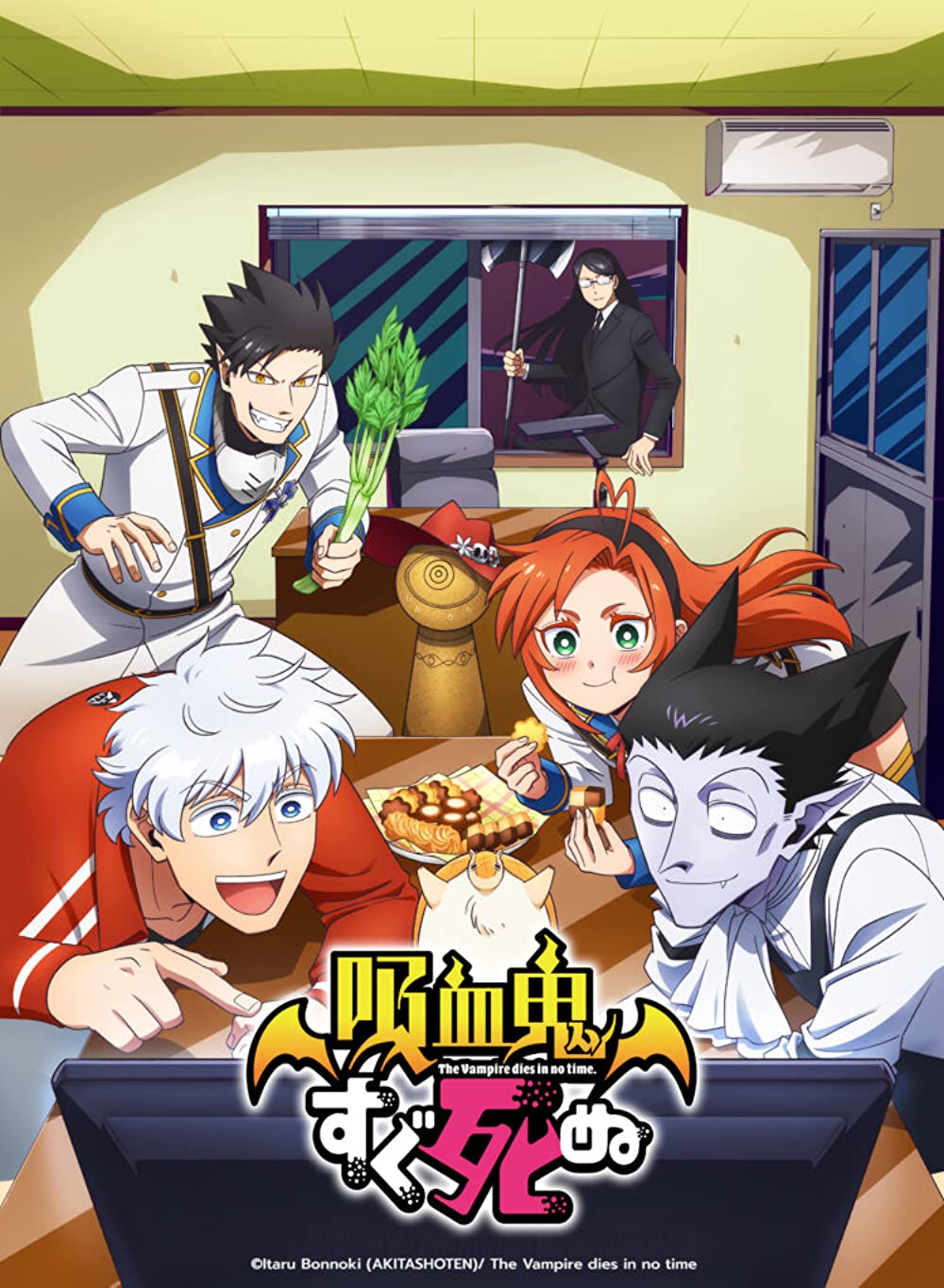
The Vampire Dies in No Time: Season 1 – review


Director: Various

First Aired: 2021

Contains spoilers

The Vampire Dies in No Time is an anime based on a manga, and my thanks to Leila for pointing it out. It is a case of the (English) title being literally what happens in the show and it is a comedy, following the general anime/manga comedic strictures. If you generally find comedic anime amusing then you will genuinely find this so. I watched the dubbed version, due to the platform I caught it on, but the English voice acting is actually rather good. Due to this I will put the names of the English voice talent into the review.

Although there are frequently recurring characters (alongside the main characters) it is episodic without an overall arc, indeed each episode can be broken down into (up to) three short vignettes.

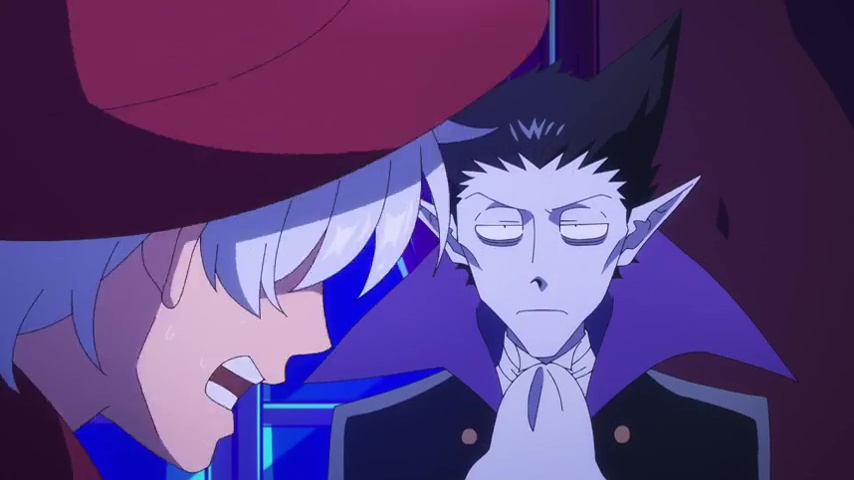
Ronaldo and Draluc

In the first episode the vampire hunter Ronaldo (Ian Sinclair) is called to a castle where the nearby townsfolk believe the vampire within, the invincible superior vampire Draluc (Frank Todaro), has kidnapped a young boy. Ronaldo takes on the job but, once he is inside and faces Draluc, the vampire almost immediately dusts. He then reconstitutes himself – this is the key to the title as Draluc will dust at the slightest thing - being hit, sunlight, a loud noise, a shock, harsh words etc. It then turns out that the boy has been sneaking in to play Draluc’s video games when he sleeps through the day and lost track of time.

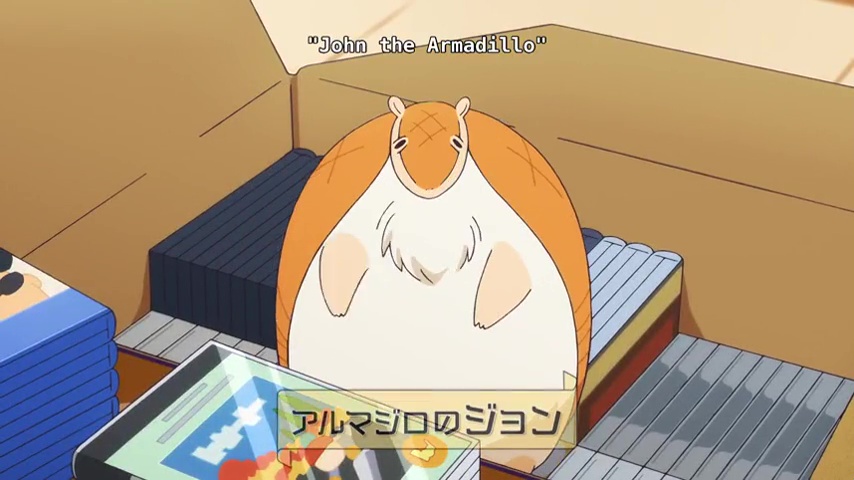
John

A sequence of events in the castle leads to it being destroyed. When Ronaldo gets back to his office, he finds Draluc there, who has decided to move in as Ronaldo’s roommate. He has also brought his armadillo familiar, John (Ellie Dritch). Ronaldo quickly bonds with John – whose speech is made up of the sound “Nu” – but wants the annoying Draluc out of there. However, one person Ronaldo fears is Fukuma, the editor of his book series The Ronaldo Chronicles. When he is forced to write the second volume, it is discovered that the public love the team up and his publishers expect them to continue working together.

some inferior vampires

I mentioned that Draluc is a superior vampire and there are also inferior vampires – for instance we get a vampire cat, Bosatsu (Jeremy Inman), who has powerful hypnosis powers, a vampire mosquito, a vampiric parasite that latches onto the victim’s groin, looks like massive testes and releases powerful pheromones that makes the victim suddenly popular, and a vampire goldfish to name a few. I should note at this point that there are also vampire vegetables at a couple of points and Ronaldo has a terrible fear of celery. There are a weird and wonderful rollcall of other vampires too, as well as unusually attired hunters – to stand out most hunters wear outfits ranging from a baseball outfit, through lingerie to dressing as a duck. The hunters are freelance and there is an official governmental Vampire Control Division also.

The Vampire Nudenium

A couple of the notable (and recurring) vampires are The Vampire Nudenium (John Stimac) who is a mostly nude vampire whose groin is covered in geraniums, he can control plants and if he feeds a seed to a human he can control them. Another is The Vampire Micro Bikini (Christopher Guerrero), whose bite forces the victim to wear a micro bikini and puts them under his power. Tsujigiri Nagiri (Christopher R. Sabat) is a former serial killer who makes weapons out of his own hardened blood and put his essence int a doll, which made him invulnerable to attacks but it also became a weakness (voodoo style).

a chupacabra

The humour is often derived from Ronaldo’s antagonistic nature, especially with Draluc, but it is also frequently resulting from a particularly anime-specific sexual place. However this is neatly written and whilst the sexual humour can be surreal at times, it manages to walk the line rather than cross it – however it certainly isn’t for kids. The animation itself looks nice but isn’t necessarily anything special. However, if you like the comedic end of anime this one is definitely worth checking out 7.5 out of 10.

The imdb page is here.

Saturday, December 26, 2020

Carmilla: A Critical Edition – review


Author: Joseph Sheridan Le Fanu

Editor: Kathleen Costello-Sullivan

First published: 2013 (edition)

The Blurb: First serialized in the journal "The Dark Blue" and published shortly thereafter in the short story collection In a Glass Darkly, Le Fanu’s 1872 vampire tale is in many ways the overlooked older sister of Bram Stoker’s more acclaimed Dracula. A thrilling gothic tale, Carmilla tells the story of a young woman lured by the charms of a female vampire.

This edition includes a student-oriented introduction, tracing the major critical responses to Carmilla, and four interdisciplinary essays by leading scholars who analyze the story from a variety of theoretical perspectives. Ranging from politics to gender, Gothicism to feminism, and nineteenth-century aestheticism to contemporary film studies, these critical yet accessible articles model the diverse ways

The review: Like Dracula, Carmilla is a piece of literature that genre fans are likely to have more than once and look at different editions for their collection. This edition is interesting as it draws attention to the slight differences between the version of the text originally published in The Dark Blue and its version when part of In a Glass Darkly. Beyond this, probably the most telling correction is in the dialogue of De Lafontaine where she says (before Carmilla’s arrival), “this night… …is full of odylic and magnetic influence” (p 13). Many editions ‘correct’ this to idyllic but odylic (as the footnote to this informs) refers to the hypothetical force odyle that was claimed to be behind mesmerism and animal magnetism.

The edition also includes four essays that are cross-disciplinary and cover Irish studies (and the interpretation of Le Fanu’s tale within that context), aesthetics and a look at the novella through the lens of Burke and Gilpin’s theorems and finally within cinema. The essays are interesting, though the one on cinema was incredibly whistle-stop, and add layers to the edition.

All in all, this is a decent edition, if only for the comparison laid out between Le Fanu’s two editions of the tale. It is, however, a tad pricey compared to other editions – being released by a University Press (in this case Syracuse). 8 out of 10 (for the edition, not the Le Fanu content, which is classic after all).

In Paperback @ Amazon US

In Paperback @ Amazon UK