Thursday, March 19, 2026
Guest Blog – Two Big Changes in Ten Years – TMtV 20th anniversary
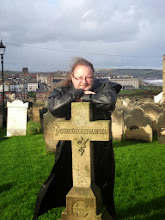
This isn’t the first time I have solicited guest blogs to celebrate a TMtV milestone, I did the same for the 10th anniversary, and one contributor was Anthony Hogg. Anthony’s article that time (linked below) actually details where our friendship sprang from and since then – as he sets out below – we started working together on a journal. Anthony is a tenacious editor and researcher – as both his work on the Highgate Vampire and the Journal of Vampire Studies attests to. So, without further ado I’d like to welcome Anthony back to TMtV...
I can’t believe it’s been ten years since the last retrospective and twenty years since the blog started. Time flies. For the blog’s tenth anniversary, I discussed Andy’s incomparable output, our friendly banter and the significance of his work to vampire studies.[1] To be honest, not much has changed—except for two things.
At the time I wrote it, I was secretly devising a vampire studies organisation. One that would have its own journal.[2] The year before, I had even helped organise an event called There Are Such Things! Vampire Studies Symposium 2015. Held at North Central Texas College’s Corinth campus on October 31 that year, the event was a “tester” for my idea.[3]
By 2018, I was in now-or-never mode. I had settled on a name. Contributions to the proposed journal commenced the year before. I had a constitution drawn up. The inaugural meeting of the Vampire Studies Association took place on October 31, 2018 at City Library, Melbourne. Nominating myself as president, Andy seemed the natural choice as Deputy President, so I nominated him too. We both won.
The association, as I mentioned at that meeting, was a “front” for the proposed journal. I had been soliciting and receiving contributions from 2017 onward. A good chunk of the journal was good to go. Its publication was supposed to mark the hundredth anniversary of Montague Summers’s seminal The Vampire, His Kith and Kin (1928). I even presented a dummy cover of the intended journal, mostly compromised of Monty’s studio portrait. Unfortunately, I didn’t get it finished on time.
Several false starts followed before, at long last, the first issue of the Journal of Vampire Studies was published on December 17, 2020 (without Monty on the cover). The person who’d been accompanying me on that journey, reviewing submissions—and determining which ones made the cut—was my mate (and Assistant Editor), Andy.
It was his experience reviewing material and fast turnaround that made him a natural choice for the gig. His turnaround’s still remarkable. Andy’s even written several reviews for the journal. Two appear in our latest volume.[4] I can always count on him to deliver his inciteful takes on the books he reviews and the submissions we receive. That’s why he’s still my Assistant Editor. I couldn’t ask for a better colleague and his readers are definitely in good hands. So, here’s to you Andy, and another ten years!
Copies of the journal are available through various online retailers including Amazon, Waterstones and Blackwell’s. For more information on the association, visit here.
Notes
[1] Anthony Hogg, “Ten Years of TMtV: Guest Blog: A Scholar and a Gentleman—My Mate, Andy,” Taliesin Meets the Vampires (blog), March 2, 2016, https://taliesinttlg.blogspot.com/2016/03/ten-years-of-tmtv-guest-blog-scholar.html.
[2] The closest contemporary examples were the Canadian chapter of the Transylvania Society of Dracula’s Journal of Dracula Studies (the society became the North American chapter, then the central one); Slayage, published by the Whedon Studies Association (now the Association for the Study of Buffy+); or Cercle V’s L’Upir. Only the latter is no longer published.
[3] For more information on the event, see Anthony Hogg, “Vampire Studies Symposium 2015: The ‘Lost’ Footage,” The Vampirologist (blog), December 8, 2017, https://thevampirologist.wordpress.com/2017/12/08/vampire-studies-symposium-2015-the-lost-footage/.
[4] Andrew M. Boylan, review of The Vampire: An Edinburgh Companion, edited by Nick Groom and William Hughes, Journal of Vampire Studies 5 (2025): 104–11; review of Unlocking Dracula A.D. 1972: A Classic Horror Film in Context, by David Huckvale, 112– 13.
Bio: Anthony Hogg is the president of the Vampire Studies Association and editor of the Journal of Vampire Studies. He lives in Melbourne.
Posted by
Taliesin_ttlg
at
1:29 PM
0
comments
Labels: reference - folklore, reference - history, reference - media, vampire
Friday, February 23, 2024
Handbook of the Vampire: Introduction to the Handbook of the Vampire
This is my First post looking in an in-depth way at Palgrave’s Handbook of the Vampire, a monumental reference work that has an introduction and 97 chapters concerning all aspects of vampire study. It is published as an e-book with the chapters available through institutional logins and being published as a two-volume hardcopy. I am lucky enough to have provided two chapters for the handbook (which I won’t be writing blog posts on but you can find links to the Handbook pages for each chapter I provided on the Handbook Page I have set up).
This first post concerns the Introduction, written by editor Simon Bacon. Of course, the chapter is an editorial, it outlines the scope of the project and what the reader can hope to find within. He suggests that “So much more research and study are required to understand and recognise the full implications of what we are saying when we say ‘VAMPIRE.’”. This is fitting coming from Simon – he and I indulge in frequent correspondence and have collaborated a few times, but his output into the arena of vampire study is vast (as both editor and author) but his definition of vampire is wide also and it is this width that allowed him to catch a vast net to snare the cornucopia of treasures within the Handbook.
I also have to give a moment of thanks for the fact that one of my entries for the Handbook was actually cited within the introduction.
As I continue to look at the Handbook, I will point out interesting ideas, new sources of vampire media and even where I disagree with a proposition within a chapter. This project, to map each chapter, over time, here at TMtV will undoubtedly take a long time. I will read the chapters over time and then have to write the article and schedule it for posting, of course, but it is a journey I think will be worth taking.
Posted by
Taliesin_ttlg
at
10:00 AM
0
comments
Labels: palgrave's handbook of the vampire, reference - folklore, reference - history, reference - media, vampire
Wednesday, April 21, 2021
With Stake and Spade: Vampiric Diversity in Poland – review
Author: Łukasz Kozak
Translator: Mark Bence
First published: 2020
The blurb: Everyone has heard of vampires, but few know about upiórs, strzygas, strzygońs, and wieszczys. Yet sources from Poland and the former Polish–Lithuanian Commonwealth offer a wealth of fascinating material to discover Slavic beliefs in the living dead, which later became a universal myth known the world over. This book contains a small but representative selection of 80 texts spanning almost 500 years, ranging from scholarly works and religious treatises to official documents, ethnographic essays, and press reports on true events.
The review: I was lucky enough to win this volume in a competition. We are firmly in the realm of the folkloric vampire, and the Polish variants of the restless dead as listed in the blurb. The introduction to the book looks into the four types to offer an overview but the main event is a reproduction of various documents (be it passages from books, manuscripts, newspaper reports etc) which mention the walking dead. Each entry is referenced to the appropriate source document, which is essential, though an index may have been a useful addition.
There are some really interesting moments within the texts. The idea of who might become the restless dead and the aspects and habits are fairly interchangeable between the types but – remembering that I primarily look at the vampire in a media sense – what I found interesting was some of the tropes that came up that are not commonly known as being folkloric and more a media invention.
So, several entries spoke about the vampire returning to the coffin/grave at cock crow and some suggested that at the point of cock crow an exposed corpse would die – not too unusual from a media point of view, the idea that the restless dead return to an inanimate state at daybreak can be found in the Vampire and the Devil’s Son (1852), to offer an early fictional example. However, there were several entries that suggested that the vampire would be reduced to tar on the cock crow – and this brings the trope of death by daylight to mind and is fascinating to find a folkloric variant. Another fascinating entry dating to 1873 highlighted a conflation of vampire (in the form of upiór) and werewolf, to quote: “After his death, he was thought to have become a werewolf, who left his resting place at night to wander about the village, visiting houses and terrifying God’s folk, like an omen of the plague…”
Most fascinating was the following entry from the Gazeta Polska, dated 1871, which said about criminals who are insufficiently punished when alive who will “turn their bodies into so-called “strzygas” or “upiórs” (which the populace imagine in the form of bats) that emerge from their graves at midnight”. This is a pre-Stoker and folkloric association of bat and vampire and is, from my point of view, rather exciting.
The main event is presented as is, and so there is no analysis just presentation of the entries – so for a more casual reader this may make the volume less engaging, though it is an invaluable source for researchers (be that of the vampire or Polish folklore generally). The volume uses high grade, thick paper stock. I will quickly mention the graphic (almost pop) art, in orange, purple and lilac that appears within volume as well as adorning the cover - not my cup of tea, I’m afraid, however it is very striking and makes this volume stand out against its academic fellows. 9 out of 10.
Posted by
Taliesin_ttlg
at
3:38 AM
2
comments
Labels: folklore, reference - folklore, strzygas, strzygońs, upiórs, vampire, werewolf, wieszczys
Saturday, November 16, 2019
Vampires of Lore: Traditional Tales and Modern Misconceptions – review
First Published: 2019
Contains spoilers
The Blurb: Vampire . . . the word immediately conjures up bloodstained fangs, an aversion to sunlight, bats, garlic, and wooden stakes. These undead immortals have haunted our favorite books, television shows, and movies for decades. This exploration of a seemingly supernatural topic delves into past traditions around the world and how those traditions have affected our pop-culture modern-day monster. Explore belief systems as well as origins of various notions we all seem to have about vampires, and unearth the bloody dirt about this mystical creature. Discover differences and similarities between the realm of folklore and what modern media has taught us. Did villagers really use wooden stakes, garlic, and mirrors? What about vampires turning into bats or hypnotizing victims? Did they really cause disease, turn into dogs, and sleep in coffins? Topics are arranged by trait so that the reader can consider each characteristic before believing or dismissing it. So . . . if you're ready, let's hunt some vampires.
The review: There is a trepidation when facing a reference book sometimes. I have looked at them previously – especially ones driven by a desire by a publisher to tap into a pop culture area and where they seem to spend more attention on design (this is a nice hardback volume with fancy, glossy pages) than content – and found myself annoyed. Annoyed by lack of referencing, lack of indexing and, in some of the worst cases, errors by the bucket full.
So, lets cover off what this is about first before looking as to whether it addressed the standard gripes. Sylvia has set a task of examining tropes from the vampire genre (running on a vampire definition in chapter one of a restless corpse, corporeal and blood-drinker, but veering off-piste when there is something of interest to see) and comparing them to extant folklore to see whether those tropes/traits are from original sourcing or a media invention. The working definition established, the book is then split into a further 19 chapters each about a given trait (for example, sunlight has a chapter, as does garlic and mirrors respectively).
The splitting the chapters into trait might have made a lack of index forgivable – except he does index his work, happy days, and each chapter has end-note citations, and there is an overall bibliography. The writing is fairly chatty, but engaging for it, but I would say that the chapters are fairly short and there is certainly scope in some for expansion.
When it comes to accuracy I found (for the most part) that the author had examined relevant sources and was in the right ballpark. There were areas that possibly demanded deeper exploration – so, as a prime example, the conclusion was that a vampire’s ability to fly was from the media vampire and likely a twentieth-century invention (whilst acknowledging a couple of rare folkloric examples, one Russian and one Chinese). However, I would counter argue that flying is referenced in Pepopukin in Corsica (1826) and actively seen in Phantoms (1863). To give the author fair hearing their conclusion is stated to rest around “major vampire-themed works” but Alexandre Dumas père, it can be argued, must be deemed a major source and his Ruthven based stage-play contains stage notes that state, “Lord Ruthven first sits up—then rises completely and having shaken his hair to the wind, he deploys great wings and flies off.” However – having said that (and if the author ever does a 2nd edition I hope they consider the works I have mentioned) this was an incredibly rare moment where I disagreed with the conclusion on an error of fact (or perhaps parameter). For the main this showed a diligence in research exemplified by the marvellous find of a brief reference to the, so-called, Vampire of Snowdon – a tantalising moment from 1890.
So, it is a light volume – it took a day to read – but written in a very readable style and, whilst I believe there was plenty of room for expansion, as a primer for the division between folklore and media this does the job well. 7.5 out of 10.
In Hardback @ Amazon US
In Hardback @ Amazon UK
Posted by
Taliesin_ttlg
at
12:10 AM
0
comments
Labels: Arnold Paole, Carmilla (related), Dracula (related), Peter Plogojowitz, reference - folklore, reference - media, ruthven (related)
Thursday, November 08, 2018
When Brave Men Shudder: The Scottish origins of Dracula – review
First Published: 2018
The Blurb: Gripped by the demon of inspiration, he entered into the mind of the infamous Count Dracula…
The year: 1895. The place: a remote Scottish fishing village. Bram Stoker is feverishly penning his cadaverous tale of vampire horror as his family look on aghast.
Everything was conspiring to produce those words of gore... everything. What were the supernatural influences he found in the village? Who was the mystic poet who dominated his restless thoughts? Why was the pagan world trying to communicate with him?
Family memories, maps, photographs and newly-opened archives provide the untold story of how Dracula came to be written. Long untold and now never to be forgotten, this is the tale of a book that shocked the world, a book that would make the brave shudder…
The review: Over the years there has been a faction, if I can call it that, which suggests that Slains Castle in Aberdeenshire was the inspiration for Castle Dracula and/or the direct inspiration for the novel. What Mike Shepherd, a resident of Cruden Bay, has done is take that concept and – through a variety of evidences looked into the truth of this.
It is well established that certain sections, or perhaps even the majority, of Dracula was written when Bram Stoker took his month-long holidays in Cruden Bay. The fact that he wrote two other novels set specifically in the area shows his love for the place. We also know that he had made plans for a vampire novel, which became Dracula, before ever visiting the village. Indeed, Shepherd's even-handed approach to this is revealed when he states “It’s part of local myth that the sight of Slains Castle inspired Bram Stoker to write Dracula. This is incorrect…” and goes on to explain the motif of the castle in pre-Cruden Bay notes. However, I think it is fair to say that its presence above the village will have influenced (consciously or subconsciously) and Shepherd reveals that Slains had (and the ruins still contain) an octagonal room – a feature specifically mentioned in the novel and that Stoker had visited the castle as a guest.
In truth, the uncovered information this volume contains about Dracula specifically (such as the octagonal room) could have been the subject of a journal paper. The book is expanded further as the author explores Stoker’s relationship with the location and draws in subjects such as his long love of the poetry of Walt Whitman. The book is then more about Stoker – man and author – than Dracula, his famous opus. This volume is expanded further still with details of the local area; historical, sociological and mythological, which I have to say were fascinating in their own right. Shepherd does offer much in the way of supposition, about the book and the man – but that is fine, as he is clear that it is supposition and is not possibility passed off as hard fact.
The writing style is chatty, enthusiastic and clearly filled with a passion for both the author he examines and the location. One piece of clarification, if I may, when addressing the novel Lady of the Shroud the author suggests “She appears to be a ghost”, but she was actually posing as a vampire. Given that this touches on the legendary creature of Stoker’s famous novel I felt it was a missed moment of connectivity – but very, very minor in the grand scheme. 7 out of 10.
In Paperback @ Amazon US
In Paperback @ Amazon UK
Posted by
Taliesin_ttlg
at
3:33 AM
0
comments
Labels: Dracula, Dracula (related), reference - folklore, reference - media
Sunday, October 21, 2018
The Vampire: a New History – review
First published: 2018
Contains spoilers
The blurb: An authoritative new history of the vampire, two hundred years after it first appeared on the literary scene Published to mark the bicentenary of John Polidori's publication of The Vampyre, Nick Groom's detailed new account illuminates the complex history of the iconic creature. The vampire first came to public prominence in the early eighteenth century, when Enlightenment science collided with Eastern European folklore and apparently verified outbreaks of vampirism, capturing the attention of medical researchers, political commentators, social theorists, theologians, and philosophers. Groom accordingly traces the vampire from its role as a monster embodying humankind's fears, to that of an unlikely hero for the marginalized and excluded in the twenty-first century. Drawing on literary and artistic representations, as well as medical, forensic, empirical, and sociopolitical perspectives, this rich and eerie history presents the vampire as a strikingly complex being that has been used to express the traumas and contradictions of the human condition.
The review: I came across Nick Groom as the beset expert in The Luke McQueen Pilots: Britain's Hidden Vampire Crisis, however I had also read an essay in the Cambridge Companion to Dracula and, unfortunately, I found that the weakest of the chapters. However, one piece of work does not cover a body of work and – free of the confines of a chapter – Groom’s work here excels.
Groom explores the vampire from the 18th Century panics – arguing that these were the first vampires, and that revenants, spectres etc. are not vampires as emerged in the panics, indeed cutting the vampires from other blood drinking mythological creatures. It is a position that I can accept as an argument basis (as much as I can recognise the folkloric tropes that are common). He then draws a thorough socio-political history that allows us to see the context.
He carries this through the panics into the 19th century literature that developed (and I must say I always appreciate finding new pieces, and Groom covers pieces I’d not considered before). He skirts around Christabel suggesting that she appears vampiric, if not actually a vampire (I subscribe to it not being a vampire piece but, again, Groom dealt with this even-handedly.
The final chapter then moves on to Dracula (a brief view beyond Dracula is found in the conclusion but Dracula is seen as the loci between the developing vampire from the panics into the modern phenomena). To concentrate on this, for a moment, as it was where I was less positive about his previous essay; where the author drew a direct line between Ţepeş and the Count previously, in this it is less concreate a connection that is drawn (and then only briefly). I perhaps would still want a recognition that there is a strong view against the connection but it felt less “In Search of Dracula”.
One thing I did enjoy was how he drew the view of female hysteria with the figure of Lucy (and her subsequent healing, through the stake). There was mileage to connect this back to Varney the Vampire and Clara Crofton. Another thing I enjoyed was his vampire/vampiric reading of Frankenstein and I will, at some point, look to explore that here – with all due credit, of course.
But it is the historical context… the politics, the religious contentions, the societal views that he explores and ties into the development of the vampire as a figure up to, and including, Dracula that makes this such an important book. Highly recommended. 9 out of 10.
In Hardback @ Amazon US
In Hardback @ Amazon UK
Posted by
Taliesin_ttlg
at
11:00 AM
0
comments
Labels: capitalism, Carmilla, classic literature, Dracula, Frankenstein's Monster, reference - folklore, reference - history, reference - media, Ruthven, undead, vampire ass, Vlad Ţepeş, werewolf
Monday, October 01, 2018
Undead Memory: Vampires and Human Memory in Popular Culture – review
Editors: Simon Bacon & Katarzyna Bronk
First published: 2013
The Blurb: Vampires have never been as popular in Western culture as they are now: Twilight, True Blood, The Vampire Diaries and their fans have secured the vampire’s place in contemporary culture. Yet the role vampires play in how we remember our pasts and configure our futures has yet to be explored. The present volume fills this gap, addressing the many ways in which vampire narratives have been used to describe the tensions between memory and identity in the twentieth and twenty-first centuries.
The first part of the volume considers the use of the vampire to deal with rapid cultural change, both to remember the past and to imagine possible futures. The second part examines vampire narratives as external cultural archives, a memory library allowing us to reference the past and understand how this underpins our present. Finally, the collection explores how the undead comes to embody memorial practice itself: an autonomous entity that gives form to traumatic, feminist, postcolonial and oral traditions and reveals the resilience of minority memory.
Ranging from actual reports of vampire activity to literary and cinematic interpretations of the blood-drinking revenant, this timely study investigates the ways in which the «undead memory» of the vampire throughout Western culture has helped us to remember more clearly who we were, who we are, and who we will/may become.
The review: Full disclosure, I class Simon Bacon as a friend and have even had work published in a volume he edited. I actually had this volume on my wishlist prior to meeting him but hadn’t purchased it due to the high cost of academic tomes. Then I spotted, one of the occasional Amazon mega-price drops and got hold of it. My first reaction was to not review it, due to my association with Simon, but I enjoyed it so much as a volume that I decided to do so – but with the disclosure contained in this paragraph.
The book looks at the vampire as a receptacle (or not) for memory and the highlight moments for me included the essay drawn around the 18th century panics by Leo Ruickbie and Constitutional Amnesia and Future Memory by Hadas Elber-Aviram, which focused on three favourite sci-fi pieces; I Am Legend, Fledgling and Blindsight. I felt a (minor) trick was missed Sorcha Ní Fhlainn whose essay “Old Things, Fine Things”: Of Vampires, Antique Dealers and Timelessness did touch on Blacula but could well have looked at Ganja and Hess as well. I was also disappointed that Hannah Priest didn’t touch on the conflation of werewolves and vampires in older literature. Simon’s essay, based on Let me In now perhaps serves as a hors d'oeuvre for his later volume Becoming Vampire.
Films this volume made me seek out were We Are What We Are (2010) and Breaking the Waves (1996), both of which will feature here in the future. 8 out of 10.
In Hardback @ Amazon US
In Hardback @ Amazon UK
Posted by
Taliesin_ttlg
at
12:34 AM
0
comments
Labels: reference - folklore, reference - media, vampire
Thursday, February 01, 2018
On Vampires – review
First published: 2017
Contains spoilers
The Blurb: Join cryptozoologist and folklorist Ronald Murphy as he journeys throughout history in his quest to uncover the impetus for the archetype of the vampire. Beginning at the lair of cannibals at the dawn of human history, explore the images and evolving ideas of the vampire, tracing these concepts up to the information age. Keep a stake close by as you uncover the world of the vampire.
The review: You can call me old fashioned but when I read a reference book I expect referencing. If an argument is put forward without evidence, and referencing thereof, it is nothing but assertion. Whilst the author of On Vampires very occasionally refers to other texts, he does not reference. To be fair there is a bibliography, however the book is so filled with assertions and (quite frankly) wild theorem that I found myself doing surface level research via google to check the assertions and more often than not came away with nothing or undermining evidence. If the author wishes to provide sourced evidence later I will revisit the book.
The book begins with a foreword by a “sceptical psychic” and then an introduction where the author references the alleged vampire of Eerie Cemetery. However, no background research is offered to the reader. Rather urban legend is presented, if not as fact then, uncontested and without corroboration. Murphy Jr does not return to Eerie within the text.
We then have a discussion of the Palaeolithic origins for vampires. This chapter really is supposition and wild imagining. Yes, there is evidence of cannibalism from Palaeolithic sites – this does not necessarily lend itself to the development of vampire myth (and there certainly is no evidence thereof) and the entire section feels nothing more than projection of pet (wild) hypothesis over archaeological evidence.
Citing the find of a skull in Monte Cicero as an example of Palaeolithic vampire slaying was, to say the least, problematic. A surface google revealed that whilst a skull, split at the base, had been found this could equally have been caused by something like Paget’s disease. The same (referenced) source suggested that the skull found was Neanderthal and not Homo Sapiens.
Now, it needs to be said that Murphy Jr uses the “Summers” system of vampirism – anything that vaguely sounds like the modern take of vampires, within myth or folklore, is treated as a vampire. I actually don’t necessarily disagree with this approach from a media sense but this volume conflates the media vampire and actual folklore. Thus, citing Lilith and suggesting, “Without Lilith and her numerous incarnations there might very well be no vampires in human form.” (p 31) is problematic. Despite being archetypally attached to some of the same mythological explanation of negative social events (in this case infant mortality), Lilith was not the progenitor of the vampire (myth) until the figure was conflated into the media version of the myth. Is Lilith interesting, yes; is she important to the development of restless corpse folklore, unlikely.
He also states, “many believe the myths of vampires were born from this legend {of Lilith}, as well as that of Cain,” (p 30) I have seen no evidence connecting Cain and vampirism prior to the mythology invented for the game Vampire the Masquerade (I can accept that an artist might have conflated the two prior to this, if evidence can be provided, but do not believe this will have been prior to the twentieth century). In the chapter following Lilith, on Egypt, we see one of the real issues with selective research. The author makes a case for connecting obscure Egyptian deity Shesmu into the vampire narrative, confidently stating that “he was known as the “Lord of Blood”,” (pg 37) amongst other chilling titles. He conveniently does not mention his less macabre titles, such as “Lord of Perfume” and “Lord of Wine”, nor does he mention that the Ancient Egyptians offered wine as the blood of the Gods. Of course, an even-handed revelation would have undermined the vampire argument.
Moving to the Greco-Roman world he cites the lamia as “the closest construction of a traditional vampire the ancient world has to offer… …seducing and then devouring the living and even possessing a serpentine aspect of needle like canine teeth.” (p 52) However the traditional Slavic vampire was not a seducer (sex may have been involved, but not seduction) and was a bloated ruddy corpse whose description never included fangs, to my knowledge.
On the Roman side he suggests that “it is a plausible scenario that the idea of the vampire being able to transform into a bat was first sewn into this work of Pliny.” (p 55) This is in respect of striges and is a leap of logic of mind-boggling audacity. Firstly, the striges were a bird (rather than a bat), secondly, bats and vampires were almost certainly not conflated prior to the discovery of the New World, thirdly, this was a popular media conflation and not one of mainstream folklore and finally there is only a little evidence of that conflation until the concept was popularised by Bram Stoker.
Beyond this, I tried to research the Roman vampire Murphy Jr mentions, named Scorn, and drew an absolute blank – googling the character in both English and Latin. I suspect the character to be the author’s invention but do stand to be corrected.
Next we get a whistle-stop tour of the Middle Ages and the Renaissance. One thing I noticed was the author’s on-running misunderstanding of the Christian factions, as he repeatedly suggested that the Romanian territories were Catholic rather than Orthodox (the distinct sects growing disparate leading to the Rome/Orthodox schism, which occurred in 1054). He suggests that vampires were “killed” in this period by a stake through the heart – stakes pinned the corpse to the grave – and whilst grave dirt does form part of the traditional Slavic folklore (such as eating dirt from a vampire’s grave to cure a victim of an attack), the need to sleep in native/grave earth is a media invention.
The author then conflates Vlad Ţepeş and vampires; not only in this chapter as Vlad gets the next chapter also and is mentioned elsewhere in the work. Let us be clear, there is no evidence that shows Vlad associated with vampirism prior to Bram Stoker and Stoker did little more than borrow his patronym, Dracula. Later Murphy Jr states “The voivode was a term we first saw used in the medieval period to reflect the idea of the living dead” (p 102) – my notes are less polite than what I’ll put here, but we need to point out that Voivode was an honorific used across the Slavic nations meaning warlord, which is often translated as Prince.
On thinkers off the Enlightenment, he suggests “Calmet did not reject the influence of Christianity.” (p 85) Of course he did not, he was a Benedictine monk and theologian. He did, however, reject the idea that vampires were actually real, though that isn’t mentioned. The author selectively quotes Voltaire, also, neglecting the quote: “These vampires were corpses, who went out of their graves at night to suck the blood of the living, either at their throats or stomachs, after which they returned to their cemeteries. The persons so sucked waned, grew pale, and fell into consumption; while the sucking corpses grew fat, got rosy, and enjoyed an excellent appetite. It was in Poland, Hungary, Silesia, Moravia, Austria, and Lorraine, that the dead made this good cheer. We never heard a word of vampires in London, nor even at Paris. I confess that in both these cities there were stock-jobbers, brokers, and men of business, who sucked the blood of the people in broad daylight; but they were not dead, though corrupted. These true suckers lived not in cemeteries, but in very agreeable palaces.” (Voltaire, 1764) This, of course, shows Voltaire's view of what vampire related to in reality.
This is important as both Calmet and Voltaire were responding to the stories of vampirism coming to Western Europe from the Slavic countries. I note that the author covers (briefly) the earlier story of Jure Grando but fails to cover the stories of Arnold Paole or Petar Blagojevich – two alleged vampires during the period of the Enlightenment whose stories were documented and, regarding the former, is seen as the first known source of the word entering the English language. He does, however, conflate Báthory with vampirism, which is again a modern conflation.
Moving to America he covers the New England panics but suggests Simon Whipple’s grave actually cites his cause of death “was at the hands of a “vampire””. (p 91) He includes a photo of the grave but the reproduction is so poor one cannot read the inscription, which actually says; “Altho consumptions’ vampire grasp—Had seized thy mortal frame”. I’ll let you decide whether the author’s interpretation is accurate. What I will say is: yes, Stoker was aware of the case of Mercy Brown (who incidentally wasn’t disinterred as she hadn’t been buried when examined so couldn’t have “turned in the grave” (p 94)). No, the Mercy Brown case is unlikely to have inspired the Lucy character.
So, I was less than impressed with the volume and felt the need to vent about some of the entries in this review – actually missing out many of the issues I uncovered as I read the volume. If I jump towards the end of the book I can mention that the author conflates lifestyling, media and folklore when it comes to modern vampires. However, it was his treatment of le fanu’s Carmilla that was the last straw for me.
Carmilla was not “the first vampire of the Victorian age” (pp 99-100) beyond the fact that it was not le Fanu’s first story featuring a vampiric entity (though it was the one that was most traditional in form), and beyond numerous other continental examples, Varney the Vampire predated the story and contained a scene more likely to have inspired part of the Lucy story in Dracula than the Mercy Brown case.
I am not aware that it “draws indirectly from the psycho-sexual world of Elizabeth Bathory” (p 100) though some do argue that Le Fanu did draw from Baring-Gould’s the Book of Were-wolves, but I can state that Calmet’s Treatise on Vampires and Revenants had a direct inspiration. The “small blue spot on {Laura’s} chest” (p 101) was actually described as being just below the neck and is indicative that she had been bitten. Though the story states that Laura died somewhere between writing the story down (over a year after the events) and the publication of Hesselius’ papers, to conflate a bruise from a bite with the spread of a disease (which was the unstated cause of death) is really reading too much in.
I could go on. My recommendation is leave this volume well alone.
EDIT 02/02/18 - Anthony Hogg has found the source of the "Scorn" entry and its a lift and shift from a creative writing source, which has been plagiarised pretty much. In light of that the 1 out of 10, which I thought was generous, was too generous. 0 out of 10.
In Paperback @ Amazon US
In Paperback @ Amazon UK
Posted by
Taliesin_ttlg
at
10:35 AM
0
comments
Labels: Cain, cannibalism, Carmilla, Dracula, Erzsébet Báthory, Jure Grando, lamia, Lilith, lilitu, Mercy Brown, reference - folklore, reference - history, reference - media, stryge, Vlad Ţepeş
Friday, December 22, 2017
New Orleans Vampires: History and Legend – review
First Published: 2017
The Blurb: New Orleans has a reputation as a home for creatures of the night. Popular books, movies and television shows have cemented the city's connection to vampires in public imagination. In the early days of Louisiana's colonization, rumors swirled about the fate of the Casket Girls, a group of mysterious maidens traveling to the New World from France with peculiar casket-shaped boxes. A charismatic man who moved to the French Quarter in the early 1900s eerily resembled a European aristocrat of one hundred years prior bearing the same name. A pair of brothers terrorized the town with their desire to feed on living human blood during the Great Depression. Marita Woywod Crandle investigates the origins of these legends so intricately woven through New Orleans's rich history.
The review: Is hosted at Vamped.
Posted by
Taliesin_ttlg
at
8:18 AM
0
comments
Labels: Comte de Saint-Germain, reference - folklore, reference - media, vampire
Saturday, July 30, 2016
The Monster with a Thousand Faces – review
First published: 1989
Contains spoilers
The Blurb: Brian Frost chronicles the history of the vampire in myth and literature, providing a sumptuous repast for all devotees of the bizarre. In a wide-ranging survey, including plot summaries of hundreds of novels and short stories, the reader meets an amazing assortment of vampires from the pages of weird fiction, ranging from the 10,000-year-old femme fatale in Robert E. Howard’s Conan the Conqueror to the malevolent fetus in Eddy C. Bertin’s “Something Small, Something Hungry.” Nostalgia buffs will enjoy a discussion of the vampire yarns in the pulp magazines of the interwar years, while fans of contemporary vampire fiction will also be sated.
The review: The first thing to note about this volume is the publication date. Given when it was published the book does look at certain issues, such as the impact that Vlad Tepes had on the character of Count Dracula, with an uncritical and filtered view that the work of later scholars have added to the debate. One should also note that Frost’s definition of “vampire” is broad and so this leads to a look at pre-Serbian sources in the mythology and a much wider view of vampirism in the literature chapters (which are, of course, the meat of the book).
I was perhaps unmoved by the mythology section, it added nothing to the many books out there, however it is within the literature section and, specifically, the look at pulp fiction works that the volume shines. The journey through the pulps was excellently done and is the main focus/reason I would recommend this volume.
I found the author somewhat dismissive, however, of stories (and novels) he didn’t like, writing off a tale with little to no explanation. It was opinion rather than review (not that the volume is a review book) and failed to capitalise on the fact that as poor and uninspired he might find a specific piece, it may well appeal to others and bring something, if only the sliver of an element, to the party.
However, simply for the exploration of the pulps, this deserves 6 out of 10.
Posted by
Taliesin_ttlg
at
5:30 AM
0
comments
Labels: alien vampire, Dracula, reference - folklore, reference - media, undead, vampire, Vlad Ţepeş
Friday, March 18, 2016
The Universal Vampire: Origins and Evolution of a Legend – review
First published: 2013
Contains spoilers
The blurb: Since the publication of John Polidori’s The Vampyre (1819), the vampire has been a mainstay of Western culture, appearing consistently in literature, art, music (notably opera), film, television, graphic novels and popular culture in general. Even before its entrance into the realm of arts and letters in the early nineteenth century, the vampire was a feared creature of Eastern European folklore and legend, rising from the grave at night to consume its living loved ones and neighbors, often converting them at the same time into fellow vampires.
A major question exists within vampire scholarship: to what extent is this creature a product of European cultural forms, or is the vampire indeed a universal, perhaps even archetypal figure? In this collection of sixteen original essays, the contributors shed light on this question. One essay traces the origins of the legend to the early medieval Norse Draugr, an “undead” creature who reflects the underpinnings of Dracula, the latter first appearing as a vampire in Anglo-Irish Bram Stoker’s 1897 novel, Dracula.
In addition to these investigations of the Western mythic, literary and historic traditions, other essays in this volume move outside Europe to explore vampire figures in Native American and Mesoamerican myth and ritual, as well as the existence of similar vampiric traditions in Japanese, Russian and Latin American art, theatre, literature, film, and other cultural productions.
The female vampire looms large, beginning with the Sumerian goddess Lilith, including the nineteenth-century Carmilla, and moving to vampiresses in twentieth-century film, literature, and television series. Scientific explanations for vampires and werewolves constitute another section of the book, including eighteenth-century accounts of unearthing, decapitation and cremation of suspected vampires in Eastern Europe. The vampire’s beauty, attainment of immortality and eternal youth are all suggested as reasons for its continued success in contemporary popular culture.
The review: I do like books like this but they come with two problems. One is the price tag – though I understand that an academic piece is not going to sell as well and that influences the tag. The second is a variance of quality between contributors’ pieces and the Universal Vampire is no exception when it comes to that.
Looking at the blurb, for a moment, the premise of the book is looking for universal roots within the vampire genre. The book doesn’t actually do that, in totality at least, though it does take us on an international journey.
However the first chapter, Draugula by Matthias Teichert, certainly did this and I find the exploration of both Draugr and Revenant myths and legends fascinating. It is clear that there are heavy similarities to the vampire myth that developed amongst the Slavic nations. The biggest difference was the vampire seemed to have a fixed focus on blood drinking (often, it seems, assumed due to the corpse state when exhumed) and the other types not so much. Blood drinking and flesh eating do appear within some of the myths, but not so much in this essay, which nonetheless was informative and thought provoking.
Flying to the other end of the spectrum, the piece Biomedical Origins of Vampirism by Edward O. Keith could have been left out of the book altogether. A tired re-hash of the discredited porphyria theory (with an almost embarrassed admission that the theory does not fit) is followed by equally tired looks at Pellegra and Rabies. This misses the point that illness as a source of the myth does not rest with a condition suffered by the accused vampire (as they are dead by the time an assumption of vampirism is reached) rather it is with the victims. As such this chapter managed to completely avoid tuberculosis – a disease that we know certainly did influence folk opinion in the 19th century American panics. It was amusing, therefore, that the next chapter, Evidence for the Undead by Leo Ruickbie, shot down Keith’s chapter in a couple of paragraphs. The Keith Chapter also showed a lack of remembrance or knowledge of Dracula with suggestions that the Count avoided daylight (he certainly was abroad in daylight and one of the supporting quotes for this assertion is misattributed to the Count when it was Van Helsing’s dialogue) and only preyed on women prior to their marriage (Mina was married before she attracted the Count’s nightly visitations).
If that chapter is the low point in the book there was a Lilith chapter that was pretty light and a view that Stoker (and subsequently Dracula scholars) got details of Transylvanian society and cuisine wrong was met with a mighty shrug of the shoulders as it is clear that Stoker only used travel books to research that setting. In honesty the argument was very sound but the point of the debate was lost on me.
As well as the Draugula chapter and Ruickbie chapter particular favourites included a chapter by Ridenhour comparing Carmilla and Let the Right One In and Ruthner’s look at Visum et Repertum, the report of the Arnold Paole case.
All in all, for the full volume 7.5 out of 10.
Posted by
Taliesin_ttlg
at
9:23 AM
0
comments
Labels: Arnold Paole, Carmilla, Dracula, draugr, Lilith, literary vampire, porphyria, reference - folklore, reference - media, Ruthven, undead, werewolf
Thursday, February 11, 2016
The Vampire in Folklore, History, Literature, Film and Television: A Comprehensive Bibliography – review
First published: 2015
Contains spoilers
The Blurb: This comprehensive bibliography covers writings about vampires and related creatures from the 19th century to the present. More than 6,000 entries document the vampire's penetration of Western culture, from scholarly discourse, to popular culture, politics and cook books.
Sections by topic list works covering various aspects, including general sources, folklore and history, vampires in literature, music and art, metaphorical vampires and the contemporary vampire community. Vampires from film and television--from Bela Lugosi's Dracula to Buffy the Vampire Slayer, True Blood and the Twilight Saga--are well represented.
The review for this is hosted at Vamped.
Posted by
Taliesin_ttlg
at
8:31 AM
0
comments
Labels: reference - folklore, reference - history, reference - media
Sunday, August 16, 2015
Vampire Evolution: From Myth to Modern Day – review
First Published: 2015
Contains spoilers
The blurb: Vampires are beings of myth: folkloric creatures who live off the blood of the living and have been recorded in nearly every culture around the world since the beginning of man. This work traces the evolution of the vampire, from its roots in ancient mythology to obscure folk tales and legends, leading up to when these foul beings transformed into the suave Byronic heroes that continue to influence the world’s view of the vampire today. It also examines key individuals in history involved in reshaping our concept of the creature. Popular culture is explored, along with the development of the vampire into the protagonist in plays and poems and novels. Sixty-one frightening images bring the topic right to your front door. Will you invite the visitor in?
The review: Save me from ill-researched reference books.
When this arrived (and it was sent as a review copy) I was taken by the embossed hardback cover with the red bat but as I opened it I inwardly groaned. The fancy font suggested it may be content light and the book was packed with pretty pictures (which, in fairness, are very pretty).
However I noticed a bibliography, though no index, and a reference to Anthony Hogg, which perked me up as it boded well for good research. Sadly the referencing left much to be desired (there are at least three improperly referenced bits from Anthony but only one bibliography entry) and the content proved to be one which had me shouting at the book. This took three forms – bad research/supposition, bad writing and errors. I will cover some of my (least) favourites.
Discussing Thomas Aquinas and his belief that the Devil could cause metamorphosis of men to animal the authors suggest “This might be the origin of Bram Stoker’s Dracula becoming a wolfish creature and mention in future stories of vampires shifting into bats and mist.” Now re-read the sentence, this suggests that Dracula (in Stoker’s original) didn’t turn into a bat or mist, and that lore came in later stories, but it was part of Stoker’s lore. On the next page there is a supposition that nightmares symptomatic of the Black Death inspired Dracula communicating to Renfield telepathically – which is really plucking connections out of thin air.
Mention is made of Ludovico Fatinelli – of his “Treatise on Vampires” and suggesting the gentleman was burned at the stake… Except the gentleman did not exist and the treatise is a hoax volume.
Vampire poems are mentioned such as Christabel by Coleridge, and Keats' La Belle Dame sans Merci and Lamia. True, later authors have tied Lamia and vampires together, and many claim that Christabel was an influence on Le Fanu’s Carmilla, however none of the three poems are vampire poems (and Lamia is not a poem about Lilith either, as the authors further suggest).
One of the authors (I assume Vernor) tells us the Michelle Belanger told him a lot about Byron but the quote (I assume of her) was a mismatch of half-truths, bad research and myth and stated, “he identified as a vampire”. Not one single scholarly tome I have read on Byron suggests this; indeed Byron stated, whilst repudiating authorship of Polidori’s story, “I have, besides, a personal dislike to ‘Vampires’ and the little acquaintance I have with them would by no means induce me to divulge their secrets” (The Gentleman’s Magazine, Vol 125 1819 p633). The authors suggest Byron’s fragment (which we know Polidori expanded upon) was published before Polidori’s story – it was published after to prove Byron wasn’t the author of Polidori’s work and contains no vampire aspect. Its only real impact on the genre was the fact that Polidori used it as a base for his work.
Whilst talking of Planche’s The Vampire, or Bride of the Isles (1820), the author says that “Not since Varney did a vampire so clearly introduce the dualism of intellectual man and mindless, killing predator…” except of course that it predated Varney by twenty five years!
On Dracula it is suggested that the “phantom-like ship, Demeter was based off a real story of a boat by the same name” – except that the real shipwrecked vessel was called the Dmitry and the crew landed safely. The authors revive the suggestion that Van Helsing was based on Robert Roosevelt (except the author states Theodore Roosevelt) and Dracula was based on Walt Whitman (taking on “his attributes” even though we know the character’s appearance came from the Baring-Gould description of a werewolf) and the book was some sort of psychodrama of homophobia due to Stoker’s syphilis – despite the fact that the belief he had died of this comes from as late as 1975 and Daniel Farson (his grand-nephew) and has no corroborating evidence. In other words there is little evidence to support the suppositions. Vernor quotes himself as saying “Washington Irving—the very same man Stoker had in mind to play the character Dracula on stage”, err that would be Sir Henry Irving. The normal inflated conflation with Vlad Tepes occurs and later, discussing other books, the authors suggest that Dracula needs his “native earth” though this is from the movies and the book had different lore, being “in soil barren of holy memories it cannot rest”.
Whilst talking about books, the authors cover Anne Rice and quote Louis’ opening narrative… except (as well as not being referenced) it isn’t from the book but from the film – which itself is covered in the next chapter – hence why it talks of the death of his wife, which as an event replaced the death of his brother from the book.
When it comes to films apparently Lugosi “starred in Dracula sequels” – actually he only played Dracula one other time. In the Munsters Marilyn is called a “fairly normal teenage daughter” – she was the niece. Apparently in Black Sunday Asa uses “the Elizabeth Bathory method of attaining youth and beauty through virgin blood.” Well there isn’t a bath of blood in sight and she is revived by the blood of an older (and presumably non-virginal) male doctor and actually acts as an energy vampire when attacking her doppleganger.
Calling Dracula (1992) “the first faithful cinematic retelling of the source material” is a push, to say the least, and suggesting it introduced “other elements hinted at, but not fully explained in the novel, like the growing relationship between Count Dracula and Mina Harker” is nigh on fraudulent as that relationship was not hinted at! Blade (as in the Marvel character) is described as African-American, in the original comics he is British. Also, it might have just been really badly written but “trying to find the next True Blood, television networks adapted other vampire book series to television, like author Tanya Huff’s Blood series became the show Blood Ties (2007)”. Now, given the authors correctly date True Blood to 2008 earlier in the paragraph one has to either worry at the clunky writing or the time machine involved.
Adding in a section about Self-Identified Vampires I suppose was inevitable, though it is so thin as to not over-egg the pudding, but not necessarily welcome in a reference work on vampires in folklore and media.
So, there we have it. I have barely touched on the issues I had with it. The volume does look very pretty though. 2.5 out of 10 for the pretty pictures.
Posted by
Taliesin_ttlg
at
1:28 AM
0
comments
Labels: Carmilla, Comte de Saint-Germain, Dracula, energy vampire, Erzsébet Báthory, folklore, Lilith, nosferatu, reference - folklore, reference - media, Ruthven, undead, vampire, Vlad Ţepeş
Saturday, September 20, 2014
Metamorphoses of the Vampire in Literature and Film: Cultural Transformations in Europe, 1732-1933 – review
Release Date: 2010
Contains spoilers
The Blurb: For the last three hundred years, fictions of the vampire have fed off anxieties about cultural continuity. Though commonly represented as a parasitic aggressor from without, the vampire is in fact a native of Europe, and its "metamorphoses," to quote Baudelaire, a distorted image of social transformation. Because the vampire grows strong whenever and wherever traditions weaken, its representations have multiplied with every political, economic, and technological revolution from the eighteenth century on. Today, in the age of globalization, vampire fictions are more virulent than ever, and the monster enjoys hunting grounds as vast as the international market.
Metamorphoses of the Vampire explains why representations of vampirism began in the eighteenth century, flourished in the nineteenth, and came to eclipse nearly all other forms of monstrosity in the early twentieth century. Many of the works by French and German authors discussed here have never been presented to students and scholars in the English-speaking world. While there are many excellent studies that examine Victorian vampires, the undead in cinema, contemporary vampire fictions, and the vampire in folklore, until now no work has attempted to account for the unifying logic that underlies the vampire's many and often apparently contradictory forms.
The review: It is a singularly impressively difficult task to undertake; attempting to “account for the unifying logic that underlies the vampire's many and often apparently contradictory forms.” A Grand Unified Theory of the media vampire, so to speak.
In truth Butler does not succeed, in my opinion anyway, which is not to say that this book is without merit – indeed it is brimming with merit. I just think that such a theory, such a logic is ethereal – running from the light like Nosferatu at dawn and obfuscated by each piece of literature, theatre or film that does not fit in with the logic.
However Butler takes us on a fascinating jaunt through the hubbub of the media vampire drawing into parallel with cultural changes in Europe. The date range should have kept us firmly away from the burgeoning Hollywood vampire but it does rear its head on occasion.
Interesting to me was some of the sources that I had not come across before. Potocki’s The Manuscript Found in Saragossa is now in the “to read” pile as is Memoires of my Nervous Illness. The latter by Schreber has a chapter built around it and, whilst I believe that its association with vampirism might prove to be less overt, I find the idea of it fascinating.
This is not a book, however, for the casual reader. Butler has a PhD in comparative Literature and thus this volume is very scholarly – not that it should put you off, and his style prevents the contents from becoming dry, but the warning is there. Indexing, citation lists and notes are all present and correct allowing the student to use the volume properly as a source itself. 7.5 out of 10.
Posted by
Taliesin_ttlg
at
8:58 AM
0
comments
Labels: Carmilla, Dracula, literary vampire, nosferatu, reference - folklore, reference - media, Ruthven, vampire, Varney the Vampire
Thursday, September 18, 2014
Written in Blood: A Cultural History of the British Vampire – review
First Published: 2014
The blurb: The British Isles has a remarkable association with vampires – chilling supernatural creatures of the night. From the nineteenth-century writings of John Polidori, James Rymer, Sheridan Le Fanu and Bram Stoker, to the modern literary horrors of Clive Barker, Ramsey Campbell, Brian Lumley and Kim Newman, the vampire casts a strange and compelling shadow that spreads from the realms of fantasy into the world of the living. Here you will find vampire murderers and vampire hunters together with the real-life mysteries of Croglin Grange, Alnwick Castle, the Vampire of the Villas, the Yorkshire Vampire and the enduring phenomenon of London’s famous Highgate Vampire.
In this thought-provoking book, illustrated with never before seen photographs and drawing on extensive original research, writer and paranormal historian Paul Adams explores the fascinating history of British vampirism in both fact and fiction. With extensive chapters on the post-war revival of Gothic cinema horror and the influence of cult studio Hammer Films on the vampire in British television and music, here is a modern guide where every page is truly written in blood…
The review: Paul Adams takes us on a whistle-stop tour of vampirism as it ties in to British culture, running the gamut from 1816 to 2013 and looking at everything from Penny Dreadfuls through to Hammer films and beyond. He looks at legends (such as Croglin Grange) and some of the earlier appearances of the restless dead (as recorded by William of Newburgh and Walter Map). He touches on continental Europe, of course, and delves into vampire murderers – which does see him veering off the Isles as well as into general occult orientated killings, I think as a need to pad out what would have been a thin chapter had he remained in Britain.
Mostly I found his writing balanced, the discussion of the Highgate Vampire steered a fair line between the two primary personalities involved in the case without fawning over either. The book is quite tabloid in its brevity, in places, but Adams chose to write an overview – each chapter may have generated a reference book of its own. The writing style is chatty and engaging but the book does have a bibliography and indexing, allowing further reading into the subjects.
Given the general balance shown, I found it (possibly unfairly) unfortunate that he had not unearthed the potential controversy surrounding the authenticity of the Penny Dreadful story, The Skeleton Count, or, the Vampire Mistress. But, then again, my own reference book
All in all, a fine primer on a plethora of vampire related topics. 7.5 out of 10.
Posted by
Taliesin_ttlg
at
12:19 PM
0
comments
Labels: Carmilla, Dracula, Erzsébet Báthory, literary vampire, reference - folklore, reference - history, reference - media, Ruthven, serial killer, Varney the Vampire, Vlad Ţepeş
Sunday, August 31, 2014
Realm of the Vampire: History and the Undead – review
First published: 2009
The Blurb: Do vampires exist? Our ancestors certainly believed they did.
We are forced to rely on ancient records and eyewitness testimony, and absolute proof remains in the shadows, just out of reach.
Vampire research has fallen into a pattern of debunking, with academic writers chasing after trendy theories to explain away the vampire.
The review: I came across this book through Anthony Hogg and purchased it via kindle as this seems to be the only way to get the book currently.
After a foreword by David A Sattman, which seems to garble the Arnold Paole story, we move onto Wood’s work. He briefly introduces English Tradition and then the New England vampire scares before going into the work proper. This concentrates primarily on Polish vampirism.
There is debate as to whether the restless dead of the English tradition, revenants, can rightly be called vampires. Wood answers that by laying down the concept that whilst, “More and more modern authors, frustrated by this linguistic looseness, have attempted to restrict the use of the term ‘vampire’ by imposing an artificial dichotomy between the vampire-as-living-corpses and other unquiet dead. The folkloric sources of many nations, many realms of the undead, do not support this dichotomy, which itself is based upon a unique set of eighteenth-century cases.” Pretty much espousing, therefore, the Montague Summers broad view of the folklore.
Wood seems to almost take the view point of accepting the existence of vampires as reported. To me, accepting the theories of (say) Barber does not lessen the power of the original belief and thus I can, at least, accept a (mistaken) genuine belief by those who laid down the stories and unearthed the corpses, and the impact this had culturally, psychologically and politically thereafter.
Wood is right in his assertion that less is known of the Polish traditions, compared to those of the more Southern Slavs, and draws a fairly vivid picture of a Poland at the height of its power. He introduces us to concepts such as the zmory, living vampires that fulfilled a night hag role but tended to be shown as young and beautiful (interestingly the zmory only appear in Bane's Encyclopedia of Vampire Mythology, under zmora, as an alternative for incubus and do not have their own section). He also contemplates whether the occult activities in Poland (and Czech) led to the large numbers of restless dead reported through the post-Renaissance period – a position that seems sustainable only if one agrees that the outbreaks were real.
One thing not mentioned, but that did strike me whilst reading the book, was around the thought that victims of vampiric attack often speak of strangulation and not blood drinking, the blood drinking apparently assumed because of the state of the corpse when exhumed. However, if the vampire strangled a victim and then drank the blood post mortem, then surviving victims would only have reported strangulation.
One frustrating part of the book was that whilst it has a large sources section, there was a tendency to not cite within text and one feels that a scholarly work should do so. There is no index, though this might have just been missed from the kindle version as redundant (kindle's having a search capacity). Beyond this it was an enjoyable read and, whilst I disagree with some of Wood's assertions, an interesting tome. 7 out of 10.
Posted by
Taliesin_ttlg
at
3:04 AM
0
comments
Labels: Arnold Paole, Peter Plogojowitz, reference - folklore, reference - history, revenants, vampire, zmory
Saturday, March 01, 2014
Vampire Lore – review
First Published: 2006
Contains spoilers
The Blurb: This omnibus volume collects under a single cover the entire oeuvre of writings by Jan Louis Perkowski on the vampire theme in mythology and folklore, including his three previously monographs (Vampires, Dwarves and Witches Amongst the Ontario Kashubs, 1972; Vampires of the Slavs, 1976; and The Darkling: A Treatise on Slavic Vampirism, 1989), in addition to 18 previously uncollected articles on the subject, one newly written for this volume.
As Bruce McClelland notes in his Preface to the volume, in the folklore of the Slavs, the vampire plays a specific role in a broader system of folk belief. Where in the West, the vampire is utterly monstrous, the symbol of pure evil and darkness that is nevertheless romanticized and eroticized, its moral status is more nuanced and ambiguous in the Slavic conception. Yet the ancient Slavic folklore vampire represents the historical basis of the pop and cultural vampire about which movies, television shows, and video games are still being profitably made.
Some of the materials here are enormously useful because they reveal historical stages in the conception of the vampire that are quite different from what most would know about the vampire who are familiar only with the Western literary tradition. This corrective aspect of Perkowski’s vampires, which exposes a tradition directly linked to the Balkan or at any rate Slavic folklore that follows a path that is quite independent of the 19th-century literary/metaphorical notions of the vampire, has had a difficult time getting traction in popular consciousness in the West, which suggests an entrenchment of Romantic and Gothic traditions, and a concomitant resistance to correction by legitimate ethnographic research.
The review: What can I say about this volume? In a single word – essential.
I already had Perkowski’s volume the Darkling, which is contained in this volume, but this pulled together all three core volumes by Perkowski and 18 further papers. For those that do not know Perkowski, he is probably the foremost expert, in English, regarding Slavic folklore – and for our purposes the vampire. I have seen articles that disagree with some of his conclusions – I’m not sure that I agree with all – but all his writing makes the reader think and introduces concepts not covered in other sources. Painstakingly researched I don’t think you can get a better primer into Slavic vampirism. However it is a scholarly book, do not expect anything less and sometimes the language can be from the stuffy depths of academia.
Further criticisms I could level at the volume are that it is that it is sorely lacking an index and that certain bits of the volume are contained twice within the volume – but that is because Vampire of the Slavs pulled together various writings and thus reproduced part of Vampires, Dwarves and Witches Amongst the Ontario Kashubs and a paper that is placed within the collected papers, thus to make the volume absolutely complete they were included twice. Other than this, any student of the folklore vampire needs this book on their shelves. 9 out of 10.
Posted by
Taliesin_ttlg
at
7:06 AM
0
comments
Labels: reference - folklore, vampire
Thursday, January 30, 2014
The Vampire in Slavic Cultures – review
First published: 2009
Contains spoilers
The Blurb: Eight hundred years before Bram Stoker gave us the West's most memorable vampire in Dracula (1897) and long before the exploits of Vlad "the Impaler" Tepes horrified Europe (1431-46), the Russian Primary Chronicles write of a Novgorodian priest as Upyr' Likhij, or Wicked Vampire (1047). The Slavic and Balkan worlds abound in histories, legends, myths and literary portraits of the so-called undead, creatures which draw life out of the living in order to sustain their own. These stories of the vampire simultaneously fascinate and horrify, as they draw the reader closer to an understanding of death and the undead.
This unique volume brings together a wide variety of historical, critical, and literary texts that reveal and explore the origins, growth, and development of the vampire myth from its beginnings to the 21st century. These texts explore the vampire within the region of its origin in Western cultures: the lands of the Balkans, Eastern Europe and Russia. From the earliest recorded tales to the recent offerings of Russian vampires on film, this volume gives the reader a dynamic perspective on one the world's most enduring cultural phenomena, the vampire.
The Review: Normally I try to avoid comment on price when doing a review – content is more important, and I’d expect a higher price for an academic reference book. However I must mention that (at time of review) the new volume price for this book, on Amazon UK, has only just (for the first time) dipped below £100. On Amazon US it is still over $115.
Now, trusting I didn’t spend anywhere near that for my used copy, and despite the fact that it is a large tome, the contents of this would seem to be problematic given the price. Firstly it is made up of extracts from other works (all accredited) as well as having a section of literary offerings. There are extracts ranging from the great – for example Keyworth’s Troublesome Corpses – to the not so great – I still have no love for Konstantinos’ Vampires: the Occult Truth. However extracts from books such as Dundes’ The Vampire a Casebook and just about anything by Perkowski were noticeable by their absence. Perhaps permission to reprint couldn’t be gained, however missing these when including some of the lower quality extracts seemed at best a mistake.
The first section contains several definitions of vampires. Pulling these together from a variety of sources was a great idea. It allows the student to see several variants. However it has absolutely no commentary and this is a problem. So, when we get mention of vampires taking the form of a monstrous bat, Garza does not inform the reader that the primary association of bats and vampires comes from the novel Dracula. Given this is a reference book I would have expected some commentary but the book contains no primary commentary on the extracts, hence suggesting that Garza is an editor rather than author at the head of the review (he does translate a couple of pieces).
Worst still is that the reference for each extract dates the extract to the publication Garza used. Thus, when we read the definition of vampire from Dudley Wright’s Vampires and vampirism it offers the date of 2001 (the date the specific publication it was lifted from was reprinted) but the reader may be unaware that the original publication date is 1914. Looking at the date enables us to track changes in genre/folklore thoughts (to be absolutely fair some of the literature, later in the volume, carries an original publication date at the end).
Worse comes with the referencing and footnotes from the extracts. Some have them intact, some don’t – and we know some should have footnotes because the footnote’s citation number is still in the text but the foot (or end) note is nowhere to be seen. At the best this was lazy and unhelpful.
There are sections on both Vlad Ţepeş and Erzsébet Báthory. In the introduction Garza admits that neither was Slavic but suggests that “the geographic proximity of their dominions to the lands of the Slavs clearly had an effect on the development of the vampire myth in those neighbouring countries,” No evidence is offered for this by Garza, though he does suggest that both figures were given the “moniker of ‘vampire’”. Certainly that never occurred until post-Stoker for Ţepeş. Then again, given the cover of the volume I shouldn’t have been surprised by this content. Anyway, the sections themselves carry little in the way of balanced extracts. Though I personally suspect Báthory was guilty (at least to a degree) of the crimes accused (though they were used by her enemies to their advantage) I would have liked to have seen a “she was innocent and framed” article as a balance. As for Ţepeş an extract from Dracula: Sense and Nonsense or similar was sorely needed to offer a balanced viewpoint.
I was mystified as to why an essay on The Golem was included – again commentary would have explained Garza’s thinking, perhaps he expected readers would only be people with his lesson plan? I was also mystified as to why an extract from Blavatsky’s Isis Unveiled was included, only to be followed by a Montague Summers’ extract that contained the very same extract!
I was rather excited about the literature section. Though I have read the Night Watch (there is an extract from this), Viy and the Family of the Vourdalak there were others included that I had been unaware of and wanted to read. Positively I discovered Jan Neruda’s The Vampire and Iván Turgénieff’s Phantoms (even if I had to find the date of publication from other sources).
I was bemused at the inclusion of the extract from Dracula and the full text of the Vampyre: A Tale. Let us look at the title of the book again – In Slavic Cultures – as important as these two works are, they are not from Slavic culture (though some of the lore used by Stoker is). Other inclusions that were actually from Slavic culture (primarily Russian, it has to be said) bemused me just as much. Karamzin’s the Island of Bornholm is certainly gothic but may not even have a troublesome corpse, never mind a vampire (and is deliberate in its obfuscation). There were four Pushkin poems included – ish. I say ish because The Bridegroom was included twice. A commentary explaining why the different translations were included would have been useful. More useful would have been an explanation why The Bridegroom (x2) and Evil Spirits were included as neither contains any hint of vampirism. At least Pushkin’s the Drowned Man has a troublesome corpse in it, though whether it was a vampire in the strictest sense of the word is highly debatable.
Pelevin’s A Werewolf Problem in Central Russia is fantastic – but has no vampire aspect (so why not an extract from his (currently untranslated) vampire novel Empire V?) Indeed why not two extracts (the vampire parts obviously) from the Probratim: A Slav Novel by Prof. P Jones (1895)? (If you are interested, my reference book, The Media Vampire, covers this work pp136-144!) Indeed why not an extract or the full text of Milovan Glišić’s Posle Devedeset Godina or 90 Years Later – unfortunately not available yet in English but based on pure Slavic vampire lore and the legend of Sava Savanović. The volume’s final section contained vampire lyrics in Russian popular music, which is fair enough if you want that sort of thing.
To be fair, the interesting sections were interesting, but the book has one more sin that needs to be recounted. It doesn’t have an index, so its academic use becomes further limited. In total honesty the book confounded my expectations as I expected a fresh reference work that explored the Slavic vampire rather than a regurgitation of other books, many of which I had. If you see it cheap you might want it, if you are in Garza’s classes then it expect it becomes much more useful but at full price it comes with a health warning. 5 out of 10.
Posted by
Taliesin_ttlg
at
9:34 AM
0
comments
Labels: Arnold Paole, Dracula, Erzsébet Báthory, folklore, reference - folklore, reference - history, reference - media, upyr, vampire, Vlad Ţepeş, vourdalak, werewolf, witch/vampire