Showing posts with label wendigo. Show all posts

Monday, October 12, 2026

Back from Grimmfest 2026


Greetings from the other side of Grimmfest and I’ve had a fab four days of horror and there were, indeed, some vampire and vampire adjacent films to report back on.

First of all, of course, the festival opened with Horror of Dracula, which looked great in its 4K remaster, and it was brilliant to see on the big screen. The Blu-ray set has been delayed after Hammer discovered a printing error and so it being on was a big bonus.


Under Your Feet

The next film to mention was the Spanish film Under Your Feet, directed by Cristian Bernard. Single mom Isabella (Maribel Verdú) moves into an apartment with her kids, but all is not right. This is a witch orientated film but the three weird sisters feed on the mechanically extracted essence of children and trade with the parents for them, offering property (the apartment) or success in return. The essence offers them youth. Next to mention and vampire adjacent was the film Grind, directed by Ed Dougherty, Brea Grant and Chelsea Stardust. An anthology, it critiques late-stage capitalism. (which is famously vampiric) but in one specific section we meet social media content moderators who are chosen specifically because they’ll react to the content viscerally, which the corporation feeds on.

Motherwitch

One of the highlights of the festival, if not the highlight, was Cypriot folk-horror film Motherwitch, directed by Minos Papas, a film that also explored the historic colonisation and exploitation of Cyprus by the British. Artist Eleni (Margarita Zachariou) loses all three children in a freak accident and decides to bring them back. The medium is through paint, but paint that includes the use of blood and they return as kalikantzari, a creature that does appear in Bane’s Encyclopedia of the vampire. We have met them before (under the variant spelling kallikantzaros) in The Field Guide to Evil, though in that they were more goblin like. In this, however, they feel more revenant – though as violently mischievous as the goblin variety. This was certainly of genre interest, given the inclusion in Bane and the restless dead status, though they do not do anything particularly vampiric.

Ithaqua

Horror of Dracula was not the only Hammer film over the festival and the resurrected company’s new film Ithaqua, by Casey Walker, also showed. Ithaqua of the title, or the wind with teeth, is a Manitou, though the, mercifully brief, CGI for that at the end was poor and marred an otherwise well shot, fun film. However, the film also has wendigo – and these are of the turned human variety. They are drawn much like those in Ravenous being turned humans (though these barely pass) after eating human flesh. Like that, one mouthful consumed is enough to turn – though this has the influence of Ithaqua to thank for that – and they are essentially vampires within a Western winter setting.

The Whisper

The festival opened with a vampire film and ended with one (sort of, the last slot each day had two screenings to choose from, and so it was one of two ending films), The Whisper is a joint Uruguayan/Argentinian production directed by Gustavo Hernández. Lucia (Ana Clara Guanco Aguilera) flees her vampire father Victor (Luciano Cáceres), with her little brother Adrian (Marcelo Michinaux). These are born vampires, who turn when they die, and the intimation is that the curse follows the male line (with Lucia playing clean up for her father before they flee). Unfortunately, near the isolated house they move to (left to her by her mother) is a gang who make snuff movies and so she soon ends up on their radar. The whisper is the ability the vampire has to insinuate themselves into a human’s head and control them. They must kill those they prey on, or they turn into “abominations”, which are feral killing machines and sunlight rules hold. A solid vampire film, it is relentlessly dark, given the human trafficking/snuff storyline.

Saturday, September 26, 2026

Grindsploitation – review


Director: Various

Release date: 2016

Contains spoilers

Coming from Troma, Grindsploitation was sort of an anthology based around exploitation cinema. I say sort of as most of its 2.5 hour running time was made up of fake trailers for films. There are a couple of shorts in there, but mostly it’s the trailers. Some of the later volumes of grindsploitation (I believe there are 14 at the time of writing) had a few more shorts that this one did, balancing the trailer to short ratio better.

The Girl Who Once Drank Blood

The vampire orientated parts of this looked at first to be all trailers. The first was for a fake film called Arbor Day, directed by Jim Towns, and was possibly more genre interest than anything. The film purported to be one of plants becoming aware, mobile and deadly and it gets on the radar when the question is asked, “Trees don’t drink blood?” We are in the realm of vampiric vegetation. Then there was the Shane Ryan directed The Girl Who Once Drank Blood – again, ostensibly vampiric the girl (Amelia Rose) does apparently drink blood. There needs to be a mention of the Alexander Emmert directed The Wendigo, because of the crossover that can happen – though this seems to be the antlered variant (we only see the antlers).

Cannibal Vampire... From Outer Space

The next trailer to look at, by Tony Masiello, was definitely vamp, however. For the fake film Cannibal Vampire Call-Girl Hookers From Outer Space Part 3, it was well into the exploitation camp and I wouldn’t blink if I actually found a series of films with that name. Then we got the first vampire related short in the form of Ruben Rodriguez’ No Strings Attached. A lonely girl (Andrea Castro) has placed a personal ad looking for a vampire and is on a date, in her apartment, with a guy (Chris Riquinha) dressed as a vampire. She is less than impressed and when he suggests getting it on (sooner rather than later as he has to get the costume back to the store) the date is over.

turned hungry

One he has gone, however, a woman (Marilena Rapalo) appears at the girl’s balcony door but when the girl threatens to call the cops the woman vanishes and then appears behind her. Fanged, she is the real deal and has a proposition. She will give the girl what she wants and make her a vampire, all she has to do is consent… which she does. The turning occurs by a spell and the girl is a vampire, the woman is mortal again and I liked the idea of passing the curse and freeing yourself. Unfortunately for the woman, the girl is hungry… and then the man returns as he has left his fangs behind…

Jimmy Olea as Uno

The final part to look at is another short, listed as Uno, directed by Reyna Young, it is subtitled in film as Uno: Badass Mariachi Vampire Hunter. Intertitles suggest that Uno (Jimmy Olea) hunts vampires with his sister Luna (Reyna Young) and brother Roberto (Adam Richardson). But Roberto has been kidnapped and the others are out to rescue him. We have seen Roberto bound with duct tape over the mouth and the rescue section consists of fighting four vampires – which the supposed badasses make heavy work of, especially as Uno insists on shooting vampires, which clearly has no impact. The last one tells them Roberto is dead before being killed. And that’s it…

Marilena Rapalo as a vampire

So, of the two shorts I was really impressed by the first but the second fell a little flat. The Uno character was clearly comedy orientated, and done in an exploitation manner, but the short suffered for having little story content – something that can impact short films of course. The full package, as it were, was a mixed bag but the heavy focus on the trailers overwhelmed the format a little and a better balance with shorts would have helped. It scores, of course, for the vampire bits and I think, on balance, 4 out of 10 is fair.

The imdb page is here.

On Blu-Ray @ Amazon US

On Blu-Ray @ Amazon UK

Thursday, October 02, 2025

Short Film: Liminality


This roughly 12-minute short film, released in 2008 and directed by James Lujan was made by First Nation filmmakers and uses the myth of the Wendigo as its basis. Now, I have been criticised in the past for covering media containing the wendigo – one commentator in particular was very determined that the wendigo could not be classed as a vampire. To be fair, I am selective when I cover the wendigo; some films lend themselves to being classed under the wider vampire umbrella, with the cannibalistic creature displaying vampiric traits, and some less so. In this case the filmmakers themselves make a definitive tie to the vampire within the film.

the bar

It starts with Cody (Cody Lightning) entering a sleazy bar. The camera takes in the customers as he heads to the bartender, Glog (Mark Reed), and asks for the cheapest beer they have. He’s looking for Captain Hawthorn (Pierre Barrera), Cody’s Uncle, and Glog laughs, he knows an Aaron Hawthorn but he ain’t no Captain. Eventually he wakes a drunk at the bar. Cody says he has a message from Penelope and holds up a chain but Hawthorn is dismissive and heads to the pool table.

wendigo at the bar

Cody tells Glog that Hawthorn was from a group of elite wendigo hunters, as he explains them Glog likens them to vampires. Cody then suggests that he needs his Uncle’s help, the Reservation was attacked by Wendigo but they weren’t like normal. Instead of loners they worked as a pack and the same killing techniques didn’t uniformly work. They have killed all the Reservation including Penelope – Cody’s mother and Hawthorn’s sister. They came as bikers and Cody believes the only sure fire way of dealing with them is the hunting group he believes Hawthorn was part of. Then he hears the sound of bikes arriving…

wendigo

This is a neat little story with the wendigo being very vampire-like indeed. The methods of killing that sometimes work are all from the standard vampire playbook – the use of holy water that is mentioned is tied to the wendigo being susceptible to whatever belief they had before turning – so a Christian will be susceptible to Christian iconography. The short, at time of writing, is available on Fawesome.tv.

The imdb page is here.

Tuesday, January 28, 2025

The Legend of Lake Hollow – review


Director: Chris Hollo

Release date: 2024

Contains spoilers

The wendigo is a strange creature to place under the vampire taxonomy, when it comes to film depictions, as it can sometimes be portrayed as an anthropomorphic monster that doesn’t quite fit in the genre and sometimes a more human like dead (or alive) thing. The eternal hunger it feels for human flesh helps push it that way, especially if it was once human. I have been criticised for featuring a wendigo film here before, and I do tend to look at these things on a case by case basis and, in this case, I felt there was enough to warrant a review.

arrival

The film starts with two friends, Dan (Kyle Rankin) and Carson (Brendan Bald) arriving at a cabin in the woods. As they approach the cabin a trail camera goes off (with a visible flash, which I understand is not how they work, as the flash would scare the animals). Inside, after a comment about finding the cabin in an advert provided by someone from Dan’s work, and whether Dan was using it as a work trip, Carson discovers that despite no Wi-Fi there was Bluetooth and it connects to the trail cam. He grabs the photo it took of them and then something blurry but uncanny from the night before.

Mark and Shay

Consideration of the picture is interrupted by the sound of a vehicle – probably Dan’s brother Mark (James David West). It is Mark but, rather than coming alone for the lad’s week away, he has his girlfriend Shay (Liz Atwater) with him and she has brought her best friend Laurie (Meg Barlowe). We discover that Mark disapproves of geologist Dan’s job – he works for a fracking company. There is a sub-plot that he has come partly to run some exploratory tests but, despite being mentioned by the wendigo (Micah Oser) later, it is so low key dealt with it really doesn’t add much of an environmental thread.

Meg Barlowe as Laurie

Having met the creepy caretaker, Al (Will Waldron), the weirdness in the night is Mark awaking to the sounds of sex and seeing the flash of the trail cam go off. He goes out to check it (of course the Bluetooth signal reaches the cabin) and sees figures in the water who then vanish. The next day he and Laurie go to find Al’s cabin, while the others check trail cams and look around. They don’t find Al but find his injured grandson Grady (Austin Copps) who says that he needs to get away and that *they* normally leave them alone and suggests he was attacked and his grandfather was taken by the lake folk. They get him back to their cabin but their vehicles have been pushed into the lake and the landline malfunctions (Mark can hear 911, they can’t hear him and then it goes dead).

lake folk

Of course, the true enemy is a wendigo. The lake folk seem to be ghosts but do appear to be semi-corporeal. The wendigo can shapeshift into any victim and so most of the kills are offscreen so the viewer is left guessing whether a person is real or the monster, but the film doesn’t capitalise on the sense of paranoia that should create. The cabin (which is very modern, given it is a lure for food) has wendigo carved above the door, which is a bit of a giveaway. The film uses a plot device lifted from Scooby-Doo on Zombie Island with regards the lake people.

true form on camera

The cameras were placed there by wendigo hunters and were blessed, so it can’t remove them, and the camera captures its true form. Whilst it appears to be the deer skulled version at first, that is just a mask and it is a cadaveric human, who has been there centuries and who, in the form of a beautiful woman, married the cabin builder in 1880 and then ate him over the winter and now rents it out when hungry (and had it fitted with electricity etc). So it is an eternal, shapeshifting (but dead looking) cannibal and I think that is enough to class it as a vampire.

wendigo unmasked

The acting is ok, and rather it is the script that fails to generate the tension and also assigns strange character reactions – especially from Laurie who falls for Grady instantly and mostly overlooks any weirdness around him. The fact they can’t get help leads to consideration of hiking out of there. But the 25 miles will take 2 days and so it’s dismissed… except it is 25 miles following the road they drove in on and they could surely cover that off in a day, if they wanted (and would soon be well away from the lake). As I mentioned, the environmental thread is underexplored. I’m going for 3.5 out of 10. It feels a tad churlish but 4 just seemed too generous and the biggest issue is that it fails to be a horror (the ghosts don’t particularly spook and the kills are off screen) but doesn’t hold enough tension as a thriller.

The imdb page is here.

On Demand @ Amazon US

On Demand @ Amazon UK

Sunday, August 25, 2024

Handbook of the Vampire: Canadian Vampires


Written for Handbook of the Vampire by Murray Leeder & Andre Loiselle the Chapter Page can be found here.

This chapter of the Handbook takes a look at vampire films, and some literature, coming out of Canada and recognises a comedic seam running through many of the films so that even the more obscure films perhaps not touched on, such as the Death of Alice Blue, do fit within that comedic seam. The authors capture a good proportion of the Canadian output, however, and suggests that traditional vampires are migrants to the country, which of course is a place of colonial settlement. There are, however, good examples of properly horror based Canadian vampire films, with David Cronenberg’s Rabid being a prime example (which, itself, was remade by the Canadian Soska Sisters).

It was interesting to discover that there are several soucouyant novels from Canadian authors and Leeder & Loiselle make the connection between the vampire and the Wendigo and also drew attention to Algernon Blackwood’s story, the Wendigo – one I will have to find and inwardly digest.

Murray Leeder always delivers a well-turned prose and this collaboration is no exception and offers the reader a grounding study of the vampire in Canadian film and literature.

Sunday, May 05, 2024

Use of Tropes: Ghostkeeper


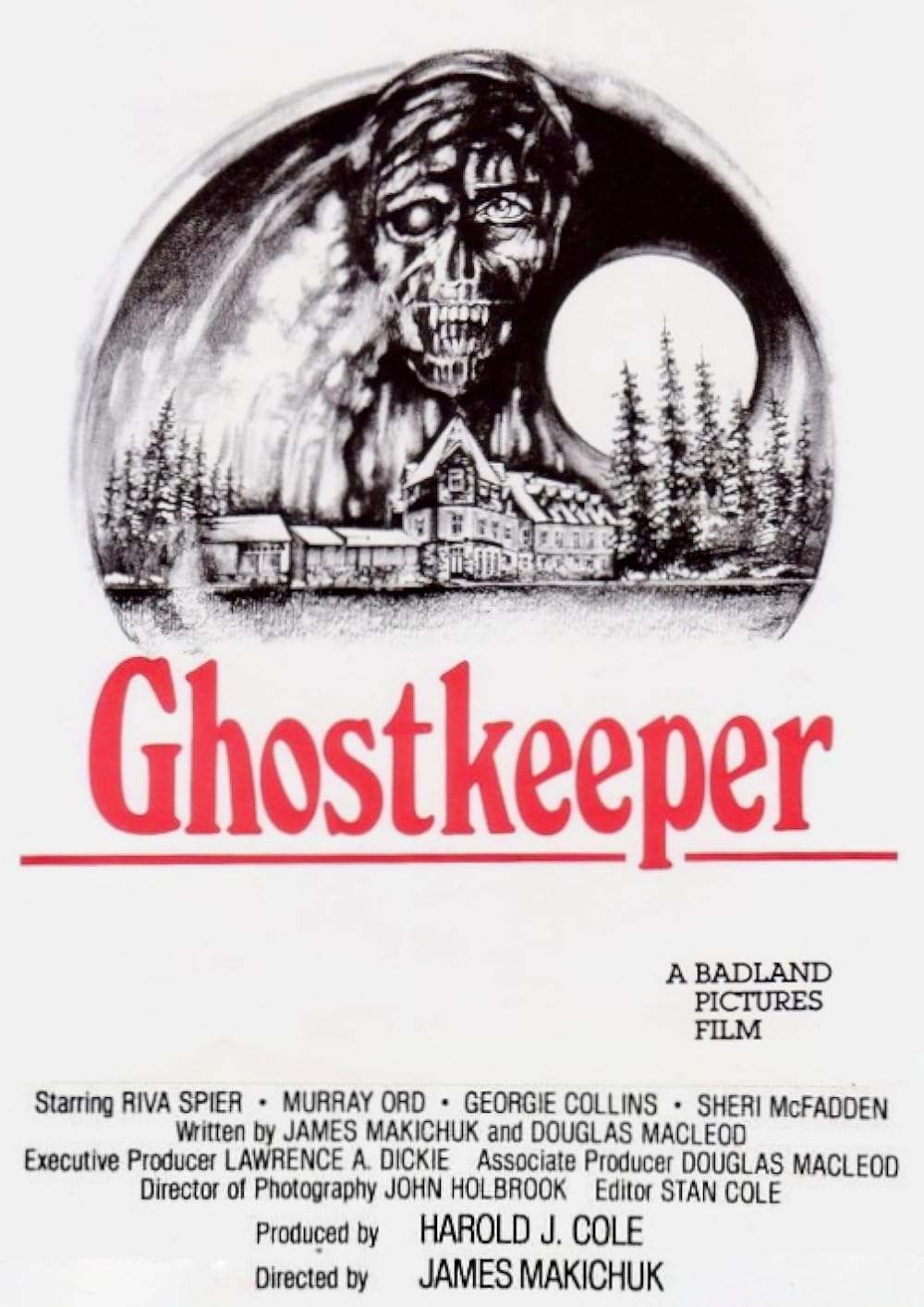
Now the wendigo (or windigo, in this) is an odd one in that it originates from Native American myth and thus is not the standard, undead, vampire. It is, however, cannibalistic and whilst sometimes drawn as an antlered spirit is also sometimes drawn as a person. It is safe to say it has crossover into the vampire myth/archetypes, especially when drawn by filmmakers, and is worth looking at on a case-by-case basis.

When it comes to this 1981 Canadian film, directed by Jim Makichuk it is more difficult as the film is more a slasher than anything else and we see little of the windigo (John MacMillan) and even less of any cannibalistic activity – indeed that is almost implied rather than shown. As such I have decided to look at this as a film that uses a vampiric trope, the supernatural creature who consumes flesh.

arriving on snowmobiles

It starts with a snowmobile pulling up outside a store high in the Rockies. Marty (Murray Ord) and Jenny (Riva Spier, Rabid) dismount and go in the store, the storekeeper (Les Kimber) proves not particularly engaging with them, especially as Marty comes off as an obnoxious entitled prat. He does direct Jenny towards some coffee to warm up. A second snowmobile pulls up and Chrissy (Sheri McFadden) comes in the store.

the lodge

They talk about where they are all staying (its New Years Eve and there is to be a party) and Chrissy speaks about exploring. The storekeeper warns them that a storm is coming in and suggests not exploring but they ignore him. After a ride they come up to what might be a logging road through the trees, with a keep out sign. Despite Jenny’s protests, they ignore the sign and head up it – at the end of the trail is Deer Lodge. Chrissy crashes her snowmobile and they decide to go in, despite it looking abandoned.

Riva Spier as Jenny

Now, just to note that the lodge was, situated in mountain snow as it is, reminiscent of the Overlook Hotel in the Shining. This hotel is smaller and is more a location than a character (and is not a vampiric building) but the similarity is there. They force a door open and the hotel does appear abandoned, they discover there hasn’t been a guest for five years but they later realise the heating is on. Exploring Jenny feels like someone is there and we see a face spying on her.

Georgie Collins as the Ghostkeeper

After night has fallen they hunker down next to a fire, with obvious flirting between Chrissy and Marty, He goes to find another bottle of wine and something attacks him in the kitchen. Chrissy and Jenny run in, after hearing his cry of surprise, and he has bested “it”, which turns out to be an old lady (Georgie Collins). She is assumed to be a caretaker (later she mentions that her son, Danny (Bill Grove), is around somewhere) and she reluctantly gives them rooms for the night. She never actually gives her name and is credited as Ghostkeeper.

Bill Grove as Danny

Whilst Chrissy goes for a bath, the couple argue. Jenny knows Marty wants to sleep with Chrissy and just wants him to be honest. For his part, being a prat as noted earlier, he just points out to her that she has no problem spending his money. As the film goes on it is suggested by the old lady that Jenny has the strength of character to take over (I’ll come to what) and Danny holds Chrissy underwater in the bath – not killing her but making her unconscious – and then carries her into an icy area of the hotel (basement area) and slitting her throat leaving her to the creature locked in there.

the book

So, the old lady is the caretaker of a windigo and beyond seeing it be given Chrissy we don’t see much action from it. An intertitle at the opening of the film suggests they are ghosts who live on human flesh to survive, Jenny finds a book on native legends that says that these giants can be kept by certain people, normally woman, who possess an ancient power handed down from one to the next along with a newspaper report on mutilated corpses. This supernatural flesh eating then is the trope, along with a concentration on the "familiar" servant. The film itself has a touch of the slasher (with Danny pursuing Jenny with a chainsaw), Marty quickly loses it and the film piles on lots of uncanny atmosphere.

John MacMillan as the Windigo

It is in producing this atmosphere, where the film is at its best, helped in no uncertain terms by Georgie Collins whose performance offers both strange and sinister in turns. The film itself is quite small, adding to the atmosphere, with a limited cast and feels very much of its time. Indeed, if made today then the intimation of flesh eating would undoubtedly have been more explicit but the focus on atmosphere offers the film more of a charm than it perhaps should have had.

The imdb page is here.

On DVD @ Amazon US

On DVD @ Amazon UK

Wednesday, May 19, 2021

Use of Tropes: The Retreat


The Retreat is a 2020 film that was directed by Bruce Wemple and is a film that concerns itself with the wendigo. However, there can be some overlap between wendigo and vampire and this uses a trope from the vampire genre very knowingly. It is also a film that plays with psychosis and insanity and whilst I felt that it did so very well, I could understand why some would dislike that aspect as it disjointedly bounces through perceived realities.

That sense of altered perceptions starts from the get go when we see Gus (Grant Schumacher) in the woods, seeming quite desperate, and then the voice of a psychiatrist (Peter Stray) cuts in, asking where he thinks he is and then moving to him and best friend Adam (Dylan Grunn) driving into the Adirondack High Peaks.

Rick Montgomery Jr. as Marty

Adam is getting married in two weeks and his bachelor party is him and Gus doing four days of winter hiking. Their base, before the hike, is an air bnb run by Marty (Rick Montgomery Jr.), who knows about the wedding and has got beers in. Also staying that night is another hiker, Ryan (Chris Cimperman), a heavy drug user who is looking to take an oft-untravelled route. Marty has several pictures in the house of the wendigo, in the antlered guise and when I said the use of tropes was very knowing it is within this scene that it is spelt out.

picture

Gus asks about the pictures and Marty explains that they are the wendigo and it is worth reproducing his dialogue. “The Native Americans, they have a legend that it protects the forest, but for the most part, it’s a monster…” “Well, it can take the form of say, a… a vampire-beast thingy. You know, hunt by the sound or the scent of blood, or it can come in the form of a… a spirit. It possesses a human and makes them a monster.” So, this is the primary trope, hunting for blood through the scent of blood. The spirit aspect leads us towards a form of vampiric possession therefore.

hiking

Marty goes on to say that it “Preys on the most selfish… the most corruptible.” So the guys start off whilst still dark (which makes Adam’s concern about reaching the lean-to where they will spend the next night whilst there is still light a tad alarmist, given he wasn’t concerned about losing direction in the dark when they set out). Gus is uncomfortable and there are shinning eyes in the dark but it is that first night when he suggests they drink hallucinogenic tea (that Ryan gave him) where things go wrong.

wendigo hunting

Adam had a sip, but Gus chugged the rest and, in the night, thinks he hears something. He leaves the lean-to in order that he might investigate and finds himself facing a wendigo. Now there are two types we see – one, the antlered kind, is always in the distance, watching and manipulating (we hear later that they like to psychologically play with their victims) and others like this, humanoid – perhaps previous victims turned? Gus gets a knife and manages to stab the beast as it pins him down but, in the light of day, Adam is missing and he eventually finds him stabbed and dead.

cannibalism

Gus loses it and the film is his story. We discover, through flashback, that he is selfish and petty – resenting Adam’s relationship for the way it impinges on their friendship. He buries the body in the snow but it then seems to follow him. There are moments when he is found and rescued, moments where Adam is alive, moments where his reflection speaks to him and moments back in civilisation. All this might be a result of the hallucinogen, it might be his guilt or it might be the wendigo torturing him. The idea that they hunt by the scent of blood is specifically returned to as a plot device and there is a moment of cannibalism.

horned wendigo in the trees

Is it a vampire film? No, whilst there can be crossover these are monsters (in reality or of the mind we are not sure) and the humanoid (or ex-human) ones seem animalistic in their actions (almost like hunting dogs), whilst the antlered one seems more like a malevolent forest spirit. However, the invoking of vampires in the dialogue, laying out the trope of the hunt for blood, makes this of genre interest certainly.

The imdb page is here.

On Demand @ Amazon US

On Demand @ Amazon UK

Saturday, April 06, 2019

Vitaortus Book 3 - review

Author: Dea Schofield

First Published: 2014


The Blurb: After the shape-shifting violence of the night of the Brumalia in Vitaortus Book Two, Devi Trevathan, Prime Channel, has trouble forgiving her new sanguinivorous friends. She refuses to speak to her Champion, Lord Alexander Gregory, but there is a price to pay. The Vitaortus now have a mysterious disease which threatens the plants’ survival. Meanwhile, bizarre happenings are spreading out from remote Pacific islands which Alec and company have been investigating. Ex-CIA assassins, demons, zombies, revenants, sorcerers, spirits–and of course, new species of Vampire—all figure in Gregory finding his way back into Devi’s good graces. But the Washington DC-based religio-political group, The Brotherhood, has dire plans for her, as well as for all mankind. A supernatural wild card has joined them with a nefarious plot to wreak havoc, terror, and apocalyptic consequences. Can Devi, with help from her supernatural friends, stop it?

The review: Is hosted at Vamped.

In Paperback @ Amazon US

In Paperback @ Amazon UK

Friday, September 16, 2016

Blood of the Dragon: The Journals of Vlad Draculya the Impaler – review

Author: David T Pudlevitcz

Illustrator: David St. Albans

Release date: 2015

Contains spoilers


The blurb: Being the only true journal of Vladislaus Tepes Bassarab called Draculya; Voivode of Wallachia, Knight Order of the Dragon, Defender of the Faith and the Realm of the Holy Roman Empire, Count of Transylvania, Protector of Moldavia, Bey of the Ottoman Sultans, Alchemist, Necromancer, Vampyre! Penned by his own dead hand.

The review: The first thing to say about Blood of the Dragon is that it is a tome of considerable length. Published as penned by Pudlecitcz and illustrated by St Albans the first conceit of the book is that it is a publication of the actual journal of Vlad III, bookended with chapters around the archaeologists forced to do so by the vampire.

This vampire is the creature of Stoker’s novel but it was Stoker who led the fight against the vampire and Dracula is (an inaccurate, according to the vampire) recollection of those events.

The bulk of the novel takes in the events surrounding the birth and life of Vlad III and ties vampirism in at an early stage in his life when Vlad and friends, whilst in Constantinople at age 9, are attacked by a vampire. Vlad is forced to help detect the grave and destroy the vampire – and this includes pouring the vampire’s blood over the boy. Unfortunately blood gets into a cut on Vlad’s tongue and the “vampiric ally” attaches itself to the boy – therefore much of Vlad’s bloodthirstiness in life was due to being a living vampire.

You can see this as a type of vampiric possession and Vlad is lucky to survive with soul/will intact and not become a minor undead. Eventually the ally is exorcised but Vlad will, subsequently, invite another ally to become a parasitic/symbiotic part of himself and this is what allows him to live beyond death.

The book invokes a variety of names and types of vampires, draws in some figures such as Erzsébet Báthory and the Comte de Saint-Germain (as periphery mentions more than anything) and layers fiction onto history (and some pseudo-history) in a satisfying way. The archaic turns of phrase actually work in context – especially compared to other books where they jar. Most fundamentally the book draws on Lovecraftian mythos at its heart.

This version of Dracula can walk during overcast days, when well fed, but temporarily dies in sunlight (the book actually misses, given it was supposedly written at the end of the 19th century, that sunlight was not listed within vampiric myth in any great measure, if at all, until the release of Nosferatu, eine Symphonie des Grauens). This Dracula feasts on negative emotion as much as the blood it is conveyed on and steals souls for his master as he does so (to reveal more than this is too much of a spoiler).

The most important thing the book manages to do is give the character a strong voice; it is a narcissistic, egoist voice, prone to self-contradiction and repeating salient points – but it is a genuine voice. Worth the entry price, indeed. 7.5 out of 10.

Saturday, December 19, 2015

Vamp or Not? Ravenous

Recently I received a message from Leila, who suggested I watch Ravenous with a view to a ‘Vamp or Not?’ The film was from 1999 and directed by Antonia Bird and I was aware of it, however I always assumed it fell simply into the cannibalism camp.

As it stands that is sort of correct, in fact it features a windigo (or wendigo) – a cannibalistic creature from Native American traditions. Given the tendency to link vampires with many other mythological creatures it is surprising that the wendigo is not tied to the vampire myth more often. Certainly the usual suspects – be it Summers or Bane – do not feature the creature in their volumes. That said they were tied together in the film Dracula, Lord of the Damned.

getting a new posting
After a Nietzsche quote, “He who fights with monsters should look to it that he himself does not become a monster” and a further anonymous quote that says “eat me” the film begins. It is set in 1847 and Capt. John Boyd (Guy Pearce) is being awarded a medal for his efforts in a battle. Following the ceremony the men are all given steaks but Boyd can barely look at his. As he cuts into the rare meat his mind flashes to bloody images of war and he runs from the table to vomit. The general, Slauson (John Spencer), tells Boyd that he is no hero and he is sending him as far away as possible – that being Fort Spencer in California. As we stay with Boyd he appears to be suffering from PTSD.

buried under the dead
Boyd arrives at the fort in winter and meets the forts oddball personnel – ably commanded by Col. Hart (Jeffrey Jones). We discover Boyd’s history. He was in a battle against Mexican soldiers but froze. His company were massacred and he played dead. He was dragged off and placed in a pile of bodies, the blood from the dead running down his throat. He pulled himself out of the pile but something had changed. We see him, in flashback, break a guard’s neck with his bare hands and he then took the fort.

Robert Carlyle as F W Colqhoun
Things change when Boyd spots a man in the dark, starving and exhausted. His name is F.W. Colqhoun (Robert Carlyle) and he tells the tale of settlers, lost as they were misguided by a Col Ives, and stuck in a cave through winter. He says that they ran out of food and, whilst he was out of the cave, one of the settlers died and he returned to find the others cooking the dead man’s legs. They ate their erstwhile companion but Ives changed and quickly their numbers dwindled. Colghoun left the last remaining woman with Ives and escaped.

the wendigo
Hart decides to investigate and takes a contingent out to the cave but they soon discover it was a trick and Colqhoun has led them to a place of slaughter. Before they go George (Joseph Runningfox), a Native American, tells Boyd that he believes this to be a tale of a wendigo and shows him a picture of the creature. When pushed he suggests that white men eat the flesh of Jesus and the skin with the picture on has Christ on the reverse, indicating a connection of sorts. Also, en route to the cave, Boyd actually asks Colquon if he felt different when he had eaten flesh and he affirms this, suggesting an increase in strength.

Guy Pearce as Boyd
Boyd ends up the survivor of the party, having shot Colqhoun and watched him sit up immediately afterwards. He leaps from a cliff to escape (or perhaps kill himself) and survives as trees break his fall – though he breaks his leg badly, with the bone stuck out of the flesh. We see him physically push the bone back in and then he eats of the flesh of another soldier. We then see him walk back to the fort – injured, yes, but able to walk on what is a severe break.

Cross on head
Later Colqhoun – under his alias of Col. Ives – suggests that he had been dying of tuberculosis and suffering from depression when he heard of the legend of the wendigo, how a man eating the flesh of another man would absorb that man’s spirit and become stronger but also filled with a terrible unending hunger that only gets worse with each cannibalistic meal. When Ives and Boyd have their showdown Ives paints a cross on his brow in blood and is always wearing a crucifix around his wrist, tying in the Christ (or perhaps antichrist) aspect.

blood on lip
So… is it Vamp? Well vampires are known to be flesh eaters as well as blood drinkers, on occasion, and Boyd was changed by drinking blood rather than full on flesh eating and, symbolically at least, came back from the dead. The film suggests a supernatural aspect with the quick healing (later we see Colqhoun’s bullet wound has not just healed but vanished without a scar) and increased strength. There is the theme of the endless, increasing hunger that is a common vampire trope. On the trail to the camp a man is injured and Colqhoun cannot resist and licks the wound whilst the man sleeps – waking him and forcing them to bind him. I can’t help but think that the reference to tuberculosis was purposeful given the US connection between the disease and vampirism.

a mad glint in the eye
I said that the usual suspects of the widened vampire myth do not seem to cover wendigos but some writers do. Grace L Dillon in the Ashgate Encyclopedia of Literary and Cinematic Monsters suggests “The windigo’s cannibalistic behaviour recalls the vampire, the zombie and the werewolf. ‘Like the vampire, it feasts on flesh and blood,’ writes Columbo.” (pp 591-592) In this case we have a change in men just by eating flesh, but that change is supernatural and confers some of the traits often seen in vampirism – hunger, increased strength and rapid healing.

Boyd at Fort Spencer
What seemed strange, within the plot, was the small intake that was necessary to turn. Whilst Colqhuon clearly had eaten of many, and we could (from a cannibalism perspective) almost assume a contraction of Kuru, Boyd seemed to have become wendigo from a small amount of blood entering his system – this gave him the strength to overcome his fear and take the enemy fort. One thing that seemed strange was the fact that cooked flesh was just as effective when it came to healing and also (implied) for turning - especially as the flesh seemed to be a conduit for energy vampirism given the comments about absorption of spirit. Whilst that indefinable something that would have screamed Vamp was not there, on the evidence in film I think suggesting that this is, in the broadest sense, Vamp is fair.

raising a glass
As for the film itself, it was a revelation. Carlyle and Pearce are as good as one would expect. There is a quirkiness to this and black comedy that belies some serious themes – such as PTSD and other mental health impairments (when we consider that Colqhoun was clinically depressed). The oddball unit reminded me just a touch of MASH. I’d seriously recommend this one.

The imdb page is here.