Showing posts with label upyr. Show all posts

Wednesday, March 22, 2023

Upyr – review


Director: Sergey Vinokurov

Release date: 1997

Contains spoilers


This is going to be a review with no score, once again, as I managed to see Upyr but with very rubbish subtitles – to the point that it was sometimes unintelligible, and yet it was a film that had a certain something and made me wish that more meaningful subs had been available.

This is a Russia of desolate towns and empty streets, of organised crime and corrupt police and, above all else, vampires.

the hunters

The film starts aboard a ship with an older man (Nikolay Lavrov) speaking to a younger one (Aleksey Serebryakov). It was here that my problems with the subtitles began as some of the conversation makes very little sense as translated. However it is clear that these are killers and the younger man has been in the business three years. They have a device to help them but both prefer more old-fashioned methods. Their conversation continues as they dock and go into a café.

death of a hunter

The older man excuses himself to go to the toilet. Eventually the younger follows after him and he is sat against the wall – he has been bitten, he says. The younger one knows what to do and retrieving a stake, stakes the older one. He continues his journey, intending to meet their customer, but instead one of the customer's associates meets the young slayer (for that is what he is) and suggests that he has rescinded the contract and recommends he gets the ferry before it leaves (stranding him there for two days). He beats the associate up.
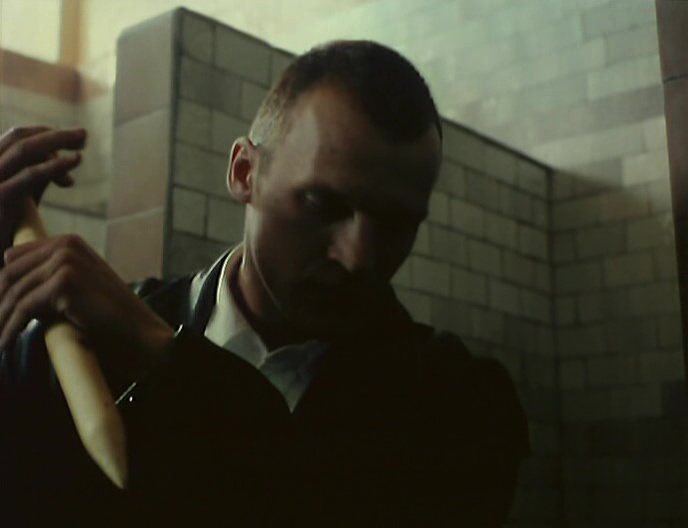
staking

He eventually gets to the customer's home but he won’t let him in – until he suggests he will take his fee and leave. Once the door is open, he turns against the customer and forces him to admit that his daughter is being used as leverage to make him rescind the contract. As things develop, we discover that the customer has been turned (though the daughter hasn’t). There is a dangerous nature drawn around the young slayer and the action sequences are energetic but in short, accurate bursts.

staked

So we get quite a bit of staking and discover that vampires cast no reflection – and thus he can distinguish organised crime thugs from vampires. I have seen the end sequence, where he meets the primary upyr, described as Tarkovskian and that is a lofty description but fair, I think. The film has a rollicking soundtrack provided by Tequilajazzz, I just wish I had been able to follow the dialogue better than I could.

The imdb page is here.

Saturday, November 21, 2015

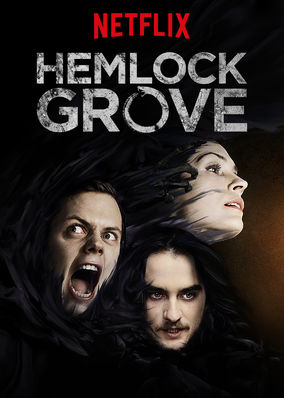
Hemlock Grove – season 3 – review


Director: various

Release date: 2015

Contains spoilers


Hemlock Grove is a Netflix exclusive and I was very impressed with season 1, it was interesting and a new spin on old tropes – especially as, at heart, it was a Frankenstein’s Monster, Wolfman, Vampire rehash. However, when Season 2 was released I was less impressed. I felt it was missing a vital element that season 1 had carried and had side-lined its more interesting characters.

Famke Janssen as Olivia
As Season 3 starts the daughter of Roman Godfrey (Bill Skarsgård), our resident vampire or upyr, has been kidnapped by the reptilian Dr Spivak (J.C. MacKenzie, Dark Angel: Love in Vein) and Roman and his gypsy (and werewolf) friend Peter (Landon Liboiron) are desperately searching for her. Peter has also given the family blessing to Andreas (Luke Camilleri) to marry Peter’s clairvoyant cousin Destiny (Kaniehtiio Horn, Embrace of the Vampire & Being Human (US)). Shelley (Madeleine Martin), our Frankenstein’s Monster equivalent, has been released from custody due to lack of evidence in the murders she was accused of, however – to Roman’s ire – it is into their mother’s custody. Said mother, Olivia (Famke Janssen), seems back on bitchy form if destitute as Roman has cut her off from the Godfrey fortune.

despondent and suicidal
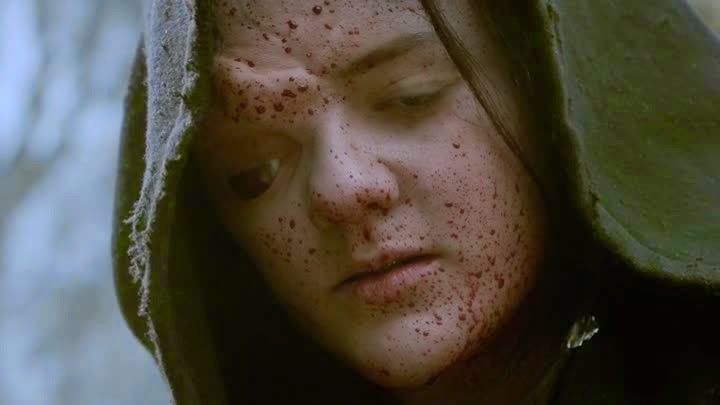
So that is how we begin and the series follows several threads. There is the gypsies using the wolf pack (there are more wolves than Peter in town) to hijack caviar and sell it to the Croatian Mob and the subsequent fallout when Andreas tries to rip the Mob off. There is Shelley, despondent and suicidal, finding friendship and love amongst Hemlock Grove’s homeless community. There is the search for Spivak and the attempt to get Nadia back. The season concentrates more than it has done on mad scientist Johann Pryce (Joel de la Fuente) and give the character space to really shine and develop.

Camille De Pazzis as Annie
There is also the arrival of the mysterious Annie (Camille De Pazzis), an upyr who comes into Roman’s life. Through her we discover that there is a vast global community of upyrs and Roman is able to discover more both about himself and about Spivak, who is actually a creature from upyr myth. Later we discover that they were evolutionary competitors that the upyr virtually wiped out. At the same time we see people attacked, and, through the attackers POV, we see they have a strange visual function that highlights their prey.

felt like zompire
Eventually it becomes clear that it is upyr being attacked, the assailant ripping the victims chest open and eating the heart, and when Roman and Annie kill an attacker they discover that it is a diseased upyr. The disease is a parasitic tumour that invades the central nervous system, causing irrational madness and a hunger for their own species’ flesh (and heart particularly it seems). The tumour wraps around the optic nerve causing the visual tell by highlighting upyr but also giving the infected a massive intolerance to light (they freeze when caught in bright light). They are diseased, rotting, (fast) zombie-like and ultimately self-consuming. I’d say they can happily be called zompires. Olivia develops the disease but why she takes so long to lose her mind when others seem to turn almost instantly is unknown.

Pryce and Roman
This season was excellent. Famke Janssen was on fine form as Olivia and the Shelley storyline was marvellously handled with subtlety and just a dash of the Beats. I mentioned already the Pryce storyline and I have to say the promise from one of the promotional posters of "no happy endings" was (mostly) not stinted on. After a disappointed mid-season this left Hemlock Grove on a high. 7.5 out of 10.

The imdb page is here.

Saturday, July 26, 2014

Hemlock Grove: Season 2 – review

Director: Various

First released: 2014

Contains spoilers

I liked the first season of Hemlock Grove. I felt that the way they did the monster mash was interesting. The lycanthropy had some nice twists, the idea of an upyr who didn’t know his own nature worked well and the variant of the Frankenstein Monster was fantastic.

So when season 2 was released to Netflix (the series is a Netflix original) I had much to look forward to. Unfortunately the series fell short for me this time around.

transforming
The werewolf of our tale, Peter Rumancek (Landon Liboiron), left Hemlock Grove and is on the road with his mother Lynda (Lili Taylor, the Addiction). They are at a Romany funeral when it is raided by the feds. Lynda is arrested for a variety of charges and taken to Hemlock Grove correctional facility, forcing Peter to return there and stay with his psychic cousin Destiny (Kaniehtiio Horn, Embrace of the Vampire & Being Human (US)). In order that he might get the money for a lawyer he grifts a couple of drug dealers into buying a "traditional gypsy drug" formula by giving them an innocuous fluid and then partially turning to make them feel that they have tripped – unfortunately it is turning on the wrong moon and that way leads to becoming a feral, murderous vargulf.

the baby
Meanwhile newly awaken upyr Roman (Bill Skarsgård) has taken over biotech firm Godfrey industries whilst his mother, Olivia (Famke Janssen), recovers – Roman bit off her tongue at the end of the last episode. He has his daughter hidden in his new house, a baby girl with unnaturally blue eyes. If Roman was a bit of a spoilt brat in the first series he acts it even more so when faced with the responsibilities of management. He also seems to have completely forgotten about the upyr ability to control minds – but more on his powers later.

Nicole Boivin as Shelley
You see one problem I have with the second season was that some of the best characters are sidelined. Shelley (Nicole Boivin) is on the run (the authorities think the giant girl is both a monster and murderer) and so after fighting the vargulf from the first series (that pops out of the grave as she wasn’t beheaded) she hides in an abandoned house for most of the series. Olivia is sidelined from being a Dynasty level bitch queen to recovering invalid. We also discover that she is becoming human – the mad doctor Johann Pryce (Joel de la Fuente) believing it is something to do with the effect of upyr venom on one of their own kind. To be fair, in the last episode Olivia is very much back.

a serial killer cult?
The main story sees Roman and Peter having to rebuild their trust whilst sharing premonition dreams of murders made to look like accidents, which are being committed by perpetrators wearing blank masks. Meanwhile a girl comes into their lives called Miranda (Madeline Brewer) who falls for them both but also starts lactating and feeding Nadia (the baby). Of course both stories become conflated and the Order of the Dragon have their fingers in the pie too. So, what about the vampirism?

leeches
Well, Roman spends a lot of his time, at first, trying to control the hunger. He pays a man to wear leeches and then collects the bloated parasites as a snack but that only satisfies so far. Then it is the genre standard trying to (and failing to) control his hunger and, to be honest, it is a little tired as a device – especially in the second season of a series – that said it does lead to a nicely gory dream sequence with a stretched mouth and as much blood as a Japanese splatterpunk film. Where it gets more interesting is when Pryce reveals that upyrism is a retrovirus and that he can potentially cure it. This does cause Roman to be less powerful than he might have been and might have answered the mind control except, of course, that didn’t explain why he didn’t have/use it earlier on.

a moment of gore
The season wasn’t awful, but as I have intimated I felt there was something missing. That something almost seemed to return at the finale (which was in episode 10, the season shedding its length by three episodes) until we get a pay-off to a storyline that just seemed so convoluted, under-expained and ridiculous that it added a dull clang to the sharp chime of the final episode. This one was struggling as a season and perhaps they should have stayed at 1. That said it had some moments within it to make it better than it might have been. 5 out of 10.

The imdb page is here.

Thursday, January 30, 2014

The Vampire in Slavic Cultures – review

Editor: Thomas J Garza

First published: 2009

Contains spoilers

The Blurb: Eight hundred years before Bram Stoker gave us the West's most memorable vampire in Dracula (1897) and long before the exploits of Vlad "the Impaler" Tepes horrified Europe (1431-46), the Russian Primary Chronicles write of a Novgorodian priest as Upyr' Likhij, or Wicked Vampire (1047). The Slavic and Balkan worlds abound in histories, legends, myths and literary portraits of the so-called undead, creatures which draw life out of the living in order to sustain their own. These stories of the vampire simultaneously fascinate and horrify, as they draw the reader closer to an understanding of death and the undead.

This unique volume brings together a wide variety of historical, critical, and literary texts that reveal and explore the origins, growth, and development of the vampire myth from its beginnings to the 21st century. These texts explore the vampire within the region of its origin in Western cultures: the lands of the Balkans, Eastern Europe and Russia. From the earliest recorded tales to the recent offerings of Russian vampires on film, this volume gives the reader a dynamic perspective on one the world's most enduring cultural phenomena, the vampire.

The Review: Normally I try to avoid comment on price when doing a review – content is more important, and I’d expect a higher price for an academic reference book. However I must mention that (at time of review) the new volume price for this book, on Amazon UK, has only just (for the first time) dipped below £100. On Amazon US it is still over $115.

Now, trusting I didn’t spend anywhere near that for my used copy, and despite the fact that it is a large tome, the contents of this would seem to be problematic given the price. Firstly it is made up of extracts from other works (all accredited) as well as having a section of literary offerings. There are extracts ranging from the great – for example Keyworth’s Troublesome Corpses – to the not so great – I still have no love for Konstantinos’ Vampires: the Occult Truth. However extracts from books such as Dundes’ The Vampire a Casebook and just about anything by Perkowski were noticeable by their absence. Perhaps permission to reprint couldn’t be gained, however missing these when including some of the lower quality extracts seemed at best a mistake.

The first section contains several definitions of vampires. Pulling these together from a variety of sources was a great idea. It allows the student to see several variants. However it has absolutely no commentary and this is a problem. So, when we get mention of vampires taking the form of a monstrous bat, Garza does not inform the reader that the primary association of bats and vampires comes from the novel Dracula. Given this is a reference book I would have expected some commentary but the book contains no primary commentary on the extracts, hence suggesting that Garza is an editor rather than author at the head of the review (he does translate a couple of pieces).

Worst still is that the reference for each extract dates the extract to the publication Garza used. Thus, when we read the definition of vampire from Dudley Wright’s Vampires and vampirism it offers the date of 2001 (the date the specific publication it was lifted from was reprinted) but the reader may be unaware that the original publication date is 1914. Looking at the date enables us to track changes in genre/folklore thoughts (to be absolutely fair some of the literature, later in the volume, carries an original publication date at the end).

Worse comes with the referencing and footnotes from the extracts. Some have them intact, some don’t – and we know some should have footnotes because the footnote’s citation number is still in the text but the foot (or end) note is nowhere to be seen. At the best this was lazy and unhelpful.

There are sections on both Vlad Ţepeş and Erzsébet Báthory. In the introduction Garza admits that neither was Slavic but suggests that “the geographic proximity of their dominions to the lands of the Slavs clearly had an effect on the development of the vampire myth in those neighbouring countries,” No evidence is offered for this by Garza, though he does suggest that both figures were given the “moniker of ‘vampire’”. Certainly that never occurred until post-Stoker for Ţepeş. Then again, given the cover of the volume I shouldn’t have been surprised by this content. Anyway, the sections themselves carry little in the way of balanced extracts. Though I personally suspect Báthory was guilty (at least to a degree) of the crimes accused (though they were used by her enemies to their advantage) I would have liked to have seen a “she was innocent and framed” article as a balance. As for Ţepeş an extract from Dracula: Sense and Nonsense or similar was sorely needed to offer a balanced viewpoint.

I was mystified as to why an essay on The Golem was included – again commentary would have explained Garza’s thinking, perhaps he expected readers would only be people with his lesson plan? I was also mystified as to why an extract from Blavatsky’s Isis Unveiled was included, only to be followed by a Montague Summers’ extract that contained the very same extract!

I was rather excited about the literature section. Though I have read the Night Watch (there is an extract from this), Viy and the Family of the Vourdalak there were others included that I had been unaware of and wanted to read. Positively I discovered Jan Neruda’s The Vampire and Iván Turgénieff’s Phantoms (even if I had to find the date of publication from other sources).

I was bemused at the inclusion of the extract from Dracula and the full text of the Vampyre: A Tale. Let us look at the title of the book again – In Slavic Cultures – as important as these two works are, they are not from Slavic culture (though some of the lore used by Stoker is). Other inclusions that were actually from Slavic culture (primarily Russian, it has to be said) bemused me just as much. Karamzin’s the Island of Bornholm is certainly gothic but may not even have a troublesome corpse, never mind a vampire (and is deliberate in its obfuscation). There were four Pushkin poems included – ish. I say ish because The Bridegroom was included twice. A commentary explaining why the different translations were included would have been useful. More useful would have been an explanation why The Bridegroom (x2) and Evil Spirits were included as neither contains any hint of vampirism. At least Pushkin’s the Drowned Man has a troublesome corpse in it, though whether it was a vampire in the strictest sense of the word is highly debatable.

Pelevin’s A Werewolf Problem in Central Russia is fantastic – but has no vampire aspect (so why not an extract from his (currently untranslated) vampire novel Empire V?) Indeed why not two extracts (the vampire parts obviously) from the Probratim: A Slav Novel by Prof. P Jones (1895)? (If you are interested, my reference book, The Media Vampire, covers this work pp136-144!) Indeed why not an extract or the full text of Milovan Glišić’s Posle Devedeset Godina or 90 Years Later – unfortunately not available yet in English but based on pure Slavic vampire lore and the legend of Sava Savanović. The volume’s final section contained vampire lyrics in Russian popular music, which is fair enough if you want that sort of thing.

To be fair, the interesting sections were interesting, but the book has one more sin that needs to be recounted. It doesn’t have an index, so its academic use becomes further limited. In total honesty the book confounded my expectations as I expected a fresh reference work that explored the Slavic vampire rather than a regurgitation of other books, many of which I had. If you see it cheap you might want it, if you are in Garza’s classes then it expect it becomes much more useful but at full price it comes with a health warning. 5 out of 10.

Friday, May 24, 2013

Hemlock Grove – season 1 – review

Director: Various

First aired: 2013

Contains spoilers

Hemlock Grove, produced by Eli Roth (who directed an episode), is unusal in the fact that it was a series developed for and broadcast via online provider Netflix and might be a herald of a new way of producing interesting series.

It had a cast that included well-known actors, effects that worked rather well and has been likened to Twin Peaks. In that it is set in a small town and is focused on the murder of a young woman then maybe it is. However at its heart it is a new and interesting twist on the monster mash.

Landon Liboiron as Peter
The murder (only the first) takes place on a full moon and is brutal. Attracted to the death are two very different young men. Peter Rumancek (Landon Liboiron) is a young man of gypsy extraction. He and his mother, Lynda (Lili Taylor, the Addiction), have just moved to a deceased uncle’s trailer. Early on a young, inquisitive girl called Christina (Freya Tingley), suggests that (because of his finger length) he is a werewolf and actually spreads that rumour through the school.

transforming
The thing is, he is actually a werewolf and I was impressed with the idea around the change. His human eyes fall out, he sloughs his skin and becomes a quadruped wolf (that eats his human body remains). He is also not the killer. There is an insane werewolf out there and he decides he wants to find it, especially when a werewolf hunter, Dr Clementine Chasseur (Kandyse McClure), comes to town. Possing as a federal wildlife agent, she is an agent for the church who is initiated into the Order of the Dragon.

Shelley is the Frankenstein Monster 
The other inquisitive youth is Roman Godfrey (Bill Skarsgård), heir-apparent to the Godfrey estate and son of Olivia (Famke Janssen). His father, JR (Paul Popowich, Vlad & Vampires Anonymous), committed suicide when he was a child. The Godfrey institute is a bio-tech institute that his uncle Norman (Dougray Scott, Perfect Creature) and Olivia have joint interest in. Now I said this was a monster mash and his sister Shelley (Nicole Boivin) died as a baby and was resurrected through a phosphorus treatment by mad scientist and Godfrey employee Dr Johann Pryce (Joel de la Fuente). This has left her deformed, a lumbering giant who cannot speak (bar through a voice program on her smartphone) but is gentle-hearted and intelligent. She is Frankenstein’s Monster essentially; her name is a give-away, of course.

born with a caul
That just leaves the vampire and that is Roman. Peter immediately recognises him as an upyr but also recognises that the rich boy doesn’t know what he is. The word vampire is not used but we get clues. The fact he was born with a caul is mentioned and he discovers that he can make people do his will (his nose bleeds afterwards). His mother is an upyr, she is addicted to a liquid that you take as an eyedrop and is produced by the gypsies. It takes the edge off the hunger.

using mojo
We do later see the end results of a feed, the victim flayed of her skin, the neck broken but still alive. Olivia uses Johann to cover up her tracks. Roman’s confused/repressed identity comes out in a need to cut himself during sex, fascinated with the blood on his fingers. At one point he slashes his chest open when receiving fellatio. However it is only in the very last episode that the vampirism is actually revealed to him and (fully to) the audience.

fangs revealed
We hear Olivia’s backstory, her pregnancy with a gypsy slave, the disgrace she brought on her family, her eloping and subsequent suicide. We discover the numerous attempts over the years to have a child, all of them dying or being killed as the upyr aspect had not appeared until Roman. We also discover that to truly become upyr they must take their own lives. Other lore includes the principle that a full upyr heals quickly (Olivia is shot with little impact) and they can walk in sunlight. Interestingly (and unconnected to Clementine) Roman suggests that he and Peter are the Order of the Dragon too.

Bill Skarsgård as Roman
I really enjoyed the series, it was interesting, had some varied subplots, such as Roman’s cousin Leitha (Penelope Mitchell) falling pregnant to, she claims, an angel and the mysterious Ouroboros project. The acting was strong – the two main lads took a little bit of time to find their feet but eventually developed a good chemistry between them. Can the standard be maintained in a further series? I hope so as it was stronger than some of the main TV produced series. 7 out of 10.

The imdb page is here.

Monday, January 28, 2013

Troublesome Corpses: Vampires & Revenants from Antiquity to the Present – review

Author: David Keyworth

First Published: 2007

The Blurb: Since earliest times man has feared troublesome corpses – the bodies of the dead which do not lie still and decompose, but rise again to revisit the living. European folklore is particularly rich in tales of vampires and reanimated cadavers. The Undead take many forms, as do precautions to avert an attack and methods of destruction should precautions fail.

What distinguishes vampires from other revenants? What metaphysical agencies empower the Undead and how do theological contortions help explain them? And why did popular belief in the existence of the undead wane during the eighteenth Century? These and other vampiric questions are addressed in David Keyworth’s encyclopaedic survey of troublesome corpses.

The Review: It is difficult to review this book without using words such as seminal, wonderful and necessary: so there you go, I got them out of the way.

Heyworth’s book explores the concept of corpses who just won’t stay still and the main question within the book is, “what is the difference between a vampire and the other types of undead?” This is not an etymological question and the simple answer seems to be blood. The vampire panics of the eighteenth century had revenants that were not only called ‘vampire’ for the first time (in print at least) but drank the blood of victims. Blood did come into earlier folklore but it was not as central as it was in the eighteenth century vampire reports/folklore.

To take us on this journey Keyworth takes us from Antiquity, through Medieval writing all the way to the Eighteenth century and beyond that, touching onto the twenty-first century. However, keep in mind that this is an exploration of the vampire of folklore, media vampires need not apply except in passing. I found the discussions around the revenants of medieval England and the Scandinavian draugrs particularly fascinating.

It has to be said, however, that the book is so much more than the above. It looks deeply into all aspects of the vampire reports and folklore with impressive referencing and useful indexing.This book has been either the source of, or has informed, several threads on the Facebook Vampire Lore and Legend page and is, in itself, invaluable to all students of the vampire. 10 out of 10.