Showing posts with label created by hypnosis. Show all posts

Saturday, October 30, 2021

Use of Tropes: Tales of Terror


I was contacted by Leila who wondered if I had given thought to the potential vampire aspects of the segment Morella in the 1962 Roger Corman vehicle Tales of Terror. In truth it was one of Corman’s Poe themed films I had not seen and so it seemed like a mighty fine excuse to watch it, if nothing else. After all this was a film with an exceptional genre cast – with Vincent Price front and centre in all three segments and Peter Lorre (M) and Basil Rathbone (Queen of Blood, the Magic Sword & Madhouse) supporting in a segment each. The screenplay was by Peter Matheson.

However, before I look at the film I wanted to just touch on interpretations of Poe’s story, which was published in 1835. In the Forlorn Demon (1953) Allen Tate made an observation regarding “Poe's heroines—Berenice, Ligeia, Madeline, Morella, {who} with the curious exception of the abstemious Eleanora—are ill-disguised vampires”. Indeed, I have looked at the Fall of the House of Usher, from whence Madeline comes, for it’s play with vampire tropes. Twitchell likens Morella to a lamia (which he ties into the vampire myth) mentioning her cold hands and almost mesmeric eyes.

Locke's House

The story has Morella die, in childbirth, leaving the unnamed narrator with a child who he does not name (until the story climax) but who, as she grows, looks more and more like her mother. It is clear in the original that the narrator was tied to his wife but not in love (indeed she repulsed him eventually) but doted upon his daughter. Not so in the film, which begins with the now adult (26-years old) daughter, Lenora (Maggie Pierce), returning to the family home to visit her father Locke (Vincent Price). She arrives at night and the coachman has to return to Boston, so she dismisses him thinking her father’s servants will help with her luggage.

Lenora arrives

However, no-one answers the door and she lets herself in. The inside of the mansion is festooned with cobwebs and no-one answers her calls. In the dinning hall the remains of a feast are buried in the dust of years and cobwebs aplenty (and a large spider to make the heroine scream). The kitchen is in marginally better shape. She finds her father and we hear that he has had no contact with her, bar paying for her tuition, having sent her away. She wanted to see him and he retorts that she has and should leave. On his own he speaks (to Morella (Leona Gage)) and says that her murderer has returned.

Morella mumified

Eventually truths start to emerge. The mummified corpse of Morella lies upon a bed – Locke unable to bear the thought of her buried in the earth. It also transpires that Lenore is dying, hence wanting to reconcile and her father quickly softens. In the story the narrator gives the child Morella’s name at baptism, when she is ten, and the child dies as he seems to hear the mother, from her tomb, say “I am here!” He then carries her to the vault to find the corpse of Morella gone. Tate suggests, “that the daughter is no real daughter but, as Morella's empty "tomb" reveals, Morella herself come back as a vampire to wreak upon her "lover"

spectral touch

In this film, as father and daughter reconcile and Locke says “You have come home at last”, we hear the spectral voice of Morella say “At Last!” and see the complexion of the corpse change from mummified to something more lifelike. Lenore goes to bed and we see a shadowy spectral form of Morella leave her corpse and move through the house. I was reminded of the folkloric theory of the vampire actually remaining in its grave and its spirit wandering the neighbourhood. It reaches out to Lenora who screams. When Locke gets there she dies, but then breaths again after a moment, only to pass again. He covers her up but she makes a noise, he moves the sheet but the blonde Lenora is now the brunette Morella. Running back to the room where Morella’s corpse had lain, he sees Lenora now mummified on the bed…

Locke and Morella

It is easy to see, given the connection previously made by academics between Poe’ story and vampirism, how some tropes could stray into this. In this Morella has waited to return to avenge herself – not only on the child she blamed for killing her but also Locke, who she strangles as the house burns around them – as Tate suggested the returned Morella “{wreaking} upon her lover” though the narrator survives and Locke is killed. In this, it should also be noted, Locke adored his wife, she went unburied as he couldn’t bear to be parted and rather than doting on the child, he sent her away hating the one who had murdered his wife. Thus, Morella is the restless dead and she appears to need Lenora’s life to come back. Whilst she seems to possess the body, it does physically transform (and swap clothing, it should be noted) and the corpse takes on Lenora’s form – one might argue she has literally taken her daughter’s life so she might live. This lasts until her revenge is wreaked and she falls, becoming Lenora once more.

hypnotised at the point of death

I also want to mention the segment The Case of M. Valdemar, where Price plays the titular character – a dying man who has turned to the sinister Carmichael (Basil Rathbone), a mesmerist, to help manage his pain on condition that he allows Carmichael to hypnotise him at the point of death. This occurs and then Carmichael holds him in a state between life and death (despite the voice of Valdemar begging for release). I mention this because this reminded me of the Bloodthirsty Doll, which was released in 1970, in which the vampire is created by hypnotising her whilst dying.

ambulatory and rotting

The other thing to mention is that in this the state is kept for some time (we have an establishing shot showing a passage from rain to snow), though in Poe’s The Facts in the Case of M. Valdemar (1845) we are told directly that death had been arrested for nearly 7 months. In the film, however, Valdemar is able to get up and attack Carmichael to defend his widow (Debra Paget) rotting as he moves towards him. In the story, released by the mesmerist, we graphically get, “within the space of a single minute, or even less, shrunk -- crumbled -- absolutely rotted away beneath my hands. Upon the bed, before that whole company, there lay a nearly liquid mass of loathsome -- of detestable putridity.” A literary prototype for vampiric rapid decay in cinema, well over a century later.

The imdb page is here.

On Demand @ Amazon US

On Blu-Ray @ Amazon UK

Saturday, May 05, 2018

Honourable Mention: Carmilla Hyde


This was a 2010 Australian movie that was written and directed by David De Vries and it isn’t a vampire movie. However, by the name you can tell it takes some of its premise from Carmilla and there are common tropes running through it.

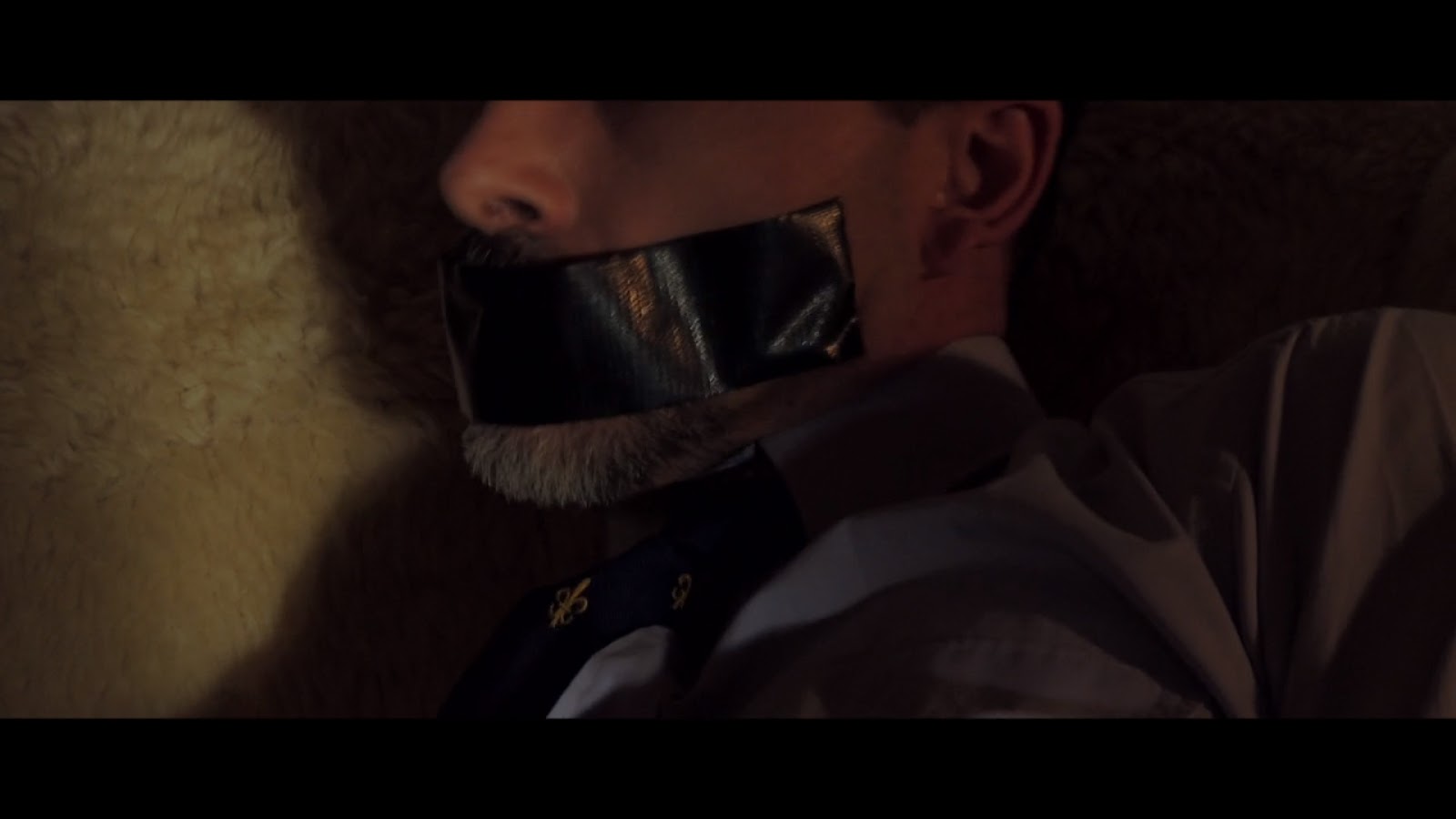
The film starts with a woman, Carmilla Hyde (Anni Lindner) sat with a bruised, bound man, Dr Webster (Sam Tripodi), with duct tape over his mouth. She holds a cut-throat razor. As we go into the credits we see comic books, as well as the covers of Carmilla and Stevenson’s Strange Case of Dr Jekyll and Mr Hyde.

Carmilla not Millie
Millie (who is also Carmilla) is a shyly reserved young woman who shares a large house with Sara (Nina Pearce). Sara owes back rent, that Millie has been covering. Sara is with Nathan (Cameron Hall), whom she describes as a f*ck buddy. Millie, on the other hand, is bookish (she’s reading Nietzsche’s Beyond Good and Evil) and a virgin. Sara’s friend Britt (Georgii Speakman) wants to move in but the lease is in Millie’s name (so they couldn’t get rid of her from the house) and Millie isn’t interested in renting the spare room out. Britt hatches a plot to bring Millie down a peg or two.

poster
When they are all in one-night Sara takes Millie off for a daring makeover. When back downstairs she is given a glass of wine that Britt has spiked (its never said what with, one assumes it is some sort of date rape concoction that removes inhibitions). When she awakes in the morning there is blood on her sheets and she has a memory gap. She suggests to Sara that she has been raped but gets little sympathy (she was up for it, her housemate says) and then Britt emails her a film of her having sex and dirty talking.

Dr Webster's a bit tied up
She goes to a psychologist, Dr Webster, who persuades her to let him use hypnosis. He explains the limitations of hypnosis – limitations that the film then abandons for the sake of narrative – and helps her to remember. She asks if he can make her forget and he asks what she wants. She says to be free of guilt and inhibitions and he opens that possibility. As she comes out of the trance (but still under the altered state of the hypnosis) she releases a stream of expletives.

becoming Carmilla Hyde
She is more assured, more confident and asks how long it will last – he says it will last for a short while but she will regain her inhibitions by the time she next awakens. He suggests that he could give her a post-hypnotic trigger that will place her in the state as she wishes – the trigger is drinking a glass of red wine and speaking a trigger word. She chooses Carmilla Hyde as her trigger phrase and, with her new-found confidence, she looks to gain revenge – aiming to seduce and bring down both Nathan and Britt. However, memories supressed by Millie are surfacing through Carmilla, revealing past trauma.

Britt and Carmilla
So what is interesting here is that one of the ways the vampire genre can be interpreted as a metaphor is that the fangs and bite represent penetration. In this case she is literally penetrated (there is hymen bleeding) and this leads to her turning – in this case to a new personality, indeed it is suggested that Carmilla Hyde (as she insists on being called) is a separate personality. Whilst she isn’t a vampire, she is certainly a vamp. Sexually active and sexually aggressive (which, of course, the female vampire was portrayed as, certainly in the classic 19th century tomes). Also interesting is the use of hypnosis, as we have a small cadre of vampire stories/films in which hypnosis creates the vampire (Blood of Dracula & the Bloodthirsty Doll) or impacts the appearance of the vampire (Dracula).

Nathan and Britt
Before the hypnosis, when coming to terms with the rape, Millie throws a figurine of Christ – perhaps showing a conscious abandonment of God – the cause of the vampirism in the 1992 Dracula. When Millie first triggers the change, she raises a glass to a poster that she has of Carmilla and there are two moments when the story is partially quoted with an abridgement around “In the rapture of my enormous humiliation I live in your warm life, and you shall die, die, sweetly die into mine” and also the abridged, “You will think me cruel, very selfish, but love is always selfish… …How jealous I am you cannot know. You must come with me, loving me, to death; or else hate me and still come with me… …Love will have its sacrifices.

repressed memories
She also gains the power to hypnotise others. Whether there was a goof in running order around this I don’t know. She is eventually given pills that will induce a hypnotic state and uses these to put more than one person in a trance – but the first person she seems to hypnotise is before that point – though they have undergone a head trauma, one cannot see how she was able to just hypnotise them unless one accepts she has powers or if the scene ordering was changed and originally the scene was meant to occur after she was given the pills.

Cameron Hall as Nathan
I must repeat that she isn’t a vampire (Britt does mention the V word but in relation to the origin of the name Carmilla). However, all the above does seem to be drawn from a merging of vampire tropes and Jekyll and Hyde tropes (remembering that vampires and Hyde have been drawn together before, for example in Daughter of Dr Jekyll). The power of hypnosis seemed a bit too invasive, by the end of this, and it relied on a massive suspension of belief but there are those tropes and the tie to Carmilla.

The imdb page is here.

Sunday, June 12, 2016

The Vampire in Science Fiction Film and Literature – review

Author: Paul Meehan

First published: 2014

Contains spoilers


The Blurb: This examination of the history of vampires within the science fiction realm also analyses the role of science and pseudo-science from the 18th century to modern times. The vampire's connection with science fiction is traced to its literary origins during the Victorian Era in seminal works by Bram Stoker, H.G. Wells, Arthur Conan Doyle and other writers of the period and later refined by modern SF writers such as Richard Matheson, Whitley Strieber and Brian Aldiss.

The history of the science fiction vampire in the cinema, from the silent era to the 21st century is given in detail. More than 60 films are discussed, including works by such acclaimed directors as Roger Corman, Mario Bava, David Cronenberg, Guillermo Del Toro and Steven Spielberg. The book treats of time-travelling vampires, spacefaring vampires, future-noir hemophages, giant mutant bats, vampiric plants, blood-drinking mad scientists, cyber-vamps, half-human hybrid dhampirs and bloodsucking extraterrestrials - the ever-popular children of the night.

The review: I do like a vampire reference work and it is always nice to find one that looks at a less trodden path of the genre. This, therefore plugged a definite gap in the market but, like all reference books, it did contain one or two controversial claims – however the genre is so wide that is to be expected.

Of course, regular readers will know that it was this book that led me to examine the film the Quatermass Xperiment and was, from my point of view, worthwhile just for that. As well as that his inclusion of L'Atlantide, provided a novel and films that I will be examining at some point. There was a nice examination of the roots of the vampire in science fiction through the late 19th century inclusions (Dracula, for instance, could be said to be science fiction and War of the Worlds had a vampiric element).

Meehan was wrong when he supposed – having looked at the Blood Beast Terror - that “any connection between moths and vampires is obscure other than the fact that they are both creatures of the night”. He does mention Dracula’s control of them but the moth and butterfly is a part of Slavic folklore – as noted by Milovan Glišić in After Ninety Years. A minor thing really, as it is not the most mainstream of lore and certainly won’t have influenced the makers of the mentioned film, but nonetheless it is extant lore.

Not all of the entries I agreed with. I haven’t read George du Maurier’s Trilby but I have watched Svengali (1931) and do not believe there is an aspect of psychic vampirism around it. I also have to mention that whilst listing the wonderful film Goke, Bodysnatcher from Hell was welcome, the claim “Japanese culture is not one to embrace vampirism” is not one supported by the facts – indeed the Japanese have produced many fine vampire films and kyūketsuki (the Japanese word for vampire) was introduced into the Japanese language in the early twentieth century. Perhaps Meehan meant that there is not, perhaps, the level of vampiric entities in Japanese folklore, but even then there are some.

There is nothing, however, that majorly detracts from the usefulness of the book as a whole. A good, solid 7.5 out of 10.

Sunday, March 31, 2013

The Bad Sister – review

Author: Emma Tennant

First Published: 1978

Contains spoilers

I have the novel the Bad Sister in the Emma Tennant omnibus of the same name. The Omnibus also contains the novels Two Women of London and Wild Nights. This review is looking at the Bad Sister only and I must thank my friend Leila who put me on to the book.

The story is actually a female centric reworking of the 1824 novel by James Hogg, “The Private Memoirs and Confessions of a Justified Sinner”. Though whilst the earlier novel concerned a world of angels, devils and possession, this novel concerns vampirism – though, in some senses, it is almost hidden within the pages. Whilst it is primarily a reworking in some respects it could also be a sequel.

It is told from two points of view. An unnamed TV journalist is re-investigating the murder of Michael Dalzell, the owner of an Estate in the Scottish borders, and his daughter Ishbel. The larger part of the novel is handed over to the journal of a woman named Jane, allegedly his illegitimate child.

The journalist looks into Dalzell’s past, he was a drinker and gambler (indeed he eventually lost his estates through gambling debts). On the night before his wedding, having lost hard in a London gaming room, he is confronted by a woman named Mary, a shop-girl whom he had a dalliance with and is now pregnant with his child. Some years later it appears that Mary turned up at his estates with Jane, her daughter, and a mysterious woman called Margaret or Meg. For those who knew him he seemed unusually tolerant as they squatted in one of his cottages, especially after it turned into a women’s commune and some of the alleged behaviour that went on, though other evidence suggests that he actually gave the cottage to Mary.

A friend of Jane, Stephen, contacts the journalist and provides Jane’s journal  The prose style changes here and becomes very thick in the language, poetic and almost lost as Jane describes her life and her relationship with Meg, a woman she reveres and fears and holds some kind of power over her. Meg is sending Jane on ‘journeys’, preparing her, and has promised her a mysterious man (through her journal she is dismissive to the point of abhorrence of her boyfriend/partner Tony). The man is Gil-Martin and this is why I said sequel as Gil-Martin is a central character in the original novel, and the journalist mentions summoning him from the seventeenth century – which is when the original book was set.

The aim of these journeys is to prepare Jane to kill her bad sister. Through her journal we lose sense of who the bad sister is; is it a part of Jane, is it Miranda (Tony’s friend, or possibly ex or current lover), is it Ishbel. The inference is, from the journalist, that Jane killed her sister. Though the journal does not mention her father contemporaneously to the journal, the journalist is sure that she killed him under hypnosis (the police suspect is his daughter, though which one is never clarified). All that said, the journal might be the delusions of a paranoid schizophrenic and a psychiatrist says as much.

The vampirism comes into the book later in the journal. To prepare Jane, Meg bites her and suckles her blood. This leads to changes in Jane, she feels ill during the day and when she walks into a kitchen filled with garlic bulbs she is overcome by the stench (garlic is mentioned later, in the scene the bulbs are described but never named). When she strikes at “the bad sister” it is in the form of Miranda, Jane’s teeth grow and she bites her. By this time she has no reflection, though perhaps Miranda is her reflection. She then leaves this world through one of the journeys, as Meg promised, though how she did this and got the journal to Stephen is one of the story’s idiosyncrasies. Such things are fine as the book deliberately leaves us on unsure ground.

Whilst Jane says she is leaving by ship, she also describes the appearance of Gil-Martin near her mother’s cottage. The coda to the story is the journalist hearing of strange goings on near Dalzell’s old estates, with workers unwilling to chop down a copse of trees due to supernatural disturbances on the work site. He investigates and finds a shallow grave, marked with a stick. The grave contains a well preserved corpse, the face smooth, the dyed hair grown out in the grave. The stick that marked the grave also pierced through the corpse's chest. It was positively identified as Jane.

Was she a vampire? She believed she was and that Meg was, according to her journal. She, at the very least, acted like one and may have suffered from paranoid schizophrenia or a.n.other mental health impairment, possibly including clinical vampirism. There is the suggestion that she was under hypnotic compulsion, but she might just have been a vampire. We are left to wonder.

The journal section is not the easiest of reads, as I say it is poetic and lush to the point of being thick. It doesn’t become too much of a chore and the style is absolutely necessary. Overall though I was convinced, the more I read, at just what a good film the straight retelling of this book would make. It would be an artistic, confusing traipse through the psyche of a woman possibly manipulated psychologically or supernaturally, possibly deluded and possibly a vampire. 6.5 out of 10.

Tuesday, October 02, 2007

The Bloodthirsty Doll – review


Directed by: Michio Yamamoto

Release date: 1970

Contains spoilers

Before I look at this film I want to explain the film title I have used. This film, ‘Yûreiyashiki no kyôfu: Chi o suu ningyô’, has a variety of Western titles but if you look at imdb ‘Bloodthirsty Doll’ is not listed. However the DVD I have does use the title (as well as Legacy of Dracula, but there are no substantive Dracula connections with any of the film series by TOHO). Is this a new title to fit it in with the other two films in the series? Probably, but it works well enough.

Of all of the three TOHO films I am going to be looking at this is probably the least vampiric, in a traditional Western sense, and yet has some lore that is very unusual and, to me, fits in with that created by Stoker – in a quite off the wall way. The film begins with Kazuhiko Sagawa (Atsuo Nakamura) being driven, in a taxi, to his sweetheart’s home. He had met Yuko Nonomura (Yukiko Kobayshi) in Tokyo but then had to work abroad for six months.

The taxi gets to the house, as a storm rages, and drops him there. He is admitted by the mute deaf servant Genzo (Kaku Takashina) who then attacks him. This brief fight is quickly ended by Yuko’s mother (Yoko Minakaze) who then tells Kazuhiko that Yuko died some two weeks earlier having been in a car accident. Kazuhiko stays the night, intending to visit the grave the next day, but awakes and hears something in the house. Through the keyhole of a door he sees movement and enters the room, no one is there. He checks a closet and sees Yuko, he is hit and passes out.

When he awakes the mother tells him that he must have been having a nightmare. Alone, he looks out of a window and sees Yuko running through the grounds. He follows her into a graveyard and finds her. She asks him to kill her but he holds her instead. We see her eyes change, in a very effective and subtle way and her arm raises.

Keiko (Kayo Matsuo) bolts awake from a nightmare. Her brother is Kazuhiko and he has not called for 8 days. She persuades her boyfriend, Hiroshi (Akira Nakao), to drive up to Yuko’s home. They meet the mother who tells them that Kazuhiko left the day after arriving and then they visit the grave. Near the grave are the corpses of mutilated birds, presumably attacked by Yuko, and Kazuhiko’s bloodied cufflink. They knobble their own car in order to stay the night.

The film, which is on the short side, then follows their investigation into the events and the family’s dark history. I don’t want to go into that too much but suffice it to say that we are dealing with a vampire. But what an unusual vampire…

Yuko does kill, but by knife and is referred to as a vampire. The way she became a vampire is the unusual aspect however. As she was dying she was hypnotised, and this has caused the vampirism – how we do not know. Using hypnosis to create a vampire has been done before in the movies, specifically in Blood of Dracula but somehow I do not think that was the inspiration.

However, if we look to Dracula, we do see that hypnotism plays a prominent role in the story of Lucy. ‘“In trance she dies, and in trance she is UnDead, too. So it is that she differ from all other. Usually when the UnDead sleep at home," as he spoke he made a comprehensive sweep of his arm to designate what to a vampire was `home', "their face show what they are, but this so sweet that was when she not UnDead she go back to the nothings of the common dead.”’ Describes how Lucy seems almost human at times, due to the fact that she died in a trance. Yuko passes through phases, sometimes becoming the girl she was, weeping and asking for death. When she becomes vampiric her eyes change and she attacks anyone, other than her mother and Genzo.

The only way Yuko can be released is by the hypnotist releasing her, or dying himself. Sorry to hit you with a major end of film spoiler but she does die and I mention it because of the extra lore insight. Through the film her arm, which was injured in the accident, is bloodied. When she dies it seems to collapse on itself, as she reverts to corpse, in a very Hammer like effect. Indeed, all the TOHO vampire films are heavily influenced by Hammer, but most with unique Japanese twists.

The film is about obsession and the refusal to let go of the past but it also has a little to say about following correct funeral rites. Yuko was buried but she was not cremated first, as standard. When the grave is opened her mother has replaced the body with a life-sized doll.

I have read that the dubbing on some versions of this is poor, but the version I have is subtitled and the acting seemed fine. If there is a major problem it is in the dark scenes which can be exceptionally dark, even brightening the screen does not help.

An unusual film, no doubt, but absolutely necessary for the strange and unusual lore. 5 out of 10.

The imdb page is here.

Monday, March 06, 2006

Blood of Dracula - review

DVD
Release Date: 1957

Director: Herbert L. Strock

Contains spoilers.

6 weeks ago Nancy Perkin’s (Sandra Harrison) mother died. Her father has remarried already and now intends to send his daughter to an all-girl boarding school.

Nancy is a ball of frustrated anger; anger at her father for abandoning the memory of her mother so soon, anger at his abandonment of her, angry because she is being separated from her friends and boyfriend. Yes, Nancy is an angry bunny! Indeed, so angry is she that she actually tries to crash her father’s car, by grabbing the steering wheel from the back seat of the car, as she would rather that her father, step-mother and she died than end up at the school.

She is sent to Sherwood Academy where she comes to the attention of Miss Branding (Louise Lewis), the chemistry teacher. Miss Branding has a plan, she intends to save mankind from the male domination of science, hurtling the planet towards the danger of the A-bomb. She will show that there is more destructive power within the human being than contained within the A-bomb.

She doesn’t use chemistry, as one might think, in fact my first reaction was that might be a Jekyll and Hyde type film. Instead she has purchased a Carpathian amulet and will hypnotize Nancy, unleashing her anger by making her a vampire.

This all sounds a little far-fetched, I know, but this is 50’s drive-in hokum. There is even a musical break in which a male gate-crasher of the girls’ initiation party sings Puppy Love.

Most fascinating is the use of hypnotism. Stoker uses hypnosis to great effect in “Dracula”. Van Helsing hypnotizes Lucy just before she dies, and this affects her undeath. Yet it is not the cause.

Hypnosis causing vampirism has been used elsewhere. If we look at “Chi O Suu Ningyoo”, released in the UK as “Legacy of Dracula”, we see that the return of Yuko as a vampire was caused by hypnosis. However Legacy was not until 1970, as far as I know “Blood of Dracula” was the earliest example where the vampire (and I mean a supernatural vampire and not someone convinced they are one) was created by hypnosis. This really spoke volumes to me as I watched the film, I’ve often wondered where the filmmakers of “Legacy of Dracula” gained their concept of using hypnosis to raise the vampire and, whilst there is no indication that “Blood of Dracula” was that inspiration, it is at least another example. Nancy may not be undead as such, but she is certainly transmogrified, into makeup that probably has more to do with the wolfman than a vampire.

It is clear, despite the hypnotism taping into Nancy’s anger, that the girl does not want to be the way she is. She confronts Miss Branding, despite the details of her activities being lost within the mists of trance, knowing that she suffers urges that are wrong and asks her to release her from whatever it is affecting her. After a refusal Nancy vamps out and attacks the teacher, a fight that leads to both their deaths. Strangely, however, Nancy’s demise involved a stake (albeit accidentally) being thrust through the heart – despite not being undead. There is no happy ending here, Miss Branding is stopped and killed, but Nancy is killed and the research of the evil chemistry teacher is lost too. It is definitely a dark ending. It is also worth mentioning that this is a female lead film, all male characters are virtually incidental.

As a piece of cinema I could only really give this film perhaps 2 out of 10, but in the grand scheme of vampire cinema – especially due to the hypnosis theory – I’d have to raise it up to 3 out of 10. Be warned, however, the sound on the DVD is not brilliant, however the version I have does have a really nice set of movie poster postcards (well small things...).

The IMDB page for the film is here.