Director: Francis Ford Coppola
Release date: 2012
Contains spoilers
Twixt has received an awfully large amount of bad press. The film from the director of
Dracula (1992) has been fairly savaged by critics and fans alike. Perhaps this is why, having watched the film once – and really enjoying it – I immediately watched the film a second time to see if it withstood further scrutiny, to see whether it was a low expectation on my part that boosted the film in my eyes. As far as I can tell it wasn’t.
However, it is not a horror movie and, perhaps, that is where people have turned against it. It is certainly gothic but with an almost David Lynch attitude. It is a slice of American Gothic, but one which remembers that the true Gothic piece looks inward. It plays with time, in a way that only dreams can do. It openly uses vampires as metaphor – and perhaps this puts many a viewer off. It explores the creative process and this is fitting as Coppola has said that he came up with the concept within an alcohol induced sleep, a concept that had no ending when he dreamt it. The film depicts, therefore, the search by the artist for the film.
 |
| the clock tower |
We begin in a small town and the narration of Tom Waits (Dracula 1992) introduces us to this world. The town is small but attracts runaways, the dispossessed and those who just want to lose themselves. The local sheriff, Bobby LaGrange (Bruce Dern), is mentioned; a man who likes to woodwork (he builds bat houses). Dominating the town is a clock tower, seven clock faces all tell different times and some say the belfry is the home to evil. The town has a past, a terrible murder took place there in the 1950s, a dozen children killed. Over the lake a camp has emerged, young people there (Gothic in dress) are said, by townsfolk, to be evil, Satanic – especially their leader Flamingo (Alden Ehrenreich).
 |
| Val Kilmer as Hall |
Into the town comes Hall Baltimore (Val Kilmer), a writer of witch related horror novels on a signing tour. He can’t find the bookstore but then realises that books are sold in the hardware store and so he sits, alone, calling out to the occasional shopper – none of whom seem interested. Then Bobby LaGrange comes over. He knows of Hall but does ask how it feels to be the Bargain Basement Stephen King. He asks if Hall will read some of his stuff and then mentions the mass murder. Hall is ready to get out of Dodge but Bobby insists he comes to the morgue to see a “doozy” he has there.
 |
| the murder victim, staked |
The morgue is less attached to and more part of the small sheriff’s office and Bobby has Deputy Arbus (Bruce A. Miroglio) wheel the corpse out. We see the body covered in a sheet and a large stake emerging from her chest, when Bobby goes to reveal her face Hall stops him. Bobby suggests there is a story in the murder, probably about a serial killer, and they should collaborate on it. Hall is not interested. He goes to have his thermos filled with coffee and discovers that Edgar Allan Poe (Ben Chaplin) once stayed in the town. He goes to the old Chickering hotel, where he stayed, and we recognise the derelict hotel as the place where the killings took place. Hall takes a swig of whiskey and then pours the rest of the bottle over the sign to Poe – an invocation of sorts.
 |
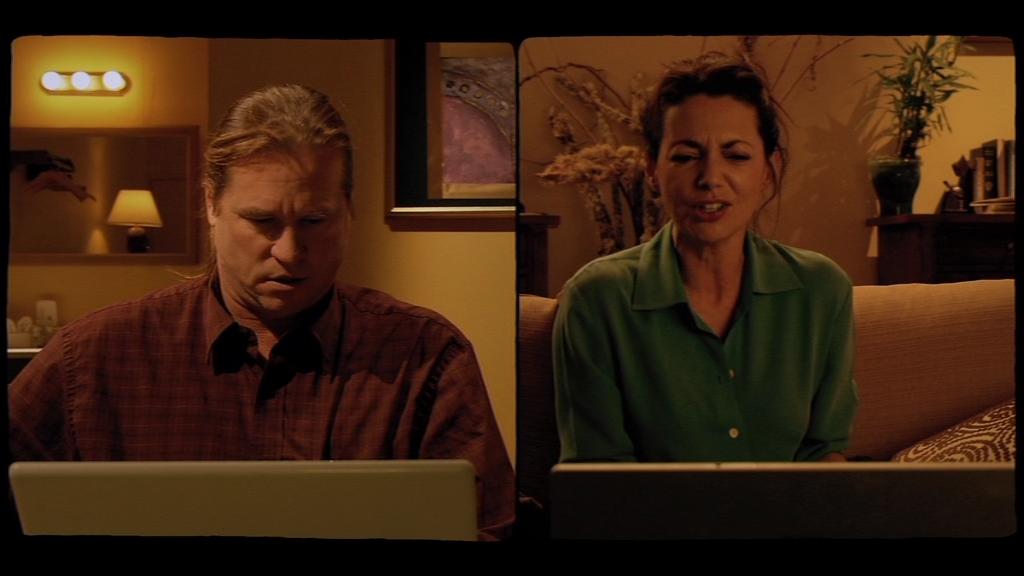
| arguing with Denise |
Hall gets a motel and, as he unpacks, we begin to see a little of his life. He has a first edition paperback of his first novel signed to his daughter, Vicky (Fiona Medaris), and, as the film moves on, we realise that she died and it was from there that his career perhaps took its turn for the worst. He has a skype conversation with his wife Denise (Joanne Whalley). The conversation begins with him saying he wants to write something for himself but, as it progresses into an argument, we discover that he can’t get an advance for his next book as he has refused to write another witch novel and she desperately needs the money for bills.
 |
| Elle Fanning as V |
Hall slams the laptop lid down and reaches for the bottle; the bell tower rings and we see the world shift. Hall goes for a walk, swings seem to move of their own accord. He takes a fork in the road and, as an owl screeches, he passes a brick vault. A girl (Elle Fanning) walks besides him. She is concerned about her buck teeth, though Hall says her teeth are fine (though the braces maybe not so). She says that all the kids call her Vampira on account of them but he can call her V. When he asks her real name she says Virginia. She knows his work and he mentions that the clock tower keeps ringing. It is impossible, she says, to keep time straight there. They reach a restored Chickering hotel but she won’t enter.
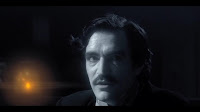 |
| Ben Chaplin as Poe |
He does and gets a drink. He notices a rectangular patch in the floor and he is told that he has found the grave and that twelve children are buried below the floor. The woman in the hotel grabs V, who is hanging around near the door. The young girl bites the woman to escape. Hall chases after her and then sees the rectangle open and children emerging with a man, Pastor Allan Floyd (Anthony Fusco). They are playing in front of the hotel but when the Pastor sees V he becomes agitated. As he leads them back to their grave, V leads Hall away. He stumbles as he crosses a bridge and is picked up by Poe whom Hall asks to show him the way.
 |
| a model execution machine |
He awakens with Denise shouting to him through the laptop. When he looks at the screen she is holding his first edition of Walt Whitman’s Leaves of Grass. She has had it valued (though he says it is priceless) and will sell it if he doesn’t get another advance. I am sure that Coppola will have known the connection between Whitman and Stoker but Leaves of Grass was a pun title in itself grass being a name used by publishers for works of minor value (and leaves being the pages of the books) and so it sums up Hall’s career at that point. In desperation he returns to find Bobby and agrees to collaborate on a book, which LeGrange had suggested should be called the vampire executioner. He has even built a model of an execution device for vampires that he shows Hall, inspired by the fact that the stake in the girl seemed to have been pushed in by a device. It is during this conversation that Hall suggests that, whilst he normally writes about witches, a vampire is nothing “
but a witch who sucks blood?” Hall contacts Sam (David Paymer), his publisher, and convinces him to wire an advance to Denise but Sam demands a bullet-proof ending and Hall hasn’t got any ending yet.
 |
| Alden Ehrenreich as Flamingo |
The film goes on to merge the present and the past. The murder of the girl and the murder of the children become conflated as V becomes the image of a girl hunted by the Pastor as she tries to save the children from him – he kills them because he thinks the folk by the lake are vampires and so, by killing them, he is saving their souls. The folk, of course, are in our time and V is also the image of the girl in the morgue. In Hall’s dream state we see Flamingo rescue the 1950’s V and bite her before the pastor kidnaps her and bricks her up in the vault. When a waking Hall visits Flamingo and his group the young man is reciting Baudelaire. Baudelaire is associated with Poe through his love of Poe’s work and also wrote some vampire related poetry, most famously Le Vampire in the work Fleurs du Mal. Bobby claims that Flamingo is a vampire.
 |
| remove the stake... |
Poe becomes Hall’s guide and explains how it was his (wife and cousin) Virginia who became, in death, his muse and that he wrote about the death of beauty, but Hall has his own demons to face in the form of Vicky and the guilt he feels over her death. She is his Virginia. There seems to be more than just dreams going on as, for instance, he sees the grave in the Chickering Hotel in a dream, enters the derelict building thereafter and finds the grave in reality. Of course there is also the little matter of the murdered girl as well and the question of what will happen if the stake is removed?
 |
| Hall and V |
The first thing to state is just how much I loved the look of the film. The dreamtime shots were astounding, with their muted colours and ethereal figures. I have tried not to spoil the plot but, to be totally honest, it is difficult to explain the film without spoiling it a little as the plot is so tied up in the merging of reality and dreams and the displacement of time. The vampires are fantastic. There is clearly someone who believes in vampires enough to stake a girl, there are vampires which become metaphors for Hall, vampirism is used as a scapegoat for those things we fear because we don’t understand and perhaps they are real in some small way.
 |
| Flamingo bites V |
Who or what is V. Hall mentions witchcraft but he is a man who made his career on witches. In some respects she is a (vampiric) ghost looking for peace. Is she the girl recently murdered or the child walled up by the pastor? Ultimately she is both as she, as we meet her, is a product of Hall’s inner mind and in a dream such duality is perfectly acceptable. She also represents Poe’s Virginia and becomes conflated with Vicky in Hall’s mind.
 |
| fangs |
The performance by Val Kilmer is excellent. He is jaded, lost, a man who can’t work past an event, a trauma, to continue with his life but a man on the cusp of a moment of self-enlightenment. Equally Ben Chaplin is fantastic as Poe, enigmatically matter of fact he leads the writer (and the director in some respects) to their ending. I have heard complaints about a lack of ending (and, as mentioned, Coppola initially didn’t have one) but the ending provided is almost inevitable given the journey we took and indeed it is the journey that proves the most valuable part of the exploration. Elle Fanning is fantastically ethereal as V.
I really did enjoy this, as you can probably tell by the length of this review,
8 out of 10.
The imdb page is
here.
The review was based on the German DVD release; Twixt: Virginias Geheimnis.