Showing posts with label created by science. Show all posts

Wednesday, May 06, 2026

Short Film(s): Dead to the Last Drop


So, it was quite some time ago that I looked at Maxx Bloodd – Vampire Spy, a short film directed by and staring Rock Savage. The film, apparently from 1993, had ultra-low video quality and no IMDb page (it still doesn’t) but it has now had a Blu-ray release as part of the Rock Savage Collection Volume 1.

Also on that disc is Dead to the Last Drop – a short anthology of three vampire short films. I considered splitting the three films up, but it is the anthology that has an IMDb page and so I eventually decided to keep them together. Irreverent, with casual racism thrown in (but nothing as shocking as the blackface used in Maxx Bloodd), these are shorts for the viewer who likes their straight to video fare to be as low budget as possible.

Mod Mutilator as himself

The first short is called The Omega Wrestler, a title I assume nodding towards The Omega Man. It features the luchador-mask wearing Mod Mutilator (himself) who has settled down to watch wrestling with a concern that he is running low on beer and that he needs pizza. The last bit is easily solved and he orders a delivery.

death by silver kitchen knife

Meanwhile, a vampire queen (L M Woods) pitches up with her minions – including main minion Ivan (Don Woods), who informs her that this is the home of the wrester who killed her vampire sisters – Santo. After MM kills a random vampire with a silver kitchen knife, with the vampire queen laying siege, it becomes apparent he is not Santo and then, after Ivan suggests Blue Demon and this is refuted, Ivan loses his head for incompetence.

L M Woods as the vampire queen

The vampires decide they will kill the wrestler after he unleashes a racist tirade based on their Mexican heritage, and they eat the pizza delivery guy (Kenny Charnock). Separated from his pizza and down to his last beer, he needs reinforcements and this eventually takes the form of Harry Gross (Rock Savage) a psychic investigator in all three films. MM doesn’t want help with the vampires, he wants Harry to bring beer…

Marvin Kennedy as Dracula

The second short is the Vampire Pierre. Harry Gross is visited by a good vampire called Big D, or simply Dracula (Marvin Kennedy). Dracula made a killing investing in blood banks and doesn’t need to hunt people anymore. However, he was seduced by a French vampire named Fifi (L W Woods) who stole his family ring. The ring has the power to call and control zombies. She has stolen it for a French vampire named Pierre (Frank Vassallo) who wishes to use it to rule the world. Dracula hires Harry to get it back.

Rock Savage as Harry

Fifi is sent to take Harry out – though, luckily, he has a spectral gun that can kill things such as vampires – though he’ll soon discover it doesn’t work on zombies. This one stereotypes the French and has some incredibly crap bat on display but also concentrates on the Harry character, who is more a cameo in the other two shorts.

Frank Vassallo as Scarlett Sheik

The Final Short is Bloodsucking Sheiks. The short starts with Nazi doctor Von Cresse (Marvin Kennedy) – a scientist who developed a youth formula in the 1940s – with terrorist Scarlett Sheik (Frank Vassallo). Von Cresse has developed a new formula that will turn a person into a vampire. It is used on the Scarlett Sheik, and they intend to use it on his men also, creating a vampire terrorist cell.

evil mad scientist makes vampire

Agent Rex Jones (Eric Koger) goes to Tiki Joe’s Bar to get his new mission – finding and stopping the Scarlett Sheik. What he doesn’t know is where the terrorist is or what his plot entails. Luckily Harry Gross comes in – he was offered the job first and recommended Rex – who suggests Tiki Joe (Don Woods) might have info – indeed he has heard a rumour that they’ll attempt to assassinate the Israeli Prime Minister…

Pierre takes a bite

All three have moments set around race that is poor – though the stereotyping in the Vampire Pierre is probably the lesser as the other two carry quite offensive wording as well as falling back on lazy stereotypes. The Harry character is drawn as quite cool and, to be honest, felt like a non-vampire version of Maxx Bloodd. One for the low budget aficionados and the vampire completist.

The imdb page is here.

Saturday, March 21, 2026

Guest Blog - “If it doesn’t look like a vampire, or sound like a vampire, can it still be a vampire?” – TMtV 20th anniversary


We’ve come to the end of the 20th anniversary celebration and, last but not least, I’d like to welcome Simon Bacon to TMtV. We met through vampire groups on Facebook, becoming firm pals, and have had many discussions regarding our toothsome friends. An author and editor, I have corresponded over his vampire monograms and have been lucky enough to be included in several of the academic volumes he has edited.

In discussing the mutability of the vampire the much cited vampire scholar Nina Auerbach writes “we all know Dracula, or think we do… .” Although she was using Stoker’s Count as an example of how even the most “recognizable” of the undead doesn’t remain a fixed character in the popular imagination, it is just as true for what constitutes a vampire. Indeed, in many people’s minds Count Dracula is synonymous with the idea of the vampire with the implication that they must all drink blood, can transform into a bat (and possibly a wolf), are very sexy, wear evening dress with greased back, black hair and speak with a broad Eastern European accent—it should be noted that this is predicated far more on Bela Lugosi in Tod Browning’s 1931 film Dracula, than Stoker’s 1897 novel (see figure 1).

Figure 1. Bela Lugosi as Count Dracula about to enjoy a night-time snack with Lucy (Frances Dade) in Dracula, directed by Tod Browning. Universal Pictures, 1931.

However, the cinematic vampire, although providing what some see as the quintessential representation of the King of the Vampires (Count Dracula), seems to be continuously unsure about what a vampire looks like or what makes it one. What follows is an idiosyncratic selection of (and some of my favourite) films that have a very non-canonical view of what a vampire is.

Two of the earliest representations of vampires on film aren’t really vampires as we’d think of them now. They were from the early 20th century and both represented the “dark” side of society. The first features what was then known as a “Vamp,” that was a more sexually malevolent form of the New Woman from the end of the 19th Century and who asserted their independence by preying on wealthy men for their money. Theda Bara was one of the most well known of these and A Fool There Was (1915) the best surviving example of her playing her vampy best. In many ways her credentials as a vampire were more explicit in the marketing around the film and of Bara herself so that there was little to distinguish between her on- and off-screen personas. Apart from being called “The Vampire” in the films titles there is nothing else in the film that would really mark her out as one of the undead (see figure 2).

Figure 2. A triumphant Theda Bera (The Vampire) enjoys the sight of her latest victim who has lost his wealth and his family because of her in A Fool There Was, directed by Frank Powell. Fox Film Corporation, 1915.

Similarly the French serial Les vampires takes another yet equally oblique turn in what constitutes a vampire. Here, the titular “vampires” are in fact a gang of crooks led by the Grand Vampire that prey on the people of Paris and who think nothing of murder, kidnapping, and terrorism to get what they want. Although the film is well known for a sequence featuring a dancer dressed as a bat (see figure 3), once again there is little to connect the film to actual vampires apart from their metaphorical “feeding” on the wealth of their “prey.”

Figure 3. Marta Koutiloff, played by Stacia Napierkowska, dancing as a vampire bat in the ballet “The Vampires” in Les vampires, directed by Louis Feuillade. Gaumont, 1915.

Back in Hollywood, vampires became one of the pantheon of classic monsters in the 1930s, though even within that there were no strict borders between the various forms of creatures that could be called undead which could range from someone brought back from the dead (by whatever means), to a ghost, a ghoul, a zombie...or even a mummy. As mentioned above Lugosi’s performance solidified the idea of what Dracula was, and consequently, vampires, but even here the Count himself wasn’t sure of what exactly made him a vampire. In House of Dracula (1945), the second film starring John Carradine as the Count, sees the vampire looking for a cure for his vampirism (in reality he wants to sink his fangs into the pretty nurse assisting Dr Edelmann who he seeks help from). What is of interest here is that the doctor takes blood samples from Dracula and under the microscope we see vampiric blood cells attacking human blood cells marking out vampirism as a disease of the blood (see figure 4).

Figure 4. Dracula’s blood under the microscope showing the black tendrils in it is the true vampire as it attacks human blood cells, in House of Dracula, directed by Erle C. Kenton. Universal Pictures, 1945.

We could argue it is Dracula’s blood that is the vampire, not the Count himself. This is a curious idea that has been picked up since in a few screen narratives such as Dark Shadows (1966-71) and the Dracula (2013-14) series by Cole Haddon. The importance of blood, and what we might call the medicalisation of the vampire, is also seen in The Return of Dr X (1939), featuring a rare turn in horror films for Humphrey Bogart. Here at least the “vampire” in question needs fresh human blood, though rather disappointingly for its undead credentials it’s not from biting a beautiful young woman in the neck, but rather transfusing her blood into his own body (the reverse of Stoker’s use of transfusions where they are to combat vampirism rather than promoting it). Here, Bogart as the eponymous Dr X (Maurice Xavier) is brought back from the dead using synthetic blood, however, this no longer works and he needs a special type (type one) of fresh human blood to stay alive. His vampy credentials highlighted by his pale white skin and greased back, black hair--his monstrosity emphasized by a bride of Frankenstein white streak running through it (see figure 5).

Figure 5. Humphrey Bogart as the suitably deathly pale Dr X, in The Return of Dr X, directed by Vincent Sherman. Warner Brothers, 1939.

Post-WWII and the rise of science fiction on film only increased the complications of identifying vampires—even Dracula is affected by the appearance of aliens as seen in Plan 9 from Outer Space (1958) where humans are brought back from the dead as zombies and one of these “zombies” is non-other than Bela Lugosi in full Dracula costume. In some ways this was exampled earlier by the science-gone-mad idea in Dr X, but the involvement of aliens would only exacerbate the problematic nature of vampire identity. A good one to start with is The Thing from Another World (1951) where the “Thing” is a Frankenstein’s monster style alien (see figure 6) that has been cut from beneath the Arctic ice where its ship had crashed an unknown time ago.

Figure 6. “The Thing,” played by James Arness, as a vegetal vampire from outer space, in The Thing from Another World, directed by Christian Nyby. Winchester Pictures Corporation, 1951.

Once defrosted the creature is driven by a need for human blood, and it exhibits a kind of immortality as parts of it, when cut off, regrow when fed blood. Perhaps more strikingly the creature is in fact a plant of some kind—this correlates to other vegetal aliens that crave human essence such as the pods in Invasion of the Body Snatchers (1956/1978), and The Queen of Blood (1966). While the creature cannot change its shape in this film—other than its severed parts being able to take on their own lives—later adaptions of the story, The Thing (1982/2011), make such transformations explicit to how it survives and multiplies. Indeed, just as the first “Thing” required human blood to live, the later “Things” require human lives to thrive—oddly echoing the BBC Dracula mini-series from 2020 in which the Count requires blood as “lives” to sustain himself.

Something of this is repeated in Tobe Hooper’s Lifeforce (1985) where alien vampires, whose spaceship hides in the tail of Halley’s Comet, awaken to feed on human essence each time it returns to the vicinity of the planet Earth (every 74.7 years). The aliens themselves are huge bat-like creatures but can possess the bodies of humans and consume/suck-out soul/lifeforce by putting their mouths over that of their victims (see figure 7).

Figure 7. A guard (John Keegan) having the lifeforce sucked out of him by an unseen Space Girl (Mathilda May) in Lifeforce, directed by Tobe Hooper. London-Cannon Films, 1985.

These are then “sent” back up to the mother ship for the rest of the colony to feed on. An earlier example of a similar kind of vampiric possession as a means of survival was seen in Planet of the Vampires (1965) where the survivors of an alien race are trapped on a barren planet after its sun has burnt out. Using the distress signal of a crashed space ship they attract 2 other ships and then inhabit the bodies of the humanoids piloting them. Of note here is that their vampirism is purely predicated on the possession of humanoid bodies (see figure 8), which although deadly to the hosts—if they’re not already dead—does not provide any kind of sustenance to them (such vampiric possession, though often non-deadly is a more recent feature of vampire narratives such as The Vampire Diaries (2009-17) and The Originals (2013-18).

Figure 8. A deadly game of “guess whose body is possessed by a vampire” featuring Wes Wescant (Ángel Aranda), Sanya (Norma Bengell), and Captain Mark Markary (Barry Sullivan), in Planet of the Vampires, directed by Mario Bava. Italian International Film, 1965.

Returning to Lifeforce, and its idea of feeding off of human essence and “draining” their victims, this is not a million miles away from psychic vampires, most recently and famously seen in the figure of Colin Robinson from What We Do in the Shadows (2019-24) where he purposely bores people to death and/or annoys them to distraction so that he can feed on their emotional energy (see figure 9). This has returned such forms of untypical vampirism back into the popular imagination—it’s actually something that has a longer history in literary vampires seen in The House of the Vampire (1907) by George Sylvester Viereck and “The Transfer” (1911) by Algernon Blackwood.

Figure 9. Colin Robinson (Mark Proksch) as the person in the office that everyone tries to avoid, in What We Do in the Shadows, created by Jemaine Clement. FX Productions, 2019-24.

To sum up this rather eclectic list of some of my favourite vampire films, and to mangle and repurpose a well known phrase about ducks, “if it doesn’t walk like a vampire, or quack like a vampire, it doesn’t mean it’s not a vampire!”

Bio: Simon Bacon has authored/edited/co-edited 40+ books on vampires, monsters and gothic horror in popular culture and his Amazon Author page can be found here (US) and here (UK).

Saturday, November 22, 2025

Vamp or Not? The Home


I was contacted by Simon Bacon regarding James DeMonaco’s 2025 feature, saying that it was “defo vampy” though warning it was medical rather than supernatural. Well then, let’s see.

The film starts with Max (played older by Pete Davidson, and young in flashbacks by Jagger Nelson) led coughing on a couch, in a run down apartment, the TV talking about climate change – there is an aspect of eco-horror to this but it is generally under-explored. A flashback shows a celebration in his foster home as his foster-brother Luke (Matthew Miniero) prepares to leave for college.

Max's Mural

There is a theme of “thicker than blood” to describe their foster relationship and Max has that tattooed on his chest. Adult Max is artistically talented and breaks into a derelict building to paint an eco-awareness mural. He is arrested and, in the cell, remembers the time when he was told by his foster parents (Jessica Hecht & Victor Williams) that Luke had committed suicide at college. His foster father comes to him and says that he had a word with a judge and cut a deal to have Max avoid jail time (a little harsh for painting a mural, one feels) for community service. He is to work four months at a retirement home.

Pete Davidson as Max

He gets there and is told what his job involves and to not go to the fourth floor as special care patients are up there. Yet, from the beginning, things seem off. He stumbles onto geriatric, masked sex, discovers he can’t really sleep and hears screaming through the vents. He quickly investigates the fourth floor and is attacked by a screaming man (Stuart Rudin, Stake Land), leading to him being caught and reprimanded. But things keep getting odder and he begins to unearth a government conspiracy…

Luke aged

And here we have the spoiler alert as I need to drill into the aspects of “Vamp or Not?” There is a conspiracy, but not the fabricated one the residents draw to entertain themselves at Max’s expense. The residents are worshippers of Dea – called in film the God of Youth but Dea was simply Goddess in Latin. His foster parents are in on it and send foster children to the home to be used as a source of vitality for the residents and certain staff. The screaming man is Luke, aged beyond recognition and he was trying to save Max, not attack him.

procedure

The idea is that the home’s doctor, Sabian (Bruce Altman), discovered a gland behind the right eye, which is the source of a person’s youth and vitality and dries up with age. He is draining the gland of its “nectar” by piercing the eye, pushing through to the gland, and the residents subsequently drink it. Max has been drained nightly – hence believing he isn’t sleeping – but at a ceremony they intend to take much more. They say he will end up feeling 100-years-old and, as we have seen with the other fourth floor residents, draining the nectar prematurely ages them. For the recipients it staves off aging further and increases their libidos.

Max and Lou

I guess we could liken the victims, in this case, to the undead. Aged beyond recognition, sat in a half-life that is no life at all, perhaps embodiments (Luke is at least) of undead memory. The vampirism is very similar to that displayed in Brand Upon the Brain! (which called the extracted fluid nectar, also) and The Leech Woman - though this is the product of a gland, like the Leech Woman, rather than the brain itself, which was the case in Brand. Very much Vamp, this did carry me along for the journey.

The imdb page is here.

On Blu-Ray @ Amazon US

On Blu-Ray @ Amazon UK

Wednesday, June 11, 2025

Amazing Spider-Man: Blood Hunt – review


Authors: Various

Artists: Various

Release date: 2024 (tpb)

The Blurb: Collects Amazing Spider-Man: Blood Hunt #1-3, Amazing Spider-Man (2022) #49 And Miles Morales: Spider-Man (2023) #21-22.

Marvel's Spider-Men swing into the BLOOD HUNT! Vampires are running rampant through New York City - and while the Avengers are caught in the middle, someone has to take care of the citizens of the Big Apple. That person? Peter Parker, the spectacular Spider-Man! But if only things were that simple. They never are, and that means Spidey has a massive role to play in the nightmarish saga - one that involves Morbius, the Living Vampire! But will Morbius be fanged foe or friend this time? And will Peter need to take him out or save him?! Meanwhile, the world's greatest vampire slayer, Blade, has a plan - and his only hope for victory rests with the young Spider-Man, Miles Morales! But Blade's mission comes with a massive cost Miles may be unwilling to pay!


The review:
The second tpb to be released in the Blood Hunt event – this one concentrates on spider-men, with a Peter Parker story and a Miles Morales story. It starts with Parker, fighting vampires and rather enjoying himself fighting monsters, when he gets a text from a criminal, Kareem, asking Parker to get Spider-Man to help him. When he gets to him he discovers that Kareem's partner in crime, Rabbit, has been turned and he needs the hero's help. They find the vampire who bit Rabbit – he has chained himself, ashamed of what he has become and begs Spider-Man to kill him. Suddenly he realises that the vampires are not just monsters, but Kareem stakes the vampire anyway and Rabbit (and Kareem who was turning, having been bitten by Rabbit) are cured. With the shine taken off vampire hunting, Spider-Man is suddenly confronted by Lizard (who is somewhat rough about getting his attention). Lizard and Misty Knight are trying to track down Michael Morbius who has been kidnapped and this leads to a vampire corporation. The Morales story stands aside from the Amazing Spider-Man story, shows us Blade turning him and then a team up with Hightail, and later Blade’s daughter Brielle Brooks, to defeat energy vampire R'ym'r.
Tonally lighter, for the Amazing Spider-Man part of the TPB at least, this was still a welcome foray into the Blood Hunt event – with a much more street level focus. Whilst both stories featured vampires (the Morales one, being energy ones of course) the action occurred with the main Blood Hunt as a wider event and these stories occurring separately – albeit sundeath offering a starting point. 7 out of 10.

In Paperback @ Amazon US

In Paperback @ Amazon UK

Thursday, February 27, 2025

Use of Tropes: The Substance


With numerous Oscar nominations I thought it about time I watched Coralie Fargeat’s 2024 movie The Substance. I went in expecting body horror, I also recognised many influences on the narrative as I watched but I don’t think I was expecting to strongly feel a vampire trope. Now, before we go on, I have to say that whilst I think there is something we might describe as auto-vampirism, I do not think there was any intention to touch into a vampiric element (unless that was the vampirism of the movie and TV industries themselves). However it was such a strong recognition within me that I felt compelled to feature The Substance here.

Elisabeth in the corridor

The film starts with an egg, the yolk is injected and it splits into two – it essentially communicates the main plot and then, to give us the background we need on main character Elisabeth Sparkles (Demi Moore), we see her Walk of Fame star being laid and then see it weather and crack over time. In the present of the film, she is hosting a daytime TV fitness show. The studio has a long corridor with carpet that was not the same as the famous carpet in the Overlook Hotel but I couldn’t help but think had been chosen to bring it to mind. Elisabeth, after filming, needs a restroom but the ladies is out of order and so she goes in the gents. Whilst in a cubicle she hears station executive Harvey (Dennis Quaid) discussing getting a younger replacement for her as he makes his misogynistic ageist views about her apparent. When she later meets him for lunch he is drawn as the greed of the industry personified.

the sale's pitch

Elisabeth ends up in a car crash but, luckily, is uninjured, but the various events have had an emotional toll. Before she leaves the young male nurse (Robin Greer) feels her spine and declares her an ideal candidate. When she has left the hospital, she finds she has been slipped a memory stick labelled with The Substance and a note saying how it changed the writer’s life. I’m not going blow-by-blow as it is the vampiric trope I want to get to. Suffice it to say that she listens to the cryptic message on the stick, ignores it but eventually, driven by the casting advert aiming to replace her, contacts the people behind the Substance. What I found interesting was in no place is finance mentioned, nor are full instructions given (and yet Elisabeth seems to know what to do). Having got her starter package from a back alley building she injects the substance.

eye division

It works pretty quickly and we see her in pain and her pupil divide and become two as her body is twisted, things move below the skin, two eyes sit in a socket and her back splits from which emerges a younger woman – who later names herself Sue (Margaret Qualley). The rules of the Substance are as follows: “You are the matrix. Everything comes from you. Everything is you. This is simply a better version of yourself. You just have to share. One week for one and one week for the other. A perfect balance of seven days each. The one and only thing not to forget: You. Are. One. You can't escape from yourself.” The injection can only be used once and should then be discarded. The other self has to inject stabiliser every day (which is harvested spinal fluid from the original). Whilst one is active for seven days, the other is fed intravenously (food refills are provided by the invisible ones behind this). However, the balance has to be maintained.

the hag's finger

Sue gets Elisabeth’s fitness show slot and is a hit. Elisabeth seems lost within her weeks and Sue wants more than she has (they forget they are one and the same). Sue overruns, due to carnal desire, actively taking an extra dose of spinal fluid. When Elisabeth is switched with her after this (the switch being achieved through tubes that seem to exchange their blood between them) a finger has become old, gnarled and greyed – almost crone or hag like. Literally, if Sue takes time from her, remains her young self-longer, then it greatly ages (parts of) Elisabeth and this was the trope I spotted. Although they are split into two, they are meant to be one and so it is very reminiscent of vampire films such as I Vampiri and Countess Dracula - though she is not getting her youth from the death of others. Indeed, the accelerated aging affecting her normal self as a price for the periods of youth is very much like Countess Dracula. Elisabeth discovers she can stop this and there is a termination solution for the other self but also discovers “What has been used on one side, is lost on the other side. There's no going back.

Margaret Qualley as Sue

There are obvious things the film draws on. The elements of The Picture of Dorian Gray and perhaps even Strange Case of Dr Jekyll and Mr Hyde in the science, though it is youth and fame that is explored as well as the misogynist heart of the fame machine that sees female value in sexualised youth, are very apparent. I had noticed a while back that Kim Newman had made a connection to The Wasp Woman, which does share some broad themes with this and which was one I examined as a potential vampire film (concluding it depended on how broad your definition of the genre is). I loved the look of this film; it wore superficialness as a badge of honour and applied a stylistic gloss, which worked so well given the themes it explores. I had been told some time before that the third act turns heavily into body horror so that was no surprise but there is a blood filled sequence that gives Japanese Splatter-punk a run for its money. Is it a vampire film – in truth no, whilst it plays with the youth stealing trope, she steals from herself (rather than vampirically stealing from others) after all, They. Are. One.

The imdb page is here.

On Demand @ On Mubi via Amazon US

On Demand @ On Mubi via Amazon UK

Wednesday, February 05, 2025

Alien Siege – review


Director: Robert Stadd

Release date: 2005

Contains spoilers

Oh lawdy. This came on my radar as an alien vampire film and it is (in a very loose definition of vampire sense). It is also a film that was made specifically for the sci-fi channel. It really struggles therefore with script, narrative, acting and any level of budget to make this look as good as it should want to look.

It is set on an Earth in which we have been visited by the Kulku, an advanced alien race. Later we hear they pride themselves on their intergalactic philanthropic works but that is not the case with us. You see, there is a pandemic on their home planet, a virus that threatens to make the race extinct and the cure is… human blood. So they have essentially invaded, using advance tech that we can’t fight against. The film is six weeks later…

alien lander launches

So, the Kulku have demanded we hand over 8 million people. It is up to each nation to do their bit, and it is suggested that many nations handed over their prison populations. America have to hand over 800,000 people and rather than use prisoners (which, in reality, I recon would be America’s go to policy) they have decided to do a random lottery and if your name comes up you are detained by human military and sent for processing by the space vamps. There is a basic maths issue here as the film suggests that 650,000 Americans had been handed over but there are 300,000 to go…. Something doesn’t add up.

nozzle delivery

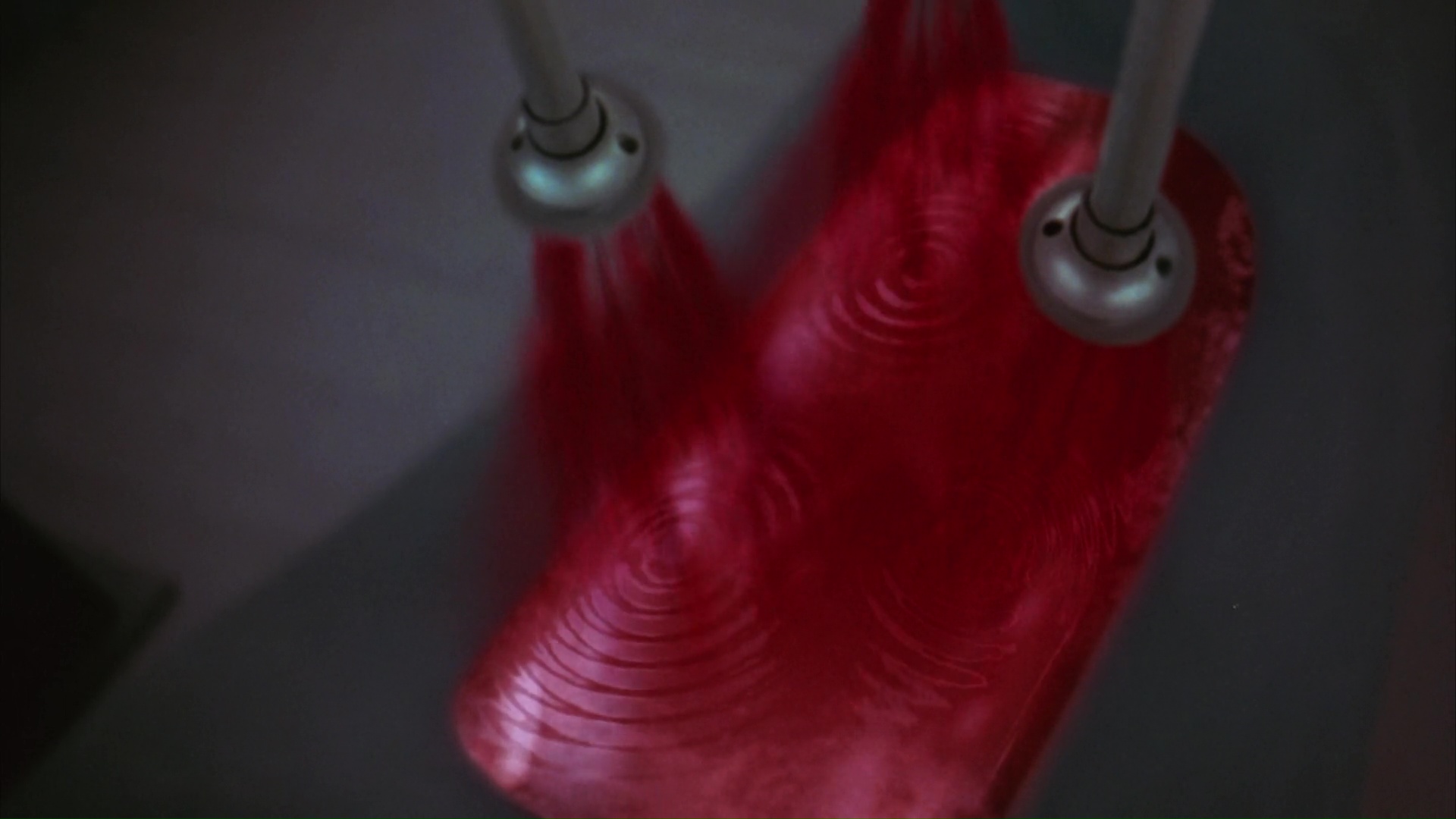
The other issue that the invaders have is that the Kulku travelled via a wormhole and… well the explanation was a bit odd but it got them to Earth (and it is a one way trip) but they can send things back through – just not living things so the aliens are stuck but the blood apparently can be sent back (they don’t just suck the blood out, but liquidise the person apparently, and then three shower nozzles spray the blood into a pod, yeah really – and the idea of asking for planet wide donations is not touched on). This ignores the fact that blood is essentially living tissue – what property they need to make a cure and why it works when inert is not answered.

Erin Ross as Heather

So, the film is essentially an intergalactic version of the Trolley Problem. Of course, it needs a human interest side and this is found through Dr Stephen Chase (Brad Johnson) who discovers that his daughter, Heather (Erin Ross), has been chosen and so tries to hide her. That doesn’t go very well and she is taken for processing. He tries to swap himself for her but it appears she has a blood anomaly that the Kulku have been looking for and her blood can produce many more cures, so they won’t let him stand in for her. However, there is a resistance who attack the facility and Chase manages to get to the leaders with a proposition – save Heather and he’ll give them special tech.

Brad Johnson as Chase

Now, one might question why (and how) a race living so far from Earth that they need a wormhole and cannot travel back by conventional means would know that human blood would cure the virus? Well, apparently, they’ve been here before and Roswell was a crash of one of their scout ships. Chase has been a lead researcher trying to backwards engineer their tech. Issues, issues. One, we have no idea how they got to and from Earth that time, did they abduct humans – if so they may know what our blood is like, I guess, but its still a stretch to think that it would be, and they would know it would be, the cure for their illness. And then there are the coincidences – the daughter of an alien tech researcher is chosen in lottery (and somehow he knows, we don’t hear how), she just happens to have anomalous blood, and she happens to be taken to a processing centre that the resistance happens to attack (for the most part humanity seem to be sleepwalking into this).

a Kulku

As for the Kulku… well they look remarkably like us, save having dyed blonde eyebrows, a black mark at the neck (which, when we see the black marks of the virus, I assumed was a viral lesion, but that doesn’t vanish when someone is cured whereas the lesions over the torso do vanish) and a grey dot on the cheek – which turns out to be a comms device. The spaceships and lasers are cgi generated. The acting is wooden throughout. The dialogue is awful (and the docile lottery people feel outstandingly unrealistic… go over there… ok… in reality, surely they would try and overpower the small number of army guards and not a one seems to cry, despite knowing they are going to be liquidised to make alien medicine – there is a touch on more realistic reactions when a hunted “winner” jumps from a high building rather than surrender). Really quite poor but the taking of human blood to prolong life (by staving of a deadly virus) puts it onto our radar. 2 out of 10.

The imdb page is here.

On DVD @ Amazon US

On DVD @ Amazon UK

Thursday, November 28, 2024

Vamp or Not? Monstrosity


Suggested to me by Simon Bacon, this 1963 film was directed by Joseph V. Mascelli and Jack Pollexfen and it matches its title as it is a bit of a monstrosity. Simon saw within it a potential of it being a vampire film firstly due to its opening lines from the narrator (Bradford Dillman) that says “For in the ancient folk legends, tales are told of blood-sucking vampires, crawling out of graves to live on the bodies of helpless victims. Is man now doomed to produce a race of ever-living monstrosities, worse than the vampires of legend?” Through that he likened the film to the story Good Lady Duncayne and, to be fair, this does have an elderly rich lady, Mrs March (Marjorie Eaton), employing a Doctor, in this case mad scientist Dr Frank (Frank Gerstle), to restore her youth. Blood is not the order of the day, however.

In the reactor chamber

It starts with Dr Frank transplanting an animal brain into the newly deceased female body he has stolen – in a procedure that involves an atomic reactor chamber. We then see him stealing a newly interned corpse, aided by the monstrous looking reanimated male corpse in which he put the brain of a dog. This reanimated corpse has fangs in the lower jaw, giving a bestial look that brings the Island of Dr Moreau to mind.

Marjorie Eaton as Mrs March

He has discovered that the transplant works better the fresher the corpse and the aim is to be really fresh and transplant Mrs March’s brain into a living woman’s body. To this end she has lured three young woman, Anita (Lisa Lang), Bea (Judy Bamber) and Nina (Erika Peters), to her home, which she shares with “toy boy” Victor (Frank Fowler). She will select one of the girls to be her host, as it were, and through the course of the film one will end up with a cat’s brain.

Two of the candidates

So, the use of science to gain eternal life but this is by brain transplant and so calls to mind the superb Get Out (2017) – though this does not have the haunting vestiges of the original owner mentioned. The use of atomic power does bring Atom Age Vampire to mind but the vampiric surgery in that had to be repeated. This would be initially a one-shot transplant, killing the person though not the body (with the assumption that the new owner would swap bodies at some point as the new one ages). I am veering towards Not Vamp, it just didn’t feel like it was to me – despite invoking the vampire at the head of the film, but I can see why Simon suggested it might be and I am interested to hear what you think in the comments.

The imdb page is here.

On DVD @ Amazon US

On DVD @ Amazon UK

Saturday, September 14, 2024

Shark Girl – Review


Directors: Justin Shilton & Rob Zazzali

Release date:2024

Contains spoilers

I had been approached to consider Shark Girl for review, with co-director Rob Zazzali suggesting “while not a straight-up vampire movie, it definitely has consistent vampire vibes.” But I was concerned, not because it was the directors’ first feature but because I was still haunted by memories of Sharkula. Well, first off, as far as I am concerned this can be classed as a vampire film. However, more importantly, I was not only pleasantly surprised, but I was also rather impressed.

Ryan Bertroche as Ron

The film starts with an emergency at the SoCal nuclear reactor. With limited funds the filmmakers managed to give a fair sense of the emergency visually as well as in audio. A reactor fire, they vent coolant into the sea. A shark is caught in the ejected effluent – the shark isn’t brilliantly rendered but is on for a brief moment and not repeated and gives us enough but not so much it detracts. I will say at this point that I was also taken by very competent photography and it was the professional photography through that impressed me - too often it is a failure point in budget films.

looking for likes

Heidi (Alexandra Corin Johnston) is an influencer. Now it is interesting to me that influencer culture is being used so much in horror films generally and within vampire films specifically. It is not a shock, obviously the films are reflecting times, and I do look at influencer culture along with the vampire as capitalist and zombie as consumer in my contribution to the forthcoming Toxic Nostalgia on Screen. What was interesting to me, therefore, was the portrayal of Heidi, at this point, as pleasant and exploited – this is not the normal portrayal of an influencer.

Alexandra Corin Johnston as Heidi

For instance, she sees a flyer about a missing dog and wants to take time to share it with her followers. Her boyfriend and photographer Ron (Ryan Bertroche) has no such sympathies. They head to the beach for more shots, and he wants her in the water (to capture a wet hair flip). She does not want to go in but he bullies her in and again to make her go further out. He is distracted with his camera when something grabs Heidi and pulls her under – sensibly the filmmakers showed nothing here and leave it to the imagination of the viewer – when he can’t see her, he gets the hump and leaves – dropping a terse voicemail. He assumes she has left and has no real concern for her.

beach attack

A couple are on the beach at night, she’s a little freaked as it is so dark. After a while he notices something and realises it is a body. He goes over and it is Heidi, alive but unconscious. They have no signal, so he sends his girlfriend to get help. Heidi comes round, grabs the young man and bites his neck. When the woman comes back she attacks her also. Now we see her teeth have become sharp and shark-like, but that is the only transformation aspect used. We also only see her bite and feed like a vampire – there is dialogue about victims ripped apart and body parts strewn, this is all off screen but this decision works. With knowledge of the shark aspect we accept the unseen frenzy, with the aesthetic we accept the vampire feeding.

Sumayyah Ameerah as Sienna

So, as the film progresses we see Heidi transform more in personality than physically – she becomes more predatory, unwilling to be the victim to Ron, other influencers, agents or temperamental designers. This develops further where she becomes alien to the world, indifferent, even cruel. The word alien is useful as there is a thread that borrows from Species (1995). Also involved are Christopher (Nick Tag) a wannabe reporter who went to her high school and her best friend Sienna (Sumayyah Ameerah), a marine biologist. The film's narrative is underpinned with conspiracy theory, mostly around industrial conspiracy. 

shark teeth

There isn’t a lot of lore – she is a mutation and we can say created by science, or at least the detritus science leaves behind. Pressing her head in the right place makes her paralyse for a short moment (equivalent to striking a shark on the nose and disrupting the electrical sense). She is not the only one to have been mutated and there is a serum that can be personalised to revert the mutation, we also realise that a bite can turn another. There was nearly a staking moment – a harpoon is used – but it did not strike the heart.

Nick Tag as Christopher

What I liked about this, first and foremost, was the very competent photography. The acting was good and whilst the story was a tad on the silly side the filmmakers knew what they were doing with it. I liked the idea that Christopher’s suspicions get raised as wound bite diameters were too small for a shark large enough to do the damage found – the fact that it doesn’t seem that the authorities work that out isn’t overly commented on. Heidi leaves a trail, which is too close to her for getting away with her activities, but the timeframe is small enough that the fact we only see her friends tracking her does work. I also like the choice the filmmakers made to not have bad practical or CGI effects and work on a less is more basis. Is it the greatest film, nope, but it is a film called Shark Girl for heaven’s sake. However, it looks good, has a decent characterisation in Heidi and entertained. 6 out of 10 surprised me but is absolutely fair.

The imdb page is here.

On Demand @ Amazon US