Showing posts with label tropes. Show all posts

Friday, July 03, 2026

Vamp or Not? Monster House


For those who are unaware, I have a keen interest in the idea of the vampiric building and wrote a chapter, Vampiric Buildings: Life Soaked into Mortar and Blood into Earth for Palgrave’s Handbook of the Vampire. I was aware of the 2006, Gil Kenan directed, Monster House and think I did see it back in the day. However, I decided to take a look with pretty fresh eyes (I remembered next to nothing about the content) and a view to see whether we could call the house of the title a vampiric building.

The film starts the day before Halloween in US suburbia, within a nostalgia dictated timeframe. It starts with a very young girl riding her trike and greeting inanimate objects. Suddenly the speeding trike stops, the animation follows a leaf but the inference is that she has flown off the bike. She hasn’t, but she is stuck on the verge of a lawn, for some reason unable to move (I’ll return to why later). Suddenly the door flies open and house owner Mr Nebbercracker (Steve Buscemi, Paris Je T’aime, Hotel Transylvania 1, 2 & 3) comes screeching out of the house, yelling at the girl and in the tirade asks if she wants to be eaten alive – she runs off crying and he breaks and takes the trike.

Steve Buscemi voices Nebbercracker

This is watched from over the road by DJ (Mitchel Musso), a young boy who has been observing the antics of Nebbercracker and logging them. His parents are going away for the weekend and have arranged for Zee (Maggie Gyllenhaal) to babysit. Meanwhile, his friend Chowder (Sam Lerner) arrives but his ball ends up on Nebbercracker’s lawn. DJ notices that he hasn’t reacted and goes to retrieve it but the old man emerges and, in the tussle, collapses – DJ thinks dead. Paramedics come and pick him up – the viewer notices that grass seems to grow and grasp one of the gurney wheels, which breaks off and is then consumed by the earth. That night DJ receives phone calls from the house – making him believe that the ghost of Nebbercracker is haunting him.

the house awake

Now, we have heard local rumour from Bones (Jason Lee), Zee’s boyfriend, who lost his kite, as a kid, to Nebbercracker, who suggests the old man had been married, fattened her up and ate her (bringing in a cannibal theme – though the story is gossip and not truth). Kicked out by Zee he taunts the absent old man (and by default the house) only for the front door to open and his kite be there. With a similar lure used later with Chowder’s ball it indicates an intelligence (and memory) at play. The house consumes Bones. The next day DJ and Chowder save a prep school student selling candy, Jenny (Spencer Locke, the Vampire Diaries), and the three realise they have to neutralise the house before trick or treaters arrive.

the gang

Getting some half-baked advice (that is accurate) they are told they have to “strike at the source of life – the heart”. This is, of course, a vampire trope. They decide that the heart must be the furnace and they have to douse it (the house chimney has been active despite being empty). We have also seen that the house can morph its physical self and the front door becomes a mouth, with teeth (and the veranda can widen the maw), it opens a gullet within the hallway and the hall carpet becomes a tongue. 

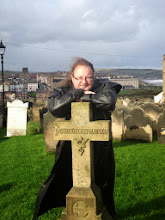
Constance's grave

When Nebbercracker is released from hospital (and the kids have just escaped from inside the house) DJ realises that the house is Nebbercracker’s wife Constance (Kathleen Turner). We get the story that she was an unwilling circus freak – the Giantess – and war veteran Nebbercracker helped her escape. He was building the house when trick or treaters caused her to fly into a rage, fall into the foundations and be buried in concrete – that has become a shrine/grave for her. He soon realised that her spirit had possessed the house, that she would attack those who approached and hated Halloween. Nebbercracker was actually protected the neighbourhood and had been essentially a prisoner of his own making for forty five years.

with legs

So – is the house a vampire. Well, possessed by Constance’s spirit it is certainly a monster and arguably (through Constance) undead. It is sentient, intelligent, remembers both what happened to Constance and those who have been near. It is polymorphic, able to change from a creepy house into an animated creature – at the end of the film it takes two trees as legs and becomes mobile. The idea of striking the heart was correct. The question is, does it feed on the victims? That isn’t clear. We do know that those it consumes in the course of the movie all survive but that does not mean to say that normally it would not digest them or drain their energy – the film is silent and probably deliberately so as it is a PG movie. Assuming it does, I think we can call this a vampiric building and one whose source (ie the possession) is communicated to the viewer – in other vehicles these things can be simply alive and bad.

The imdb page is here.

On Blu-Ray @ Amazon US

On Blu-Ray @ Amazon UK

Friday, June 05, 2026

Honourable Mention: A Haunting on the Hill


This 2023 sequel to The Haunting of Hill House by Elizabeth Hand was authorised by Shirley Jackson’s estate as an official sequel to the seminal novel. The book obviously features Hill House, and the ‘haunting’ therein but also touches into witchcraft and, with the recurring appearance of a supernatural Fetch of a hare (or multiple thereof) has a touch of folk horror to it. There are some interesting (literal) echoes from the original story.

I put haunting in parenthesis because it is mentioned through the book that it is not a haunted house, rather that the house is aware, an entity of its own. The phenomena in the house stems from that. It is further suggested that the house both hates and needs the occupants and it is this need that leads us to an Honourable Mention again as the reason for the need is perhaps hinted but not explicit. The house is owned by Ainsley, who is part of a coven of three, the others unhappy that she occasionally rents it out as to do so is dangerous – the three watch over it and Evadne, one of three, asks of one of the group in the house, “Hill House—how do you think it survives?” adding “Ainsley’s done virtually nothing to maintain it. No one has. Hill House looks almost the same today as when it was built a hundred and forty years ago. Why do you think that is?” The implication being that it takes something from residents within and maintaining itself through that. This is almost, but not quite, spoken again later (or that was my reading, at least). It becomes clear that those it manages to “take” remain in spirit, perhaps as puppets for the house, which sits against the idea of the house not being haunted.

The only other vampire adjacent comments is character Nisa suggesting that they may need garlic. We get the tale, within the dialogue, of one of the characters meeting a woman who suggests she met a haint (a restless ghost or spirit) who impregnated her. Mentioned as haints do occasionally get mentioned in vampire texts.

In Paperback @ Amazon US

In Paperback @ Amazon UK

Sunday, March 15, 2026

Guest Blog – Why Don't Vampires Act Their Age (A Theory) – TMtV 20th anniversary


It’s with great pleasure that I welcome E.H. Drake to the blog. I met her when I reviewed the first book in her vampire trilogy, Blood Herring, and subsequently reviewed the sequels, Blood Renegade and Blood Renegade. But as well as an author, Drake is the host of a podcast and did me the honour of inviting me on, where I took part in a panel discussion. Without further ado, here’s Drake’s blog:

Why is it that Edward Cullen, a man pushing a hundred years old, goes absolutely coocoo bananas for a seventeen-year-old girl? Why doesn’t he simplify things by pretending to be in college, living with roommates, and investing in some index funds?

Meanwhile, in Interview with the Vampire, Claudia is stuck in the body of a child, yearning for the adult life she’s been robbed of. Yet, she still behaves with the emotional volatility of a toddler.

What gives?

Let’s eliminate the obvious first. No writer (that we know of) is immortal. Therefore, writing immortality is just a mental exercise in virtual reality. Now that that’s out of the way, let’s talk about why these "ancient" beings are so immature. As a vampire author, I have a couple of theories.

Limits of the Human Mind


We tend to overestimate our minds. We believe we remember things as sharply as a 4K clarity, despite the fact that I can’t even remember why I walked into the kitchen five minutes ago.

Think about it. Nobody reading this remembers their own birth or the specific struggle of learning to walk. Every day, I take my ability to talk or write for granted, while my toddler takes forever to form a single sentence.

Even you, reading this blog right now, will likely only remember the gist of it when you’re done. You’ll remember how it made you feel or think, but the specific words will fade.

When you compound this limited mental space with hormones, personal bias, and trauma, we humans basically forget more than we remember.

We also know that the older we get, the more selective our memories become. Even putting aside conditions like Alzheimer's or dementia, if we make it to a hundred, we’re liable to hear stories about our own lives and have zero recollection. We'll have lived experiences we simply cannot access.

Now, crank up the dial. What if you were a thousand years old? Five thousand? As old as the pyramids of Egypt?


In this context, it makes sense that Claudia forgets the nuances of her human life. Is it any wonder she only starts rebelling against her "forever child" role in her sixties, while simultaneously throwing massive tantrums? She’s old enough to be a grandmother, but she’s working with a brain that has been deleting files for decades.

The "Frozen Brain" Theory


To really understand the lack of maturity, we have to look at the medical reality implied by becoming a vampire.


Take Edward. He was a young man on the edge of death, forced into an excruciating change and turned into a monster without so much as a “How do you do?”

Research on arrested psychological development suggests that severe trauma, especially in youth, can "freeze" a person's emotional maturity at the age the trauma occurred. It impairs emotional regulation and leads to poor impulse control.

The Peter Pan Problem


We've discussed the emotional side, but let's go a step further.

In most vampire lore, when you turn, your physical development stops. You are a snapshot in time. If your whole body stops aging, what does that mean for the brain?

Neuroscience tells us that the Prefrontal Cortex, the part of the brain responsible for impulse control and rational decision-making, doesn't fully mature until your mid-20s. If you are turned at 17, your brain never reaches the finish line. Your hormones stay the same. The logic center of your brain will forever be under-construction.

We often conflate age with wisdom, but medical history (like the famous case of Phineas Gage) shows that if the frontal lobe is damaged or stunted, personality and emotional regulation shift dramatically. Seriously, just look into head injuries with American Football. I'll wait.

This could be why Edward runs off to other countries at the drop of a hat or tries to flounce in sun. He isn't some old soul; he's just a teenager with a very long memory.

Even Claudia, yearning for an adult life, makes such irrational, impulsive choices. Her betrayal of Lestat is understandable, but it's executed with the short-sightedness of a child.

So, is it any wonder the mighty creatures of the night never really grow up? Every vampire story is a cocktail of physical and medical trauma, which is the perfect recipe for developmental stagnation. By the time we meet them, they have more in common with Peter Pan than they do with us, sad, aging mortals. I mean, think about it. Dracula doesn’t even cast a shadow.

But hey, I’m just a silly human woman exploring the trope.


Bio: E.H. Drake is an indie author living in the United States with her family. She loves dogs, almost anything with vampires, and reading three books at a time. 

Her debut trilogy is a vampire-buddy cop mystery series, The Blood Herring Chronicles. She is currently working on young adult superhero and zombie western. You can find her books, podcast, and events at EHDrake.com.

Saturday, August 17, 2024

Short Film: Queen of Night Chapter 2


A sequel short film to Queen of Night, this one released in 2023 and just under 9.5 minutes. In the first short we met D’Angelo (Michael Beasley) and his friend Millie (Natasha Collado) in the aftermath of some occult incident. This takes place a month later.

taking Jessica's form

The two friends are in D’Angelo’s room, he is trying to study, and she wants to show him a trick. Knowing she won’t let up, he closes his book and she changes her form into that of Jessica (Jayleen Maldonado) – a girl from one of D’Angelo’s classes who he has a crush on. Millie suggests he practice talking to Jessica through her. He doesn’t comply and is soon leaving her in his room whilst he goes to get pizza. She gets in bed for a nap.

no vampires here

After he has left a couple, Leon (Christopher Guity) and Tara (Zullyvette Muniz), break in and go to stab Millie – she isn’t in the bed anymore. She confronts them, fangs showing. We get a lowdown here of what has happened to Millie. Having bitten and dropped Leon, Tara calls her a vampire, but Millie responds that there are no vampires here – she’s a succubus. I do have to say thanks here to blog reader Ghostly who commented about her succubus nature on the post for the first short. I was aware of that but I am always appreciative of comments and there was every chance I didn’t know, so it’s never a wasted comment.

looking like a vampire

Of course, the line between succubus and vampire is thin – I often feature them here as they more often than not have a vampiric element (often energy devouring). In this case we don’t know if she is feeding but she has vampire like fangs and goes for the neck - the look is very vampire. She is brought to her senses by being sprayed with holy water (which would be as effective against a demon type as a vampire) and there is a mention that Millie is possessed. The night, however, is not over… Like the first film I couldn’t find an IMDb page at the time of writing.

Thursday, January 25, 2024

Use of Tropes: Nemesis of Fire


Published in 1908 in the volume John Silence, Physician Extraordinary, this is a story by Algernon Blackwood and I came across it in David Annwn Jones’ excellent volume Vampires on the Silent Screen. When discussing an episode of the 1916 serial The Mysteries of Myra entitled the Fire Elemental (now sadly lost), Jones describes an episode in which a fire demon is summoned with the promise of a blood sacrifice. The episode description includes possession (of a spirit, interestingly) and trapping within ultraviolet rays. To tie a demonic (or spirit) source into vampirism and the depiction of it in early cinema is not so strange when we consider that Count Orlock is of demonic heritage.

Jones makes the connection not only between Hereward Carrington, who advised on The Mysteries of Myra, and Blackwood but directly to this story and suggests it was drawn on for the vampiric episode of the serial. One can certainly see that, with the story resonating to the descriptions we have of the Myra episode. They are not the same story, it must be stated, but one could see how this inspired. Narrated by Mr Hubbard, almost a Watson to the psychic detective Dr John Silence, the tale sees the pair visiting Col. Wragge who has reported strange goings on, though the materialistic soldier remains rather stoic on interview. The air in Wragge’s house feels oppressively hot and Silence soon deduces that there is a fire elemental at play.

The trop here comes down to the use of blood. Silence intends to manage the elemental through the use of blood: “The emanations of blood—which, as Levi says, is the first incarnation of the universal fluid—furnish the materials out of which the creatures of discarnate life, spirits if you prefer, can fashion themselves a temporary appearance.” This is why I have looked at the story as a use of tropes – whilst the elemental is drawn to blood, it uses it to draw corporeal shape rather than to consume. It is, however, the intertextual connection with Myra that also interests me and adds to the story's genre interest. The elemental itself was summoned due to a curse/protective spell cast on a Mummy, which Wragge’s deceased brother had taken from its tomb. As well as creating a vessel out of blood the elemental is able to possess Wragge, at one point.