Saturday, June 29, 2013

True Blood – Season 5 – review

Director: Various

First aired: 2012

Contains spoilers

Season 5 of True Blood is now on UK DVD and so it is time to look at the season. For a recap of my thoughts on previous seasons you can follow the links to Season 1, Season 2, Season 3 and Season 4.

As season 4 ended Bill (Stephen Moyer, Ultraviolet & Priest) and Eric (Alexander Skarsgård) were arrested by the Vampire Authority and Tara (Rutina Wesley) was fatally shot when she took a bullet for Sookie (Anna Paquin). Of course this is supernatural TV and therefore she is “saved” by being turned – by Pam (Kristin Bauer van Straten).

the Ifrit
I felt that the last season was somewhat fallow. This season they improved on the last and concentrated more on the vampires. Before we look at that aspect I should mention the other plots. Someone is murdering shifters and it turns out to be a pro-human, klu klux klan styled group. The local werewolf pack has a power struggle. Terry Bellefleur (Todd Lowe) is hunted by an ifrit, the spirit being part of a curse placed on him and his squad in Iraq. Lafayette (Nelsan Ellis) has to come to terms with the aftermath of the previous season and the loss of his lover Jesus and the fairies are back and not as bad as previously made out.

Russell Edgington recovers from burial
In this season we meet an old vampire returned in the form of the recently dug up Russell Edgington (Denis O'Hare), newly created vampires such as the Reverend Steve Newlin (Michael McMillian) – who we last saw as an anti-vampire hate pedlar but who seemed to be finding coming to terms with his homosexuality more difficult than his newly undead status, and the ruling authority, which included Salome (Valentina Cervi) – yes, the Salome.

Stephan Moyer as Bill
The Authority are the ones that placed vampires onto the mainstreaming agenda but there are still those (even amongst its inner circle) that believe it to be a mistake and believe that humans are cattle. What was interesting was the idea that the vampires have religion. Having been likened to those who are persecuted by right-wing Christianity, the show turns things around and introduces a form of religious zealotry to the vampires.

Rutina Wesley as Tara
The vampires have a bible – different to the human one but Judaeo based it seems as the first vampire is listed as Lilith. It is believed that God made vampire in his/her own image – they are closer to the image of God as they are at the pinnacle of the food chain. They also have a vial of blood believed to be the blood of Lilith – this blood is extremely potent and causes euphoria and hallucinations/divine visions (depending on your point of view).

Lilith emerges from a poll of blood
Bill and Eric are embroiled in the Authority’s machinations and conversion to the faith of Lilith, each reacting very differently. We see Lilith and she appears to emerge from pools of blood. A war between humanity and the vampires is worryingly near as True Blood factories are bombed, cutting off the vampires’ fake blood supply. The show covers these events from a distance, keeping its focus on a small group of vampires.

So, as I said earlier, I think the show pulled something back when compared to the previous season. That is not to say it has regained the initial strength of season 1 but it was much more entertaining than it has been. Not enough to drag the score too much up but noticeable to the viewer. 6.5 out of 10.

The imdb page is here.

Thursday, June 27, 2013

Hotel Transylvania – review

Author: Chelsea Quinn Yarbro

First Published: 1978

Contains spoilers

The Blurb: Since 1978, Chelsea Quinn Yarbro has produced about two dozen novels and numerous short stories detailing the life of a character first introduced to the reading world as Le Comte de Saint-Germain.

We first meet him in Paris during the reign of Louis XV when he is, apparently, a wealthy, worldly, charismatic aristocrat, envied and desired by many but fully known to none. In fact, he is a vampire, born in the Carpathian Mountains in 2119 BC, turned in his late-thirties in 2080 BC and destined to roam the world forever, watching and participating in history and, through the author, giving us an amazing perspective on the time-tapestry of human civilization.

In Hôtel Transylvania Saint-Germain makes his first appearance in a story that blends history and fiction as Saint-Germain is pitted against Satanists to preserve Madelaine de Montalia from ruin.

The Review: The above blurb gives a potted history of Saint-Gemain, a character Chelsea Quinn Yarbro introduced to the world in 1978 but who was based on the historical Comte de Saint Germain who lived through the 18th Century and who would try to deflect enquiries into his background with fantasies – he once claimed to be 500 years old – and who eventually revealed/claimed that he was a son of Francis II Rákóczi, the Prince of Transylvania.

Yarbro’s series is a very long running and rather famous one and thus I was a little embarrassed to admit I had not read any of the series. As such I purchased the kindle edition of the book (and also the kindle edition of another long running, and too long ignored, series). The first thing I have to say is that the kindle edition is sloppy. Typos abound and it is in desperate need of a proof. I trust other (physical) editions are not so poorly edited.

As for the book itself it is very well written but perhaps a tad un-vampiric. There is lore, of course, but Saint-Germain is very much a “good guy vampire” and so we see little in the way of biting etcetera. That said as an alternative historical fantasy it does work well.

I said there was lore and some of it is unusual. Saint-Germain can only be killed by fire or by having his spine severed. There is the mention of a folklore that those born at the Winter Solstice will be a vampire. Vampires lose their sexual impetus, a trait shared with the Ricean vampires. Saint-Germain cannot cross water or go abroad in sunlight – however he has got past these limitations by filling the soles and heals of his boots with native soil.

The enemies in the book are Satanists and this leads to an interesting switch on religious paraphernalia. Saint-Germain can hold a cross but it will ward the Satanists. Incidentally Saint-Germain recognises Satan as a primal energy source. Leader of the Satanists, Saint Sebastian, uses ritual degradation and sacrifice to gain power and this includes “drawing youth from her like a bee drawing nectar”, and I suggest this makes him an energy vampire.

Over-all it was a great read, though I would have preferred much more in the way of vampiric activity – that’s me though. I have ignored the typos when deciding on the score, 8 out of 10.

Tuesday, June 25, 2013

Blood for Irina – review

Director: Chris Alexander

Release date: 2012

Contains spoiler

The blurb on the DVD suggests that this is a film “inspired by Herzog, Rollin and Franco” and that is a heady combination – as to how close the film actually got, well I’ll save that for the end of the review.

In the first instance, however, I have to say that Blood for Irina is an independent arthouse flick, virtually silent, concentrating on mood above story, is the thought of that turns your stomach and you like your vampires to be horror, action or even sparkle based… well just look away now…

motel sign
Still with me? Then we shall begin. The film itself begins with blood swirling in water as classical music plays. There are no titles for the longest time and the director certainly enjoyed lingering with shots. For a film that is only some 69 minutes long he doesn’t shy away from ponderous views, allowing the mood to infuse the viewer. Moving from the blood, the scene is replaced with a doll on the rocks of a waterfront. The influence of Rollin is apparent in the visuals and the music is replaced with an ambient drone.

Shauna Henry as Irina
We follow the end of days for the vampire Irina (Shauna Henry). She lives in room 31 of a rundown, dilapidated motel. At night she goes out looking for victims. Some she brings back, some she attacks in the streets. When they are brought back it is often a man (David Goodfellow), the owner of the motel we assume, who cleans up her mess. It is apparent that Irina is dying, the blood she takes, craves even, is often wasted as she brings it back up.

she is like me... lost
We see her past in flashback; the vampire (Jason Tannis) who – back then – seemed to be dying also, who turned her and, in turn, made her commit a heinous crime. In modern times we see a prostitute, Pink (Carrie Gemmell). Looking as though she abuses substances it is apparent that she and Irina orbit the same desperate planet. I said that it is virtually silent and the only dialogue that we get is overdub of thoughts and they are sparse (the first distinguishable words come in 18 minutes into the film). Irina says that she breathes blood and drinks blood. Of Pink she suggests that “she is like me – lost”.

blooded mouth
There is little lore given. Though Irina wears sunglasses after dark, I got no real sense that sunlight was an issue. Apparently vampires have a finite life and when they knowingly pass the “gift” on, sharing the blood, they die. However there is an indication that this need not be the case and that new vampires can be created through the act of feeding. When a body is found by the man, still moving, he stakes the victim. That said we only have our expectation that the victim was turning… a stick through the heart is just as effective against a human… and we do not know whether Irina would have survived if he had not been staked.

haunting the streets
What carries the film for me is the soundtrack, Chris Alexander has clearly worked on a budget but the ambient soundscape adds an impressive atmosphere to the film. The acting is all physical and Shauna Henry’s ethereal presence as she glides through the streets adds a lot to the atmosphere also. So; Herzog, Rollin and Franco? Frankly, with Herzog, no, I didn’t see it. His work might have inspired but left no telling mark. Franco a little but the Rollin influence shone from the screen.

feed
That said this is not an easy film to watch, and whilst Chris Alexander has created an auteur vision, the translation to screen is not necessarily perfect. The budget constraints mentioned above won’t have helped but, more, the film perhaps needed a stronger narrative (though that narrative needn’t have been delivered vocally). However, it was a very good effort, though an effort that will be hated by those who like their movies a little less experimental but, perhaps, a vision that will garner a cult following also. 5 out of 10.

The IMDb page is here.

Monday, June 24, 2013

RIP Richard Matheson

Breaking news that Richard Matheson has, sadly, passed away at the age of 87… His daughter Ali has written “My beloved father passed away yesterday at home surrounded by the people and things he loved...he was funny, brilliant, loving, generous, kind, creative, and the most wonderful father ever...I miss you and love you forever Pop and I know you are now happy and healthy in a beautiful place full of love and joy you always knew was there...

Matheson was the only twentieth century author whose seminal novel is so important to the vampire genre it received a permanent link on the blog front page menu as a piece of Classic Literature. That novel was, of course, I am Legend, which has spawned several film adaptations (the Last Man on Earth being the best and, ironically, one that he distanced himself from, changing his name in the credits to Logan Swanson) and also was a main inspiration to George Romero and thus helped shape the zombie genre also.


Matheson also worked on several vampire films including, but not limited to The Night Stalker, Dracula and Dead of Night. A genre icon, his presence will be sorely missed.

Sunday, June 23, 2013

Honourable Mention: 30 Nights of Paranormal Activity with the Devil Inside the Girl with the Dragon Tattoo

For a film that doesn’t – probably – feature a vampire, and that only gets an honourable mention, this Craig Moss directed 2013 flick probably has the longest title that has featured on the blog.

A pastiche of a variety of modern horror flicks, the film mainly parodies the found footage genre as Dana (Kathryn Fiore), her husband Aaron (Flip Schultz, Breaking Wind) and his daughter Liz (Olivia Alexander) find that their new family home (that was Dana’s home as a child until her possessed father killed the cast of The Artist) is haunted. So why the mention?

Ben Morrison as Abe
Liz notices her next door neighbour is Abraham Lincoln (Ben Morrison), in his guise as a vampire hunter, and falls for him. Later in the film two women, Selene (Tina Casciani) and Alice (Kimberly Leemans), come over and start making out. The naming of the character as Selene indicates that she may be a vampire but we don’t find out as Abe comes over, Liz sends them away and then slips him a roofie. Before she can have her wicked way with him she is dragged away by the ghost of the recently departed manny Felipe (Arturo del Puerto) who then teabags the helpless hunter.

axing the Ghost Brothers
This leads to him reappearing at the end of the film in a scene where he kills the paranormal investigators, the Ghost Brothers. When challenged – as he is a vampire hunter – he puts his psychotic new persona down to his treatment by Felipe. A quick put down with a Taser and that, as they say, is that; except to mention that the film takes place in Carlsbad, which was the name of the destination in Dracula: Prince of Darkness, some 2km from Dracula's castle.

The film itself was pretty much as you would expect it to be and features a smorgasbord of film parodies from the obvious ones relayed in the title (though no 30 Days of Night) and unusual choices such as the Hunger Games and Dark Night Rises. The imdb page is here.

Friday, June 21, 2013

Honourable Mention: Sanctuary Season 4

The series Sanctuary gets an honourable mention for two primary reasons. Firstly the premise that some of the key characters (reduced to two in this season, plus a further two in flash backs) were changed genetically after injecting vampire source blood in the 19th century and because one of those key characters, Nikola Tesla (Jonathon Young), is actually a vampire (the last vampire known to be alive).

At the end of Season 3, Praxis (a city in hollow earth) had been destroyed, a horde of hollow earth abnormals had begun to surface and Helen Magnus (Amanda Tapping) had jumped back in time to prevent Mad Scientist Adam Worth (Ian Tracey) from destroying the timeline.

Springheeled Jack
Magnus does indeed stop Worth – and has a brief meeting with Springheeled Jack – but the trip is one way. She puts herself into seclusion until time passes and she can re-enter society where she left it (her power is longevity). In the meantime (back in our timeframe) Will (Robin Dunne) tries to broker a peace between the hollow earth abnormals and the UN but the chances of peace are slim. Eventually hollow earth insurgents go to ground, the US sets up a homeland security type agency to deal with abnormals (yet the public are still strangely ignorant of the ‘monsters’ amongst them) and the Sanctuary loses its Government backing.

Jonathon Young as Tesla
The vampire activity is very low in this season. Tesla does show up in a couple of episodes but – barring he and werewolf (or Hyper Accelerated Protean) Henry (Ryan Robbins) teaming up for some fisticuffs with some insurgents – there is no actual vampire angle worth exploring. The season itself was rather good but had some filler episodes and went down an ‘obligatory singing episode’ line, which proved unfortunate. The story ends with this season as the show has now been cancelled.

The imdb page is here.

Monday, June 17, 2013

Unholy Testament – Full Circle – review

Author: Carole Gill

Release date: 2013

Contains spoilers

The Blurb: All of the hideous secrets of Blackstone House and its inhabitants are revealed in this, the third book in The Blackstone Vampires Series.

Rose Baines continues to be held captive by the demon Eco (Unholy Testament - The Beginnings) and must read the rest of his journal which is a confession of all of his sins.

The rest of the journal focuses on the characters that have haunted Rose's living life and undead existence. But primarily, Eco's journal tells of the sick and twisted obsession he has had for Blackstone House's former mistress, evil and debauched Eve Darton.

This is gothic horror at its darkest. Eco's lustful relationship with Eve is told against the backdrop of aristocratic devil rites, both in England and France, including satanic sacrifices; continuing to the Great Fire of London 1666. Along the way there are plagues, vampire destroyers and witch hunts and of course vampires!

Human evil and supernatural evil are explored in detail. There are Resurrection men who supply a necrophile doctor. Every vice and evil is examined including the hideous truth of Rose's father and the reasons he murdered her family.

Every evil that Rose Baines was subjected to is closely examined as are those who committed the worst sins against her.

This is not light reading and although there is romance within the story, the darkness that surrounds it is relentless.

The review: First a disclaimer, Carole Gill is a friend on Facebook but, as always, I will try and be honest and balanced in my review.

This is the third book in the Blackstone series and continues on exactly where book 2 left off. The majority of the book is the testament by, and the confession of, the demonic creature Eco. A true vampire, child of a fallen angel.

This testament introduces other characters including Vlad Ţepeş. It also looks at the events from Book 1 from a different viewpoint.

However something within the book didn’t gel for me. The testament is being read by Rose as she is held on a ship. The reasoning behind this is so that she might generate a sympathy for Eco (we are led to believe). However there is another agenda and this comes to a head at the end of the book but that ending just seemed rushed to me. We had spent so long immersed in Eco’s past that the events in the book’s present seemed to be resolved very quickly and I feel that the final section of the book needs expanding, it needs drawing out and motivations need exploring (to be fair motivations might be explored in book 4).

It is a shame but it did mar the book for me at the end. 6 out of 10.

Saturday, June 15, 2013

Angel – seasons 1- 5 – review

Director: Various

First Aired: 1999-2004

Contains spoilers

The internet can be a hostile place, mainly down to the fact that people are offered a voice and can use that voice anonymously and without responsibility. I say this because some time ago I developed a case of the trolls (or, more probably, troll in the singular). Hiding behind a mask of anonymity this person attacked me for my reviews of the series Forever Knight (go check the comments, if you like, on season 2 and season 3). Now I will defend this person’s right to disagree with me but the person made some fundamental errors.

Angel, beloved of pin-sized brains?
Firstly he (his gender assumed on the basis of how he addressed me) supposed I was female (calling me a “dumb broad” and a “bitch”), secondly he attacked my spelling (there are going to be both spelling and grammatical errors on the blog but I suspect the troll was American, it wouldn’t be the first time an American commentator has failed to realise that there are internationally two primary forms of English spelling), tied in with this was the troll’s inability to spin a coherent sentence together at times and lastly he told me to “go back to watching Angel for that's all your pin sized brain can grasp”.

hang around, review coming
The last bit was amusing as I had not reviewed the Angel series at that point. I will now and explain to my more coherent readers exactly why it has taken so long. Essentially it is because I prefer to watch and review, rather than think back on a series not watched for years. We had the Angel series on VHS but recently it appeared cheaply as a five season DVD box-set and so it was purchased, duly watched and now is being reviewed.

an Orlock-a-like
Angel (David Boreanaz, Macabre Pair of Shorts), of course, was the titular character of the series and had first appeared as a recurring character in the series Buffy the Vampire Slayer. Angel had been the evil vampire Angelus who, having fed upon a gypsy girl, was cursed to have a soul, feels guilt and is trying to make up for his past. He began this by helping Buffy but they fell in love and he experienced a moment of perfect happiness that stripped his soul away again. In the other series he was re-ensouled, killed (by Buffy) and then restored to his undeath existence. His subsequent split from Buffy saw this series begin. Essentially he becomes a champion, helping the helpless.

Gunn and Fred
Other characters from Buffy appear and disappear in guest appearances, but some have a more permanent appearance including Cordelia (Charisma Carpenter, Lost Boys: the Thirst), Wesley (Alexis Denisof) and, having made a cameo in a season 1 episode, a reformed (and also vampire with a soul) Spike (James Marsters, Smallville: Thirst). Other main good-guy characters were half-demon, and conduit to the powers-that-be, Doyle (Glenn Quinn) who was in season 1 only, musical empath Lorne (Andy Hallett), science-nerd and survivor of a Hell dimension Fred (Amy Acker) and street-wise vampire slayer Gunn (J. August Richards).

Charisma Carpenter as Cordelia
Whilst the primary “big bad” changed season on season the constant factor was evil law firm (aren’t they all) Wolfram and Hart, the senior partners of which were demons in another dimension. They were aware of a prophecy that stated the vampire with a soul was a major player in the apocalypse, though whether that was for good and evil was unknown. Of course the appearance of Spike skewed that somewhat. The machinations of Wolfram and Hart on Earth were represented (early on) by two young lawyers, Lindsey (Christian Kane) and Lilah (Stephanie Romanov).

Blood Demon form
The vampire lore had been established in Buffy but we did get visual confirmation (on at least two occasions) that the turning process involved an exchange of blood. The vampires were soulless and incorporated blood demons into their makeup. When Angel travels to the Hell dimension Pylea he finds that the laws of meta-physics have changed. The sun does not cause him to combust but when he “vamps out” he doesn’t just develop a vampire face but turns fully into a blood demon. This then is the vampire’s true form. Angel’s sire Darla (Julie Benz) is returned from the dead and she and Angel conceive a child. This is impossible for two vampires and she has to stake herself to give birth.

James Marsters as Spike
The series started in a way that seemed (on re-watch) rather cheap, in season 1 at least, but the effects did improve. Each season had a moment of meandering from time to time but overall each season became gradually stronger and stronger. On my original viewing the final season felt weaker, mainly because the team took over Wolfram and Hart and the premise felt awkward. Having looked at the season again, I realised that I rather liked what they did with it. Indeed my favourite three moments in the series came from season 1 and season 5 respectively. In season 1 we see (a still evil) Spike watching Angel and his soliloquy (or commentary of Angel’s actions) shows just why Spike was such a popular character in both series.

Puppet Angel
The first season 5 highlight saw Angel cursed and turned into a puppet, complete with removable felt nose. This was a throw-away episode but showcases the comedy that the writers were able to inject into the series (and Buffy). It is also an example of vampiric puppet – a rare occurrence – and this puppet can morph into his vampire face. The second highlight from season 5 involved Numero Cinco (Danny Mora).

Numero Cinco
We had seen the luchador walking the corridors of Wolfram and Hart delivering mail but discover that he was a hero, one of a family of luchadores who fought evil. His brothers were killed by an Aztec demon and he gave up on being a hero but the demon has returned. It was great to see a nod to the Mexican wrestling movie. Of course Angelus had to reappear at some point in the full run of 5 seasons, indeed the threat of Angel losing his soul was a factor throughout the show. In many respects I felt that Angel was much darker than its parent show but perhaps didn’t generate the same level of chemistry between the leads.

It was worth, to me, sitting through the lot again. Some of the series has failed to age that well but, overall, it still has a lot to offer. Of course, according to the troll, that just proves that I have a pin-sized brain but I’m happy whilst he is sad and twisted, so that’s okay. 6.5 out of 10 for the five seasons in total.

The imdb page is here.

On DVD @ Amazon US

On DVD @ Amazon UK

Thursday, June 13, 2013

Eldren: The Book of the Dark – review

Author: Willie Meikle

First published: 2007

Contains spoilers

The Blurb: Two boys in the West of Scotland awaken an ancient vampire. And the only way to stop it is in the power of a book—a bible detailing the dark religion of the Eldren. But time is running out, and the sun is getting low.

Are you afraid of the dark?

You will be.

The review: In March this year I reviewed the Vampire Bible by Willie Meikle, a reimagining and rewritten version of the old testament. The idea was that before Adam, God created Yorah and Eriah and forbade them to eat the flesh of animals. Eriah is tempted by the serpent to drink the blood of a lamb, as it is not the flesh, and then she frenziedly attacks her mate; his spilt blood creating the Eldren – or vampires.

For us, the biblical story remains the same, this is extra – rather than totally alternative – mythology and passages that would later make up parts of the Vampire Bible are also part of Eldren, though in the main it is a modern day story of the vampires.

There are actually three types of vampire – Eldren (split philosophically into those who keep the tenants of God and those who worship the serpent), and then humans who have been turned. These are sub-divided into two distinct types, intelligent ones (some of whom hunt the Eldren themselves) and other ones who are more animal than anything, tied to the will of the Eldren who created them.

Practical lore sees the vampires unaffected by religious paraphernalia (in terms of the Christian church but there is a Hebrew exorcism that seems to work), they have reflections but they must avoid sunlight and garlic. A stake through the heart, beheading and a garlic clove in the mouth (if they haven’t turned to dust) are the order of the day (a stake in the heart seems to incapacitate but when removed they come around again). They can create powerful illusions as they feed to keep the victim docile. There is a scene where a pregnant woman is fed upon, her baby is born vampiric and dies in the sun.

The book itself is a good, old fashioned horror. The prose is as you would expect for a good horror novel and the story sees the rapid fall of a town as vampirism takes over. 8 out of 10.

Tuesday, June 11, 2013

An Irish Vampire In Hollywood – review

Director: Pegarty Long

Release Date: 2007

Contains spoilers

Oh Lordy, Lordy… I won’t go on about how the DVD cover is not representative of the film (though I could go on about how much better the film might have been if it resembled the cover). I won’t go on about the title being pretty much at odds with the actual film – though the original title of the Irish Vampire goes West wasn’t much better. No.

Instead I will go on to ask whether filmmakers think the public are terminally stupid or whether they actually believe the crap they write. A little brutal? Not when you read the three (at time of this review) user reviews on IMDb (and the similar reviews on Amazon). Now, I fully accept that everyone has different tastes but the three 10 point reviews on IMDb are clearly by people associated with the film and no one with an ounce of honesty could give it 10 points – no matter how generous.

what big nails you have
The reviews liken it to The Cabinet of Dr Caligari, or suggest it contains the magic of poetry or that it is a film of humour and mystery. The filmmakers are either seriously deluded or dishonest as they sell this. My thoughts are drawn to Ed Wood but the charm of his films were in the fact that he genuinely believed in them. I hope that it is the case with this despite the distinct lack of charm.

feed
What is it about. A legend informs us, “When Dr. O’Nosital (Vincent Coppola), a scientist who had dedicated his life to destroying vampires, accidentally developed a serum that would allow the Vampire to walk the day and rule the world, the Vampire decided to take the doctor’s most precious gifts… his daughters, to use as leverage for the serum. And so Vanquo (Chris Payne Gilbert, Pearblossom & Moonlight), Irish Vampire, poet-sucking artist sucking Creature of the night, travelled in the cloak of darkness to America.” The first meeting we have with Dr. O’Nosital tells us much of what we need to know about the film; it is a god-awful moment of film-making best forgotten.

the party
Vanquo goes to America and gate crashes a dinner party hosted by sisters Manananaan (Philomene Long) and Mara (Pegarty Long). We are treated to the most God-awful poem about Ireland and then Manananaan is kidnapped… though we would be hard pushed to realise so as the film vanishes into its own pretentious faux-art film mode. Essentially, thereafter, Mara goes to Ireland to rescue her sister and wanders around fairly aimlessly plaintively calling Manananaan as her sister screeches Mara (she’s been turned, or half turned, or whatever).Occasionally fairies warn of vampires and generally little happens.

Manananaan
Now, I am not being ageist but assuming this was filmed in 2007 the sisters were 67. This makes them possibly older than their on screen father and one has to wonder at the two vampires (as there is also good vampire, and brother to Vanquo, Malachi (Declan Geraghty)) who seem to romantically fall for the sisters. Of course they did, this is undoubtedly a vanity project on their part. Badly shot and badly acted – except for Chris Payne Gilbert who tries to make a silk purse from the sow’s ear of a script. There is little story (snippets of events such as the mad scientist father making a creature occur but, in that case, it is more Rocky Horror – sans comedy and genius – than Mary Shelley), little happens and I can’t really go on as there is nothing to commend this film.

1 out of 10 is a much more honest score than the reviews on IMDb but, should you want to read them the imdb page is here.

On DVD @ Amazon US

On DVD @ Amazon UK

Sunday, June 09, 2013

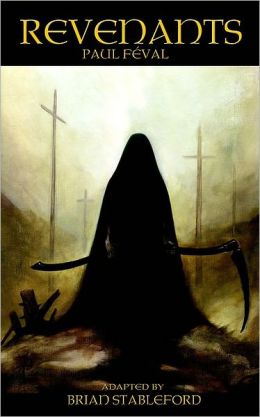
Honourable Mentions: Revenants

The Blurb: “When the damned calls out to the avenger;
“When the Stone missing from the Tomb of Tanneguy is found again;
“Treguern, three times dead, will be resurrected.

“The Prophecy of Treguern.”

1800, On the windswept moors of Brittany, renegade priest Gabriel Le Brec and Fihol de Treguern embark on a scheme to defraud an insurance company by faking the death of the latter. This sets in motion a danse macabre of murders, betrayals, people who change their names, lost birth certificates, false testimonies an Ann Radcliffe romance, a Miltonian struggle between Good and Evil and an impossible phantasmagoria of living men who pretend to be dead and dead men who return to claim vengeance.

The Mention: This is a novel, originally printed piecemeal in 1852, by French author Paul Féval, who is a favourite of Taliesin Meets the Vampires. Other works by Féval that we have looked at are The Vampire Countess, Knightshade and Vampire City . Now, all those books had (at least the belief in) vampires.

Revenants are the restless dead. Arguably they are another form of vampire (or the vampire is a sub-group of revenant), however the primary trait of the vampire (from the 18th century Vampire Panics) was the sucking of blood – an assumption as many of the attacks actually focused on asphyxiation but the presence of blood at the mouth etcetera, when the vampire was exhumed, was taken as proof of blood drinking. Conversely revenant myths would often not mention blood drinking (though there are exceptions where blood is mentioned in myth).

In this case the revenant seems to be simply restless dead, indeed the first occurrence in text is actually one who was still alive but had faked his death. Later in the book (as the time frame jumps to the 1820s) there are several revenants who may be fakes or may be the restless dead. Translator Brian Stableford, in his notes, suggests that there is only one instance of a definitely (or probably) real revenant.

The revenant aspect might be of genre interest enough to earn a honourable mention in its own right. However vampires are mentioned in passing as well. Commander Malo, a warrior priest, is said to be familiar with vampires from Poland, Hungary, Moravia and Silesia.

Also interesting is a discussion about the play The Vampire, referring to the play by Nodier based on Polidori’s The Vampyre. It was a runaway success in 1820, as the story suggests, but Stableford points out that it was having revived success in 1852 too. The character Gabriel de Feuillans is likened in text to the vampire of the play. In truth he is a man who will kill for money, rather than blood.

I enjoyed the book, despite some holes born out of the piecemeal writing style, and it deserves to be looked at as, at least, something of genre interest.

Thursday, June 06, 2013

First Impressions: Byzantium

Neil Jordan is a consummate storyteller and that trait often is passed to his characters, so that the story we hear is a story within a story. Narrators reading us bedtime tales to fascinate us; be that in the Company of Wolves or Interview with the Vampire or in his literature works such as Mistaken. The 2013 Byzantium follows a similar trope, with the storyteller being the forever sixteen year old vampire Eleanor (Saoirse Ronan).

I went to see this on opening night, though this first impression is delayed, and came away with the sense that this is a film taking from both the modern and the past, familiar and yet something new. For instance there are scenes from the early 19th century that carry exactly the atmosphere as I would want to see in a serious attempt to film Polidori’s the Vampyre. This is not accidental and the clue is within the two characters Ruthven (Jonny Lee Miller, Dracula 2001 and Dark Shadows) – whose name is correctly pronounced, in film, as Riven – and Darvell (Sam Riley) who shares the protagonist’s name from Byron’s Fragment of a Novel.

Gemma Arterton as Clara
However I also felt overtones of more modern vampire tales, most noticeably I felt that Eleanor’s scenes and her look owed a debt to the Moth Diaries. There are many more references to vampire works within the film, some blatant such as the scenes played from Dracula: Prince of Darkness. I might have misheard but am sure that vampire Clara (Gemma Arterton) joking calls herself Carmilla. Clara herself is first met in a lap dancing club, such establishments (along with strip joints) being a prime location in many modern vampire films.

tasting blood
As well as borrowing from the heritage of vampire stories/films past, Jordan brings us something new, in the form of the film’s mythology. Strangely this is not explored in depth, but simply is. By this I mean that there are aspects of the film that have their own story, aspects that Jordan reveals enough to tantalise, but whose full story remains to be told. This is not so much frustrating, rather Jordan offers enough to feed into this story but they do beg for a further story of their own.

in the cairn-like structure
These aspects include the turning method. The prospective vampire is given an ornate box that contains a map. The map shows the way to an island (off the coast of Ireland). The passing of the map is almost ritualistic. As such Ruthven has been to the island but is still given the map when he is invited to turn, and perhaps the island is out of reach without the map. The island is almost nothing but a rock jutting out of the sea, the steep climb up the rock leading to a cairn-like structure. The prospective vampire enters the cairn causing birds to flock out (bat-like in their swarm) and meets the thing inside. What is it? We don’t know. It takes the form of the one facing it but perhaps it is an old Celtic God (Darvell suggests that the vampires’ God is older than the Christian God). The prospective vampire is attacked and the waterfalls that cascade down the island turn red. The vampire then emerges, dead and then reborn. What is the full meaning of the ritual? What is its source?

mother and daughter
There is more than a hint of feminism to the story; our two female protagonists are on the run (although Clara hides this fact from Eleanor) from a secret society of male vampires. Females cannot be turned, so when Clara stole the map (and thus stole immortality) she was banished. When she passed the map to her daughter, Eleanor, the turning of the younger woman was seen as an abomination. What is the history of this society? How deep are its claws within our world (we see that they have infiltrated the police)? Again questions that are not to be answered. The claw, however, is an appropriate metaphor as the vampires do not have fangs; rather a singular nail sharpens to be used to penetrate their victim. The society being misogynistic and male based gives a feeling that is almost reminiscent of We Are the Night in reverse. Standard vampire movie tropes like lack of reflection and the inability to withstand the sun are lost but the need for invitation remains. EDIT 28.6.13: The vampires in this are called soucriants, this is a derivative of Soucayant a vampire type from the island of Trinidad. The film takes the spelling from a mention in Jean Rhys’ Wide Sargasso Sea. However the name is about all the lore that the film takes from this vampire type. According to Bane the Soucayant appears as an old woman who sleeps all day, however at night it sheds its skin and ventures forth as a ball of light. Victims will have two small bite marks but the Soucayant is compulsive and if you throw seeds for it, at a crossroads, it will stop and count them and (interestingly) be destroyed by the rising sun. As mentioned, in this sunlight is not an issue and the vampires show no form of shape shifting ability – ball of light or otherwise.

feeding
If Clara is the hooker with a heart (and a taste for blood), then Eleanor is purity and innocence, her feeds are almost gentile and an act of mercy and she knows nothing of the world that Clara shields her from (of course she understands that Clara is a prostitute, her innocence is with regards the vampire society that hunts them). However things unravel when Eleanor meets a young man named Frank (Caleb Landry Jones), a teenager whose long battle against leukaemia has made him socially awkward – as well as causing him to be on anti-coagulants (you can guess what will happen there). Their romance is difficult, awkward and everything that other modern vampire films might tell us romance isn’t. It is when she decides to finally reveal her story that the story is able to come to a conclusion.

Unfortunately, the theatre was virtually empty when I went to see the film. There was me and my son and then one couple. The couple walked out halfway through. Clearly the film didn’t have what they were looking for and it is a film that concentrates on character and story, rather than action. As I suggested, the film has a romance, but it is dysfunctional, bumbling and hardly an epic sweeping tale designed to impress tweens. It has vampires but all neo-gothic trappings are thrown to the side (there is, as I have indicated, a Byronesque feel but it is 19th century gothic not our post-modern sub cultural version) and instead we get the decay of an urban seaside town. There is also a hint of David Lynch in some of the shots, especially the Byzantium sign.

The film is not Neil Jordan’s finest film but it is still a very good Neil Jordan movie and such a movie is always welcome. I really did enjoy it and, perhaps surprisingly, so did my son. In my opinion, a film that is definitely worth catching. The imdb page is here.

Tuesday, June 04, 2013

So Dark – review


Director: Al Lougher


Release Date: 2013


Contains spoilers


Picking up from where So Pretty ended, this continuation of vampire Sean’s (Jeremy Palko, Vampire Diaries season 4) story widens its vista. Not only in the fact that it is (whilst still a short) over twice the length but also in that the action has moved from the train and the opening shot is a panoramic view of Miami.

Russo and Wilburn
Agent Wilburn (Keri Maletto) has just intercepted the Miami PD call re the murder on the train and has swooped in to interview the suspect that cops Russo (Todd Bruno) and Crowley (Wil J. Jackson) have picked up. They are befuddled by the FBI interest given that, whilst the murder was bloody, the suspect stayed on the train, was picked up at the next stop, offered no resistance and has not lawyered up. The last fact does not surprise Wilburn. As per her orders they have put him in the basement – an area without cameras or windows. Also in the station is one of the passengers from the train, Violet (Julie Kendall).

the cross vibrates
Wilburn is not her real name and she is part of a band of hunters (attached to the government it would appear). In her case she has a cross (which vibrates on the table when too close to Sean) and a UV torch (that can burn him). He has allowed himself to be captured and Wilburn’s picture is on his wall at home. In the So Pretty review I mentioned a potential inference of telepathy but this film lets us know that he studies his potential victims, choosing the worst to take for tea.

vampire in the box
I don’t want to spoil too much but we do hear about “the boxes”, experimental holding cells where vampires are placed, starved and observed. We see this in action with the vampire (Aaron Goldenberg) gnawing at his own wrists. Every day the door is unlocked for a short period when the sun is at its zenith and the hunters wait to see how long it will be before the captive commits suicide rather than starve.

Sean, an anti-hero
I was struck, again, by how well shot these shorts are and was also taken with how they have made Sean brutal and yet sympathetic. An anti-hero who has videos of sunrise to watch in the safety of his darkened room. I also liked the fact that the location actually felt like a police station rather than other films where a desk in a hotel room would be used to pass off the location. Perhaps there wasn’t the same natural repartee between the leads as we got in the first film but, of course, the characters are antagonistic to each other and both leads were great.

I sincerely hope we get to see more of Sean’s world. 7 out of 10. So Dark is embedded below.

The imdb page is here.