Thursday, April 30, 2009
A Bite of Love – review
Release date: 1990
Contains spoilers
Sometimes expectations can work the opposite way one would expect. I had been told that this Hong Kong movie was really awful and went into it with my mind set to put up with a really awful movie. Now, it isn’t the best Chinese produced vampire movie, not by a long shot, but it is better than some of the efforts out there and I found myself not hating it quite as much as I would have thought.
The film begins in England and we get a montage of images introducing us to some of the primary characters. We see a Chinese man, only given the name Duke Lee’s Butler (Shiu Hung Lui), meet someone in order to pay bills – though he has little money. We see a man, a gangster named Fung (Norman Chu), leave hospital though he is still on saline and blood drips.
We see a woman, Anna (Rosamund Kwan), in a gallery – she is Fung’s virtuous sister and it is her birthday. We see an orphan boy crying for he has lost money, being ripped off for his last ten pounds and having to steal flowers from a cemetery. We see the butler selling goods to make money and then spotting a woman who is knocked out with a football and finally we see a carriage head towards a large ramshackle castle.
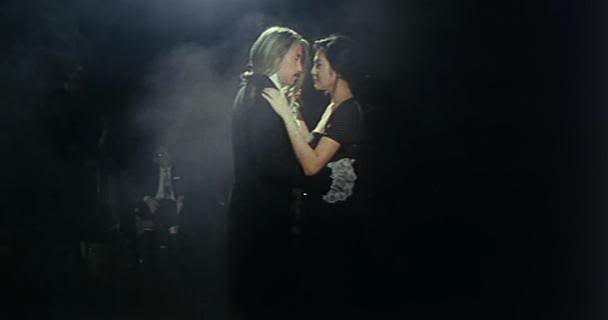
In the castle is a coffin and in the coffin is our vampire – Duke Lee (George Lam). He is long haired – though in a gag that I didn’t particularly get his hair is a wig (of which he has a selection) and the butler’s grey hair is a wig also. He is also quite effete and is groomed by the butler before going to breakfast. The butler reveals the woman who struck by the football, a tempter for the vampire. But Duke Lee does not bite humans. The butler complains that blood is expensive to buy and they have no money. The small sherry glass of blood he offers the Duke has to last two days. The Duke goes out.
He goes to his normal club but it is closed for a private function. Fung has hired it for Ann’s birthday – though the entertainment is clearly for him and his men. Lee sees Anna and falls for her instantly. However she also has an auspicious birth date and time (which, we discover later, means that a vampire drinking her blood will become a king vampire). Lee and Anna dance but he runs when he sees the cross she wears at her wrist.
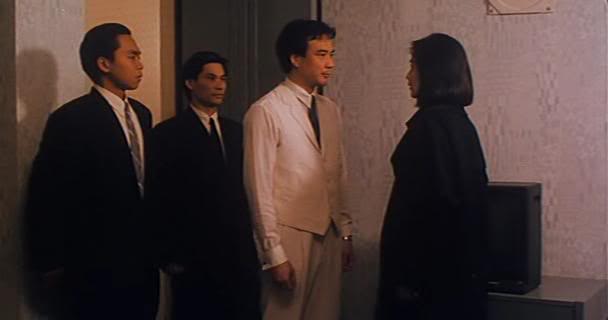
However, the gangster is not happy with the other man’s presence. After Lee interferes with a knife stunt (essentially it was thrown at the orphan boy), Fung collapses. However, in the hospital, he sends his men after ‘the long-haired monster’. There is a resultant fight – with Lee using magic and not actually touching any of them – but during the melee the orphan boy (whom the gangsters had beaten to find Lee) is thrown out of a window. Lee tries to save him but the sunlight drives him back.
The orphan is in hospital and has a rare blood type – the same as Fung. Fung has taken all the blood supply but Anna begs him for a bag. She takes it to the boy but Lee is there and has intravenously given the boy his blood (an act that will cause his magic to diminish irrevocably). The boy is well. Anna goes to tell her brother he can be cured and suggests that she ask the Duke for his help.
The Duke, the next night, turns up at Anna’s whilst she is bathing (a fact that seems to barely faze her). They spend time together and she asks if he will save her brother. He refuses because her brother is a bad man. Be that as it may, they kiss and the Duke has to fight his urge to bite her. He suddenly realises that there is something wrong with the orphan. The gangsters have drained blood off him to help their boss – it hasn’t worked – and now use him as bait to catch the Duke. After a chase he is caught, chained and shipped (along with the kid) to Hong Kong. Pretending that his fingers are a telephone he gets word to the butler – a case of telepathy to telephony.
He ends up chained in the cellar with the kid. He admits to the orphan that he is a vampire. Rather than be afraid he sees it as a means of escape. Unfortunately the Duke is too weak. However, with Anna’s help and a drop (yes a single drop) from the kid they manage to get out of the cellar – though he will have to fight his way out – on the way out Fung is bitten and they have a problem of an evil vampire to contend with.
The lore is pretty mixed up. Obviously he is not a kyonsi so we should explore what Lee is. Anna meets Mr Tsang (Kan-Wing Tsang) in a laser disc (remember them?) store that is showing Fright Night - Tsang is renting that and Fright Night Part 2. He also happens to be an occult expert. Having checked that she is not a vampire he gives her a book that she looks through. The first vampire in it is a kyonsi, the next a Western vampire. The one she stops at he calls a mixed vampire and, one assumes, is like the vampire in Exorcist Master.
The mixed vampire is scared of the cross and of bright light. Tears of sincerity are lethal to it (which has a nice twist at the end, which I won’t spoil). The blood of a mixed vampire heals, as we have seen, and it is only the bite which will turn another. The turning takes twenty four hours – during which time, if the biting vampire is killed the victim is saved. If the victim is a child, the child will not turn until 18 – odd but there you go.
A stake through the heart will kill a mixed vampire – this leads to a fairly effective comedy scene with Anna trying to stake her brother before he turns fully. He is under the bed and she finds herself hampered, dropping the stake and so forth. Okay, it isn’t laugh out loud funny but it is amusing none-the-less.
Of course, that is all well and good unless the vampire happens to have drunk the blood of someone born at an auspicious time on an auspicious day – like Anna. At that point the vampire becomes ultra powerful and can shrug off say, a metal stake through the heart, into a streetlamp and the resultant electrocution.
The effects aren’t too bad but the whole thing hangs together like a collection of set pieces. The unusual lore seemed cobbled together in an attempt to tie in with whatever seemed to be working story wise and whatever comedy piece they were looking for, rather than decide on the lore and then build the story. I wasn’t convinced by the romance aspect at all and, to be honest, Lee was a fairly poor specimen of a vampire. Yet, as I say, not as bad as I’d been led to believe. 3 out of 10.
The imdb page is here.
Posted by
Taliesin_ttlg
at
3:20 PM
0
comments
Wednesday, April 29, 2009
Bottomfeeder – review
First Published: 2006
Contains spoilers
The Blurb: Phil Merman is a regular guy.
A regular guy who just happens to be immortal, for whatever that’s worth. So far all it’s gotten him is a divorce, a lack of friends and family, and a string of soul-killing jobs with no room for advancement. Bound to a self-imposed ethical code bordering on vigilantism, Phil prowls the bowels of New York City in search of suitable sustenance – the homeless, the insane, no one who’ll be missed – all the while wondering how he became what he is. Are there others of his kind? Would he want to know them? Clues to the mystery of his existence begin to reveal themselves, luring him into spaces perhaps best left unknown.
The review: I was contacted by Tara, a reader of the blog, who suggested this volume to me and I am rather grateful that she did. I am always glad to receive recommendations and was especially drawn by her description of the book being “more of a character study than an adventurous plot driven story”.
It is 2001 and Phil has been a vampire since he was attacked in 1974, he lives in New York and, as I read it, I felt it was a New York I had come across through the acerbic and hysterical stand up of Bill Hicks – no surprise then when Phil quotes Hicks. There is a cynicism to Phil as well as a pretension – his language often falls into a conceited pattern. However, what we discover is an ordinary guy, with loves, hates, irrational fears and his own personal bigotries.
Tara said it was more a character study and this is true, but there is a story, crafted skilfully into the study and a twist at the end that, whilst I felt there was something odd about the character involved, I never saw coming. The final page of the book is a black humoured slice of irony that was worth the ride we have been on.
The vampire lore is sparse as the vampires themselves do not know all about themselves. Having met Eddie – one of his own kind – Phil is introduced to vampire society. There are libertines, group therapies and a home for those turned who have mental and physical disabilities.
The vampires know they must avoid sunlight – it burns them quickly, they can heal physical wounds and are immune to diseases and most intoxicants (though a libertine vampire has developed a herbal drug that keeps her stock of humans docile and gets the vampire high when the blood is drunk). Phil assumes a stake through the heart will kill, but does not truly know and whilst we witness a decapitation we never actually definitively discover if that is the end – though we suspect it is. Holy items are ineffective as a vampire deterrent. The bite of a vampire causes the victim to become limp and Phil believes it is because the saliva has an anesthetising toxin.
I thoroughly enjoyed this, a trip into well written literature that creates a vampire who actually comes across as a real, flawed person - one whom, I must admit, I didn't overly like as a person but whose voice and tale was well worth reading. 8.5 out of 10.
Posted by
Taliesin_ttlg
at
10:22 AM
0
comments
Labels: vampire
Tuesday, April 28, 2009
Commercial Vampire: Macdonalds
To be honest, Ronald is more scary than any monster they could dream up…
Posted by
Taliesin_ttlg
at
1:56 PM
8
comments
Monday, April 27, 2009
Honourable Mentions: South Park – The Ungroundable
Posted by
Taliesin_ttlg
at
1:21 PM
0
comments
Labels: belief in vampires, vampyre
Sunday, April 26, 2009
Available from Tomorrow
Go on over to the home page and click sneaky peek to get a flavour for what is in the issue.
Of course, enlightened self interest is a wondrous thing and in issue 3 you’ll find a tale entitled “Setting the Record Straight” by yours truly, where I explore what really happened to Lucy Westenra.
Posted by
Taliesin_ttlg
at
3:58 AM
2
comments
Saturday, April 25, 2009
Vamp or Not? The Vanished
Ame no Machi is a 2006 Japanese movie directed by Makoto Tanaka and based on a short story by Hideyuki Kikuchi – the man who wrote 17 Vampire Hunter D novels. Friend and vampire aficionado Leila contacted me and insisted I watched this as she felt it was a definitive ‘Vamp or Not?’ but was still undecided herself.
I can understand the torn feelings she had over this because, as I sit to write this article – having cogitated for some time and even slept on the issue – I am still unsure as to the direction I am going to go. There are definitely vampiric elements but the aim of the film was certainly in other directions. Let us start at the beginning, however.
It is raining (I believe that the Japanese title means Rain Town – but I stand to be corrected) and Mr Uchida, an elderly gentleman, is in his house. We see a picture of a woman, obviously his wife. Suddenly a child is at the door, seen through the glass, calling for his mother and asking to be let in. Uchida picks up the phone and calls someone – he is back, he says. The child is at the window, and although it is difficult to tell through the glass he looks about seven years old. Uchida addresses him as Shin and says that his mother has been dead ten years. The boy becomes more demanding of entrance when a man approaches and puts a cloth sack over his head.
The man drives out into the woods in a truck. He looks nervous as he stops and pulls a crate down that he drags deeper into the trees, off the road. He opens the crate, which at first seems empty to us, and approaches with obvious trepidation; then the boy stands – still wearing the sack. The man whacks him across the head with a cosh and then leans into the crate. He is grabbed and pulled in – obviously indicating some strength.
We see the boy running, his arms outstretched, still wearing the sack. He is pursued by the man, obviously limping. The scene would be darkly funny if it wasn’t so disturbing. They run over a bridge, suddenly the child veers and goes straight through the barrier, falling and impacting heavily on a rock. By the time the man gets there we see blood stains but the body is gone.
Souta is a journalist in Tokyo – we soon discover he works for one of the more obnoxious tabloids. He is interviewing a woman who is clearly a prostitute and who now sells her daughter into prostitution. Her daughter has a little girl herself. By the time he gets back to the office his editor is ready to pull a story as he hasn’t really applied himself. He gives him a new story, ignoring the prostitution one, a child’s body has been found, in a river, all internal organs gone.
We get an insight into how this tabloid works. Souta suggests that fish entered the body, probably through the anus, and ate the organs. He also recognises that the paper wants a story about organ trafficking in Japan – the truth of the situation be damned. He seems burnt out and uninterested, flashbacks show us that the story he was doing on prostitution was personal – he is the son of a prostitute, who then abandoned him.
He heads out of Tokyo and to the hospital were the child’s body is kept. The doctor insists that he does not believe in the supernatural but then completely opens up to Souta – he clearly needs to talk to someone. The doctor believes that the body was fake, the organs are not missing they never were there. He shows him the autopsy report and the inside of the child – in photographs – seems to be just a yellow mass. The Doctor offers to take him to the body.
The boy is laid out on the autopsy table and the doctor asks Souta not to film. He puts his video camera down. Souta is encouraged to touch the boy, his skin has an elasticity when rigor mortis should have set in and the body contained no blood (though blood was left on the rocks earlier). The doctor goes to get the boy's belongings and Souta takes an opportunity to shoot some pictures with his camera phone, of the face, chest and (under the sheet) legs. We notice the boys hand twitching. The belongings were a school uniform for Hinoemura school, with the name badge Shin Uchida. Suddenly the boy sits up and runs from the room.
This leaves the doctor, clearly mad and hiding under a sheet, whilst the seemingly un-phased reporter phones in to the office. He checks his camera and we see that the boy’s feet were deformed. He heads towards Hinoemura, a small village, and stops at the records office of a nearby town. The only Shin Uchida was born in 1962 but he was in a group of 30 children who went missing during a school activity nearly 30 years before. One of the office workers, Fumio, offers to give him a ride.
They stop at a restaurant, where Souta reads a file on the events and eats noodles. The rains start and Fumio suddenly states they have to leave. In the car they talk. We discover that the children of the area are told that to go in the rains as they will cause you to drown – hence her reaction. One child of the thirty was reported found and claimed they had been led off by another group of school children – but no other school had a field trip that day. It is suggested that the other children might have been thought, in times gone by, to be kappa or amanoyjaku devils – I’ll get back to these.
Anyway, the village is nearly empty and I do not want to verbatim go through the film. So I will state that the children, we discover, appear every year with the rains and, if allowed entry, become unruly and uncontrollable – to the point of even killing their parents. Most of the parents have left the village, or are dead, and the village is almost dead itself. As for the children, whilst they appear normal at first – and Souta gains the attention of a young girl named Ayako Takahasi whose parents are gone – they are far from normal.
They seem to change at night – though they can be violent during the day. They make animalistic noises, their eyes become black and bulging and they develop fangs. They seem, at night, to have less control over their violent urges. We also discover that the children can be killed by head trauma. They do seem to need an invitation before they enter someone’s home.
When they attack they seem to primarily go for the neck. We meet the Yasuba family. The man from the beginning, with the sack, is the younger son who was not on the field trip. He is bitten at one point and we see a bandage on his neck with two points of blood soaking through. When the mother is attacked we clearly see fang marks on the neck. This is vampire territory, though whether they are feeding or simply attacking is not revealed.
It was also interesting to note that they seem to crave love. Ayako starts to call Souta brother – one of the frustrating bits was the film doesn’t actually explain whether this is just an affectation to endear herself or whether, given he was abandoned, she actually was his sister and his presence on the case was, therefore, fated. Be that as it may, when he tells her he hates her, her hair goes big (in a demonic way) but she backs away and then – later – tries to make him say he loves her again.
The nocturnal activity, the immortality, the fangs and the neck biting are all prime vampire. The head trauma is part of some vampire stories (as well as other genre lore) and the need for love does sometimes appear in vampire stories. However, clearly, the filmmakers were doing a changeling child film, Japanese style, and I think the mention of Kappa and the amanoyjaku devil is important. Kappa are water spirits, which neatly ties into the rains, and have water filled depressions upon their heads, which when drained can steal their strength, immobilise or kill them depending on the version of the myth. They are known to kidnap children in some stories. The amanoyjaku I assume is an alternate spelling of amanojaku who in (some versions of) the tale Urikohime impersonates the melon daughter by wearing her flayed skin. I am sure aspects of both these traditional creatures were brought into play.
This is, of course, the problem. I do not think the filmmakers intended to bring in a vampiric aspect per se, but there are definitive aspects that fit neatly into the genre. The film itself was a little ponderous in places and there were things around the lead characters I felt were under-explored – especially Souta and Fumio’s relationship. When it came to the kids, however, it consistently hit the spot and, be they changeling children or vampire children, kids at the door demanding entrance and showing fangs are always going to be a winner. It is certainly of interest to the vampire genre fan, however, and I wouldn’t be surprised if this starts hitting vamp filmographies at some point. I am still undecided, but leaning towards this being within the genre. The imdb page is here.
Posted by
Taliesin_ttlg
at
12:04 AM
2
comments
Labels: genre interest, vampire
Friday, April 24, 2009
Dishonourable Mention: Absence of Light
I said some time ago that perhaps I need a dishonourable, as well as an honourable, mention section. Well, I’m not going to create a new index area – this will be listed under the honourable mention index – but I could hardly call this Patrick Desmond film anything other than dishonourable.
The plot of this movie is a confused mess – partly because of the need to throw everything bar the kitchen sink in. The stunts are poor, the CGI is bad, the fact that it is shot on cam is distracting in a bad way and the acting is poor with fluffed lines aplenty, leaving the viewer with the curious feeling that perhaps another take was needed. Worst of all is the plethora of cult stars in the film, why they were there is beyond me and they were so miscast it was untrue. Michael Berryman, Tom Savini, Tony Todd and Caroline Munro – I look to all of you. Unfortunate, as I had been quietly excited about this because Caroline Munro was in it.
I mentioned bad CGI and it truly is badly constructed, poorly textured and awfully matted onto film. Scarily there are commentators on IMDb who try to tell us how good the computer effects are… they aren’t. Of course the sin is that they had Tom Savini on set, a man who could fart better physical effects than the computer ones they had on screen. Why wasn’t his talent exploited? I don’t know.
Which brings us to vampires… the vampire scene is little more than a dream sequence that agent Puritan (Richard Conant) has. It has no real story impact, they are just dream vampires and nothing more. I guess that the filmmakers had some fangs handy and wanted to do something with them. Be that as it may we have three vampire women (of course, after Dracula, it is always three) who are not affected by the cross (Puritan has no faith) and like to suck a little blood.
That brief sequence aside there is little else for me to do but mention that the imdb page is here and leave you with a rogues’ gallery of those who should have known better:


Posted by
Taliesin_ttlg
at
8:12 AM
0
comments
Labels: fleeting visitation, vampire
Thursday, April 23, 2009
Commercial Vampire: Pepsi and Doritos
Technically the vampire is only in this for a very short period of time, and being a Halloween type advert it is more monster mash than vampiric, but it is nice to see Frankenstein’s Monster under the vampire’s control once more.
Posted by
Taliesin_ttlg
at
8:00 AM
0
comments
Wednesday, April 22, 2009
New Film: Vampire Girl Vs Frankenstein Girl
Friend of the blog Everlost posted about this at his Vampire News blog and well…
Some ropey effects (check the skull bit)…
Ultra violence…
Lots of gore…
Japanese sensibilities…
I have to have this movie when it comes out.
Posted by
Taliesin_ttlg
at
9:42 AM
3
comments
Young Dracula – seasons 1 & 2 – review
Directed by: Josh Agnew, Craig Lines
First aired from: 2006
Contains spoilers
Children’s TV can often fall flat, especially that from Britain. There is a tendency for a level of poor writing with pantomimic acting from the adult cast, and, of course, child actors and the issues that can bring. This is why it is frustrating that when the BBC produce something for children that has excellent storylines, intelligent scripting and a competent to brilliant range of acting, they then fail to release said series on DVD.
Young Dracula works, I’ll say that up front, it has a level of darkness (especially in the second series), it treats its target audience with respect, it does have a high level of comedy but does not overplay its hand, it has nuances and references included for the genre fan (probably out of experiential range with the target audience) and, quite frankly, one of the best performances I have seen in kid’s TV. It still airs on CBBC from time to time and yet the BBC have failed to exploit this to any level commercially. Before I continue extolling its virtues let us look at the premise.
Vlad (Gerran Howell) is a thirteen year old who has always wanted to fit in – but he is a vampire. Son and heir to the Count (Keith-Lee Castle) he is much the same as most mortals, or breathers, at least until he is 16 and gains his vampire powers. At this point the various strengths (turning into a bat, super strength, being able to create fire etc) and weaknesses (killed by direct sunlight and garlic, having no reflection plus turning into a being of pure evil) will come to him. The Dracula family, comprised of the Count, Vlad and sister Ingrid (Clare Thomas), have moved to Stokley after one too many pitchfork wielding mobs. This gives him opportunity to go to school and do normal mortal things – something frowned upon by vampire society. Mother Magda (Donna Grant) appears occasionally – she left the Count for a werewolf named Patrick.
I mentioned references and they do come thick and fast. If I had any doubt that Ingrid was named for Ingrid Pitt they were lost when she declares at one point “Call me Countess Dracula." Magda’s surname is Westenra – taken of course from the novel, though clearly she was never meant to be the same character - a lot of the references are just use of name. She and the Count were never married but she will return and use his feelings for her in order to try and gain an advantage.
They arrive in a hearse and a sharp eye will see, written on the back of the vehicle, the name Demeter – the ship Dracula travels to England in, in the novel. The driver, butler and general dogsbody is Renfield (Simon Ludders). Like his novel counterpart he does eat bugs but, in one episode, we discover that he is Renfield Junior and there was a previous servant Renfield Senior – a master alchemist – also played by Ludders.
Luckily Stokley has a castle, which Vlad managed to arrange purchase of, for his father, via the internet. In the first series the castle is pretty much just that but in the second series it takes on a personality of its own, as does any place where the Count lives for any amount of time. Vlad manages to make friends with Robin Branaugh (Craig Roberts) – a Goth orientated young lad, who is rather impressed to discover that his new friend is a vampire, and the Branaugh family play a large part in the series. Much of the series does involve Vlad trying to get his father to maintain the no biting rule as a part of trying to hide their true natures.
However, the new woodwork teacher at the school is not so impressed with Stokely’s new family, as Eric Van Helsing (Terence Maynard) comes from a long line of slayers – and we discover that there is a guild of slayers also. He is estranged from his wife, Mina (Jo-Anne Knowles), as she never believed in vampires and his obsession drove them apart. His son, Jonathon (Terry Haywood), lives with him and – eventually – he too comes to believe in vampires and becomes a slayer.
The series involves an awfully large amount of humour – one source being the talking, stuffed hell hound Zoltan (voiced by Andy Bradshaw) and obviously named for Zoltan, Hound of Dracula - but the humour worked and didn’t rely on treating the target audience like idiots. More visceral humour – like the occasional fart gag – was used sparingly and thus worked in context. However, whilst the second series did not lose its sense of humour it did become very dark in places and the fact that this was kid’s TV did not preclude at least one on screen bite and some vampire slayage.
The acting, as I mentioned, ranged from perfectly competent to brilliant and there are three actors to mention at the forefront. Terence Maynard was excellent as the quite ineffectual Van Helsing. Clare Thomas was fantastic as the wonderfully evil Ingrid – allowing a touch of vulnerability to settle upon her character when called for. However the best reason to watch this, to me, was for Keith-Lee Castle's performance as the Count.
Keith-Lee Castle is no stranger to the genre. He played a vampire in the Urban Gothic episode Vampirology, he played Renfield in a vampire episode of Lexx and a vampire’s victim (and vampire lifestyler) in Vampire Diary. His Count Dracula was simply magnificent; arrogant, evil, misogynistic (Ingrid means nothing to him as she is only a girl, only Vlad is of importance), incredibly funny (with wonderful timing) and carrying a rock star aura. According to IMDb the producers first approached David Bowie to play the Count – I am glad that Castle got the role.
This is how kid’s TV should be, something for the kids, something for the adults and treating its target audience with respect. As far as I know this only ran for the two seasons, the first seemed a little more stand alone per episode, the second was a little more story arc in orientation but it neatly finished that arc and yet left a minor cliff hanger in case it ever returned. Great stuff, but come on Beeb – release the DVD. 7 out of 10.
The imdb page is here.
Posted by
Taliesin_ttlg
at
8:34 AM
4
comments