Wednesday, October 18, 2006

Night – review

poster

Directed by: Byron C Miller

Release Date: 2006

Contains spoilers

Night is a hard film to review in that it is obviously low budget, with some poor acting and some implausibility and yet it does rise above its limitations and whilst some of the more arty moments are superfluous it has some nice ideas thrown into it, playing with the genre standards in interesting, and on occasions understated, ways.

The film begins with a robbery gone bad in a bar. Cop Mike Jericho (John Hardy) enters the bar and tries to talk to the robber (Will Green) having dropped his gun. bullets cannot hurt me...The robber threatens to shoot Mike and Mike’s partner Jimi Cannon (Shawn Le Tang) tackles him from behind. The robber lets off a shot and it hits a bystander, we later discover to be Tonia (Melanie Ginnett). Mike notices that she has been hit and yet she does not fall, in fact she serenely crosses her arms over her wound. All this becomes lost as they stop the robber. The two cops go to a bar, Jimi wanting to go on to a club, but Mike is distracted. Tonia is on his mind, though he says nothing about what he saw.

a really bad dreamMike goes home alone, briefly seeing a figure of a man, Konatsu (John Park), who vanishes. Jimi goes to the club and, at home, Mike has nightmarish dreams. Firstly he speaks to Jimi, though the conversation is odd and then he is in a white space and sees the girl laid out. He touches her and there are flashes of images, then he vomits blood at which point he awakens suddenly.

The next day Mike goes missing, taking the day off work to look for the girl and his search running into the weekend. During this period he is watched by Tonia who, eventually, makes contact. She turns Mike and this is one of the nicer understated touches. She feeds from his wrist and then forces him to feed from her neck, a polar opposite of the normal turning scene, which tends to be neck then wrist. He seems wracked with spasm and then becomes elated. Tonia takes him to see ‘the others’, there is a group of vampires living together and who are of a diverse set of backgrounds and ethnicity.

One at the house, Luther (Ronny Vega), is an interesting character in a genre sense. He is a Renfield type character who shoots up vampire blood and can venture into the sunlight whilst keeping all the vampire strengths including immortality. The logic of how that works was woolly, to say the least, but it was fascinating.

aftermath of the first feedMike is told he is a vampire (because, of course, having your blood drained and then being fed blood, causing an elated high, isn’t a dead giveaway) but he does not wish to kill. He leaves the house and, as Tonia promised, instinct takes over and he feeds – fleeing the scene when he realises that Konatsu is watching him. Tonia tells Mike that Konatsu is an old friend and nothing to worry about but later we hear that the others find him eerie and he is Tonia’s sire.

Mike quickly takes to his new life but Jimi is looking for him and so, via Luther, Mike sets up a story to keep his partner off his trail and cause Jimi to believe he is dead and his body is lost. However, as the saying goes, the best laid plans of mice and men…

The vampires in this are somewhat different to your standard vampire. They live in a close-knit family unit and are, generally, supportive of each other. The family unit idea was reminiscent of that portrayed in Near Dark but this “family” was less dysfunctional. Of the traditional remedies, stakes through the heart, crosses and garlic etc do not work. Enough damage will make them go into a comatose state, whilst they heal, and fire (and sunlight) are the only solution. They are stronger and faster than a human, do not age and never grow sick. One of the nice things about the film is the fact that what we are seeing is the acceptance of the vampiric condition by a mortal turned. It is clear that killing to survive is painful at first, Mike cries following his first kill, but he quickly becomes as one with his new life and actually identifies the moment this happens. We also discover that the vampires, or Tonia at least, can trick a mortal’s mind – in fact she turned Mike because the mind trick she tried on him failed.

On the downside, the DVD sound for the dialogue was a little low, though the soundtrack itself generally worked and had a nice industrial/ambient feel – I don’t think that it took me through the “the same unpredictable range of emotions as the characters” as the homepage promises, nor did the characters for that matter, but it suited the film well. The arty shots sometimes got in the way and made the film feel cluttered.

Some of the acting and, to be fair, some of the casting was poor – special mention should go to Jimi’s unnamed cop friend who seemed so out of place and whose performance was definitely below average. The best performance, to me, was Ginnett as Tonia, who fit the role well seeming aloof and mysterious and yet also personable – for a killer who created a whole family unit of vampires. that's gotta hurtI was less taken by Le Tang who just didn’t gel for me. I did like the side character Nathaniel (Kelly Weaver) a vampire in pain, who was turned with his wife some one hundred years before but she could not handle the vampiric condition, died as a result and, a century on, he still mourns for her (he seemed the only angst-ridden vampire, but I liked the way that came out, especially when we see him hunt).

Some of the scenes, for example those of Jimi’s love life, to me, added nothing to the film, having said that the scene where Mike and Tonia finally get it together, which has juxtaposed scenes of the rest of the vampire family hunting – some seductive and others brutal, worked well. I also said early on that I felt that some parts of the film seemed implausible and that mainly surrounded the action. The vampires are faster and stronger than a human. We see Luther take out several street gang members armed with only a switchblade. Yet whenever Jimi rumbled with the vamps he seemed to come out on top. messyIn fact, during a fight with Luther, he holds his own really well. One questions, given the amount of damage it is apparent is needed to slow one of these creatures down, just how a mortal could hold their own at all – especially as the fight between Jimi and Luther was hand to hand. It almost seemed that they were trying to make Jimi a mortal facsimile of Blade and that just didn’t work.

All in all, however, I fairly enjoyed this as, amongst a fairly ordinary main plot, the film makers tried to do something different with the genre. It was nice to see vampires who accepted their condition, revelled in it even, as the fashion seems to be for angst amongst the living dead. Don’t get me wrong with the plot, there was some nice game playing involved but it was a little transparent. There was some effort put into this but my guess is it was let down by funds (or lack of them) and I’ll give the film 4 out of 10 and say it is worth a watch for genre fans.

The imdb page is here.

I look at a re-edit here.

Rosie Lugosi – live at the Mill

A reminder that Rosie Lugosi is performing a Halloween show at the Marsh Mill, in Thornton near Blackpool on Saturday the 21st October at 6pm.

Presumably her spoken word show, regular readers will know that I attended the last one and so can say with some authority that it is well worth going to.

Tuesday, October 17, 2006

New vampire blog and a new film

Just came across a new vampire news blog called Vamp News which is worth checking out.

Interestingly they have mentioned a new vampire film, “Desert of Blood” based on the 1959 old west movie “Curse of the Undead.”

A homepage, with synopsis and trailer, is here.

Brutal Bloodsuckers – DVD

Arrived recently is the DVD entitled Brutal Bloodsuckers. A compilation of 6 movies, I knew before purchase that it was going to be a mixed bag affair as it had 2 movies in the set that I already owned, the excellent Stange things happen at sundown and the poor Vampire Sisters.

Given the cheap price and some of the titles, I knew I was in for a hit and miss few days but, the films are all reviewed now and you can access the reviews via the links below. The films in the set are:

  • Vampire Sisters T_ttlg score 2.5 out of 10

  • Night T_ttlg score 4 out of 10

  • Vampire Hunter T_ttlg score 2 out of 10

  • Strange things happen at sundown T_ttlg score 8 out of 10

  • Lifeblood T_ttlg score 3.5 out of 10

  • Barely Legal Lesbian Vampires: The Curse of Ed Wood T_ttlg score 0 out of 10


  • Monday, October 16, 2006

    30 Days of Night: Rumors of the Undead – review

    Authors: Steve Niles & Jess Mariotte

    Release Date: 2006

    Contains spoilers

    This novel is based on the world created in the graphic novel/comic series which starts with the graphic novel 30 Days of Night. The story begins immediately after the events of the graphic novel short story “Agent Norris MIA”. I haven’t read that, unfortunately, but the introduction to this novel does state you do not need to be familiar with that story to fully follow the novel and this did seem to be the case.

    Knowledge of the stories, whilst unnecessary, enhances the experience as awareness of the references makes a lot of the events hauntingly familiar and that does drawn the novel closer around you. The events take place between Dark Days and “Return to Barrow”, actually passing beyond the “Return to Barrow” timeline (the events of which are mentioned briefly but not in detail). There is also some reference to the events in the graphic novel short “Dead Billy Dead” published in “Bloodsucker Tales Vol. 1”.

    If you are unfamiliar with the stories mentioned above the book does a very nice job of bringing the reader up to date. In the graphic novels, by Dark Days, we discover that Stella Olemaun released a book based on the events she survived in Barrow called 30 days of Night and the novel contains, throughout, excerpts from Stella’s book. These were great but they did leave me wishing that Niles would pull together a prose version of that book.

    The story is concerned with FBI Special Agent Andy Gray, erstwhile partner of Agent Norris. It follows his discovery that his missing partner has become a vampire, his struggle with accepting the truth and the way his life falls apart as he tries to uncover evidence of the vampires’ existence to the chagrin of his superiors, the shadowy Government project Operation Red-Blooded (who suppress, often violently, the knowledge of the vampires) and, of course, the vampires themselves.

    As the evidence mounts up Gray is left with the ultimate conclusion that “it seemed unlikely… …that such a specific sort of story would have roots in so many different places and that such a diverse assortment of people would fear the beings who came in the night.

    “Unlikely, unless those people all understood something that modern Western civilisation, in its limitless ‘wisdom’ and sophistication, had decided to pretend was nothing more than a story.

    “Vampires were real.”


    The vampires themselves are ruthless killing machines, their ‘condition’ causing their hands to curl into talons and causing razor rows of teeth to sprout in their mouths. They can take a huge amount of damage; Norris at the head of the novel survives at least seventy gunshot wounds. The only two things that can kill them are sunlight and removal of the head – “Nothing lives without a head.” This is the joy of 30 days, whilst some of those vampirised have more about them, many become psychotic killing machines – 30 days is all about placing the horror back into the vampire genre and is a nice change of pace from the slough of vampires with pathos and overly romantic vampires.

    I loved the world that Niles had created with the 30 days graphic novels but, as I said in my review of 30 Days of Night, I had problems with the original’s lack of characterisation – a flaw that was much improved upon later in the series. This does not suffer from that in any way shape or form, Gray is an excellently thought out character and we really do get inside his head as he descends into near madness and out the other side, the novel also complements the original graphic novel by adding characterisation that was not there initially through the excerpts from Stella’s book.

    This more than makes up for the fact that, by the very nature of this being prose, we have lost Templesmith’s excellent artwork - with the exception of the cover.

    This is not high literature, but it doesn’t matter as it isn’t meant to be. The prose is strong and the style flows well, with strong description of the carnage wreaked by the vampires and stronger description of the wreckage of Gray’s life. It was a book that I could not put down and, as well as wanting a specific prose version of the 30 days story, from Stella’s point of view, I was left with a desire for Niles to produce more general prose set in the 30 days universe, especially if it concerned Operation Red-Blooded. I’m more than happy to give this novel 8 out of 10 as a rollercoaster ride through the horror that is the 30 Days universe.

    Sunday, October 15, 2006

    In the Times Online…

    An interesting article about an English Vampiress in Peru:

    A BRITISH woman reputedly buried with a stake in her heart in a seaside town in Peru has become known in South America as the “bride of Dracula”.

    Stories about Sarah Ellen Roberts, who died in the port of Pisco in 1913, are being spread by television documentaries, a lurid comic book and a film.

    According to her municipal tombstone, she was born in Blackburn in 1872 and died in Pisco aged 41. Soon after her death, say historians, lurid stories circulated about a pale-faced foreign lady who stalked the town, feasting on the blood of animals and young children.

    The rest of the article is here.

    Over at the Zombie Astronaut

    It is a bit of a vampire fest, this week, over at the Zombie Astronaut. In the “Pardon me but your teeth are in my neck” section are the first four parts of the BBCs version of Dracula. Also, in the “Last Requests” section are Hammer’s audio version of Dracula and Nightfalls’ version of Carmilla.

    ZA is now weekly, so you’ll have to be quick.

    Saturday, October 14, 2006

    Behind the Masque

    Well, it has taken a little time, and I must admit that I was a little slow at times in uploading, but in a flurry of typing frenzy my novella Behind the Masque is now fully uploaded to the sister blog Taliesin writes the vampires.

    For those who never saw my original post about this, I wrote Behind the Masque some 16 years ago and it has been languishing ever since, so I decided to post it on the net, in case folks got anything from it. Be gentle, it is not my best work!

    A warning however, the novella contains expletives, occult references, sexual references and violence – if you are offended by such things please don’t complain just steer clear.

    Vampire Beach Babes reminder

    A reminder that the goth/surf band the vampire beach babes are playing the Misery of Sound, Blackpool, in two weeks time – October the 26th.

    Tickets are available via Odddboots, give them an email for payment details, and are £3.00 or it is £4.00 on the door.

    Friday, October 13, 2006

    Kuroneko – review

    DVD

    Release Date: 1968

    Directed by: Kaneto Shindô

    Contains spoilers

    This film is a Japanese offering from 1968 and is an astonishing piece of cinema with an unusual vampiric element. Though the film is very much about vengeful spirits and, I know, that some have questioned whether it is actually a vampire movie it most definitely is – though being from a different tradition than your atypical Eastern European vampire the resulting rules are very different and yet eerily familiar.

    The film begins with a hut and a group of samurai emerging from the trees; they are bedraggled, wild looking and lap greedily at the stream by the hut. Inside the hut are two women, we later discover to be Yone (Nobuko Otowa) and her daughter-in-law Oshiga or Shige (Kiwako Taichi) as she is more familiarly known. Cat feeds upon the corpseThe samurai enter and steal their food and then the two women are gang raped. We see the samurai leave and then smoke begin to billow from the doorway, the hut is engulfed in a beautifully filmed inferno which eventually leaves nothing but a charred skeleton of a building with the two corpses blackened and bloodied. A black cat enters the ruins and begins to feed upon the blood from the corpses’ necks.

    A samurai rides in the night, he seems almost asleep upon his horse, to the point that he doesn’t notice the white shape that jumps over him. Kiwako Taichi as ShigeHe sees a young woman, we recognise as Shige, and she is scared of travelling through the bamboo grove alone. He offers to escort her. They reach her home and she offers him hospitality. Her mother, Yone, brings food and sake. There is a long conversation; much of it has a political overtone as the film is very concerned with the socio-dynamics of the rich and poor. However we note much as this occurs. At one point, behind her back, we see the mother’s hair swish like a cat’s tail, and often, through the bamboo grove and in the house, we hear a cat cry. We also hear that three years before, whilst tilling the fields, Yone’s son, Gintoki (Kichiemon Nakamura) was shanghaied into the war and has not been seen since. true form appears for a secondThe mother leaves, being discrete Shige says before pouring more sake. For a moment her arm is that of a cat’s. The samurai blinks and, of course, it is just a girl’s arm. They end up in the curtained bed and, after some fumbling she bites into his throat. His body is found in the grove the next day.

    We’ll stop here a moment and look at the cat/ghost/vampire we are dealing with. Despite the neck bite it might not seem vampiric and yet the elements are familiar to the Western myths and strong within Japanese folklore. The story itself is, I believe, loosely based on the Japanese tale, “The Cat’s return”. vampiric feedingA google couldn’t find much about this but I am reminded also of the traditional tale, The Vampire Cat of Nabéshima, in fact, later in the film, we see a reflection of Yone in the water and the face is very much of a demonic cat. Cats are also very much a part of both traditional and literary Western vampire myth. In traditional myth one way a vampire could be created was for a black cat to leap over the corpse in its coffin. In Carmilla, the vampire is able to transform into a giant cat and often feeds in that form whilst sat on the victim’s chest.

    In this film we later discover that the two women have offered themselves to the evil Gods or spirits in order to exact their revenge. click to read subtitlesTheir vow means they cannot reveal their true identities or why they have done this and must suck the blood of samurai. It becomes very apparent that the house is a construct, only seen by victims. It also becomes apparent, as the movie progresses, that there are various ways the vampires can be killed. To breach their vow will kill them, to recite an edifying sutra will put their soul to rest and it seems that the sword can kill them also. It seems that the women cannot be seen at dawn, though it is never explicitly said that the sun kills them, and this ties in with both vampiric and ghost traditions.

    another samurai diesIn the film we see a progression of Samurai killed by the women. Each kill sequence becomes shorter as this is a filmic device to show the destruction the women weave. One of the samurai becomes suspicious before he and Shige reach the house and he attacks her. She evades his sword with high leaps and kills him in the grove. Eventually the Mikado (Hideo Kanze) orders master samurai Raiko (Kei Sato) to deal with the situation.

    Raiko’s forces are at war and we cut to that battlefield. We see a hairy giant of a man with an iron club chasing a bedraggled man. They run through the rushes but the giant’s leg becomes stuck in a pothole. The man runs at him with a sword. We see him ride to Raiko and present the giant man’s head. He is Gintoki and he is bathed and given honour. He goes to his home and discovers that it is a burnt out shell, his mother and wife are missing and then he is given the task of destroying the monster which kills samurai by tearing out their throats.

    He meets Shige, who hides her face bashfully and, when they reach the house, does not invite him in. However he asks for entry to rest and has seen her face and we see a moment of almost recognition. In the house he recognises the two women but cannot reconcile their new clothes and home with his family. He eventually asks them outright but they cannot answer. The rest of the film concerns his struggle to decide whether they are his family, or evil spirits who have taken their guise, his love for his wife and his struggle with the need to be with his family and to destroy the monsters for his master.

    The film is beautifully shot, the bamboo used to give elements of motion where no motion exists. It is difficult to explain just how beautiful some of the cinematography is and screenshots do not do it justice, it has to be seen in motion to fully appreciate. true face in the reflectionThe film is filled with imagery that will stay with the viewer long after watching. It is also wonderfully acted, although that acting can seem rather stagey at times as there are elements that are almost kabuki in nature.

    The soundtrack is perfect for the piece stirring when needed, beautifully romantic at the right times. The film is, most definitely, a masterwork that explores tragedy, horror, honour and politics. The twenty four page booklet, which comes with the Masters of Cinema edition DVD, explains to us that in Japanese culture, as well as being a supernatural icon, the cat “resembles the lower classes of medieval Japanese society abused by the nobles and the samurai.” As such we end with the question, are these vengful vampire spirits evil or actually heroes?

    This is an unusual vampire film but it is also a wonderful vampire film with a fantastically downbeat ending that you must see the film to experience. 8.5 out of 10.

    The imdb page is here.
     

    Thursday, October 12, 2006

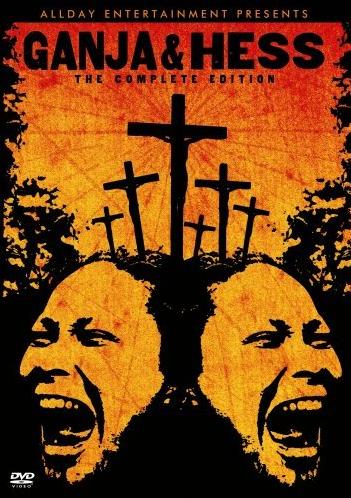
    Ganja and Hess – review

    DVD

    Released: 1973

    Directed by: Bill Gunn

    Contains spoilers

    This review is of the complete edition of Ganja and Hess, which is essentially a director’s cut with three extra minutes of footage previously unreleased to the home market. It should be noted that the additional footage is of a lower quality than the rest of the film. This film was first shown at the Critics’ Week at the 1973 Cannes Festival, to a standing ovation. Unfortunately, from what I can gather, it was then butchered to create a blaxploitation flick. I have never seen the re-cut version, but having seen this original vision I must say that it seems as though that were a sin.

    The film itself is most definitely arthouse, filled with startling images, soliloquy and oblique reference and runs at an, almost, languid pace. If such films turn you off then perhaps it is best to leave Ganja and Hess, but then again perhaps not – I’ll explain later.

    The film starts with a little text opening in which we discover that Dr Hess Green (Duane Jones) is a doctor of anthropology and geology and was studying the black civilisation of Myrthia. We discover that he was stabbed three times, in remembrance of the trinity, and became an addict who was unable to die or be killed – actually not quite true. We then hear a voice-over by Reverend Williams (Sam Waymon), a minister but also, to earn extra money, both a chauffeur and stableman for Hess. He tells us that Hess was not a criminal but a victim and that his addiction was to blood.

    Hess meets his Myrthiannew assistant, George Meda (Bill Gun), a strange man who tells a meandering and unfunny story over dinner that does not amuse his new employer. Having dreamt about the people of Myrthia and a knife from that culture, Hess awakens and finds Meda in a tree with a noose nearby. He is self-admittedly neurotic and has thought of suicide in the past. Later he attacks Hess in bed and, following a struggle, grabs the Myrthia knife and stabs Hess.

    first taste for HessMeda composes a pretentious suicide note that underlines his neurosis and then bathes himself. Meanwhile Hess has awakened without a mark upon him. Meda holds the gun to his own chest and fires, killing himself. Hess goes to him and is going to ring, presumably the police, when he is drawn to the blood and ends up lapping it from the floor.

    At first Hess, to survive, steals from blood banks. However, in a bar, a pimp (Tommy Lane) sets him up with a girl (Candece Tarpley). The aim is to rob Hess and the doctor is stabbed but the knife does not bother him. The girl shoots him and this has no effect either. He kills them both, and in a marvellous scene we see him cut the girls throat and blood spurt out of the artery to the rhythm of her heart – it is just a pity that the blood is a little orange though that could be due to a faded transfer.

    Meda’s wife, Ganja (Marlene Clark), turns up looking for her husband and Hess tells her he has gone away. Hess sates his needHowever, she has not enough money for a hotel and ends up staying with him and they soon become lovers. Hess goes to the city, where he approaches a girl with a baby. Meanwhile Ganja insinuates herself into the wine cellar, a place only Hess must enter, and finds the frozen corpse of her husband in a walk in freezer. We see Hess in the girl’s apartment, her baby cries somewhere and she is on the bed soaked in blood.

    Marlene Clark as GanjaGanja has assumed that Hess has killed her husband but, in a marvellously shot and acted soliloquy we realise that Ganja’s philosophy is that she must do all that is best for herself and, despite the fact that she believes Hess to be psychotic they marry. The service is interesting as, understatedly, we see a Mythrian briefly in the background – so briefly that perhaps it can be almost missed -and we have intercut scenes of husband and wife disposing of Meda’s frozen corpse.

    not a standard honeymoonOn their wedding night Hess tells Ganja that he wants her to live forever and stabs her with the knife, making her as he is. Unfortunately, it seems that she has no taste for killing.

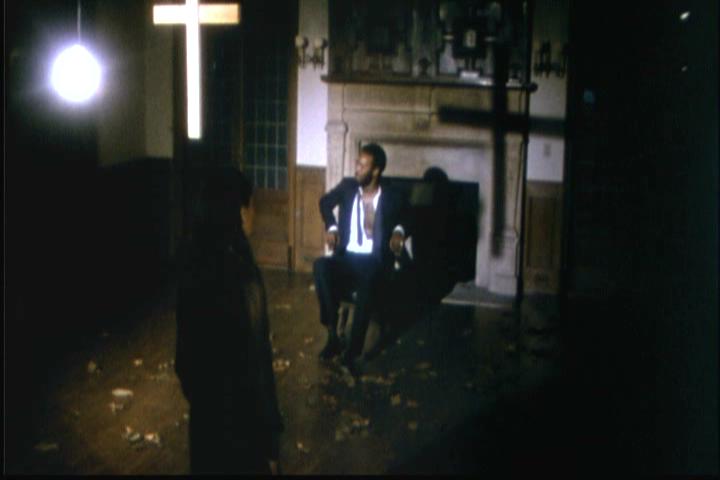
    The vampire lore is unusual; most aspects are shown to us visually, through dreamlike sequences and in throw away comments. threatened below the shadow of the crossTheir bodies are cold permanently, they are addicted to blood, they seem immortal and yet, as I intimated earlier they can die. The method of destruction is also unusual; it is achieved by having the shadow of a religious icon of good (say the cross) rest upon their heart.

    The acting is excellent, Clark as Ganja is at turns unpleasant and yet understandable. She can bait and be bitchy and yet we realise exactly where she has come from and why she acts that way. Hess seems aloof and yet carries a dignity or perhaps even a resignation to his condition, he is the addict, unable to go cold turkey and yet cognisant of the predicament he finds himself in. The soundtrack is an astonishing mix of more traditional African music, soul and gospel which combine to weave a rich aural tapestry and the direction, whilst at times languid, offers the film a definitive feel and character.

    The film itself is about addiction, true, but it is also about victims and aggressors and the way they can be interchangeable, it is also about redemption. Ganja's inner torment as she is forced to feedIt is chock full of startling and sometimes savage imagery but by its very nature the film is not going to appeal to all. To quote David Kalat’s liner notes for the DVD “Perhaps you will find this movie oblique, off-putting or just plain strange. That’s your prerogative. But I dare say even if you find you don’t ‘get’ it, you will never fully expunge Ganja and Hess from your mind.” It is rare that liner notes are accurate, never mind insightful and this is why I said at the head of the review that, even if such films as this are not your cup of tea, perhaps you should watch this one.

    One for those who like films such as “The Addiction” (1995), in style, and “Martin” (1976), in pace, though whilst those films share a feel of Ganja and Hess they are not the same beast. Probably a love it or hate it movie, I loved it and will give the film 8 out of 10.

    The imdb page is here.

    Wednesday, October 11, 2006

    The Blood Opera Sequence - review

    Author: Tanith Lee

    Contains spoilers

    The Blurbs:

    Volume 1: Dark Dance – First Published 1992

    Rachaela Day leads a grey, uneventful life in the London suburbs – until she receives a mysterious letter from the Scarabae family. Recalling her dead mother’s warnings, she wants nothing to do with them. But they persist: they want her to come and live with them, to be part of their family – to reclaim her dark ancestry…

    And suddenly Rachaela has no choice. Losing both her ill paid job and her flat, she is forced to join the family in The House, the great Gothic cliff-top mansion in the middle of nowhere. The house where the apparently ageless Scarabae lurk behind stained-glass windows that block out the unpleasant light of day, where a giant cat stalks the corridors and where, on the night of a storm, the tall dark man of Rachaela’s nightmares appears. And only then will she know the real, chilling reason why the Scarabae worked so hard to bring her into their fold.

    Volume 2: Personal Darkness – First Published 1993

    Stiff and ancient, their faces blackened, skin pale but unburned, they move across the heaths and hills until they come to the pink-tinged outskirts of the city, where windows glow like Polaroid and the innocent mingle with the damned.

    There they make a new home, a beautiful home to replace the one that lies in ashes. Puccini will play, the chessboard will come out, and the seductions and the feasts will begin…

    But for motorcycle riding Uncle Camillo, Malach the warrior, for glamorous Althene, and pale-eyed, half-mortal Rachaela, the history of the Scarabae has reached a turning point. One of their own – little, beautiful Ruth – is igniting a blaze of blood and chaos across London so that now, among the deathless ones, a life must be sacrificed, another begun…

    Volume 3: Darkness, I – First Published 1994

    Lapped in the luxury of Scarabae wealth, lulled by her relationship with Althene, Rachaela has given birth to her second child. A girl. A beautiful, white haired, grey-eyed girl.

    But something is wrong, for children do not mature as fast as this one. Her name is Anna, but other than that, little is known.

    Before Rachaela can decide who she is, or Malach – in self-imposed exile – can make up his mind, Anna is violently abducted: another victim in a global phenomenon of stolen children.

    Cain – monster, blood-lusting genius and outcast of the Scarabae – has Anna now, and has every intention of keeping her. And there she will remain, unless Malach can reclaim her…

    The Review

    This series was recommended to me by Leila. The first book is a richly evocative modern gothic book, as one would expect from the talent that is Tanith Lee. That said, having completed the first book I was almost ready to go down the ‘Vamp or Not?’ line.

    The family, the Scarabae, are the ‘vampires’ in question but that status is somewhat blurred in the first volume. They appear to be longed lived, compared to normal humans, perhaps reaching several centuries and they are aloof to the world. They have been driven out of many countries by the superstitious. They avoid the daylight, but it is not the destroyer one would imagine and there is only one mention of blood drinking and that is during a sexual encounter. It should be noted that, whilst Rachaela’s mother was from out of the family, the Scarabae are incestuous and we hear that it is rare that their seed takes with an ordinary human. Rachaela believes that they have convinced themselves that they are vampires, though it is interesting that we discover that the eldest Scarabae, Camillo, murdered his betrothed when he tried to drink her blood he explains:

    “I tried to pretend once I was like Adamus is. I slit her neck with a table knife. But the gene didn’t come out in me.”

    This lead me to believe that perhaps vampirism is part of the family, somewhere. Certainly it is a belief shared by one character as several family members are staked. However, stakes kill humans as well as they might kill vampires.

    The first novel itself was reminiscent of Mervyn Peake’s Gormenghast, with the rambling mansion, full of strangeness. Also in the fact that little really occurred in the first volume and yet, as happened with Gormenghast, one becomes sucked into the strange world that Lee draws around us.

    The second novel, Personal Darkness, continues the story of the Scarabae – now displaced to London and yet in their displacement a life seems to grow within them. The old family members seem to grow younger as the days pass.

    The book is more explosive than the first, following the story of Ruth, young and murderous and how Malach, a Scarabae from mainland Europe, tries to find and tame her. The novel also follows Rachaela as she becomes, despite herself, more at ease with her Scarabae heritage and begins to fit in, to a degree, with the family.

    We learn more of the vampiric nature of the Scarabae. In this novel it seems that they drink blood only for sexual gratification, and then only rarely. Ruth drinks the blood of her victims because she deems it necessary, an affirmation of her familial ties. The family are rich and, we discover, extremely powerful, and the long lives they talk of seem to be endless.

    Again we hear that the older Scarabae dislike the sun, though it causes no real harm. When Ruth asks Malach why the sun does not affect the two of them he explains, “We draw our personal darkness around us to keep us safe from the sun.”

    We also discover that the Scarabae are inhumanly strong, can withstand much damage and some can heal. Malach, at times, seems like he has supernatural powers – at one point he manages to set a tone from a glass that shatters all other glass in a pub. They also can contact the dead in the form of séance. These are not the vampires of traditional myth, rather they seem like the figures who inspired such myth.

    As with the first book this is a beautifully drawn novel, Lee’s writing sensuous and able to draw up sumptuous visions in the reader’s mind.

    I did not like the third book as much as the first two, it seemed too global and therefore scattered. At times we become lost within the minutia of lives and, whilst that very same minutia worked in the first two books as they were concerned entirely with Rachaela and Ruth, the global nature of the book meant that the minutia distracted from the story. We did, however, meet Cain, still a drinker of blood – though it was apparent that blood was only drunk for pleasure, be it sexual or sadistic. More interesting in a vampiric sense was the progression of the characters Camillo and Miranda. Both old, ancient even, in the first book they both become younger and younger through this book, more so than in the second volume even. We even discover that Miranda’s stained, old teeth had fallen out and were replaced by young new teeth.

    This, it seems, is the Scarabae way - they either become young again or they reincarnate, still Scarabae. The kidnapped children, mentioned in the blurb, are all Scarabae who through accident, or more probably because of the low birth rate amongst the Scarabae, were reincarnated within human families. The exception is Anna, Rachaela’s second child, brought up in the Scarabae world but of profound interest to outcast, and myth amongst his own kind, Cain.

    This series is a fantastic gothic read, despite my reservations about the third book, and yet was very nearly a ‘Vamp or Not?’ as I said at the head of the review. That said the Scarabae are vampires, vampires rethought, reinvented. Blood drinkers by choice only and yet long-lived, even eternal. Vampires who have begun to believe the superstitions spoken about them, such as the need to avoid the daylight. This is an unusual take on vampirism but I would expect no less from Tanith Lee’s fertile imaginings. 8 out of 10 for the series as a whole.

    Tuesday, October 10, 2006

    Bunnies

    I’ve been waiting a long time to give the 30 Second Bunny Theatre a name check here. However, unfortunately so far, the bunnies have not recreated a vampire movie.

    However, there is a Halloween Sound-Board that has a bunny vampire on it and that’s all the excuse I need!

    For those who don’t know, the 30 Second Bunny Theatre recreates movies, in 30 seconds, with bunnies – it does exactly what it says on the tin. These are hilarious and I’d suggest a good long perusal of the site.

    Monday, October 09, 2006

    The Last Man on Earth – review

    DVD

    Directed by: Ubaldo Ragona

    Release Date: 1964

    Contains spoilers

    Originally planned to be a Hammer production, which was eventually rejected because the censor office threatened to ban the film in Britain if Hammer made it, this Italian movie is the only film so far that has got close to capturing Richard Matheson’s novel I am Legend, though it did significantly veer from the original book in places. Just to note, also, that my DVD print of this is not exactly the best in the world, so I apologise now for the screenshots.

    The film stars Vincent Price as Dr Robert Morgan, the last man of the title. We start with scenes of a desolate city, occasional corpses upon the streets. In a house an alarm clock sounds and Morgan awakens. “Another day to live through,” Vincent Price’s marvellous voice intones, “I’d better get started.”

    His daily routine, which has lasted three years, involves checking his generator, and then checking the mirrors, crosses and garlic that he has on his external doors. making stakesThere are corpses outside his home; we discover that ‘they’ feed upon the weaker of their own kind. The mirror on his door is smashed as their own reflection repels them and his garlic, which the infected are allergic to, is becoming stale. He checks his ham radio, to no avail, and then makes stakes upon a lathe before venturing out.

    In the city he gets petrol from an abandoned tanker and then takes the bodies from outside his home to The Pithunting a vampire, a vast landfill or corpses, still burning, that he feeds with flesh, petrol and more flame. He goes to a supermarket, there is a generator still running, presumably maintained by Morgan, and he keeps his garlic in the refrigerated meat locker. He takes more mirrors from another store and then he hunts. Methodically Morgan goes from house to house in the city, marking off each location as he searches out the hiding places of the dead.

    When he gets home and barricades himself in, and the sun has set, the assault on his house begins. There have been some that have said that these vampires are more like zombies and complained that this is not a vampire movie. There are vast differences, yes they shamble and are of a lower level of reasoning, but they use tools, smashing at the house with sticks, they can speak and have memory. The main vampire outside the house calls for Morgan. He is Ben Cortman (Giacomo Rossi-Stuart), erstwhile friend and work colleague of Morgan. We should also remember that these vampires are the dead, they have died of plague and then have come back from the grave – as such they are reminiscent of the vampiric revenants of myth. We must further note that zombies do not fear their own reflection, are not stakable (in the heart at least) and are not repelled by garlic.

    One of the problems with the film, as marvellous as Price is in his portrayal of unlikely action heroMorgan, is the fact that he seems an unlikely action hero. There is a sequence, when he is late back to the house having fallen asleep at his wife’s grave, where he fights through the vampires (who then smash his car through the night as it is not safely away in his garage). This highlights this problem, but it is only one of perception on my part as a viewer. Later we hear that individually they do not scare Morgan as they are ineffectual, it is their weight of numbers that frightens him.

    We discover what has happened to the world through flashback. Morgan and Cortman were employed by a science institute, looking into a plague that was sweeping through Europe. That plague obviously travelled, the film indicating it was wind-born. As more and more fell to the plague a state of emergency was called, the dead burned in The Pit – the official reason being that it was for public health but some believing rumours that the dead were returning. Morgan’s daughter Kathy (Christi Courtland) fell to it first in his family, the army taking her away to The Pit. Virginia returnsThen his wife Virginia (Franca Bettoia) died. Morgan took her to the country and buried her, rather than have her thrown in The Pit. It is a marvellously haunting scene when he hears a whispering outside the house, and sees the door handle turning, then, as he opens the door, we see the horror on his face as Virginia comes to him her hands grasping forward.

    Morgan doesn’t really know why he survived, but suspects that it had something to do with a bat bite he suffered in Panama years before. He has theorised that the bat carried a version of the disease and he became immune.

    Of course, if you have read the book, you’ll know that there are not just the dead vampires. Morgan eventually finds Ruth (Franca Bettoia), a woman who walks in the daylight. He takes her in, but is suspicious of her and then discovers that she is infected, she has a serum that holds back the spread of the disease and her and others are rebuilding society. Unfortunately there is no place for a legendary monster like Morgan in this new world, a solitary creature who stalks the daylight killing indiscriminately – many of those he killed were alive.

    The film spirals on to an end that, whilst having the same result of the book, reaches that ending via a much different route.

    vampiric intrusionOther than the issues of seeing Vincent Price in action sequences there are other problems with the film. The direction, whilst competent, just doesn’t allow level of paranoia to reach the levels that perhaps the book attained and, on a more technical level, there are issues with day and night shots being annoyingly intermingled, so it is daylight when it should be night – but that is typical for the films of the time this was shot.

    The greatest thing about the film, however, is Price, despite my action scene misgivings. He really acts his socks off and, given that he is the sole player for much of the film, the film is carried by his marvellous voice – mostly heard in voice-over. A scene, as he watches home movies, and is driven first to maniacal laughter and then to tears highlights perfectly just how good Price’s performance was. This should serve as a warning to anyone making a version of the book, you need a lead actor with the gravitas to command the screen, Price had that.

    I am Legend is crying out for an accurate conversion to film, and it is all too apparent that the chances of that happening are remote. However, whilst we wait, this is the best adaptation you can see of the book. 7 out of 10.

    The film is public domain and can be downloaded at The Archive. Note that the version available for download is not the widescreen print.
    end of the last man
    The imdb page is here.

    A look at the colour re-master is here.
    I’ll leave this with Morgan’s words at the end of the movie, as realisation finally dawns upon him all too late, “They were afraid of me.”

    Sunday, October 08, 2006

    Over at the Haunted Vampire


    This question has been posed at the Mystery of the Haunted Vampire:

    Is the vampire’s appeal greater now than in the past because humans believe in heavenly immortality less?


    Nip over and join in the debate, it is an interesting question.

    Picture by Victoria Frances

    Saturday, October 07, 2006

    Vampire Wars: Battle for the Universe - review

    dvd

    Directed by: Matthew Hastings

    Release Date: 2005

    Contains spoilers

    It is a rare occasion when Amazon recommends a region 1 film to me, being that I live in Region 2 and, so, when they recommended this I thought; it’s cheap so I may as well. I fully expected to hate the movie and found myself pleasantly surprised. That is not to say that it is the best film in the world, this is a lower budget, take your brain out B movie and yet it has a certain something.

    From the title (it also has an alternate title “Bloodsuckers”) you can tell that this is a sci-fi, in fact this owes much to Whedon’s “Firefly” (2002). Essentially we are in 2210 and humanity has colonised the stars, this is a pessimistic view of humanity, the type of humanity who would strip mine an entire planet. We have discovered that there is intelligent life out there and it is all vampiric.

    The vampires are not the vampires of superstition, crosses, sunlight and holy water don’t work and there types are many and varied. We meet a few of the species in the movie. a voorhees vampireThe first type we meet are the Voorhees. These are more your typical vampires, they are fast, can run up trees and are of a decent intelligence level. They heal too quickly to make conventional weapons much more than a slowing down tool and must be killed by penetrating the bony chest cavity and piercing the heart. Obviously their name is given in reference to the Friday the 13th (1980 onwards) movies.

    When we enter the film a V-San (or vampire sanitation) crew from the starship Hieronymus (which I wondered whether was in reference to Boch or to the vampire hunting assistant in Captain Kronos Vampire Hunter) are cleaning up the voorhees gory mess. This is a rag-tag crew made up of Captain Churchill (Joe Lando), Roman Kuchinsky (Aaron Pearl), Rosa Wong (Leanne Adachi), half-vampire Quintana (Natassia Malthe) and rooky second in command Damian Underwood (Dominic Zamprogna).

    true face of the voorheesIt is through Underwood, on his first mission, that we are told much about the Voorhees. They appear to be flesh eaters, they can infect humans and turn them (as can many of the vampire species) and, when seen on scanners, they are rotten, skull like creatures.

    Following the clean-up (and it is clean-up and not rescue) they get a distress call from a research station. There they find one survivor, Fiona (A J Cook) and we meet the next type of vampires, Leatherfaces (in reference to ‘The Texas Chainsaw Massacre” (1974)). This type of vampire hunts in large packs, they wear the skin of their victims as trophies and they are bleeders, shoot one and they will eventually bleed out. During the mission they loose Dominic Zamprogna as UnderwoodChurchill and Underwood has to take command. The crew is at odds. We have heard that Underwood was booted out of the military because of a disaster that occurred and, we later discover, he took the blame for due to misplaced loyalty. Rosa and Roman blame him for Churchill’s death, they also dislike Quintana because of her vampiric nature. Underwood has realised that the defence systems of the research station had been shut off prior to the attack and suspects foul play, he has to pull the crew together to solve the mystery.

    Natassia Malthe as QuintanaQuintana is played by the very beautiful Natassia Malthe and is one of the best reasons to watch the film. Not only gorgeous, the character is fascinating and I had the feeling, as I watched, that this is how Bloodrayne should have been played. Her character is the daughter of two scientists who were captured and turned and her childhood, amongst humans, was a science experiment. She has to drink plasma, can read minds and can sense vampiric presence. There is an interesting “sex scene” between her and Underwood. She cannot physically have sex as she will go “Black widow” during and has vampiric tantric sex, where she stimulates his mind and makes him feel that he is having sex with his, now dead, wife (Carrie Flemming). This was clever and a tease, one expected to see Quintana (hence the tease) but the introduction of the concept of Underwood's now deceased wife built the character even more.

    The film is gory, no doubt about that, and one feels that the majority of the budget was blown on gore and cgi spaceships. That is generally no bad thing but the cracks do show occasionally and one of those times is on a space station. a hungry vampire hostThey realise the space station has been overrun and end up in an outside location shot that made little sense as this is a floating station in space. They would have been better sticking to internal shots that might have been samey but would have been more logical, the location did jolt. Whilst there, they realise that all the deaths were caused by a vampiric creature who injects a deadly venom that necrotises the flesh of the victim, they like their food dead but still warm. When they see it, just one it appears, Quintana does not know what it is and they waste it.

    the true vampire emergesUnfortunately it is the host, not the actual vampires, these are worm like vampires that take over a host (and several are in the same host) called Vermus Nosferatii. The worms flee the dying host and it is an Alien (1979) type moment. Most are killed, by electrocution through tasers, and they capture one that Quintana gets to speak. The creature is clearly a hand puppet (you can see the fingers below the construct) but that didn’t really matter – I just thought it was an ingenious use of budget.

    The rest of the main actors are fair enough, in general, Zamprogna as Michael Ironside as MucoUnderwood very much comes across as the altogether eager rooky that he is meant to. Probably the most disappointing performance was by Michael Ironside as Muco, the Voorhees leader and big bad of the movie. He played the role much too pantomime, which is a shame as I like Ironside generally. Unfortunately some of the incidental human characters, including that of Fiona, were poorly portrayed.

    This movie has problems, it is true, but I was able to detach brain and thoroughly enjoy myself. There is good characterisation and tension between the characters and a rich background that, if all things are fair, should lead to much fan-fiction being produced. It has been commented that this felt like a pilot for a series and that is true, and down to this background within the film I feel. Parts of the plot do not stand to scrutiny (Underwood being the key to the entire thing was altogether too contrived) and some of the acting is poor, but most of the main characters are played with competence. Probably the key to the entire film was the fact that they added a high level of ingenuity, though much of the plot and look could be traced to other films it felt like they had thought outside the box when they constructed the film which offered a creativity often lacking in modern low-budget films.

    This is B movie heaven, expect no more and you won’t be disappointed, however it will irk the traditional vampire movie fan. I did like the cross-reference, in the names of the vampire species, to other horror movies – it could have back-fired but was actually a nice touch. There are sfx and location problems, but if your brain has been taken out you can live with it and the makers did well with what was obviously a lower level budget. I’m going out on a limb here and giving this movie 5.5 out of 10, probably too strong a score but given as this is a film I will definitely be watching again – though perhaps it helped that I expected to hate it.

    The imdb page is here.

    Friday, October 06, 2006

    I Am Legend - pics

    As we keep an eye on potential disaster, I Am Legend, Upcoming Horror have posted links to behind the scene shots. Picture a 'vampire' on set.