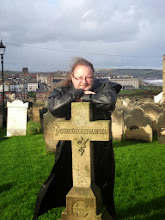
For this post on our Ten Years of TMtV series I have the great honour of posting this interview with Jean-Marc Lofficier. Jean-Marc and his wife Randy are veterans of the comic book world, having worked on DC and Marvel titles. For me, however, Jean-Marc will always be the editor of Black Coat Press, a singularly brilliant enterprise that has made a large number of French Language 19th Century pieces of literature available to the English reading world, including many vampire titles.
TMtV: Jean-Marc, welcome to Taliesin Meets the Vampires I know you through Black Coat Press but you have also worked in the comic industry. Could you tell us a bit about that?
JM: Randy and I began writing comics in the early 1980s, usually filling in for our friends Roy Thomas and Gerry Conway, who at the time had gotten very much involved in writing movies. Roy and I have continued collaborating over the years on numerous projects; the latest being a Marvel Arcana issue devoted to the Original Black Knight, and a French comic featuring a WWII group of heroes called Les Partisans. We have also collaborated with Marv Wolfman and Len Wein.
In France, I took over the editorship of what has become Hexagon Comics around 2007 and I am still the main writer for that line.
TMtV: Do you have a preference for writing prose or writing for comics/graphic novels?
JM: I can’t say that I have a particular preference for either, but when one is lucky enough to work with a terrific artist—and I’ve been privileged over the years to work with Joe Orlando, Ted McKeever, Ladrönn, Alfredo Macall, etc.—then writing comics can be an exhilarating experience because of the merging of two visions into one; the result is usually superior to what I had envisioned in my mind.
TMtV: You work a lot with Randy, could you tell us a little about that collaborative work?
JM: When we write in English, I tend to do the plotting, the first draft, as it were, and then Randy takes care of the actual style and dialogues, although even then, there is always a certain amount of back and forth. When we do something in French, we discuss the concepts and the ideas, but I usually take it from there.
TMtV: I know you have worked for both DC and Marvel, and that there was vampire material with both companies. Could you tell us which you were involved with?
JM: Several vampire-themed stories, indeed. At Marvel, I was responsible for a back-up feature in Dr. Strange called “Tales of the Vishanti” and one of the things I did in it was a multi-part story called “Curse of the Darkhold” that retraced the origins of the vampires in the Marvel Universe since their origins in the pre-cataclysmic Atlantean era.
In 1995, Topps asked Roy to do an adaptation of Francis Ford Coppola’s
Dracula movie, and that led to a three-issue Frankenstein-Dracula War mini-series which I plotted, following Roy’s instructions regarding the interplay between the two monsters, but adding Count Saint-Germain as an additional foil.
In 1999, DC asked my friend the artist Ladrönn and I to modernize the concept of Transilvane created by Jack Kirby in Jimmy Olsen in the 1970s. Transilvane is a miniature planet inhabited by monsters from classic horror films, led by a Dracula look-alike called Count Dragorin. So we did two issues with that.
Also that same year, we wrote the second book in a trilogy of Elseworlds drawn by Ted McKeever which took place in a futuristic universe resembling that of the pre-war German expressionist cinema; that book called
Batman – Nosferatu mixed Murnau’s classic vampire film with The Cabinet of Dr. Caligari, both featuring imagery reminiscent of Batman and the Joker.
Recently, for Hexagon Comics, I wrote a story entitled Los Frontizeros (The Frontiersmen) that takes place at the Texan-Mexican border in the 1860s in which a trio of heroes fight a nest of vampires—and dinosaurs to boot!
TMtV: Batman: Nosferatu is a particular favourite of mine. Can you tell us a bit about how that came to be and how you pulled the story together?
JM: The original concept was to do merge Fritz Lang’s Metropolis and Siegel & Shuster’s Metropolis into a single universe. We recast the film into a DC universe story finding analogues for all the film’s characters, but generally following the plot of the movie. That led to a lot of thinking about that universe: Where is it? When is it? Why is it like that? Once the world-building was one, it then occurred to us that there was room for other keystone DC characters such as Batman, Wonder Woman, etc. DC was generous enough to give us the green light for a trilogy, despite the fact that neither the story (relying on knowing rather obscure movies), nor Ted’s art, were being particularly commercial at the time. (These were the times of Wolverine and The Punisher, if you remember.) I did have two more books plotted, but they didn’t go for it.
TMtV: To me, the volume did owe a lot to the Cabinet of Dr Caligari, why did you look to both silent films for inspiration?
JM: As I said, the core concept was to recast German Expressionist cinema, so the first book owes its story to Metropolis, the second to
Nosferatu and Caligari, and the third (which stars Wonder woman) to
Mabuse and The Blue Angel. Had we continued the series, we would have used The Blue Light and Queen of Atlantis.
TMtV: You also do translation work, what was it that led you into this?
JM: In comics, we translated (and received awards for) most of the best comics France has produced: stories by Moebius, Philippe Druillet, Jacques Tardi, François Schuiten, Andreas, etc. Our stuff was published by Marvel/Epic, Dark Horse, NBM, etc. We also translated a French humor comic called French Ice or Renegade Press.
When we started Black Coat Press, Randy and I decided to retranslate some of the classics of French pulp literature, including Arsène Lupin, the Phantom of the Opera, Rouletabille, etc. We have also dug up two obscure French pulp characters which we more freely adapted and modernized: Doctor Omega, which is a Dr. Who look-alike, and Doc Ardan, which is kind of like a young Doc Savage.
TMtV: Does an amount of the author’s craft remain in the translating process?
JM: Very much so. Ideally, a good translation should not read stilted or awkward, as if it is indeed a translation. It should be a smooth read, just as if it had been written in English, while respecting the intentions and the narrative of the original.
TMtV: Looking at Black Coat Press, how did this come about as a concept?
JM: We got tired of offering excellent, ground-breaking French materials to American publishers and being turned down. The advances made in POD (print-on-demand) technology made it possible us to start a small press and do what we wanted to do without needing anyone’s permission. We were soon joined by Brian Stableford, who had also experienced the same problems, and who has built up 90% of our catalog over the years.
TMtV: For me, the Press has been a Godsend, providing access to 19th century vampire tomes that either would have been outside my language skills or just totally unknown to me. You also produce translations of a wide range of French Imaginative Fiction not just vampire works. How do you decide which books should be translated and released?
JM: Brian decides what he wants to translate, and he does it. Once in a while, I may suggest a text to him, and he is kind enough to do it as well. Obviously we both choose texts (or authors) that we consider as ground-breaking, or even merely significant, in the history of popular literature: science fiction, fantasy, horror, and detective fiction. French popular literature has a unique and distinctive “voice” going back to the 18th century. When I was an adolescent in France, the paperback imprints I bought published both French and British or American books side by side. You could find both Holmes and Lupin, or Fantômas and the Saint, Hercule Poirot and Rouletabille in the Livre de poche, or Bob Morane and Doc Savage, the Black Coats,
Dracula and The Scarlet Pimpernel at Marabout, etc. I always felt very sad that you—in England or America—did not have the same experience and in effect grew up with only “half” of all the wonderful stuff there was out there. So I made it my mission—as in “missionary”—to export as much as I could so that you could belatedly become acquainted with all the books I read.
TMtV: Do you have a favourite translation published by Black Coat?
JM: There really are too many to list here. In the mystery genre I’m particularly proud of having published Paul Féval’s Black Coats series and John Devil; in the science fiction genre, the complete works of Maurice Renard, J.-H. Rosny and André Couvreur; in the horror genre, Féval’s vampire trilogy of novels (
I look at them here: the Vampire Countess,
Knightshade and Vampire City - Ed.) and Lamothe-Langon’s
The Virgin Vampire. I’m also happy to have introduced (or in a few cases reintroduced) such wonderful pulp heroes as Doctor Omega, The Nyctalope, Sâr Dubnotal,
Harry Dickson, Judex and Doc Ardan to an English-speaking audience.
TMtV: I find the variety and array of pre-Stoker vampire lore fascinating, are there any pre-Stoker vampire rules you particularly like?
JM: I thought that the whole Vampire Countess lore and her interface with what is basically the Medical Examiner of that era was fascinating; and also the vampire as an agent of divine wrath in Lamothe-Langon’s was a wonderful concept. We’re so far away from Dracula that one can’t help speculate that the field would be like today had other writers grabbed these concepts way back when and ran with them. But the French were never any good at commercially exploiting and developing their own works. The history of French popular literature is a graveyard of lost opportunities.
TMtV: Are there any books (vampire or otherwise) you particularly want to translate and publish?
JM: We’re working on them! :-) There is a big novel by Arnould Galopin who pits his own Harry / Allan Dickson detective against a Fantômas-lookalike called Tenebras. Brian will be translating that one. Randy and I are working on more Doc Ardan novels, and another Galopin novel featuring Dickson, Holmes and the mystery of Jack the Ripper. We also have an anthology of classic French Fantasy works in the works.
TMtV: Black Coat also publishes the Tales of the Shadowmen, tell us a little about them and how they came about?
JM: Again—my love of French pulp and desire to share them with fellow fans from all over the world, ho don’t read French. Basically, it’s a yearly collection of original short stories in which we respectfully crossover characters from French fiction with other characters—Lupin / Holmes was the basic model initiated by Maurice Leblanc at the start of the 20th century. We’ve had some wonderful crossovers over the years. We just released Volume 12 last December.
Some of the TOTS stories featuring classic vampires, plus a bunch of new stories, were collected in a two-volume series called The Vampire Almanac which you were kind enough to review very positively. (
see Volume 1 and Volume 2 - Ed.)
TMtV: Generally do you have a favorite vampire novel and/or film and what do you like about them?
JM: I have great, equal fondness for Féval’s Vampire City (as a concept) and Vampire Countess (as a narrative with great characters); both have tremendous potential, which some of the authors of TOTS have indeed developed in the past.
In the movies, I like the classics: Nosferatu,
Horror of Dracula, and Dan Curtis’
TV adaptation with Jack Palance in the role. I’m not enormously fond of
Bela Lugosi’s,
John Carradine’s or
Francis Ford Coppola’s versions. I also like the
Hammer’s Karnstein movies. More recently, we were great fans of the
Buffy TV series, although its portrayal of vampires wasn’t particularly ground-breaking.
TMtV: What is coming up from yourself?
JM: As I mentioned above, The Man in Grey (the Arnould Galopin Holmes.Dickson/Jack the Ripper novel), the French Fantasy Treasury, and more Doc Ardan (at least two more). Also, a second collection of short stories entitled Pacifica 2.
TMtV: My thanks to Jean-Marc for graciously answering my questions and for agreeing to be a part of 10 years of TMTV.
Bio: Randy & Jean-Marc Lofficier have been a writing team since 1979, first covering the Hollywood scene for American and foreign cinema magazines. They co-authored a dozen books on movies and TV series, including The Doctor Who Programme Guide, as well as an 800-page encyclopedia on French Science Fiction. They have written several novels, edited over a dozen anthologies, penned animation scripts for television and feature films, and scripted numerous comic-books for US, French and even Italian publishers. They won the Inkpot Award for Outstanding Achievement in Comic Arts for their translations of Moebius’ works in America. Since 2003, they have been the publishers of two SF imprints, Black Coat Press in the US and Rivière Blanche in France, as well as the French comics company Hexagon Comics. The Lofficier homepage is
here.


 It’s been a little while since we had a vampire commercial break and so, for those who don’t know, these adverts just prove my point that vampires get everywhere. We are avoiding the Volvo/Twilight ads – just because it is hardly surprising that there is a commercial aspect in respect of Twilight.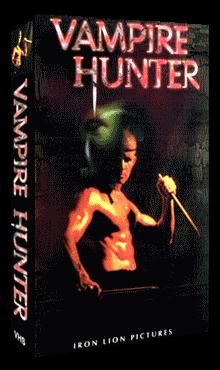
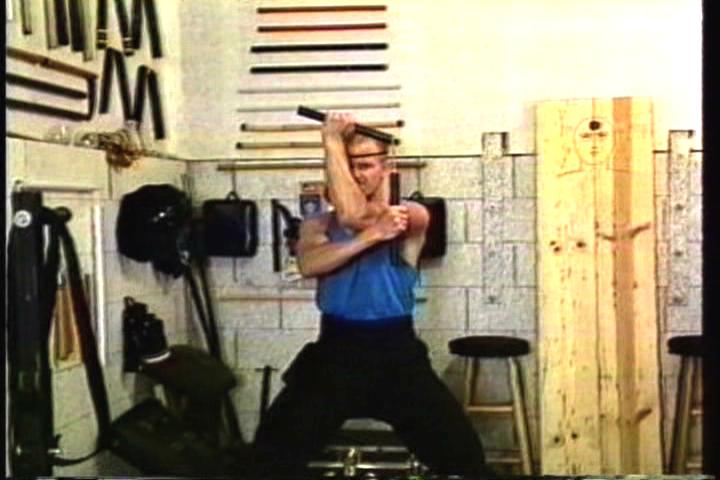 The film itself is a bit of a fantasy play-out for Gallimore. Ex-marine, weapons expert and martial artist John O’Ryan (Sean Gallimore) has now settled to civilian life as a fantasy artist. Gallimore himself is a fantasy artist and a martial artist, which is why I say that it is a bit of a fantasy fulfilment movie. However we get ahead of ourselves. The film starts with a woman in a gallery, bound and gagged. A man enters holding a gun and suddenly a vampire, Morgan Bane (Leonardo Millan), appears. Given the budget, to have him appear from animated smoke was a brave move. Bane admonishes the man for being armed with a gun, he takes his jacket off and reveals garlic and stakes. A second vampire, a kind of heavy metal comedy vampire servant, also joins in. The man is quickly despatched. It seems that Bane is bored of immortality and is looking for a challenge.
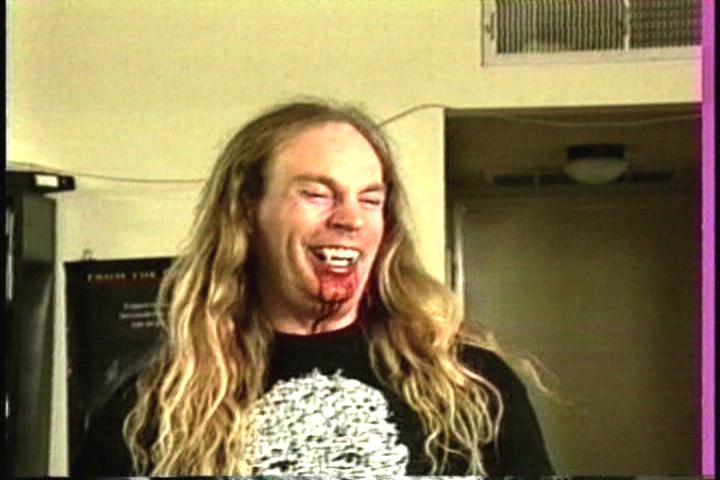 attacks Bane with a stake. John stops him and Bane’s bodyguard pulls a gun. Aiming a water pistol at Bane (filled with holy water) Ramone is able to escape. When he gets back to his apartment the long-haired vampire is waiting for him. Ramone despatches the vampire but I did like the idea of the vampire spitting blood at his enemy to distract him.
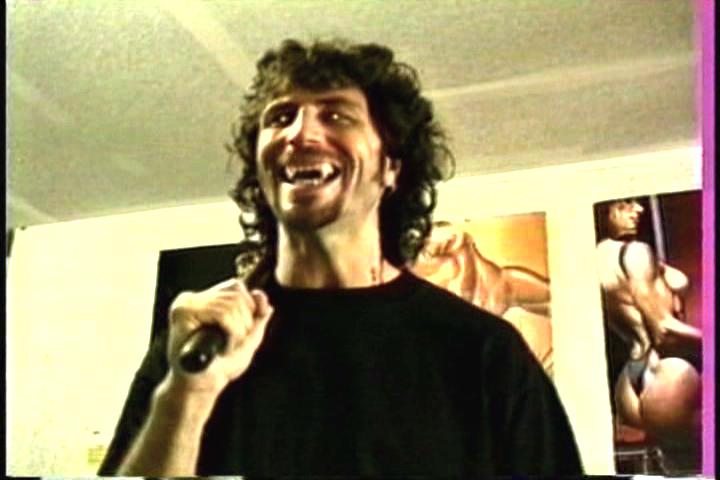 The next night Ray turns up at John’s house and he has been vampirised. After some fighting John kills his friend and discovers that Bane has taken Heather. It is up to John, with Ramone’s help, to get heather back and stop Bane.
 fights with his martial arts buddies who are in the film. The martial arts look good, the choreography of the fights perhaps not so as it is clear on many occasions that no contact is really made. This is, of course, the inexperience of an amateur filmmaker. There is some gore involved and, given the budget, it works quite well.
 At the end of the film Bane changes into a monster vampire. As you can see from the screenshot, the makeover isn’t brilliant but again we are talking budget restrictions. It was a brave move, perhaps, and given the level of the film not too shoddy compared to what it could have been. That said the glowing red eyes of the vampires actually worked well and put other low (and some higher) budget productions to shame.
 When we’ve looked at the commercial vampire before they’ve always been trying to sell us something. This time it is good health in this French Canadian anti-smoking advert courtesy of You Tube.


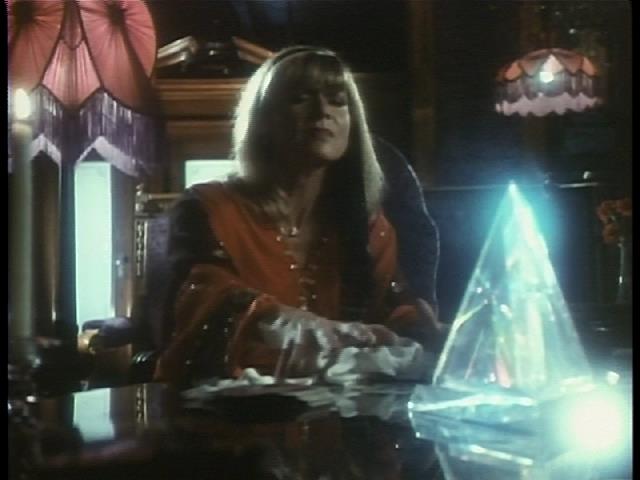


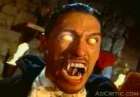 Another example of the vampire used to sell products, this time it is the turn of the comedy vampire, and sees the vampire destroyed by a liberal helping of garlic Tabasco sauce.


 I was, quite frankly, rather disappointed with the whole thing. I decided not to review it until it became available on DVD and they re-edited the damn thing… and I waited… and I waited… and finally we have a DVD – a limited DVD (mine is numbered 0012). And… it isn’t re-cut. It is still in its poxy little chapters and the chapter number flashes up with logo as it goes along. If you remember my 30 Days of Night: Blood Trails review you’ll already know that keeping it episodic like that bugs me. This isn’t as intrusive as Blood Trails but it is still a pain. Worse because the thing needed a good re-edit, even worse because the expunged scenes are not added in but extras… Now the one with Ingrid Pitt does have a plot important aspect to it (she gives Ed (Jamie Dornan) a Green Man medallion that saves his life and, without the scene, we wonder what the Hell he pulls from his pocket that stopped a crossbow bolt) but… let us get to plot.
 We start with Ed on army manoeuvres in a forest. He sees something in the dark and it is the vampire Melech (Sebastian Knapp) taking a bite out of Ed’s girlfriend Jen (Nora-Jane Noone). It is a nightmare and he is in a military hospital He has been injured in Iraq as he planted a flag (the significance of the flag, whilst it features in the film as stands, is lost unless you see the extra scenes in the DVD extras). A detective wants to ask him questions. It cuts back to a month before.
 Ed has 16 hours compassionate leave before he ships to Iraq and is picked up by his friend Necro (Matthew Forrest). Now, the character is called Necro and drives a hearse but any significance (or even why he has a hearse) is sacrificed to the Gods of let us not develop characters. Of course the absolute lack of proper character development is probably down to writing 5 minute episodes but it is annoying. Ed and Necro want to go to a rave – though they do not know where it is going to be. Jen is not returning Ed’s calls and it turns out he stood her up the week before for an army night out. Jen and Necro went to a rave, where she met and got off with Melech. Necro met a girl – for girl read vampire, though he doesn’t know it at this point – called Lilith (Lois Winstone, yes, Ray’s daughter).
 Now they pass, early on, a US army truck driven by Melech – that has a girl tied in the back as a snack and I did go back to the scene and confirm that it was Melech. Why? Because at the climax of the film… a vampire burns up in the first light of the sun. So why is our vampire driving a truck during the day? Who the Hell knows. Perhaps because it is overcast – though we question why he would risk immolation? We also meet the Crockers. First of all we meet Rich (Tamer Hassan) and Terry (Lee Whitlock) and later Danny (Lee Long) and they are the most stereotyped Mockney type drug dealing gangsters you’d have the misfortune to watch but they do underline one aspect of the film – the blooming awful dialogue that bears no resemblance to how people actually speak.
 Anyway Necro and Ed are in the hearse with Big Jim (Jody Halse) and Tina (Katie Borland)… Hold on, where did they appear from. Suddenly they were there, no explanation, as if by magic… but actually it was sloppy filmmaking. The Crockers have had a run in with a couple of vampires – who eventually carve a code on Terry’s stomach. Necro has the same code, in Lilith’s lipstick, on his – it is a mirror image of the radio frequency the rave will be advertised on, broadcast from a pirate radio station. Jen, meanwhile, is already at the rave site, invited by Melech.
 The crux of this is that the vampires have decided to go away – why, we don’t know. They are sailing to an island that is “off the grid” near Africa and they need some snackage for the journey – so they are going to harvest all the humans at the rave. Well all of them bar Jen – ‘cause Melech wants her (she reminds him of someone from the past it seems) – and Necro – because Lilith wants him. To do this they are first going to gas the humans…
 Now I want to hold off here and question why the Hell the vampires needed to wear gasmasks? After all they have no need to breath and… but wait they can get stoned on weed – indeed the best line in the film is uttered by the vampire Uncle Leopold (Trevor Byfield) when he mentions that he has been “smoking this shit for 768 years” – so I guess the undead do breath in this film. Anyhoo they are going to gas them, knock them all unconscious, mechanically drain their blood into a big container and then neatly put the bodies in body bags. Will Ed and Jen make up and how will they escape?
 If I sound disparaging it is because I am. Perhaps naively I had high hopes for a new Hammer film. I hoped they would pull out all the stops and shout at the world, "We're Back!" Bad dialogue, plot gaps and, candidly, weak acting was not what I wanted. Okay, I wasn’t expecting Academy Award level stuff but... I did expect, for example, vampires who got covered in blood (and I mean their clothes, face and hair absolutely plastered in the stuff) to not suddenly be clean in the next scene we see them in. As an aside, I must mention the scene where a guy is approached, whilst in the toilet, by two hot vampire babes and then taken off to be fed on – as soon as he said that he was a ‘cheeky monkey’… well lets just say being fed on by two vamps was a fate better than he deserved.
 There are positives. Sebastian Knapp really looks the part as Melech and steals scenes just by being there. The actor has a really strong presence and I hope he does some fine things in the future. The film is rather bloody, which is good, and there are some nice vampire moments. This brings us to lore… The vampires can be photographed. They are resilient and very strong. Beheading or a stake through the heart will kill them as will sunlight (unless driving a truck). An extra scene on the DVD indicates that failure to feed causes feverish sickness and then death.
 There is some indication of psychic powers – Leopold tells Ed “I can smell death on you, soldier”. They may be selling drugs laced with vampire blood – one of these pills leads Ed to have a vision of an Iraqi girl riddled with bullets asking him to “play with me”. A foreshadowing of events to come or just a bad trip brought on by his anxiety about his posting. The film doesn’t say or do anything useful with the moment. Perhaps it was simply a political comment regarding civilian casualties in Iraq or the theatre of war generally, if so it was poorly handled and out of place.
 This is no longer just a freebie on MySpace, where excesses might be forgiven; this is now a commercial exercise where folks are asked to shell out hard earned money. As such this needs the surgery of a blooming good re-edit with scenes put back in, the flow of the film improved and… even then it might still be on the critical list. 3.5 out of 10 – and it breaks my heart to have to give Hammer’s comeback film a low score. The imdb page is here.