Thursday, October 31, 2013

Vampires: Romance to Rippers; an Anthology of Risqué Stories Volume 1 – review

First Published: 2013

Contains spoilers

The Blurb: Vampires! Glimpse into the steamy worlds of burning desire, and hot sex, where blood and lust collide. Explore some of the sexiest vampires to exist on this side of the grave. Essays, excerpts, and short stories from award winning authors Charity Parkerson, Kurt Kamm, Bertena Varney and more that will make you blush, satisfy your most carnal urges, and have you begging for more from the sexiest creatures of the night. Including a bonus story from BellaDonna Drakul that is sure to scare the pants off of you.

The Review: This is the erotica companion volume to the anthology of almost the same name and I want, unfortunately, to start with a critique of the introduction by Bertina Varney as, unfortunately, it was filled with aspects that I felt were inaccurate, misinterpreted or I simply did not agree with.

Varney uses the introduction to try and analyse the rise in vampire erotica and decides that a primary point was the fact that women write modern vampire erotica whereas the 19th century writers tended to be male. She cites a misogyny in the early vampire literature, which whilst it was there, was not in all influential 19th century literature. She begins with Varney the Vampire suggesting it was written by Prest when it is mostly agreed that Rymer was the primary author, indeed Curt Herr offers an authoritative argument for Rymer’s penning of the series. However, beyond the authorship (almost a trivial matter), she quotes the very famous opening feeding scene – where Varney feeds on Flora Bannerworth – and suggests that it is a rape scene. It clearly isn’t, there isn’t even a sub-text with which to argue that – the scene is simply a vampire feeding; no more, no less.

She then turns her attentions to Dracula and I do agree with her that the staking of Lucy is essentially a gang rape – I have argued much the same myself – but Lucy is a much maligned character done great disservice by both filmmakers and authors, and that tradition is carried on here by calling her promiscuous and suggesting that she “juggles three male suitors”. She, of course, does nothing of the sort – rather she receives three proposals in a day and physically cries at the pain she causes as she turns down the first two and steadfastly waits for the third proposal from the man she actually loves.

One problem I had with the argument was the fact that other 19th century literature was ignored, perhaps because it did not fit in with the theory. Some is obscure, for instance as early as 1825 Etienne-Léon de Lamothe-Langon's novel The Vampire or The Hungarian Virgin had a female vampire who symbolised divine wrath, punishing the man who wronged her (thus avenging for misogyny suffered) and, in a more mainstream way, the erotic aspects of Carmilla occur between two women and whilst misogyny may be read into the authoritative actions of the father (and father figures) the erotica is sapphic in nature, including a thinly veiled description of an orgasm.

I think what mainly exasperated me about the introduction was the perception that vampires are now erotic exclusively because of female writers. Certainly there are many female authors who write vampire erotica (and paranormal romance) but there are male writers also. Nor is the subject matter/sub-genre the province of the female heterosexual; there are volumes of vampire erotica designed for straight and gay men as well as straight and gay women (and all points in between). In short I felt there was too narrow a view.

Unfortunately I have spent a long time critiquing the introduction – and will add that I did not have such thoughts with regards Bertina Varney’s introduction to the companion anthology, which did a sterling job. The volume then moves to an essay by the first author, J.B. Stilwell. I actually thought this would have made a better introduction and found it delightfully insightful. Not so much Stilwell’s next entry into the volume, an excerpt entitled “Hot Dark Comfort”. Not that there was anything intrinsically wrong with it but it was exactly the same excerpt that was published in the companion anthology with an added sex scene. Given that the two anthologies are related I thought that a unique piece would have been more appropriate.

You will see from the blurb that it mentions a bonus story by BellaDonna Drakul that would “scare the pants of you”. I was very much taken with the story submitted in the companion anthology by Drakul and again found myself enthralled by her prose, as she weaved a fascinating tale of a vampire artist and his macabre method of creating his masterpieces. It was not erotic (I suppose it helps fulfil the ripper aspect of the main title) but it was certainly evocative and, for me, was the highlight of the volume.

Some of the stories were more erotic than others, and the word “cooch”, used in one story, must list as the most un-erotic noun used to describe the female genitalia ever. “The Making of Marea” by Scarlette D’Noire was a tale of being turned and was, perhaps, less erotic but it was certainly interesting – especially around the power plays described – and I would very much like to read more of the story. Conversely Emily Walker’s “One Night with the Vampire” was excellently written as a piece of erotica but the story was a tad flimsy. I specifically want to mention Cinsearea S’ story “Love You to Death” as the author eschewed the “hunk” trope and used an emaciated corpse to excellent and sensuous effect.

The overall volume was smaller than the companion piece but, that said, none of the stories were actually poor and the prose was more consistently solid. Worth reading, especially for BellaDonna Drakul’s story. 6.5 out of 10.

Monday, October 28, 2013

My Stepbrother is a Vampire!?! – review

Director: David DeCoteau

Release date: 2013

Contains spoilers

And when I say spoilers I mean a massive one as I feel it necessary to spoil the one burning question in the film, which is “Is Victor (Jud Birza) – the stepbrother of the title – a vampire?” Stay tuned for that one, my friends.

But before that we have to consider the bizarre fact that David DeCoteau has directed a family movie… I’ll let you cogitate over that for a moment. So, is the fact that there is no room for his normal lingering on underpants wearing young men with washboard stomachs enough to improve this above his normal output? Not really.

Dee Wallace narrates the cat
We start with Nancy (Shae Landers) rushing home as her story is narrated by the cat Tabitha (Dee Wallace). Nancy is a normal girl who writes feminist fantasy literature but she is distracted. As she rings her best friend, Lucy (Lauren Greg), we discover it is because she believes her stepbrother to be a vampire. The story cuts back in time…

love is in the air
Lucy gently ribs Nancy for not realising that friend Jimmy (Nick Galarza) fancies her, but Nancy has no place in her life for romance. Her mother, Denise (Tracy Nelson), is a therapist for troubled youths and has not really dated since Nancy’s father died. However that day she had a dental appointment and the dentist Gordon (William McNamara, the Bleeding) has asked her out on a date. Soon they are married.

Jud Birza as Victor
Nancy is a little suspicious of how her life will change now that she has a stepfather, stepbrother and cat in the house. She also thinks something is odd about Victor. He wears very high factor sunblock and seemed to arrange his room in miraculous time. He also seems to be able to communicate with the cat – though Tabitha never appears to listen to his commands. He transfers to her school and soon he is hanging with friends Jimmy and Mitch (Joseph Rich), whilst Lucy clearly has the hots for him.

The V Club
Actually, he wears the sunblock as he has sensitive skin, a condition inherited from his mom. Jimmy and Mitch have asked how to be cool like Victor and he has suggested that he acts all mysterious because mysterious and pale = vampire, especially since Twilight, and the girls go for that. So the film builds an “is he, isn’t he” mystery, with Nancy convinced, the boys dressing uncool in capes and fake fangs and Lucy simply hot for the guy. Nancy meets a patient of her mom's called Renny Helsing (Seth Austin), clearly nuts (yes, Renny is short for Renfield) but on her side.

putting pics up
There were odd bits – Nancy covers her room with apotropaic items, including what looks like pages from the bible mixed with sketches of fangs and anime style vampire sketches – how they would help her is beyond my ken. Nancy also researches the “original” vampire in the form of the novel Dracula and yet seems to think that Dracula burnt in the sun (yes, I know that has been added in many of the movies but they clearly reference the novel) and that Victor will want Lucy because of her name. Ultimately it comes out that he is a dhampir on his mom's side, friendly and puts great stock in family.

fangs appear once
The acting is basic in the main, with that kid’s TV juvenile edge to behaviour and dialogue. There really aren’t any effects to mention. The soundtrack had a comedic edge to it. There is a moment with a TA (Twilight Anonymous) group that is mildly amusing (but shooting fish in a barrel) and we get the observation that vampires were made to sparkle so hot guys would remove their shirts.

The problem is, it tries to be knowing but the knowing aspect is lost against the juvenile air and in the fact that it doesn’t know half as much as it lets on. 2 out of 10.

The imdb page is here.

Saturday, October 26, 2013

Honourable Mentions: Shadow People

This is a 2013 film by Matthew Arnold and the reason it is getting an Honourable Mention is because of the subject matter it covers and how it interacts with original vampire folklore – note there isn’t actually something within the film we would recognise necessarily as a vampire.

You will be aware that in much of the early reports of the 18th century vampire panics that people reported visitations and invariably reported being strangled rather than being bitten. The assumption around the vampire drinking blood probably came from the discovery of “fresh blood” in the mouths, organs and coffins of suspected vampires. As such the vampire is like the mare, which gave its name to “nightmare”.

Fuseli the Nightmare
From Teresa Bane’s Encyclopedia of Vampire Mythology (p 121), under the entry ride, we here that, “Upon entering the room, the vampire usually induces a form of sleep paralysis, rendering the victim unable to move or speak but otherwise fully aware of his surroundings. By either sitting upon his chest or straddling the victim, the vampire then causes some varying amount of pressure to the person’s body.” Bane’s entry goes on to discuss a sexual aspect and, indeed, there can sometimes be that with the phenomena. Henry Fuseli famously painted the Nightmare depicting this and there is a school of thought that the phenomena of sleep paralysis, and the resulting hallucinations that can occur, can explain aspects of vampirism, incubus/succubus visitation, grey alien “abduction”, indeed the plethora of night time visitation myths.

shadow...
This film looks at this phenomena – the “visitors” being called shadow people. It begins with various people discussing a viral video of a sleep experiment, which seems to be causing seemingly healthy people to die in their sleep. The Japanese film the Ring is mentioned and this film tracks the release of the video. One aspect of it I wasn’t keen on was the fact that it was shot like a documentary with the film being re-enactments and then other documentary footage (with alternate actors playing the characters) was interspersed within. Whilst a clever idea, it did break the flow of the film and thus any tension it built.

Teng scared
We then get a scene set in Cambodia in 1979. A group of men sit talking of a recent death in a nearby village. It is said that the man who died had seen his killer before, that he was attacked in his sleep and his face was contorted in terror – he is not the only one to die. This is listened to by a young boy named Teng (Chham) who becomes scared and doesn’t want to sleep. His mother (Chak Reya) tells him not to worry but allows one candle to be left on. A shadow moves in the room and, when she checks on him, he is dead.

Dallas Roberts as Charlie Crow
Kentucky in 2008 and Charlie Crow (Dallas Roberts) is a late night radio talk show host whose ratings are falling. He is called, towards the end of the show, by a young man called Jeff (Jonathan Baron, True Blood season 6) who claims to be seeing shadows. They are not ghosts he insists but Charlie cuts him off as a crank call. After scenes that show his estrangement from his ex-wife (Anne Dudek) and son, Preston (Mattie Liptak) he finds a package from Jeff, containing photos of a sleep experiment and a notebook full of his fears.

Jonathan Baron as Jeff
Jeff calls the show again and Charlie speaks to him. Jeff says that they come if you think about them and then asks how someone can stop thinking about a given thing. He has a gun and a shot is fired, though it becomes quickly apparent that he shot the wall not himself. Charlie, after coercion from the station, goes to visit Jeff in hospital but he is dead, he died in his sleep. This sends Charlie on a path to discover the truth. Along the way a college girl (Mariah Bonner) who helps him with his research dies in her sleep (having seen shadows in the showers). He starts talking about this on his show, the ratings go up and people contact about their experiences but others die.

fangs
So, what is going on? The film doesn’t tell us exactly. It suggests that this might be something brought from Cambodia as the CDC agent Sophie Lacombe (Alison Eastwood) discovers a previous outbreak, but this is contrary to Charlie’s research into the old European myths. We see an attack on Charlie as he is paralysed in bed and the thing lunges at him. From our point of view it is interesting that it has fangs – they look better in the one second flash than in the still by the way. Ultimately Lacombe decides that it is a negative placebo effect, that if you believe that these things are there you can end up causing the effects (paralysis and then death) yourself. However the film doesn’t confirm either way and, because of this, we do not hear what exactly kills the people (presumably it would be draining energy – which would make them vampiric – or the individuals scaring themselves to death). The film does not include a sexual aspect.

in the TV
I won’t go into the video of the experiment from the 70s or how it gets out – from the point of view of this honourable mention it is a side issue. If the documentary aspect had been cut out then more could have been done with the mystery and the horror/thriller moments (I think it was more thriller than horror as stands). However, from a TMtV viewpoint this is a film that examines the phenomena that could have either been supernatural creatures interpreted as vampires or the phenomenon of mass hysteria within a community that led to the delusion of a vampire outbreak. Either way it is of genre interest.

The imdb page is here.

Thursday, October 24, 2013

Embrace of the Vampire (2013) – review

Director: Carl Bessai

Release date: 2013

Contains spoilers

The original Embrace of the Vampire was a rather disappointing film, known more for offering sight of Alyssa Milano’s boobs than for its vampiric content. Thus this remake did not have a lot to live up to.

In many respects, however, this is not really a remake. Other than the fact that it follows a sexually inactive/repressed girl called Charlotte (Sharon Hinnendael) attending college and drawing the interest of a vampire (and having a quick lesbian encounter). Other than that the background, lore and plotting are all new.

Sorina attacks
The film begins in Bucovina in 1735. A horse gallops across the landscape as a woman is held down on a table. A wise woman (Maya Massar) dismounts from the horse and enters the home. She places a cross in the woman’s hand and then cuts into her arm with a knife. Into the wound she pours blood (later revealed to be vampire blood). We hear that *she* is coming. She is a vampire called Sorina (Claire Smithies). The two women have vanished and Sorina takes her rage out on a man left to harry her, his name being Stefan (Victor Webster, Mutant X).

Sharon Hinnendael as Charlotte
So what was going on? Later we discover that the girl was Sorina’s daughter and to save her from the vampire they performed a ritual that mingled the blood of the vampire with the human, making her (and her line) a dhampir. Charlotte is of that line and both she and we get the full story from the wise woman’s descendant Daciana (Keegan Connor Tracy). Now I wasn’t going to spoil who the modern day vampire is, though he has a name and a purpose. However the artwork for the film kind of gives it away and so it is Stefan, who is now going by the name Cole.

sleepwalking aftermath
His presence is causing Charlotte to have bad dreams, sleepwalk, hallucinate and causing her bloodstone pendant to burn her skin, but she doesn’t know his until later on, thinking that her dhampir nature is nothing more than a rare blood disorder that killed her mother. Straight from convent school, she is at college on a fencing scholarship (guess who her coach is) and she is shy, sexually repressed and inexperienced in life generally.

job interview
Much of the film follows her as her boss from her part time job, Chris (Ryan Kennedy, Blade: the Series) falls for her, she meets bitchiness head on in the form of Eliza (C.C. Sheffield, True Blood: Season 3) and has a drunken lesbian encounter with a member of the fencing team called Sarah (Chelsey Reist). So, why the interest from the vampire?

revealing the inner monster
This is key to our lore. In this it is possible for the vampire to become human again if he drinks the blood, offered willingly, from a virgin of the blood line of the vampire who turned him. The sacrifice will damn the virgin to Hell, however. Strangely we see a dream that suggests Charlotte may have been abused (though it is possible, from the symbolism, that the vampire killed the abuser), which would quite possibly have put paid to his ambitions. Apparently only heterosexual sexual encounters count too given the definite loss of her lesbian virginity. Other lore suggests that the vampires are fast, strong and burn violently in sunlight.

blood shower
The acting is fair enough – with Sharon Hinnendael convincingly repressed as Charlotte. It perhaps needed a little tightening in the script, there is nothing definitive but it all felt a little loose and takes a while to get where it is going. That said it hangs together much better than the original film. The new lore is a tad hokey (and reminiscent of the convoluted daywalking lore in contemporarily released Fright Night 2: New Blood) but at least offers more of a story than the first version of this. All in all not bad. 5.5 out of 10.

The imdb page is here.

Tuesday, October 22, 2013

Phobia – review

Director: Jon Keeyes

Release date: 2013

Contains spoilers

Vampirism and hypnotism are casual bedfellows. Of course the concept of the vampire’s eye mojo is well established but by hypnotism I am more referring to pendulum swinging mesmerism. We need look no further than Dracula. Famously Van Helsing hypnotises Mina so that he can use her connection to the Count to try and track him as he bolts back to his homeland. However the book also mention Charcot – a pioneer of hypnosis – and indeed the reference (and the fact that he is mentioned posthumously) is sometimes used to date the story. Charcot is a character in this film, played by Michael Crabtree.

Hypnotism is used in films such as Blood of Dracula and the Bloodthirsty Doll to create the vampire. In this it is used to try and cure phobias but one man fears that he is cursed to be a vampire…

Erica Leerhsen as Lesley
However the film starts with a murder. It is 1866, California, and a scream awakens a young girl, Lesley Parker (Presley Money). She walks through the darkened house and finds her mother (Susana Gibb, After Sundown) dead. Her father (Ian Sinclair, Vamps, Blood & Smoking Guns and the English dub of Rosario and Vampire, Capu 2) looms behind her, a knife in hand and gibbering about setting her free. She runs and he chases, only to fall down the stairs and stab himself in the chest.

by Freud's beard, that's fake
The film moves to France in 1885 and a woman (Erica Leerhsen), the now adult Doctor Lesley Parker, is dressing as a man (in a most unconvincing bob wig) so as to attend lectures by Dr Charcot. She has dressed as a man because she found herself not taken seriously in medical school due to her gender. Her disguise is seen straight through by fellow student Sigmund Freud (Matt Moore, Hallow’s End). This is not surprising, not because it was Freud but because he wore the most ridiculously fake beard himself (though I figure that was a costuming malfunction not part of the film!) Lesley’s reason for being there is because she wants to learn Charcot’s technique and use it (along with group therapy) to help cure phobias. She suffers from Nyctophobia herself, due to the events we saw earlier.

Chase Ryan Jeffery as Val
A friend of Freud, Val Drakul (Chase Ryan Jeffery), is attending Charcot as a patient – his fear is that he has inherited the family curse (being a descendent of Vlad Ţepeş) of vampirism. He has blank moments and a killer certainly stalks the Paris night, ripping out throats with his teeth. Charcot and Freud suggest that he is an ideal patient for Lesley and so it is off to California and some therapy that is all going to go wrong – whilst they develop feelings for each other (her gender revealed).

a victim
Putting the astoundingly fake beard behind us the costuming of this film was actually well done given its indie nature. However the story was a whodunit that relied on the supernatural (for yes there are supernatural vampires in this), and tried to pack so much exposition in that the plot didn’t have room to breathe. There is a full group in therapy and we explore all of their fears – yet they are hardly needed, there is the blossoming love story, a wandering detective (Matthew Tompkins) and a spectacularly effective séance (though the cgi perhaps looked a little out of place and a replication of some Victorian séance trickery might have worked better).

This was a brave movie. I can’t reveal the vampire as it will spoil the whodunit aspect of the film, but ultimately it struggled (unfortunately even more than I struggled to keep my face straight when faced with Freud’s beard). 5 out of 10.

The imdb page is here.

Sunday, October 20, 2013

Vampires: Romance to Rippers; an Anthology of Tasty Stories Volume 1 – review

First Published: 2013

Contains spoilers

The Blurb: Vampires!

Sixteen authors give you a glimpse into the dark worlds of lost love, murderous rage, and undeniable sex appeal where deadly quests and blood lust spanning centuries of time reign supreme.

Explore some of the most unique vampires to exist on this side of the grave. Essays, excerpts, and short stories from award winning authors Karen Dales, Kurt Kamm, Bertena Varney and more. They will entertain you, thrill you, and bewilder you as they reveal the dark secrets of the most beloved creatures of the night, including eleven times bestselling author Terri Reid creator of the Mary O’Reilly Series.

So, which will it be: the romantic vampire, the revenant vampire, the elemental, the fanged vampire, or the mythological female vampire? Begin reading and find out!

The Review: Anthologies are a strange beast. In many respects we have grown past the anthology subject being simply “vampires” but, because of the breadth of the genre, we have now a market for anthologies that look at an aspect of vampirism.

Vampires: Romance to Rippers tries to step beyond this by presenting vampire stories from a spectrum, from the romantic to the violent, and this is an interesting take. However just the spectrum choice might leave some readers cold at one end of the spectrum and others cold at the opposite end – though it may also serve to broaden the tastes and experience of other readers.

What left me, personally, slightly cold was the inclusion of a lot of excerpts from larger works. Don’t get me wrong, I have submitted an excerpt for publication myself, before now, and in this volume there was one particularly excellent one I’d like to point out later in the review. However, the trouble with excerpts is that you often feel that you are in a larger story (which, of course you are) and so you get less of the self-contained exciting vignette that, to me, showcases the skill of the short story writer. However, this anthology contains some well received stories (by me) but also some poorer ones and I will touch on one or two of each.

Unfortunately the anthology began with probably the two stories that left me coldest. Karen Dales The Guest had the interesting setting of a Buddhist temple but really did feel like it was just a smaller part of a greater whole. The story seemed to want to build a mood rather than tell an interesting tale and, on a personal taste level, I didn’t like her prose.

This was followed by two pieces by Elita Daniels. Her essay about why she enjoys reading and writing about vampires was, I felt, out of place and – frankly – somewhat patronising as she kept repeating phrases such as “what’s not to love” and “who wouldn’t want a piece.” It felt like I was being told why I should like vampires, rather than her explaining why she did, and the essay had a feel of a blog article more than anything. There was nothing intrinsically wrong with the prose in her excerpt from her Guardian series, but it was probably at the most romantic end of the spectrum and her vampires were (almost literally) defanged – a strange move from someone who enjoys writing about vampires to try and make them as human normal as possible. There was mention of institutions that newly turned vampires were taken to, though I do not know if her series expands on this as a focal piece. I feel she has a whole story there, a story of despair and pain set within that small stage, with the vampire as the victim, without the paranormal romance stuff getting in the way.

On the other side of the coin the excerpt by Kurt Kamm from his Code Blood was stunning and is the excerpt I mentioned earlier. Excellent prose introduced a (not supernatural) character who was disturbing and fascinating at the same time. Markus is an albino with a love of the macabre and, as we meet him, he has just made off with a woman’s severed foot from the scene of an accident. The excerpt was so good that I stopped reading (I was on a train at the time) whipped out my smart phone and ordered the full novel.

I was very taken with BellaDonna Drakul’s “Forgotten immortal”, a tale in which hallucinatory narcotics leads Benedikt Emory on a quest to resurrect a dead vampire, whose essence has spoken to him during a vivid trip. The story was neatly self-contained, had the kick in the tale that gives a short purpose and the evocative prose painted a German Expressionist landscape in my imagination.

Touched the Sun was another excerpt, this time by Laura Enright. Though an excerpt, her full book – To Touch the Sun – takes place in modern Chicago (so her author’s note informed). This is a flashback to a turning and is set in the trenches of the First World War. The setting was nice, not totally unique as it is a setting that Baltimore extensively used, but if there was some familiarity in the setting and the imagery of the vampires scavenging across No Man’s Land, that was where it ended and this was its own beast. I liked the idea of the mix of feral and sentient vampires in this.

So, all in all, a pleasing enough anthology the perhaps straddles a spectrum a little too broad in such a vast genre. I would perhaps have fewer excerpts and there are, as mentioned, a couple of entries that are weaker than others (though that has much to do with taste). However it is certainly worth your time. 6.5 out of 10.

Friday, October 18, 2013

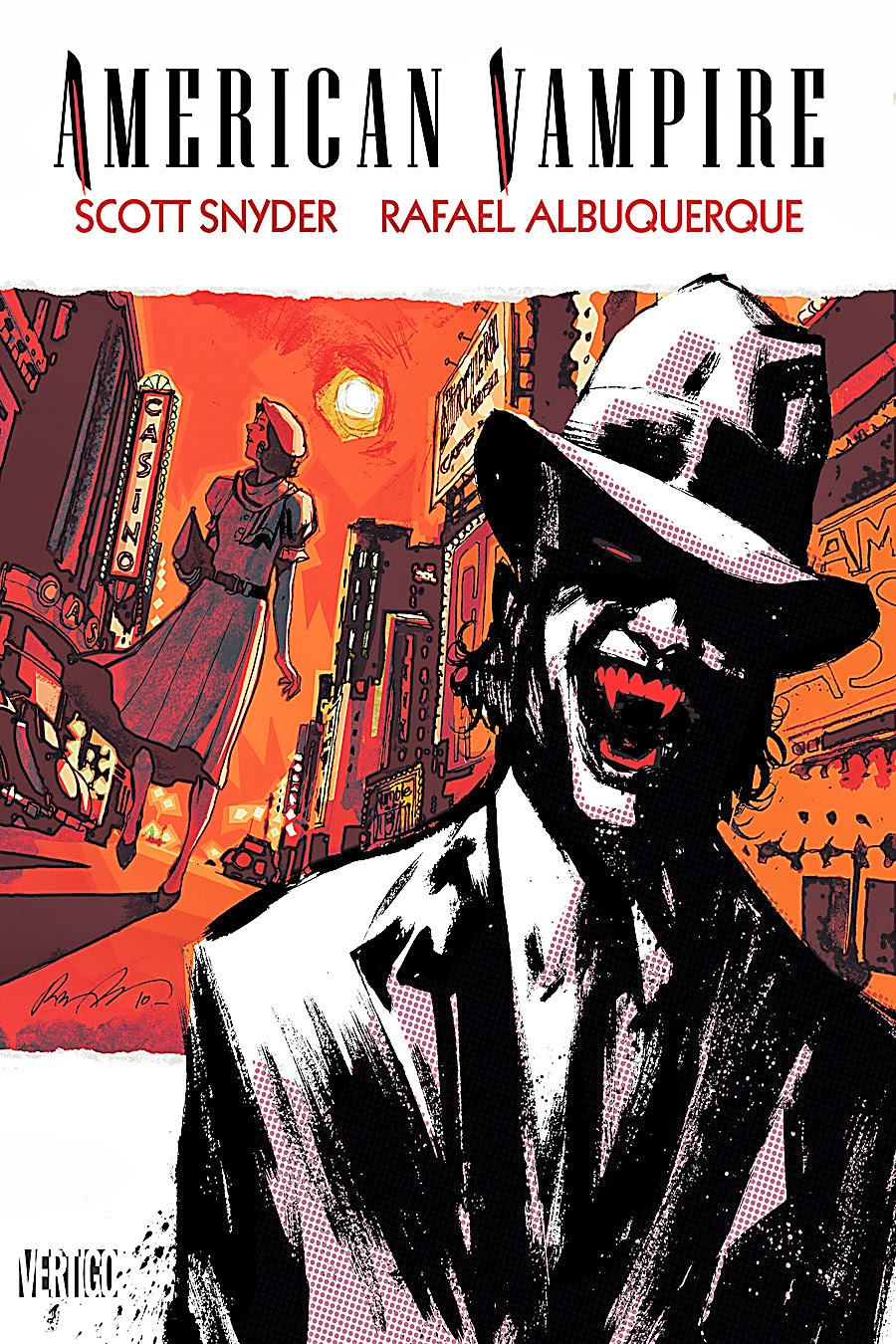
Guest Blog: American Vampire Vol. 2 - review

A warm welcome back to Clark Nuttall with a new guest blog, this time looking at the second volume of the American Vampire series.

Writer: Scott Snyder

Artists: Rafael Albuquerque & Mateus Santoluoco

Release date 2011

The Blurb: Las Vegas, Nevada, 1936. Its days of glitz and glamour are still far off in the future. But with gambling, whoring and violent crime its chief economic activities, this rough and tumble town is already earning its “Sin City” moniker. And Cash McCogan, Vegas' tough-as-nails police chief, is out to clean it up – even if it means taking on the filthy rich consortium that's building the astonishing Hoover Dam just miles away.

There's just one problem: The Colorado River isn't the only thing near Vegas that's been “damned”.

First and deadliest of his breed, American vampire Skinner Sweet has set up shop in Sin City. It's his kind of town, a place where any thirst can be quenched for a price. But he's not the only vampire who wants to sink his teeth into Vegas. An all-out war is about to break out between some of the oldest and deadliest vamps in the world – along with a shadowy society dedicated to taking them all down for good.

When the dust settles, who will be left alive (or undead) to stake their claim?

The Review: Regular readers of Taliesin's blog will be aware he reviewed Volume 1 in this series some time back, but as yet hadn't obtained a copy of Volume 2. Thus it falls to me to further expand on the world and adventures of Skinner Sweet.

Taliesin referred to the “blocky” artwork in Volume 1 that he didn't particularly enjoy. Having not yet read that I unfortunately can't compare and contrast. I felt the artwork was easy to follow, possibly due to the introduction of Mateus Santoluoco as artist alongside Rafael. However, enough of that and on with the story.

Skinner Sweet is now in Vegas and running many of the seedier elements of a town not yet notorious, serving up women and gambling for the men involved in the building of the Hoover Dam. This, of course, brings him to the attention of police chief Cash McCogan. Cash finds himself being forced to work with 2 FBI agents, Jack Straw and Felicia Book to solve and prevent the murders of the 4 men in charge of the construction companies building the dam.

The storyline appears to follow elements of the first, in running 2 parallel stories, the other involving Pearl Jones from Volume 1, alongside said FBI agents.

We find out, as Cash does later during the ensuing mayhem, that they are actually agents from an order called the “Vassals of the Morning Star” and are out to destroy all vampires.

As I don't wish to spoil things too much for anyone who wishes to read it, all I will say is that Pearl “helps” the Vassals to discover that wood will not kill an American vampire, but she does disclose what will, which leads to a showdown between Old World vampires, an American vampire and a group out to kill all.

Anyone who read Volume 1 would do well to pick up Volume 2 and read what I feel is a welcome addition to the vampire in graphic novel form. There are twists and turns aplenty to keep the reader interested, and a preview of Volume 3, which I will be looking for as soon as possible.

I enjoyed this intensely and would happily give it 8 out of 10.

Wednesday, October 16, 2013

Vampire Diaries – season 4 – review

Director: various

First aired: 2012-2013

Contains spoilers

I’d said, when I watched Season 3 of this show, that it was losing me. This season it definitely lost me.

At its heart, if you like that sort of thing, I guess there is a show that might offer something but to me it felt like the creators of the show had plumb run out of ideas.

Elena feeds
At the end of last season Elena (Nina Dobrev) was turned into a vampire and so that is a major thread of this season – she’s a vampire, she doesn’t want to feed, she’s sired (essentially an emotional slave) to emasculated bad boy vampire Damon (Ian Somerhalder), she’s switched her emotions off and become a psychopath, they’re on and overwhelming her – all whilst looking for a cure for her. That sums it up and it annoyed, she annoyed and it wasn’t Nina Dobrev’s fault because she was good as Katherine (her doppelganger) so it must have been a writing/direction issue.

Kat Graham as Bonnie 
The main thread is that there was a witch, Silas, who became immortal and, when the powerful witch who did this discovered he loved another, was magically frozen in place with a cure to his immortality in his hand. The idea being that he could kill himself (or a hunter could kill him, we’ll get to them). As this would mean he spent eternity with his love the witch created the other side – a limbo for magical creatures who die, so that he would never reach his love (in heaven, we assume). So the show sees him manipulating events – local witch Bonnie (Kat Graham) is the key to lowering the veil (as the removal of the other side is called) – and he is the new big bad.

Silas in tomb
There were several problems with this. Firstly Bonnie allows herself to be manipulated despite magic that involves sacrificing 36 people (the murder of 12 humans and 12 hybrid werewolves/vampires occurs before she finds out but she goes along with the slaughter of 12 witches), which just didn’t gel. Secondly he’s a vampire and yet we have already met the original vampires. Thirdly it is pointed out that he can’t do magic and yet can get in everyone’s heads and make them see what he wants (whilst vampires can manipulate a dream state that is much further than that). Fourthly, with limbo gone why would every supernatural creature killed come back to life (as the show maintains) surely they’d finally pass over to heaven/hell or whatever pixie-land awaits them?

Ian Somerhalder as Damon
Whilst all this is going on the Damon character is still emasculated. The scripts tried to give him an edge but it was unbelievable – probably because (as a friend pointed out) Damon was a bad assed, serial killing sociopath who everyone now simply accepts. The same can be said of original vampire (and werewolf hybrid) Klaus (Joseph Morgan) who you can see being manoeuvred into a sympathetic position when it was his ruthlessness that made him a fun character. This is partly to do with the fact that the original vampires are getting a spin-off show, entitled (with originality) as The Originals. This series was 23 episodes as a disjointedly positioned introduction episode for that series had to be crowbarred in. Beyond that the series felt about as twice as long as the thin storyline demanded. It was like the story had no steam to propel it on – new character April (Grace Phipps) underlined this as she was introduced but then had precisely zero (bar some cipher work) to do.

a hunter and magic tattoo
I mentioned the hunters and this brings us to the subject of annoying coincidences. It transpires that there are five hunters, sporting mystical tattoos that grow when they kill vampires, created by witches to kill vampires but, more specifically, Silas. The Original vampires met them only once in their long lives and yet we come across two in this episode and, as they are replaced when they die, Jeremy (Steven R. McQueen) becomes one as well. We never see Silas’ face, even his messed up ‘true face’ is a lie, and this is because it turns out at the end of the series that Silas has a doppelganger who is someone we know well in the series. Another annoying coincidence.

perhaps the show needs a stake?
There are plot holes I can’t mention due to them being a spoiler too far, but the show – for me – was poor both because of these and because it had no forward impetus. I said last review if they kept travelling in the direction they had chosen it would drop to being a below average show. It has. 4 out of 10 – and I was tempted to drop a little lower still.

The season's imdb page is here.

Monday, October 14, 2013

Svatba Upírů – review

Directed by: Jaroslav Soukup

Release date: 1993

Contains spoilers

I had been left a comment on my review of Czech film Upír Z Feratu by Stuart Hample letting me know about Svatba Upírů – also known as the Vampire Wedding. At the time I found some subtitles online but could not track down the film (though I believe it has had a Czech DVD release).

A Czech friend of mine finally got me together with the film (the version I saw is from a TV broadcast I believe). I have to say that the fan made subtitles are rough and quite literal in places. As the film is somewhat of a comedy this is a little problematic but I have taken that into account. Indeed the comedy element (and the feel of the film generally) seemed to be comparable to the Fearless Vampire Killers - indeed at one point other vampires in the Carpathians are mentioned, as is their leader, one Count Polanski. This fits in with Stuart’s comment, which mentioned Polanski’s opus. The film is said to be based on the works of Sheridan Le Fanu but this is at a very vague level.

Rudolf Hrusinský as Richard Bancroft
The film begins with a carriage. The passengers are Richard Bancroft (Rudolf Hrusinský) and his Uncle Archibald (Petr Nározný). They are English traders and are travelling to Prague. Richard is a young romantic who believes the trip will be full of adventure. The howling of wolves excites him, his uncle is dismissive, preferring to sleep. When they get to an inn the stables are on fire. Richard pours water over his head and runs into the blaze to free the horses. Inside he sees a woman, Olivie (Iveta Bartosová), and runs to rescue her – she ends up pulling him out of the blaze and as the unconscious Englishman comes round he falls in love. However she is the companion to the Count Kronberg (Viktor Preiss).

Olivie and Count Kronberg
Richard reads guidebooks for chivalry and, that night, finds it difficult to sleep. He walks outside and meets Olivie but becomes tongue tied. In the morning he steals some of his Uncle’s perfume, which it is said no woman can resist (Uncle is, as we see as the film progresses, a bit of a letch), and tried to find Olivie but her rooms are empty. Archibald meets a Col. Degendorf (Petr Pelzer) who is also travelling to Prague on a sad, personal mission. That night a drunk man picks a sword fight with Count Kronberg. The Count toys with him until the man pulls a pistol. Richard intervenes. The Count thanks him before he and Olivie ride off in a carriage, but she drops her handkerchief out of the window for Richard.

masquerade ball
Once in Prague Richard pines over Olivie. He spots the Count’s servant and follows him to the Count’s residence. He tries to gain an audience but fails – he does meet one lady residing there, though, who will become the source of some of the farcical bedroom humour later. When he gets back to the hotel there has been an invite from the Count to attend a masquerade ball, which Richard and Archibald do. As they wait to gain entrance the Colonel tries to push his way in. It is his association with the two Englishmen that gains him entrance. He is looking for his son.

bite marks
Of course it will come as no surprise that the Count and most of his entourage (including Olivie and the Colonel’s son) are vampires. Richard and Archibald find themselves kicked out of the hotel they are staying in (due to ‘double booking’) and moved to a “haunted” guest house that the Count uses as a hunting ground. From Richard’s new window you can see the Count’s residence and a graveyard lying between. Olivie and Richard fall in love and the resultant bites on his neck draw the Doctor Hermann (Ludek Kopriva) into the tale.

shot in coffin
In a nice sequence the Colonel has a coffin exhumed and in it is his son. He shoots him through the heart with a silver bullet and this causes him to convulse. The lid is put back on the coffin and sat on as the coffin rocks. When it quietens down the lid is opened and a white dove flies out. This represents the freed soul and the vampire’s corpse has gone. Later we see plenty of doves flying around but certain vampires have no souls.

biting a foot
The vampires do not reflect and must return to their coffins at cock-crow. What happens if they are caught in the sun is not explained in dialogue – certainly when the coffin belonging to the Colonel’s son is opened he does not seem affected by the sun. He can move but, as we see later in film, the movement is perfunctory, with a vampire moving to simply close the coffin lid. However we learn later that the vampires are impervious to bullet and stake at night and only vulnerable during the day.

smoking cross
Garlic does not affect vampires – indeed the Count rather likes it – but crosses burn when touched. A priest’s blessing would make a vampire pass out. We meet one dowager vampire (Nelly Gaierová) whose teeth are false and kept in water. The vampires cast no reflection in a mirror and that is about all the lore.

vampire dentures
The film itself looks lovely – though a little washed out on the version I saw, I assume that was a sourcing issue – and as I said earlier the film shares the atmosphere found in Polanski’s Fearless Vampire Killers. The acting seemed good for what the film was – which was much more a romantic comedy in period dress than a horror film. Nothing wrong with that though, so long as you know what you are getting. The humour is gentle, however, and I assume that there were language jokes that the too literal subtitles lost. I would like to see this getting an international release, restored with good subtitles – I think it would be a genre staple if it had such a distribution. There are images within the film – such as the smoking cross or the exhumation scene – that are classic vampire cinema.

Very much worth hunting down, however. 7 out of 10.
The imdb page is here.

Saturday, October 12, 2013

Frankenweenie – review

Director: Tim Burton

Release date: 2012

Contains spoilers

I have to admit that I had avoided Frankenweenie. Tim Burton had been a firm favourite director (and I still rate Ed Wood and Big Fish as two of the most marvellous films out there) but I have felt that later movies were somewhat off the boil. More so, however, was that I have the original live action Frankenweenie on DVD as an extra on The Nightmare Before Christmas and – to be frank – wondered what the point of the remake was without actually investigating it.

Giant sea monkeys
Then I heard that the film, which is an animation, included a vampire cat and it went straight on to the radar. I watched the film expecting to write an Honourable Mention for a fleeting visitation but found that what started as a poignant tale of a boy, his dog and not letting a little thing like death get in the way morphed into a full on Monster Mash and this deserved a full on review. It certainly shows a love for the Monster Movies of yore.

Weird Girl and Mr Whiskers 
Victor Frankenstein (Charlie Tahan, I am Legend) is a young boy, living in the quiet town New Holland. His best friend is his dog Sparky, though Dad (Martin Short) worries that he has no human friends. When a (suspiciously Vincent Price looking) Mr. Rzykruski (Martin Landau, Ed Wood) becomes science teacher at school Vincent finds his interest piqued, though Weird Girl (Catherine O'Hara, the Nightmare Before Christmas) has warned him that her cat (Mr Whislers) has dreamt of him and left a V shaped poo (which she shows him). She says that whenever he dreams of someone it means a significant event – for good or bad.

retrieving Sparky
Mr. Rzykruski has announced a science fair and Edgar 'E' Gore (Atticus Shaffer) wants to partner Victor – but Victor works alone. Victor asks for his Science Fair permission slip to be signed but a compromise is suggested by his dad; the permission slip can be signed if Victor also takes up a sport. However, at the baseball field, disaster strikes. Victor knocks the ball out of the park but Sparky chases after it, retrieves it but is knocked down. Sparky ends up buried in the pet cemetery. After a science lesson shows a frog’s galvanic reaction, Victor has an idea, digs up Sparky and reanimates his dead dog during a lightning storm.

gerbil mummy
Following this, Edgar discovers Victor's secret and forces the young Frankenstein to repeat the experiment on a fish – the fish reanimates but is invisible. They don't know why it went wrong (Sparky was reanimated as much with love as with electricity it is later revealed) so, when the other kids in the town discover the secret, we get a series of ill-fated reanimations. Sea monkeys are turned into giant sea monkeys (they kind of fill the Creature from the Black Lagoon role but also act a little like the Gremlins), a hamster becomes the Mummy, a tortoise becomes a Gamera equivalent and a rat is kind of the wolfman.

Mr Whisker's transformed
Mr Whiskers brings back a bat that Weird Girl tries to reanimate but the lightning strikes whilst Mr Whiskers is holding the bat in his mouth. There is a merging of the two and Mr Whiskers becomes the fanged, bat winged vampire cat. This proves the most dogged (if you pardon the oxymoron) of the monsters and is there at the climax of the film – that takes place in a burning windmill.

Dracula, Prince of Darkness
There is no doubt that Tim Burton knows his monster movies and the pastiche works as a concept. Through the poodle next door we even get a bride of Frankenstein, with the outrageous mallen streaks caused by a wet nose on Sparky’s neck bolt. We even get a bit of Dracula Prince of Darkness on the TV, the technicolour lost because the movie we are watching is black and white, as befits a tribute to the monster movies of yore. All that said it felt disjointed.

Staked
The first section was pretty much “the boy, dog, death will be overcome” of the original short though more characters are introduced than the original, as they weren’t necessary in the original. However the film abandons this as it morphs into the Monster Mash. This makes it feel like a film of two parts and whilst we needed the set up lifted from the original, I felt that the transition needed to be smoother. The girl next door, Elsa Van Helsing (Winona Ryder, Dracula (1992)), is clearly a first love interest – and this should be mirrored with Sparky as she owns the poodle who takes the role of the Bride of Frankenstein – and yet it felt hollow and unused, despite being integral to the ending. The end pay-off is saccharine sweet and a poignant, darker ending would have been braver.

That said, all the above does not make it a bad film, but does prevent it from being a great film. 6 out of 10.

The imdb page is here.