Thursday, April 29, 2010

La Belle Captive – review

dvd
Director: Alain Robbe-Grillet

Release date: 1983

Contains spoilers

Alain Robbe-Grillet was a French author and filmmaker associated with the Nouveau Roman trend. He actually wrote a novel entitled La Belle Captive in 1975. I’ll admit now that I haven’t read any of his work but I have seen reference to them in other works and understand that this film, first released in 1983, had little in common with the novel, using the name only and lifting perhaps some themes – indeed I have seen it referred to as more a spiritual sequel to the novel. But the themes and characters within this film also came from other Robbe-Grillet works, for instance Les Gommes.

Now, I will say that – as I have not read any of his literature nor seen any other of his films – I am coming at this as a Robbe-Grillet virgin. There will be deeper connections I have missed and I apologies in advance to Robbe-Grillet scholars. The film itself is less a vampire film and more has vampire themes which are played with and explored. I came across it after recommendation from my friend Leila who described it thus, “Imagine if David Lynch and Jean Rollin collaborated”.

Sara Zeitgeist on her bike holds the film together
There certainly was an element of Lynch in the precision of the imagery. If Rollin captures a dream within his work, trying to draw a particular dream from the dreamer’s point of view then Robbe-Grillet, like Lynch, uses consciously dreamlike imagery – sometimes with such force that it might be called heavy-handed. The film itself begins with a motorcycle ridden by Sara Zeitgeist (Cyrielle Clair) – the view of her, on her bike, becoming a binding motif through the film and zeitgeist means, of course, the spirit of the age. We also get the credits appearing in a frame upon a beach. We will explore this later but the layout of the image is based on the painting the Fair Captive by René Magritte.

meeting the blonde with no name
We meet Walter (Daniel Mesguich) he is at a club, he is alone and worries that the organisation no longer uses him. He orders a vodka tomato juice – the bartender corrects him and calls it a Bloody Mary. He is watching a blonde woman (Gabrielle Lazure) and starts dancing with her. She is flirtatious but tells him she no longer has a name, if she finds it she’ll tell him, time no longer exists for her and that there is something wrong with her phone so she cannot give him a number. She tries his Bloody Mary but strongly dislikes it.

the meeting at cemetery crossroads
He gets a phone call from his chief, Sara Zeitgeist, and is told to meet her at the cemetery crossroads. When he gets back from the phone the blonde woman is gone. Walter’s voiceover, in which he suggests that he is an agent, and his dress are both very reminiscent of the stereotypical film noir detective. He meets Zeitgeist who tells him he must deliver a letter to the senator Comte Henri de Corinth and ensure that he is present when the letter is opened.

the blonde in the road
He drives along the highway and then sees something in the road. He stops and it is the blonde led on the highway, she has a wound in her leg, seems insensible and her hands are bound. Walter helps her into his car and decides to get help for her prior to finding the Comte de Corinth. As they drive, for a moment, their positions shift so that they look like a couple taking a romantic drive. He eventually finds a house called Villa Seconde and has the gate guards let him in so that he can use the phone.

blood at her mouth?
He takes her into a room where suited men are stood around. He addresses them and they close in on him, their presence claustrophobic and threatening. As they discuss her, and one wants to buy her, they comment on her binding and call her the beautiful captive. A bartender is feeding her a drink and Walter demands to know what it is, taking it off her and smashing it to the floor. There is a red trickle on her mouth and, given her reaction to tomato juice was negative, we assume it is blood.

more than a nuzzle
Walter calls out again for a doctor and a man introduces himself as Doctor Morgentodt (François Chaumette). He takes them upstairs to a room and Walter asks him for something to break the chain binding the woman’s hands. The doctor locks them in the room. We see her hands suddenly free and then her clothes vanish and they are together on the bed, she nuzzles tellingly into his neck. We see a beach and he screams himself awake.

finding bite marks
Looking around he discovers that the room – and then the whole mansion – is decayed and broken – not the place of opulence he saw before. The chain has a name on it; Marie-Ange van de Reeves. His neck has blood on it and, it seems, punctures. He decides to continue his mission but, in a café, he sees a newspaper headline that says the Comte de Corinth’s fiancée has been kidnapped – there is a picture of Marie-Ange. The café girl thinks it odd that de Corinth is reported as not knowing his fiancée’s name.

the Comte de Corinth
The film uses repetition, especially using Magritte’s symbolism and art. This repetition is purposeful (as Robbe-Grillet uses such a device in much of his work) and knowing. The repeated finding of bloodied shoes is commented on by the police inspector (Daniel Emilfork) we meet who points out that they have three of a pair. When, eventually, Walter gets to the Comte de Corinth we find that the man is dead, punctures in his neck.

Comte de Corinth is interesting and clearly a multilayered symbolic figure – as is everything within the film. In 1797 Goethe wrote the poem the Bride of Corinth – which introduced (as far as I am aware) the first female vampire in Germanic poetry. The Bride, incidentally, gives a gift of a golden chain at her wedding, much like the one Marie-Ange wore and Walter now has in his possession. Further Comte de Corinth appeared in an earlier Robbe-Grillet work. In the book “Robbe-Grillet and Modernity: Science, Sexuality and Subversion” by Raylene L Ramsay it is pointed out that Corinth “Is an expert at underwater hunting with a harpoon and joins a series of maiden hunting and target practice on female figures”.
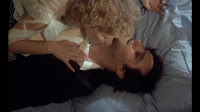
Marie-Ange takes another bite
The Inspector tells Walter that Marie-Ange was not the kidnapped fiancée but, in fact, a girl who died on a beach, of a harpoon wound ‘accidentally’ inflicted by de Corinth some six or seven years ago. The sado-masochistic component that can be found in some of Robbe-Grillet’s work is perhaps referenced in the piercing of the thigh but other symbolism comes to mind. She is almost the female aspect of the wounded king – hence Walter becomes a grail knight. The fact that it is her thigh which is pierced carries more than a hint of virginity lost. The piercing fits in with vampirism, bringing to mind the idea of the stake through the heart, subverted to a more obviously sexual symbolism due to the location. Given the use of the beach as the place where the injury was originally inflicted I was also reminded, a little, of the finding of the vampire buried on the beach in the Blood Spattered Bride and, of course, of Jean Rollin generally as the beach is a symbol he often uses. In many respects, whilst she clearly drinks his blood, Marie-Ange (or Marie Angel) is stealing away Walter’s spirit or soul, causing his obsession (revealed in the repetition) that is reminiscent of the OCD elements displayed by the folkloric vampire.

Magritte themes
Magritte used a beach and the set up of an easel and picture in the painting the Fair Captive as well as well as the Human Condition and, in many respects, Robbe-Grillet makes this a posthumous collaboration with the artist. Variants of the pictures become a theme within the film with the ball seen in the Human Condition replaced with Marie-Ange’s bloodied shoe. From postcards to paintings hung on the wall, Magritte haunts Walter and, when his brain is scanned at one point, Magritte’s images (such as bowler hat wearing men) fill his psyche.

Sara Zeitgeist's bedroom
I am sure that I have only scratched the surface of this psycho-sexual drama, which sees Marie-Ange as both vampire (supernatural) and vamp (femme fatale) and thus reaches back and touches the cinematic roots of the genre. It is truly an exploration piece and one that demands more than a single watch to get the most from it. A casual viewer might pass it off as pretentious (and I guess in some respects it is) but it is deeply fascinating once you realise the depth of reference and symbolism. 7 out of 10.

The imdb page is here.

Wednesday, April 28, 2010

Burned Released

I have been contacted to let me know that the book Burned by P.C. and Kristin Cast has been released, the seventh book in the House of Night series. The book is teen fiction, and some visitors may already be invested in the series, if so the synopsis goes a little like:

“Things have turned black at the House of Night. Zoey Redbird’s soul has shattered. With everything she’s ever stood for falling apart, and a broken heart making her want to stay in the Otherworld forever, Zoey’s fading fast. It’s seeming more and more doubtful that she will be able pull herself back together in time to rejoin her friends and set the world to rights. As the only living person who can reach her, Stark must find a way to get to her. But how? He will have to die to do so, the Vampire High Council stipulates. And then Zoey will give up for sure. There are only 7 days left…”

There is a sample chapter you can read here and the trailer is below.


Tuesday, April 27, 2010

Honourable Mentions: Under the Sunset

dvd
The Others are a Gothic/Horror Metal band who hail from Binghamton, New York. Under the Sunset – a Vampire Musical Tale is a 40+ minute vampire film based on their music, directed by and starring Mark Dickinson also known as the band’s front man Marquis.

Now, as you know, I’m keen on all things vampire and thus wanted to catch this film, especially as I heard some of the music and rather liked it. One thing I find with some Gothic Metal is that it can sometimes stray towards Death Metal, and the problem I have with Death Metal is not the music but the vocalists who think that screamy, shouty vocals are good… Marquis sings – well, the music is good and the subject matter dark. Also Marquis was good enough to let me have a watch of the film.

The film, incidentally, is down for an honourable mention because it is, by design, primarily supportive of the music and I felt that the honourable mention route was the best way to look at it.

harassing the vampire
The film has a rather simple premise at its heart, boy (Mark Dickinson) meets girl (Kendra Baker), girl is vampire, boy becomes bloodsucking creature of the night. Of course things are not as simple as that. The boy meets girl when she is being hassled by three others – I assumed also vampires. She comes to him in the night and turns him but eternal love proves to be rather short in duration as he is left on his own and becomes filled with murderous blood lust and a desire for revenge.

love or hunger?
The film is purposefully grainy with imperfections built onto the imagery. It gave the film an older look but, perhaps, not so much a grindhouse type look. I was reaching, as I watched, for what it felt like in tone, because of the aging effect. Certainly something out of the late sixties/early seventies and then a cemetery scene in daylight appeared on screen and I suddenly realised that it was the work of Andy Milligan that came to mind, say something like the Body Beneath or at least the external shots of that movie. Having said that I now feel like apologising to the band whilst I explain that it was only in the tonal quality of the aged film effect and nothing else!

a broken heart
The lore, as we see it, seems to be that vampires are created through a ‘drain and feed the dying victim blood’ method. Stakes through the heart and chopping off the head seem to be the order of the day when it comes to despatching the undead. There was an aspect which suggested to the viewer that becoming a vampire offered rapid decay of the mortal remains – the man rises as a skeleton at first and when in vampiric slumber returns to such a state. It also suggests that the slumber is voluntary as we see the vampires up and about in the daytime. That said, much of the movie uses imagery to enhance the songs and the artistry honestly doesn’t need strict logic within the lore.

the pain of rebirth
For that underlines the video, a mood enhancing set of images that help tell the story born in the concept album of the same name. The images are macabre, but then so is the story and we should be thankful that bands continue to put horror into music. The band have a MySpace page here, which links to their homepage also, and the DVD and album are both available from Amazon.

As I go, I’ll say that whilst I liked Marquis’ vocals the band also have female vocals from Mistress Jessica – who was a member of the band in the past – on some of the tracks. I’ll leave you with a video from my favourite track on the DVD – though the video itself is not taken from the Under the Sunset footage. Til the Mourning Comes:


Monday, April 26, 2010

Shadowland – UK release

You might remember my review of Shadowland, which I rather enjoyed. Well the UK release is scheduled for the 3rd May 2010. The cover I have put on this post is the new UK DVD artwork.

Pirate Pictures have also let me know that Carlos Antonio León, who played vampire Lazarus in the film, will be in Belfast at some of the HMV locations signing autographs and available for photo ops. Check local stores for details.

Sunday, April 25, 2010

Las Vampiras – review

poster
Directed by: Frederico Curiel

Release date: 1969

Contains spoilers

If there is one thing guaranteed to put a big old smile on my face it is the thought of a Mexican wrestling movie with vampires in it. Okay, not a single one I have seen is, shall we say, Oscar material but they all put that grin firmly into place. Whilst my critical faculties may baulk at the unadulterated badness of the films, as a viewer I revel in that very badness and, ultimately, films should be entertaining. When I hear that John Carradine is in the film, badly dubbed into Spanish, my anticipation soars and when I witness an interpretive dance routine in the middle of the thing... well does viewing schlock get any better?

John Carradine has been a vampire...
The film actually begins with Carradine, as himself, introducing the movie. He asks us if we believe in vampires? He suggests that Lucifer is the most powerful of all spirits, able to make any man submit to his will and that vampires are his preferred demons. He actually reads this out of a book and ascribes it all to Edgar Allan Poe (who, to my knowledge, wrote no such thing) and then says that he, Carradine, has been a vampire… He fades from his chair.

wrestling matchMil Máscaras (himself; who would go on to be in Los Vampiros de Coyoacán – which I have on DVD twice but cannot, to date, locate English subtitles for anywhere!) flies himself into town and then heads to a wrestling match. Unusually this is the only actual ring match we see. He is driving to his next match when there is a car crash and bats fly from the other vehicle. He gets to his match but his opponent is missing. Bats fly out of the missing wrestler’s locker room. We later discover that several sportsmen have vanished.

Mil Máscaras
He is with a friend and the police officer Lt. Garfias discussing vampires, Garfias is dismissive. They put the news on and a reporter called Carlos Meyer is being interviewed about the recent crash of a plane from Transylvania Airlines but is cut off by the interviewer when he says he wants to warn the world about vampires. Máscaras asks his aid Alicia to get him some documents from a Professor Sinclair. In these papers he discovers that vampires need mild weather, high humidity and a certain blood type (that later appears to mean human generally)! It seems their natural form is that of the bat and they can transform into human shape (which was a little bizarre).

Mil Máscaras and Carlos Meyer
He decides to search a certain cemetery and nips off to see a cartographer he knows to get a map. A vampire, in the meantime, flies into his home in (really crap) bat form and drains Alicia. The police come but still don’t believe in vampires. Máscaras goes to the cemetery and is about to enter a crypt when Meyer approaches him – they go in together. There is a sealed area that is marked as belonging to Countess Dracula – they knock the wall down and bats fly out.

Marta Romero as Aura
It seems that Countess Dracula, otherwise known as Valeria (María Duval, Samson vs the Vampire Women), has been trapped for some time after her husband was killed by humans. She meets up with Aura (Marta Romero) – who is the big bad vampire in this. You can tell that they are important as their costumes are a richer green than the ordinary vampires. It seems vampires are almost hunted to extinction. The only surviving male vampire, Branos (John Carradine), was injured by a splint of oak in his brain, has lost his powers and is quite mad. She keeps him in a cage. She thinks that one of the two who accidentally freed Valeria could be the chosen one who will become the new king of the vampires.

María Duval as Valeria
Máscaras and Meyer have worked out where the vampires’ hideout should be (a mountain with the same dimensions as the Carpathians!) when Aura and Valeria turn up at Máscaras’ home and spin some line about them and a girlfriend, Carmen, who has vanished and bats that flew away. They think she was attacked by vampires. There was some paper but they left it at the scene. Meyers and Máscaras get in the women's car and are locked in the back (a screen separating them from their kidnappers). I did wonder at how the vampire chicks got this spy film type car but that question quickly melted as I stared at the wonder of Máscaras and Meyer sliding from side to side, into the car doors, until they make the vampires crash. The women fly away in bat form.

All hail the crap bat attack
How will they tackle these fiendish creatures? Máscaras suggests stakes, but Meyer tells him that only works when in human form. Meyer suggests fire and silver bullets are the way forward and it just so happens that his girlfriend, Carmen (Maura Monti), lives with her uncle who has silver bullets. They go there but her uncle is being attacked by bats – the form vampires chose when feeding Máscaras later reveals, though the film seems to disagree with his supposition – he is dead but at least they get their silver bullets.

a vampire slave disintegrates
Before heading off they go back to Máscaras’ place and suddenly they are attacked by a horde of henchmen in bad batman-type henchmen clothes. They fight them off and Meyer and one struggle with a gun, the henchman accidentally shooting himself in the stomach. He dies, disintegrating, whilst the other henchmen run. They are vampire slaves – remember the missing sportsmen. When drained the vampires inject them with a poison that makes them mindless servants of the vampires.

bring on the dancing girls
The vampires, however, have dissension in the ranks. It seems that Branos is not as mad as made out (he acts on it to keep himself safe) and just needs a good feed to get his powers back. Valeria decides that he should be king of the vampires and challenges Aura to Satan’s trial - a method that will decide which of them should be vampire queen. The trial begins with the earlier mentioned interpretive dance routine which Carradine seems to particularly enjoy (if his facial expressions are to be believed).

duel of the vampire women
By the time the trial gets to the meat – a fight between the two vampire women using flaming torches – Máscaras and Meyer have arrived (fallen into an oubliette and faced a spiked ball) and when they are detected it brings the trial to a temporary end and uneasy truce. After all they have to deal with the two would-be vampire hunters and there’s still a good 35 minutes of film to go.

I haven’t mentioned, yet, the eye mojo that seems rather effective in this and the fact that they really must hide from the sun – though sunlight is never used in the movie except to give a convenient escape moment for the heroes. That is about all we get in the way of lore. I also haven’t mentioned the gladiatorial contest – there might not be the multiple ring matches but Máscaras gets to fight in other ways!

Branos goes for the throat
This is rubbish, it’s badly paced, and it has stupid ideas (a mountain in Mexico being identical to the Carpathian range). Yet it is still great fun, we have chicks in leotards dancing, we have a wrestler wearing several designs of mask (Mil Máscaras means a thousand masks and his trademark was to change them), we have John Carradine camping it up to the max, we have the crappiest of bats and we have vampires.

The film only deserves 3.5 out of 10 as a film – but you owe it to yourself to track it down, crack a beer or two (or your beverage of choice) and marvel at it.

The imdb page is here.

Saturday, April 24, 2010

Welcoming the Next Generation

I was contacted by Nicole about a blog article she had written entitled Before Twilight: 14 Greatest Vampire Stories of All Time and she wondered whether I would mention it. I am more than glad to.

This piece underlines why I don’t believe that Twilight is the force of sparkly evil that many folks rile against. It is a starting location that will hopefully lead people to discover the riches of the vampire genre - perhaps people who may not have known that they have an underlying need for our toothsome friends otherwise.

Nicole’s list has some interesting choices. I will mention that whilst the recognisable form of the vampire story was created in the late 19th Century, invented one might say by Bram Stoker with Dracula, the genre really commenced in the early 19th Century, in English at least.

I will say that Nicole has hit the nail on the head re the film I am Legend when she says (about Neville) “his quest for a cure leads to him finding his soul” Unfortunately, this to me is where the film went badly wrong, losing the secular point of the novel (not to mention the fact that it was so out with the actual story of the novel) and to me the benchmark version is still the Last Man on Earth.

But, hey, it is all opinion and Nicole has written an interesting and insightful blog, if occasionally very inaccurate, "Based on a play by Hamilton Deane and John Balderston, it was then turned into a novel by Bram Stoker" - no, honestly, no. Nevermind, get on over there and have a read and let the irony of it being on a phlebotomy website wash over you.

Friday, April 23, 2010

Vamp or Not? Disciple of Death

dvd
This was a 1972 British flick that was directed by Tom Parkinson. It was written by Parkinson and Mike Raven, disc jockey and actor who was so keen on making it as a horror actor that he starred in and financed this movie.

If the name Mike Raven seems familiar it is because he was in ‘Crucible of Terror’, ‘I, Monster’ and, from a vampire genre point of view, he was in Lust for a Vampire.

I was contacted by my friend Leila who told me that she had seen Disciple of Death on an old vampire filmography but had dismissed the notion that it might be vamp. However, having checked it out recently she thought I should too.

Marguerite Hardiman as Julia
The film begins with a funeral procession as a coffin is taken for burial in un-consecrated grounds, containing a suicide. Cut forward in time and Julia (Marguerite Hardiman) is trying to sneak out of her home. Her mother catches her and asks where she is going as her father, the squire (George Belbin), would be unhappy if she was meeting that ‘farmhand’ Ralph (Stephen Bradley).

Stephen Bradley as Ralph
She is, indeed, going to meet Ralph. He is not a ‘farmhand’ but owns a small area of land, that he farms with his twin sister Ruth (Virginia Wetherell, Dracula). He is looking to buy more land so that he is good enough to marry Julia and recons that he should be there in five years. She can’t wait that long and they agree to betroth to each other by mingling blood. He cuts their fingers and a drop (of hers) falls on the stone slab (covering the suicide grave) that they are sat on. When he says now you are mine, a spectral voice (that only she hears) claims her and the blood vanishes into the stone.

the gypsy is murdered
On her way home she sees a gypsy (Daisika) who reads her fortune but then panics, fearing what she reads. That night a strange figure appears in her room, causing her to scream but, by the time her parents get there, she is alone and they assume a nightmare. The next day, after church, she meets Ralph at the disused manor and they meet a stranger (Mike Raven, whose character is never named) who has claimed the manor as his inheritance. When the gypsy meets the stranger she recognises him for what he is and so he strangles her. He later goes to Julia’s home and her father seems quite taken with the stranger, though the parson (Ronald Lacey) seems suspicious.

the parson and the stranger
That night the servants Mathew (Joe Dunlop) and Betty (Louise Jameson) sneak off for rumpy. He is murdered and she is taken away. At Mathew’s funeral the pastor speaks of evil and is going to warn his congregation of the stranger but his words are choked by magic. As menacing as the stranger may be he seems quite taken with Julia and, feeding into our ‘Vamp or Not?’ he does say to her that he hoped that he “shall live, or at least exist, with the hope of seeing you again.”

the stranger with his slaves
As taken as he may be, the next to be kidnapped is Ruth. She is bound and gagged and prepared for sacrifice by Betty and several other pale faced girls. We notice the stranger is pale and has white hair (as opposed to his normal black hair). Ruth is told that he must sacrifice virgins for Satan until he meets one who is willing to be sacrificed. He will then be able to rest, with that particular virgin, in Hell. We have a blood sacrifice, eternal life (from the gypsy's words it appears that he has haunted the region before) and the idea that final death can come through a willing sacrifice – this echoes films such as Nosferatu and Vampire in Venice.

blood drinking
He actually gives Ruth opportunity to be the willing sacrifice. When she refuses he makes her his undead slave by taking her heart and placing it in a box. He gets her blood in a goblet and drinks of it. The undead slaves are obedient to him but Ruth proves herself capable of disobedience when she goes to her brother (through the power of love) and lures him back to the manor house – in time to see Julia getting cosy with the stranger.

Trinity schminity
Ralph and the Parson go to Melchisidech (Nicholas Amer) the cabbalist for help. His character is painful. Supposedly the font of wisdom but also a comedy character we get awful lines such as, “Trinity Shminity, this is none of your Christian schmattas. This is your kosher yiddische magic!” He gives them magic sand, holy water and a symbol with which to fight the stranger and they must steal and burn a necklace containing the drop of Julia’s blood, which was absorbed into his grave, in order that he might be sent back to Hell. When the parson goes back in Melchisidech’s home to ask a further question he sees that the cabbalist is really a long dead skeleton.

summoned, 1 satanic dwarf
However, the stranger has summoned up a creature of earth (which gives the elemental powers of water, air and fire) to fight the good guys. He gets powers akin to the stranger but during the day – indicating that the stranger only has power at night. The creature takes the form of a fanged dwarf, who does – at one point – bite a neck like a vampire.

We don’t have to go in to the will they succeed question as it adds nothing to the ‘Vamp or Not?’ discussion. We have a creature “dead and not dead” we are told, brought back by blood, forced to sacrifice virgins and consume their blood. There is some indication of aging, though we are not sure if blood consumption reverses it. He is given peace through the sacrifice of a virgin/virtuous woman – which fits in with some vampire films. There is enough to call this vamp, I think.

black dress, big boobs and dark hair - must be a horror hostess
Raven is clearly the central character and he really wants to be Christopher Lee. The problem is that whilst he has a presence, Lee would have had a commanding presence. The tone of the film is off kilter and the comedy inappropriate (and not very funny). The DVD print is blooming awful – at least on the Graveyard Theatre edition. It is introduced by Morella – an Elvira rip off, who shows that the main requisite to be a horror hostess is a black dress, big boobs and dark hair.

The imdb page is here.


Wednesday, April 21, 2010

The Landlord – review

dvd
Director: Emil Hyde

Release date: 2009

Contains spoilers

Sometimes I love exploring the murky realms of the vampire genre. As you trawl the flotsam and jetsam of low budget, independent filmmaking you can sometimes stumble across a real little gem… and that is just what happened as I came across Emil Hyde’s the landlord.

As we explore the story you’d be forgiven for wondering whether there was some degree of madness involved, which might encourage someone to make such an obviously complex filmmaking project. Especially as it is the director’s first film and especially as it is the acting debut of some of the leads. Mad, perhaps... courageous, definitely... and inspired is beyond doubt.

drawing the symbol
The film begins with Tyler (Derek Dziak) showing a yuppie couple around an apartment. The place is spacious, cheap and gas is included in the price. We notice a telltale sign of a small splatter of blood on the toilet but they do not. They take it and we see them moving in. The man starts acting odd, speaking in a monotone voice, buying a hacksaw and then we see him drawing a symbol on a mirror (which glows as he traces it). A demon, Rabisu (Rom Barkhorder), appears. The man attacks his wife.

warping into reality
The next day Tyler comes up with a new toilet seat, sees the carnage (she, of course, is dead and the husband is in a corner, dead, half way through sawing his own hand off) and throws up – through the toilet seat. Rabisu appears – and I have to say I loved the freaky warping effects. Essentially he is a slave to another demon, the dog faced Lamashtu (Lori Myers), and Tyler is the human slave to both of them – the tenants he gets are food. He does complain that they could have waited until after the rent was due.

Derek Dziak as Tyler
Tyler goes to a bar and gets wildly drunk. Later he has to help Rabisu get rid of the evidence, the demon grinds the bones and (eventually) the teeth down and Tyler has to get rid of the dust. He has to repaint the apartment, tell the woman in the ground floor flat, Ms Lipinsky (Joan McGrath), that the noisy neighbours have gone and go to see his sister, Amy (Michelle Courvais). The house belongs to her and she pays him to look after it. When she gives him a wodge of cash we discover she knows all about the demons.

Erin Myers as Donna
It is around this time that Donna (Erin Myers) comes to town. She has run out on her husband and is trying to get a divorce. In a fantastic aside we see her at a hotel, trying to get a room and it is the hotel from hell. The film is full of these little incidental asides that build a substantial filmic world and are all genuinely funny. Suffice it to say that Donna rents the room, Tyler falls for her and she is early stage pregnant – newborns happening to be a demon’s favourite food. Add in a couple of detectives, who are investigating the 16 missing persons from that address in 7 years and one of whom is convinced that Tyler is a cannibal murderer, and you have a recipe for disaster in the driest of comedic ways.

vampir with goggles
So, where are the vampires you might ask? Well Amy is a bent cop. She is having an affair with her partner and also traffics with… vampires. Now these aren’t your normal vampires (in the credits they are called ghouls but the film makes it clear they are vamps). The first one we actually meet walks in the daylight but wears goggles. We aren’t actually sure whether they protect the eyes or are an affectation. However we do know that they are undead.

vampire attack
They are created by a bite to the neck. Their teeth are rows of sharp fangs, rather than side fangs. They can withstand gunshot (even a headshot is survived) and it appears that it is heart trauma that is the only thing that can kill one of these things. They have reflections and, I suspect, that religous artifacts would have no impact upon them. They do not appear too bright but it would also seem that that is due to who was chosen to be turned rather than an inherent trait.

Michelle Courvais as Amy
Amy and her partner have a deal with the vampires. They point out which prey the vampires can have; in the attack that we witness they send the vampires after a group of drug dealers. They also cover for the vampires; when a drug dealer fires off a shot, a neighbour telephones the police station but Amy intercepts the despatch by radioing in to the effect that they are nearby and to disregard the call as it is nothing. In return the vampires provide them with any ill-gotten gains, money, jewellery and drugs. They are also not permitted to hunt innocents, especially kids.

The actual vampire aspect plays a full plot role, it isn’t just added in as an aside, but could have been developed further in its own right. That said it worked as it was and provided a nice breakup of the Tyler and the demons story. I also have to say that as dark as it got the whole film with funny and I was drawn completely in.

Rabisu watches the shopping channel
The acting was actually really well done. Both Erin Myers and Derek Dziak provided good solid performances and it was the first film for both actors. Michelle Courvais was particularly good as Amy but it was Rom Barkhordar who stole the show as the TV obsessed demon, who loved shopping channels (he steals Tyler’s credit card to buy a jerky juicer, to make human flesh jerky, and I should also mention that the fake infomercial for that was excellently done). He plays it with exactly the right pitch of camp to make this homicidal, flesh eating demon the star of the show.

scooping brains
The effects are, for the most part, well done. The gore scenes are perhaps a little fake (especially with regards body parts) but, you know what, it works. Because we are watching a comedy the film develops a natural latitude there. There is some too obvious CGI matting work at the climax that was absolutely necessary given the budget that would have been needed to do the scene any other way, which looked a bit iffy but was only brief and entirely forgivable.

the Demon Queen Lamashtu is rarely happy
The entire film is a wonderful oddity, with a slightly off kilter aspect that is funny, charming and rather dark in places – the aside in a pregnancy clinic is brutally comic and devastatingly observational in its pitch but is incredibly black in the humour. The film gives reveals at the end that are actually surprising, because of the way Hyde built the story.

This is a must see, and I can foresee it being one of the darlings of the festival circuits. 7.5 out of 10. The film’s official page is here and the imdb page is here.