Monday, April 30, 2007

Vamp or Not? The She Beast


The reason for looking at this 1966 movie that was directed by Michael Reeves comes mainly from the fact that I have seen it on a vampire filmography. The film also has the alternative title “Revenge of the Blood Beast”, which is vaguely vampiric. It concerns a witch and, of course, witch and vampire mythologies are closely linked.

The story is fairly simple. We start by seeing Count Van Helsing (John Karlsen) in modern day, at the time of filming, Transylvania. Okay, you’ve read right, he might now be a Count but we have Van Helsing in the film and we are in Transylvania – a good start at least. This Van Helsing, however, seems to be a drunken old duffer, whose castle has been repossessed by the Communist Government. He reads from a journal (his Great, Great Grandfather’s) and we hear the story of the witch Baldera.


It seems that the witch was killing children and so the villagers, along with the local priest, went to do her in. This was despite the fact that, the then, Count Van Helsing warned them that he had to exorcise her first or they’d be stuck with her forever. When they try to capture her, the priest holds up a cross, which I suppose would be sensible if you are hunting any form of evil creature, but is most tied to the vampire myth.


The manner of killing her included tying her to a chair, staking her with a long metal stake (good sign again) and dunking her in the lake several times. Well, there is nothing like a good witch dunking I suppose. Unfortunately she did manage to utter a curse, promising that she would be back to hunt down their descendants.


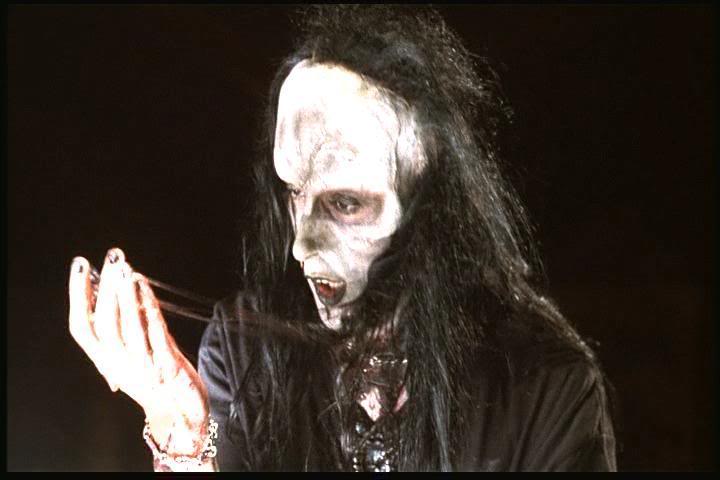
The witch herself was a hideous deformed crone with teeth that do look a little fanglike. She doesn’t say too much and normally runs around screaming and cackling. Such is life.

Back in the modern day and honeymooning English couple Peter (Ian Ogilvy in his first role) and Veronica (Barbara Steele) are lost and end up in the village near the lake – a place where pendants made of garlic are given out to all and sundry. They meet Van Helsing and Veronica thinks she knows his name, “Do you know the Dracula’s?” she asks and he confirms that his ancestors wiped them out and that there are no more vampires in Transylvania (which is a big sign to this being Not Vamp).

A run in with the voyeuristic innkeeper Groper (Mel Welles) sees the couple quickly leaving the village (but not until Peter had given Groper a severe beating) but they crash their car (because Groper fiddled with it or because of the witch’s influence is not clearly indicated) into the lake. Peter emerges from the water relatively unscathed, however the body pulled out of the car is not Veronica but the old hag Baldera.


Van Helsing realises that they have swapped places and he must perform the right of exorcism to get Veronica back. In order that he might do this he reawakens the witch, but she gets away…

This is not a good film, it has a level of infantile anti-communist humour running through it that is embarrassing, awful acting and a Keystone Kops rip off scene, if you can believe that. The acting is uniformly poor and not even the presence of the normally fantastic Barbara Steele can save the day (that said she did shoot all her scenes in a single 12 hour period).


Is it vampiric though? Frankly, no. Baldera is a witch who kills (in respect of the one modern kill we actually see) with a hammer and sickle. She might look fanged but she is all too mortal. When the cops have her body Van Helsing is scared that they will perform an autopsy which will kill her and negate the opportunity to rescue Veronica. She is immune to the cold, because she is used to it, but a hypo full of drugs can knock her out.


There are, of course, elements that have been lifted from the vampire genre, the presence of Van Helsing, the use of garlic etc but they are not strong enough to warrant this being classed as vampiric.

One to strike off the vampire filmographies but, if you want to see just how bad it is, it is available for free download from The Archive , indeed it was the DivX version from there that I watched for this review.

The imdb page is here.

Sunday, April 29, 2007

Curse of the Undead – review


Directed by: Edward Dein

Release date: 1959

Contains spoilers


Curse of the Undead, which was originally to be called “Eat me Gently” until Universal got cold feet over the title, was the first example of the vampire Western sub-genre. Late on, I believe on the 90s video box, the name Dracula was associated with the film but, in fairness, the film never makes any form of connection or reference to the Count and builds an unusual lore all of its own.

The film begins with a buggy riding through town, driven by Dr John Carter (John Hoyt) with his daughter Dolores (Kathleen Crowley). Many of the doors of the town have wreaths upon them. They reach a house, visiting a young girl named Cora (Nancy Kilgas) who is his patient. In the house are the mother and father and also Preacher Dan Young (Eric Fleming) – Dan is Dolores suitor. The Doctor declares that Cora is doing much better and, talking to Dan, admits that he doesn’t know why. Many young girls have died and he cannot think of any plague that would target young girls specifically, suggesting it is more like a curse than an epidemic.

The whole group go to eat dinner, leaving Cora alone. They hear the girl scream and enter the room to see her dead across the bed, the blind revolving wildly. Dan notices that she has two weeping punctures on her neck.

The Doc has more troubles than that, however. When he returns home to his ranch he discovers that his son, Tim (Jimmy Murphy), has been beaten by local landowner Buffer (Bruce Gordon) and his men. Buffer had dammed up a stream and, once Tim had asked and begged for him to remove the dam, the young lad tore the dam up himself and got his beating in return. There has also been a spate of the Carter’s fences being mysteriously knocked down and cattle going missing.

Tim wants to kill Buffer but the Doc will have none of it. He goes to town and sees the Sheriff (Edward Binns). The Sheriff tackles Buffer but a mysterious man in black, we later discover to be called Drake Robey (Michael Pate), follows the buggy out of town. When the buggy reaches the ranch Doc Carter is dead, two wounds on his neck. Tim’s suspicions naturally fall to Buffer and, after the funeral, Tim gets drunk and ends up drawing against Buffer. Tim is gunned down for his trouble.

Delores offers $100 to hire a gun to take down the murderer (whom she believes is Buffer, though he didn't really kill the Doc and his shooting of Tim was self defence) and it is Drake who answers her call.

Of course, Drake is a vampire, we have already seen him take over Doc Carter’s coffin as a resting place, and the lore the film draws around us is interesting and unusual – though perhaps not unique.

We discover much of the lore through a diary that Dan finds. He discovers that in 1860 the ranch belonged to the Robles’ family. One of the Robles sons, Drago, was sent to Spain leaving his sweetheart Isabella (Jeanna Cross) behind. She had an affair with his brother Roberto (Henry Delgado) and, on his return, Drago killed his brother. Filled with remorse he committed suicide and it is the act of suicide that turned him into a vampire. This, of course, fits in with some of the more traditional vampire myths. Mark of the Vampire was originally to have suicide as a reason for someone turning into a vampire, though that part of the story found its way to the cutting room floor.

Drago’s father, Don Miguel (Edward Colmans), tried to end the curse by pinning Drago’s heart to his coffin. Too late, he discovered that the silver dagger he used was inappropriate as only a wooden stake would do. He found the coffin empty, only the dagger left behind. Drago and Drake are, of course, one and the same – confirmed by Dan through a portrait of Drago - and this is his homecoming.

Drake can and does function in daylight, though he is uncomfortable and claims he has a rare eye condition. There is some hint of telepathic control, which causes Delores to sleepwalk – he is also in love with Delores, but the film doesn’t fall back on the old reincarnation of a lost love route. As he can survive gunshot he is an ideal gun for hire or assassin and I can’t think of a film before this one where the vampire has taken up that profession.

It is sometimes claimed that this is the first film in which the vampire is reluctant. I’m not too sure about that, there are other examples such as Dracula wishing to be cured in House of Dracula (1945), but this is certainly one of the first were it was done so explicitly; “What I am is not my own choice. You should pity me, not judge me in my torment. Do you think I wanted this?” Robey asks Dan in a confrontation between the two.

The vampire does fear the cross and there is a clever piece of slaying at the end which fits nicely in the old West theme and uses the vampire’s own arrogance against him. The hint is, due to the two puncture wounds in victims’ necks, that the vampire is fanged but, in fairness, no fangs are ever seen.

As a Western I cannot comment, I really am no expert in that field, but as a vampire film this has a lot. It is perhaps slightly less atmospheric than some, even though the director tries his best to pull a moody atmosphere around us, but the lore is unique. I did find the film a tad slow at times and the basic story is perhaps a little simple even if the lore is great. Pate is great as Robey and one thing the film does is take the Western standard of the man in black and make him a real force of (albeit reluctant) evil.

An unusual and interesting film that, perhaps, needed a little more atmosphere but created its own little sub-genre - 5 out of 10.

The imdb page is here.

Friday, April 27, 2007

Fortean Times for Hammery Goodness

This month’s Fortean Times has a feature article about Hammer Horror (as well as the studio’s work adorning the front cover). Also, we get a feature on Erzsébet Báthory and the regular cartoon Phenomenonix concentrates very much on the Hammer theme, featuring the shooting of a vampire film and the lure of a bosomy maiden.

The Magazine also has a website here.

Thursday, April 26, 2007

New Film: Night Junkies

still from official site

I just noticed this via The Coven Organization and from The Trailer (viewer discretion advised) this looks like a movie I could get excited about.

The basic story is:

“Night Junkies is a dark, sexy, urban vampire thriller with an injection of Tarantino cool and ballistic action.

”Set in the winding streets and dark alleyways of riverside London, the story centres on an unusual couple, Ruby and Vincent. Ruby works as a lap dancer for an East-end outfit intent on promoting her as a call girl. Coming from a very dark past, Ruby has always had to battle the world. Vincent was 'turned' in a dark alleyway by a femme fatale, and after weeks of battling with his condition, he has now learnt to give in to his addiction: blood.

”Vincent and Ruby meet via a chance encounter in a London café and fall in love during one special night. Vincent goes against his heart and tries to feed on Ruby to satisfy his addiction. Ruby escapes, but has now been 'turned' and has also become an addict... a junkie... a vampire. Ruby, unsure of what is happening to her, returns to a remorseful Vincent who convinces her to stay and work things out. Together they try to go 'cold turkey' on their blood addiction. Ruby's previous 'owners' want their star girl back and Matt (a contemporary Jack The Ripper) seeks her out.

”Matt eventually catches up with them, which makes for an explosive and deadly fight to the end... ”


An official website is here and it looks like the DVD is out in July, though I can’t find a supplier doing pre-orders yet.

Dracula sequel – new rumours

Monica Bellucci as a bride

Some time ago I reported that the Stoker estate had given approval for a sequel to the 1931 version of Dracula. Now, Cinematical have reported on rumours surrounding cast and crew.

Ernest Dickerson is said to direct. Javier Bardem has been rumoured for Dracula with John Hurt as Van Helsing. Both exciting and confusing is the casting of Monica Bellucci as Lucy. In the 1931 film Lucy was turned and it is intimated that Van Helsing dealt with her, in the Spanish Version, it is somewhat more then an intimation.

So, Monica Bellucci playing a vampire Lucy? It wouldn’t be the first time she’s been a vampire as she played a bride in Coppola’s Dracula. But, then, what is it with Van Helsing? In the first film he kills two vampires, Lucy and Dracula, and they’re both still spooking around in the sequel.

More details as they appear.

Wednesday, April 25, 2007

Relic Hunter: Vampire’s Kiss – TV Episode – review


Directed by: Ian Toynton

First aired: 2001

Contains spoilers


This was the 7th episode of Season 3 of Relic Hunter. Relic Hunter itself was a take-your brain out mix of Indiana Jones and Tomb Raider. Fluff television in the grand scheme of things but entertaining enough to while away 45 minutes, plus it had Tia Carrere as Sydney Fox – the eponymous relic hunter – and that was in no way a bad thing. In this episode the relic is tied in with vampirism.

We start of in Czechoslovakia in 1720. A man offers a diabolic prayer to Satan and is to drink from a chalice when a mob of vampire hunters start banging at the door. He is, we learn later, Count Stanislaf. The Count picks up his chalice, leaving the lid, and heads for a secret door.


Syd’s assistant Karen (Tanja Reichert) is taking night school lessons from visiting lecturer and vampire author Lucas Blackmer (Adrian Paul). Being an author of vampire novels, we get to hear a little of his theory of why vampires are so popular. Seduction is their weapon and they are, he maintains, the consummate lover. He asks to see Karen after class.

She tells Syd and Nigel (Christien Anholt) that college rumour is that Lucas is a vampire. He asked about Syd when he spoke to Karen and her suspicions were raised not by what he said but how he said it (and his wonderfully green eyes!) Suddenly he is there and asks Syd to walk with him. She seems much taken with the man. He explains that he is doing research for his new book – based on Stanislaf – and wants Syd’s help in finding the chalice. Allegedly the chalice is the source of the vampirism and was originally owned by Vlad Tepes. When Syd asks for proof he produces the chalice lid and shows her a rubbing of a seal of the dragon – Vlad’s seal.


They are suddenly attacked but Syd fights their assailant off. It is off to Czechoslovakia for Lucas and Syd, leaving a worried Karen behind. She persuades Nigel to break into Lucas’ home where they find high factor sunblock, total eye covering contacts and a coffin. They are attacked by the earlier assailant, a man called Kantor (Lawrence Bayne). Will Syd find the chalice? Was Stanislaf a vampire? Is Lucas a vampire? Indeed are they one and the same?

The evidence does point to the concept that Stanislaf was a vampire. The chalice is meant to bestow vampirism and a ritual must be conducted with it every three hundred years to maintain undeath (according to Nigel that would be in a few days, yet we know that Stanislaf did his ritual in 1720 - maths is not the academics strong point, obviously).


We see the alleged body of one of Stanislaf's victims. A young monk who helped the fleeing vampire and was found three days later mummified – okay that mummification might not have taken place in three days but the monks certainly believe it. We also hear of a river boat voyage he took in which all 15 passengers mysteriously died.

As for Lucas, well the show does all it can to lead you in that direction and some of it is marvellously done. There is a well staged shot with Syd by a mirror in which it would be impossible for

 Lucas to be seen given its position. It is not even directly mentioned but the prominence of the mirror in the shot, as well as Syd’s meaningful glance towards it when he has left the room, plays with our expectations from the general genre. As to whether he is or not, you’ll have to watch the episode. Now you’re probably thinking, but you’ve put a screenshot with this paragraph of him with fangs, but this is specifically from a dream sequence.


We get some vampire slaying lore also. The crypt that Stanislaf fled from has been rigged with an arrow trap to prevent his return, which fires silver tipped arrows with a cross engraved in the head. Such arrows are also used by Kantor. Kantor pulls the curtain when he has Karen and Nigel to test them in sunlight.


Kantor also has a cross that ejects a silver stake from the bottom, a nice piece of kit.

Of course this is fluff, but it is entertaining fluff. It also builds the expectations well and doesn’t get distracted by non-vampiric story lines. I don’t know where they got the chalice idea from as a piece of lore, especially tied into Vlad, but it doesn’t matter. Take your brains out and enjoy. 6 out of 10 as a good fun vampire episode.

The imdb page is here.

Tuesday, April 24, 2007

Honourable Mentions – The Day Watch


The Day Watch by Sergei Lukyanenko (translated into English by Andrew Bromfield) is the sequel to The Night Watch. Like the first book it concerns the Others, witches, werewolves, magicians and vampires (to name but a few) who live a shadowy life beyond the eyes of the mortal world and who are split into Light and Dark (plus a third group, the Inquisition, who maintain the purity of the Treaty between the two sides).

Like he first book this is split into three stories which are interlinked and are also interlinked with the events of the first volume. The book concerns itself with the great machinations of the two sides and, whilst there is the occasional vampire character, there is not enough vampiric action to warrant a review here – concentrating very much on the magicians and witches.

We do, however, get a few snippets of vampiric lore. Vampires are invariably of the Dark Side and are treated as cannon fodder by the Day Watch (the police force belonging to the Dark). This is because their powers are low level, but we do discover that there are higher vampires, indeed a member of the Inquisition we meet is one, these are very different and powerful creatures. However we do not glean anything about their powers here.

We also discover a little about ‘the Call’, the mystical summoning that vampires use to lure victims: “I suddenly understood very clearly why vampires’ victims smile as they present their necks to be bitten. When the Call sounds, they’re happy. This is the sweet moment they have been waiting for all their lives, and compared with this, life is as empty and as grey as the world of the Twilight.”

When we see a victim of a vampiress it is described that the amount of blood drawn was small but, during the drinking, the life was completely drained. That vampiress is brought before the Tribunal of the Inquisition (as she had no licence to hunt) and when she is condemned to dematerialisation- in other words her stolen life force irrevocably withdrawn from her – she slumps dead to the floor. We are told that an older vampire would have crumbled to dust.

The book is an excellent read, as was the first, and to a degree I believe I enjoyed it more. Lukyanenko occasionally shows us the thoughts of a Dark Other and then a light Other and really draws an image where they actually believe the same thing, about life or the other side, and it is the fundamental base philosophy that stops them seeing eye to eye, even though they virtually agree.

Well worth seeking out, though only as part of the series.

Monday, April 23, 2007

In The Blood – review


Author: V Lucien Maier

Released: 2005

Contains spoilers

In the Blood is an independently released vampire novel (the first of two) which is available for purchase directly from the author in either pdf or audio format. It is the audio version that I have listened to – so apologies if I have misspelled any of the more unusual character names. Firstly kudos to Maier for the obvious effort put in to producing such an audio.

The story is concerned with Taylor (primarily) and his best friend Scott. Whilst rock climbing, they cross a mountain stream and an accident with a fraying rope causes them to fall over a waterfall. When they awake they are in a cavern and, unable to escape the way they entered, explore deeper.

They find the (rather high tech) lair of a vampire named Thurant and they are given two choices. Thurant will not harm them but will either wipe their memories or turn them. They choose to be turned, though it is clear that Thurant was actually waiting for Taylor – who proves to be a uniquely powerful vampire – and the fate aspect of the story does mean that certain situations seem to occur with ease through the novel.

It is here that we should investigate some of the new lore that Maier has introduced. The vampires came to be some 1500 years previously. A young man experimented (alchemically it seems) with ways to improve the human condition. He failed. However, the potions he created, which had no obvious effect on him, did alter his sons when they were born, at a genetic level. They lived improved, but relatively normal, lives until they came across a murder and an urge overcame them – they drained the fresh kill.

The younger son, Tinar, returned home and confessed what had happened. He was locked away and, after three days, the bloodlust which had consumed him was defeated. Rayond ran into the night, succumbing to his new addiction. It was discovered that the brothers could change others with their bite. When someone is bitten they see a change in themselves, as well as gain a blood thirst, but they are relatively weak. Once they drink they come to full power and, if they detox for three days, can control their addiction. It seems that the physical addiction only lasts for a few days but the psychological addiction lasts eternally.

It is an interesting and unusual premise, as is the idea that sensitivity to light (not just sunlight) is directly proportional to the amount and frequency of blood drunk. The more a vampire drinks the more deadly light becomes.

Scott and Taylor opt for vampirism, and also the first drink and detox – choosing a rapist and a murderer, respectively, as their victims. Scott remains with his girlfriend as Taylor hits the road. His road trip takes him to Los Angeles where he meets another vampire, Tricia. Tricia has never fed, nor has any of her group. They live in fear of the Nightshade – a group of evil blood-drinking vampires.

The book does have some technical issues. The prose themselves could use a tidy up, for example, in dialogue you do get sections where each line of dialogue ends in “…. said”, over several turns of a conversation. Another example would be saying something like “he had to ask”, then speaking in the character’s voice to pose the question and then ending the dialogue with “he asked”. It just feels a tad clumsy but these, and other such issues, could easily be solved by a good proofread and edit through.

The audio book version has issues also. We get odd moments where the volume and recording quality obviously changes, also, occasionally, one sentence will be clipped too close to another, without a natural pause. These seem to be issues with the editing process and could easily be solved with professional audio editing. I understand, however, how difficult it is to make even a short recording and I repeat the kudos, given at the head of this, for making a recording of this length (some 3.5 hours).

That said, the key to any book is the tale and this has an interesting premise, unusual lore and a good story idea in the clash between the clean and addicted vampires. Many of the issues I’ve mentioned are born of the independent process and the difficulties that a new author faces in getting the support of the commercial industry – which would have set a team of professional editors at the work. Maier can take this and polish it to create a little gem – the bare bones are there and I hope he takes my criticisms as constructive. As it stands, this kept me listening which is the goal of any author – to have people hear their tale, 4 out of 10 would rise once the problems have been ironed out.

Sunday, April 22, 2007

Grand Theatre Academy – Dracula

Last night I attended the evening presentation of Dracula, by the Grand Theatre Academy in Blackpool. The play was performed by the adult members of the Youth Theatre – which put the ages of those involved between 19 and 25. These young people did a marvellous job.

Perhaps there are fewer male members of the Youth Theatre, but many of the male roles were played by actresses and yet their performances enabled you to detach from such gender considerations. Mention here must go to Sarah Eaton who played Dracula. She gave an engrossing performance and even managed to adopt a Lugosi-esque accent without it sounding cornball.

There must be mention of two performances in particular. Yasmine Spracklen gave a thoughtful and mature air to her role as Mina, offering a character close to my understanding of that portrayed by Stoker.

I have said that many of the roles were played by actresses but there were a few actors involved and star of the show, for me, was Ali Hall who gave a thoroughly riveting portrayal of Jonathon Harker. If that young man is not destined for bigger and better things then there is no justice in the world.

The play itself was based on the 1996 script by John Godber and Jane Thornton – a remarkably novel accurate retelling, though it did involve changes as one would expect.

The play was directed by Paul David-Gough and I want to thank all involved for an entertaining night.

Saturday, April 21, 2007

Midnight Mass – review


Directed by: Tony Mandile

Release date: 2003

Contains spoilers

This movie was based on a novella of the same name by F. Paul Wilson (who has a cameo in the film) and I believe that novella has been expanded to full novel, however I have read neither. As such I went into the movie cold, but did I leave cold? Frankly, yes, but it is a shame as the film had a lot going for it.

The film owes a lot to I am Legend in premise if not content and begins with news reports from around the world of a virus that has emerged. Eventually, as the world
is over-run by the undead, we see the last broadcast which claims that the virus story was a Government cover-up and gives us our vampire slaying and protection rules. Sunlight and a stake through the heart will kill them, crosses repel them.

It is an interesting opening but it isn’t unique and we only have to look at the remake of Dawn of the Dead, which came out the following year, to see it be done with much more panache. The difference I feel came in the fact that Dawn showed us footage, blurry yes, but in this we primarily see newscasters – playing Johnny Cash over the top was also a stroke of genius by the Dawn crew.

We see a girl, Gwen (Pamela Carp), on a boardwalk. We also see a car full of Goths, obviously not vampires as it is daytime. These are the Vichy, collaborators with the vampires, hoping to get a little slice of immortality. They look to take Gwen when they realise that there is another girl nearby. As they capture the other, Gwen maces one and escapes.

We then see Gwen on her bike, at night. She rides to a church, which has been de-sanctified and has had the crosses removed, and sees vampire ex-priest Palmeri (Marvin W Schwartz) sacrifice the captured girl.

Here we have an issue. The world is overrun by vampires who come out at night and yet we see Gwen, and others, wandering the night. No. They’d be holed up somewhere. Gwen is attacked, and manages to kill her attacker, but it is only one. This is where the issue finds its source, we seem to have a very sparse and spread out plague. The film does try to answer this, as we’ll see, but the answer didn’t hold much water.

Long story short, Gwen (who is an atheist), goes to find her friend Joe (Douglas Gibson) a priest who used to run the parish before being falsely accused of child abuse. After some angst she gets him to return and he reclaims the church.

We get some interesting other snippets of vampire lore as we go along. It seems the vampire population exploded too quickly and Dracula has Risen From the Grave.
many are weak through lack of food – this is meant to explain the lack of vampires on the streets but you’d think they would be out trying to find any morsel they could. We see Palmeri look into the church – with crosses replaced - and it causes him to bleed from the eyes, which was nice - if slightly derivative of

We also get a moment with a mass, when Joe has transubstantiated the wine. A Vichy turned vampire drinks it and it dissolves him from the inside out. We often get the effect of holy water but rarely (in fact I can’t think of one other example) of the wine turned into the blood of Christ.

Of course, with all the Christian goings on Gwen is out of sorts. She clings to atheism although she wears a cross. This should be a great exploration but is let down partially by scripting and more so by acting.
The acting was weak (don’t get me wrong I have seen a lot worse) and the characters were often very stereotyped – worst offender was the Irish parishioner so happy that Father Joe is back. It did seem to me like the film makers wanted to make both a social commentary and a theological one, yet they missed the mark on both counts.

The ending of the film was odd in that we got a win by one side, then the other, then the other. I felt the story flipping side to side like a mad pendulum and it was all in a relatively short section of the running time.

The special effects are sometimes quite good for the budget but, at other times, they look awful. Mandile does his best to not show the joins by actually not showing us certain scenes (as an example we see Joe swinging a sledgehammer at a prone vampire but not the impact) but at times it is unavoidable and the weaker effects do detract. I also dislike it when a film mixes its vampire types for no reason. Palmeri is simply fanged, but the other vampires are more demonic in visage with mouths brimming with misshapen tusks – make your mind up or at least explain why the difference. That said, the effects issues were the least of my complaints.

The greatest was that I never felt as though I was in the world they described. There were not enough vampires walking the streets, the humans wandered around with seeming impunity. I just didn’t buy it.

I wanted to like this and the basic premise is great. It needs a tighter script, a stronger cast, better effects and many more vampires. 3 out of 10 for a damn good idea that could be taken and vastly improved upon.

The imdb page is here.

Friday, April 20, 2007

Saturday the 14th – review


Directed by: Howard R Cohen

Release Date: 1981

Contains spoilers

This was another film I caught recently on Zone Horror and whilst I remember seeing it around as a kid it is a film I’d never actually watched it before. It is a multi-monster horror spoof, although some of the main characters are vampires.

The film begins with a car (with Transylvanian number plates) outside a dilapidated house in which are sat the vampires Waldemar (Jeffrey Tambor) and Yolanda (Nancy Lee Andrews). Waldemar wonders where the realtor (Carole Androsky) is and it is suggested that by 4 o’clock she meant in the afternoon. When they do meet with her (note the sun is shining by the way) they are eager to buy the house but there is a problem.

We cut to the reading of a will and the house has been left to a family consisting of dad John (Richard Benjamin, who was previously in Love at First Bite), mom Mary (Paula Prentiss) and kids Debbie (Kari Michaelson) and Billy (Kevin Brando). The attorney (Stacy Keach Sr) is about to warn them of the house’s curse when he dies. The vampires do not want the house but a book it contains – the book of evil - and there is a note in the fridge that says do not open the book. Billy, unfortunately, has found the book and as he turns the pages the illustrations of monsters vanish and appear in the real world.

Soon Mary has been bitten by Waldemar and is acting vampiric – she develops an aversion to strong sunlight and garlic and puts earth in her bed - and Monster’s are stalking through the house. For the most part these are very bad monster suits as the screenshot of the creature from the black lagoon type monster shows. Whilst there is some peril to the family the monsters only seem to get visitors to the house.

Help is on hand in the form of an exterminator named Van Helsing (Severn Darden).

Other then what I have mentioned the only other vampire lore shown is an ability to turn into bats. We don’t even get a decent fang. I guess I should mention the throwaway comments re the ‘events with the Harker woman, a century before’. A direct reference, of course, to Dracula.

The problem with the film is it is just not that funny. Sure the monster costumes are the height in kitsch but that doesn’t make them amusing necessarily. There is an on running joke, with regards oblivious John and Mary, about any noise at night, including a monster falling through a window, being owls (and the fact that Mary can’t tell the difference between an owl and a bat) that is severely overplayed. The rest of the film fell really flat laughs wise and, at one point, I realised that much was of the zany antic level of Scooby-Doo, just not as funny or well scripted and the zaniness seemed extremely forced.

This might have a nostalgia element for those who saw it in the eighties but, if so, I am not privy to such feelings.

The most interesting aspect of the film came in the twist in story – I won’t spoil it – yet whilst it is fairly well done it was somewhat illogical. The very final scene is so saccharine that it physically causes your teeth to ache.

Not a great movie. 2 out of 10.

The imdb page is here.

Thursday, April 19, 2007

New Moon – review


Author: Stephenie Meyer

First Published: 2007 (UK)

Contains spoilers

If you read my recent review of Twilight, of which this is the sequel, you’ll know that Meyer’s books are for a teen market and yet they are written with a level of maturity that enables them to be easily accessible to a more adult readership. The previous volume was very much a romance and this, in its way, is a romance also.

I say ‘in its way’ as this is much more of an unrequited love story – for the most part. It begins where the last book left off and we have (human) Bella and (vampire) Edward together and very much in love. However, after an unfortunate paper cut on her birthday, which results in Edward’s ‘brother’ Jasper almost attacking Bella, Edward decides that being with her is too dangerous for her and leaves.

A vast majority of the book then follows Bella as she tries to cope with her loss. She lives a half life at first, even describing herself as a zombie, but with the help of her friend Jacob – from the near by reservation – she begins to rediscover some form of life. She also develops a taste for putting her life in jeopardy, not the thing to do when you are somewhat of an accident prone klutz, as she can hear Edward’s voice when she does so, admonishing her for her actions.

The first story had a degree of supernatural thriller as well and this volume expands on that greatly. I do not believe it to be too much of a spoiler to say that werewolves appear; whilst their presence was presented as a mystery at first, it wasn’t too difficult to spot. We also have, of course, vampiric action and get to see a lot more of vampire society. We do get a little more vampiric lore but I fear that looking at that might be a spoiler too far.

I actually enjoyed this volume more than the first. The prose was good, again, and I must commend Meyer for her flawless ability to draw characters that are utterly believable – especially when writing in first person. Sometimes the reactions of the main characters can seem a little too overwrought but this is in no way a criticism of the novel or the writing as those reactions were fitting of teen characters (or, in Edward’s case, a character whose romantic experience is underdeveloped despite his advanced chronological years) and will resonate with the target audience.

The fact that the romance aspect became unrequited was more in keeping with my tastes. Meyer draws similes with Romeo and Juliet (Bella is studying the play in school) but the references are not overplayed. However it is the expansion of the supernatural thriller aspects, to make them a more vital part of the novel, which really increased my enjoyment.

6.5 out of 10.

Wednesday, April 18, 2007

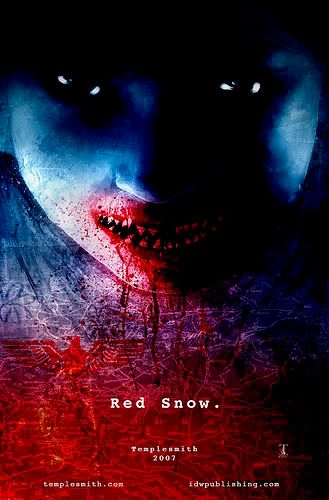
30 Days of Night mini series – Red Snow - announced

A new 3 issue 30 Days of Night mini series, called Red Snow, is due to start in August 2007. The blurb looks a little like this:

“1941. Hitler's Operation Silver Fox has failed but the war on the Eastern Front drags on as the Russian winter starts to bite.

“British military attaché Corporal Charlie Keating observes the war from the Soviet side, making sure crucial supplies get through to aid Stalin's front in the battle against the Nazis. He sees first hand how tough the Russians have it, yet somehow even the local peasants manage to live amidst the ruins of their country. With luck, he too will survive to see the end of the war.

“But something else is out there and they're not the Nazis. No matter how hard humanity tries to kill itself, something does it better.”

Night Hunter – review


Director: Rick Jacobson

Release Date: 1996

Contains spoilers

I first caught this a couple of years ago, well actually I only caught the last ten minutes and was kind of relieved that I didn’t see the rest of the film. However, it was on Zone Horror the other night and I decided it should be watched in its entirety in order that I might continue my quest to bring you all things vampiric.

The film starts off in a shack and a vampire hunting family – the Cutters - are battening down the hatches for the night. They put some liquid on the child, Jack (played as a child by Chris Aguilar). Now let us stop for a moment and examine this liquid. One might think it was holy water – though there is no evidence of that. All I can tell you is that they anoint young Jack with it and later in the film the older Jack (Don ‘The Dragon’ Wilson) puts some on himself. It seems to have no discernible effect. It might be the same liquid, referred to as elixir if memory serves – I’d given up on notes at that point – that Jack pours on someone’s gunshot wound to heal it. Who knows?

Anyhoo, Jack is put in a cupboard to hide and given a book. There is a knock on the door, from Sid (Sid Sham) - a fellow hunter, and they let him in. Sid has gone bad, however, and lets the vampires in. Jack sneaks from his hiding spot and the book ends up in the fire, is retrieved and Jack is put out the window as his family are slaughtered.

The present day (well 1995) and Jack goes in a restaurant, guns a blazing and fights it out with four vampires. The guns are to slow them, because in this the only way to kill a vampire is to break its neck. Jack thinks the vampires are now all dead (the book had a list of names of all the vampires) but the cops are after him and a reporter named Raimy (Melanie Smith) is also on his trail.

Unfortunately there are five more vampires, led by Fischer (Nicholas Guest), and they have descended on LA as there is to be an eclipse. It seems that a vampire bite will only turn someone during an eclipse. Hmmm…

The vampire lore is pretty much as I pointed out, they must have
their necks broken and nothing else bothers them. Sorry… sunlight is a bit bright for them so they wear dark glasses. Also, for some reason, their coffins are in a room refrigerated down to sub-zero temperature. There is a nice moment, however, where the cops examine the body of a vampire and we discover that the wound from the gunshot moments earlier looks like a month old scar.

The hunters seem more than human also. They have a psychic vampire tracking ability and seem a little more hardy than we mere mortals. There is also a sub-story about Fischer recognising Raimy from another era – that old chestnut – and wanting her to be his vampire bride – but really I couldn’t care and neither could the writer as this is mentioned but never explored in any detail.

The acting was uniformly poor. Cash Casey as the disbelieving suddenly believing cop was simply unbelievable in a wholly bad way. Wilson was so stoic as Jack Cutter that he made Blade seem like a non-stop madcap joker. I refuse to contemplate what was going on with Nicholas Guest’s ‘evil’ laugh.

The worst thing about this film is, without a doubt, the directing. Every time an action scene begins, for the duration of the scene, the camera violently shakes. I don’t really know what Jacobson was trying to achieve with this, perhaps it was a device to portray the preternatural speed and reactions of the vampires. It was, in reality, simply annoying and nothing more. The acting may not have been of the highest calibre and the story might have been simple and cliched (with the more interesting aspects unexplained) but the film would have scored higher if it hadn't been for the shaking cameras.

There really isn’t much else to say about this, so I’ll shut up. 0.5 out of 10 is given for the described concept of how the healing gunshot looked.

The imdb page is here.