Showing posts sorted by relevance for query Fernando Bilbao. Sort by date Show all posts

Friday, March 02, 2007

The Vampires Night Orgy - review


Directed by: León Klimovsky

Release date: 1972 (imdb lists as 1973)

Contains spoilers

This is pure euro-horror and one might be forgiven, due to the title, for wondering whether this falls under the sexploitation banner – it doesn’t. There is the merest touch of nudity but this is horror, with some quite disturbing concepts that are endangered by, amongst over issues, a bizarre soundtrack that can be best described as psychedelic jazz meets "bad 1970’s porn soundtrack". In some respects the soundtrack is so weird that it is great but soundtracks are vitally important to mood and atmosphere and this is so strange, and at times jolly, that it goes dampen the atmosphere.

Be that as it may, the beginning shows a scene of a funeral. As the coffin is lowered into the grave it falls, breaking open. The mourners run as we see a blackened, steaming corpse filled with worms and maggots.

A bus makes its way through the Spanish countryside. All the passengers have been hired to work at an estate in a variety of jobs from gardener to tutor and the agency who has hired them has arranged the transportation. They are 110 km from their destination, Bujoli, when the bus driver (L Villena) has a heart attack and dies. They manage to stop the bus and one of the passengers, Godo (Luis Ciges), takes the little girl, Violet (Sarita Gil), off the bus whilst they deal with the corpse – placing him on the back seat and covering him. Violet goes for an explore and we see the start of a bizarre sub-story.


Violet meets a little boy (Fernando E Romero) whom she speaks to for a while, until he vanishes. This sub-story continues through much of the film and is generally unexplained. The bus sets off again with one of the passengers, Ernesto (Gaspar 'Indio' González), driving. He sees a sign for a nearby village, Tolnio, and takes a detour in order to find food and rest. The village is deserted and yet the inn seems set for visitors. Another traveller, Luis (Jack Taylor), enters and says that the whole village seems empty. He seems quite taken by Alma (Dyanik Zurakowska).


Indeed Luis and Alma are the hero and heroine of the piece and this is one of the places where the disturbing little ideas can be seen. Luis has a habit of looking through a peep hole and voyeuristically watching Alma getting ready for bed. This is not the normal way to build up the hero of a film. That night, when all are in bed, Ernesto is asleep in the bar when he is woken by a cuckoo clock. He hears something and explores the village. Suddenly he is surrounded by villagers who pounce on him – they are in a village of vampires.


The next day the villagers are around and the mayor, Boris (José Guardiola), explains that the night before they were all at the cemetery for a funeral. There is another one of the disturbing elements here when the villagers try to work out what they will feed the guests. One says that the Countess (Helga Liné) will supply and then we see a villager, credited as The Giant (Fernando Bilbao), approach a blacksmith at the Countess’ command and cut off his leg, which is then served to the travellers.


Ernesto suddenly reappears looking very grey of the face, though a hangover is assumed, and mentions that he has dealt with the driver's body. This leads to the black humoured little comment by traveller Marcos (Manuel de Blas) about he wouldn’t have cared if they’d eaten the corpse – they probably had. The travellers go to their respective vehicles but both have broken down – suspicious that – and the coach travellers admit they have no money. Not to worry, their bills will be paid by the Countess who also gives them cash.

As more passengers vanish Luis becomes suspicious and tries to find a means of escape for himself and Alma.


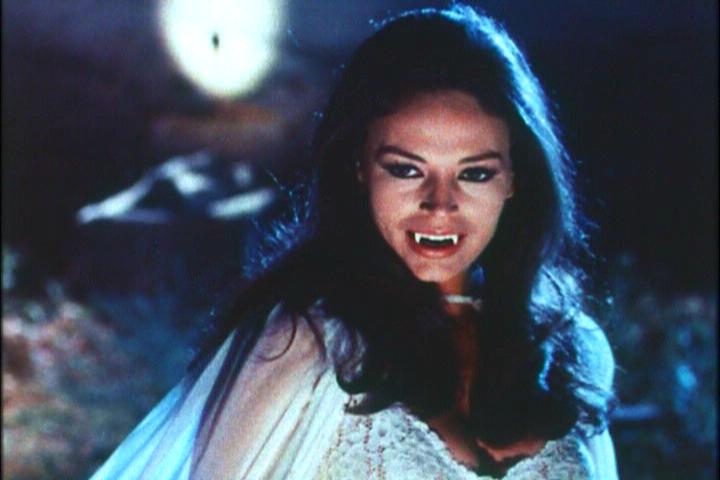
The vampires are somewhat different. You might think that they can go around in daylight but the point is clearly made that whilst in Tolnio the sun never shines, it is always overcast. Only the countess is fanged, the villagers are more like revenants and feed in packs. We do not know the villagers’ sleeping arrangements but the countess has a stone coffin in a crypt like basement area. At one point we see Boris drink his ‘special liquor’, having refused any food or standard drink, which clearly looks like bottled blood.


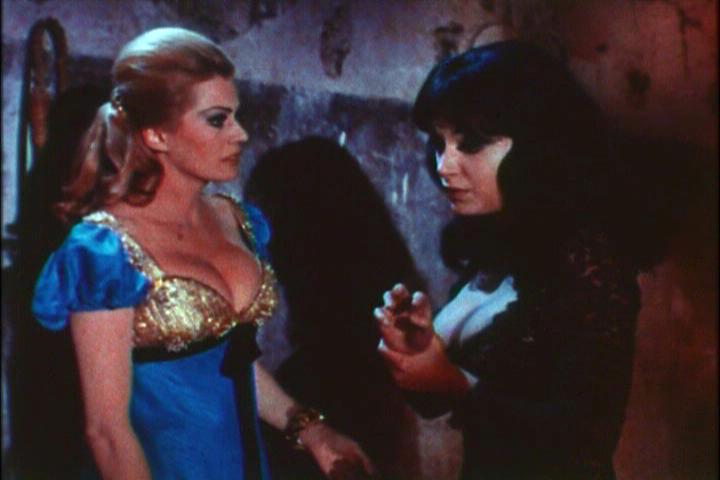
There is a great scene when the Countess has would be tutor Cesar (David Aller) recite a monologue for her and then beds him. Post-coital she vamps and bites him. It is only a quick nip, however, and then she throws him over a balcony to a pack of villagers who descend upon him. The villagers out-number the travellers, plus each person killed joins, and thus swells, the ranks of the undead. Why they attacked in such a piecemeal way is not explained, but I’ll go with the flow with regards that. Of course this piecemeal factor lead to the sacrificing of villager’s limbs to feed the victims during their stay and this is, as far as I am aware, a completely unique premise.

The storyline with the little boy is odd and somewhat disturbing. He can clearly be seen by the villagers, though he only seems to appear before Violet and not the other travellers. At one point he takes her to the cemetery and they bury her doll, though he specifically leaves one arm out of the grave, then he vanishes leaving violet locked in the cemetery. When villagers come he returns and hides her, clearly trying to save her, though it is to a disastrous result. Who he was, whether he was a ghost or a vampire, we never know.

The film is dubbed and the dubbing is quite poor. It also leads to Violet’s mother, Raquel (Charo Soriano) having a most amusingly dubbed voice, unfortunately the comedy of it does not fit into what the filmmakers were trying to produce.


As I said, the film’s themes are quite disturbing. The cannibalistic meals lead to a cooked finger being served (and covered up by having the innkeeper cut off a finger to make it look like an accident led to the finger being in the meal). Unfortunately the atmosphere never quite builds as one would hope and I suspect that the main culprit is the soundtrack, along with the dubbing, though the direction has some responsibility. The film’s pace fails badly at time. This was most noticeable when Violet and the boy play hide and seek, and Violet’s lack of reaction after she has (accidentally) seen The Giant hack off a man’s arm, during this scene, was unfortunately unbelievable. It has got to be said that, given the subject matter, the film is fairly gore free; in fact it is almost bloodless.

The film ends with a strange (and somewhat incongruous in set-up) little twist and, whilst I expected a twist, it wasn’t what I thought it might be.


The village of vampires was a great idea and some of the disturbing touches were fantastic. These make this a fairly good piece of Euro-horror that the pacing, soundtrack and dubbing cannot completely ruin. As it is 4 out of 10 reflects the great little touches, despite itself, and I’d love to see this re-scored and in its original language – though that wouldn’t help the moments of poor direction.

The imdb page is here.

Wednesday, August 28, 2013

Vamp or Not? The Erotic Rites of Frankenstein

Ah Jess Franco, there is no other director's work quite like his, and the 1972 La maldición de Frankenstein proves that point. Like many Franco films there are multiple editions. Some are ruder, some are clothed. The Spanish release had a sub-story concerning gypsy girl Esmeralda (Lina Romay, Female Vampire, Vampire Junction, Vampire Blues, Killer Barbys Vs Dracula, Revenge in the House of Usher & Snakewoman) that didn’t touch the main plot (bar referentially) and added an erotic aspect – it was with this cut that the film gained the name the Erotic Rites of Frankenstein.

Jess Franco cameos as Morpho
However such kinky goings on do not concern us as the focus of the “Vamp or Not?” is the character Melisa (Anne Libert, Daughter of Dracula). Now the Amazon UK ‘review’ (less a review and more a 3 line synopsis) suggests that she is “a blind vampire with wolfman hands”. Sounds good but we know that these things can be deceptive and, indeed, she is not that at all.

I've been making a man
However the film proper starts with Dr Frankenstein (Dennis Price, the Horror of it all, Son of Dracula (1974), the Magic Christian, Dracula Prisoner of Frankenstein & Twins of Evil) who, with his lab assistant Morpho (Jess Franco), is trying to improve his creature (Fernando Bilbao, the Vampires Night Orgy, Fangs of the Living Dead and also Daughter of Dracula & Dracula Prisoner of Frankenstein) – by giving him the facility to speak (although all he then says is that he is in pain!) A coach pulls outside the castle and the agents of the occultist Cagliostro (Howard Vernon, also Daughter of Dracula, Revenge in the House of Usher and Dracula Prisoner of Frankenstein) break in. Those agents consist of a coachman and the aforementioned Melisa.

feathery fingers
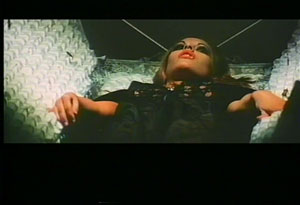
As we see Melisa she has odd looking talons and green feathered hands, she also has streaks of green feathers on her body. This is because she is part human and part bird (so, not wolfman at all). We discover that she is blind, can intercept the telepathic communications of Cagliostro and is a seer. There is an odd cawing noise she makes that seems to work like echolocation (or perhaps that was just me). Anyway she attacks Frankenstein and seems to bite his neck, in a way that is rather vampiric, and then shows her blood spattered mouth. So, she’s a bird vampire?

mangled and lacerated, apparently
Lets have a look at the forensics! Frankenstein’s body is found in the forest, rather than the scene of the crime. Later Dr Seward (Alberto Dalbés, La Mansión de la Niebla and also also Daughter of Dracula & Dracula Prisoner of Frankenstein) tells Frankenstein’s daughter, Vera (Beatriz Savón), that it was difficult to diagnose the cause of death. No vital organs were involved (presumably they were all there then) but Seward suspects that he haemorrhaged to death. Then he suggested that it was apparent that he was mangled and lacerated and was stripped of flesh – when asked if it could have been mountain lions or wolves the good doctor suggests it was more likely vultures. This dialogue was, at best, self contradictory (and all in the one scene) and, worse, the most we see of wounds are three rather superficial lacerations to his neck (and we see them often as his technology keeps getting used to revive him). That is until his spectacularly hysterical second-death by acid, at least.

Blood at mouth
The reason Cagliostro has stolen the monster is that the occultist wants to make a new breed of monster. He intends to make a beautiful woman and then have her breed with the monster. Cagliostro also seems to have a court, where all the courtiers are monsters, with skeletons and zombies included in their number. However getting back to Melisa, we see her rolling (her face) in blood again later on but, aside from the idea that she might have stripped flesh off Frankenstein, we don’t really see anything more.

Not really a vampire
So vampire? I don’t really think so. As with all Franco there is a multiple crossover – Seward, for instance, crops up in many a Franco film and was lifted from Dracula. Her manner of attack (and possibly feeding) was certainly reminiscent of a vampire. Probably safest to say Not Vamp – but of genre interest.

The imdb page is here.

Tuesday, May 23, 2023

Buenas Noches, Señor Monstruo – review


Director: Antonio Mercero

Release date: 1982

Contains spoilers

Poor, poor Paul Naschy, to think that, once upon a 1982 he ended up in this; and just to note that his wolf man in this does not use the Waldemar Daninsky name as (according to the IMDb trivia) he “detested the script”.

This had been on my radar for some time but it is only recently I got to see it with fan-subs and, whilst I was expecting a kid orientated flick I was not expecting a vehicle for Spanish kid-pop-group Regaliz, full of cheesy pop songs (with context accurate lyrics) and dance moments. That said, it does have Dracula (Luis Escobar) in it so it deserves its place here.

blowpipe

The film starts with a school trip to the lake. Jaime (Jaime Benet) and Eduardo (Eduard Navarrete) are bug hunting, keeping in touch by walkie talkie (Jaime is unsure as to why they have to use code names). Jaime reports in that he has seen a large lizard and Eduardo tells him not to let it get away. Jaime resolves to use his blowpipe (!) and Eduardo counsels to aim for the tail. Well, he’s nowhere near the tail but he does hit teacher (Rosa Redondo) in the butt. He is chased and, collecting Eduardo as they run, they become lost in the wood. Then the storm hits.

the hearse

So they think they see feet passing by and decide to leave their hidey hole/shelter and immediately run into Astrid (Astrid Fenollar) and Eva (Eva Mariol) – so that’s the members of Regaliz all together. Anyway, Jaime remembers that he has sparklers and so they light them and sing through the forest. Eventually they come to a road and a coach comes past, recognised by the kids as a hearse carrying two coffins and, apparently, driverless. They then spot a castle and go to look for shelter/help.

Luis Escobar as Dracula

In the castle the (currently human) Wolf Man (Paul Naschy) and Quasimodo (Guillermo Montesinos) are bowling with skulls. An alarm wakes Dracula, who grabs his fanged dentures as he leaves his coffin. Frankenstein (Andrés Mejuto) is still working on perfecting his Monster (Fernando Bilbao) and bemoaning that the monsters are no longer feared by the humans. When the kids turn up he decides that they should feed them, give them a bed for the night and then (at midnight) scare them. There is singing and dancing amongst all this and the kids find a surprising ally in the Son of Dracula (Miguel Ángel Valero).

dance routine

This is silly, kids’ fodder and doesn’t have a secondary adult layer to it to keep the parents entertained. The kids look to be having fun but much of the cast, including some of the kids, are dubbed. We get some nice bits, like Dracula taking his dentures out and filing his fangs sharp, and Wolf Man is a reluctant monster despite living with the other monsters. The story isn’t much to write home about – the kids are surrogate for the world the monsters want to terrify and defeat the monsters partly due to the monsters’ pratt falls and partly through the power of song and dance. When ‘rescued’ by a search party no one believes there were monsters there. You can track this down, there are fansubs out there but the DVD is not English subbed. I am sure that for some this will be a film that invokes rose-tinted glasses, for the rest of us 3 out of 10.

The imdb page is here.
On DVD (no subs) @ Amazon US

On DVD (no subs) @ Amazon UK

Friday, March 07, 2008

Daughter of Dracula – review


Director: Jess Franco

Release Date: 1972

Contains spoilers


Ah, Jess Franco. There is something compelling about his films, not matter how poor they are. Something that makes it impossible to tear your eyes away from the screen. Despite his bizarre zoom habit they are very watchable.

At the head of this film it seems as though we are in for a treat. Why? Cinematic narrative. The film, unusually for a Franco vampire movie, has a story. At first…

At the head we get a script on screen about Dracula (the only time he is mentioned) and then a mention of Castle Karlstein. This is somewhat confusing as Karlstein obviously refers to Karnstein, which is the family name of Carmilla. The film proper begins with a Franco sexploitative moment, a woman getting undressed and bathing whilst someone peeps in on her. It is clear, even though we only get an eye, that the watcher is a woman. The watcher bears fangs and then the bathing woman screams.

An old woman is dying. Around her are Count Max Karlstein (Daniel White), his secretary Cyril Jefferson (Jess Franco) and his daughter (?) Karine (Anne Libert). The woman is waiting for her daughter, Luisa (Britt Nichols) to come. She arrives and the woman tells her that she is of the Karlstein line and gives her a key to the crypt where the first Count (Howard Vernon) is buried, he was a vampire.

At this point all pretence of story falls apart, despite the fact that it really felt, for a moment, like there was one. What we get is Louisa going to the crypt and becoming a vampire. However the film hints that she was the mysterious vampire anyway, which makes no sense. We get a love story between her and Karine, which goes nowhere and is simply an excuse for the obligatory Franco lesbian scenes. We get the mystery vampire, with Franco intent on making us think it is a man when we know otherwise. We get a police investigation of the murders with Jefferson sure there is a vampire and the police and a reporter (Fernando Bilbao) intent on blaming the present Count Karlstein.

None of this actually fits into a narrative framework properly. For example, and cutting to the end of the film, Jefferson discovers his wife has had an affair with the present Count Karlstein and so vows to kill the vampire! He goes off to the crypt (begging the question why he hadn’t been there before) and is joined by the previously sceptical reporter and inspector (Alberto Dalbés). They help him stake the Count (through the head) and burn a coffin – contents unknown but thought online to contain Luisa. It made no climactic sense as the film did not build to it.

The title is senseless as there is no real indication through the film that the Count was Dracula – he had a different name after all. Indeed the only real connection was the fact that Vernon played Dracula the same year in Franco’s Dracula, Prisoner of Frankenstein. At least this time the vampire was not green in colour but the role was limited mainly to lying in a coffin.

Indeed may of the same faces return in this, though not necessarily in the same roles, and one wonders if left over footage from the previous film was salvaged?

All that said, there is a dreamlike quality to this that is compelling and is probably only marred by the attempts at dialogue based narrative that seem to fail miserably. Unfortunately it is not a patch upon some of the Jean Rollin efforts in developing that dreamscape on film. There is no real horror captured in the film, Luisa's dress being the most horrific thing you'll see. Unfortunately the erotica isn't particularly erotic either, feeling staged rather than natural.

Like the film itself, the soundtrack seems misplaced, lush at times and yet inappropriate. It adds to the quality of the film in a way that is difficult to describe as it shouldn’t work at all.

Not a great film and yet compelling at the same time, the film's strength lies in the fact that it portrays Franco’s oneirism on the screen for us all to see and for that reason it also fails. 3 out of 10.

The imdb page is here.

Wednesday, September 13, 2006

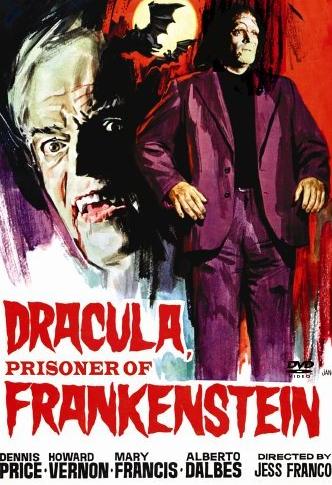
Dracula Prisoner of Frankenstein - review

Directed by: Jess Franco

Release Date: 1972

Contains spoilers

Let’s get it on record, I like Jess Franco movies. It is not just the exploitation factors but an intangible something within the films. As surreal, badly plotted (if plotted at all), strangely shot and poorly acted as they might be there is a certain something.

Dracula Prisoner of Frankenstein is one of the most bizarre I have seen, which is odd given that, on the surface, it is simply a monster mash. Firstly there is a distinct lack of the exploitation that Franco is famous for, you will not see a naked bosom in this - never mind a sex scene. The most you will see is some fairly unrevealing lingerie on a cabaret singer (Josyane Gibert). The surrealism of Franco is also lacking, in the traditional sense, the surrealism comes in the fact that there is barely any dialogue and nothing of real plot substance until 40 minutes into the movie.

The plot, as far as I could ascertain, essentially runs like this. Dracula (Howard Vernon) is terrorising the locale, as Dracula is want to do. The look of Dracula seemed familiar to me and it wouldn’t actually surprise me if Franco’s vision didn’t, at least a little, inspire the makeup artists who created the look of the Count in The Legend of the Seven Golden Vampires, two years later.

Jonathon Seward (Alberto Dalbés) visits one of Dracula’s victims. Now there is an interesting moment here where he appears to plunge a needle into the girl’s left eye (a move that causes the light to fail). I say appear as I re-watched the scene several times and it wasn’t that clear, and without dialogue there wasn’t chance of explanation, but it is a manner of disposing of the undead used in Black Sunday. Seward takes his buggy up to the castle and finds Dracula’s coffin and disposes of him in a most bizarre manner.

Dracula lies, eyes wide open; Seward takes a stake, which looks little more substantial than a thick twig, and hammers it gently in with a reflex hammer (no blooming great mallet here). The stake falls, not in anything, as Dracula dies, for he transforms into a dead bat.

It appears that Seward has saved the day but he has a patient (I assume from the cast list, as it isn’t clear in the film, that she is Maria played by Paca Gabaldón) who seems to react strongly to the forces of evil. She acts as a psychic barometer, very much in the way Renfield did in Dracula and has a reaction despite the fact that the Count has been disposed of. Dr Frankenstein (Dennis Price) has come to town.

Frankenstein and his deaf/mute assistant (Again not clear due to lack of dialogue but I’m assuming Morpho played by Luis Barboo) set up shop in Dracula’s castle. It is interesting how Franco deliberately (?) juxtaposed technology. Whilst Frankenstein mentions Seward’s science later it is clear that the innocent have no technology. They use horse drawn buggies and their homes are candlelit, whereas Frankenstein has a motor vehicle, plus his lab and electric light bulbs. Frankenstein reenergizes his monster (Fernando Bilbao) and sends him to kidnap the cabaret singer.

They use her blood to resurrect Dracula in a most effective and yet bizarre resurrection. The blood is drawn by transfusion methods, to fill a bell jar in which the bat corpse is kept. Franco shows us a live bat in a jar licking up the “blood”. When the bat is almost covered Frankenstein uses his equipment and resurrects the Count. The fact that blood was not enough was bizarre enough, but the use of the equipment is both unusual and means that Dracula is now Frankenstein’s slave. Morpho then disposes of the cabaret singer in a furnace but not before he fondles, quite disturbingly, her corpse.

So, why has Frankenstein resurrected Dracula? It seems he is creating a shadow army with which to rule the world. No more explanation is given. He has Dracula vampirise Maria (which puts her, due to the use of the lab, under his control as well) in order to take Seward’s weaponry away (remember she is a psychic barometer) though why he didn’t just have Seward killed is another question altogether – though the monster does beat him. Unbeknown to him, however, there is another vampire girl (Britt Nichols) who is not under his control.

A gypsy woman, Amira (Geneviève Robert), who is dying having been attacked by the vampire girl, binds Seward’s wounds and tells him that it is his courage that will defeat the evil but, when the moon is full, the wolfman (Brandy) will come and help him. This is pointless as Seward does bugger all from now on but stand around, miles from the castle, and look broody. Meanwhile Dracula and Maria kill a husband and wife, presumably to be vampirised as they end up in the lab – though we never see them in action.

We then have the monster fight and it is bizarre. The vampire girl kills Morpho and then the wolfman attacks Frankenstein’s monster (a fight the monster eventually wins). As Frankenstein watches this he is attacked by the vampire girl. He electrocutes her in his equipment, burning her in bat form. Incensed at the attack he gets a pike and, because of disloyalty, kills Dracula and Maria in their coffins (and presumably the husband and wife if they were turned). He then uses his equipment to kill the monster and declares he will find another way (of dominating the world I assume). I say this is bizarre as he and his were attacked by a couple of monsters not under his control and so turned on those under his control, men with such insecurity problems are unlikely to ever achieve world domination.

Seward and a mob of gypsies enter the castle and find skeletons in the vampire coffins (why they became skeletons and not bats this time I don’t know). He holds up a crucifix and gives thanks to God – fin.

As you can see the plot is an incoherent mess with motivations flying all over the place without any real form of explanation. Again this will have a lot to do with lack of dialogue and, probably, because key bits of the film ended up on the cutting room floor. I say this because the story does seem to lurch forward bizarrely at the end. Up until the fight the film has been languid, the fight occurs in the last 5 or 10 minutes.

Franco has put in some great shots, especially of the castle, and yet marred it with shaky camera work at times, ridiculous zooms and a complete disregard of day and night. In fact it seems to have been that the film has been shot whenever Franco felt like it - day and night being a minor inconvenience. There is no real acting to speak of, with lack of dialogue we simply get reaction shots, these mainly consist of women screaming and don’t expect any real reaction from Frankenstein and even less from the weirdly bug eyed Dracula who seems to have been resurrected sans brain and personality.

Yet there are some fascinating concepts daring to poke through the swamp and because of this it is a difficult film to give a score to. Franco tried to shoot this as a straight movie, missing much of his idiosyncrasies, and yet they are still there, lurking in the shadows. It is an incoherent mess in places and yet there are great ideas also, that no one other than Franco would have come up with. This is not a great film to introduce a viewer to Franco and is hard work for those of us who love (despite ourselves) his movies. 3 out of 10. To a degree I believe I have been overly generous, despite the interesting aspects in the film, as to me the best part of the movie was the DVD cover.

The IMDB page is here.

Thursday, May 18, 2006

Fangs of the Living Dead - review


Director: Amando De Ossorio

Release Date: 1968

Contains spoilers

Fangs of the Living Dead is an exploitation flick from the late 1960s, hailing from Italy and Spain. As such it is dubbed (or at least I hope it is or the voice looping is atrocious!) and thus one of the problems with the film, its overly melodramatic acting, might actually be a problem with respect the voice actors rather than the original cast.

It begins in a Doctors office in Rome when Dr. Pietro Lufuani (Gianni Medici) is summoned to a nearby bar by his fiancée Sylvia (Anita Ekberg). When he gets there, along with their friend Max (Cesar Benet), Sylvia reveals she has a letter from her uncle (Julian Ugarte), the Count Walbrooke. Sylvia was taken by her father from her mother when she was new born. It appears, however, that her mother was a Countess and she has just died, leaving her castle and title to Sylvia. Sylvia states her intention to travel to the castle but she will be back in two weeks for their wedding.

Arriving at the village below the castle she enters a bar where she is served by Bertha (Diana Lorys) who works at the bar with her sister, Freia (Rosanna Yanni). When she announces that she is the new Countess all the locals go silent. Their fear is interrupted by Vladis (Fernando Bilbao), her uncle’s coachman, who hurries her to the castle. At this point I couldn’t help but think bad things regarding the aristocracy, given that she never paid for her beer!

Arriving at the castle she is informed that her uncle would not be available until 10 that night. When he finally appears (see the screen capture) he is the very picture of a 50s/60s Satanist from a bad B movie – wait it is a bad B movie, though he isn't a satanist! He kisses his niece and she notices how cold his skin is. He shows her a picture of her great grandmother, Malenka (also played by Ekberg in flashback scenes), he then tells her that her mother died of melancholy and is in the castle crypt – off then to the crypt.

Now, as they wandered into the crypt I, thought to myself, 'who on earth keeps all those torches and braziers lit?' This is actually a film which answers such questions; it is the Count who keeps the fires alight, in reverence to the dead.

That night Sylvia is awakened as the door to her room opens. In slinks the rather busty brunette Blinka (Adriana Ambesi). She informs Sylvia that her uncle is not what he seems, that he isn’t really her uncle, being over 100 years old, and that he kept her mother a virtual prisoner. She then tries to lull Sylvia to sleep before kissing her neck. Just then the Count bursts in and drags Blinka off. Sylvia searches, hearing screams and finds Blinka chained and being whipped by the count. He turns the woman’s head to Sylvia and shows she has fangs.

Sylvia, of course runs off and she is caught by her uncle who tells her to break her engagement and then reveals the history of Malenka – a brilliant bio-chemist who dabbled in the black arts and perfected necrobiology (hey, I didn't make that up!). For her troubles she was burnt as a witch but not before she had made her second husband a nosferatu – the 'none dead'. The Count is, of course, that second husband.

Pietro receives a letter breaking the engagement and, not being a man to take no as an answer, goes to find Sylvia with Max, a comic relief character, in tow. Turned away from the castle he goes to the inn. He is asked to examine Bertha and says she is anemic. The Count visits her and she dies. When we see her in the coffin her hand twitches and fangs appear. The next day she is buried.

Sylvia escapes the castle, with Blinka’s help, when the Count is distracted from trying to feed Sylvia his blood by Bertha, back from the grave. Sylvia gets to the inn and is reunited with her love, but has been accosted by Bertha as she made her way through the cemetery. Because of this apparent vampiric ressurection Pietro, Max and the local drunken Doctor, Dr. Horbringer (Carlos Casaravilla), stake out the cemetery and see Bertha rise from the grave. During this time Sylvia has been captured.

They head for the castle and Pietro ends up chained in the dungeon whilst Max tries his luck with Blinka. Cue the following exchange, “I am a vampire.” Drawls Blinka “I love exotic women.” Replies Max.

Here everything goes wrong with the movie. So far it has been a low grade, melodramatic piece of euro-horror pantomime about vampires. Okay the reactions of the characters are often unbelievable, their own perceptions turning from belief to disbelief and back again as quick as the eye can blink, but the film has a direction. Suddenly the Count reveals that it is all a scam to have Sylvia locked away as mad, presumably so he will get the estate, having killed her love because she is a "vampire" from a family of "vampires". Bertha’s death was faked and they knew that the drunken Dr. Horbringer would sign the death certificate – the scriptwriters forgetting that it was Pietro who announced her dead.

The Count's exposition over, Sylvia appears and is told to kill and drink from Pietro. Blinka interupts proceedings just as Sylvia is, apparently, going to kill Pietro and a rather long cat fight begins between Blinka and Bertha. The Count is totally distracted by the enthralling sight of these busty maidens fighting and fails to notice as Sylvia frees Pietro and the direction of the film turns around again.

Pietro punches the Count who falls back into a chair; Pietro has a torch, though it is not clear if he actually stakes the Count or if the Count falls onto something. However, the Count dies and crumbles to dust as the painting of Malenka burns.

In a coda to the film, which forgets to mention the fates of Bertha and Blinka, we see Sylvia and Pietro leave the castle, followed by Max. Freia approaches Max and asks him to take her to Rome and he vamps out in broad daylight chasing her, Benny Hill style, out of the castle.

The film could have been an average euro-horror and it is a shame. I previously posted it was truly awful, and was mildly shocked, whilst I re-watched it, that I was quite enjoying it in a B movie kind of way. It is the inability to decide if the film is or isn’t about vampires that spoils the film, the huge swings in direction at the end just kill the film off. Seemingly this was because the producers decided that enough had been filmed three weeks before the seven week filming schedule had ended, still it doesn't make for a good film. For a score I’ll have to give 2.5 out of 10.

The imdb page is here.