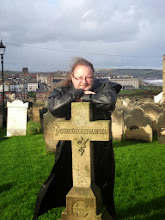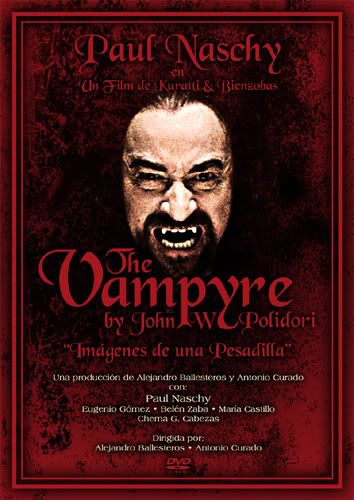
Antonio Curado (Madrid, 1974) is a Latin and Greek teacher in a High School. He works in a laureate about the Petronius' Satyrica, exploring the symbolism within the bizarre world of the Roman novel. He has published several texts about the horror tales inserted in the Satyrica, including a lycanthropic one. His interest in these horror tales led Antonio to direct his first short movie, which was the adaptation The Vampyre by John W Polidori, based upon the classic vampire tale, with his friend Alejandro Ballesteros.
Last year I stumbled across the film. This was only the second film I can think of that was based on the story, the first being the loose adaptation The Vampire’s Ghost.
My post on the blog led to Antonio contacting me and he kindly sent me the short on DVD and we corresponded for a while. I am pleased to say that he consented to being interviewed for the blog. Just to note, at Antonio’s request, I have slightly edited his answers due to the fact that English is not his first language. However the edits are light indeed, firstly because Antonio’s English is very good but secondly because I didn’t want to change the voice or timbre of the answers.
 Adaptations of The Vampyre are, sadly, few and far between. What inspired you to adapt the story?
 Well, as far as I was concerned, I thought that there wasn’t a real adaptation of Polidori’s masterpiece. To tell the truth, I wasn’t sure about it, but almost sure. I have always loved the tale and, since I was at the High School, I wished to make a movie with it. It’s just a case of love for a specific genre
  of literature. It would be hard stuff, really. And when my friend and co-director, Alejandro Ballesteros, suggested that I make a short movie, I didn’t have a doubt: The Vampyre. I started to investigate and discovered The Vampyre Ghost, but it’s hard for me to find the echoes of Polidori in it. I noticed that there is actually a script from 1973, which was never shot. And the most peculiar thing about it, the first appearance of Lord Ruthven (or a monster with its name…) in a movie occurs in a bizarre American movie with Paul Naschy, Countess Dracula's Orgy of Blood, by Donald F. Glut. Since Paul Naschy became later involved in our project, it’s a curious coincidence.
How familiar where you with Polidori’s story before the project began?
I read Polidori’s tale for the first time when I was around sixteen. And it was disturbing stuff to me, really. By the same time, I watched the Spanish film Rowing in the Wind, which portrayed the legendary night at Villa Diodati, and the dramatic personality of Polidori (rolled by Jose Luis Gómez) had a profound impact in my young psyche. I have returned to The Vampyre often since. It’s probably one of the literary pieces I know the best. The romantic passages, the travelling around the places I love the most, just like Rome and Athens, mean too much to me. I’d read Ernestus Berchtold too (I think this is the tale that Polidori wrote actually in the Diodati competition).
The film, by its length, does summarise the story. Would you wish to do a full length film of the story, and if so how likely is it that the film will come to fruition?
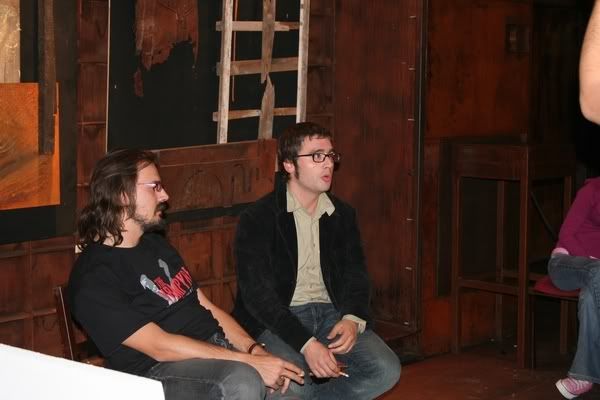
I wish, I wish, but it’s not easy for me to even imagine it. You know, we are amateur directors, with no money, and outside of the common places of Spanish cinema. We are real outsiders. The Vampyre is a short piece, but you can make a long movie with it, just like Roger Corman made with the short stories of Poe. There is a good bunch of places, situations, roles…you know, Andy, we have tried to summarise the situations, and it wasn’t easy, really. We had a lot of problems doing it, and the first reason was the money. We had no money at all, and I don’t think we’ll ever have access to enough money to make a full length movie with The Vampyre. Who knows, but I don’t think so. Our first attempt making a short movie was too big by the subject and the people we have involved in it. We learned a lot, and we suffered a lot too.
What was Paul Naschy like to work with?

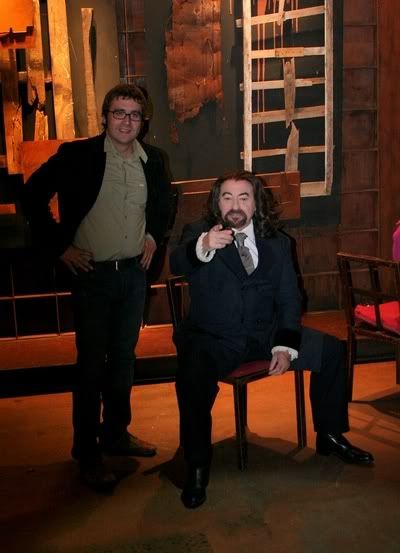
It was a dream firstly. Two guys with no experience convince a living legend to work with them. He’s a great man. He worked for nothing, he really believed in our project, but this added an additional set of responsibility we didn’t have when we started to think about making the movie. We didn’t want to disappoint him. The filming was hard, till late at night, with rain and cold weather. And he never complained. To me, Paul was a real legend. I admire his work and his choices, doing a kind of work not usual in Spanish cinema through the years. Then you know the man and it’s curious when you start to have some friendship with him. I have learnt a lot with him and I’ll never forget what he did for our project. He’s the first Lord Ruthven, pal, the original vampire on the screen for the first time. And we made the point. It’s an object of pride, isn’t it?
Are there any on set anecdotes you would wish to share with my readers?
Well, I never told this before, but something funny happen without our knowledge. It could have been dramatic. The vampire fangs were hard to find. We talked with a make-up expert in order to get them by the cheapest way (some people asked us for too much money). We went to a Madrid make-up office where a great professional took measurements of Paul’s teeth and did the fangs as best and as cheap as he could. So we made the movie. The sharp fangs weren’t too comfortable for Paul, and sometimes it really became a nightmare to me. I mean, I thought that I have no legitimacy making a man like Paul Naschy suffering like this (I’m exaggerating…). By the end of the filming, when it was all over, the girl in charge of the make-up (Consolación Guerrero, who did a really great job), confessed to me that the fangs were broken since the first day. She stuck the false teeth with strong glue and was praying all through the shoot that we didn’t notice. We had luck and now we can laugh about it. But if it would have happened…
I noticed several nods towards Dracula in the movie. In the dialogue you had a line about not drinking wine, Naschy seems to emulate Lugosi at one point (in his hand movements) and you use Swan Lake, which famously was used in the Todd Browning version of Dracula. How deliberate were these references and why did you choose to reference the later story?
Absolutely deliberate. You have noted that the movie is a great tribute to the classic horror films, and at the end of the credits you can see that it’s dedicated to Murnau, Browning and Whale. We have used a lot of common gimmicks of the genre, like the circles on the screen (we used them to cover some imperfections too). Of course, Swan Lake is a Dracula nod (and it’s like a miracle, because the first time we put the music on the scene, it fitted perfectly with the entire sequence, even the apotheosis was all along with the music: it’s the sequence we are proudest of, and it was so hard while we shot it…), and so the ‘drinking wine’ line (although in our movie it is said ‘I never….drink wine’, and Lugosi says ‘I never drink…wine’).  It’s a freak nod for the fans, obviously. The way Paul move his hands is pure Lugosi: as a matter of fact, my instructions directing were specifically ‘to move the hands like Lugosi’. And Naschy was happy making a tribute to the great Bela. As you noted, it’s an anachronism because The Vampyre is before Dracula, and the logical thing was that Lugosi imitated Naschy playing Ruthven…but it was pretty difficult for obvious reasons, so we put a lot of Lugosian stuff into Lord Ruthven. It’s our tribute to the classic horror movies we love so much.
Some time ago we corresponded and you mentioned that the film might be an extra on an upcoming DVD release. Has this happened and, if so, which DVD will the film appear on?

A long time ago we had been told that The Vampyre would appear as an extra content to the BCI/Deimos edition of the Naschy movie Human Beasts. They asked us for a Beta copy, and we sent it to them, and waited for an answer. Since that moment, we had no word about it. And look, Andy, this seems magical: while I’m answering your questions, my friend and co-director Alejandro, calls me and tell me that Human Beasts is out on the street with The Vampyre in it! It’s not a joke. We couldn’t believe it, I mean, they could have told us something about it. But they didn’t even mail!! I suppose that we have to be grateful, and obviously we are, but I have a strange sensation. Why didn’t they tell us anything? Well, if somebody wants to buy Human Beasts, he’ll buy The Vampyre by John W. Polidori too. The BCI/Deimos editions are really impressive and I’m sure that they even have improved the quality of the image. I have not watched it yet. I’ll buy it too…
Do you have any current projects you’d care to tell us about?
Yes, we have a new project. It’s a short film too, less pretentious, I think. It’s called Sacamantecas. It’s difficult to translate the title. It tells the story of a man who falls into a hypnotic trance and sees a bizarre scene where an old witch tries to convince a man to kill a young boy and rub his body with the lard of the kid in order to recover his health from a horrible pain. It’s an old story based in real events; a Spanish psycho killer, you know. There was a few ‘Sacamantecas’ in Spain, and it could be a curious experiment. It’ll star Eugenio Gómez, the same actor that plays the role of Aubrey in The Vampyre by John W. Polidori. He’s a great actor and a better guy. He has become our actor fetish. Well, Andy, thanks for your interest and I wish to greet to all the friends of Taliesin meets the Vampyre. This is a great webpage for all the fans!!! Good blood.
Many thanks for your time.
The diemos release of ‘Human Beasts’ referenced in the interview is available
Or
Plus all good DVD retailers.
Last year I stumbled across the film. This was only the second film I can think of that was based on the story, the first being the loose adaptation The Vampire’s Ghost.
My post on the blog led to Antonio contacting me and he kindly sent me the short on DVD and we corresponded for a while. I am pleased to say that he consented to being interviewed for the blog. Just to note, at Antonio’s request, I have slightly edited his answers due to the fact that English is not his first language. However the edits are light indeed, firstly because Antonio’s English is very good but secondly because I didn’t want to change the voice or timbre of the answers.
Adaptations of The Vampyre are, sadly, few and far between. What inspired you to adapt the story? Well, as far as I was concerned, I thought that there wasn’t a real adaptation of Polidori’s masterpiece. To tell the truth, I wasn’t sure about it, but almost sure. I have always loved the tale and, since I was at the High School, I wished to make a movie with it. It’s just a case of love for a specific genre
  of literature. It would be hard stuff, really. And when my friend and co-director, Alejandro Ballesteros, suggested that I make a short movie, I didn’t have a doubt: The Vampyre. I started to investigate and discovered The Vampyre Ghost, but it’s hard for me to find the echoes of Polidori in it. I noticed that there is actually a script from 1973, which was never shot. And the most peculiar thing about it, the first appearance of Lord Ruthven (or a monster with its name…) in a movie occurs in a bizarre American movie with Paul Naschy, Countess Dracula's Orgy of Blood, by Donald F. Glut. Since Paul Naschy became later involved in our project, it’s a curious coincidence. How familiar where you with Polidori’s story before the project began? I read Polidori’s tale for the first time when I was around sixteen. And it was disturbing stuff to me, really. By the same time, I watched the Spanish film Rowing in the Wind, which portrayed the legendary night at Villa Diodati, and the dramatic personality of Polidori (rolled by Jose Luis Gómez) had a profound impact in my young psyche. I have returned to The Vampyre often since. It’s probably one of the literary pieces I know the best. The romantic passages, the travelling around the places I love the most, just like Rome and Athens, mean too much to me. I’d read Ernestus Berchtold too (I think this is the tale that Polidori wrote actually in the Diodati competition). The film, by its length, does summarise the story. Would you wish to do a full length film of the story, and if so how likely is it that the film will come to fruition? I wish, I wish, but it’s not easy for me to even imagine it. You know, we are amateur directors, with no money, and outside of the common places of Spanish cinema. We are real outsiders. The Vampyre is a short piece, but you can make a long movie with it, just like Roger Corman made with the short stories of Poe. There is a good bunch of places, situations, roles…you know, Andy, we have tried to summarise the situations, and it wasn’t easy, really. We had a lot of problems doing it, and the first reason was the money. We had no money at all, and I don’t think we’ll ever have access to enough money to make a full length movie with The Vampyre. Who knows, but I don’t think so. Our first attempt making a short movie was too big by the subject and the people we have involved in it. We learned a lot, and we suffered a lot too. What was Paul Naschy like to work with?
  It was a dream firstly. Two guys with no experience convince a living legend to work with them. He’s a great man. He worked for nothing, he really believed in our project, but this added an additional set of responsibility we didn’t have when we started to think about making the movie. We didn’t want to disappoint him. The filming was hard, till late at night, with rain and cold weather. And he never complained. To me, Paul was a real legend. I admire his work and his choices, doing a kind of work not usual in Spanish cinema through the years. Then you know the man and it’s curious when you start to have some friendship with him. I have learnt a lot with him and I’ll never forget what he did for our project. He’s the first Lord Ruthven, pal, the original vampire on the screen for the first time. And we made the point. It’s an object of pride, isn’t it? Are there any on set anecdotes you would wish to share with my readers? Well, I never told this before, but something funny happen without our knowledge. It could have been dramatic. The vampire fangs were hard to find. We talked with a make-up expert in order to get them by the cheapest way (some people asked us for too much money). We went to a Madrid make-up office where a great professional took measurements of Paul’s teeth and did the fangs as best and as cheap as he could. So we made the movie. The sharp fangs weren’t too comfortable for Paul, and sometimes it really became a nightmare to me. I mean, I thought that I have no legitimacy making a man like Paul Naschy suffering like this (I’m exaggerating…). By the end of the filming, when it was all over, the girl in charge of the make-up (Consolación Guerrero, who did a really great job), confessed to me that the fangs were broken since the first day. She stuck the false teeth with strong glue and was praying all through the shoot that we didn’t notice. We had luck and now we can laugh about it. But if it would have happened… I noticed several nods towards Dracula in the movie. In the dialogue you had a line about not drinking wine, Naschy seems to emulate Lugosi at one point (in his hand movements) and you use Swan Lake, which famously was used in the Todd Browning version of Dracula. How deliberate were these references and why did you choose to reference the later story? Absolutely deliberate. You have noted that the movie is a great tribute to the classic horror films, and at the end of the credits you can see that it’s dedicated to Murnau, Browning and Whale. We have used a lot of common gimmicks of the genre, like the circles on the screen (we used them to cover some imperfections too). Of course, Swan Lake is a Dracula nod (and it’s like a miracle, because the first time we put the music on the scene, it fitted perfectly with the entire sequence, even the apotheosis was all along with the music: it’s the sequence we are proudest of, and it was so hard while we shot it…), and so the ‘drinking wine’ line (although in our movie it is said ‘I never….drink wine’, and Lugosi says ‘I never drink…wine’).
 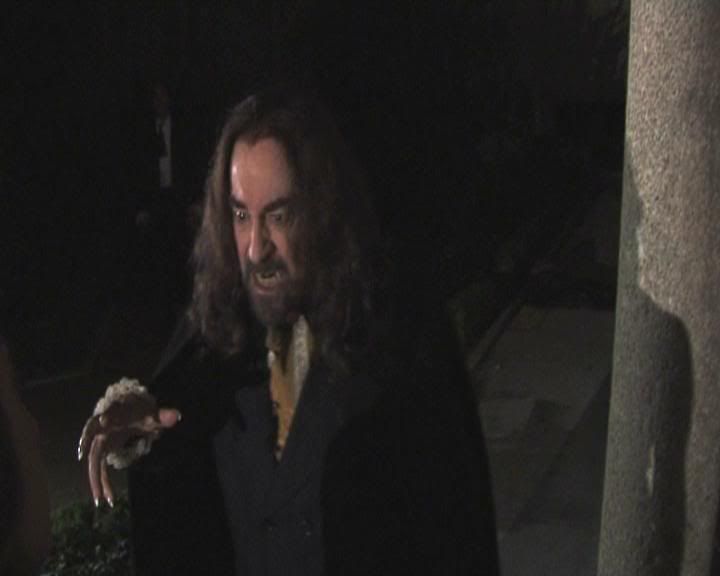 It’s a freak nod for the fans, obviously. The way Paul move his hands is pure Lugosi: as a matter of fact, my instructions directing were specifically ‘to move the hands like Lugosi’. And Naschy was happy making a tribute to the great Bela. As you noted, it’s an anachronism because The Vampyre is before Dracula, and the logical thing was that Lugosi imitated Naschy playing Ruthven…but it was pretty difficult for obvious reasons, so we put a lot of Lugosian stuff into Lord Ruthven. It’s our tribute to the classic horror movies we love so much. Some time ago we corresponded and you mentioned that the film might be an extra on an upcoming DVD release. Has this happened and, if so, which DVD will the film appear on?
  A long time ago we had been told that The Vampyre would appear as an extra content to the BCI/Deimos edition of the Naschy movie Human Beasts. They asked us for a Beta copy, and we sent it to them, and waited for an answer. Since that moment, we had no word about it. And look, Andy, this seems magical: while I’m answering your questions, my friend and co-director Alejandro, calls me and tell me that Human Beasts is out on the street with The Vampyre in it! It’s not a joke. We couldn’t believe it, I mean, they could have told us something about it. But they didn’t even mail!! I suppose that we have to be grateful, and obviously we are, but I have a strange sensation. Why didn’t they tell us anything? Well, if somebody wants to buy Human Beasts, he’ll buy The Vampyre by John W. Polidori too. The BCI/Deimos editions are really impressive and I’m sure that they even have improved the quality of the image. I have not watched it yet. I’ll buy it too… Do you have any current projects you’d care to tell us about? Yes, we have a new project. It’s a short film too, less pretentious, I think. It’s called Sacamantecas. It’s difficult to translate the title. It tells the story of a man who falls into a hypnotic trance and sees a bizarre scene where an old witch tries to convince a man to kill a young boy and rub his body with the lard of the kid in order to recover his health from a horrible pain. It’s an old story based in real events; a Spanish psycho killer, you know. There was a few ‘Sacamantecas’ in Spain, and it could be a curious experiment. It’ll star Eugenio Gómez, the same actor that plays the role of Aubrey in The Vampyre by John W. Polidori. He’s a great actor and a better guy. He has become our actor fetish. Well, Andy, thanks for your interest and I wish to greet to all the friends of Taliesin meets the Vampyre. This is a great webpage for all the fans!!! Good blood. Many thanks for your time.
 The diemos release of ‘Human Beasts’ referenced in the interview is available
Or
Plus all good DVD retailers.