Showing posts with label cannibal. Show all posts

Friday, June 19, 2026

Diva in the Netherworld – review


Director: Takafumi Nagamine

Release date: 1980

Contains spoilers

My word, what did I just watch? This has to be up there in the most bizarre of Japanese fantasy films. Vampires, cannibals, werewolves and a (pretty dragon-like) kaiju all make an appearance.

It starts with two women speaking to camera. One of them, who identifies herself as Donald (Kiyose Fujiwara), gives the news that she is to retire from professional wrestling and will concentrate on a pop career. The other woman is called Micki (Yôko Kurita) – so yeah, a Disney reference – and is her partner in the new venture, the pair making up the singers of Idol group The Bloodies.

recording

We see them in a car, with their manager driving. He has arranged a show but out in the countryside – we see a rather fake looking mountain in the distance of the landscape. Suddenly he loses breaks and they are going rather fast, the car flies off the road, lands and he breaks but pops a tyre. As they change the tyre (with Donald lifting the car) a man on a bike approaches. He is the servant in a mansion and his Master would be delighted to host them.

the homeowners

The mansion is Western style and he takes them through the house, the manager getting separated when he stops to phone the venue (and gets the servant who suggests the mansion occupants are rather nice and they should stay the night). The servant opens one door and our view is filled with Hanako, the kaiju. This does not seem out of place and then leads them to the lady of the house (who is the master he referred to).

Donald the vampire

They essentially are getting them to stay to kill and eat as they are cannibals but they don’t have the measure of their impromptu guests. You see Donald is a vampire – known to the others and whenever she vamps out they have a supply of blood to inject her with. As well as this is appears she occasionally snacks on Micki when she is asleep. Also, it’s a full moon that night and the manager is a werewolf – hence when he gets decapitated later, his head remains alive and animate for some time after. As well as getting wolfen when the moon comes from behind clouds, light reflecting on a serving lid causes him to grow an instantaneous beard.

the werewolf

It is entirely mad and please do not expect it to make any sense whatsoever. It runs along with some level of comic book energy, following its own rules but, despite its madcap scheme, it makes less sense in a narrative way than, for instance, House. The repeated song by the Bloodies, which bemoans older generations, is catchy but overused in the short running time. 5 out of 10.

The imdb page is here.

Saturday, February 10, 2024

Short Film: Junji Ito Collection: Fashion Model


From the Junji Ito Collection comes this short anime recreation of the manga Fashion Model, being one of two segments in the episode. The episode first aired in 2018.

The story starts with Iwasaki having a premonition that something bad is going to happen. He goes to a café and is flicking through a magazine when he spots a model within the pages (Miss Fuchi, though he does not know her name at this point). In contrast to the pretty, young starlets otherwise featured, the model has a singular look (one might say almost Addamsesque). Her image disturbs him so much that she invades his dreams and he is so pre-occupied he almost fails to write the screenplay that he and his student filmmaking buddies need.

in the magazine

As it is, he manages to start to forget her image, writes the script and the film wins a competition. With that success they are going to make a second film and decide to audition non-school actresses. Iwasaki’s sense of dread returns and, after identifying Tamae Mori as their likely lead, they open another application and it is Miss Fuchi. Despite Iwasaki’s sense of foreboding the others decide to hire her, as well as Tamae Mori, because Miss Fuchi is a professional model and so might raise the film’s profile.

Miss Fuchi

They meet their stars; Miss Fuchi is hugely tall, monstrous in feature and, given the sense of unease that accompanies her (for Iwasaki, at least) I think we could describe her as unhomely, in a Freudian sense, her career anomalous (and Junji Ito was clearly commenting on a monstrousness at the heart of the fashion industry, made manifest). As they drive to location she laughs, revealing a maw of wicked looking fangs. When the crew concentrate their attentions on the pretty lead, she deals with her in a particularly cannibalistic way (assuming Miss Fuchi is human).

her bite

This brings the Fuchi story to life, in colour, animated and with voice acting. The collection as a whole is definitely worthwhile, especially if you love Junji Ito’s work. The imdb page is here.

On Blu-Ray @ Amazon US

On Blu-Ray @ Amazon UK

Friday, December 22, 2023

Interesting Short: The Mystery of the Haunted House


Back into the world of Juni Ito and not one, but actually two interesting shorts. This first was published in 2003, with the variant in 2004. I read them both in the UK collection Smashed. To start with, however, the original story is set in a small Japanese village where a travelling haunted house attraction establishes itself.

Villagers are sceptical, given the very high price of entrance. However the showman behind the haunt allows one villager to enter for free and he soon runs out terrified. Koichi and Satoshi are young boys who decide to sneak in after hours. They are caught by the showman admires their moxy and allows them to enter.

At first the haunt seems tame but then exhibits are revealed to be live – a severed head speaks and they meet a crucified man. They are, it is claimed, the showman’s siblings and he uses magical powers to hold them enslaved and tortured. By far the worst torture is being forced to look after the showman’s son (the mother, an abomination, is not with them). At this point the spitting of nails tells us that the showman is none other than an adult Soichi.

adult Soichi and Miss Fuchi

When we last saw Soichi, in the story Rumors, he was still a boy and facing an irate Miss Fuchi – the shark-mawed recurring vampiric character. When we see his son, cannibalistic with rows of sharp teeth, it is clear that the child is Soichi and Miss Fuchi’s offspring (as a youth, Soichi had been rather taken with her when he saw her photo in a fashion magazine).

I won’t spoil the fate of the two boys but it is worth noting the ending as Miss Fuchi, Soichi’s partner (I assume not wife as the child is refered to as a bastard), turns up and drags him away, vowing to kill him if he runs away again. This, in itself, would be an interesting coda to the stories Junji Ito has given us about both Soichi and Miss Fuchi. However, the next year he did a variant version of this story entitled The Mystery of the Haunted House: Soichi's Version (also published as The Souichi Front).

offspring

Strangely, the story does not start with Soichi but his cousin Michina, who has been searching for the family since they all went missing. She is actually about to give up when she meets the son of a landlady who spits nails. He has acted strangely since a travelling Haunt came to town. As she investigates, she discovers examples of changed behaviour in children wherever this show went (essentially Soichi is cursing children to act like him).

She eventually tracks down the haunt but meets a dishevelled old man first of all, who is fleeing the haunt where he was indentured, she does not realise at first that this is the wreck of the man who was her cousin (and Soichi’s brother) Koichi. The Haunt is much like the first variant and she finds the son in a cage. However, in this Miss Fuchi is not as forgiving when she arrives and we see her jaws around Soichi’s head (with the son biting into his shoulder). The real twist, however, is that at this point Soichi (still a child) awakens… was the Haunt only a dream… one of the kids from the first variant shares his brother’s name… or perhaps this variant featured a vision of the future, with the first variant being part of his actual story?

In Hardback @ Amazon US

In Hardback @ Amazon UK

Tuesday, December 12, 2023

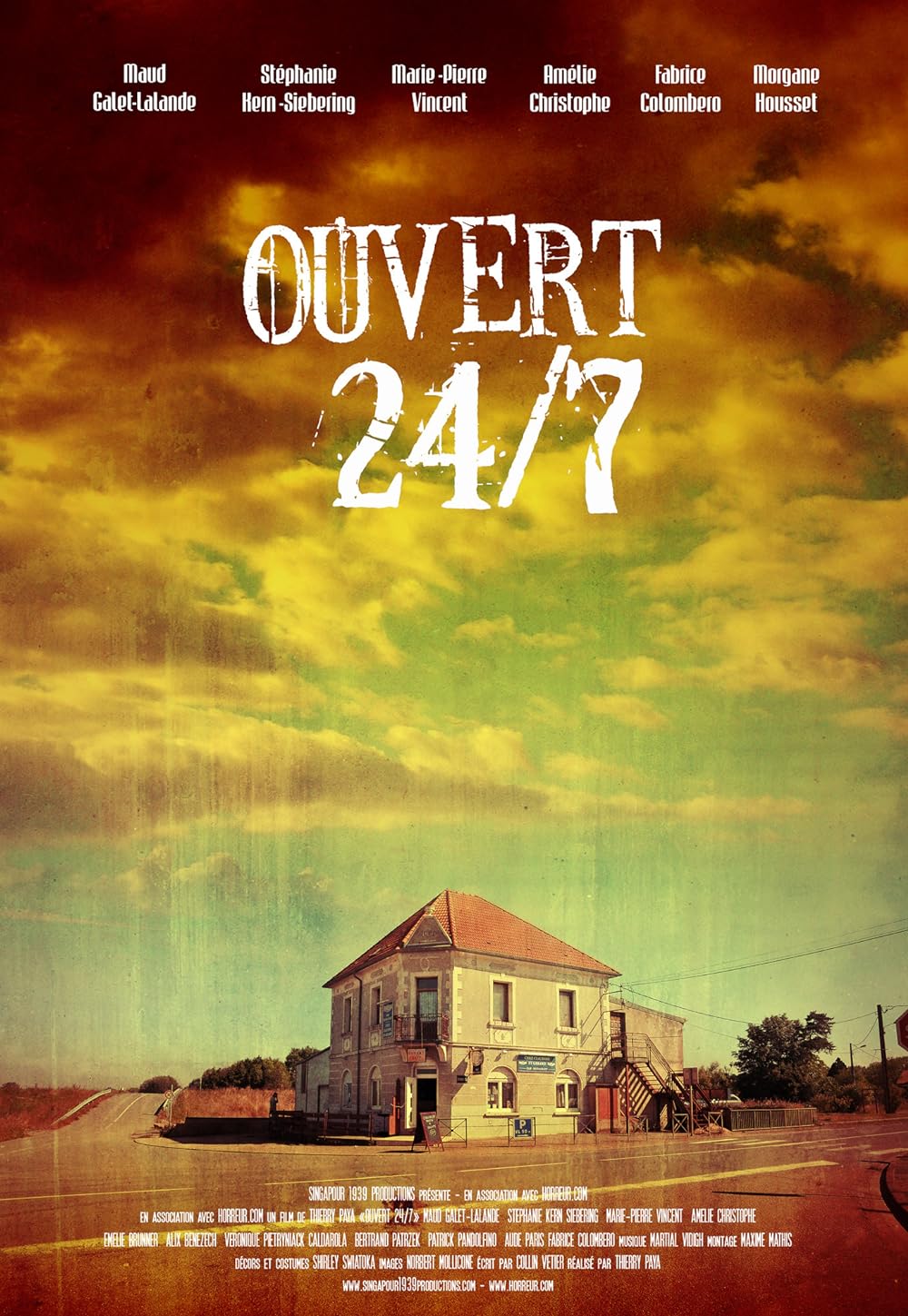
Honourable Mention: Ouvert 24/7


Despite its Troma release and the presence of Lloyd Kaufman in the film, this Thierry Paya directed film from 2010 has more in common with New Extremity from its native France than the normal fare from the Troma table.

It’s a portmanteau film with a wraparound based on a truck stop with the two customers and the waitress telling stories to pass the time. It starts with a truck pulling up and the trucker ordering a beer. When he starts to tell his story, he is accused of being a drunk, and admits to it – worrying given the large vehicle he pulled up in.

the trucker

The stories include one about a pair of cannibal lesbians (not the reason for the mention, though cannibalism and vampirism skate closely together), one about a child eating ogress (or so the credits suggest, listing Marie-Pierre Vincent in that role, though there is also a hint of the character being a witch), which draws in on numerous fairytales to inform its narrative, and one about sisters who violently escape their incestuous father to head to the city to see a musical star.

standoff

It is from the ogress’ story that we get the mention – I had seen the term vampirism used regarding the film but this is not accurate. The child-eater does primarily eat children (she can’t resist chowing on an adult at one point but can’t keep the flesh down). However, it is at her home when a cop (Bertrand Patrzek) shows up and demands an interview with her that we get the mention of vampires. In a standoff, on comfy sofas, she pulls a knife and he a crucifix and then splashes her with holy water, to no avail, accusing her of being a vampire. She isn’t and so he leaves (he only does vampires) – gunning down a grey faced visitor as he leaves (the neighbour) and suggesting the ogress stake her (though she doesn't as she has a crocodile to feed the cadaver to).

A mention in passing and a vampire hunter (and credited as such). The film is interesting, though I felt the stories lacked denouement. The imdb page is here.

On DVD @ Amazon US

On DVD @ Amazon UK

Monday, December 04, 2023

Use of Tropes: Alice in Terrorland


One book I have always adored is Lewis Carroll’s Alice's Adventures in Wonderland and, as I moved from childhood, I realised what a good vehicle it was to create a darker, adult hue. This is the case here, although I must say that I think the title of Richard John Taylor’s 2023 vehicle is awful and made me, at least, think that I was going to get a “The Asylum” level of film, rather than what we did get.

So Alice (Lizzy Willis) is a young lady who survives the fire that kills her parents. She spends a short time in the care system until her grandmother, Beth (Rula Lenska, SON of Nosferatu), is located and she is sent to Wonderland to stay with her. Wonderland is an old, decaying house, remote in the countryside, where Lewis Carroll had been said to have lived for a time and the family had changed the house name to Wonderland in honour of that. Alice, Beth tells her, was named for the book, although Alice and Beth had never met – her mother and grandmother were estranged.

Steve Wraith as the Rabbit

Alice develops a fever and Beth sits with her, reading from the book. She has a series of fever dreams based on Wonderland and the characters within, but the nightmarish dreams may be trying to warn her of something in the real world. They are filled with dark imagery as the characters from Wonderland come to life in her mind, for instance the Rabbit (Steve Wraith) is a mask wearing child killer, whose homicide is triggered by tardiness and the Walrus (Rikki Kimpton) is a carpenter who is also a cannibalistic serial killer.

the Red Queen

The vampire trope comes in around the Red Queen, who is represented in the dreams as Beth. The Red Queen, on a couple of occasions, reveals a maw of sharp teeth and we see her with her skin looking dead at one point. The appearance of the teeth, of course, reminds the viewer of certain constructions of the vampire image. Tied to this is the warning Alice receives that the Red Queen is grief and she feeds on it. They, then, are our tropes.

Beth and Alice

The film itself is an interesting psychological exploration of grief and instinct, Alice’s subconscious grasping the unheimlich and warning her of the danger it senses within the uncanny. The low budget is combatted by clever photography of the Gothic surrounds and the use of shadow and insinuation to hide within. The shame is that a bigger budget may have allowed the filmmakers to draw the Wonderland characters in a more complex way and draw some of the terror forth. The film rests on the performances of Lizzy Willis and Rula Lenska, both of whom do a sterling job.

The imdb page is here.

Tuesday, July 04, 2023

Use of Tropes: The Silence of the Hams


Released in 1994 and directed by Ezio Greggio, this was a spoof that aimed primarily at Silence of the Lambs but drew in other crime, thriller and horror films that included a good dose of Psycho. It isn’t a film that has particularly stood the test of time, to be fair it wasn’t that great on release. However it does have one recognisable riff on the vampire genre (though not a vampire) with a look that might actually be a trope in and of itself.

The film sees new FBI agent Jo Dee Foster (Billy Zane, Vlad, Surviving Evil & Bloodrayne) searching for help in solving a serial killer case by consulting incarcerated cannibal Dr. Animal Cannibal Pizza (Dom DeLuise, the Cannonball Run) – from here on referred to as ACP. The trope, incidentally, is not around riffing Hannibal Lector – though at some point I will have to look at the vampiric overtones of that character, which have been recognised by a couple of scholars.

Dr. Animal Cannibal Pizza 

However, the trope does involve ACP. Jo goes to see him once more and he rises (Nosferatu-like) in his cell (propelled by an elongated fart). ACP is wearing a red satin robe and his hair is stylised like Dracula’s in Dracula (1992) and as he speaks there is the borrowed dialogue “I have crossed oceans of time to find you…”. He then claims his parting is crooked as he can’t use a mirror. As he speaks he uses a foil electric razor, cuts himself and tastes the blood and that is that. It is interesting that the look (the cape and hair) are in and of themselves tropes.

The imdb page is here.

On VHS @ Amazon US

On DVD @ Amazon UK

Thursday, April 13, 2023

Cemetery of Lost Souls – review


Director: Rodrigo Aragão

Release date: 2020

Contains spoilers

The version of this Brazilian horror film, entitled O Cemitério das Almas Perdidas in the Portuguese, was somewhat different on Tubi as suggested on the IMDb page, which lists it as being 2hr 14mins as opposed to the streaming service's 1hr 34mins. Whether the timing is wrong on IMDb or whether 40-minutes have vanished is unknown. However, given the God-awful dubbing I really do want to see the Brazilian original release. Don’t get me wrong, however, as bad as the dubbing was (and it was) I still enjoyed this flick.

writing the grimoire

It starts with a blind monk, Cipriano, writing in a grimoire as a satanic choir sings and a demon whispers to the monk. A group of monks/knights approach the monastery. We then see them looking down on a man who seems to be being boiled in blood (presumably the satanic monk). The leader of the knights looks at the grimoire when a monk (Renato Chocair) comes to him with a jug and then slits his throat, blood spattering the book. We never get this monk’s true name as when asked he takes the original’s name and calls himself Cipriano.

incongruous

We then see him on the hold of a boat heading to the new colonies. The boat is in a storm and in trouble but Cipriano says that they need not die that day but they will need blood. One of the passengers comes behind another and slits his throat. Cipriano draws sigils on the inner hull in blood and speaks an incantation. He calls upon the demon to withdraw to Hell and take the storm with it, and the storm calms. They reach shore and, as they look up, they see a Gothic castle on a mountain top.

placing the coffin

As incongruous as the castle might seem, a slice of European Gothic in Brazil, it does transmit the nature of the film and is no more incongruous than a castle at the end of a pastel suburban scene in Edward Scissorhands. The film, however, flips to a sunny scene with a young boy running through a clearing, flying a kite. The kite becomes caught in a tree behind a cemetery gate. He climbs to pull it down and falls into the cemetery. He comes round and sees a parade of people carrying a coffin into the cemetery. They leave it just inside the gates – people emerge from the crypt and open it, dragging the bound, living occupant off. The boy passes out.

more like a haunt

He wakes in the clearing and a girl is there but the scene turns dark and he is surrounded by bodies. He wakes again and is in a water run-out in the cliffs above the sea. A long nailed hand comes from the dark and pushes him. He wakes again, an adult in a truck with other performers in their travelling show and we are in the present. The show might be described as a freak show but given the performers all wear costumes, it is actually more like a mobile haunt. They have their first show, after setting up, scaring the locals. However a woman and her cronies come along and accuse them as being in league with the devil. They fail to convince them otherwise and, before they can leave, they are captured – bar the ring master who is murdered – and taken in coffins to the cemetery.

Renato Chocair as Cipriano

Cutting back in time again we meet Aiyra (Allana Lopes), a young woman about to go through a rite with her tribe. She is rendered unconscious by the shaman when the Portuguese attack and slaughter her people. When she comes round in the bodies, Cipriano assumes she has returned from the dead and has her brought to the crypt below the castle. It is clear that he sexually abuses her and this does not sit well with the coloniser Joaquim (Caio Macedo) who teaches her Portuguese and then goes to a nearby (cannibal) tribe to arrange her rescue.

vampires

Trapped by the natives, a desperate Cipriano draws inverted crosses in blood on his companions heads and feeds them blood also. This turns them into (essentially) vampires – though, as we see them later, they look a bit more zombie, but they are essentially immortal and the blood regenerates them to their living form and even can make them younger. Joaquim steals the grimoire and uses the incantations to seal the gate and prevent them from passing through it. Cipriano grabs the book through the gate but Joaquim manages to rip essential pages out and the vampires are trapped behind the gate.

Aiyra turned

And that’s the story – a monk (it has been suggested Jesuit) who turns evil, uses black magic and becomes a vampire. Cipriano turns Aiyra also and the vampires have a deal with a nearby village that they will provide them with victims and in return they won’t lure and eat their children. The lore that ties them into vampirism, beyond the feeding on flesh and blood to remain young and their apparent immortality, is within their destruction. They avoid sunlight and one is left by the rest to burn in the sun.

feeding blood

I liked this. The story was a bit convoluted in places and the transitions between past and present weren’t overly smooth but it kept me entertained and interested despite the really bad dubbing. I can’t overly comment on acting because of said dubbing. There had clearly been a bit of budget blown on the film and it looks good in some parts. There’s quite a bit of splattered gore, especially later on, and the colonisers are really drawn as irredeemable (bar the honest Joaquim). I enjoyed this one and really want to see the original language version. 6 out of 10.

The imdb page is here.

Tuesday, August 02, 2022

Use of Tropes: Cannibal Apocalypse


There is no doubt that Italian director Antonio Margheriti knew his way around the vampire genre, but also that his vampire films (and those that played with tropes from the genre) were some of the stranger and more interesting entries into the genre.

The prosaically titled Cannibal Apocalypse, from 1980, certainly played with vampire tropes and flirted around the Venn diagram where vampires and zombies intersect. The story's narrative demands leaps of faith in places, but the film is certainly an interesting take though might have been a bit tauter when it comes to the horror aspect.

the soldiers

The film starts with stock footage of Vietnam, with American choppers in the sky. A troop led by Norman Hopper (John Saxon) are attacking a Viet Cong village and, after one soldier is killed by a dog with explosives at the collar, they go in heavy, machine guns and flame-throwers blazing. Some villagers run, others fight. In a pit they have two American soldiers prisoner.

Thompson bites Hopper

I didn’t get a sense as to whether this was a rescue or a coincidence (Hopper knows one of the men, Charlie Bukowski (Giovanni Lombardo Radice, City of the Living Dead & the Reverend), and describes himself as his commanding officer later). We see a woman run from the caves in flames, a victim of the flame thrower, and then she falls through the bamboo grating into the pit. Bukowski and the other prisoner, Tom Thompson (Tony King), turn onto her and start eating her flesh. The troops find them and Hopper leans into the pit. When Thompson spots him, he grabs for his arm and bites into his flesh.

John Saxon as Hopper

Hopper bolts awake at home, back in the States. He’s not had the nightmares for a while. When taking his meds, he looks into the fridge and becomes entranced by dripping meat – the camera, importantly, lingers on the blood rather than the meat. Wife, and local TV presenter, Jane (Elizabeth Turner) seems overly worried and the next day we see her pick up Doctor Phil Mendez (Ramiro Oliveros), whilst he’s jogging, to ask him about her concerns as Hopper hasn’t had the nightmares for some time. Mendez uses the opportunity to sleaze a bit (Jane had chosen Hopper over him) and gets a lift to the psychiatric hospital where he works and where Bukowski and Thompson are inmates. Bukowski is just leaving, his first pass out of hospital.

Cinzia De Carolis as Mary

As for Hopper he seems happy enough playing with a remote-control plane and then showing the young kid next door how it works. The kid’s teen sister, Mary (Cinzia De Carolis, Night of the Devils) comes over and asks if she can borrow Jane’s hair dryer. They go in the house and Mary fakes a thigh injury to sexually entice him. Saved by the bell, it seems, as the phone rings, Hopper answers and it is Bukowski. Importantly Hopper says he was thinking about him (and he had the dream, of course), which though subtle does suggest a (limited) psychic link. They talk about having a drink but Mary is messing with the hair dryer and Hopper changes his mind. Off the phone he approaches Mary and the approach is sexually charged. He lifts her jumper – the camera cuts as we hear her exclaim…

cinema attack

Bukowski walks through the town, getting in the way of bikers sexually harassing a couple of girls and then deciding to go to the cinema to watch a war picture (From Hell to Victory) – probably not the best choice for a Vet on day release from the psychiatric hospital. The film, however, does suggest that they have been home at least 6 years. A couple go in after him and start making out right in front of him. She is leaning over the chair and he reaches out to her and then leans in and takes a bite out of neck/shoulder.

Bukowski's siege

He's chased out of the cinema – at which point the bikers go after him also. The bikers smash a thrift market window and Bukowski goes in chased by a biker on his motorbike. In the market (which was closed) Bukowski finds a stall with guns (well it is America) and kills the biker and then a security guard who comes to investigate. Soon the market is surrounded by cops. Jane gets to hear about the incident through her TV job and phones Hopper as a Vet has gone mad (she really does doubt him) but he’s home and yet, knowing instantly it is Bukowski, he goes to intervene. As he gets in his car Mary comes across. No one has ever bitten her like that she says, and doesn't seem upset… he drives away.

Tony King as Thompson

Suffice it to say he talks Bukowski down but, on his way into a waiting ambulance, the Vet bites a cop’s hand. In the hospital Bukowski and Thompson conspire to bite a nurse, Helen (May Heatherly, Vampyres). The hospital has identified a virus – they liken it to rabies – however there is no rhyme or reason as to why the two prisoners displayed symptoms in Vietnam and then have been bite free until this day, why Hopper never seemed to “turn” until this day and why those bitten on the day are symptomatic and infectious in a matter of hours (the cop and Helen for instance, the girl in the cinema is essentially forgotten about).

feeding

The infected do seem to have a connection. Helen turns on her Doctor boyfriend (biting his tongue out) and then hurries to free the two from their restraints. Hopper might have loyalty to his men but that loyalty seems stretched (escape of a secure facility, stealing vehicles, fighting and killing bikers and cops). Talking of which, the bikers suddenly pitching up to attack them during their escape is a stretch, as is the cops getting hold of a flame-thrower! The infected do seem to be connected somehow, aware when another one is near and also, of course, they don’t attack each other.

turned cop

This is ultimately some form of cannibalism causing virus (they really want to munch on flesh) but the camera does linger on blood a couple of times as though that is the motivator and all flesh consumed is raw. The film more uses tropes from the vampire genre (though arguably vampirism is nothing more than cannibalism) and the zombie genre (especially them sat munching on flesh in a couple of shots that feels straight out of that genre). The  hinted sexual element, through Hopper and Mary, is more vampire than zombie. They are still thinking (though some are more rational and calculating than others) and, as mentioned, they seem connected. The horror, however, could have been ramped up, both in tension and in gore; for instance the cop is caught having attacked two other cops and munching (on what appears to be ripped off breast) flesh – the attack, unseen, could have been a cracking horror gore scene. As mentioned, there are some story leaps of faith. That said, this has something about it despite being less well known than some.

The imdb page is here.

On Blu-Ray @ Amazon US

On Blu-Ray @ Amazon UK

Sunday, July 03, 2022

The Sanctuary – review


Director: Allen Kool

Release date: 2019

Contains spoilers

So, I watched the film The Taste of Blood without realising that it followed this film (set some twenty years earlier). The sequel had plenty of narrative weaknesses. This part was narratively stronger due to it being, I think, simpler in premise. That is not to say it had a strong sense of narrative, nor that it didn’t have other weaknesses. However, I do think it held together better than the sequel – up to a point.

murder

The film starts with a campfire and a group of (mostly) kids telling scary stories – grandpa (James M Jenkinson) takes over the telling and the story he offers is this film. The start of his story talks about a couple, Wade (Dylen Michael Guiry) and his girlfriend. He sees she has a bloke’s card with a number on it – gets jealous and psychotic and kills her (the murder hidden behind a fade to black and then seeing her corpse in a bathtub). He is arrested – and apparently holding him amounts to cuffing him to a pipe (one assumes that the town was too small for more than a single holding cell, already full).

Dylen Michael Guiry as Wade

The Sheriff, Glen (Drew Riedstra), transports Wade and car thief Henry (Ed Robinson) to the Penitentiary but, out in the countryside something hits the windscreen and he crashes. Glen is killed and Wade manages to break out of the car and get Glen’s handcuff keys and gun. Henry asks for help, he knows where they can lay low but Wade breaks his neck. Now, Dylen Michael Guiry doesn’t seem too built and whilst his character is unhinged the ability to, cold, break another’s neck in one easy move seemed… implausible.

John-Riley O'Handley as Nate

By the time Glen is overdue and the transport found Wade has got far away, dunked himself accidentally in a river and there’s been a storm and so the cops have no idea where he is. Nate Fields (John-Riley O'Handley) is drafted in as temporary sheriff… Wade meanwhile has stumbled across a farm in the dark and ended up with a rifle pressed against his back. The owner is the elderly Harley Whalen (Rick Amsbury) but his wife Edna (Lawrene Denkers) tells Harley to put the gun down and brings Wade in to offer a hot bath and hot meal.

The Whalens

There are two issues here, one of the film’s making and one of my own. The film’s is that whilst the section of Wade ingratiating himself with the Whalens worked to a degree it was hamstrung by two things – firstly it was hard to buy Guiry’s performance – for instance his smiles whilst he had a rifle at his back struck more as sneers, he played overtly saccharine but had mini rages when not observed and one felt he just didn’t had the nuance needed – he needed a performance more like Sting's in Brimstone and treacle and didn’t have the chops for it. The other thing was there wasn’t enough atmosphere built by the director, making us fear for the old couple.

watching

The issue that was my own making was the (SPOILER) knowledge that the Whalens are cannibal killers, due to having watched the sequel first – but because they were drawn as doddering oldsters Wade never felt in peril (and we had no sympathy for him). What I had hoped was that the connection to (I’m guessing) Sawney Bean would be explicit – but no, just a mention of an old Scottish clan, destroyed with unspeakable things done to the men and the women burned alive. The film is also not explicit when it comes to the supernatural element – we see them younger and we see them eating meat (not explicitly stated as human) and no explicit connection between the two – though it is through cannibalism that they get physically younger.

Rick Amsbury as Harley

However, up to the point of Wade in the household the film does hold itself together better than the sequel. However, it has Nate go to the house (not see Wade and get fed a story about a visiting grandson) and a cliff-hanger around Wade and Harley and then cuts forward and concentrates on Nate – giving us backstory we don’t need for this character (in this film at least) and dragging the pace down to that of a snail. It has been months when he discovers that the Whalens never had grandchildren and goes out to see them again.

bloodied knife

Beyond this the makeup for the Whalens works, as it does in the sequel, and we spend more time with them (or so it feels) which is no bad thing as Amsbury and Denkers work well in their roles – though more tension would have helped that section of the film. I really want to give this the benefit of the doubt – the shying away from explicit violence meant that complex sfx were not necessary but also missed a beat for the horror fan, until the soap opera of Nate’s life the pace worked better and whilst there were filmmaking faux pas it did try and hold its own. Unfortunately Guiry wasn’t experienced enough to carry this, and it needed a strong primary villain (especially as the Whalen aspect was meant to be hidden for most of the film). 3.5 out of 10.

The imdb page is here.

On Demand @ Amazon US

On Demand @ Amazon UK

Saturday, June 25, 2022

The Taste of Blood – review


Director: Allen Kool

Release date: 2021

Contains spoilers


It is important, I think, for films to enunciate their story – not all films, some hinge on obscurity, or capturing a moment rather than narrative, but for the main it is a rule of thumb that’s rather important. This film doesn’t do that well – for instance we understand that the film centres on cannibals but only know that they are “cannibals in the 20th century, descendants from the an (sic) old Scottish family from the 16th century” via IMDb – the film doesn’t mention this.

meat

It might seem an unimportant detail but it is part of the story and other more important details are also lost. I assume that this ties the antagonists to the Sawney Bean legend – but I don’t know for sure. I might be doing the filmmakers a disservice as I discovered that this would seem to be a sequel (to a film called the Sanctuary, which features the same antagonists) but that is not clear and, whilst I’ll search that film out, I hadn’t seen it when I watched this.

Erica Sherwood as Janet

So, after an opening where we see reverend Janet (Erica Sherwood) imposed against the countryside (with a suggestion she is dead and the character does meet her end in film), in which she talks about evil, we see a man trekking through the snow. He is shot and then we see a figure dragging his body on a sledge. The film cuts a chapel, specifically the stained-glass window and blood trickling on it, as opening credits roll.

Nate and Dan

Nate (Timothy Paul McCarthy) is asleep and the sleep is disturbed, memories invading it. As I watched first time I didn’t know, but I now suspect the dreams are from the Sanctuary. Nate is a drunk PI, living in a mobile home and long since estranged from his law enforcement job. His friend Dan (Daryl Marks) comes to see him, he has solid work for him but Nate has spent 20 years obsessing about the Whalens, Harley (Rick Amsbury) and Edna (Lawrene Denkers) – cannibals who he is sure are still out there.

Lawrene Denkers as Edna

Dan suggests that they would be over 100 and likely dead but Nate is convinced that eating flesh makes them younger – which is how they escaped last time – and they are still out there. So, this is our vampiric aspect, eating flesh to gain/maintain youth. When we meet the pair we see they are now very old looking – the aging makeup, whilst clearly makeup, was rather well done. As the film progresses, we discover that Edna believes the flesh isn’t working anymore.

Hope and her doppelgänger

We discover they are living in a large house/hotel (closed currently) in Canada with a young woman called Hope (Amelia Phillips). Hope talks often to what might be a projection of a second personality or a twin (I suspect the former but the film didn’t make that clear). The other one doesn’t like the fact that Hope has found religion and, as the film progresses, a boyfriend, Jacob (Darius Rathe). Meanwhile Nate gets a lead on the Whalens and goes after them.

cgi fire

The filmmakers did do quite a bit with a low budget but some of the cgi they used just looked a bit false – I get it was a large building on fire and the budget will dictate the methodology used, but there was some blood/wounding effects that looked poor. I wanted the narrative to be a bit more explicit (as I mentioned at the start), I didn’t overly develop much empathy with Hope (the entire romance seemed just a little bit trite), nor with Nate… There wasn’t much of a horror element drawn with the Whalens, indeed there were moments with victims that we see little and then it felt that they were forgotten about – making the entire horror/gore side seem dodged.

crumble to dust

There is a supernatural element to their longevity and on death their bodies crumble (though the cgi effect wasn’t great). There are moments with Hope that seem to show her as immaterial, which seemed odd, and we do see eyes turn red. There isn’t much other lore communicated. I can see the effort that went into this but there were elements that just didn’t work for me – elements where I think lack of experience caused the filmmakers to either miss or gloss over, which might have ramped the horror, the tension or developed the characters. 4 out of 10.

The imdb page is here.