Showing posts with label fox spirit. Show all posts

Sunday, March 12, 2023

The 3-D Army – review


Director: Chen Chun-Liang

Release date: 1989

Contains spoilers

Although it isn’t titled as such, this could be classed as Hello Dracula 5. It does not follow the previous films but it does have kyonsi and Chin Tu (Magic of Spell) reprising his role of Grandpa Chin (sometimes subtitled as Grandpa Gold), along with his ward Tien Tien – who has become a young girl again. In this he seems to be responsible for two boys, Blackie and Dragonfly, whose background and status are not explained.

the race

The film starts with the kids racing, as part of a rite, in two teams. There are both the wards (plus another couple of kids) of Grandpa Chin and also a group of kids under the tutelage of Magician An (Huang Chung-Yu), including his son An An. The final race sees the teams riding the street on unicycles (with the ability to push and grapple, but not hurt) until reaching a small assault course of some netting and a climbing frame. The first to have a team member reach the flag at the top of the frame wins. It is Grandpa Chin’s kids who win, though An An accuses them of cheating and challenges them to meet him that night.

Tien Tien

The three main kids do enter the forest that night but before they get to the meeting point they hear what sounds like a girl crying. They find a cage, covered in spell scrolls, with a fox in it and so release the fox. They get to the meeting point and An An challenges them to fight (but not Tien Tien, who he has a crush on) and has 4 older fighters with him. They do fight and, eventually, An An comes off worse, his defeat helped by a young girl who fires fabric at him.

kyonsi

The girl is clearly a spirit but the kids don’t realise as they speak to her – her name is Mimi and later she admits to being the fox. Elsewhere Magician An goes to his master, a morally dubious sorcerer, and admits that he had captured the fox but someone released it. The sorcerer is not really bothered, he will get her eventually and is focused on getting hold of another magician called Hung Kun… who is already dead. Cut to a corpse herder (and Chin’s brother) who is taking 7 corpses to the mortuary. One is chained with bells as well as having a spell scroll, he is Hung Kun and is so powerful that they need the extra resource to control him.

the little vampire skimming 

To avenge An An for his beating in the forest, one of Magician An’s household steals one of the corpses from the mortuary, so as to make Grandpa Chin look bad. Of course, he choses Hung Kun and the kyonsi gets out of control and kills. The kids try to cover up the vampire being missing, so they can retrieve it, but it is eventually discovered. A remorseful An An admits it was down to him. Following this An An and the other kids hang out together. Mimi also makes herself known to the kids and she has a little vampire friend who she also introduces them to. However the sorcerer still wants Mimi, Hung Kun and, when he finds out about him, the little vampire. He captures them in a spirit house, eventually, and it’s down to the kids to rescue them, and An An being in danger also puts Magician An onto a redemption arc.

Hing Kun

This suffered from not backgrounding the characters well. Of course those who know the series will recognise the general strokes and the main characters but, especially as this is not listed as part of the series, it needed more character exposition. The spirit house section pushes the film further into strange – the ghost kids are not utilised in this but the sorcerer has constructed life-sized dolls that come alive and fight and these are kind of the equivalent (but villainous). The kyonsi has the additional power of being able to become invisible – it takes child urine or black dog’s blood to force him to become visible (and the urine damages him). Otherwise it is fairly standard lore. 4 out of 10.

The imdb page is here.

Tuesday, March 09, 2021

Honourable mention: Lovecraft Country – season 1


Lovecraft Country Season 1 aired in 2020 and was notable for creating a supernatural show based (very loosely) on Lovecraftian lore but with a primarily black cast – certainly with regards the protagonists in the series. It also included a science fiction/time travel element, along with a multiverse aspect, and drew in world folklore.

As I started to watch I noted a few moments that touched on vampires and I really do mean touch. However later in the series there is an episode (and a character who later recurs) who is most definitely an energy vampire. On balance, however, I decided that the appearances are light in the season and therefore I’d keep to an honourable mention.

War of the Worlds moment

The first vampire reference might be missed – indeed it is a matter of obscure classification. We see a soldier, Tic (Jonathan Majors), in the trenches. The scene is black and white as we begin and moves to colour as a voice-over narrates. But what was a very earthly conflict takes on a new form when we see flying saucers and the tripods of War of the Worlds. And this is our first vampiric moment as, in the novel of War of the Worlds, one can interpret the Martians as alien vampires, feeding on the blood of humanity. All this is a dream as Tic (short for Atticus) rides a segregated bus back to Chicago.

Jonathan Majors as Tic

Tic is a Korean War veteran, who joined the army to get away from his father, Montrose (Michael Kenneth Williams). Back in Chicago his father is missing but a letter talks about his heritage and a place called Ardham. His Uncle George (Courtney B. Vance) writes a travel guide for African Americans and agrees to take him (as he researches for the guide) and a childhood friend Leti (Jurnee Smollett) goes with. After escaping a racist attack they end up being walked into woods by a racist sheriff (Jamie Harris, Blood Ransom) and his men. They are saved when creatures attack the cops.

a shoggoth

Earlier Tic has described Shoggoth to Leti and with the multiple eyes these were, I am guessing, a take on Shoggoth. They are also our next vampiric moment. They discover that they are afraid of light – like vampires, George concludes. When one of the cops is bitten he quickly turns into one – again the dialogue states like vampires, and in both cases certainly a knowing use of genre tropes. Having escaped the cops (and the shoggoth) they discover that Tic is being manipulated by an occult society the Sons of Adam. The founder, Titus (Michael Rose), impregnated one of his slaves (the implication being through rape) and Tic is a direct descendent making him, and his blood, special. The next casual vampire reference was discovering that Uncle George’s favourite book is Dracula - interestingly Montrose’s favourite book is the Count of Monte Cristo, which mentions vampires also. I should also mention the racist (and occultist) police captain (Mac Brandt) who had literally stolen black bodies to fix his own injuries, his torso a Frankenstinean patchwork built with the body of a victim.

using the tails to feed

However, Tic was in Korea and the episode "Meet Me in Daegu" is a flashback to his time there and also the story of Ji-Ah (Jamie Chung). Ji-Ah’s mother married her step-father and discovered he was sexually abusing her. To stop him she went to a shaman and she invoked a kumiho – the Korean version of a nine-tail fox – which possessed the daughter. She has been told that if the kumiho takes 100 victims then it will leave the body and Ji-Ah (the human soul) will be restored. Ji-Ah seduces and sleeps with men (the step-father being the first) and during this her nine tails emerge (from various areas of her body, including her eyes) and she devours the man’s soul, taking their memories (she remembers none of Ji-Ah’s past pre-possession). She works as a nurse and Tic originally is to be her 100th victim, as he was part of a squad who killed two nurses whilst looking for a communist spy and then took her best friend (the spy). However, she falls in love with him and tries to fight her nature and this, to me, was one of the strongest episodes of the season.

Jurnee Smollett as Leti

I really rather enjoyed this series. If it had a fault it was that they threw everything in and some of the ideas are under-explored as a result. I have seen criticism of its portrayals of the white characters, most of whom are drawn as racist. However, if you think this went too far then please, stow your privilege. Firstly, this is from a black point of view during the Jim Crow era - from segregation and racially motivated hostility, through to the fearful reactions when the police arrived it screamed authenticity, and the description of the white characters might be uncomfortable for some but will certainly capture the zeitgeist of that era of American history. The Freeman family, specifically, were impacted (in Montrose and George’s childhood) by the Tulsa Massacre and Chicago is shown during Emmett Till's funeral. Again I have read criticism of using those real-life events but to my mind it is important that they are talked about and they add a context to a show where the way humans treat each other make them more monstrous than any eldritch terror.

The imdb page is here.

Friday, March 23, 2018

Guardians of the Night – review

Director: Emilis Velyvis

Release date: 2016

Contains spoilers

I’m going to say it from the get go, this owes such a debt to Night Watch its untrue – though it doesn’t have the grim atmosphere, lyricism or set pieces of the older film – coupled with a lashing of Men in Black (and actually name checks that film/urban legend).

However the vampirism of the Night Watch series can be secondary, whereas these vampires (or, not vampires) take centre stage (and are the bad guys). I say “not vampires” because vampires are dismissed as a product of Hollywood and these are referred to as ghouls… but a rose by any other name…

Ivan Yankovskiy as pasha
So we start with a stairway, the camera work is disorientating, a woman (Lyubov Aksyonova) is bundled up the stairs though we only see a distinctive tattoo on the back of her neck and not her features. A young man, Pasha (Ivan Yankovskiy), follows her. He reaches the roof of the building, he bleeds from the nose and his hands are cut and bloodied. He takes a run off the roof… And awakens screaming. His mother (Ekaterina Volkova) asks if it was the flying dream again.

the tattoo
Pasha is a delivery man and travels Moscow delivering parcels. He notices posters for a Lithuanian singer called Dana – the posters have her facing away from camera and she bears the same tattoo from the dream. He is delivering his last package at the Hilton, a programme on TV mentions Dana is missing and a girl checks in – he notices the tattoo. He asks the concierge for her room number, the concierge gives it whilst also reaching out for the reward offered for information about her.

out of the coffin
A crate is carried into a room and inside it is a coffin. As Stefa (Sabina Akhmedova) fills a glass with blood the chain is removed from the coffin and a desiccated looking corpse stirs. The mummified corpse, Yankul ( Mikhail Evlanov), ignores the blood and leaps after a dove. The bird’s blood is enough to make him appear young again. Meanwhile Pasha is looking to get in to see Dana and Yankul and Stefa have been contacted by the concierge. Stefa stalks on the outside of the building, whilst Yankul and a warrior named Mikhal (Aleksey Dmitriev) head for the room, swatting Pasha out of the way.

guardians
They are in the process of taking Dana when humans arrive and engage them. The ghouls show ‘vamp face’ and fight back. Pasha and Dana head to the roof, pursued by Mikhal. Dana calls Pasha a warrior and wants to jump from the building roof – something he is understandably reluctant to do. Suddenly he is tussling with Mikhal and accidentally stakes him with a table leg. Dana escapes and an incredulous Pasha meets Gamayun (Leonid Yarmolnik) who leads “D” division – a government agency whose purpose is to control demons. The creatures we have met are ghouls and the humans are wipping memories with a herbal spray. Eventually it is used on Pasha but he seems to remember and ends up being recruited by D division as a frontiersman – someone sensitive to “alternative life forms”.

killed
So – the ghouls produce fangs and have vamp face, turn to ashen skeletons if staked/have their heart destroyed, are burned by sunlight and by garlic. They are fast and strong and appear to be another species rather than undead (for the main). They can be tasered effectively. Dana is the heir to one of two ghoul families and, according to prophecy, if a ghoul unites with her during the eclipse (due in two days) then they will get ultimate power and overturn the peace with humanity – she is trying to escape that.

Anastasiya Tsoy as the fox spirit
We do get other creatures – most notably a friendly fox spirit (Anastasiya Tsoy) – but the film itself is a workable adventure, slightly derivative of other things and a little by the numbers (in events and reactions) but absolutely watchable. A nice little bit of Russian urban fantasy that perhaps needed a little more grit but has some nice bloody scenes occasionally (the attack of ghouls across the city worked rather well). Some of the effects worked better than others. 6 out of 10.

The imdb page is here.

Sunday, February 07, 2016

The Vampire Count of Monte Cristo – review

Authors: Alexandre Dumas & Matthew Baugh

First published: 2013

Contains spoilers

The Blurb: 1815 – Marseille. Edmond Dantes is young, in love with the beautiful Mercedes, and has just been named the captain of the merchant vessel, Pharaon. It seems as if there is nothing but happiness and prosperity in the young man's future. Unfortunately, Edmond's success has brought jealous enemies. Danglars wants his career and Fernand wants his fiancée. The two conspire against Edmond and frame him for treason.

He is brought before Prosecutor deVillefort, who recognizes his innocence. Unfortunately, the Prosecutor is a man with his own secrets and he fears that freeing Edmond could bring them to light. He convicts Edmond and has him imprisoned in a dungeon from which no man has ever escaped.

1830 - The Château d'If. After fifteen years in his tiny cell, Edmond nearly loses his sanity. Then he meets a fellow prisoner, the brilliant scholar and mystic Abbé Faria. The two become close and Faria teaches Edmond languages, science, philosophy, and sorcery. Using his occult skills of divination he reveals the conspiracy. Faria hopes the revelation will give Edmond a sense of peace but instead it fires his desire for vengeance. When Faria falls ill and dies, Edmond breaks his promise to his friend and turns to the darkest form of magic.

He makes a pact with an unspeakable entity to help him escape and give him the power to destroy his enemies. Edmond Dantes dies in the Château d'If and is reborn as a vampire, an undead creature who hungers for revenge as much as he thirsts for blood.

1838 – Paris. The wealthy and mysterious Count of Monte Cristo arrives in Paris. He is an eccentric who is never seen eating or drinking and refuses to venture out in the daylight. Rumors abound that the Count is a vampire, but this only adds to the charismatic stranger's mystique. He becomes the center of Parisian society, seducing the entire city with his charm… including all of Edmond Dantes' enemies.

Things have changed in the years since Edmond was framed and his enemies have prospered. Danglers is now a banker and one of the richest men on the continent; deVillefort is the highest legal official in France; worst of all, Fernand--now a general and a war hero--is married to Mercedes. The Count plays a dangerous game, turning his dark arts to the destruction of these powerful men, and even their innocent children are caught up in his byzantine schemes. Will the innocent perish along with the guilty? And what of Edmond Dantes? Will he find redemption, or will he be swept up and destroyed by the very forces he has invoked?

The review: I’ve not read too many literary mash-ups, where the original classic is taken and changed, modernised or made horror or sci-fi. The Count of Monte Cristo was, on reflection, an obvious candidate for such a treatment however. We actually looked at the original story here as Dumas had the Count likened to a vampire – even Ruthven himself. The scene I relayed doesn’t actually happen in this retelling as Dumas wrote it, rather the conversation is referred to.

As for the mash-up author, Matthew Baugh, I had come across his work before in the forms of submissions for The Vampire Almanac Vol 1 and Vol 2 and so he was remarkably qualified to take the original work and re-work it in such a way that it is seamless in the telling. Unlike many mash-ups there was a choice to make the story serious, rather than add a comedic element, and this was an excellent decision.

The vampirism – in this case – is satanic in origin, due to the summoning of Zathael the Angel of vengeance who just so happened to be Satan before he fell. As a vampire, Monte Cristo is undead and able to pass his curse on. He develops, through Alchemy, a pill that helps stave off the blood lust and if he shares his blood he makes a connection with the mortal and puts them in thrall to him. Sunlight weakens him considerably and whilst a wound from a bullet or sword would neither bleed nor hurt him, if silver is involved it will cause damage.

We do get other supernatural creatures mentioned. Cristo’s servant Ali is said to be ridden by the orisha Ogoun. The Count relays, in passing, having met a fox spirit, werewolves and “the loathsome undead of Haiti”. As for vampires the Count suggests “There are as many species of vampire as there are beasts of prey.

This was great fun and a compelling read. Highly recommended 8.5 out of 10.

Wednesday, February 05, 2014

A Chinese Ghost Story (2011) – review

Director: Wilson Yip

Release date: 2011

Contains spoilers

I find myself in debt to Leila again as she informed me of the release of this remake of the classic 1987 film A Chinese Ghost Story. The film itself I found on YouTube with English subs but, as I looked into it, I saw a lot of (almost inevitable) negativity aimed towards this remake of the original film.

This, of course, ignores the fact that the 1987 film is itself a remake of the Shaw Brother’s 1960 movie Enchanting Shadow. As for the vampire nature of the films, Enchanting Shadow most definitely had a vampiric element. It is more difficult to say with the 1987 film and we had a poll that decided the film was properly a TMtV Honourable Mention. As for this version there is definite energy vampirism and several tropes that correlate with Western media based vampirism.

Louis Koo as Yin Chek Ha
The actual start of the film gives a prologue that is very different to the other two films. It follows the Taoist swordsman character present in all three films, Yin Chek Ha (Louis Koo), when he was a younger man. It sees him hunting a demon (or ghost, but the subtitles call them demons), Siu Sin (Yifei Liu). In the sequence that is (to be fair) a little confused, we do see her leap on him and apparently go to bite the neck. It doesn’t happen, however, and the two fall in love. For reasons under-explored he decides that demons and humans cannot be together and causes her to lose her memories of him. This is caused, we later discover, by use of his “mighty weapon” (which could lead to all sorts of schoolboy jokes). When he goes to help his brethren defeat the tree demon Lou Lou (Kara Hui) he does not have that weapon and she is injured, banished but not destroyed, also two demon hunters die and another, Thunder (Siu-Wong Fan), loses an arm and kicks Yin Chek Ha out of the order.

Shaoqun Yu as Ning Choi San 
As the film starts proper it follows Ning Choi San (Shaoqun Yu) and, in homage to the 1987 film the same theme music plays. However Ning Choi San is an engineer sent to relieve the Black Mountain Village who have no water (rather than be a tax collector). He is captured by villagers (who refuse to listen to his story) and is about to have his hands cut off for stealing water when one of the villagers, Ti Nga (Jing Li), finds his imperial seal. Ti Nga is sent with him to the mountain along with workmen – who are actually all murderers shackled together, this job is their chance at redemption and pardon – as the villagers fear demons. There is a moment with him and a white fox (and candy) that may be something to do with Siu Sin but then the weather turns bad and they shelter in nearby Lan York Tze temple.

fox
The reason I mention the fox is because we see in the prologue that Sui Sin loves candy, she doesn’t immediately attack Ning Choi San (although she also later says he doesn’t have the smell that corrupt men have) and at the finale he finds her body in the form of the fox. This confuses her with the fox spirit to some degree and may explain why she later shows fangs and elliptical pupils. Back to the film and Ning Choi San is looking at a deep pool of water surrounding a tree as the convicts are seduced by women. This seduction leads to the women sucking the lifeforce out of the convicts. Sui Sin, meanwhile, is trying to seduce (half-heartedly I felt) Ning Choi San.

energy vampirism
Ti Nga is nearly got by a demon when Yin Chek Ha comes to the rescue. In this scene he despatches most of the demons bar two (snake spirits) and Sui Sin. When we see one of the demons die it sort of dusts and we see a rather bat like outline in the effect. Ning Choi San sees him kill one and takes it as a murder and thus runs with Sui Sin, trying to protect her. Of course any pursuit he offers is limited as he still loves Sui Sin and the love triangle detracts from the storyline when compared to the very simple love story portrayed in the other two versions of the tale. It also makes Yin Chek Ha much more of a primary character.

show fangs
Other vampire-like moments, then, take the form of the fact that the demons are not sucking life energy for themselves but for Lou Lou. This is to help heal her and break the banishment but she does repeatedly say that she is hungry in reference to the energy. Lou Lou later threatens to rip a heart out and drink the blood. I mentioned the fangs that Sui Sin shows, she also threatens to bite someone. As you can see there are tropes used that are familiar but the most telling factor is the sucking of energy, via a seduction, that is then used to feed the central enemy.

Kara Hui as Lou Lou
The film itself is not bad but not a patch on the two predecessor films. They took it in an unusual direction with the love triangle but it distracted more than enhanced. Ning Choi San doesn’t have the air of the innocent/fool archetype that the character had in the previous versions, partly an acting issue and partly because the film couldn’t concentrate on him as much (he just vanishes off from time to time) and the film feels a tad disjointed because of it. The final confrontation is spectacular, however.

All in all 5 out of 10. The imdb page is here.

Thursday, April 14, 2011

Labyrinth of Death – review

Director: Ricky Lau

Release date: 1988

Contains spoilers

Another film from the prolific Ricky Lau and, I am afraid to say, one at the weaker end of the films he has directed.

It begins with soldiers on the Great Wall. A holy man appears and uses a crystal sceptre to make a child kyonsi appear. He says he will use it to control others. A horde of kyonsi attack and, after a brief moment of making explosions hit the soldiers, are defeated by the holy man’s acolytes. He assumes he has won when the child kyonsi’s parents appear.

mother kyonsi
They are fighting back hard and, eventually, the holy man himself has to get involved. He is about to strike them down but is prevented by a woman (a God form it appears) who suggests that he should show mercy as the kyonsi have the chance to meet Buddhism. She takes the kyonsi away.

evil king
The evil king, who has long white hair and fangs, along with his minions attack a procession and steal away a princess. Her veil is lifted and, to his dismay, she is ugly. After a moment’s thought he decides waste not, want not but is suddenly attacked by the female god-form. She defeats him and imprisons him. She places a mystical sword in his heart that will kill him if he commits evil and sentences him to 1000 years of imprisonment. A mystical connection is set up with the kyonsi to draw away his badness over the 1000 years.

grandfather
700 years later and a young girl helps her grandfather, a corpse herder who prefers to play majong. He takes the latest set of corpses onto the road but a storm builds up and he hides in the cave – round about the time that the child kyonsi has awakened and slipped out of his coffin. The grandfather sees a gem and goes to steal it – releasing the evil king. Evil King takes over the grandfather’s mind and sends him out to do his bidding.

I am evil
First of all he attacks his own granddaughter, who has found a mystical pearl. Eventually the tale becomes a backwards and forwards of the king trying to get the pearl and the child kyonsi (whom he believes can release the sword from his heart). Certain characters are taken over and then freed and there is a lot of wire-fu, bad effects, strange makeup and (at the end) rubber suits. The evil king’s dilemma (of having the sword in his heart) doesn’t seem to prevent him from committing acts of evil most of the time (occasionally he indicates a heartburn effect) and he is certainly not prevented from ordering others to do evil.

The kyonsi parents are raised up to protect their child – though the father does get taken over at one point.

speared crap bat
The narrative of this let it down. We don’t know who certain characters are, what their motivations might be etc. They may well be staples of Chinese culture so, from that perspective, I am probably doing them a disservice. For instance, three baddies come along and I had no idea who they were until they died – and took animal form. One was a fox spirit but another was speared and transformed into a crap bat – not related to vampirism but crap nonetheless.

All in all there are much better kyonsi films, much better Chinese fables and much better wire fu films. 3 out of 10 as it was strangely hypnotic. The imdb page is here.

Thursday, September 16, 2010

Vampire Princess Miyu (OAV) – review

Director: Hirano Toshihiro

Release date: 1988

Contains spoilers

OAV stands for original animation video and, unlike the western ‘direct-to-video’, OAV was not a pejorative but a necessity to fill the demand for animation (especially pre cable and satellite). Vampire Princess Miyu has therefore had two animated incarnations. A TV series from 1997 (which I have on DVD and so will review at some point) and this OAV 4 episode series – which is over 2 DVDs nowadays.

Probably the first thing I noticed in Miyu – and this is also the case in the series produced a decade later – was that the animation had aged. It was clearly of a time. That is not to say it was bad just old looking. Perhaps, however, in this case that added something to the atmosphere generated.

Each episode of the animation was based in a season, starting with summer and moving round in order, and concerned Miyu (Watanabe Naoko) the vampire princess of the title who hides amongst humanity as a schoolgirl (though her presence at the school only really comes into one episode). However, unlike the later series, Miyu was not necessarily the key protagonist.

Miyu and Himiko
That honour fell to Se Himiko (Koyama Mami), a spiritualist who is called to Kyoto, in the first episode, as a consultant for a girl who has fallen into an endless sleep. She, at first, suspects that the girl is possessed by a fox spirit. However it is a shinma that has possessed her. The shinma were both Gods and demons (the name coming from combining the kanji for God with that for demon). Shinma had retreated into the dark some time ago and it is Miyu’s job to send them back to the dark should they stray into the human world.

blood at mouth
The vampires were the one bloodline of shinma who did not retreat into the darkness, remaining as guardians. As a gift for remaining their restrictions were lifted – in other words they can walk in daylight and religious artefacts do not harm them. They are not, however, immortal – or at least pure vampires such as Miyu are not. They can turn humans (and do need blood to survive). Miyu’s mother was shinma her father was human turned. Human vampires can live for eternity but by losing death they also lose drive and motivation, as it were.

larva
In the first episode there does appear to be a vampire on the loose – draining girls of blood unto death. Miyu, however believes it to be a pale imitation (indeed it is a manifestation of another type of shinma). Miyu is helped by her servant Larva (Shiozawa Emi), a shinma from a bloodline that did not retreat into the dark but escaped over the ocean. His features are hidden by a mask sealed to his face.

small bite marks
There is a greyness to Miyu’s morality. She protects humans and yet feeds from them (she is drawn to the most beautiful of men and women). Not all those she feeds on would become vampires. A young man she bites is described later as “living in happiness” he may still walk around but his mind has retreated to another place – possibly the dreamlike world Miyu can transport people to. Some who are bitten grow and live normally until their blood awakens and they become vampires.

just damned creepy
There is almost a languid pace to Miyu but it is more than made up for in the atmosphere. The first couple of episodes establish the relationship between Miyu and Himiko and the other two offer more background to Miyu herself. I couldn’t help but feel, however, a little short changed – as though there was more story that needed to be told. Of course, further story was recorded 9 years later.

Still, a reasonably satisfying little anime 6 out of 10.

The imdb page is here.


Saturday, June 13, 2009

Vamp or Not? The Sacred Book of the Werewolf


The Blurb: “A Hu-Li is beautiful, slender and curiously foxlike. She lives in Moscow and works as a classy prostitute in the city’s premier hotels. But when a client goes inexplicably and fatally berserk at the sight of her in his luxury suite, A Hu-Li has to leave in a hurry. She decides to explore new avenues and place an ad on the internet – and that’s when her troubles really start.

Vamp or Not? The Sacred Book of the Werewolf by Victor Pelevin is a novel of Russian origin, excellently translated by Andrew Bromfield. To go into the story seems almost unfair on the book: it is a supernatural romance, on one level at least, it has overtones of Nabokov (A Hu-Li might be of ancient age but looks mid-teen) and Kundera (with its heady mix of base sex with existentialist exploration). It seeks to look for spiritual truth and yet manages to be a searing satire of the political fall into neo-liberalism.

A Hu-Li is a fox-spirit, an eternal (or at least long lived) being from Chinese mythology and it is her nature that brings this into the realm of ‘Vamp or Not?’ When mentioning this to a friend, Leila, she pointed out that there are certain similarities between the fox-spirit and the Western succubus and indeed trickster. Fox-spirit in this certainly embodies trickster (she is told she smells of “Deception. But not a wily kind of deception, more as if you’re having a joke”) but it is the succubian aspects that brings this onto the vamp radar.

There are essential similarities between the succubus and the vampire – especially the psychic vampire. The big difference is that the succubus may feed on energy during the sexual act but she is also a demon – in a Western Christian mythic sense. A Hu-Li is not a demon in that sense but she does feed on life energy and uses the sexual act in which to do so – kind of. I say kind of, as she uses her tail to induce a hypnotic state for the man, where he thinks he is having sex (she might read a book during this) and she feeds off the resultant life energy that builds during the act. She also allows the feeding to move through its cyclic state and some of her life energy to pass back – for the sake of karma. A resultant death tends to be an accident and is more likely to occur if the man ‘slips off the tail’ – or somehow escapes his hypnotic state and sees the truth. In the story this occurs, near the beginning, and the death is a suicide.

Even though there is a feeding off life energy, I am not convinced that we can equate her to the vampire. She cannot create another of her own kind – they are descended from a heavenly stone – and says herself “Is this vampirism? I’m not sure it is. We simply pick up what the irrational human being carelessly discards.”

There is a werewolf in this, with whom she falls in love (though werewolf in the title of the book is used as an overall name for all were-creatures). Through this there is a nice twist on the silver myth. It is were-creatures that put out the 'truth' regarding the devastating effect of silver bullets. In reality the silver would prevent the wound from festering and, given the cost, less bullets would likely be fired meaning a lower chance of a fatal shot.

This is an astounding piece of literature. Not vamp but worth reading. Thanks to Ian who lent the book to me.

Sunday, November 30, 2008

Vamp or Not? Painted Skin


I do like a bit of Chinese cinema and given that this 2008 Gordon Chan directed movie was a luscious looking film of epic proportions and supernatural in basis I would surely have gone out of my way to see it. However, blog matters first of all. When I saw the imdb synopsis “an action-thriller centered on a vampire-like woman who eats the skins and hearts of her lovers” then the film just had to be investigated. Is it Vamp… not really, but let’s see.

Out in the desert a General, Wang Sheng (Kun Chen), leads his men on a raid against bandits. In the main hut in the bandit village the leader has a girl, Xiao Wei (Xun Zhuo), all in furs (the fact they are white is significant). Before the raiders get to him it is obvious he has been killed by means unseen by the viewer due to camera angle. Wang rescues her and takes her back to the city. He tells his wife, Pei Rong (Wei Zhao), that Xiao Wei’s parents are dead.


The guards are out in force and there is a banging at the city door. A body lies outside the gates, presumably in a stupor, and is taken to Sheng’s home. It is Yong (Donnie Yeng) and in flashback we see that he was a general with phenomenal martial skills. However he did not wish to lead the men (plus Pei Rong chose, romantically, Shang over him) and left his commission to travel. Once he comes around he leaves the house.


He goes to a restaurant where he meets Xia Bing (Betty Sun), a toy-boyish young woman. Pei Rong finds him and tells him that she fears that Xiao Wei is a demon. She seems to be able to charm people, Pei Rong accidentally cut her and she miraculously healed and a Taoist warned Pei Rong of the other woman’s nature and then immediately died. He was missing his heart and since Xaio Wei arrived there have been several murders were the hearts have been removed. Pei Rong begs Yong for his help.


The culprit is a chameleon demon, Xiao Yi (Qi Yuwu), who is taking the hearts. He is in love with Xiao Wei and knows that she needs to eat human hearts in order that her skin will not rot. For her part Xiao Wei is in love with Sheng and wants to be his new wife usurping the household. Indeed this film is less a horror or action movie, it is a romance that investigates several types of love through supernatural metaphor. Xiao Wei is a fox spirit.


Now we have come across fox spirits before. They have appeared in Mr Vampire 4 , for instance, where a Taoist was attacked by one who used seduction to undermine him. She was not, however, one of the kyonsi that primarily featured in the movie. The vampire in Amazing Stories was more western typed but the fox spirit in that actively attacked the vampire and defended the hero. There is, however, nothing to connect fox spirits with vampires per se. They are vamps, in one sense of the word, but not bloodsuckers.


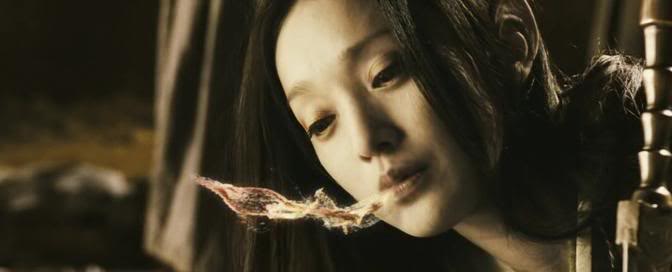
The reason this is called Painted Skin is due to the fact that the spirit can remove her skin to paint it, thus hiding any demon marks one assumes, and below the skin is an approximation of a human form made up of worms that crawl and squirm – it was a wonderful effect. Xiao Yi can become invisible, he is a chameleon after all, but sunlight will cause him to cast a shadow. He has a long lizard like tongue.


Xia Bing is a demon hunter by familial trade and her Grandfather had actually taken fox spirit’s tail. She and Yong hunt the demons but things become sticky when Yong is framed for murder. Following this Xiao Wei reveals herself to Pei Rong and then manipulates her into drinking a demon poison that makes her white (and causes her to cry blood tears) and then she has to falsely confess that she was really the demon.


In the cumulative battle Xia Bing reveals that her family’s blood on a blade (as demon busters) can injure demons where a normal sword might not. This was reminiscent of the lore that appeared in the OAV anime Blood: the last vampire and the subsequent series Blood+ and yet I do not think that this adds to the argument that this could be vampire as the lore in the Blood animes is so obscure.


For instance, whilst this works, there is also a magic blade that Xia Bing finally gets to unsheathe during the battle – her own anger and hatred had prevented this before – and subsequently wield. Only she can use it, so it is much like her own blood being useful against the demons, though this leads to some nice disintegration and reintegration (of the blade) effects when it is passed to Yong and subsequently returned to Xia Bing.


All in all I think there was a liberal use of the word vampire in the synopsis I quoted as there is nothing remotely vampiric about this film. It is, however, a rich, evocative movie that I thoroughly enjoyed. Not Vamp.

The imdb page is here.