Director: George A Romero
Release date: 1976
Contains spoilers
It is fitting that Romero, the Big Daddy of the zombie genre, made a vampire film. It is also fitting that said film is one of the better flicks that the genre has to offer. It takes the vampire genre and plays with it, it is in homage and yet deconstructs it and – like all the best Romero films – there is a deeper social message within, this time concerning faith.
I will say however that, whilst this isn’t that well known a film I fully intend to spoil the ending. You have been warned.
The film begins with a journey. Martin Madahas (John Amplas) travels on a train. Of course one of the most famous vampire stories begins with a train journey as well, I refer to
Dracula. Am I reading too much in; giving too much credit to Romero? Dracula’s second paragraph begins,
“The impression I had was that we were leaving the West and entering the East”. The train Martin is on is heading for Pittsburgh and then to New York, later we here that he has travelled from Indianapolis. He has travelled West to East, it might be coincidence but it is a rather nice one. Martin, however, is no Jonathon Harker.
As he boards he spots a woman (Francine Middleton) who travels alone to New York. That night he leaves his carriage and having edged passed a sleeper (the hand from the curtained cubicle is kind of reminiscent of the hand of a corpse) goes to the toilet and prepares a needle with some type of drug. He goes to the woman’s carriage and listens in before picking the lock. We see, for a moment, a black and white shot of the woman welcoming him – this seems to be a running fantasy/memory and I’ll discuss this later. When he enters the room is empty – she in the toilet.

As she emerges she is wearing a facial mask. Two things to note, firstly it makes her look like the dead, secondly, later in the scene, the mask vanishes in a massive continuity error. They look at each other and then he is on her, injecting her and holding her, smothering her screams, as the drug takes effect. This is a protracted, disturbing scene without the standard Hollywood conceit of drugs that work immediately. She calls him a
“freak, rapist, asshole.” He is concerned at explaining to her that he is always careful with the needles.
Eventually she is unconscious. He strips to his underwear and strips her naked. He kisses and holds her and it appears rather loving. Does he rape her? The film doesn’t show this but it is clear that he has raped victims before as the film later tells us that he has never slept with (
done the sexy stuff) a willing, awake woman but intimates he has when they are asleep, so to speak, and during the bloodletting. He manoeuvres her above him, slits her wrist (he hesitates at first, an error in the filming that was kept) and drinks from her wrist. Before he leaves he cleans up and makes it look like a suicide.
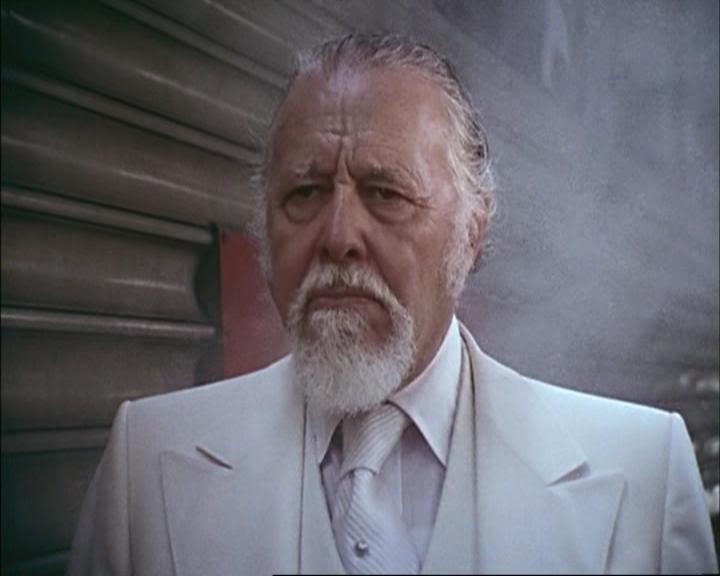
Martin departs the train (following a hairy moment when it appears as though someone has boarded looking for the woman) and is met by Tada Cuda (Lincoln Maazel). Other than saying that they have to get another train (to Braddock) he doesn’t really say much until they reach his home. We start with black and white overlays again as Cuda accuses him of being Nosferatu.
There is garlic on doors that he doesn’t want Martin to enter. He states that he will save his soul and then destroy him. He says that he shares his house with his granddaughter, Christina (Christine Forrest, who Romero would marry in 1981), she will speak to him but he must not respond. He is free to come and go but if he takes anyone from the city then Cuda will destroy him without salvation. He then states that he has heard that Martin is an imbecile and asks if he can speak.
Marin follows him down from his attic room and bursts into Cuda’s room. Cuda holds up a cross and Martin speaks,
“I am your cousin,” he says. He eats some garlic and puts the cross to his own face and explains that there is no magic – indeed we find through the film that Martin is enamoured by (stage) magic tricks. So there is a claim of ‘no magic’ but Martin certainly drinks blood, so what is he.
Well there is certainly some form of mental impairment, if it is only chronic shyness. However we do notice that Martin takes some things very literally also, though this could be due to a lack of social skills born of limited interaction. He seems to quickly give up on convincing Cuda and actually mocks him, at one point stalking him in a stereotypical vampire costume – perhaps the mockery was meant to break the belief in vampires but it failed.
Martin spends a lot of time talking to a radio talk show and, whilst this aspect didn’t necessarily work as perfectly as it could, this interaction helped us discover a lot more about Martin. He is dismissive of the movie vampires but describes becoming shaky when he needs to feed – as though it is an addiction or a compulsion.
Cuda tells the consistently cynical Christina that Martin was born in 1892 – and the family books testify to this – and when she asks Martin how old he is he replies that he is 84. Christina recognises madness, but believes the madness is within the family, especially her grandfather, and it is their crazy talk that has made Martin believe (of course she doesn’t know that, whether he is a vampire or not, he is a killer).
The black and white sequences are interesting as we look at this. They might be fantasy, Martin projecting onto his present, or they might be memory, Certainly, when Cuda gets old style priest Father Zulemas (J Clifford Forrest Jr.) to perform an exorcism we see black and white footage of similar from the past and that footage has been shown earlier in the movie. Then again the image of the woman on the train beckoning him was pure fantasy. Romero never actually reveals the truth, to quote the director
“We can believe that MARTIN is cursed, or we can believe he is simply mad. His dreams of torch-bearing mobs and fog-shrouded mountains may be called up from films he has seen. We have seen them too.”
The film is quite low budget looking but that adds to the sense of decay that Romero builds around us. This is a town which is dying in an industrial sense. The church is a burnt out husk. Cuda assumes that the last priest, Father Carelli, abandoned them – until new priest Father Howard (George A Romero, himself) informs him that his predecessor had cancer and may actually have died.
The performances fit, though many of the principles were not necessarily actors. Amplas is perfect as the withdrawn, slightly eerie Martin and I should mention a bit part for Tom Savini – this was the first project he and Romero worked on together.
Direction wise this is dour, Taxi Driver dour almost. There is an almost black comedy moment with an attack gone wrong – Martin attacks a housewife (Sara Venable) when he knows her husband is away but, unbeknown to our vampire, she had her lover at the house – but as well as the black humour that tinges the scene there is also a tension pervading through that shows Romero at his best.
I mentioned I would spoil the ending – this is where you should turn away if you do not want the spoiler. Martin is seduced by a bored housewife, Abby Santini (Elyane Nadeau), and whilst running from her at first, succumbs to her wiles. Because of her he cannot choose a victim and is getting rather shaky – he eventually goes after a hobo and that nearly goes badly wrong – however she eventually slits her own wrists.
This is ironic as Cuda assumes that Martin did it – she was probably the only one he wouldn’t have killed – and thus destroys him without salvation, via the traditional stake through the heart. It is a great scene (despite the filming error of the side shot showing the stake going all the way through the body and then the front shot showing it pronounced) but the irony of the act is what gives the scene its gravitas – Martin died for a crime he did not commit, killed by Cuda’s unflappable and erroneous faith.
A marvellous movie;
8 out of 10.
The imdb page is
here. Click
here for my review of the 2023 Second Sight release of the film.