Showing posts with label internal parasite. Show all posts

Friday, July 10, 2026

Blood on Her Tongue – review


Author: Johanna van Veen

First published: 2025

Contains spoilers

The Blurb: "I'm in your blood, and you are in mine…"

The Netherlands, 1887. Lucy's twin sister Sarah is unwell. She refuses to eat, mumbles nonsensically, and is increasingly obsessed with a centuries-old corpse recently discovered on her husband's grand estate.

The doctor has diagnosed her with temporary insanity caused by a fever of the brain. To protect her twin from a terrible fate in a lunatic asylum, Lucy must unravel the mystery surrounding her sister's condition, but it's clear her twin is hiding something. Then again, Lucy is harbouring secrets of her own, too.

Then, the worst happens. Sarah's behaviour takes a turn for the strange. She becomes angry…and hungry.

Lucy soon comes to suspect that something is trying to possess her beloved sister. Or is it madness? As Sarah changes before her very eyes, Lucy must reckon with the dark, monstrous truth – or risk losing her forever.

A haunting gothic tale for fans of all things supernatural, Blood on Her Tongue is refreshingly biting and unashamedly chilling, taking its place as a horror story for the ages.

The review: This novel by Johanna van Veen is, first and foremost, a masterclass in Gothic literature. Whether the theme was vampirism or not, the prose, describing events out by Dutch peat fields, drips with a heavy atmosphere, the novel conjuring the thick black waters of the bog. Told from the point of view of identical twin Lucy, the book contains a Byronic character in the form of Sarah’s husband Michael, with overtones of Heathcliffe in his character. It is a novel where the overtures of madness, and fear of being mislabelled an hysteric, haunt the primary female characters. It also has a vampire.

And yet, what a vampire… though it is a spoiler, I trust not too much, that the vampirism comes from a bog woman, found with brick in mouth and stakes pining her to her boggy grave. Yet, as we discover more we discover that it is not the outer body but an intelligent, sentient parasite, dependent on human blood and flesh, which eats at the host’s brain assimilating thoughts, memories and personality. From the blurb you’ll be able to tell that it is Lucy’s twin, Sarah, who becomes infected but Lucy, as close as she is to her sibling, struggles to see where the human ends and the parasite begins. Weak and starved, after enforced hibernation, we discover that the parasite can, when recovered, heal the host and prolong the physical lifetime of the body. A starved parasite can eat a whole victim, and quickly, which includes bones as well as flesh. However, it is not drawn as physically overpowered, which was a nice touch. The parasite is a separate species but there are overtones of vampiric possession.

The book does have a queer aspect, which doesn’t reveal until late in the narrative, and explores themes of betrayal and secrets within the Gothic wrapper. This was a fabulous discovery, and I really did enjoy it. 8.5 out of 10.

In Paperback @ Amazon US

In Paperback @ Amazon UK

Tuesday, March 31, 2026

Wormtown – review


Director: Sergio Pinheiro

Release date: 2025

Contains spoilers

When is not a vampire film, actually a vampire film? I struggled with how I would approach Wormtown, a film I first watched at Grimmfest 2025. There is a vampiric parasite at the heart of this – as I’ll explore – and more so it takes beats from I Am Legend, though probably more so the Omega Man. The festival programme said the film had “just a pinch of classic vampire lore and a sly tip of the hat to Richard Matheson’s I AM LEGEND.” I nearly went down Use of Tropes, but there is something essentially Vamp at its heart (for the infected literally and for the film figuratively).

worms in the eyes

It starts with Mayor Joshua (Jim Azelvandre) going for an eye exam. The optometrist has opened up at night for him as he has noticed a light sensitivity. As the eye is examined, worms are seen inside the eye. So… this is the first thing to note. At the heart of this film are worms and this gives a feel of the Strain (I’ll return to the light sensitivity) and, like in the series the worms are easily passed on. The worms have a blood consumption element and we’ll come to that.

a nocturnal existence

So, the film proper takes place where a large proportion of the town populace are infected. The mayor runs a radio broadcast that is the only signal available and plays gentle country folk and talks about the idyllic little town. The populace sleep through the day and the town comes alive at night and, a tad like the Omega Man, modern technology – mobile phones, Bluetooth and the internet – are all shunned. So the infected, like in the Omega Man, shun technology – but there is a reason, as the signals hurt the worms. They develop skin lesions too, much like in the Omega Man, and they act in a cult like way. The film does examine cult behaviour.

Rachel Ryu as Kara

There is a reason, however. When infected, various worms develop acting like a colony. The primary one is the heart worm, larger than all others, coiled round the heart it feeds on the host’s blood – this being the vampiric element I mentioned. They also develop brain worms, which we can assume moderates behaviour. There are uninfected and three women, living in a warehouse area and trying to solve the infestation, are our primary characters. They are Kara (Rachel Ryu) – who is disaffected, hating their life – and the lesbian couple Jess (Caitlin McWethy) and Rose (Emily Soppe), the latter being the scientist amongst them (she taught science at the high school). There are also uninfected living more normally in town, who have the cultists trying to recruit them nightly and there is an Amish community nearby, left alone as they produce foodstuff.

Jess bloodied

At the head of the film some kids get caught out at dawn and one, Tommy (Milo McDonald), is caught in the sunlight. His mother Alice (Maggie Lou Rader) can’t get to him because of the sun and he starts haemorrhaging blood and worms until he dies. The scene is like a vampire in the sun (with added worms). Jess, out scavenging, finds the body, takes worm samples, films the heart worm in the chest cavity and (when Alice cries out from her home) falls into the corpse. This causes a panic, Rose cleans the blood off back at the warehouse, finds a worm burrow, and manages to cut the worm out of her back. However, the worm-folk take it as a desecration of the corpse.

daylight outfits

As the film develops, we discover that Mayor Joshua is holding secrets. One being the state of his body, with the flesh raw and open. Through him we discover this will happen to all the worm-folk, as he puts it, eventually there is more worm than flesh and they are literally eating the infected – they are parasites, they are not in symbiosis. He is also hiding the truth of what is happening in the wider world. He has Rangers, storytellers he says, but essentially the law and some of those move in daylight in specially designed clothing. We also discover that uninfected smell repulsive to the infected and their vision alters so that the dark is bright to them. One character becomes infected and something goes wrong and two heart worms develop and one has to be extracted – it is a visceral scene and a painful process.

sunlight haemorrhaging

I really like this when I saw it at the festival, and enjoyed it more on second view. The vampire tropes are obvious and the worms themselves vampiric, however (though very different) I tonally got a bit of a feel of Stake Land. The practical effects are brilliant, especially the sunlight haemorrhaging. The story perhaps meanders a little and some of the cult themes could have stood a bit more exploration. But I have a soft spot for this one. 7 out of 10.

The imdb page is here.

On Demand @ Amazon US

On Demand @ Amazon UK

Wednesday, December 14, 2022

Slash/Back – review


Director: Nyla Innuksuk

Release date: 2022

Contains spoilers

Adding in elements that explore the coming of age of Inuit girls (this film tells its story through the eyes of a group of girls), and also touching on questions of alienation from tradition as these indigenous youth push away from their collective past but discover they need that tradition to survive, Slash/Back is a film that skirts around horror (it is perhaps a little more action, though has some tentacled moments and some interesting body horror) as it uses that youth lens but has alien vampires.

Tasiana Shirley as Maika

It begins on a ship as a father teaches his daughter Maika (played young by Niviaq Mike and older by Tasiana Shirley) to hunt. This is followed by a man out in the wild, in modern day, who sees something odd in the snow and is killed, with an implication that it has his face off. Elsewhere the older Maika seems embarrassed by her father and mother and both estranged from and ashamed of her indigenous heritage. We see this in things as simple as responding to her parents in English, to her desire to attack traditional art and food and dislike of her home, the town of Pangnirtung, Nunavut.

spotting the bear

After a moment where her little sister, Aju (Frankie Vincent-Wolfe), has some money conned from her by Maika’s friend Uki (the tough-as-nails Nalajoss Ellsworth) and she gets it back, she takes her father’s rifle and she, Uki, Jesse (Alexis Wolfe) and Lenna (Chelsea Prusky) take a boat out to the Land and leave Aju behind. After Uki has bragged about being a great shot, and Maika has refused to show off her shooting skills, they spot a bear acting odd, it walks strangely. About this time Aju finds them – having cycled – when Uki shoots the bear.

the bear attacks

It falls and then suddenly it is up and runs at Aju, who is frozen. It is on her before Maika can load and shoot but, once Maika can get the shot off, it falls and the young girl is shaken but otherwise unharmed. However, she is covered in a black oily substance, rather than blood. They return to the town and we see a tentacle or snake like thing emerge from the bear’s eye-socket and slink away. Back home the girls talk to their contemporaries about what happened – Uki suggests it was Ijirak – shapeshifting creatures that steal children in Inuit folklore but Maika reacts vehemently against the thought that it might be anything like that.

the parasite infested fox 

Having been invited to a party when the adults are out (it is solstice and the adults have a dance organised) the girls go out – with the grounded Lenna sneaking out and Uki not to be found as she has gone back to the Land because of a dare by Maika. There Uki sees a group of animals acting odd around a shape – which she realises is draining blood when it attaches a tentacle to prey and later suggests is some sort of ship (the leaps to understand what is occurring in this are taken on faith) – and is attacked by an artic fox. The fox has tentacles that emerge from its eyes and mouth and Uki manages to kill it by slitting its throat – getting the black blood on herself in the process.

wearing the cop like a disguise

Back at the village she crashes the party to tell everyone about the hunter aliens but we have seen a polar bear attack a cop and he has been taken over and enters the party hunting Uki. So, the aliens do drink blood, draining their prey dry, but then may wear the kill like an ill-fitting skin and can smell their own blood. They are hunting Uki and Aju until the primary girls turn the tables and, embracing their own traditions, hunt them back. As they work out what is happening they also work out that the blood fuels the aliens so their flesh puppets are quicker and stronger but falter when they run out of fuel, as it were. We do get a face ripped away and see inside one of the possessed (possessed is perhaps a bit strong given that it is more wearing skin).

the girls hunt the aliens

This is good fun, it is simplistic in how it explains the lore – as I said above the girls just seem to work out things in great narrative explaining leaps, but there are fab moments, like Maika and Jesse suddenly ignoring they are looking for killer alien parasites wearing a person as a disguise and argue over a boy. The tension between tradition and modernity is explored well – a line about folklore being old people stories made up because there was no internet was inciteful in its summing up of that tension. The acting is sometimes faltering, but works as a group of kids becoming adults and exposes their awkwardness.

face (mask) removed

The effects are fun – the fact that the human/aliens look like masks work, because they are actually skin masks and I enjoyed their inhuman, jerky movements. The whole effect side has a B quality to it that works with the sci-fi element. There is a whole bit of this that feels like a homage to the Thing – apt as we get Jesse explaining the plot of the film. There is an element of social justice with Maika wearing a jacket that says “No justice on stolen land”, a Caucasian cop hassling the kids and the film title, at the end, morphing to Land Back – so of course the idea of aliens coming, killing the animals and draining the blood of the animals and people fits into that narrative.

feeding

On the other hand, as fun as this is it does struggle to carry a horror element as well as it might, as well as moving the narrative explanations with leaps that felt too much of a character’s logical leap and so I think 6 out of 10 is fair. The imdb page is here.

On Demand @ Amazon US

On Demand @ Shudder via Amazon UK

Thursday, November 17, 2022

Guillermo del Toro's Cabinet of Curiosities – the Autopsy – review


Director: David Prior

First aired: 2022

Contains spoilers

Cabinet of Curiosities was a Del Toro executively produced anthology series, where the great director introduces each episode, which was released in time for Halloween 2022 on Netflix and proved to be a strong series of episodes that drew from Lovecraft (2 of the episodes are based on Lovecraft shorts) amongst others.

The autopsy is based on a short by Michael Shea and is the closest the series got to a vampire episode – though this is not so much your undead vampire but an alien vampire amongst us.

running through the mine

The episode starts with men getting into a mine elevator. It starts to descend when a miner, Joe Allen (Luke Roberts), jumps onto the elevator roof. Close to the shaft he jumps down to the floor and runs along, a large ball-like object in his arms. He manipulates it, lights moving on it, and releases it, continuing his run. Shards seems to float and an explosion rocks the mine.

Winters and Craven

Dr. Carl Winters (F. Murray Abraham) arrives in town. An old friend of the sheriff, Nate Craven (Glynn Turman), he has been called in to autopsy the bodies. The mining company will not pay out unless those killed were killed in the pursuit of their employment – if Allen set off a bomb, as suspected, they do not have to pay out worker’s compensation. Before they head to the rather desolate looking morgue, Craven tells Winters about the disappearances in town.

the body

He relays that they were up to 6 disappearances when, on one search of the woods, they found a body, covered in tarpaulin and stowed in a tree. The body had been butchered, professionally it seemed, but more noticeable there wasn’t a drop of blood in the flesh. They took pictures and put the body back, leaving a couple of hunters to watch for someone returning – they vanished along with the corpse. They did, however, get an ID as Abel Dougherty (James Acton).

in the bar

Dougherty had met a man, Joe Allen, in a bar and was convinced he was actually Eddie Sykes a friend who vanished two months before when he went hiking to watch a meteor shower. As we watch the flashback we see Allen use eye mojo to hypnotise Sykes and walk him from the bar. Allen and Sykes are the same person and, in his rooms, the sheriff finds a murmuring, vibrating ball that Sykes/Allen found in the woods – the object from the beginning. They take the object and go to find Allen at the mine, but he smashes a car window, takes the ball and runs to the shaft (returning us to the opening of the episode).

bloodless organs

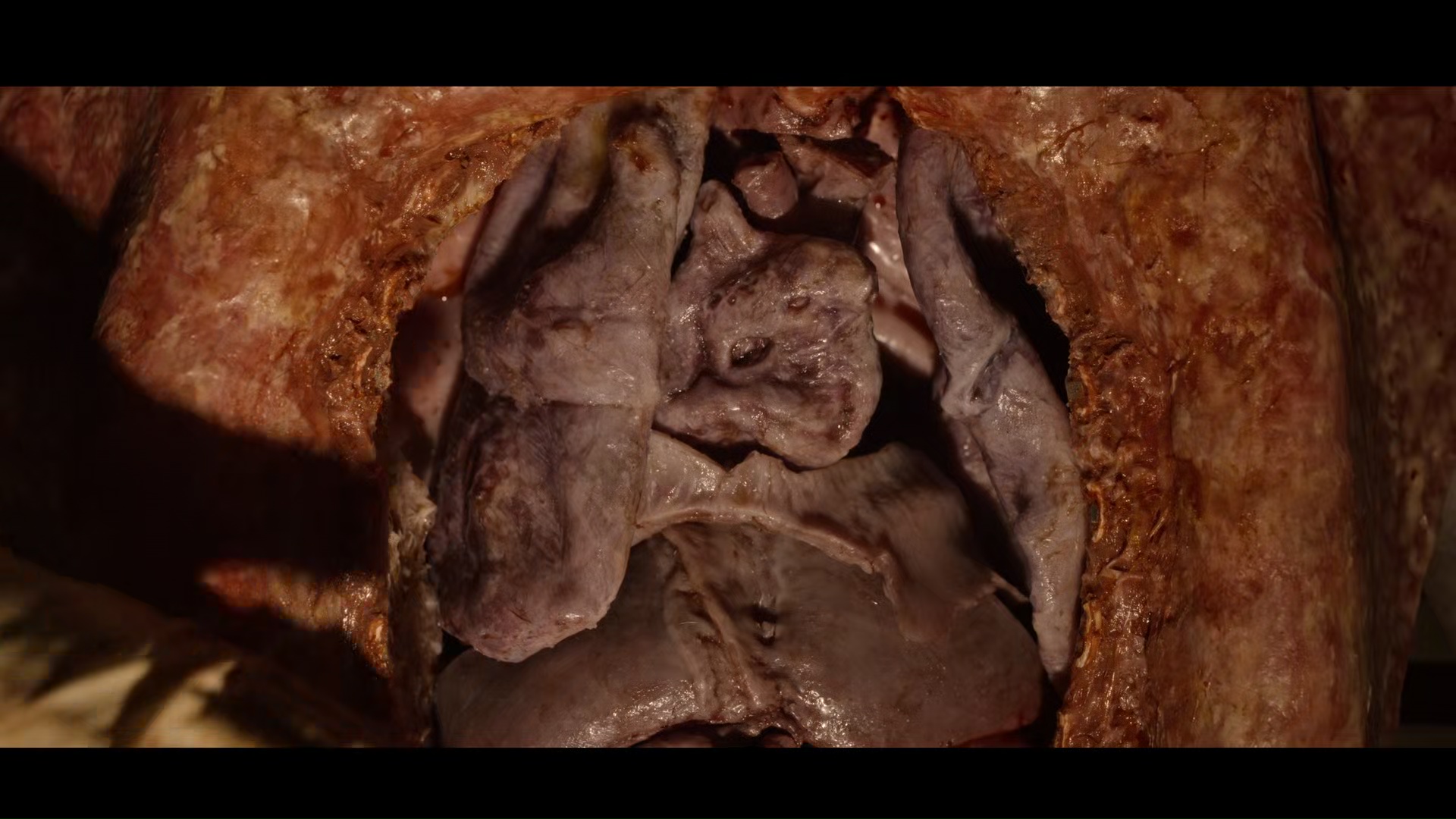
Winters goes to the morgue and sends the Sheriff home to rest whilst he starts to work. The second corpse he examines has a strange hole penetrating the chest and when he opens him up the lungs and heart are drained of blood. The next body has a similar chest wound and no blood left within. Photos from the mine suggest that the two exsanguinated bodies were found next to Allen's corpse – Winters articulates (to Craven via the tape recorder) his crazy thought that the blood from the two might be in Allen’s stomach.

the creature

It's round about then that Allen’s corpse starts to become ambulatory. Cutting sutures from his mouth (a small detail that made little sense as there hadn’t been an autopsy yet – but perhaps put in as a deliberate nod to Del Toro’s Cronos), he asks for help, saying he is trapped in the flesh and is starving. What we have is a parasitic alien creature that inhabits a host and feeds on the flesh and blood of others. It seems that the creature also feeds on pain and fear – it admits to reinvesting energy stolen from the two miners, whose blood it consumed in the cave, to keep their brains alive and directly feed in the information of what it was doing to them. It also suggests it gets a sexual pleasure from the feed, experiencing orgasms through the host’s body.

F. Murray Abraham as Winters

The sphere was its ship and the explosion was as a result of it having to destroy it on discovery to keep the species hidden. The creature itself was larval when it landed but it has grown and is a tentacled thing reliant on its host for senses such as sight and hearing. This was a cracking, atmospheric little film made all the more powerful by F. Murray Abraham’s powerhouse performance as the dour, terminally ill coroner (the parasite can smell his cancer through Allen’s senses and calls it delicious). The verbal sparring between Winters and Allen is superb. 7.5 out of 10.

The episode's imdb page is here.

Monday, January 11, 2021

Dark Forces – review


Director: Bernardo Arellano

Release date: 2020

Contains spoilers

Ah Netflix, you can bring us some films from all over the world, introducing us to new and strange vistas… But some of them come with a serious WTF.

Take Mexican horror flick, Dark Forces. It looks magnificent but it really decided that cohesion was for other movies. Great Dollops of the occult, vampires, criminals and cracking lighting but whilst the basic story seemed to be there, characterisation wasn’t and lore was occult in the worst possible way – so obscured as to be frustrating.

Tenoch Huerta as Franco

So we see a city and Franco (Tenoch Huerta) riding a motorbike through the night. He stops at a hotel, a decrepit place where he rents a room. He is there, it seems, to consult an albino girl who is a medium but there is a financial cost and the consultation cannot take place for two weeks, until the full moon. Meanwhile he meets some of the occupants of the hotel most notably femme fatale (and barmaid) Rubí (Eréndira Ibarra) and occultist Jack (Dale Carley).

vampire attack

Whilst there he starts to suffer either dreams of a vampire or an actual predation. He also needs the money for the consultation, so he and Ruby go on a heist, which leads to her getting a nasty head gash that he has to sew but is strangely missing (as is the blood) in the subsequent sex scene. The consultation is to find out where his sister is being held – which given it turns out to be at the compound of crime lord, and Franco’s erstwhile employer, Max (Mauricio Aspe), shouldn’t have been a stretch to discover by conventional means.

leech parasite thing

Then there are the leeches. Somewhat phallic creatures that live inside some of the characters and seem to be the actual vampires. Or maybe not. You see the film doesn’t tell us. It throws concepts into the ring by the bucketload but doesn’t actually then explain what it is doing with them. In some films this could be a clever thing, in this it isn’t handled with enough aplomb to convince that it is anything other than a conceptual mess. If we take the leeches as an example, we never know what they are, their bearers become veiny in the face when they appear but Franco shows the same veins in a reflection before being infested. Once he is, he sees the previous host who speaks to him but perhaps that is no more than a hallucination.

Rubí vamps

The same might be said of the vampires. He seems to be preyed on whilst asleep and then, when he sleeps with Rubí for the first time she develops fangs but that is never revisited and the inference is he hallucinated it. Later he stakes a vampire but then it is another person who he has stabbed. The film fails, however, to direct the viewer to just how it wants us to view these things – real, hallucination, allegory – perhaps we should just take them as seriously trippy and leave it at that.

a vampiric ghost

Yet if the story seems to want to be 'Argento meets Lynch' with a slice of 'action hero meets anti-hero in a horror arena', and does not manage to get to where it aspires to be, the film does manage to look absolutely gorgeous (except for the flashback scenes to his sister, which feel mundane and this was, clearly, purposeful). It has so much style it drips, in location and lighting especially (though some of the cgi, especially around the leeches, could be better). Tenoch Huerta is wonderfully stoic in performance but his character needed more building by the scriptwriters. Style does not necessarily make the film. I was taken by this, even though I shouldn’t have been, but can’t suggest that more than 4 out of 10 would be fair (and I’m probably being generous).

The imdb page is here.

Tuesday, December 10, 2019

Vamp or Not? The Kiss


This was a 1988 movie directed by Pen Densham and I was told about it by Leila who said “unearthed this in my vamp or not pile - see what you think. It's demon possession but there are some tropes here”. Intrigued I sought out the film, which some kind soul had uploaded to YouTube – though the quality was a bit low.

The film is certainly an oddity, which unfortunately fails to pump up the tension as central character Amy (Meredith Salenger) has her life torn apart by an evil relative. However, this is not where the story begins, rather it starts in the Congo in 1963.


Felice and her Aunt
At a train station where piles of ivory are being shipped out, a father (Philip Pretten) is saying farewell to one of his daughters, Felice (played young by Priscilla Mouzakiotis and adult by Joanna Pacula), who is leaving with her Aunt (Céline Lomez) to go to a sanatorium. His other daughter, Hilary (played young by Talya Rubin and adult by Pamela Collyer), is staying with him. Their mother is dead and Felice has her cross, which the father suggests she give to Hilary for safe keeping.

the statue
On the train Felice sees a strange statuette that her Aunt has, she is told that it is 100 years old and we see what looks like a patch of discoloured skin on her arm. That night the aunt wakes, clearly influenced by the talisman, and we see blood at the corner of her mouth. She grabs and strangles Felice and then kisses her hard. The train stops at a station and we see a composed looking Felice disembark. A guard finds the Aunt’s body that is already in a state of advanced decomposition.

hit by a vehicle
Moving forward to the eighties and Hilary is married to Jack (Nicholas Kilbertus) and they are have a teenage daughter called Amy. They are having a barbeque to celebrate Amy’s confirmation – it appears that Hilary is a very devout Christian. Amy takes a phone call and shouts for her mother as Aunt Felice has phoned – Amy was unaware she had an Aunt. Hilary makes an excuse to go on a supply run but is looking at guns when a truck spins out of control and knocks her through the shop window before landing on her. She survives but leaves her leg behind as she is pulled from under the vehicle – she dies being operated on.

monstrous cat
At the funeral Amy spots a figure lurking in the distance (Felice) but it is several months later when Felice invites herself into their lives. So, without going into the story too much, Felice starts stripping everything away from Amy – friends mostly. This is done through sympathetic magic, and she uses the statue as a totem within her magic. She feeds it her own blood as part of the ritual. This is definitely supernatural. She also has a monstrous cat, which seems supernatural in nature, which the film’s Wikipedia page suggests is “a therianthropic manifestation of Felice”. Therianthropy is the ability to shapeshift and so I am not so sure, as we see them together. It might be a manifestation of part of herself or it might be more like a familiar.

beginning to rot
In fact, Felice is described, at one point, as being a witch and there is the sorcery aspect. However, when a friend of the family (Mimi Kuzyk, the Strain) has her blood examined it is shown to be the blood from a corpse. Whether she dies when her aunt ‘turned’ her, due to being strangled, which would beg the question of how she then grew, or her body died in adulthood (after being used up) and thus she called Hilary to get access to her niece, the film is not telling us explicitly. However, as she seems to have started to rot (in patches) and given the rapid decomposition of the Aunt I would suggest the latter.

emerging parasite
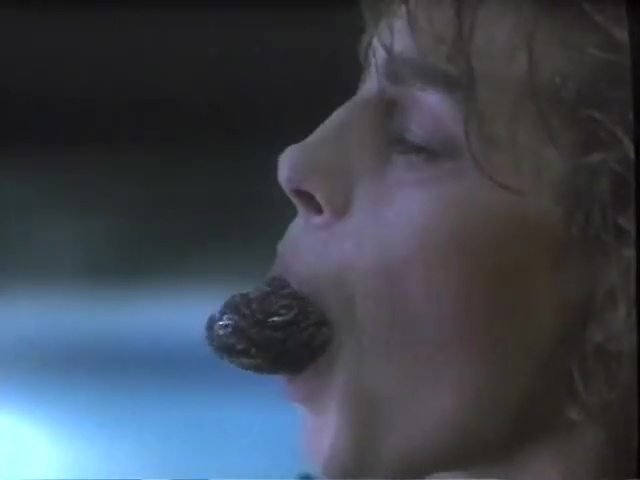
But how was she ‘turned’. We see this at the end of the film as a serpent like creature emerges from her mouth and tries to enter Amy. This parasite would seem to be a controlling intelligence – there is a recollection that Hilary felt she had lost her sister as she changed (there is also a suggestion that the possession was misdiagnosed as schizophrenia). It can certainly keep a corpse walking and talking, in order that it might find a new host. It is suggested that the family have been hosts for the entity for some time – this might suggest a genetic compatibility passed through the generations.

Amy and Felice
There is a poorly explored religious aspect – from the cross at the start of the film being removed from Felice (begging the question as to whether the father was in on it), to Felice removing a cross from the wall of the guest bedroom to a confrontation with a priest (Peter Dvorsky) who is accused of not really believing as, otherwise, Felice wouldn’t be able to enter the church. A religious item does burn her and the belief line is reminiscent of the faith needed in films such as Fright Night. There is a deliberate connection to that film as Felice is described as going all Fright Night at one point. The reference to Fright Night aside, is this Vamp?

rapid decomposition
I would have to say no. Whilst Felice is a member of the restless dead (or, at least, she is whilst her parasite still controls her body) there is no evidence of a need to drink blood, eat flesh or consume energy. However, Leila was absolutely spot on when she suggested that the film plays with tropes. It does and the Fright Night reference suggests to us that this is deliberate. So, it uses tropes (such as the reaction to religious artefacts – that have belief behind them) and the use of imagery such as the trickle of blood from the mouth and the kiss itself.

The imdb page is here.

On DVD @ Amazon US

On DVD @ Amazon UK

Monday, June 20, 2016

III Slices of Life – review

Director: Anthony G. Sumner

Release date: 2010

Contains spoilers

This was a portmanteau film and Sumner’s next portmanteau effort has already been looked at on TMtV. Gallery of Fear contained the excellent By Her Hand, She Draws You Down, which was most definitely a vampire segment. It involved an internal parasite – as does the segment we are looking at in this – but I’ll discuss the vampiric nature of it later.

The wraparound in this, Sketcher, was very interesting but deserved to be the wraparound as I felt that it lacked the exposition to be a feature – it was perfectly good, and gloriously weird, for what it did however. The first segment W.O.R.M. wasn’t bad and was a sort of techno-zombie piece. The second section Amber Alert was, frankly a bit turgid. I had guessed exactly what was going on almost straight away and then the short took forever to get to the point. The in-between time was meant to be drawing both a mystery and atmosphere and I felt it did little of either.

body in the bath
The final segment was called Pink Snapper and was probably the best segment of all three – it was certainly, sporadically, the goriest. It is also the reason we are looking at the film here. There is definitely a genre connection and I was a hairsbreadth away from giving this an honourable mention as something of genre interest but eventually went for the review. The film starts with a woman, Elizabeth (Judith Lesser), bound. Her father (Bruce Varner) locks her away – she yells at him asking how he can do this to... (presumably she was going to then say "his daughter"). He goes upstairs and starts to dismember the gory remains of a body of a man in the bath.

Deneen Melody as Susan
In the city Susan (Deneen Melody) is cooking when her brother, Eric (Galen Schloming), calls. He asks if their Uncle Jack (Mike Tracy) is home as he wants to borrow the car that evening. Jack, in his cop uniform, is drunk and asleep on the couch and Susan says Eric will have to ask when he gets home. When she gets off the phone she turns to see Jack awake. He forces himself on her – we get the impression he has been abusing her for years. He is just about to rape her when Eric gets home and attacks Jack. Jack gets the better of him and Susan brains him with a frying pan – they take his car keys and leg it.

Elizabeth Bound
Meanwhile Edgar, Elizabeth’s father, has dismembered the body, put it in black bags in the boot of his car and driven from the house to a wooded area to dispose of it (he hasn’t driven far, a few hundred yards from the house). He trips and knocks himself out. The brother and sister, in the meantime, are running out of gas and turn off the interstate. They find Edgar and Eric runs to the house for help but finds no one (he doesn’t go into the basement) and so they drive the man to hospital – still drifting in and out of consciousness, indeed in his delirium he assumes Eric is his son and asks for forgiveness.

rescuing Elizabeth
After getting Edgar to the hospital, with the staff assuming they are his kids, they go back to the house intent on stealing money, clothes and food with which to survive. They hear banging from the basement and go to investigate. There they find Elizabeth and help her out of the basement. She tells them that her aunt had visited some time before and her father changed, accusing her of being the recipient of the family curse and his actions were in order that he might starve *it*. The siblings suggest she get cleaned up whilst they look for useful items for the road.

family tree
They find a series of anatomical type pictures, along with a family tree that suggests that Elizabeth and Edgar are descended from Erzsébet Báthory (indeed their surname is Nadasdy – the familial name of Báthory’s husband). Certain pictures on the tree (including Elizabeth’s) have the word host by them. Elizabeth, meanwhile, is in the bath – we hear a hungry noise and she says to her stomach “soon”. Eric is in a bedroom when Elizabeth comes on to him, she guides his hand below when suddenly he screams, his hand emerges missing fingers and spurting blood – Elizabeth has not finished with him yet…

missing digits
The spoiler to come is that this is not quite, as may be suspected, vagina dentata. Elizabeth is the host to some form of internal parasite with sharp teeth, a desire for human flesh (and that desire is born of hunger) and a lodging place in her female bits. The suggestion is that this parasite has been passed from woman to woman in the familial line, all the way from Báthory. The film also makes it clear that the parasite can be passed to a non-family member and the woman so infected most definitely morphs into a Vamp as well as a host to a vampire. The attack on Eric is gruesome, the parasite ripping his entire body apart and not just concentrating on his penetrative parts.

Judith Lesser as Elizabeth
Now, we have classed those infected (or even taken over by) internal parasites as vampires before, but I very nearly settled on an Honourable Mention for this. I was still writing the article when I decided that this should be reviewed. The film makes the connection by using Elizabeth Báthory who is, of course, of genre interest but Eric mentions the concept of Countess Dracula. As I said at the head, this was the strongest segment. However it wasn’t perfect. The interwoven narratives needed sharpening somewhat to make it feel more like a whole, the acting was passable but not stellar and things felt just a tad too convenient at times. However it wasn’t a bad effort at all, it was an interesting take on the genre and that originality pushes me to award 5.5 out of 10 for the segment.

The imdb page is here.

Tuesday, April 19, 2016

Empire V – the Prince of Hamlet – review

Author: Victor Pelevin

Translator: Anthony Phillips

 First Published: 2006 (untranslated)

Contains spoilers

The blurb: When he started following mysterious signs on the street, Roman thought he’d found the perfect opportunity to rebel against a controlling society. When the signs lead him to a doorway in an alley, and he’s knocked out, he realises he might have been wrong.

He awakens strapped to a set of parallel bars in a richly appointed sitting room, and begins a conversation with a masked man which will change his life. His world has been a façade – one which the mysterious man, known as Brahma, is about to tear away.

A stunning novel about the real world, and about the hidden channels of power behind the scenes, Empire V is a post-modern satirical novel exploring the cults and corruption of politics, banking and power. And not only are these cults difficult to join – it turns out they may be impossible to leave…

The review:I have previously examined Pelevin’s novel the Sacred Book of the Werewolf as a ‘Vamp or Not?’ and went not – though I am now second guessing that decision. That, however, is a different matter – for the purposes of this review the previous book is important because blog reader Sepulture mentioned this novel in a comment but at that time it was not translated into English. It is also important as some of the themes explored are very similar. I’ll come to that, of course, but since that post I have occasionally had a search for the novel to see if an English translation had been released and, finally, it is available.

The book follows Roman, whose name is changed (once he is turned) to Rama as all the vampires are given the names of Gods (I use the same concept in Concilium Sanguinarius), and his induction into the world of the vampires. I’m going to concentrate on Pelevin’s lore as it is rather interesting and pretty darn unique. The vampire is turned when an entity known as the tongue grafts itself to them. The tongue sits at the soft palate of the mouth and is a symbiotic creature. Turning occurs by choice off the tongue – for reasons explained in the narrative, Brahma’s tongue wants a change of host.

The tongues were creatures that looked like giant bats during the time of the dinosaurs and so have been apex predators for a long time. After the asteroid cataclysm, which wiped out the dinosaurs, the vampires managed to extract from themselves their own essence, in the form of the tongues, and lodged within large predators. They were responsible for adapting and breeding homo sapiens and now lodge within us, though that was not our primary function.

The vampires have long since stopped relying on blood (or the red liquid, as it is called, blood being a taboo word) and actually only take in blood (and a few drops of that) in order that they might read the personality and memories of the individual to whom the blood belongs. Rather the tongue feeds on bablos – an energy form derived from humans and generated by the pursuit of money. This, of course, leads us to the satire.

This is a satirical look at capitalism and we can look back as far as Voltaire and Marx for the connection of vampires with bankers and capital itself. Being a Russian novel it is clearly a satire of the post-Perestroika society. The novel is clearly Russian, the tone of the prose captures a timbre unique to that country. Again there is a Nabakov aspect – but this time spoken of within the prose. There is also a flirtation with the Nietzschean Übermensch. Further lore includes Death Candy – a distillation that allows vampires to become temporarily fierce warriors – and the transformation into a bat form, though the book does not reveal how this is physically attained.

I was transported into the prose and thoroughly enjoyed the journey. Well worth the wait for the translation it is a wonderful and unique take on vampire lore (and I haven't touched on the lore around Ishtar, the living vampire deity, as it is too spoiler heavy), even if it’s concept treads ground already covered by films such as Hanno Cambiato Faccia. The ending was an exercise in sucker punching the reader with the unexpected, which was ironically clear to see in the preceding prose, and was, thus, incredibly satisfying. 8 out of 10.

Monday, January 18, 2016

Gallery of Fear – review

Director: Anthony G. Sumner (segment)

Release date: 2012

Contains spoilers

I like anthology and portmanteau movies (in fact I like shorts too) and I noticed Gallery of Fear on TubiTV and so settled down to watch it, without realising that one of the segments was going to be vampire related.

The film is a portmanteau film and the wraparound, “Critic's Choice”, stars the inimitable Debbie Rochon as an art critic (and bitch) chauffeured to a private viewing at a unique gallery. The segments are then the exhibits, that she is drawn into as observer. The third segment, “A Far Cry From Home”, is a murderous red-necks/slasher/torture porn affair. The second segment, “Down the Drain”, was a creature feature that was overlong with poor sfx and, for me, rather annoying.

Zoe Daelman Chlanda as Cath
The segment we are interested in is entitled “By Her Hand, She Draws You Down” and was based on the short story by Douglas Smith of the same name. It concerns a form of energy vampirism and I’m afraid I will have to spoil the full segment to examine that. To begin with, however, we hear tales of mysterious deaths in various locales and then we see husband and wife, Cath (Zoe Daelman Chlanda) and Joe (Jerry Murdock), as they head for their car. She suggests that *it* will want to move soon but when he asks where she doesn’t know.

a family sketch
Cath is sat on an esplanade, set up as a street artist. A man passes by with his pregnant wife and daughter and asks her if she does group sketches. She affirms this and he asks for a sketch of his girls, which she begins. Joe is sat elsewhere and carves an ankh into the bench he sits on. He notices what Cath is doing and hurries over to her. She has sketched mother and daughter and still has to do the mouths. He whispers to her that she had promised (not to do this to children or people who had others relying on them, we later hear) but she replies that she is hungry (importantly she does vary in the dialogue between *it* is hungry and she is hungry). She gives in though and refuses to finish the sketch, saying it just wasn’t right. When the customer complains and suggests that she only has the mouths to finish she states that the mouths are the most important bit.

Jerry Murdock as Joe
They set up elsewhere and Cath explains that the others she has have all been used up, as she was very hungry. A weird looking man named Harry (Terry Shane) approaches – the inference is that the way he is dressed leads Cath and Joe to believe him to be a derelict – he offers $20 for a sketch and Cath agrees. She draws him, doing his lips last. As he walks away Joe tells her to hurry. There is carbon paper below the sketch and a copy has been made. She opens an ankh embossed box and gets a large red crayon (it appears) out and works on the lips. She tells Joe it has to be perfect when he tries, again, to hurry her.

drawing life through art
She starts to draw air in from the picture and an energy in the form of smoke seems to rise from the lips and she sucks this in through mouth and nostrils. On the beach Harry has met his wife (Marianne Smith) but suddenly stops, his face turning grey (almost like the drawing). By the time Cath has finished, Harry is dead, his wife screaming for help. Cath and Joe leave and head to the next town but Cath is still hungry. Joe tells her that it will be dark when they arrive and she won’t be able to draw anyone.

dream Cath
Normally I’d finish the blow by blow here and let you watch the conclusion yourself but what happens next is so very interesting lore wise that complete spoilers are ahoy. Lying in bed Cath mentions that she could draw a perfect rendition of Joe’s face without him being there as she knows him so well. He dreams and, in that dream, beyond the beach and the sea we see pyramids (consistent with the ankh theme and indicative of the source of this curse). He approaches Cath and her face has become twisted, with sharp teeth and almost drawn.

sucking life
On awakening, she is not in bed. He finds her sketching in the dark and she says she needs no light for this sketch and that she is tired of being always hungry. As she starts to suck, and thinking he is the subject, he stabs her but then ends up drawing energy from her (as *it* enters him). The sketch pad shows the picture was of herself (an interesting idea of vampiric suicide by the host depleting the energy of themselves) and we see something move below the skin of Joe’s stomach. What is *it*? We don’t know; a parasite certainly. An energy thing it would seem – given the transfer – but with a physical aspect and an ability to communicate to the host and pass its hunger to them.

a victim dies
This was a shining segment of the portmanteau film. I loved the concept and it reminded me, in part, of Jan Naruda’s the Vampire (1884) in which those that the artist draws die. In that we do not know if he senses death and catalogues it or whether he causes death. In this we know they cause it and whilst we don’t know what the special composition of the ‘crayon’ is, we don’t need to know, we only need to know that it is the conduit for feeding. 6 out of 10 for the vampire segment only.

The imdb page is here.

Available at TuniTV as listed above or at Amazon via ConTV