Showing posts with label bakeneko. Show all posts

Wednesday, April 23, 2025

The Cat Creature – review


Director: Curtis Harrington

Release date: 1973

Contains spoilers

A made for TV film, I wish I had seen this before submitting a chapter for a forthcoming book as it would have fit right in. It isn’t a bakeneko film, in that it isn’t based on the rough story that underlines that Japanese genre, but it is certainly one for the bakeneko fan. It does suffer for being quite 70s US police procedural but it has some fab ideas – and a devilishly queer subtext even though the studio made Harrington remove the references to lesbianism.

Kent Smith as Frank Lucas

It starts with a car approaching a mansion. It is night and when the driver, Frank Lucas (Kent Smith, the Night Stalker), enters the building he discovers the electric is off. He goes to an office and starts a recording. He is an appraiser brought to the Drake estate by the attorneys and is working at night to meet their deadlines. He just has the special collection to do. He goes there and it is all Egyptian artifacts.

the amulet

He makes a beeline for a sarcophagus and pries it open. There is a mummy inside and he notes the golden amulet she wears, with the likeness of a cat and emeralds for eyes. He puts the lid back on and seems to leave. Out of the shadows comes another man, Joe Sung (Keye Luke, Gremlins 2: The New Batch), who steals the amulet and sneaks off as Lucas returns. Lucas starts to record about the newest part of the collection (the sarcophagus) describing the amulet. He then notices that the sarcophagus is empty, there is the shadow of a cat and cat noises as he screams.

Gale Sondergaard as Hestor

We see Joe in the city, and he enters an occult establishment called the Sorcerer’s Shop. The proprietor, Hester Black (Gale Sondergaard) speaks to him as he tries to sell the amulet as a family heirloom. We discover later that she was a fence and she smells trouble and refuses him – he leaves with the amulet but leaves the briefcase. Hester’s assistant, Sherry (Renne Jarrett), comes through to get paid and she gives her the briefcase. The viewer sees a cat shadow at the window, the shrewder viewer will see a lesbian subtext to the conversation on the part of Hester, who suggests a meal with her assistant. It was after watching the film that I picked up, on IMDb, that the studio had ordered the removal of lesbian aspects from the character, but they certainly are still there in the inferences in the dialogue.

cat eye mojo

Sherry refuses the meal and the offer of a lift home. As she walks down an alley there is a noise but it is a cat knocking over a trash can. Sherry speaks to the animal and then picks it up as a stray she intends to feed. She gets to her apartment and gets the cat a saucer of milk and then notices blood in its fur. The cat stares at her and starts making growling noises. The girl, blank eyed, responds with nods and then walks in a trance to her balcony and throws herself off.

Meredith Baxter as Rena

A woman, Rena (Meredith Baxter), goes to the Sorcerer’s Shop and gets offered Sherry’s job. Meanwhile the police, in the guise of Lt. Marco (Stuart Whitman, Ghost Story: Concrete Captain) has the university send someone who knows about Egyptology to the Blake Estate. That is Prof Roger Edmonds (David Hedison) and he notes that the sarcophagus was for a worshipper of Bast. Marco takes him round pawnshops, looking for the amulet, and they end up in the Sorcerer’s Shop speaking to Rena. Hester comes through and Marco knows her as a fence. When she protests that she has gone straight he responds “Straight eh? .Why you could sleep on a corkscrew.” The double meaning is strong with this one.

John Carradine as the clerk

So, the police manage to track down Joe at a flophouse (run by John Carradine) but are too late, hearing his screams and then finding him dead. So far we have a missing mummy and a cat (apparently) killing people. However, the coroner (Milton Parsons) says the bodies have been drained of blood and this leads to a determination that the worship of Bast was outlawed because the priesthood were committing blood sacrifices to gain everlasting life and could turn into cats. The police, of course, don’t believe that. As for Roger, well he’s falling for Rena (which leads to Hester being sharp with him, as she asks her new assistant out for a meal also).

Egyptian garb

I now need to totally spoil the ending as the lore round this is ahead of its time. Rena is the priestess of Bast and the amulet was to keep her trapped in the sarcophagus. Once removed she has returned to life, she is feeding on blood and trying to find the amulet so that she can’t be trapped again. She seems scarred of cats, and they get agitated when she is near. They also gather near where she is staying. When the amulet is put back on her she suddenly is wearing Egyptian garb and then turns back in to a mummy. Stumbling outside, the cats attack her and reduce her to dust. All this pre-empts the similar lore in Sleepwalkers, and though they turned into cat creatures, rather than cats, and were energy drinkers one can’t help wonder if this had an influence on that story?

cats attack the mummy

As I mentioned at the head of the review, there is something very 70s police procedural about this that does mar a really interesting film. It feels episodic almost and it’s a shame as the performances are solid enough, Carradine has a 2-minuite appearance that is a joy, and they could have got a really (American) Gothic flick out of this. But if you are a bakeneko fan (as this is at least adjacent), a cat vampirism fan or want an interesting take on the mummy genre it is worth tracking down. 5 out of 10.

The imdb page is here.

Monday, April 21, 2025

Use of Tropes: A Haunted Turkish Bathhouse


As a bakeneko (or ghost cat) film, A Haunted Turkish Bathhouse has some strange and unusual aspects but, of course, here at TMtV we look to the vampiric aspect and the bakeneko genre usually requires consideration on a film-by-film basis. In this case it, to me, might have been listed as being of genre interest (simply for being a bakeneko film) and of course it carries the generic bakeneko tropes. But there was a genre connection I saw that was subtly done.

reporting the change in law

The Kazuhiko Yamaguchi directed film was released in 1975 and veers away from the more traditional period stories (or modern with period flashbacks) and sets itself in a more contemporary part of the past, 1958. This was the year that the anti-prostitution act was introduced in Japan and this law is the catalyst for the film and is mentioned in a newspaper headline at the head of the film.

Yukino and Kuro

In one such brothel, about to be shut down, the manager Genzô (Taiji Tonoyama) has thought of a way around the act and intends to turn the brothel into a Turkish bathhouse (which will have the girls working in it and will have extras). His wife, Utae (Tomoko Mayama) – known to the girls as Mama, asks them if they are prepared to stay and all say yes bar Yukino (Naomi Tani). Having been reminded that any debt might have been forgiven by the act (as debt bondage was used to hold women to the brothels) but it was still a dishonour to not repay it, she leaves anyway taking her cat Kuro.

pretend gangsters

Her reason for leaving is that her boyfriend, Yûzô (Hideo Murota), is moving her in with him. He puts wedding rings on them when back at their new apartment and she asks him to move her country living younger sister Mayumi (Misa Ohara) in with them. They are in a clinch when gangsters (presumably yakuza) break in and demand he pay the money he owes – which he bought the apartment with. To protect him, she offers to take the debt and pay it off – having to return to the bathhouse (at first part time and, after he acquires more debt, full time).

Misa Ohara as Mayumi

Actually, it is all a big scam cooked up with Mama, and the gangsters were his men acting. He and she split the money Yukino earns and he was even given a fee for returning her. He is, all-in-all, a bad guy. He starts an affair with Mama, (rather graphically) rapes Mayumi and, when Yukino tells him she is pregnant (and has refused to have an abortion) he and Mama torture her (again in a rather gritty, graphic scene) during which she miscarriages and dies, they then wall her body up in the basement. It also becomes apparent that he works at the bathhouse (and presumably the brothel before) as a manager – how/if Yukino was unaware of this isn’t addressed. The second act is 6 months later and sees Mayumi (no longer innocent) start at the bathhouse, quickly becoming the highest earner, which draws the ire of the other women.

the blood appearing

So far, no bakeneko action. Indeed the film goes on with its graphic violence (we get another rape, leading to a suicide, and a murder) and intersperses that with an exploitation level of nudity. Kuro, the cat, is watching proceedings and intervenes to save Mayumi from a beating by flying through the air and scratching faces. We also see its shadow loom large behind paper walls. However, it is after the cat is decapitated that we get our bakeneko action. The plaster, behind which Yukino is walled, starts to have blood appear on it, spreading outwards and quickly taking the shape of a body. This is the subtle trope, more often than not in these films the cat licks blood and becomes a bakeneko. This blood pattern becomes the blood connection, creating the bakeneko with the corpse behind the wall.

flying bakeneko head

The wall breaks up and we see Yukino’s corpse perfectly preserved. We then see her head fall and, as she rises again, she has become the bakeneko. This means it is a bakeneko film where the corpse is possessed by the cat spirit, rather than the cat shifting form to look like a human. There isn’t much in way of blood drinking, she is after revenge, but we do get the flying disembodied bakeneko head biting into a neck that then offers a really nicely gory blood spurt. This one might be a tough watch, bearing in mind the rape scenes and is certainly full of sexploitation as well but, despite holding off on the bakeneko action for way too long, I rather enjoyed it and it is definitely something that is of genre interest, at the very least.

The imdb page is here.

On Blu-Ray @ Amazon US

On Blu-Ray @ Amazon UK

Wednesday, January 01, 2025

Bakeneko: A Vengeful Spirit – review


Director: Yoshihiro Ishikawa

Release date: 1968

Contains spoilers

Coming out of the kabuki theatre tradition with a primary tale having been translated as the Vampire Cat of Nabéshima, I have found that the Japanese bakeneko (or ghost cat) films should have their ‘vampness’ determined on a case-by-case basis.

This film actually uses the word bakeneko in the title, uses some of the elements of Nabéshima in its plot and certainly could be said to be a film that uses genre tropes. However, after deliberation I decided that there is just about enough to class this as vamp – you may differ in opinion. I must also say that the version I watched is in the Severin boxset All the Haunts be Ours vol. 2 and the disc does carry some neat extras including a reading of the Vampire Cat of Nabéshima and a short film called Man-Eater Mountain that has a vampiric plant in it.

buried alive

At the start we discover that Naoshige Nabeshima (Ryôhei Uchida) has plotted against his Lord Takafusa Ryûzôji (Keiichirô Shimada) and usurps him. He arranges to have the ousted Lord buried alive in clay and the Lord’s concubine passes out at this. She is placed in a room and, when she awakens, her cat Tama is there and she takes the cat and leaves the palace, going to a lake that she walks into holding the cat and drowns.

concubine with cat

Ten years later during an annual festival to placate the cursed pond, Naoshige is on a barge and sees a young woman on the shore, Yukiji (Kyoko Mikage), who he immediately falls for – dismissing the fact that he has told his subjects that they should not indulge in lustful longings on the festival day as it could bring the curse on them. He decides she will be one of his concubines.

licking blood

The issue is that she is promised to Jônosuke Yûki (Kôtarô Satomi) and the pair love each other. This leads to her being forcibly kidnapped and him put under house arrest and then escaping. Before this happened the pair accidentally end up at the cursed lake and, after a scare with a pair of fireballs, she finds a soaked cat – that looks very much like Tama.

neck bite

The film plays out like a period drama in places, and also a samurai sword fighting film. The pair reunite (after he is offered a pardon if he forsakes her and then refuses to do so) and fight their way to the pond until both die in the waters. The cat appears and licks her blood up and then kills and assumes a concubine’s form in order to avenge Yukiji (and her previous owner). The drinking the blood is a familiar trope and later we do get at least two neck bites. The Nabeshima references sees the cat able to induce sleep and a courtier stabbing his leg in order to stay awake and defend his Lord.

the bakeneko

The film lacks the uncanny atmosphere of some of the bakeneko films, trading it in to lean more into the samurai/period drama aspect but that does not mean it is poor in any way, just a different experience but still a very solid film using the bakeneko. The neck bites are not overly conclusive of vampirism – they could just be efficient for damaging the enemy. However the film does contain tropes if you don’t care to read this as vampiric. For me, however, it was close enough and a solid 6 out of 10.

The imdb page is here.

Friday, September 20, 2024

Evil Cat – review


Director: Dennis Yu Wan-Kwong

Release date: 1987

Contains spoilers

My friend Leila identified this film with a suggestion it is “a bit of a hotchpotch fusing vampire lore, Bakeneko and ghost possession with a magic bow” All this, of course, made me want to watch the film.

What we get is some late eighties Hong Kong fare with a more serious edge than many – there is a dedicated comedy cop character, Inspector Handsome Wu (Wong Jing), and the film is certainly not divorced from humour, such as jokes about the laziness of the apprentice, but it did take itself a bit more seriously I felt.

evil escapes

It starts in a quarry, with a large industrial vehicle. Part of the earth it is manipulating releases a strange light when disturbed. The foreman is called over and there is a large rock with writing on it. The workmen shift it (as you do) revealing a massive shaft. Suddenly light explodes out of the shaft. Elsewhere, Master Cheung (Lau Kar-Leung), is snoozing at a community play when he wakes realising the evil has escaped. We discover later he is at end of life due to cancer.

fight flashback

He gets back to his room and uncovers a couple of cases. One contains a bow and three arrows. A flashback sees his father, a Taoist priest 50 years before, fighting a person possessed by a cat demon. He manages to catch the cat in a net and holds it whilst a young Cheung stabs through his father (at his command), skewering his heart and passing into the cat. The way to kill it (without the spirit immediately possessing another) is by stabbing through the heart (with a particular wood). The cat is thrown down the shaft – it is the 8th time it has been defeated by the Cheung family, it returns every 50 years and Master Cheung must kill it one last time.

dead guard

At an industrialist’s tower block the new security guard shift is getting to work. One is sent to investigate a rancid smell. The industrialist, Mr Fan (Stuart Ong), is in a bedroom area with his PA Tina (Hsu Shu-Yuen, Vampire’s Breakfast). As they clean up he calls through for his driver Long (Mark Cheng Ho-Nam) to pick him up. Meanwhile the security guard finds a body in a pile of refuse, which comes alive and attacks him. Tina is still getting ready by the time Fan goes downstairs. All the guards are dead (we see one with a neck wound) and the door locked. He is chased through the building.

Fan in cat mode

Long is driving back (with the woman he had been dating in the car) when a figure, Master Cheung, appears in the road causing him to hammer the breaks on. The road is empty when Long gets out to look, but Master Cheung has already got in the rear seats and asks for a lift to the city. After complaints from the woman, they tie her to a lamppost and drive off. There is some banter, with Master Cheung seeing something off in Long’s future and giving him a protective amulet. When they get to Fan’s tower the cops and reporters are there – anchor-woman Cheung Siu-Chuen (Joann Tang Lai-Ying) happens to be Master Cheung’s daughter. Fan has gone home already. Later however, after Fan attacks Long he ends up going to Master Cheung and becoming his apprentice as they try and stop the cat demon.

Long and the cat

The end make-up of the cat was great, and the vampirism came in too ways. The cat drinks blood to achieve immortality within a chosen host and we also see the cat clearly sucking out lifeforce like an energy vampire. The cat does possess bodies and we get the use of prayer scrolls as a protection from the cat and a way to render the wearer invisible. The three arrows are made of the wood that can destroy the cat as well as the host and there is a comment that they are the last three pieces of this type of wood (though not what the wood is called). The bow is also meant to be magic. This was a good watch. 6 out of 10.

The imdb page is here.

On DVD @ Amazon US

On DVD @ Amazon UK

Thursday, August 01, 2024

Use of Tropes: The Ghost Cat of Otama Pond


This 1960 film was directed by Yoshihiro Ishikawa and is part of the bakeneko genre of films – changed cats, essentially. Leila contacted me and suggested there were tropes here and, an element of the bakeneko genre is vampiric – reaching back to the story The Vampire Cat of Nabéshima. This certainly has tropes we can recognise from other (Japanese) vampire cat films we have looked at here.

A lot of these films have both modern and period elements, and this is no exception, though the modern section is perhaps shorter and sparser than some and the film really concentrates on the period setting. It starts, however, in the contemporary timeframe. A couple, Tadahiko (Shôzaburô Date) and Keiko (Noriko Kitazawa) stand in front of a pond, a cat sits above them in a tree. The cat does manage to look menacing.

the old woman

The couple are taking a short cut rather than waiting for a bus but they keep getting turned around and arriving back at the lake. There is a concern that Keiko’s father will not allow their marriage if they return late and yet they cannot leave the area. Eventually they see the cat – Keiko states a hatred for them – but Tadahiko rationalises there must be a house nearby and they find a derelict building. As he looks around, a door by her opens and a sinister old lady appears, causing Keiko to faint.

exorcism

He finds her and carries her into the house. We get a lighting change and she seems to wake but the house is no longer derelict. She explores and comes across an old woman (Fujie Satsuki, who is not quite transformed into a cat), Keiko tries to leave but the woman gesticulates with her clawed hands and is able to draw her back. She wakes with a start and has a fever. In the morning Tadahiko carries her away and goes to a priest (Hiroshi Sugi) who suggests that she has the cat’s curse and bears the mark of death. He performs an exorcism and then tells Tadahiko the story of the curse – this is our main story.

the ill-fated lovers

Yachimaru is a young man in love with Kozasa – played by the same actors as Tadahiko and Keiko, it is thus implied they are reincarnations – unfortunately their family are at odds with each other and only Yachimaru’s sister, Akino (Namiji Matsuura), seems to want to help the lovers. Yachimaru is also due to leave the area to pick up a position (though he promises to return for Akino). Interestingly the cat, Tama, is Yachimura’s family cat that was found by the pond (making a tie between cat and pond).

implied blood licking

With Yachimaru leaving, Kozasa’s father (Yôichi Numata) conspires with the local magistrate (Arata Shibata) to murder Yachimaru’s father (Akira Nakamura) and grandmother (Fujie Satsuki) and steal Akino to marry her to the magistrate’s brother (Hiroshi Shingûji). The father ends up dumped in the pond (which turns to blood) and Akino kills herself by stabbing herself in the neck. Yachimaru realises something is wrong and returns home, finds his house burnt to the ground and is eventually killed and dumped in the lake. 

the lake becomes bloody

When this occurs the lake turns to blood again and Tama sits above some spilled blood on the shore. The implication is that Tama licks the blood (a common trope in these films) but we do not see that happen. We can also read that the pond takes the victim’s blood (as it turns red more than perhaps it would) and the connection between the pond and cat causes the change. However, which ever it is, the cat now hunts and haunts the villains, getting revenge and shifting shape to other people (notably Kosana sees the ghost of Yachimaru, walks into the pond – presumably drowning – and the cat takes her form) and cat person form.

ghost at the lake

It is the tie of blood to the cat, creating the curse and making it a supernatural foe that is the primary bakeneko trope. The licking blood isn’t explicit (the cat’s tongue does lick but the cat is some distance from the blood – possibly the best shot they could get). It is not clear that the changed cat then drinks blood. As such I have held this to tropes but it is certainly of genre interest.

The imdb page is here.

Saturday, May 25, 2024

A Bloodthirsty Killer – review


Director: Yong-min Lee

Release date: 1965

Contains spoilers

Also known as A Devilish Homicide, this Korean film owed a lot – I thought – to the Japanese story The Vampire Cat of Nabéshima and those films that flowed from it. Whilst contemporary, the cat spirit and the possession (or replacement) of a household member seemed replicated in this.

It starts with Lee Shi-mak (Lee Ye-chun) arriving at a building that seems, as he enters, oddly deserted. An odd-looking man spies on him entering the building. There was meant to be an art exhibition inside, a security guard tells him the exhibition has finished. However, he finds one portrait. It looks like – he says – Ae-ja (Do Kum-bong). We discover later that she was his first wife, now deceased. As he holds the portrait the canvas seems to melt.

the portrait

He quickly leaves and gets a taxi driven by the strange man who was spying on him and is taken, against his will, to a house in the countryside. He enters but all the rooms are locked until he finds one open. He is approached by an artist, Park Joon-chul, who takes him inside and gives him the portrait and begs that he leaves. Unfortunately it turns midnight and the artist has him hide under the bed. He sees the feet of a woman and she stabs the artist and then floats out of the window. The dying artist tells him the portrait contains a secret and dies.

no reflection

Shi-mak fears that he will be blamed for the murder… on cue a person (the taxi driver) starts rattling the door. Shi-mal climbs out of the window, using tied together curtains, but the man comes in. Suddenly he finds himself trapped, on the side of a building, with a guard dog below and the angry man above. He drops, fights the dog and escapes with the portrait but then finds the body of Ae-ja and takes it to his doctor friend who is perplexed as he had registered her death years before. We see that, in a mirror, her corpse does not appear and her blood, when drawn, is watery. When Shi-mak exits the room, she animates and kills the doctor.

biting the children

He gets home and he and new wife Hye-sook are beset with strange occurrences. His eldest daughter is taken by Ae-ja, whose arm reaches through a window. The corporeal ghost attacks Shi-mak’s mother on her way home from temple, causing her to fall into a river and get drawn away but the mother than appears at their home. We see her compulsively licking the face of one of her sleeping grandchildren and later we see her suckling blood from the neck of one – giving us our vampiric moment.

reflecting as a cat

The woman is actually a cat spirit and when Shi-mak vanquishes her (having seen her true form in a mirror and being given a magic ball, actually the third eye from a Buddha statue, by a housekeeper who appears to be a guardian angel) she turns into cat form. The film stalls when it goes into the backstory for an extended period but tells a story of deceit and murder as it is revealed that Hye-sook was maid to the family (and Ae-ja’s cousin) and was jealous so conspired with Shi-mak’s mother to frame the wife for an affair and then murdered her – relying on help from the artist and doctor. The cat actually ate the flesh from her corpses’ bones.

paw for a hand

The cat does act vampirically and is the sort of cat spirit that does recur in some Japanese tales. The bad pacing aside (due to the third act being mostly backstory) this is quite good fun, with some lovely weirdness and a good atmosphere for the most part. There are some good moments in here and it is particularly recommended to fans of Japanese spirit cat movies who want to see what the Koreans could do with the idea. However, the overall film is probably worth 5 out of 10.

The imdb page is here.

On DVD @ Amazon UK

Friday, June 02, 2023

Use of Tropes: Black Cat Mansion


Vampiric cats and ghost cats are a staple part of Japanese horror, reaching back to folklore and the yōkai bakeneko, or changed cat, we can also cite stories such as The Vampire Cat of Nabéshima. In cinema there are films such as Hiroku kaibyô-den and the remarkable Kuroneko.

This 1958 movie by Nobuo Nakagawa (who would go on to direct Onna kyûketsuki, released the following year) has a nested storyline with black and white scenes for the present and near past and colour for the distant past and the story would seem to take some of its story inspiration from The Vampire Cat of Nabéshima. It is told in the first place by Dr. Tetsuichiro Kuzumi (Toshio Hosokawa), who is in a darkened hospital due to a power outage. He recalls an odd tale, regarding his wife, Yoriko (Yuriko Ejima). He had moved her out of Tokyo for respite care due to her tuberculosis, into an old mansion her brother had secured for her.

strangulation

The place started being visited by an old lady, who seemed to appear and disappear and who upset their dog whenever she was present. As things go on, she attacks Yoriko twice – by strangulation. Now that doesn’t seem overly vampiric but, of course, Slavic vampires were as likely to strangle their victims as they were to suck their blood. Yoriko has dreamt of cats biting her. Tetsuichiro is taken to a temple, where a monk recalls the story of how the mansion is said to have become haunted – the scenes of this part of the film are in colour.

lapping blood

This has a story of a dishonourable Samurai named Shogen (Takashi Wada) who murders a young Samurai, Kokingo (Ryūzaburō Nakamura), after he accuses the older man of cheating at a game of Go, hides the body and tells Kokingo’s blind mother, Lady Miyaji (Fumiko Miyata), that her son has gone to the city to get further tutelage in the game. Kokingo’s spirit, however, tells her the truth and Shogen then rapes her. She curses him, through a cat, and kills herself. The cat laps her blood and is the embodiment of the curse against Shogen and his lineage. The cat takes on the form of Shogen’s mother (Fujie Satsuki), whom it has murdered and also becomes an anthropomorphic cat often.

cat ears

The cat doesn’t do much that we would class as vampiric, the blood drinking solely at the point when Lady Miyaji’s blood is licked up. However, that does mean there is some blood drinking and the story feels like The Vampire Cat of Nabéshima, in as much as the cat takes the form of a person it has killed, though in this case it is to hide and murder, rather than steal life’s blood – although it kills a maid by biting the neck. It is around these points that we get the primary trope usage and it is certainly of genre interest, along with the throttling of victims and the connection of the modern victim suffering from tuberculosis worth mentioning.

The imdb page is here.

Tuesday, May 31, 2011

Hiroku kaibyô-den - review

Director: Tanaka Tokuzô

Release date: 1969

Contains spoilers

This Japanese film has the title on IMDb of The Haunted Castle, though I have also seen the name translated to Secret Chronicles of the Ghost-Cat.

The connection between cats and vampires is not unusual. Carmilla could transform into a cat and, when it comes to the Japanese traditions, the fantastic film Kuroneko was, without a doubt, a vampire film that featured cat creatures. There was also a traditional Japanese story, dating to somewhere between 14th and early 17th century and Anglicised in 1871, which is now known in English as The Vampire Cat of Nabéshima. In fact this is a loose production of the aforementioned story.

Lord Nabeshima Tango-no-kami
The film takes place during the rule of the eighth shogun Yoshimune, placing the film’s setting somewhere between 1716 and 1745, and focuses on a noble Lord Nabeshima Tango-no-kami (note the name). He rides out one day and sees a parasol on the distance. His friend, the blind Mataichirou, is having tea served by his sister Sayo. Nabeshima joins them and comments on her beauty.

Mataichirou murdered
His Chief of Servants, Komori, is sent to Yoshimune to ask that Sayo be sent as a concubine to the Lord. This has caused concern, back in the castle, as the soldier Gyoubu's sister, Toyo, is the master’s wife and Gyoubu wishes to ensure that she remains the Lord's favourite. As it is, Mataichirou declines but the message is intercepted by Gyoubu who relays it with, shall we say, some negative spin. The Lord is incensed and when Mataichirou arrives to play Go with the Lord an argument is manufactured that leads to Nabeshima and Gyoubu murdering Mataichirou.

Sayo's suicide
The body is dumped in a well and then Sayo is banished from her home. She commits suicide in the presence of Tama, Mataichirou’s beloved cat, and as she dies she calls on it to drink her spilt blood knowing that a cat that drinks human blood gains demonic powers. It laps at the blood and she asks the cat to avenge her and her brother, essentially cursing the castle.

odd behaviour
At first the castle is haunted by the tinkling of its bell, then a ghostly mew and soon there are strange murders where bloody cat pawprints are seen leaving the scene. Then Toyo’s mother starts acting oddly and has a bandage on her head. It is removed to reveal a cut like that inflicted on Mataichirou. She is killed and the wound fades away.

possessed by the cat
Soon after Toyo herself starts acting oddly, and desires fish – a dish she never ate before. She is now possessed by the cat but does not bear a wound in her head. Now this is where I feel the film’s interpretation of The Vampire Cat of Nabéshima is at its strongest. In the traditional story a cat kills (by biting the throat and throttling) a woman (probably a concubine) named O Toyo – the name is close enough. The cat then assumes her form to aid its feeding. In this it seems to be more of a possession of the human by the cat.

fangs
Later Nabeshima is said to be tired, as though the life were being sucked out of him. In The Vampire Cat of Nabéshima the cat drinks the Prince’s life blood night after night. We are never shown enough to ascertain that this occurs in this case but we can hazard a guess. It is clear that human blood has powered the cat’s transformation to something demonic. It at first maintains cat form but grows in power until it begins to possess humans. It is eventually powerful enough to disrupt an exorcism aimed at it. This seems to be after devouring victim after victim – whilst draining the life from Nabeshima slowly.

golden eyes
We do not see blood drinking explicitly but we do see neck biting. One can safely, I think, draw the conclusion that she drinks blood to increase her power. Toyo, in cat mode, develops golden eyes and fangs as well as wild hair. We later discover that a talisman, given by a priest at a temple, wards her away. The cat side is referred to as a ghost and is dormant during daylight hours.

the cat
As you start to watch the film you would be forgiven for wondering whether you are watching a vampire movie, that is unless you are aware of The Vampire Cat of Nabéshima and recognise the Lord’s name. However, as the film progresses there are more and more tropes that become apparent – fangs, biting the neck, being warded by holy items and in possession of magical powers (Nabeshima sees Mataichirou’s disembodied head at one point and I think we can assume that cat was behind that).
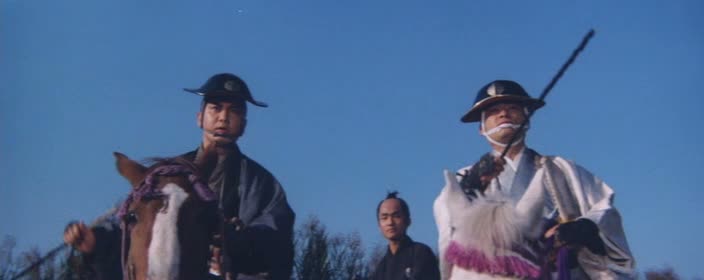
The film is a wonderful example of Japanese cinema, merging the historical Samurai film with a ghost/vampire story. The film is moody and atmospheric, mainly shot at night. The acting is good throughout and whilst the direction may not be as utterly glorious as that offered by Kaneto Shindô in the previous year’s Kuroneko it does the job masterfully. 7.5 out of 10.

The imdb page is here.