Showing posts sorted by date for query peter cushing. Sort by relevance Show all posts

Friday, April 19, 2024

Corruption – review


Director: Robert Hartford-Davis

Release date: 1968

Contains spoilers

This is another film where medical processes are used in a vampiric way – this time to restore beauty, which makes it analogous to Atom Age Vampire, indeed like that film the disfigured woman’s scarring is on half her face and like that film the mad doctor undergoes a Jekyll and Hyde like transformation – the difference here being that his transformation is not physically into a monster but mentally through the stress of the position he is in.

leaving theatre

It starts with an operation and the lead surgeon is Sir John Rowan (Peter Cushing) who has completed a monumentally long surgical procedure. He goes home and falls asleep to be woken by the telephone. It his fiancée and model, Lynn Nolan (Sue Lloyd), who reminds him of a party that photographer Mike Orme (Anthony Booth) is throwing. When the couple arrive in the car we can tell it is a May to December relationship and once in the party it is clear that Sir John does not belong in this swinging (sixties) scene.

injury

Mike clearly has a thing for Lynn and spurns another model (Vanessa Howard, the Blood Beast Terror) to photograph her. When he starts encouraging Lynn to undo her dress, suggesting the shots get kinky, Sir John intervenes and the two men fight. A photography light is knocked over, landing on Lynn and badly burning her face. In the hospital the fiancé is told they have saved Lynn’s sight and her distraught sister, Val (Kate O'Mara, the Vampire Lovers) arrives.

scarred

Lynn wakes screaming and Val is by her bedside. She is back home and Val tells Lynn that Sir John is working day and night to find a way to rejuvenate her skin. For her part Lynn, knowing that her modelling career is over and knowing she is now disfigured, simply wants to die, asking for a bottle of pills to be left for her. Sir John, for his part, is irritable given setbacks. Eventually he decides he has found a cure and shows Lynn a Guinee pig he claims to have injured in the way she was and cured.

surgery at home

He goes to the hospital and performs an unauthorised autopsy on a car crash victim stealing her pituitary glands. He is caught by his mentee Steve (Noel Trevarthen) who reluctantly turns a blind eye. At home he has made a surgery theatre with laser medical implement (the film was also released under the title Laser Killer) and operates on Lynn with Val assisting. Whether he transplants the gland (ala The Man In Half Moon Street or makes some form of injection I couldn’t tell, but the surgery also involves cutting scar tissue with both scalpel and laser.

the kill (UK version)

The next scene has a dinner party with Steve attending and Lynn’s face is back to normal. Lynn and Sir John are to go on a cruise but they return early as her face reverts to what it was. Sir John decides it is because he used a dead gland and must use a living one (how long it is deemed ‘living’ is questionable given the violent removal, as we’ll see). This sees him visiting a flat of ill repute and here the film has two versions. The UK and US versions have him visit a prostitute (Jan Waters), there is a bizarre scene of her taking a phone call and discussing clients, him getting cold feet and it all leads to an attack that is mostly unseen. In the continental version the prostitute (Marian Collins) strips and he gets cold feet, she demands payment and he begins a frenzied attack. In both cases he cuts her head off. All three versions are on the Indicator Blu-Ray.

Peter Cushing as Sir John Rowan

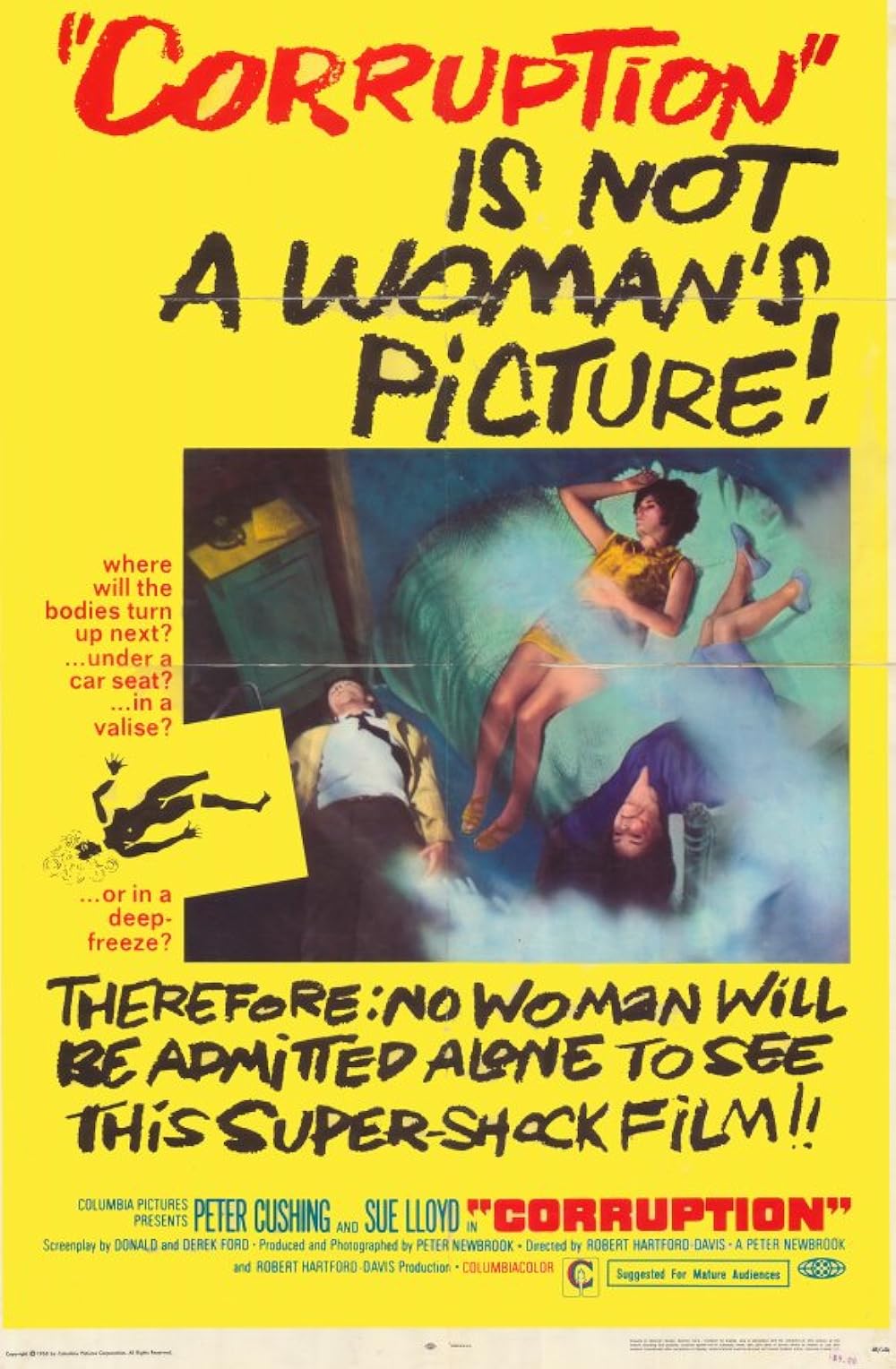
Long and short, the “living” gland also degrades but slower and Lynn demands another operation before the scarring returns. However, it is Cushing’s deranged attacks on victims that makes quite a ludicrous narrative (which includes a home invasion by criminal beatniks – or British cinema approximations of such, a most audacious train carriage murder/decapitation, and a mass laser killing) watchable. Cushing offers a superb performance, from suave to manic, with regret, shock and pathos. He makes this worth watching. Sue Lloyd likewise offered a chillingly sociopathic performance. There is an undercurrent of misogyny to the murders, which matched the cinema poster tagline “Corruption is not a woman’s picture”. The coda scene fails to hit the mark but I won’t spoil it, nevertheless 5 out of 10 for a superb Cushing performance.

The imdb page is here.

On Blu-Ray @ Amazon US

On Blu-Ray @ Amazon UK

Monday, May 29, 2023

Wrath of Dracula – review


Director: Steve Lawson

Release date: 2023 (scheduled)

Contains spoilers

Director Steve Lawson’s last foray into the vampire genre, Bram Stoker’s Van Helsing, was a strange beast. Making good use of low numbers of locations, it concentrated on a segment of Stoker’s novel and did take some liberties, though not as much as he does in this film. It was, perhaps a tad talkie, had a distinct lack of Dracula himself and, when I reviewed it, blog commentator Octobercynic said “The ending also seemed, to me, to leave the door open for a possible sequel.” Though there are intertextual links, this does not appear to be that sequel

Mark Topping as Van Helsing

So, whilst the primary character of Mina (Hannaj Bang Bendz) has a different actress to the cameo appearance of the character in the previous film, there is a picture (only) of Lucy and it is of actress Charlie Bond who played her in the earlier film and Mark Topping reprises his Van Helsing role, though without beard and, to be fair, the clean-shaven version did read towards Peter Cushing. However, the story doesn’t fit with the previous one particularly well, especially as Dracula (Sean Cronin) does not leave Transylvania, and it is much less novel orientated, ploughing its own narrative furrow.

Mina typing journal

It starts with Harker (Dean Marshall) writing to Mina, who he is already married to, alerting her that he is a prisoner in Castle Dracula. He hides the letter in papers due to be posted to England re the real estate purchases, following which he is pulled backwards by one of the brides – Maria (Ayvianna Snow, Vampire Virus), Frida (Marta Svetek) and Ilsa (Jasmine Sumner). Sometime later Mr Hawkins (Carl Wharton, Saint Dracula) brings it to Mina but isn’t very helpful as Jonathan had signed a waver and they don’t have to help him. She undertakes to go to Transylvania herself.

arriving at Castle Dracula

She uses the hand written travel itinerary she had typed for Jonathan and gets to Castle Dracula when she is intercepted by a man – Van Helsing. A couple of points here did jerk me out of the story, unfortunately. She aims a flintlock pistol at him, recognised as antique in the dialogue, but it went unnoticed by the characters that it was uncocked. A minor thing, perhaps, but then saying that she had travelled overnight from London was just plain wrong – to be fair, later Van Helsing suggested her journey did take time and it may have just been a dialogue error that was missed.

training montage

He persuades her to go to a nearby inn rather than try to get in the castle. Once there he gives her a potted history. In this Dracula, as a man, was seduced by a lamia but his strength of will caused him to make her turn him rather than just kill him. He also mentioned tracking Dracula across several countries over three years – his mention of Shanghai brought my mind immediately to Legend of the Seven Golden Vampires. His thought is that she should return to London, something she won’t do, but he suddenly realises that Dracula’s predilection for beautiful women might gain them entrance to the castle. He offers to train her – and the owning of a Chinese book on martial arts makes this feel less silly than it might of.

brides

The film’s direction, then, is one that has a bit more action; indeed, this might be said to be Steve Lawson’s female-centric gothic take of Dracula by way of Buffy the Vampire Slayer, with Mina and the brides taking centre stage. Dracula does make an appearance but it is limited and Van Helsing serves more as support for Mina than anything else. The action isn’t perfect, some moments swaying towards comedic – especially one scene where it appears speeded up slightly, but for the most part it holds the attention. Vampires in this are killed by stake through the heart, decapitation, sunlight or silver bullet – the last again being unfortunate as Van Helsing fashions bullets rather than the spherical shot the flintlock would take. There is a Bagua mirror in Van Helsing’s hunter kit but he only uses it as a mirror and not as a Taoist priest would in a Chinese vampire movie.

staking

Set in the 19th Century, the production makes good use of locations, on a tight budget, to imitate the era and the location – with tight angles allowing location work that imitates the look they needed well. Like the predecessor there is some soundtrack choices that feel intrusive, given their more modern sound. It does get a bit talkie in places, despite the action, but there is a nice staking moment. With the last film I said it would appeal more to novel fans, not so much with this but it will appeal if you liked the last effort but wanted a bit more expansion (action and location). 6 out of 10.

Note the review was from an advance screener. The imdb page is here.

Monday, August 05, 2019

Vamp or Not? Island of the Burning Damned

So, this is a 1967 British sci-fi/horror that was directed by Terence Fisher, starring Christopher Lee and guests starring Peter Cushing. I was contacted by Clark, who asked whether I had seen the film (under its title Night of the Big Heat) and looked at it as a ‘Vamp or Not?’ Given the director and stars I have mentioned it should be great, thought I, but Clark cautioned, “It's dreadful, you'll love it”, and he was right.

It starts with a meteorological station, on the island of Fara, and a car with its soft top down drives past. The driver, Angela (Jane Merrow), is clearly feeling the heat. Meanwhile a man, Godfrey Hanson (Christopher Lee), is checking a camera. It is melted. He sets up a new one but is observed by a tramp (Sydney Bromley, the Fearless Vampire Killers). The tramp has a gander at the equipment once Hanson has left and then heads to the cave where he lives. There is a high pitch sound and he looks fearful as he dies…

Jane Merrow as Angela
Angela has broken down as the car is overheating and a van, driven by Tinker (Kenneth Cope), stops. Angela can’t understand, she had the water checked on the mainland and he asks if she has put anti-freeze in it. She has and that’s the problem – as it is causing the overheat – but, she insists, you need anti-freeze in winter. As we discover it is winter throughout the UK but Fara is having an unseasonal and localised heatwave. He puts water in her car and tells her to let it cool down. By the time she reaches local inn the Swan he is sat outside enjoying a pint.

Cushing and Lee
The Swan is run by Frankie (Sarah Lawson) and the only customer indoors is Dr Stone (Peter Cushing). Angela introduces herself, she is looking for Jeff (Patrick Allen), Frankie’s husband and novelist, and she is his new secretary. Jeff has popped over to the mainland and Hanson comes in asking if Jeff has returned with his parcel. He is due any time. As it stands, unknown to Frankie, Angela and Jeff had a fling and she has followed him to the island to continue it (it sounds as though he moved there with Frankie to get away from her). The heat is rising (literally), folk start acting odd and only Hanson suspects the truth.

attacked
Hanson is a scientist and he believes that the island is being invaded by an advance force of aliens. They are increasing the heat to make the island hospitable. They start attacking energy sources, including animals and humans. I’ll let Hanson explain, “we’ve been sending out high frequency impulses to explore space… …to these beings, they represent a life force… …these beings are composed of high frequency impulses in heat form. They transfer like any form of high frequency…” so they came through the station’s scanners and then materialised, physically, in the atmosphere. At one point Hanson suggests they are from another planet, at another from “where the cosmic gases ferment”. There is so much scientific techno-babble it is untrue. The aliens, they discover, are attracted by light (another energy form) but why ‘Vamp or Not?’

a creature
Essentially, each attack sees them drain the energy (from a car battery, for example) but also from the animals they attack (be it sheep or humans). They do this by causing the animals to burn, through the sound one assumes, and extracting the energy from the combustion – Hanson suggests they are looking for an energy source to keep them alive. So, essentially, they are eaters of energy. They look like blobs that glow and the men try to use explosives to destroy them (of course, that is another energy form). How can they be killed, let us just say that we have a methodology akin to War of the Worlds – not a virus but the Earth has a method of combating the invading force.

winter heatwave
So, Vamp? Well they do consume energy – any energy (there is a logical flaw with them wasting energy by heating the planet up – assuming they somehow generate the heat) and so it depends how generous you want to be about their vampiric nature (my inner jury are still out). However, if you are happy to go down that route I can tell you that Clark was absolute right, this is dreadful but I did love it. The imdb page is here.

On DVD @ Amazon US

On DVD @ Amazon UK

Thursday, March 03, 2016

Ten Years of TMtV: Taliesin’s Top 10 Vampire Films


I have had a top 100 films posted on the blog since 2009. A top set of films is always going to cause a tad of controversy – no one is likely to agree – but I thought, during the ten years celebrations, I’d do a brief top 10 article and see where I am at this point in time as the top 100 is a living post and changes as new films enter the chart.


10 – Marebito

Director Takashi Shimizu took us into worlds hidden behind the modern visage with his 2004 film Marebito. A peculiar cross of Japanese horror, dogme filmmaking and Lovecraftian aesthetics this is possibly one of the more obscure films in the top 10. It absolutely brims with ideas – to the point that I think you could write a book studying the different aspects of the film.

I said in my original review that “the film actually redefines, to me, the sensual vampire feed, a devouring and a passionate kiss at once.” It is not that the passion of the kiss and the wanton needs of the feed have not been conflated before, they have, just not in such a satisfying way.


9 – Horror of Dracula

There had to be at least one Hammer film in the top 10 and it is fitting that the first Christopher Lee Dracula movie is one of them. I did a series of reviews near the very start of the blog, looking at all the Hammer vampire films (then) available, which was great fun and involved back to back watching of all the Hammer vehicles.

I could wax lyrical about this but will simply say “Christopher Lee and Peter Cushing” – a phrase that sums up the genius of the film. Look out for the Blu-Ray edition where a couple of the scenes have been extended from the Japanese print (though the quality of the extra footage is noticeably lower).


8 – Near Dark

Katherine Bigelow’s 1987 classic Near Dark came out the same year as the Lost Boys. Now I am a fan of the latter but it amuses me when it is held up as a visceral vampire film (especially in some modern memes complaining about the more emo romance orientated vampire films) when this was a truly visceral vampire movie.

Bloody, gory and extremely well thought out, it eschewed gothic trappings and religious artefact for a Western sensibility merged into the road trip movie. I still dislike the very last saccharine scene but the rest of the film more than makes up for it.


7 – Black Sunday

Mario Bava was one of the great directors and his 1960 film Black Sunday is not just a great vampire film or a great horror film, but a great film full stop. Although not her first film it really was the one that introduced the remarkable actress Barbara Steele to the world, playing both the innocent Princess Katia and her evil doppleganger the witch/vampire Asa.

The film was based on Gogol’s Viy, one of my favourite vampire source stories, though so vaguely you might not see the resemblance. It's also worth noting that the UK Blu-Ray release has the film I Vampiri as an extra.


6 – Viy (1967)

Again based on Gogol’s Viy, this Soviet film, directed by Konstantin Ershov and Georgiy Kropachyov, was much closer to the source story. It was one that I struggled with (with regards it being a piece of vampire cinema) as the blood drinking mentioned in the story vanishes. However it does have the phenomena of hagriding – a form of psychic vampirism – and the living corpse central to the film is archetypally vampiric in look.

Purists might argue about its inclusion but to me this is a must for every vampire fan’s collection.


5 – Vampyr

Carl Theodor Dreyer’s 1932 film is as much a mood piece as anything. Its deliberately overexposed film, the locals chosen to act for their looks rather than their abilities and the strangely detached (and H P Lovecraft lookalike) hero Allan Gray, played by Baron Nicolas de Gunzburg under the alias Julian West, all conspire to create one of the most atmospheric vampire pieces ever constructed.

The film is very loosely based on Carmilla and the Masters of Cinema edition is absolutely essential.


4 – Interview with the Vampire

Possibly a controversial inclusion (in a world where blockbuster movies can’t be recognised as great films for some reason), I remember being as nervous about the casting of Tom Cruise as Lestat as author Anne Rice. I also remember going to see the film at the cinema on a rare snowy day (my hometown gets mercifully little snow) and being absolutely blown away.

Perhaps it helps that I am a fan of director Neil Jordan’s work generally but this is the first film in the top ten with a 10 out of 10 mark. This is because the film, to me, was a nigh on perfect Gothic construct with some stellar performances, not least from Kirsten Dunst.


3 – Let Me In

Glorious. The best word I can find to describe the second vampire film in the modern era of Hammer. The film inspired less a review and more a case study when I looked at it here and, whilst I like Let the Right One In very much, I adore this version.

The film, and a proposed TV series, went on to inspire an article for Vamped, entitled Defending Abby: Nothing Wrong With ‘Let The Right One In’ Remakes, where I defend the idea of the remakes.


2 – Nosferatu, eine Symphonie des Grauens

The grandfather of vampire films. No, it wasn’t the first but it is the first surviving vampire film and what a film. An unofficial adaptation of Dracula it really did set a benchmark (though the more suave, stage play version of the Count would become the predominant guise in pop culture).

There are several cuts and versions of the film. If you have had the misfortune to see Orlock the Vampire in 3D you will understand that the wrong treatment can ruin this film. For one of the greatest moments in vampire history I recommend (as with Vampyr) the Masters of Cinema edition.


1 – Isle of the Dead

A film that has absolutely stayed with me all my life. A film I remember watching on TV with my grandfather and being wowed (although I didn’t know it was a vampire film at the time). It is ironic that the #1 film on TMtV is a film that doesn’t have a vampire in it.

Instead it has a fear of vampires, it has a belief in vampires and it has a perfect exploration of the usurpation of science by superstition when fear grips the mind. It has Boris Karloff in fine form and the fear of the vorvolaka – the vampire type at the heart of the movie – becomes a palpable presence within the film.

Saturday, August 23, 2014

The Aswang Complex in Philippine Folklore – review

Author: Maximo D. Ramos

First published: 1990

I have wanted to get some of Ramos’ work on the aswang for a long time. This is the first volume I have managed to get (the volumes appear from time to time, the price never usually at a level that would facilitate purchase).

After an introduction that explains, briefly, the five primary genus of aswang in Philippine folklore: Ghoul, Vampire, Viscera Sucker, Weredog and Witch, the book has collated testimonies gathered in the field of stories and experiences of aswang from the five types (and unclassifiable ones). Each transcript is in Tagalog (I assume) and English, unless the story was collected in English and then it is in that language only. The book usefully tells us where the story originated from and who the story was collected from, but not when, unfortunately.

What is clear is that, if we thought there was myth bleed/drift in the stories and folklore of the Slavs they have nothing on the myth drift in the Philippines. The stories in one section would often seem better or equally as well placed in another section at times. There were clear Spanish influences from the colonisation, including the addition of Christian iconography into the apotropaic measures, and also some things that made one wonder whether Western films have begun to creep into the Philippine myths. In an interesting twist on cushining a cross (i.e. putting two sticks together à la Peter Cushing) we get four friends lying on the floor in a cross shape to ward of an aswang.

As an example of myth drift, we get the tale of a viscera sucker who lies below the house of a pregnant woman in labour (viscera suckers also seem to go for foetuses and new-borns) but the feeding pattern mentioned is not only eating the baby but sipping “the blood that flows out of the mother.” This could also be deemed as vampiric activity. We get the term wakwacked – meaning having the blood sucked out (also in relation to a viscera sucker's attack).

Aswang traits can be inherited and are actually passed on in some cases. We hear of a male aswang who lay dead but still breathing as he had no one to pass his aswang nature to.

However it is fascinating to read the tales from the source, from a people many of whom believe sincerely in aswang. However, because these are collated stories, without commentary, this book is not for all. However for the budding vampirologist, student of Philippine Folklore and anthropologist/sociologists this could prove invaluable. 7 out of 10 reflects the fact that it is somewhat over-specialised.

Tuesday, September 03, 2013

Honourable Mentions: Madhouse

Okay, this one is a real stretch and just to get things straight – whilst there are two people dressed as vampires in a costume party (and another as a vampire’s victim) – there are no real vampire moments in this. However a connection to a famous vampire movie lends this a genre interest.

But first of all let us look at some of the stars of this 1974 joint API and Amicus film that was directed by Jim Clark. The star was Vincent Price (the Last Man on Earth, Scream and Scream Again, the Monster Club and a voice cameo in Bud Abbott and Lou Costello Meet Frankenstein). It co-starred Peter Cushing, Robert Quarry (Deathmaster, Count Yorga, Vampire & the Return of Count Yorga), Adrienne Corri (Vampire Circus) and Linda Hayden (Taste the Blood of Dracula & Vampira). It also contains archive footage, staged as films starring Price’s character rather than Price himself, with Basil Rathbone (Queen of Blood) and Boris Karloff (Isle of the Dead, Black Sabbath, House of Frankenstein, Mad Monster Party? & hosting the Thriller episode Masquerade). A veritable smorgasbord of genre names.

Robert Quarry and Adrienne Corri
The story starts 12 years ealier and a private screening of the new Dr Death movie – starring Paul Toombes (Vincent Price) as the titular character. After the screening Toombes announces his engagement to Ellen (Julie Crosthwaite). There is some bitchiness from a previous leading lady, Faye (Adrienne Corri), who suggests that all Toombes gave her was a stake through the heart. Then producer Oliver Quayle (Robert Quarry) drops the bombshell that Ellen was a lead… in his porn films. Toombes is incensed and then, as she retreats to a bedroom, we see someone don the Dr Death gloves. Toombes wakes from a blackout and goes to apologise to Ellen but, as he touches her shoulder, her head falls off.

Vincent Price and Peter Cushing
The credits show us Toombes being treated in a mental institution and we discover that it he was acquitted but the psychiatrists believe that he had a breakdown and became the Dr Death persona. Twelve years on and he has been released and called over to England where his friend Herbert Flay (Peter Cushing) – the writer of Dr Death – has sold a TV series based on the character to Quayle. They want him to reprise the role. However people start dying in ways identical to deaths in the Dr Death films and Toombes can only question his own sanity.

Yorga outfit
The reason for the mention centres on a costume party celebrating the TV series. It has Flay and Quayle dressed as vampires and PR woman Julia (Natasha Pyne, who played Laura in the unfortunately lost Mystery and Imagination version of Carmilla) as a vampire victim. There was an irony, of course, to Cushing being dressed as a vampire given his association with the Van Helsing character but we should remember that he made Tender Dracula that same year, in which he played an actor who believed he was a vampire (and may have been, though the film is unclear). Natasha Pyne as a victim, given her Carmilla role, and Quarry as a vampire seemed in-jokes. It is because of Quarry, however, that we mention the film as (according to IMDb) the outfit he wore was the very one he wore in Count Yorga, Vampire – though to be honest, Quarry and Cushing just dressed as vampires would probably have been enough for me.

The film itself is fascinating, star studded, silly and – eventually – blooming ridiculous. The imdb page is here.

Tuesday, January 10, 2012

Honourable Mentions: One More Time


Now I have, many a time, stated that vampires get everywhere… and they really do. This is a 1970 comedy starring the wonderful Sammy Davis Jr. (Messiah of Evil & the Cannonball Run) as Charles Salt and Peter Lawford as Christopher Pepper.

It has much of what you would expect, a swinging soundtrack, mistaken (and assumed) identities and some bits that perhaps wouldn’t be put in a film nowadays. Aside from that it has the breaking of the fourth wall and some genuinely surreal moments in amongst the more mundane gags.

Christopher Lee as Dracula
The moment we are concerned with sees Charles Salt accidentally opening a secret passageway in a bookcase (the only book he could find of interest to read being the Kama Sutra and that is the secret switch). He looks into the dark passageway and is confronted by a cornucopia of horror characters that include Peter Cushing reprising, according to imdb, his Dr Frankenstein role (though I would have preferred to think of him as Van Helsing) and Christopher Lee as Dracula. Both actors were uncredited but both had a brief speaking moment.

Peter Cushing as Dr Frankenstein
Later, when trying to show this to Pepper, the secret door opens to reveal nothing more sinister than a booze cabinet. (At the end of the film it becomes the chamber of horror again, but unseen to the audience and only revealed in noises).

So, Sir Christopher Lee reprises his Dracula character again, if only briefly and vampires, yet again, get everywhere.

The imdb page is here.

Friday, October 14, 2011

Freakshow –review

Director: Constantino Magnatta

Release date: 1989

Contains spoilers

This was an eighties portmanteau film and I actually think it was better than it should have been. It had an interesting premise at its core, a vampire section and a bit of zombie/vampire crossover.

The portmanteau section began with an audience watching a film in a cinema. The film ends, the crowd leaves and in the street a gunman (Dean Richards Wiancko, Red Blooded American Girl) opens fire, committing mass murder.

Audrey Landers as Shan
We see the aftermath through the eyes of reporter Shan Nichols (Audrey Landers) who was on the scene with a camera crew as the killer had tipped her off earlier that he would do something spectacular. She hadn’t informed the police, rather she went after the story. Her crew are disgusted with her and she is left to get home by herself. On the way back she comes across Dr Borges (Peter Read) who takes her into his freakshow – where the exhibits show the viewer their own inner demons.

warding a zombie with a cross
These then are the sections and we have the story of a desperate junky and a devilish dog, the story of a woman on a designer drug who ends up trapped in her own body and assumed dead by police, doctors and the morgue – this, of course, is a reworking of earlier similar tales. I mention a zombie/vampire cross over and this is in the final story where a couple of gravediggers are stealing the nutrient rich earth from the graveyard, to spruce up a golf course, and the dead want revenge. As well as a golf cart driving zombie, we get a priest crossing two golf clubs (in a Peter Cushing manner) and repelling a zombie.

making the delivery
The actual vampire section starts in a pizzeria on Halloween, a place full of stereotyped, misogynistic Italian pizza guys, and Wilbur – the new employee. Wilbur is sent to the stock room (after entertaining kids with magic tricks). However a call comes in for a pizza, no garlic, to be delivered to 1313 Bram Stoker Boulevard. The owner’s son is next to deliver but she won’t let him go to that place and so Wilbur is sent on the delivery. En route the pizza guys bet him 2 weeks wages that he won’t make the delivery.

welcoming the pizza guy
He gets to the building – which is a girl school – and enters the creepy, deserted looking place. Part way through a hand comes out of the floorboards at him but he seems rather calm, rationalising that it was a prank. He gets to a room were two girls wear lingerie and lure him to a bed. Suddenly he is grabbed by the throat, by a long nailed hand, and forced to watch as quite a few girls basically do a low-key, non-nude strip from a variety of outfits.

strange vampire form
We never see the hand’s owner and, eventually, he tells them to stop. He calls the hand a nice effect and then reveals his true face – he is a vampire. And what an odd looking vampire, with giant fangs and tusks that seem to emerge from his cheeks. Apparently the girls were just girls, playing a Halloween prank. No longer though, they are his now.

a veritable harem
He bites each one (a rather bloodless affair that seems more a nuzzle on the neck) and turns them all into vampires. He goes back to the pizzeria to get his revenge, suggesting to the guys that there is a party over at the school – one of the girls rings the pizza place to confirm Wilbur’s story and that, as they say, is that – well bar a quick hiss at the camera with tusks and fangs on show once more.

the floorshow
It wasn’t a great story but it had just the right level of oddness to qualify as good fun. The entire opening was drawn out and the entire prank seems too elaborate for its own good but it made an interesting, very eighties and very non-nude watch. In the grand scheme of things it doesn’t deserve a massive score (as always, it is only the vampire section that is scored) but the film (as a whole) is worth a quick watch if there is nothing else on for the weirdness factor alone. 3 out of 10.

The imdb page is here.

Thursday, March 19, 2009

Dracula and Son – review

Directed by: Edouard Molinaro

Release Date: 1976

Contains spoilers


This was a French vampire comedy and one cannot but help compare and contrast with Tender Dracula as they are both comedies, from the same country of origin, they both featured Gernard Menez in the cast and this starred Christopher Lee, whilst the earlier film starred Peter Cushing. You’ll be pleased to note that this did not plumb the depths of movie Hell that Tender Dracula managed.

There is a degree of compare and contrast to this article, however, as I watched two versions of the film before writing it. Obviously I would dearly love to see the original French film with English subtitles – as far as I am aware there is no way that’s going to happen *Edit 08/08/2022 Severin have released a 4k restoration of the Director's Cut (in French or English) and the US re-cut and dubbed version as part of the Eurocrypt of Christopher Lee Collection 2, links below – but what I actually watched were two different dubbed versions of the film. One, more comedic with very silly dubbing, came in at 78 minutes (and for clarity I shall refer to it as DaS_A). The second was less comedic, had more serious dubbing and was 94 minutes in length (for clarity I shall refer to this version as DaS_B).

How different was the dubbing? If you research the film you find that Christopher Lee shot the film in French. Some sources state he was dubbed into English and others state he dubbed himself into English. DaS_B was certainly Lee’s own voice, I am fairly certain that it was another voice actor in DaS_A. Indeed the dubbing is very silly in DaS_A, voiceovers that aren’t on the other version, characters referring to the voiceovers and even different character names. The son of ‘Dracula’ (Bernard Menez) is called Ferdinand in DaS_B and Victor in DaS_A (in which he has a faux Bronx accent). Even the start of the films are different, with the shorter film having an animation of vampires through the ages curtailing the actual running time further.

In eighteenth century Transylvania a coach looses its wheel. Before it can be fixed a second coach comes along and transports the two female passengers, Herminie (Catherine Breillat) and her chaperone Marguerite (Claude Génia), away. It is clear that it is a vampire’s coach and Marguerite is bitten on the journey. They reach a castle and Herminie is left to meet the Prince of Darkness (Christopher Lee). We should note that, on release, it was decided he was Dracula – against Lee’s protest – though the film never actually was meant to be a Dracula movie. We see one of the problems with DaS_A here – which is it creates its own plot holes. Herminie and the Prince end up having some coffin sex and she notes that she has no fang wounds with her reflection. In both versions the Prince falls for her and wants a child and heir, however in DaS_A he says he is professional with his bites and has not left a mark, but she does not turn and he leaves quite vivid wounds when he does turn her after she has given birth, whilst in DaS_B he makes it clear that he has shown self control and not bitten her.

Anyway, she does become pregnant and gives birth to a son – at which point the Prince does turn her whilst leaving the child in the care of Marguerite, who is to be the nanny. Herminie goes on her first hunt – at which point we see a cross that in DaS_A is referred to as the Transylvanian double-cross – but she fails to return to the castle in good time and is fried in the sun. Five years later and Ferdinand is a precocious brat who plays bowling with a skull and the urn of his mother’s ashes and traps Marguerite in the sun – killing her off.

By the time he is over 100, the Prince takes Ferdinand hunting as he cannot be fed from the bottle all his life. At this point Ferdinand is sporting a very silly moustache. In DaS_B no comment is made with regards this, in DaS_A the dub suggests that it is a false moustache as he doesn’t want to be seen with his father! Then the castle is lost to the Communist revolution and the Prince decides it is time to leave. Interestingly we get a call for a cross, when confronting a vampire servant, and a hammer and sickle are crossed to make a cross – I preferred the Doctor Who – the Curse of Fenric idea that faith in the revolution made the hammer and sickle a potent symbol.

To cross the border the prince has them kill a couple of French sailors and then they take their place in the coffins. Unfortunately they end up being buried at sea. Ferdinand washes up in France whilst a fishing boat picks up the Prince and he ends up in England. The next segment shows their fight to survive. The Prince struggles – even biting a rubber doll – until he is found by a movie producer who thinks him perfect for his vampire movie, obviously vampires can be filmed in this despite having no reflections. In DaS_A it is because he looks just like Christopher Lee!

Later, as a successful star, the Prince travels to Paris and is reunited with his son. However they both fall for the same girl, Nicole (Marie-Hélène Breillat) and Ferdinand decides he must protect her from his father whilst wooing her – she shows more interest in the Prince at first. The Prince wants to have his toothsome way and has decided she will replace Herminie and Ferdinand just wants a girl it seems.

Lore wise I have mentioned much of it – sunlight kills, lack of reflections etc. What I probably didn’t make clear is that a cross can kill as well as ward. However one thing that neither version of the film explains well is the fact that Ferdinand is able to become human. To be honest he doesn’t know how but I suspect it was meant to be a combination of him being a particularly poor vampire and experiencing true love.

The two films are very different experiences. One, DaS_B, a gentle comedy with some languid moments that amount to poor pacing. The other much better paced but with the most ridiculous dub and some very silly humour – that does work on certain levels but does come across as a bit student/puerile. Neither version noses above the other score wise.

I would love to see this restored and in the original French and DVD companies should note that if they released a set with an original French/English subs and the two dubbed versions it would be something, I think, collectors would go for. For both the dubbed versions 3.5 out of 10.

The imdb page is here.

On Blu-Ray @ Amazon US

On Blu-Ray @ Amazon UK (note this is Region A)