Showing posts sorted by date for query Vincent Price. Sort by relevance Show all posts

Saturday, May 30, 2026

Honourable mention: Scooby-Doo! Mystery Incorporated – Season 1


This was the first season of the 2010-2013 incarnation of Scooby-Doo as a serial cartoon where there was an overarching story arc. In actual fact, I did look at this season’s vampire episode, the Secret Serum, previously. Now, when I reviewed that I said “There is an estrangement between Shaggy (Matthew Lillard) and Velma (Mindy Cohn) – who were, it appears, an item. Plus Fred (Frank Welker) and Daphne (Grey DeLisle) seem to have issues, making the gang drift apart in different directions by the end of this – distractions; what we want is mystery solving not soap opera teen romance. For heaven’s sake we are watching a talking dog…”

vampire film

I do not take that back – the introduction of character romance (and romantic failings, in the case of Velma and Shaggy) seemed a distraction as I watched the whole thing – but there was enough mystery solving and Scooby-ness to keep me going back to it (indeed, I might be the father of an adult son but I’ll always maintain that Scooby is for all ages). In Fact, despite the more soap aspect, the season was perhaps darker than other Scooby-Doo series and, as it happens there were (beyond the vampire episode) some vampire connections through the season that were worth mentioning here.

the Bloody Stake steak house

First of all was a restaurant in Crystal Cove (the town that seems to attract fake paranormal activity at a rate of knots). A steak house, one assumes, called the Bloody Stake, which has a vampire logo. The restaurant appears in three episodes of the season and is most notable for Shaggy (Matthew Lillard) and Scooby (Frank Welker) being refused any more helpings on the "All You Can Gorge" night.

stake in hand

We see Shaggy and Scooby about to indulge in the Vincent Van Ghoul (Maurice LaMarche) movie marathon at one point. Due to this we see a tad of a vampire film staring Van Ghoul as a vampire hunter, stake in hand, with the implication that he is fighting off an army of vampires. Van Ghoul is, clearly, based on Vincent Price and I understand that Warner Bros received Price’s estate’s permission to use his likeness and voice.

vampire bust

Van Ghoul actually appeared in the 13 Ghost incarnation of Scooby-Doo and, in this season, his fans Shaggy and Scooby actually meet him when they win a competition to have dinner with him (which is a set up for a new ‘scare’ reality TV show Van Ghoul has, but leads them to saving him from a monster). In the house we see a Poster for O’Vampy, one of his films, and a vampire bust/mask out on display in the horror icon’s mansion.

teen Vamp literature

Lastly, the gang becomes embroiled for a second time with professor and horror author H.P. Hatecraft (Jeffrey Combs, Holiday Hell, Frightmare, Necronomicon: Book of the Dead & Dark House) – as an aside, Hatecraft is obviously modelled on Lovecraft, who Combs played in Necronomicon. In their second encounter Hatecraft is being ousted by Regina Wentworth (Kari Wahlgren), author of Teen vampire series Dusk (made up of Dusk: Forbidden Love, Dusk: Early Evening and Dusk: Just Before Bedtime). There is a cut-out of the main vampire character causing Daphne to muse at what Fred would look like with “fangs and skin the color of boiled pork”.

Daphne dates an actor

So, there we have the additional vampire references in Season 1 of Mystery Incorporated. Note that in Season 2 there was the reappearance of the Bloody Stake a couple of times and Daphne dating the actor from the Dusk films – but no real vampire reference otherwise. The imdb page is here.

On Demand @ Amazon US

On Demand @ Amazon UK

Wednesday, December 28, 2022

Short Film: Soy Leyenda


This short by Mario Gómez Martín was shot in 1967 and released by Escuela Oficial de Cine, Spain’s official National Film School, and excitingly is a make of I am Legend. It has appeared on YouTube, with subtitles, and is reminiscent of the earlier the Last Man on Earth but that could be just in taking beats from the novel – and the ending of this does not have the Christ connotations of the earlier film.

Moisés Menéndez as Robert Neville

It begins with a description of a world fallen, of the nuclear war and then the biological warfare. It tells us that there appeared vampires, products of the war, and the only uninfected man, Robert Neville (Moisés Menéndez), whose weapons are “those that Bram Stoker had anticipated: garlic, the cross, mirrors, stakes and sunlight…” The bit of the narration that was really strange was, before the mention of vampires, the suggestion of giant Lobsters – fear not, they do not appear, but Neville also speaks of giant grasshoppers (in a flashback scene that resonates with the novel).

Ana Castor as Ruth

The film crams in much of the story. Neville living alone (within something more akin to a bunker), the vampires led by Cortman (José María Resel) goading him to come out through the night. Menéndez perhaps does not have the powerful inner monologue that Vincent Price brought to the role but has a harried, desperate air that suits the character. We do see some level of vampire hunt, we get flashbacks to the illness of Virginia (Elisa Ramírez) – though there could have been a better segue into the flashback scenes – and her illegal burial and return. We get the delay at her grave and the appearance of Ruth (Ana Castor).

preparing to stake

It is perhaps a little hurried, after all Martín manages to cram it all into just over 36-minutes, but it is worthwhile stuff. The film suits the black and white 35mm treatment, there is a bleakness to the world that fits the story and every shadow feels oppressive. There is little in the way of practical effects. Whilst we see a stake brought to a vampire, the film cuts away from the actual impalement. Sound is this film’s ally, be it the distant yelling of the vampires or the thud of hammer on wood.

The imdb page is here.

Wednesday, November 02, 2022

Short Film: The United Monster Talent Agency


At around 8-Minutes the United Monster Talent Agency is a little bit of classic monster joy directed by Greg Nicotero and released in 2010. This isn’t so much a short film, rather it is a spoof news item. It starts, however, in a cave…

Kay (Cerina Vincent, Freaks of Nature) is led on a rock, she awakens and hears a roar. David (Sam Page) calls for her and soon they are reunited but not for long. The Gillman (Carey Jones) enters the cave and David, trying to stop its approach, is thrown to the side. It approaches Kay and then… Cut… a net is thrown on the Creature as the scene has finished.

Sam Witwer as Dracula

We are then in a Movietone news piece reporting from Hollywood and, more specifically the United Monster Talent Agency. This is the place that provides most of the monster talent for Hollywood – the conceit being that they are all actual monsters. Because of this we get fleeting moments with many classic monsters. The obvious one to mention is Dracula (Sam Witwer, Being Human (US), Dark Angel: Love in Vein & Angel) and we get him in both bat and human form.

The Thing

There are other vampires and genre related moments, however. We see an agent and a producer doing a deal over Dracula and the narrator (Andy Schoneberg) suggests its “two bloodsuckers agreeing on the price of one.” We also get a moment with the Thing From Another World (Jake Garber) and watch a scene being shot from Bud Abbot and Lou Costello meet Frankenstein, specifically the scene where Larry Talbot, on the phone, turns into the Wolfman (Dana Gould, Stan Against Evil: Vampire Creek). Incidentally the director in this scene (who in real life was Charles Barton) is played by Eli Roth.

The imdb page is here.

Saturday, October 30, 2021

Use of Tropes: Tales of Terror


I was contacted by Leila who wondered if I had given thought to the potential vampire aspects of the segment Morella in the 1962 Roger Corman vehicle Tales of Terror. In truth it was one of Corman’s Poe themed films I had not seen and so it seemed like a mighty fine excuse to watch it, if nothing else. After all this was a film with an exceptional genre cast – with Vincent Price front and centre in all three segments and Peter Lorre (M) and Basil Rathbone (Queen of Blood, the Magic Sword & Madhouse) supporting in a segment each. The screenplay was by Peter Matheson.

However, before I look at the film I wanted to just touch on interpretations of Poe’s story, which was published in 1835. In the Forlorn Demon (1953) Allen Tate made an observation regarding “Poe's heroines—Berenice, Ligeia, Madeline, Morella, {who} with the curious exception of the abstemious Eleanora—are ill-disguised vampires”. Indeed, I have looked at the Fall of the House of Usher, from whence Madeline comes, for it’s play with vampire tropes. Twitchell likens Morella to a lamia (which he ties into the vampire myth) mentioning her cold hands and almost mesmeric eyes.

Locke's House

The story has Morella die, in childbirth, leaving the unnamed narrator with a child who he does not name (until the story climax) but who, as she grows, looks more and more like her mother. It is clear in the original that the narrator was tied to his wife but not in love (indeed she repulsed him eventually) but doted upon his daughter. Not so in the film, which begins with the now adult (26-years old) daughter, Lenora (Maggie Pierce), returning to the family home to visit her father Locke (Vincent Price). She arrives at night and the coachman has to return to Boston, so she dismisses him thinking her father’s servants will help with her luggage.

Lenora arrives

However, no-one answers the door and she lets herself in. The inside of the mansion is festooned with cobwebs and no-one answers her calls. In the dinning hall the remains of a feast are buried in the dust of years and cobwebs aplenty (and a large spider to make the heroine scream). The kitchen is in marginally better shape. She finds her father and we hear that he has had no contact with her, bar paying for her tuition, having sent her away. She wanted to see him and he retorts that she has and should leave. On his own he speaks (to Morella (Leona Gage)) and says that her murderer has returned.

Morella mumified

Eventually truths start to emerge. The mummified corpse of Morella lies upon a bed – Locke unable to bear the thought of her buried in the earth. It also transpires that Lenore is dying, hence wanting to reconcile and her father quickly softens. In the story the narrator gives the child Morella’s name at baptism, when she is ten, and the child dies as he seems to hear the mother, from her tomb, say “I am here!” He then carries her to the vault to find the corpse of Morella gone. Tate suggests, “that the daughter is no real daughter but, as Morella's empty "tomb" reveals, Morella herself come back as a vampire to wreak upon her "lover"”

spectral touch

In this film, as father and daughter reconcile and Locke says “You have come home at last”, we hear the spectral voice of Morella say “At Last!” and see the complexion of the corpse change from mummified to something more lifelike. Lenore goes to bed and we see a shadowy spectral form of Morella leave her corpse and move through the house. I was reminded of the folkloric theory of the vampire actually remaining in its grave and its spirit wandering the neighbourhood. It reaches out to Lenora who screams. When Locke gets there she dies, but then breaths again after a moment, only to pass again. He covers her up but she makes a noise, he moves the sheet but the blonde Lenora is now the brunette Morella. Running back to the room where Morella’s corpse had lain, he sees Lenora now mummified on the bed…

Locke and Morella

It is easy to see, given the connection previously made by academics between Poe’ story and vampirism, how some tropes could stray into this. In this Morella has waited to return to avenge herself – not only on the child she blamed for killing her but also Locke, who she strangles as the house burns around them – as Tate suggested the returned Morella “{wreaking} upon her lover” though the narrator survives and Locke is killed. In this, it should also be noted, Locke adored his wife, she went unburied as he couldn’t bear to be parted and rather than doting on the child, he sent her away hating the one who had murdered his wife. Thus, Morella is the restless dead and she appears to need Lenora’s life to come back. Whilst she seems to possess the body, it does physically transform (and swap clothing, it should be noted) and the corpse takes on Lenora’s form – one might argue she has literally taken her daughter’s life so she might live. This lasts until her revenge is wreaked and she falls, becoming Lenora once more.

hypnotised at the point of death

I also want to mention the segment The Case of M. Valdemar, where Price plays the titular character – a dying man who has turned to the sinister Carmichael (Basil Rathbone), a mesmerist, to help manage his pain on condition that he allows Carmichael to hypnotise him at the point of death. This occurs and then Carmichael holds him in a state between life and death (despite the voice of Valdemar begging for release). I mention this because this reminded me of the Bloodthirsty Doll, which was released in 1970, in which the vampire is created by hypnotising her whilst dying.

ambulatory and rotting

The other thing to mention is that in this the state is kept for some time (we have an establishing shot showing a passage from rain to snow), though in Poe’s The Facts in the Case of M. Valdemar (1845) we are told directly that death had been arrested for nearly 7 months. In the film, however, Valdemar is able to get up and attack Carmichael to defend his widow (Debra Paget) rotting as he moves towards him. In the story, released by the mesmerist, we graphically get, “within the space of a single minute, or even less, shrunk -- crumbled -- absolutely rotted away beneath my hands. Upon the bed, before that whole company, there lay a nearly liquid mass of loathsome -- of detestable putridity.” A literary prototype for vampiric rapid decay in cinema, well over a century later.

The imdb page is here.

On Demand @ Amazon US

On Blu-Ray @ Amazon UK

Monday, March 11, 2019

I am Legend as American Myth – review

Author: Amy J Ransom

First published: 2018

The Blurb: Over the decades, Richard Matheson's 1954 novel I Am Legend has spawned a series of iconic horror and science-fiction films, including The Last Man on Earth (1964) starring Vincent Price, The Omega Man (1971) featuring Charlton Heston, and I Am Legend (2007) with Will Smith. Its compelling narrative about the last man on earth struggling to survive a pandemic that has transformed the rest of humanity into monsters has arguably become an American myth. While its core story remains intact, filmmakers have transformed its details over time, their often mixed messages reflecting changing attitudes about race and masculinity in the United States. This reexamination of Matheson's original novel situates its tale of a man's conflicted attitude about killing racialized others within its post-World War II context, engaging the question of post-traumatic stress disorder. It then analyzes in turn the novel's several film adaptations, focusing in particular on producers' choice of actor to bring to life Robert Neville, the last man on earth. Released respectively during the Cold War and the Civil Rights Movement, the Vietnam War, and then much later in the post-9/11 era, these films reveal America's ongoing struggle with racial conflict and the construction of masculinity.

The review: If you look to the sidebar of the blog you’ll see I list 5 novels as “primary classic literature” and only one is from the 20th century – Richard Matheson’s I am Legend. There is a reason for that; Matheson’s novel impacted the genre in a massive way, it created its own genre (it is arguable that the modern zombie film owes its genesis to the novel) and it is a damn fine book in and of its own right.

This is an academic book that looks at the novel through the lens of American myth and the way it (and the subsequent films) treated the subjects of race and gender (in particular). It is an insightful read and worthwhile. It uses some media studies theories that a more casual reader might not be familiar with – but explains the theories and their use – so be it adaption theory or star theory, the reader will not be lost. As well as the primary three films (the book has four main chapters looking at the novel and then its three primary adaptations in turn) the book also touched on the budget zombie flick I am Omega. I suspect it is entirely reasonable that the book ignored I am Virgin. On the other hand, I would have thought that (whilst not an adaptation) touching on the Star Trek episode Miri (1966) would have been salient when discussing the later Omega Man – as the change to the disease would seem to be a partial adaptation from that (in that there are group of infected children who are not ill but the illness sparks in adolescents/young adults).

I was somewhat confused with the assertion that the Will Smith vehicle only uses religion “tangentially”, especially when the narrative then goes on to list the way it is front and centre (the butterfly symbology is in place from the first scene and the entire plague would seem to be God’s plan, with Neville as the saviour. This takes the Christ aspect from the previous two films to a whole new level). But that was a brief moment where I think the author missed a point and generally I enjoyed her arguments and reasoning. 8 out of 10.

In Paperback @ Amazon US

In Paperback @ Amazon UK

Friday, December 21, 2018

Playing with Tropes: The Omega Man

One of the great things about introducing the “Playing with Tropes” section to the blog is that I finally feel I can cover off this 1971 film directed by Boris Sagal. Based on Richard Matheson’s I am legend, it is arguably the most famous direct make of that book, if not the most accurate (that honour remains with the Last man on Earth).

In making it, Sagal eschewed the vampire aspect that was central to the original novel and made a film steeped in Cold War paranoia, which nevertheless still contained genre tropes by the very nature of its adaptation (unlike Night of the Living Dead, which was part-inspired by the novel but arguably birthed its own genre). Like the Last Man on Earth the film threw in a Christian-centric religious aspect, more overt in this, indicating that film makers just can’t let alone with such a secular source as Matheson’s novel.

Charlton Heston as Neville
It starts with a lone car in the city, driven by Neville (Charlton Heston), he plays music on an 8-track and at one point stops to shoot at movement behind a window. As the opening credits roll, we see that there are still bodies out in the city. Neville crashes the car as he takes a corner and nearly hits an armoured truck – the robbers’ decomposed bodies still where they fell. He takes a jerrycan of gas and his gun and picks another car from a used car salesroom. In the showroom he reacts to a pinup calendar but it is the dates he reacts to – this shows us that it was 1975 when the world ended.

never stuck in traffic
After stopping off to watch Woodstock (1970) – an unusual film for Neville as one imagines the military doctor had little in common with the hippy generation but, as he intimates, the film has been showing for three years and so was likely the only film in the small theatre. The other thing to note is that the film shows crowds of people, something he misses. As he leaves the theatre he starts to realise that the sun is setting, when suddenly the payphones all start ringing – he realises that they are an auditory hallucination and wills them to silence. He races the sun home.

shooting an infected
As he opens the garage door a cowled figure pours petrol from an adjacent window at the front of the car and starts a fire, one jumps into the car and Neville races into the garage, using momentum to throw the attacker off and shooting him. Two more assailants have got in the garage as he sets off the closing mechanism. They too die. These are our replacement for the vampires of I am Legend – an infected group who call themselves the Family. In the film Neville remembers the start of the end and so, before we look at the Family, let’s cover that.

Neville's former life
It is the time of the Sino/Russian border war – a burgeoning war of two Superpowers (and, whilst there were border skirmishes between those two powers in 1969, it is interesting that the American filmmakers imply that the USA is an innocent victim of their aggressions). Later we discover that germ warfare was used and a plague hit America (and, we assume, the rest of the world). The symptoms are rapid – choking, unconsciousness and then death within minutes. Neville had developed an experimental vaccine but his pilot succumbed to the plague as they transported the sample by helicopter and they crashed. Neville used the vaccine on himself and is immune.

the Family
So, what about the Family? The disease seems to be slower acting in some. We meet a group of kids and young adults who are infected but without symptoms. The Family are infected with symptoms listed as “blindness in light, albinism, psychotic delusions, occasional stages of torpor”. This makes them pale of skin – and I’ll touch on race in a second – with the mark of affliction, whitened iris and small pupils, as well as open sores. They might be called psychotic and delusional but they just appear to have a mutual hatred of technology and the old world – which their leader, Mathias (Anthony Zerbe, the Matrix reloaded), identifies as the source of their curse. The transition from non-symptomatic infection to Family seems to be brought on by age and can be a drawn-out process or occur in minutes.

auto-da-fé
Neville not only represents the old world to them (a creature to be eradicated in order that the world can move on) but he is feared by both the Family and the kids alike as he tends to shoot indiscriminately at anything that moves. He is captured by the family and they threaten to cleanse him with fire in something that looks a lot like the inquisitions’ auto-da-fé. Indeed, the Family all wear monkish robes and he is announced as the dead (reversing the status of living corpse from vampire to hunter – after all he is the Other). Interestingly he later calls the family Half-dead. The kids rescue him and, as he is not infected, he can make a vaccine from his blood for a young man who is slowly turning, Richie (Eric Laneuville, Moonlight).

Neville and Lisa
There is much that could be written about the racial aspects of the Omega Man. The disease creates a new race it seems – on turning one seems to align automatically with the Family and young doctor Dutch (Paul Koslo) describes someone turning rapidly and attacking him. Yet, Ritchie and his sister Lisa (Rosalind Cash) had spent time with the Family early on, as the Family removed the bodies of the dead and cremated them, until the Family started to notice the differences between them. The Family do become albino, the condition whitening their skins no matter their ethnicity but Neville seems to represent the privileged white – one Family member, Zachary (Lincoln Kilpatrick), rather than relying on the anti-technology narrative Mathias espouses (and indeed we see him carry a gun, something forbidden) calls Neville’s base “Honky paradise” – though Mathias berates him for using the language of old hatreds. Neville makes a racial assumption later, suggesting that Lisa is from Harlem (and thus will never have seen a river teeming with fish). The whole film could be examined for its racial commentary.

Jesus Christ pose
A strong narrative is the religious aspect and I have already mentioned the monkish robes (although Lisa’s robe, when she turns, seems to make her look more vampish than monkish) and the idea that heretic science has brought about the end of the world, the infection is a curse and Neville was to be cleansed in a way reminiscent of the inquisition. Yet Neville also represents Christ. He is asked whether he is God, by one of the kids (Lisa is dismissive as to whether he is even a doctor, never mind a deity). It is through his blood that a cure can be found and when the Family wreck his base he manages to save a bottle of his blood, which the dying Neville passes to Dutch. He is killed by a spear (though it does not remain in him as it did with Vincent Price in the Last Man on Earth) and dies in a blood red fountain (rather than the church Price’s character dies in). Yet his pose in death, both arms and legs, is based on the common portrayal of Christ from a crucifix.

Lisa turned
So… genre tropes. The main, of course, is that the film recognisably is lifted from one of the classic vampire books. Like the book there is a twisting of the trope of the Other, with the hunter being made that and the infected/vampires being the new normal. Like the book the “answer” is in blood – though the cure is science based and not naturally occurring as in the original (in the book the Last Man is immune due to a bat bite before the plague, although he does use science as he investigates the plague). The pallor of the Family corresponds to the paleness of the vampire and the fact that they are now nocturnal and can see at night is a trope in itself. Given its heritage perhaps this is not as trope heavy as some other vehicles but it still plays with tropes.

The imdb page is here.

On DVD @ Amazon US

On DVD @ Amazon UK

Thursday, March 15, 2018

Honourable Mention: The Boy Who Left Home to Find Out About the Shivers

I am absolutely torn on this one. Part of Shelley Duvall's Faerie Tale Theatre, this was an adaptation of the Brothers Grimm’s The Story of the Youth Who Went Forth to Learn What Fear Was. It has a bit of an all star cast and my reason for including it are two-fold – one reason might be a ‘Vamp or Not?’ for something that is essentially a fleeting visitation and the other is, at best, of genre interest.

After Shelley Duval introduces the show, the story is narrated by Vincent Price and follows the adventures of Martin (Peter MacNicol, Dracula – Dead and Loving It). Martin feels the odd one out in his Transylvanian village as he does not (and never has) felt fear, unlike his superstitious father (Jeff Corey) and brother (Gary Springer). When the sexton (Jack Riley, The Night Dracula Saved the World) dresses as a ghost to try and scare Martin in the church belfry, Martin nonchalantly pushes the trespasser down the stairs, injuring him, and his father sends him away with a little money and orders never to tell anyone who his family is.

Christopher Lee as King Vladimir V
Ten miles later and Martin has reached the kingdom of King Vladimir V (Christopher Lee), he sees a note directing him to the inn as the King has a problem of a haunted castle. The King is indeed there and it is revealed that he is the son of Vladimir the Impaler, also known as Vladimir Ţepeş AKA Bad Vlad. If someone can spend three nights in the castle then they would break the curse, win the treasure, win the hand of the Princess Amanda (Dana Hill) and rule as King. Martin accepts the challenge – but not for the prizes, rather to see if he can feel a shiver. Amanda falls for Martin, though he thinks she works at the inn. So, our genre interest moment is the fact that Christopher Lee plays Vlad Ţepeş’ son (though the numbering is wrong, of course, and Vlad was never a king).

fangs
The night that interests us is the second night. Having just been missed by (and been oblivious to) a falling axe and a razor-sharp pendulum, Martin is sat by the fire when a disembodied phantom head (Gary Schwartz, The Nightmare Before Christmas) rises from the flames. The first thing I noticed was the fangs! His body follows and interacts with the head but Martin feels no fear. When he puts his head back on his shoulders he becomes corporeal and Martin teaches him how to scream menacingly. More spectres appear (none with fangs), become corporeal and, after failing to scare Martin, they all end up bowling (using bones as pins and a skull as a ball).

Martin and Attila
Was he a vampire? The fangs suggested so, and he was monstrous in visage, so perhaps he was a vampiric ghost – or perhaps he was just a ghost and the fangs were an affectation? Honestly, I just really wanted to feature the episode so I’ll leave it to you to decide whether you think the fangs were enough to qualify? The episode also features Frank Zappa as Attila the hunchback and David Warner as the innkeeper and it is a fun little way to spend just under an hour.

The imdb page is here.

Tuesday, June 28, 2016

Mr Hush – review

Director: David Lee Madison

Release date: 2010

Contains spoilers

I have to say, at the head of the review, that those who know me will realise that what I tend to do for reviews is watch the film (taking screenshots and notes) and then write the review, using IMDb for the actors’ names but avoiding the IMDb reviews until the review is in draft stage at the very least.

I was gobsmacked, therefore, when I saw how low the IMDb headline score was for the film. Now I was given access to a stream of the film by writer/director David Lee Madison, and I have to say that the film isn’t the best I’ve ever seen – but it really doesn’t deserve the derision held in that score. It is also a film featuring Stephen Geoffreys (Fright Night) the year before he did Bite Marks and he really is in cracking form – more on that later.

family moment
So the film starts in October 2010 and in a kitchen oozing domestic bliss we have Holland Price (Brad Loree), his wife Julie (Jessica Cameron) and young daughter Amy (Megan Heckman) as they prepare for Halloween night. Something struck me here, the tone of the acting was melodramatically saccharine and could have been dismissed as poor but I just felt like it was a deliberate tone set to capture an idyll that never really existed except in the minds of those stretching for a halcyon era that was meant to have been. If so then it was brilliant, if not then the tone was set several notches too sweet – I’m plumping for the former.

Brad Loree as Holland
At the end of the night, after trick or treating is completed, there is a late knock at the door. A priest, Father Flannigan (Edward X. Young), is there and tells Holland that his bus full of orphans has broken down further down the road and asks to use his phone. He insists on being invited in and then asks to use the facilities. A couple of points. Firstly, Flannigan’s Irish accent is poor – ok he is pretending to be an Irish priest (he is actually the Mr Hush of the title) but it really wasn’t a good effort. Secondly the invite aspect was too heavy handed. The film plays like a straight slasher until later on when Hush is revealed to be a vampire – this should have had Holland invite him in without being asked, rather than play the trope heavily at this point and thus spoil the twist at this point.

threatening Julie
So, Holland sits himself down until there is a scream and Flannigan appears holding Julie with a knife at her throat. He doesn’t waste much time before he slits her throat (a well done sfx) and suggests that Amy has met a similar fate. Holland legs it upstairs and drops to his knees – we soon discover she is missing, not murdered – and is coshed over the head. This moves into a dentist waiting room and Holland being given gas and air and the dentist being Hush – this is a nightmare Holland has and wakes from, now grey and bearded.

Debbie murdered
It is ten years on and Holland now lives in a tent, with a guy called Donald, and washes dishes for a living. Later we hear that he moves around a lot, still searching for Amy. However, this time around he actually opens his heart to a waitress named Debbie (Connie Giordano) and they start dating. This seems to meet the approval of her daughter, Kat (Alexis Lauren), but just when happiness seems to be on the cards the doorbell rings again, Debbie is murdered and Holland (and Kat) are kidnapped by Hush – Hush is never called so by name but often sings the ditty “Hush, Little baby” to himself.

vampire face
So, Hush is a vampire – the reveal of this is a bit of a damp squib in film both because of the invite hint early on and because the vampire makeup is a bit rubbish to be frank. Actually it is only the makeup – a serious over indulgence in greasepaint, it looks like. The fangs looked good and the copious drooling actually worked. Hush has taken it upon himself to menace and punish Holland’s bloodlines for the “sins” of his grandfather – a dream sequence Holland has with his grandmother could have been better handled to have a bit more relevance.

Stephen Geoffreys as Stark
His lackey is Stark (Stephen Geoffreys) and Geoffreys is magnificent in this, overplaying with a Dwight Frye meets Evil from Fright Night zeal that makes you wish his screen time was much longer. As for Edward X. Young, I actually felt that he might make a rather good Max if the Lost Boys were remade. A gag he makes towards the end and Geoffreys performance betray a want to make the film more comedic than it was and it might have worked better had they pushed it all the way in that direction. I assume Holland was named by combining the names of Tom Holland (Fright Night’s director) and Vincent Price (who is referenced in the Fright Night character Peter Vincent).

Edward X. Young as Mr Hush
The editing could have been tightened, to be fair, and there were noticeable sound inconsistencies. However, I liked the premise of slasher film actually being a vampire movie, I liked the idea of making one person suffer (Holland’s parents were murdered and we assume this was by Hush too – that might have made either a good prologue or a better dream sequence than the grandmother one). Compared to some films this isn’t as bad as the scores on IMDb make out. Of course, as I said at the head of the review, it isn’t the best film either – and I think it lets itself down a bit. And a fair score is probably 4 out of 10.

The imdb page is here.

The film is on demand at Vimeo or available via Amazon:

Tuesday, May 05, 2015

Honourable Mention: Ruddigore

It may seem odd, to those familiar with it, that I am giving a mention to the Gilbert and Sullivan opera Ruddigore – in the guise of the 1982 Barrie Gavin directed version. So, before I go into the production itself, we must turn to Roxana Stuart’s volume Stage Blood: Vampires of the 19th Century Stage.

Stuart looks at Ruddigore, first staged in 1887, within that volume and informs us that it was originally entitled Ruddygore, “The title was a major problem. “Ruddy” had become rather too close to “bloody,” and, amazingly, this was enough to prevent many “nice” people from attending.” (p170) So the title itself could be read as bloody gore. In many respects the opera was a parody of, or play on, melodrama – and of course the vampire had played its role in melodrama – and Stuart offers a convincing argument that it was (mostly in the second act) a direct skit of Boucicault’s The Vampire.

Probably most telling was the appearance of the character Sir Ruthven Murgatroyd – correctly pronounced in production as Riven. Of course Ruthven was the vampire from Polidori’s the Vampyre: A Tale and he had reappeared in various plays, operas and prose through the 19th century. Erik Butler also looks at the opera in his volume The Rise of the Vampire, referencing Stuart.

Robin and Rose
So we have an opera set in the town of Rederring, Cornwall, which sits in the shadow of Ruddigore Castle. The village has a cadre of professional bridesmaids (the chorus) who have been out of work as no one seems able to win the heart of the maiden Rose Maybud (Sandra Dugdale). Rose lives with her Aunt (Johanna Peters) and secretly wishes that Robin Oakapple (Keith Michell) will express a desire for her. Robin loves her but is too shy to say so. From her Aunt, who was once engaged to former Baronet Sir Roderic Murgatroyd (Donald Adams), we hear of the Ruddigore curse. Sir Rupert Murgatroyd, the first Baronet of Ruddigore, had been a witch hunter and one had cursed him whilst she was burnt at the stake – all Baronets of Ruddigore were cursed to commit a criminal act every day.

Vincent Price as Sir Despard
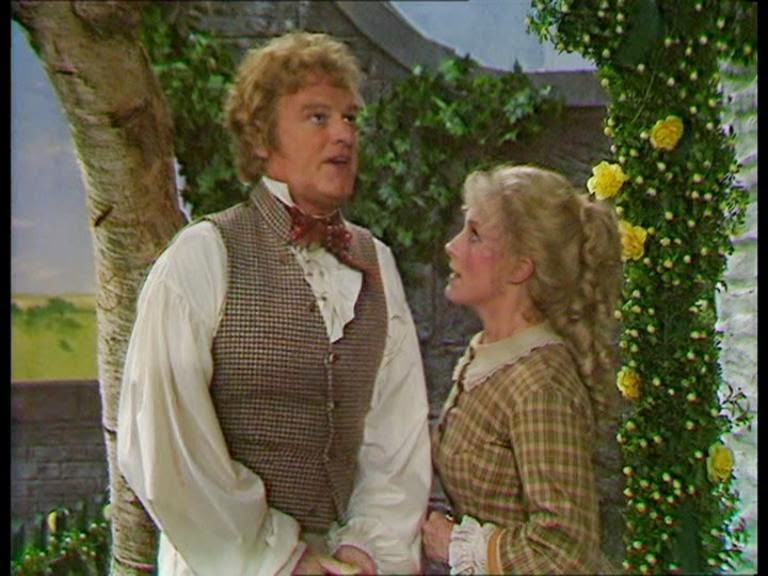
Robin has a dark secret – he was the eldest son and so should have been the next Baronet of Ruddigore. To escape that fate he has hidden away, changed his name and has been assumed dead; his younger brother Sir Despard Murgatroyd (Vincent Price, the Last Man on Earth, Madhouse, Scream and Scream Again , the Monster Club & Bud Abbott and Lou Costello meet Frankenstein) has taken the title and thus the curse. He also has a foster brother, a sailor just returned to England called Richard Dauntless (John Treleaven). Robin confesses his love for Rose to Dauntless who agrees to speak to her, falls in love himself and asks her to marry him rather than Robin.

getting a light
Rose is rather inconsistent and having said yes to Dauntless then breaks the engagement and plans to marry Robin. At this point we meet Sir Despard – a man aged by his criminal lifestyle he tries to outwit the ghosts of his ancestors (who haunt each Baronet to ensure their compliance with the curse) but who actually tries to do good, after committing the day’s crime. When we meet Sir Despard we see that he has powers, apparently; to light a cigarette he clicks his fingers and an arm emerges from a grave to strike a light and we also see him fly. We also see his costuming is somewhat vampiric, in the classic Lugosi way, or maybe just the apparel of a melodrama villain. Dauntless tells Sir Despard who Robin really is and, by doing so, allows the younger brother to pass the curse back to the elder and thus stops the marriage of Robin – now referred to as Ruthven – and Rose.

in a coffin
The second act takes place in Ruddigore Castle and Ruthven now dresses the part of a villain and, in a very vampiric twist, sleeps in a coffin. He has a false moustache, in order that he might twirl it, but is particularly bad at crime – he can be rude, but the heights of his crimes include disinheriting a son not actually born and forging his own will! When Dauntless and Rose visit him to ask for his permission for them to marry he does threaten them (weakly) but is held off by an apotropaic – in the form of the Union Jack (mentioned directly as such, rather than the Union Flag, and called such I assume because Dauntless is a sailor). He quickly caves and gives his blessing.

ancestors come from the paintings
His poor ability as a criminal brings down the ire of his ancestors whose ghostly apparitions emerge from their portraits. Stuart points out that this is lifted from Boucicault’s The Vampire. We then discover that the Baronet cannot die by any means – save by dying in agony should he not commit his daily crime. The day is eventually won as Ruthven realises that each Baronet has eventually given up their life of crime and thus died. This, he logically argues, is suicide and suicide is, of itself, a crime. Thus none of them should have died. This also allows him to commit a daily crime, without harming another, by refusing to commit a daily crime. Thus unencumbered of his “bad Baronet” persona, the fickle Rose returns to him!

held back by the Union Jack
So Ruthven can be argued to be, loosely, some form of vampire – but his life is extended by crime rather than devouring maidens. The ghosts of his ancestors might even be said, under the same argument, to be vampiric ghosts, again loosely. The intent of the satire was clear and I think – certainly as something that is of genre interest – this did deserve a honourable mention. Plus, of course, the version I looked at featured the great Vincent Price. The imdb page is here.