Showing posts sorted by relevance for query christopher lee. Sort by date Show all posts

Wednesday, February 21, 2007

The Lost Hammer Films?

It is astounding what you discover on the web and I caveat this post with the concept that the MySpace Blog I found this on is likely indulging in a gentle hoax or simply indulging in wishful thinking – though one hopes, wishes even, it to be true. However, on the Christopher Lee Fan page is a blog entry regarding 4 lost Hammer films that where found in a vault in Bray Studios. 3 are vampire orientated. The descriptions are quoted directly from the blog.

Scourge of the Vampires:

“(1961). Right after Hammer made Brides Of Dracula, the studio realized that David Peel made an, er, "a-peeling" vampire. The studio also finally convinced Christopher Lee to return to the Dracula role. The obvious result was a film that pitted both Peel's suave nobelman vampire and Lee's Dracula against humankind. Alas, Jimmy Sangster's script tried to give both actors equal time, which pleased neither. Lee stalked out in a snit during filming, and refused to don the Dracula cape again until 1965's Dracula, Prince Of Darkness. Peel asked for more money to continue in the film solo, and he was released by the studio. What remained of the film was relegated to the vaults.”

The Revenge of Dracula

“(1959). With the international smash success of Horror Of Dracula (entitled Dracula in the United Kingdom), Hammer Studios let no moss grow under its collective feet. It immediately commissioned another Dracula film, slated to star Christopher Lee. A corporate decision was made not to bring back Peter Cushing's Van Helsing in order to put the emphasis on Dracula. Again, the busy Jimmy Sangster wrote a script, whereby Count Dracula's loyal gypsy tribesmen collect his ashes and use black magic (and the blood of several virgins) to revive him. Using his loyal gypsies as shock troops, Dracula begins to systematically wipe out the villages that he believes betrayed him. The planned scenes of horrific carnage were to be leavened by a romance between a sensitive gypsy man and a gypsy girl whose sister was one of the slain virgins. The two take after Dracula, who is finally destroyed when the spire of an ancient church topples and penetrates his black heart. This rousing production came to a screeching halt when Lee adamantly refused to play the role again. As a result, a hasty re-shuffling resulted in Brides Of Dracula in 1960, which did co-star Peter Cushing in place of Lee.”

And the ‘Monster Mash’, The Edge of Midnight

“(1969). By the end of the Sixties, Hammer's original gothic horror product was showing its age, as were its horror stars. Just as Hammer aped Universal Studio's classic monster series with its own gothic horrors, Hammer decided to give its monster series a shot in the arm with a tag-teaming of monsters, just as Universal did with its "House" movies in the late Forties. Lured back to Hammer with a promise to direct as well as script the picture, Jimmy Sangster concocted a plot in which Peter Cushing's Dr. Frankenstein and his Monster meet and battle Christopher Lee's Dracula and Hammer's Spanish werewolf (played again by Oliver Reed). In the script, Dr. Frankenstein steals Dracula's ashes to experiment on them and is driven away by the authorities. He escapes to Spain, where he hears stories of the el hombre lobo and digs up the werewolf's corpse and revives him. Of course, a battle royal results. Unfortunately, neither Cushing nor Lee nor Reed could keep a straight face during filming. After many blown takes, the project was shelved. By the way, it is not true that Hammer later planned to salvage this film by adding the talents of Rowan and Martin. The atrocity known as The Maltese Bippy cannot be laid at Hammer's doorstep.”

Unfortunately, one does question the authenticity of the post given no sources are quoted, simply that the info was found on the web – I can find no such info. Even if it were true, how much footage there could be? However, these are fantastic concepts and if anyone out there could confirm the validity of these (partial, unfinished) films to this old cynic – well I’d be grateful.

Finally, thanks to the Christopher Lee Fan Page – the post made me smile and misty eyed in equal proportions.

Thursday, March 19, 2009

Dracula and Son – review

Directed by: Edouard Molinaro

Release Date: 1976

Contains spoilers


This was a French vampire comedy and one cannot but help compare and contrast with Tender Dracula as they are both comedies, from the same country of origin, they both featured Gernard Menez in the cast and this starred Christopher Lee, whilst the earlier film starred Peter Cushing. You’ll be pleased to note that this did not plumb the depths of movie Hell that Tender Dracula managed.

There is a degree of compare and contrast to this article, however, as I watched two versions of the film before writing it. Obviously I would dearly love to see the original French film with English subtitles – as far as I am aware there is no way that’s going to happen *Edit 08/08/2022 Severin have released a 4k restoration of the Director's Cut (in French or English) and the US re-cut and dubbed version as part of the Eurocrypt of Christopher Lee Collection 2, links below – but what I actually watched were two different dubbed versions of the film. One, more comedic with very silly dubbing, came in at 78 minutes (and for clarity I shall refer to it as DaS_A). The second was less comedic, had more serious dubbing and was 94 minutes in length (for clarity I shall refer to this version as DaS_B).

How different was the dubbing? If you research the film you find that Christopher Lee shot the film in French. Some sources state he was dubbed into English and others state he dubbed himself into English. DaS_B was certainly Lee’s own voice, I am fairly certain that it was another voice actor in DaS_A. Indeed the dubbing is very silly in DaS_A, voiceovers that aren’t on the other version, characters referring to the voiceovers and even different character names. The son of ‘Dracula’ (Bernard Menez) is called Ferdinand in DaS_B and Victor in DaS_A (in which he has a faux Bronx accent). Even the start of the films are different, with the shorter film having an animation of vampires through the ages curtailing the actual running time further.

In eighteenth century Transylvania a coach looses its wheel. Before it can be fixed a second coach comes along and transports the two female passengers, Herminie (Catherine Breillat) and her chaperone Marguerite (Claude Génia), away. It is clear that it is a vampire’s coach and Marguerite is bitten on the journey. They reach a castle and Herminie is left to meet the Prince of Darkness (Christopher Lee). We should note that, on release, it was decided he was Dracula – against Lee’s protest – though the film never actually was meant to be a Dracula movie. We see one of the problems with DaS_A here – which is it creates its own plot holes. Herminie and the Prince end up having some coffin sex and she notes that she has no fang wounds with her reflection. In both versions the Prince falls for her and wants a child and heir, however in DaS_A he says he is professional with his bites and has not left a mark, but she does not turn and he leaves quite vivid wounds when he does turn her after she has given birth, whilst in DaS_B he makes it clear that he has shown self control and not bitten her.

Anyway, she does become pregnant and gives birth to a son – at which point the Prince does turn her whilst leaving the child in the care of Marguerite, who is to be the nanny. Herminie goes on her first hunt – at which point we see a cross that in DaS_A is referred to as the Transylvanian double-cross – but she fails to return to the castle in good time and is fried in the sun. Five years later and Ferdinand is a precocious brat who plays bowling with a skull and the urn of his mother’s ashes and traps Marguerite in the sun – killing her off.

By the time he is over 100, the Prince takes Ferdinand hunting as he cannot be fed from the bottle all his life. At this point Ferdinand is sporting a very silly moustache. In DaS_B no comment is made with regards this, in DaS_A the dub suggests that it is a false moustache as he doesn’t want to be seen with his father! Then the castle is lost to the Communist revolution and the Prince decides it is time to leave. Interestingly we get a call for a cross, when confronting a vampire servant, and a hammer and sickle are crossed to make a cross – I preferred the Doctor Who – the Curse of Fenric idea that faith in the revolution made the hammer and sickle a potent symbol.

To cross the border the prince has them kill a couple of French sailors and then they take their place in the coffins. Unfortunately they end up being buried at sea. Ferdinand washes up in France whilst a fishing boat picks up the Prince and he ends up in England. The next segment shows their fight to survive. The Prince struggles – even biting a rubber doll – until he is found by a movie producer who thinks him perfect for his vampire movie, obviously vampires can be filmed in this despite having no reflections. In DaS_A it is because he looks just like Christopher Lee!

Later, as a successful star, the Prince travels to Paris and is reunited with his son. However they both fall for the same girl, Nicole (Marie-Hélène Breillat) and Ferdinand decides he must protect her from his father whilst wooing her – she shows more interest in the Prince at first. The Prince wants to have his toothsome way and has decided she will replace Herminie and Ferdinand just wants a girl it seems.

Lore wise I have mentioned much of it – sunlight kills, lack of reflections etc. What I probably didn’t make clear is that a cross can kill as well as ward. However one thing that neither version of the film explains well is the fact that Ferdinand is able to become human. To be honest he doesn’t know how but I suspect it was meant to be a combination of him being a particularly poor vampire and experiencing true love.

The two films are very different experiences. One, DaS_B, a gentle comedy with some languid moments that amount to poor pacing. The other much better paced but with the most ridiculous dub and some very silly humour – that does work on certain levels but does come across as a bit student/puerile. Neither version noses above the other score wise.

I would love to see this restored and in the original French and DVD companies should note that if they released a set with an original French/English subs and the two dubbed versions it would be something, I think, collectors would go for. For both the dubbed versions 3.5 out of 10.

The imdb page is here.

On Blu-Ray @ Amazon US

On Blu-Ray @ Amazon UK (note this is Region A)

Tuesday, January 10, 2012

Honourable Mentions: One More Time


Now I have, many a time, stated that vampires get everywhere… and they really do. This is a 1970 comedy starring the wonderful Sammy Davis Jr. (Messiah of Evil & the Cannonball Run) as Charles Salt and Peter Lawford as Christopher Pepper.

It has much of what you would expect, a swinging soundtrack, mistaken (and assumed) identities and some bits that perhaps wouldn’t be put in a film nowadays. Aside from that it has the breaking of the fourth wall and some genuinely surreal moments in amongst the more mundane gags.

Christopher Lee as Dracula
The moment we are concerned with sees Charles Salt accidentally opening a secret passageway in a bookcase (the only book he could find of interest to read being the Kama Sutra and that is the secret switch). He looks into the dark passageway and is confronted by a cornucopia of horror characters that include Peter Cushing reprising, according to imdb, his Dr Frankenstein role (though I would have preferred to think of him as Van Helsing) and Christopher Lee as Dracula. Both actors were uncredited but both had a brief speaking moment.

Peter Cushing as Dr Frankenstein
Later, when trying to show this to Pepper, the secret door opens to reveal nothing more sinister than a booze cabinet. (At the end of the film it becomes the chamber of horror again, but unseen to the audience and only revealed in noises).

So, Sir Christopher Lee reprises his Dracula character again, if only briefly and vampires, yet again, get everywhere.

The imdb page is here.

Thursday, March 15, 2018

Honourable Mention: The Boy Who Left Home to Find Out About the Shivers

I am absolutely torn on this one. Part of Shelley Duvall's Faerie Tale Theatre, this was an adaptation of the Brothers Grimm’s The Story of the Youth Who Went Forth to Learn What Fear Was. It has a bit of an all star cast and my reason for including it are two-fold – one reason might be a ‘Vamp or Not?’ for something that is essentially a fleeting visitation and the other is, at best, of genre interest.

After Shelley Duval introduces the show, the story is narrated by Vincent Price and follows the adventures of Martin (Peter MacNicol, Dracula – Dead and Loving It). Martin feels the odd one out in his Transylvanian village as he does not (and never has) felt fear, unlike his superstitious father (Jeff Corey) and brother (Gary Springer). When the sexton (Jack Riley, The Night Dracula Saved the World) dresses as a ghost to try and scare Martin in the church belfry, Martin nonchalantly pushes the trespasser down the stairs, injuring him, and his father sends him away with a little money and orders never to tell anyone who his family is.

Christopher Lee as King Vladimir V
Ten miles later and Martin has reached the kingdom of King Vladimir V (Christopher Lee), he sees a note directing him to the inn as the King has a problem of a haunted castle. The King is indeed there and it is revealed that he is the son of Vladimir the Impaler, also known as Vladimir Ţepeş AKA Bad Vlad. If someone can spend three nights in the castle then they would break the curse, win the treasure, win the hand of the Princess Amanda (Dana Hill) and rule as King. Martin accepts the challenge – but not for the prizes, rather to see if he can feel a shiver. Amanda falls for Martin, though he thinks she works at the inn. So, our genre interest moment is the fact that Christopher Lee plays Vlad Ţepeş’ son (though the numbering is wrong, of course, and Vlad was never a king).

fangs
The night that interests us is the second night. Having just been missed by (and been oblivious to) a falling axe and a razor-sharp pendulum, Martin is sat by the fire when a disembodied phantom head (Gary Schwartz, The Nightmare Before Christmas) rises from the flames. The first thing I noticed was the fangs! His body follows and interacts with the head but Martin feels no fear. When he puts his head back on his shoulders he becomes corporeal and Martin teaches him how to scream menacingly. More spectres appear (none with fangs), become corporeal and, after failing to scare Martin, they all end up bowling (using bones as pins and a skull as a ball).

Martin and Attila
Was he a vampire? The fangs suggested so, and he was monstrous in visage, so perhaps he was a vampiric ghost – or perhaps he was just a ghost and the fangs were an affectation? Honestly, I just really wanted to feature the episode so I’ll leave it to you to decide whether you think the fangs were enough to qualify? The episode also features Frank Zappa as Attila the hunchback and David Warner as the innkeeper and it is a fun little way to spend just under an hour.

The imdb page is here.

Sunday, September 24, 2006

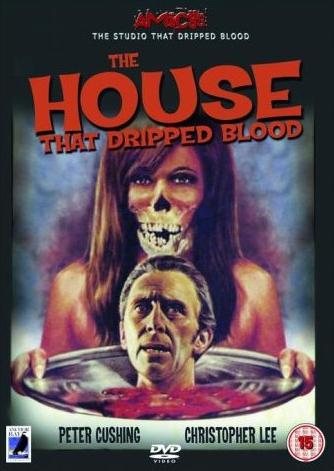
The House that Dripped Blood – review

DVDReleased: 1971

Director: Peter Duffell

Contains spoilers

The House that Dripped Blood is another Amicus film made up of short horror stories, this time written by Robert Bloch. The vampire segment (The Cloak) is the final section, although it is also part of the story that binds the parts together.

Detective Inspector Holloway (John Bennett) has been called into the unnamed town, from Scotland Yard, to investigate the disappearance of an actor, Paul Henderson (Jon Pertwee). The local copper, Sergeant Martin (John Malcolm), informs him that it is not the first strange event that has occurred to a resident of the house Henderson had rented and, through Martin, we hear the first two tales.

The first is entitled “Method for Murder” and sees a writer, Charles Hillyer (Denholm Elliott) being stalked by his own character. The second, “Waxwork”, sees retired business man Phillip Grayson (Peter Cushing) becoming obsessed with a wax dummy of Salome in a horror waxwork display. Interestingly one of the wax works is of Dracula and looks very much modelled upon Christopher Lee.

Holloway then goes to the estate agent, A J Stoker (John Bryans) – a reference undoubtedly to Bram Stoker – who continues with the tales. We hear the story of John Reid (Christopher Lee) in a segment entitled “Sweets to the sweet”, a story of witchcraft that is the best segment of the film. Finally we get to the vampire story, a segment played very much as a comedy – where the other segments were of a very sombre timbre.

Stoker rents the house to Henderson, a horror actor who is making a film entitled “Curse of the Bloodsuckers”, co-staring Carla Lynde (Ingrid Pitt). Henderson is not happy about the production. The sets are fake and wobbly, the director inexperienced and the costumes aren’t right. There is a wonderful line when Henderson laments the demise of the classic horror movie and mentions Dracula, “The one with Bela Lugosi, of course… Not this new fellow.” An obvious reference to Christopher Lee, who was in the earlier segment, and produced by Amicus’ rivals Hammer Horror.

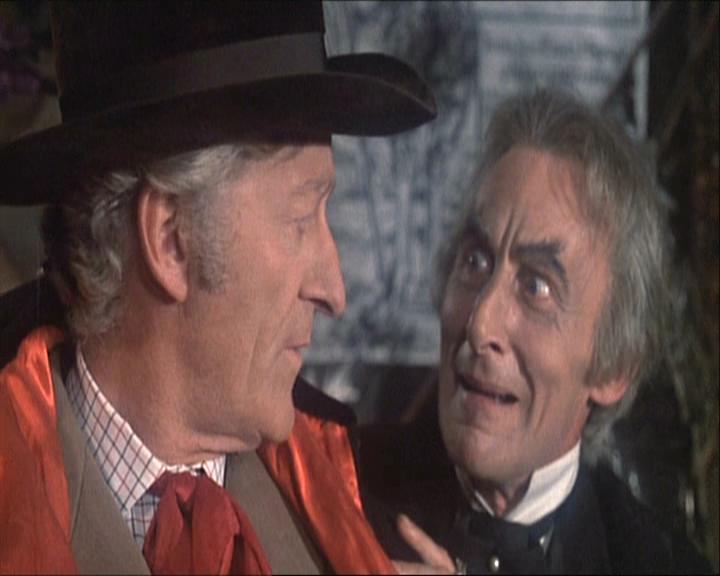
Henderson has rejected the cloak he has been given and declares that he will find his own. Buying the cloakIn his dressing room he finds a card for a costumers shop, though no-one admits leaving it. He goes to the costumers, a cobweb festooned shop with much occult paraphernalia, and meets the owner Von Hartmann (Geoffrey Bayldon). Von Hartmann shows him a vampire cloak and, rather than offer it for rent, offers it for a very cheap sale. When Henderson leaves the shop Von Hartmann says that now, finally, he can rest.

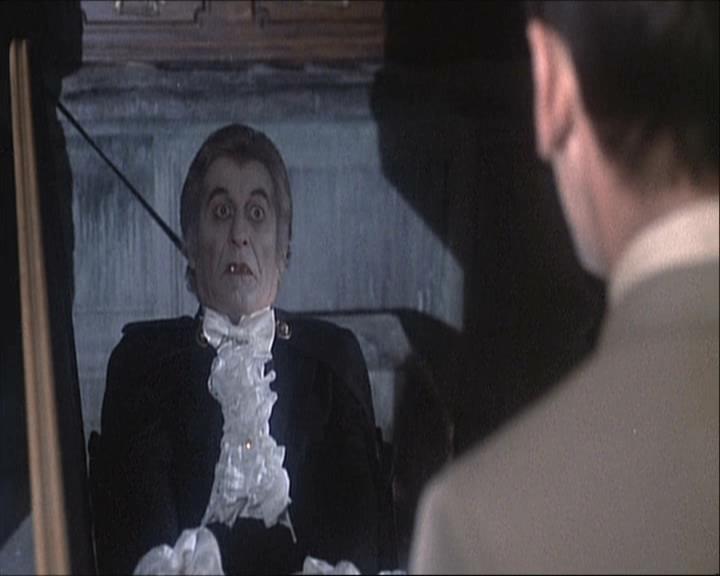
Back at the studio, the next day, Henderson is getting ready. He puts the cloak on and, to his shock, discovers that his reflection has vanished. When he removes the cloak it reappears but he is called to set before he can fully take in what it means. They film a shot where he is to bite Carla. At the end of the scene the director calls cut but Henderson is still biting Carla, unable to stop until he is pulled off her.

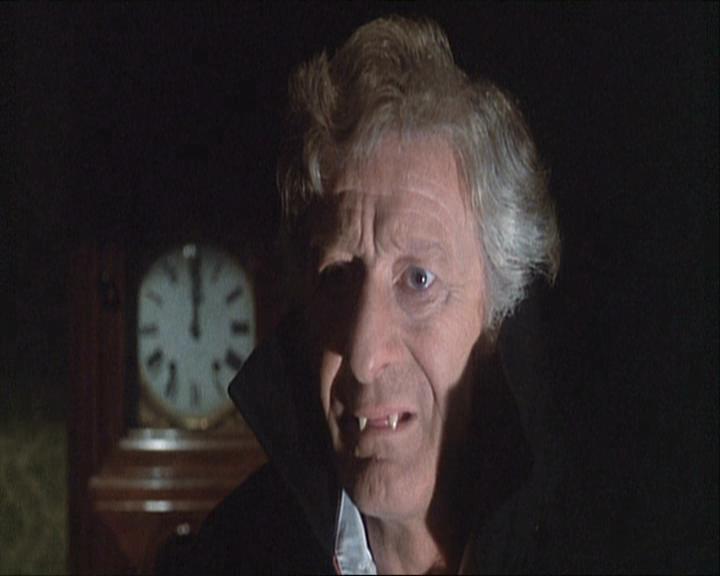
oops - fangsThat night, being something of a student of the supernatural, he tries to research the cloak. Interestingly again, one of the books he uses is Montague Summers “The Vampire: His Kith and Kin”. He puts the cloak on as the clock strikes midnight and develops fangs and then finds himself floating. This scene is played very much for laughs.

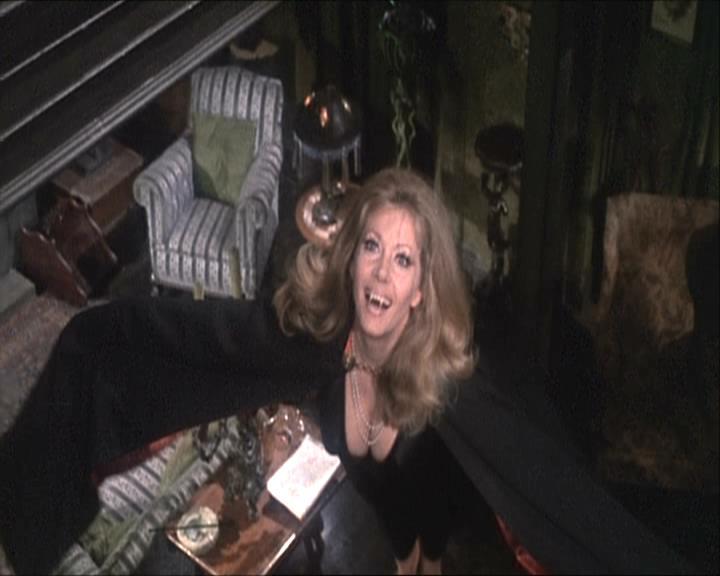
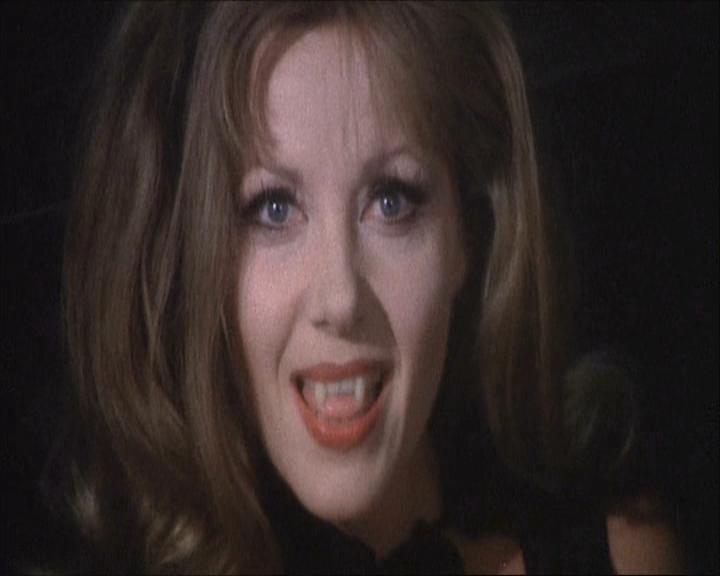
The next day there are no scenes with the cloak and, to apologise to Carla, he takes her out for a meal. Carla goads HendersonBack at the house he notices a newspaper report that says that the costumer shop has burnt down and a man’s body was found in a coffin in the basement. He realises that the body was Von Hartmann and tells Carla that he believes that the cloak was actually a vampire cloak, carrying the spirit of the vampire. She goads him into putting the cloak on, to disprove his theory and he does so, again at the stroke of midnight. Nothing happens. Then he realises that it is not his cloak but a prop from the movie. Carla FliesCarla reveals that she has his cloak. She also says, as she dons it, that they have enjoyed his portrayal of a vampire and want him to be like them for ever – indicating that Carla was a vampire, that she left the card and revealing one thing about vampires in the movie, sunlight is not a factor as we have seen Carla in the daytime. It also begs the question, why does she needs the cloak? She flies at him, fanged, and he screams.

Thus ends the segment but the story is not over. Holloway takes the keys to the house from Stoker and goes there, despite Stoker’s warning to wait until daylight. He reaches the house and goes into the cellar, breaking into a padlocked room (question unanswered is who padlocked it). fully undeadA coffin opens and a very grey faced Henderson sits and launches at Holloway, who stumbles backwards, breaks a chair and stakes the actor. A second coffin opens and Carla emerges. We see Holloway attacked by a bat – though we only see the shadow of the bat.

The film then codas with Stoker telling us that the house reflects the personality of the occupier and it awaits a decent tenant.

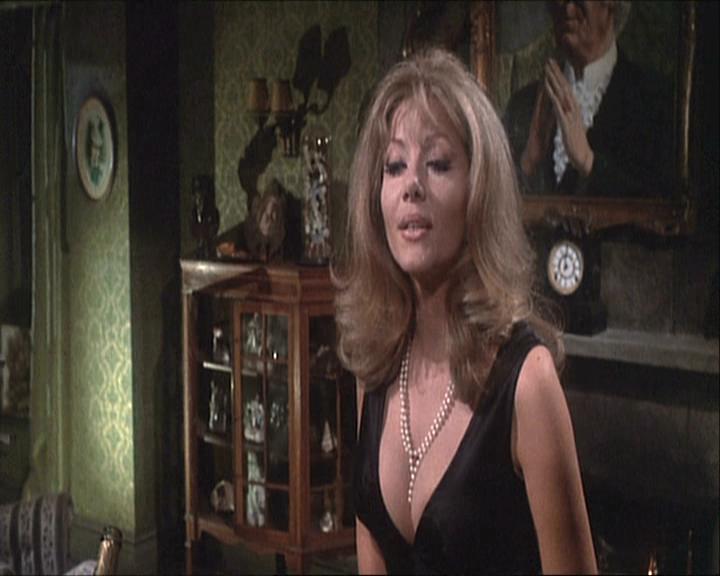
Ingrid Pitt as CarlaOne of the shames of the vampire segment is that, because it is played as a comedy (we even have a lingering close up of a donate blood poster in the studio) it really does not fit in with the rest of the film. That said, Pertwee is magnificently arrogant as Henderson and Pitt is magnificently beautiful. It was not accidental, I am sure, that all her dresses had plunging necklines and the director ensured there were plenty of cleavage shots.

The story also feels a little forced, especially after Lee’s “Sweets to the Sweet” section. There are logical errors aplenty, including such as why Carla must sleep in a coffin when she presumably didn't before she turned Henderson? That said, the good thing about the segment is the references it contains and the fact that it is self-effacing. All in all I think the vampire segment deserves 5 out of 10.

The imdb page is here.
A review of the 2020 Region B Blu-Ray release is here.

Sunday, November 14, 2010

Uncle was a Vampire – review

Director: Steno

Release date: 1959

Contains spoilers

Oh dear, just a year after performing in the magnificent Horror of Dracula, Christopher Lee then reprises the vampire in this Italian spoof known domestically as Tempi duri per I Vampiri.

Now the caveat… I say oh dear, but the version I have watched is the dubbed English language version (with Lee himself dubbed as the Italian’s filmed without sound) that is cut by 13 minutes, rather than the Italian domestic version. Thus I might be doing the actual film some injustice with the review – but I am convinced it will be only the smallest injustice.

posting the vampire
The film begins with a horse-drawn hearse leaving a castle. At the train station a big steamer trunk is being sent freight and the man sending it insists that they take care with it and, as the contents are sensitive to sunlight, it isn’t opened. He speaks to the occupant, for it does contain the Baron Roderico Da Frankurten (Christopher Lee), and says that his nephew and the Italian castle do seem to be the last hope. With his job done the servant kills himself off-screen.

Kai Fischer as Lellina
Said nephew is the Baron Osvaldo Lambertenghi (Renato Rascel) and he stands at a balcony watching his young, pretty gardener Lellina (Kai Fischer) before being summoned into a room full of men in suits. It quickly becomes clear that most of the men represent a hotel chain, who are buying his castle for 80 Million Lire. Also present is the tax man, whom he owes 80 Million to. By the end of the scene he has no castle and no money – but the new owners of the castle offer him a job.

meeting Uncle
The job is as a bell-hop and Osvaldo’s fall from grace is complete, or so he thinks, until Lellina comes over and says that the hotel Director has told her that she is fired – despite her family tending the gardens for generations. She also has a letter for Osvaldo – it is from his uncle, whom he assumes is rich, he’ll be there at mignight and his steamer trunk has arrived. Round midnight a German professor (Franco Scandurra) turns up, tired and wanting a room and mistaken by Osvaldo as his uncle. You’d think the professor would turn out to be a vampire hunter but actually he is just a tired professor whom Osvaldo keeps bugging, later, to translate some German text. Uncle doesn’t show and Osvaldo returns to his room – it is there that he finally meets his uncle.

fear the coat-hanger
Roderico asks about the crypt, but it has been turned into a bar, and says he is thirsty. He ends up prowling the castle whilst Osvaldo finds uncle’s coffin and journal, realising that he is a vampire. He goes to the professor, wakes him and asks him to translate the text. At this point he discovers that vampires fear the cross, garlic, the cock crow and they must be staked. We see the efficiency of cross shapes when a coat-hanger vaguely shaped like a cross causes Roderico to fall from a window ledge and land unconscious in the grounds.

missed opportunity
When the cock crows he awakens and heads into the castle, but Osvaldo can’t find him. Eventually Osvaldo realises that he must have taken up residence in the crypt, inside a secret panelled sarcophagus that is used as the bar. Osvaldo goes to try and stake him, finds himself interrupted and eventually misses his opportunity. Uncle knows he knows.

all the victims love him
Here we get a load of new lore, very much crow-barred in so as to work within the film's own logic. Roderico bites his nephew – passing the curse on and, as Osvaldo becomes a vampire, the 400 year old Roderico becomes mortal and goes off to die. Osvaldo bites most of the women in the castle – except for Lellina, whose rooms he protected with garlic – and the next morning they are all in love with him.

the classic Lee look
As a living vampire, he only becomes a vampire at midnight and a mortal by day, with no memory of his actions. However, the 42 victims all leave their husbands/boyfriends as they love only him – so we get a sequence of bedroom farce (with no bedrooms) involving multiple characters. The final new piece of lore is that true love will cure him and, when cured, the curse will pass back to Roderico – resurrecting him.

I struggled through this, and the humour didn’t hit the mark for me I’m afraid. Lee’s role was little more than an extended cameo and all in all I was underwhelmed. 3 out of 10. The imdb page is here.

;)Q

Tuesday, January 30, 2018

Cuadecuc, vampir – review

Director: Pere Portabella

Release date: 1971

Contains spoilers

In the introduction to The Cambridge Companion to Dracula, editor Roger Luckhurst talks about Cuadecuc, vampir and calls it “probably the most provoking adaptation of Dracula you have never seen”. He describes the reception thusly, it “was shown at the Cannes film festival to acclaim but was immediately banned in Spain. Although there is nothing explicitly stated, the fascist authorities that tightly controlled cultural expression got the message loud and clear. Count Dracula is meant to represent the undead dictator Franco”.

fascism drains Spain's vitality
This rebellion is difficult to see as a viewer not part of the region, nor under the regime, over forty years after its release. To this outsider, it is in the title that the rebellion of the film is revealed. I watched the Blu-ray release of the film in preparation of the review – and that is titled Vampir Cuadecuc, but I have used the original inverted title for the review. The word cuadecuc means ‘worm’s tail’ in Catalan but it also describes the unexposed end of a film reel. When it was filmed, the Catalan language had been brutally banned by the Fascist regime in Spain and using it (or even reading it) could be punished by a public lashing or jail sentences.

high contrast black and white
For those who are unaware of this film then you must understand that when Jess Franco made Count Dracula (1970) he allowed Pere Portabella and a small crew to film the filming. This does not make Cuadecuc, vampir a ‘making of’ Franco’s movie. It is much more (and less, in some ways) than that. Portabella makes a movie of Dracula, vampirising Franco’s production. However, he films in a high contrast black and white and this brings Dreyer’s Vampyr aesthetically to mind. The use of film as the medium of vampirism also brings Nosferatu, eine Symphonie des Grauens to mind, in which the death of the vampire is reminiscent of the death of film exposed to the sun.

Christopher Lee
But as well as telling the story – visually, the majority of the film is without any dialogue, only changing at the end where Christopher Lee speaks to the camera, explaining the run up to the death of Dracula in the novel before reading that extract. However it is the moments that are behind the scene where the film finds its deepest expression. An actor plays to the camera before Franco’s filming starts, Lee removes his face covering (as the coachman) and gives the camera a cheeky grin and a wave, we see someone with a smoke machine walking the path before Harker’s coach thunders along the (now) foggy road to be filmed. One of my favourite images was Lee led in his coffin as a crew member sprays fake cobwebs up his body.

spraying cobwebs
The film has a near perfect crap bat moment as Portabella films Franco’s bat effect, making no effort to hide the wires the rubber bat flies along. Bizarrely Klaus Kinski does not appear in the film (he plays Renfield in the parent production), which seems odd given the power of his performance. There is no dialogue but there is sound. Carles Santos creates a soundscape of tonal and ambient movements, sometimes taking modern (at the time) pieces and letting them play as a theme and then destroying them. Industrial noises invade the scenes and the soundtrack is strangely very modern (to now) in an avant-garde, experimental way.

a bride
Now you might be thinking that it sounds awful and on paper it might be that it should be, or at least be nothing more than a fleeting curio of cinema. However, it is a mesmerising mood piece that sucks the viewer in – or at least it did with me. I will say its likely to be a love it or hate it art film, but I was taken by it, I found it a much stronger piece of cinema than that constructed by Franco. Perhaps the music, the black and white and the stronger photography in general, the post-modernism that doesn’t recognise that a fourth wall even exists, the underlying rebellion. I don’t know. But for me this gets a strong 6 out of 10.

The imdb page is here.

Thursday, December 20, 2007

The Blood Demon – review


Director: Harald Reinl

Release date: 1967

Contains spoilers


When I was first told about this film I was informed that it was almost a cross between Hammer, Castle of Blood and Black Sunday. It also stars Christopher Lee. With a pedigree like that suggested how could I resist? If the description had mentioned the Pit and the Pendulum it would have been complete to be honest. I can see the influence of all the films and the studio mentioned. A visual treat that moves at a pace this was nearly a gothic masterpiece – nearly.

The film starts with a jailer, an executioner and the judge Roger von Marienberg (Lex Barker) walking a corridor until they get to the cell of Count Regula (Christopher Lee). The judge pronounces sentence. Regula has been found guilty of the torture and murder of twelve virgins. The normal sentence would be decapitation but he is to be quartered. In a complete Black Sunday moment a spike inlayed mask is placed on his face as his curse, threatening the judge and his descendents, hangs in the air.

Watching the execution is the last victim (Karin Dor), who escaped the Count somehow and whose testimony led to Regula’s fall. We get to see the preparation for the execution and, whilst the camera pulls forward 35 years before we see the full excess of quartering, the scene is powerful and chilling.

The story of Regula is being told by a peg legged traveller who spots local lawyer Roger Mont Elise (Lex Barker, again). That night he finds the lawyer and gives him a letter inviting him to be the guest of Regula at his castle. Roger is an orphan and the letter promises to tell him of his parents and lineage. Later the traveller brings another letter to Lilian (Karin Dor) saying that her inheritance awaits her at the castle.

The two make their way separately. In a village near the castle Roger discovers reticence in discussing the castle and he cannot get directions. A priest, Father Fabian (Vladimir Medar), says he knows the way and offers to travel with Roger – he has to christen a child near there anyway.

At first the journey is idyllic but things take a turn when black riders stream past the coach. Later they see the riders attacking Lilian’s coach. Lilian and her maid Babette (Christiane Rücker) are rescued and, on hearing that they travel to the same place, Roger allows them to travel with him.

The journey then becomes darker and we enter a gothic landscape that is visually stunning. At one point the forest becomes littered (in the trees) with body parts. Later the trees are filled with hanging corpses, whilst the coach bucks over bodies laid across the road. The atmosphere is reminiscent of the works of Bava – no bad thing at all.

Once in the castle – well let us just say that it becomes a gothic wet dream. All the trappings are there, from reproductions of Hieronymus Bosch on the walls to spiders, insects and snakes. Glass coffins and torture implements. This never feels over played either, we are subsumed in atmosphere. The Twelve virgins are laid out in one room, looking as fresh as the day they were murdered (and this does have a reasoning, which can’t be revealed due to the spoiler that would produce).

So, gothic, but I haven’t mentioned the vampire. Well Regula is our vampire (along with his dead servant Anathol (Carl Lange)) – to be honest, this was a hair’s breadth from being a ‘Vamp or Not?’ The reason that Regula killed the girls was that he needed the fear induced blood of thirteen virgins to create an elixir of life. He has risen from the grave to get the thirteenth blood (from Lilian) and to kill the son of his enemy (Roger).

He is raised through a blood ritual, though it is Anathol’s green blood that is used. He is a ghastly pallor and, when Fabian shoots Anathol, we see the bullet hole heal immediately. The power of the cross causes him to cower and breaks the spells needed to create the elixir of life. We won't ask why Regula only has a limited amount of time in which to complete the elixir whereas Anathol has been spooking around as the undead for some time, the obvious plot hole only comes to mind after you watched the film, when viewing it the fast pace distracts you from such thoughts.

Acting wise we have a mixed bag. Lee is superb as always, though we should mention Lange as Anathol. There are times when he steals the scene from Lee and that is no mean feat. Medar is excellent of Fabian and he is reminiscent of Sandor in Dracula, Prince of Darkness.

Dor makes a rather buxom and appealing heroine, with a hint of the Barbara Steele but, unfortunately, not having anything close to Steele’s screen presence. Barker, on the other hand, seems to sleepwalk through the production and can be wearisome. He is certainly not what I would look for in the hero of a film such as this.

I’ve waxed lyrical and this is a marvellous gothic production. It is also somewhat derivative of many classics of the genre and whilst it holds its own this distracts from the overall production. There is also just something a little off key with this. Part of it goes to the soundtrack, which for me was utterly inappropriate and did its best to wreck the atmosphere rather than enhance it. This could have been one of the great gothic movies, a classic we all look to. Unfortunately it falls that little bit short.

That said, well worth seeking out. 6 out of 10.

The imdb page is here.