Showing posts sorted by relevance for query Jess Franco. Sort by date Show all posts

Friday, March 07, 2008

Daughter of Dracula – review


Director: Jess Franco

Release Date: 1972

Contains spoilers


Ah, Jess Franco. There is something compelling about his films, not matter how poor they are. Something that makes it impossible to tear your eyes away from the screen. Despite his bizarre zoom habit they are very watchable.

At the head of this film it seems as though we are in for a treat. Why? Cinematic narrative. The film, unusually for a Franco vampire movie, has a story. At first…

At the head we get a script on screen about Dracula (the only time he is mentioned) and then a mention of Castle Karlstein. This is somewhat confusing as Karlstein obviously refers to Karnstein, which is the family name of Carmilla. The film proper begins with a Franco sexploitative moment, a woman getting undressed and bathing whilst someone peeps in on her. It is clear, even though we only get an eye, that the watcher is a woman. The watcher bears fangs and then the bathing woman screams.

An old woman is dying. Around her are Count Max Karlstein (Daniel White), his secretary Cyril Jefferson (Jess Franco) and his daughter (?) Karine (Anne Libert). The woman is waiting for her daughter, Luisa (Britt Nichols) to come. She arrives and the woman tells her that she is of the Karlstein line and gives her a key to the crypt where the first Count (Howard Vernon) is buried, he was a vampire.

At this point all pretence of story falls apart, despite the fact that it really felt, for a moment, like there was one. What we get is Louisa going to the crypt and becoming a vampire. However the film hints that she was the mysterious vampire anyway, which makes no sense. We get a love story between her and Karine, which goes nowhere and is simply an excuse for the obligatory Franco lesbian scenes. We get the mystery vampire, with Franco intent on making us think it is a man when we know otherwise. We get a police investigation of the murders with Jefferson sure there is a vampire and the police and a reporter (Fernando Bilbao) intent on blaming the present Count Karlstein.

None of this actually fits into a narrative framework properly. For example, and cutting to the end of the film, Jefferson discovers his wife has had an affair with the present Count Karlstein and so vows to kill the vampire! He goes off to the crypt (begging the question why he hadn’t been there before) and is joined by the previously sceptical reporter and inspector (Alberto Dalbés). They help him stake the Count (through the head) and burn a coffin – contents unknown but thought online to contain Luisa. It made no climactic sense as the film did not build to it.

The title is senseless as there is no real indication through the film that the Count was Dracula – he had a different name after all. Indeed the only real connection was the fact that Vernon played Dracula the same year in Franco’s Dracula, Prisoner of Frankenstein. At least this time the vampire was not green in colour but the role was limited mainly to lying in a coffin.

Indeed may of the same faces return in this, though not necessarily in the same roles, and one wonders if left over footage from the previous film was salvaged?

All that said, there is a dreamlike quality to this that is compelling and is probably only marred by the attempts at dialogue based narrative that seem to fail miserably. Unfortunately it is not a patch upon some of the Jean Rollin efforts in developing that dreamscape on film. There is no real horror captured in the film, Luisa's dress being the most horrific thing you'll see. Unfortunately the erotica isn't particularly erotic either, feeling staged rather than natural.

Like the film itself, the soundtrack seems misplaced, lush at times and yet inappropriate. It adds to the quality of the film in a way that is difficult to describe as it shouldn’t work at all.

Not a great film and yet compelling at the same time, the film's strength lies in the fact that it portrays Franco’s oneirism on the screen for us all to see and for that reason it also fails. 3 out of 10.

The imdb page is here.

Friday, January 24, 2014

Vampyros Lesbos – review


Director: Jess Franco

Release date: 1971

Contains spoilers

As I write this we are only a couple of months away from the blog’s 8th birthday. During that time I have reviewed a whole array of vampire movies from around the world. Many of those films I had on DVD (and sometime vhs) before I ever contemplated writing Taliesin Meets the Vampires. Most of those I had before have now been reviewed. There are a couple of notable exceptions.

burlesque interpretative performance
So, very recently I received an email from a blog reader asking about a missing review; specifically, wondering where the Vampyros Lesbos review had got to. It wasn’t missing however - I just hadn’t gotten around to it yet! This is, of course, unforgivable on my part as it is arguably Jess Franco’s best known vampire film (it’s either this or Female Vampire). Now I have to admit a love/hate relationship with Franco. I find myself drawn to his films and then being disappointed. My expectations and anticipation, more often than not, utterly overwhelm his execution. Vampyros Lesbos is no different really except that it is from the golden age of Franco films.

Linda and Omar
Spurred on by the email I sat down to dip into the world of Franco and revisit Vampyros Lesbos. After opening shots of the Countess Carody (Soledad Miranda, Count Dracula), boats and the minarets of Istanbul we shift into a night club and see the Countess (not revealed as such until later) offering a burlesque interpretative performance. The music has to be mentioned as Vampyros Lesbos has a wonderfully surreal acid jazz soundtrack that is perfectly evocative of the time it was shot. In the crowd are the lovers Linda Westinghouse (Ewa Strömberg) and Omar (Andrés Monales) – Omar has a thin moustache and eyes that dart like an “eagle eyes action man”.

telepathically calling Linda
We see Linda dreaming, and get images as the Countess calls out telepathically to her, such as blood drops on a window, a moth and a scorpion. Franco places these key symbols – and a kite – through the film. We cut to her on a psychiatrist’s couch and she admits having recurring dreams about the woman and an island beach house, neither of which she knows, and was shocked when she saw the performer as it was the woman from her dreams. She admits that the dreams both scare and arouse her. The psychiatrist simply doodles and then puts it all down to sexual frustration and tells her to get a better lover.

victim of a serial killer
Linda works in the Istanbul office of the law firm Simpson & Simpson and has to go to visit Countess Carody about an inheritance. She gets so far on her journey but misses a boat and has to stay in a hotel where a creepy man called Memmet (Jess Franco) warns her away from the island as it is a place of madness and death. He asks her to meet him in the wine cellar and she goes there to see a bleeding, tied woman – later we discover that Memmet is a serial killer. This, however, does not seem to trouble the lawyer who gets the next boat to the island without raising the find with the authorities!

Seconds before passing out
At the beach house – which is all too familiar – she finally meets the Countess, who is sunbathing. This is one of the interesting things about Vampyros Lesbos, Franco overturns the gothic for beaches and beach houses, darkness and moonlight for sand and sunbathing. Rather than get straight down to business the two women go skinny dipping and sunbathing (observed secretly by the Countess’ servant Morpho (José Martínez Blanco, also from Count Dracula)). At dinner they talk about the complex inheritance left to the Countess by Count Dracula – he was a Hungarian, the Countess correctly confides. Some wine (maybe drugged, maybe blood) and Linda suggests she has a headache and then passes out.

José Martínez Blanco as Morpho
She is carried to her bedroom by Morpho and then seduced by the Countess. In the morning she awakens and finds the Countess’ body floating in the swimming pool, passes out and wakes in a private hospital run by Dr Seward (Dennis Price, Son of Dracula (1974), The Horror of it All, The Magic Christian, Dracula Prisoner of Frankenstein & Twins of Evil). She has amnesia but a newspaper advert leads Omar to her. Also in the hospital is Agra (Heidrun Kussin) – Agra is interesting as she is kind of a female Renfield, she had been to the island and is psychically linked (and obsessed) with the Countess. She was Memmet’s wife and so it seems that her obsession was that which caused him to become a serial killer.

wine or blood?
Franco playing with the genre was fun. Seward is the vampire hunter but he is more interested in becoming a vampire than hunting them. There is very little in the way of religious aspect but he manages to hurt the Countess (who, of course, was not dead in the pool) with a Latin chant. He also tells us that a vampire must be killed by giving the brain a deadly blow – suggesting a hatchet or iron bar. We have the drinking of wine that is really blood (later in the film, though it may have also happened on the first meeting too). We discover that the Countess was a mortal in Istanbul and was attacked and raped by soldiers and rescued by Dracula. It is the rape that made her hate men and become a lesbian.

embarrassing tussle
The film is languid but that adds to its dreamlike quality and it is perhaps the dreamlike quality that enables us to forgive some of the plot contrivances. It doesn’t descend into silliness like a lot of Franco films (except, perhaps, during a brief fight between Seward and Morpho). There is a fair bit of nudity but nothing particularly hardcore and some of it is actually tastefully done. Certainly it is unlikely that Soledad Miranda ever looked more beautiful than in some of the shots in the film.

Soledad Miranda is at her finest
The frustration is that Franco made some incredibly intelligent plays in the film – such as his handling of the move from Gothic to beach – but these moments become lost in some of the contrivances (as much as the dreamy quality allows those). If I say that this deserves 4 out of 10 then I am probably being very fair but I do have to say that it is worth more than the sum of its score.

The imdb page is here.

Monday, March 23, 2026

Vampyros Lesbos – UltraHD – review


Director: Jess Franco

Release date: 1971 (UK disc 2026)

Contains spoilers

I have previously reviewed this Jess Franco film and this is specifically the review of the Severin UK UHD release of the film. As such the score is going to be different to that for the film in and of itself. I have a complicated relationship with the film, and Franco generally. Drawn to his films (and my favourites are a couple of his De Sade films), I do find them perhaps less impressive as some in a cinema sense (and certainly a lot less then those involved in the commentaries on this disc); it is a circle difficult to square. Severin, however, I am most definitely a fan of and deem them as one of the (if not the) best purveyors of physical movies currently in operation.

Linda and the Countess

So, the film looks gorgeous – it is not going to look any better methinks. It has been scanned in 4K from the original camera negative and is presented in German – which was the fuller cut, the Spanish version edited on release and later restored but I understand dialogue was changed. I mention in my original review the soundtrack and it sounds great on this presentation. The set comes with a slipcase and both a UHD and standard Blu-Ray disc. Both carry the full range of extras.

blood spattered

The extras include a short archival interview with Franco, an interview with Stephen Thrower – who has written on Franco – and an interview with Amy Brown who is a Soledad Miranda historian. It has in the Land of Franco part 12 – a series over several Severin Franco releases, German trailer and opening title sequence and a career appreciation by Sean Baker. There are two commentaries, one by Kat Ellinger and the other featuring Aaron AuBuchon, John Dickson and Will Morris.

the sun worshipping vampire

I doubt any of the commentators would be impressed with my review of the film, but they have a much less complicated relationship with his films than I. Both commentaries recognise that, in many respects, Franco creates a flipped version of Dracula; in a gender sense Countess Carody (Soledad Miranda, Count Dracula) is Dracula (though Dracula, within the story, turned her), Linda Westinghouse (Ewa Strömberg) is a solicitor travelling to her client and so Harker, and Agra (Heidrun Kussin) can be read as Renfield. However other inversions (from the filmic tradition as well as the novel) are the fact that the film is a sun-drenched affair with the Countess a sunbather, who definitely reflects in the mirror and the method of vampire killing is achieved by giving the brain a deadly blow rather than a stake to the heart (perhaps cerebral rather than emotional). The commentators explore the transgressive nature of the text and, whilst I think that both assign happy accidents in filmmaking to deliberate decisions (and I recognise it is likely a case of column A and B), both were really worth listening to.

strange shooting angle

You are not going to get a better-looking print of the film, plus there are plenty of extras with much to pick through for the student of media studies, and aficionados of both Franco films and vampire films more generally. For the set, 8 out of 10.

The imdb page is here.

On UHD Blu-Ray @ Amazon US

On UHD Blu-Ray @ Amazon UK

Wednesday, August 28, 2013

Vamp or Not? The Erotic Rites of Frankenstein

Ah Jess Franco, there is no other director's work quite like his, and the 1972 La maldición de Frankenstein proves that point. Like many Franco films there are multiple editions. Some are ruder, some are clothed. The Spanish release had a sub-story concerning gypsy girl Esmeralda (Lina Romay, Female Vampire, Vampire Junction, Vampire Blues, Killer Barbys Vs Dracula, Revenge in the House of Usher & Snakewoman) that didn’t touch the main plot (bar referentially) and added an erotic aspect – it was with this cut that the film gained the name the Erotic Rites of Frankenstein.

Jess Franco cameos as Morpho
However such kinky goings on do not concern us as the focus of the “Vamp or Not?” is the character Melisa (Anne Libert, Daughter of Dracula). Now the Amazon UK ‘review’ (less a review and more a 3 line synopsis) suggests that she is “a blind vampire with wolfman hands”. Sounds good but we know that these things can be deceptive and, indeed, she is not that at all.

I've been making a man
However the film proper starts with Dr Frankenstein (Dennis Price, the Horror of it all, Son of Dracula (1974), the Magic Christian, Dracula Prisoner of Frankenstein & Twins of Evil) who, with his lab assistant Morpho (Jess Franco), is trying to improve his creature (Fernando Bilbao, the Vampires Night Orgy, Fangs of the Living Dead and also Daughter of Dracula & Dracula Prisoner of Frankenstein) – by giving him the facility to speak (although all he then says is that he is in pain!) A coach pulls outside the castle and the agents of the occultist Cagliostro (Howard Vernon, also Daughter of Dracula, Revenge in the House of Usher and Dracula Prisoner of Frankenstein) break in. Those agents consist of a coachman and the aforementioned Melisa.

feathery fingers
As we see Melisa she has odd looking talons and green feathered hands, she also has streaks of green feathers on her body. This is because she is part human and part bird (so, not wolfman at all). We discover that she is blind, can intercept the telepathic communications of Cagliostro and is a seer. There is an odd cawing noise she makes that seems to work like echolocation (or perhaps that was just me). Anyway she attacks Frankenstein and seems to bite his neck, in a way that is rather vampiric, and then shows her blood spattered mouth. So, she’s a bird vampire?

mangled and lacerated, apparently
Lets have a look at the forensics! Frankenstein’s body is found in the forest, rather than the scene of the crime. Later Dr Seward (Alberto Dalbés, La Mansión de la Niebla and also also Daughter of Dracula & Dracula Prisoner of Frankenstein) tells Frankenstein’s daughter, Vera (Beatriz Savón), that it was difficult to diagnose the cause of death. No vital organs were involved (presumably they were all there then) but Seward suspects that he haemorrhaged to death. Then he suggested that it was apparent that he was mangled and lacerated and was stripped of flesh – when asked if it could have been mountain lions or wolves the good doctor suggests it was more likely vultures. This dialogue was, at best, self contradictory (and all in the one scene) and, worse, the most we see of wounds are three rather superficial lacerations to his neck (and we see them often as his technology keeps getting used to revive him). That is until his spectacularly hysterical second-death by acid, at least.

Blood at mouth
The reason Cagliostro has stolen the monster is that the occultist wants to make a new breed of monster. He intends to make a beautiful woman and then have her breed with the monster. Cagliostro also seems to have a court, where all the courtiers are monsters, with skeletons and zombies included in their number. However getting back to Melisa, we see her rolling (her face) in blood again later on but, aside from the idea that she might have stripped flesh off Frankenstein, we don’t really see anything more.

Not really a vampire
So vampire? I don’t really think so. As with all Franco there is a multiple crossover – Seward, for instance, crops up in many a Franco film and was lifted from Dracula. Her manner of attack (and possibly feeding) was certainly reminiscent of a vampire. Probably safest to say Not Vamp – but of genre interest.

The imdb page is here.

Tuesday, March 22, 2016

A Virgin Among the Living Dead – review

Director: Jess Franco

Release date: 1973

Contains spoilers

A suggestion by Ville, I had never considered looking at this movie as I had got it into my head that it was a zombie film. There is a version with additional footage shot by Jean Rollin that features zombies but the version I watched for review was not that one.

The version I watched was on Arrow Film Distribution. It was in French with English subtitles (hard-coded) and looked like it had been dropped onto disc from a VHS source. The film maintains a lot of nudity, it does not have the hardcore scene that one version does nor did it have the rape scene that is in other versions.

starting when the castle is mentioned
It begins with the camera panning across scenes of Honduras (according to the DVD blurb) and it is typical Franco fare. Then we meet Christina (Christina von Blanc) a young woman who has just travelled from London to meet her family and hear the reading of her father’s will. The woman at the inn starts when Chrstina mentions Montserrat Castle and tells her that no-one lives there or the surrounding valley. She dismisses this as she has been in correspondence with her family there, indeed she has a letter telling her when she’ll be picked up.

Christina von Blanc as Christina
The close atmosphere interrupts her sleep and she heads down from her room, where a female doctor (Nicole Guettard) is writing notes. They speak briefly when the door opens and the mute Basilio (Jess Franco) is there with a note from her Uncle Howard (Howard Vernon). As they are driven to the castle Christina is filled with thoughts of foreboding. They arrive and she finds Uncle Howard playing the piano. He suggests that he is her eternal uncle and when she kisses his cheek she exclaims that it is ice cold.

Christina with Carmencé
When she asks about Herminia she is told that she is on her death bad. Christina doesn’t understand why Uncle Howard is playing waltzes at such a time but he retorts that Herminia likes them. Also in the room is Carmencé (Britt Nichols, Tombs of the Blind Dead, Daughter of Dracula & Dracula Prisoner of Frankenstein). When Christina goes to kiss her cheek the woman deliberately turns so they kiss lip to lip. Christina takes her leave and goes to see Herminia, who grabs her and tries to say something as she dies. Christina’s Aunt Abigale (Rosa Palomar) is by the bed side.

Jess Franco as Basilio
The film descends into a nightmarish landscape. Christina hears arguing between Howard and Carmencé and we see him slap the woman but the violence seems to be more like foreplay for them as they come together carnally. A blind woman, Linda (Linda Hastreiter), suggests that she can see souls and Christina’s is good so she should leave. During this sequence we hear that Christina’s mother died when she was a baby, her father (Paul Muller, La Vendetta di Lady Morgan, I Vampiri, Count Dracula, Nightmare Castle, Fangs of the Living Dead & Vampyros Lesbos) was always away on business and so she went to a boarding school and later he remarried, Herminia being Christina’s step-mother. Later we see Linda with Carmencé; both naked, Carmencé has cut the other’s breast with scissors and drinks the blood from there.

desiccated bats
When out walking Christina decides to skinny dip and is watched by two creepy guys (until a young man intervenes) and one says he would like to bite her to the bone. When she walks with the young man they find the closed chapel of St Cecilia and a man, waiting outside, states again that the castle is empty but is haunted by its former owners. Again Christina dismisses this and persuades the young man to come to the castle. Howard chases him off and slaps her for her trouble. There are moments with desiccated bats on the bed and Christina starts seeing her father, a suicide, with a noose around his neck and blood at his mouth. He is enslaved to the Queen of the Night (Anne Libert, the Erotic Rites of Frankenstein, also Dracula Prisoner of Frankenstein and Daughter of Dracula).

Christina's father
This one has me torn. It is, in parts, one of Franco’s better efforts. It carries the themes of nightmare and the merging of dream and reality forward really well. However it struggles, as ever, to build a strong narrative and whilst there are psychosexual moments (such as Carmencé drinking Linda’s blood) that work well Franco fails to capitalise on them. Of course multiple edits don’t help for we are never sure whether we are seeing a definitive version or not (if there are zombies, however, the answer is not). Perhaps vampires (they are dead and drink blood, not eating mortal fare) maybe vampiric ghosts, I think one can look ahead from this to the spectacular La Maison Nucingen for a vision of how this might have been more competently drawn. Nevertheless, it is on the better end of Franco’s vampire films. 4.5 out of 10.

The imdb page is here.

Friday, December 14, 2012

Vampire Blues – review

Director: Jess Franco

Release date: 1999

Contains spoilers

Now, I am not quite up to date with my Jess Franco reviews but I really did have to gird my loins (if that isn’t an unfortunate phrase when connected with this sub-art house, sub-porn offering) before I tackled the review of Vampire Blues.

You see it really is that bad, shot on a cheap camera in Malaga and then drowned in visual effects that were cheap and just did not work this really was Franco at his worst. The flimsiest of stories, no dialogue worth writing home about and softcore porn scenes that were neither erotic nor titillating particularly, it was a big old mess. But on with the story (or what there is of it)

Rachel Shepard as Rachel
Rachel Crosby (played by Rachel Sheppard, voiced by Jessica Luo) is on vacation in Spain. She spends her day taking photos, lying topless on the beach and walking round the town taking more photos. Whilst she lies on the beach lounger the “fairground music” is broken with a discordant guitar and a flash of a vampire’s face. The vampire is credited as Countess Irina von Murnau (played by Analía Ivars and voiced by Leyora Zuberman).

cocked up quote
We see a detail of the face again with a quote “Be careful you, lonely people are the best prey for the searchers of blood.” It is attributed to Sheridan Le Fanu but it is from no Le Fanu work that I am aware of (as always, with a statement like that, I stand to be corrected). Countess Irina observes the girl from some trees and growls (in a barely distinguishable voice) something about obsession, blood and death.

Lawd help us
That night, as the girl sleeps, the Countess dances to a blues guitar song whilst shot through a glass vase. As things drag out intolerably a second version of her appears and the soundtrack melts into mild jazz as some imagery appears (later shown to be a picture in her rooms) that is clearly yonic by design, and the second Irina dances close to the camera, showing only her genitalia. I was far from aroused. Rachel wakes and asks who is there?

The next day she does the same thing as the day before but goes into a beach-front shop. She is looking at hats but the shopkeeper (Jess Franco) points out a t-shirt with Irina on it. He says it was made especially for her and she buys it, goes to the beach and falls asleep clutching it. When she awakens she is drawn to a house; the vampire is in it and the t-shirt has no picture. Eventually she ends up writhing on the bed with the vampire who eventually bites her.

bad effects over gypsy
The only other thing to really mention story wise is Rachel going to a mystic show and Marga the Gipsy (Lina Romay) recognises the girl, knows her name and the danger she is in and sets about trying to save her. How does she do this? Slowly, with little dialogue and by handing the girl to the vampire. However before she does hand the girl over, we see her preparing a dildo… ah… we can at least see the thought behind the ‘story’ yonic symbolism versus phallus.

blood at mouth
I have to mention the fact that they get to the vampire’s house and call out to the creature of the night but there is no response for approximately five minutes. The vampire is too busy masturbating and we are ‘treated’ to this, with so much post production effect over the imagery that the only thing clearly on screen is a puckered anus… in any sense of the word this film is a front runner for the prize of being the epitome of bad film-making  Vampire is killed by phallus (and, sorry Jess, but that isn’t the first time that has happened – see The Case of the Smiling Stiffs), victim wakes up but the vampire on the t-shirt is now her… yawn.

I think (or hope) I have expressed, through the review, how poor this film is. One of Franco’s worst 0.5 out of 10.

The imdb page is here.


Wednesday, September 13, 2006

Dracula Prisoner of Frankenstein - review

Directed by: Jess Franco

Release Date: 1972

Contains spoilers

Let’s get it on record, I like Jess Franco movies. It is not just the exploitation factors but an intangible something within the films. As surreal, badly plotted (if plotted at all), strangely shot and poorly acted as they might be there is a certain something.

Dracula Prisoner of Frankenstein is one of the most bizarre I have seen, which is odd given that, on the surface, it is simply a monster mash. Firstly there is a distinct lack of the exploitation that Franco is famous for, you will not see a naked bosom in this - never mind a sex scene. The most you will see is some fairly unrevealing lingerie on a cabaret singer (Josyane Gibert). The surrealism of Franco is also lacking, in the traditional sense, the surrealism comes in the fact that there is barely any dialogue and nothing of real plot substance until 40 minutes into the movie.

The plot, as far as I could ascertain, essentially runs like this. Dracula (Howard Vernon) is terrorising the locale, as Dracula is want to do. The look of Dracula seemed familiar to me and it wouldn’t actually surprise me if Franco’s vision didn’t, at least a little, inspire the makeup artists who created the look of the Count in The Legend of the Seven Golden Vampires, two years later.

Jonathon Seward (Alberto Dalbés) visits one of Dracula’s victims. Now there is an interesting moment here where he appears to plunge a needle into the girl’s left eye (a move that causes the light to fail). I say appear as I re-watched the scene several times and it wasn’t that clear, and without dialogue there wasn’t chance of explanation, but it is a manner of disposing of the undead used in Black Sunday. Seward takes his buggy up to the castle and finds Dracula’s coffin and disposes of him in a most bizarre manner.

Dracula lies, eyes wide open; Seward takes a stake, which looks little more substantial than a thick twig, and hammers it gently in with a reflex hammer (no blooming great mallet here). The stake falls, not in anything, as Dracula dies, for he transforms into a dead bat.

It appears that Seward has saved the day but he has a patient (I assume from the cast list, as it isn’t clear in the film, that she is Maria played by Paca Gabaldón) who seems to react strongly to the forces of evil. She acts as a psychic barometer, very much in the way Renfield did in Dracula and has a reaction despite the fact that the Count has been disposed of. Dr Frankenstein (Dennis Price) has come to town.

Frankenstein and his deaf/mute assistant (Again not clear due to lack of dialogue but I’m assuming Morpho played by Luis Barboo) set up shop in Dracula’s castle. It is interesting how Franco deliberately (?) juxtaposed technology. Whilst Frankenstein mentions Seward’s science later it is clear that the innocent have no technology. They use horse drawn buggies and their homes are candlelit, whereas Frankenstein has a motor vehicle, plus his lab and electric light bulbs. Frankenstein reenergizes his monster (Fernando Bilbao) and sends him to kidnap the cabaret singer.

They use her blood to resurrect Dracula in a most effective and yet bizarre resurrection. The blood is drawn by transfusion methods, to fill a bell jar in which the bat corpse is kept. Franco shows us a live bat in a jar licking up the “blood”. When the bat is almost covered Frankenstein uses his equipment and resurrects the Count. The fact that blood was not enough was bizarre enough, but the use of the equipment is both unusual and means that Dracula is now Frankenstein’s slave. Morpho then disposes of the cabaret singer in a furnace but not before he fondles, quite disturbingly, her corpse.

So, why has Frankenstein resurrected Dracula? It seems he is creating a shadow army with which to rule the world. No more explanation is given. He has Dracula vampirise Maria (which puts her, due to the use of the lab, under his control as well) in order to take Seward’s weaponry away (remember she is a psychic barometer) though why he didn’t just have Seward killed is another question altogether – though the monster does beat him. Unbeknown to him, however, there is another vampire girl (Britt Nichols) who is not under his control.

A gypsy woman, Amira (Geneviève Robert), who is dying having been attacked by the vampire girl, binds Seward’s wounds and tells him that it is his courage that will defeat the evil but, when the moon is full, the wolfman (Brandy) will come and help him. This is pointless as Seward does bugger all from now on but stand around, miles from the castle, and look broody. Meanwhile Dracula and Maria kill a husband and wife, presumably to be vampirised as they end up in the lab – though we never see them in action.

We then have the monster fight and it is bizarre. The vampire girl kills Morpho and then the wolfman attacks Frankenstein’s monster (a fight the monster eventually wins). As Frankenstein watches this he is attacked by the vampire girl. He electrocutes her in his equipment, burning her in bat form. Incensed at the attack he gets a pike and, because of disloyalty, kills Dracula and Maria in their coffins (and presumably the husband and wife if they were turned). He then uses his equipment to kill the monster and declares he will find another way (of dominating the world I assume). I say this is bizarre as he and his were attacked by a couple of monsters not under his control and so turned on those under his control, men with such insecurity problems are unlikely to ever achieve world domination.

Seward and a mob of gypsies enter the castle and find skeletons in the vampire coffins (why they became skeletons and not bats this time I don’t know). He holds up a crucifix and gives thanks to God – fin.

As you can see the plot is an incoherent mess with motivations flying all over the place without any real form of explanation. Again this will have a lot to do with lack of dialogue and, probably, because key bits of the film ended up on the cutting room floor. I say this because the story does seem to lurch forward bizarrely at the end. Up until the fight the film has been languid, the fight occurs in the last 5 or 10 minutes.

Franco has put in some great shots, especially of the castle, and yet marred it with shaky camera work at times, ridiculous zooms and a complete disregard of day and night. In fact it seems to have been that the film has been shot whenever Franco felt like it - day and night being a minor inconvenience. There is no real acting to speak of, with lack of dialogue we simply get reaction shots, these mainly consist of women screaming and don’t expect any real reaction from Frankenstein and even less from the weirdly bug eyed Dracula who seems to have been resurrected sans brain and personality.

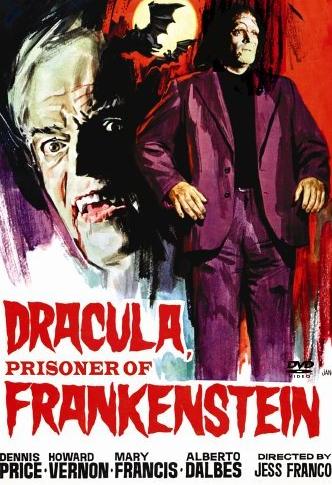
Yet there are some fascinating concepts daring to poke through the swamp and because of this it is a difficult film to give a score to. Franco tried to shoot this as a straight movie, missing much of his idiosyncrasies, and yet they are still there, lurking in the shadows. It is an incoherent mess in places and yet there are great ideas also, that no one other than Franco would have come up with. This is not a great film to introduce a viewer to Franco and is hard work for those of us who love (despite ourselves) his movies. 3 out of 10. To a degree I believe I have been overly generous, despite the interesting aspects in the film, as to me the best part of the movie was the DVD cover.

The IMDB page is here.

Thursday, February 08, 2007

New to DVD: Jess Franco’s Count Dracula

Coming out on region 1 DVD at the end of February is Jess Franco’s Count Dracula, the maverick director’s 1970 attempt at Bram Stoker’s novel. Franco said that he wanted to make an entirely accurate make of the book and, in this, he failed – or so I have read. However it is a version of the book I have wanted to see for some time.

Why, you may ask. A look at the cast should tell you. Herbert Lom as Van Helsing and Klaus Kinski as Renfield should wet your appetite for the main course, Christopher Lee in his only non-Hammer appearance as the Count. (I have heard suggestion that Lee played Dracula in other, non-Hammer, films. Most notably "Uncle was a Vampire", in which he played a vampire but was not called Dracula and "Dracula and Son" in which his character, in the original, was simply called 'Prince of Darkness' and never refered to as Dracula).

The disc is listed as a Special Edition and the extras look interesting also, there is a Soledad Miranda essay, a Jess Franco featurette “Beloved Count” and, most interesting to me, Christopher Lee reading Bram Stoker’s Dracula.

The DVD is released on 27.02.07, my copy is pre-ordered!

Friday, June 13, 2008

Snakewoman – review


Director: Jess Franco

Release Date: 2005

Contains spoilers

I didn’t think, before viewing this film, that I was going to be writing a review. The film came on to my radar as I heard it was a loose remake of Franco’s own Vampyros Lesbos – though to be truthful it has about as much in common with that as it does with the classic Franco flick Female Vampire. That said, given the title, I was suspicious as to its vampiric content.

We have considered the concept of a snakewoman as a vampire before, actually in the first ‘Vamp or Not?’ I did, in the form of Lair of the White Worm and I was primed to draw examples from that and conjure similes… A pointless beginning. This is a vampire movie (or as close as Franco gets) and it is, by far, one of his better modern efforts that I’ve seen. It has a plot… sort of… and a lyrical quality that was sadly lacking in say Vampire Junction. Even so…. Wait… I’m jumping to a conclusion… let us begin….


Actually being non-linear wouldn’t be to bad a thing as the film has a non-linear quality that doesn’t work fantastically, but is there. However we begin with a woman, Carla (Fata Morgana), driving her car. We see flocks of flamingos (a recurring theme through this film) and occasionally she phones Tony (Exequiel Caldas), her boss.

She is heading towards the property owned by the estate of Oriana (Carmen Montes), a star of yesteryear whose shocking films and music have faded to obscurity. Tony wishes to buy the rights to the archive material owned by her descendants and re-release it in the modern world. When Carla gets to the estate it is deserted but he tells her to wait.


We seem to enter a dreamscape as Carla doses in her car, we see Oriana and she is naked bar a cloak and a full body tattoo of a snake. This is, except in ‘old’ film footage, the most we see Oriana dressed and, more often, she is fully naked. There is a failure, on the part of Carla, to secure the media rights… However, she seems to attract the attention of Oriana.


There is a sub-plot of a girl named Alpha (Christie Levin), who is clearly mad and worships ‘the mistress’ (Oriana). She is ‘cared for’ by a man, referred to as Doctor and sometimes seen in monk’s robes, yet credited as Nostradamus (Antonio Mayans). He seems to spend much of the film, especially inter-cut during sex scenes, chanting in Latin. He also seems to know something of Oriana.


Towards the end of the film Carla appears, having been missing for three days, and is placed under the care of psychiatrist Dr Van Helsing (Lina Romay). Carla, however, is still haunted by Oriana and the estate seems to have relented and sent the footage to Tony. We shall look at why in a moment but let us look at the vampire aspects.


Oriana claims she is the granddaughter of the original and yet later says that to sell the rights to the footage would be to sell her past. It is clear that they look exactly the same (bar the tattoo) and Carla certainly believes her to be the original. She has a tendency to bite – sometimes for pleasure (and feeding we assume) – and sometimes, in the case of Nostradamus, to kill.


We get a very explicit feeding at the, shall we say, intimate female parts. This has the effect of causing orgasm and generating feelings of love. We also get the feeding, in old film footage, at the intimate male member – though this looked terribly fake! It did seem that Franco was getting close, with this, to actually managing to get his base concept (through his films, through the decades) onto film at last.


Other than that, standard vampire rules seem suspended. We get no bats – though we do get flapping of cape in a bat like way, ala Female Vampire. Sunlight is not an issue, but then it rarely is in Franco movies. If you are wondering why she is the snakewoman, well as far as I could see it was due to her tattoo and nothing more.


We get a dripping mouth of blood shot, several times, that fails to work as it is onto camera and we can see blood pool on the glass and this would seem a shame. However perhaps Franco was trying to do something else… perhaps it was meant to pool upon the camera lens as it were. Carla views the lost film and, when she is alone at last, the film turns to colour and she is there, with Oriana, in the movie. This is where the film ends and suggests immortality through the medium of film and also seems to be why the footage was sent, having been initially refused, to allow Carla a portal to her love.

The soundtrack is blooming awful; a mixture of jazz, classical, discordant ‘ambient’ messes and dance music. The only standard theme was the habit of characters to sing or whistle out of tune over it (and to a different melody). There was probably a very real reasoning for the way the soundtrack was chosen but it was awfully intrusive, especially as dialogue was minimalist.

The sex scenes are actually quite tastefully shot, and rather explicit.

This is the best modern film Franco has produced, of those I have seen, it could get close to being one of his finest films period, but then misses. The lack of elucidation in respect of plot is problematic as the plot is there (thinly). Teasing us with plot and then failing to deliver is frustrating as is launching into a non-linear aspect part way through for no reason what-so-ever and then returning to a linear structure. The running time is slightly over-long, especially given the lack of exposition.
The oneirism displayed is marvellous, one feels that Franco is close to actually visually communicating exactly what he wants to. This is not, however, going to be popular with those unaware of Franco’s other work. 3 out of 10.

The imdb page is here.