Showing posts sorted by relevance for query Vincent Price. Sort by date Show all posts

Tuesday, September 03, 2013

Honourable Mentions: Madhouse

Okay, this one is a real stretch and just to get things straight – whilst there are two people dressed as vampires in a costume party (and another as a vampire’s victim) – there are no real vampire moments in this. However a connection to a famous vampire movie lends this a genre interest.

But first of all let us look at some of the stars of this 1974 joint API and Amicus film that was directed by Jim Clark. The star was Vincent Price (the Last Man on Earth, Scream and Scream Again, the Monster Club and a voice cameo in Bud Abbott and Lou Costello Meet Frankenstein). It co-starred Peter Cushing, Robert Quarry (Deathmaster, Count Yorga, Vampire & the Return of Count Yorga), Adrienne Corri (Vampire Circus) and Linda Hayden (Taste the Blood of Dracula & Vampira). It also contains archive footage, staged as films starring Price’s character rather than Price himself, with Basil Rathbone (Queen of Blood) and Boris Karloff (Isle of the Dead, Black Sabbath, House of Frankenstein, Mad Monster Party? & hosting the Thriller episode Masquerade). A veritable smorgasbord of genre names.

Robert Quarry and Adrienne Corri
The story starts 12 years ealier and a private screening of the new Dr Death movie – starring Paul Toombes (Vincent Price) as the titular character. After the screening Toombes announces his engagement to Ellen (Julie Crosthwaite). There is some bitchiness from a previous leading lady, Faye (Adrienne Corri), who suggests that all Toombes gave her was a stake through the heart. Then producer Oliver Quayle (Robert Quarry) drops the bombshell that Ellen was a lead… in his porn films. Toombes is incensed and then, as she retreats to a bedroom, we see someone don the Dr Death gloves. Toombes wakes from a blackout and goes to apologise to Ellen but, as he touches her shoulder, her head falls off.

Vincent Price and Peter Cushing
The credits show us Toombes being treated in a mental institution and we discover that it he was acquitted but the psychiatrists believe that he had a breakdown and became the Dr Death persona. Twelve years on and he has been released and called over to England where his friend Herbert Flay (Peter Cushing) – the writer of Dr Death – has sold a TV series based on the character to Quayle. They want him to reprise the role. However people start dying in ways identical to deaths in the Dr Death films and Toombes can only question his own sanity.

Yorga outfit
The reason for the mention centres on a costume party celebrating the TV series. It has Flay and Quayle dressed as vampires and PR woman Julia (Natasha Pyne, who played Laura in the unfortunately lost Mystery and Imagination version of Carmilla) as a vampire victim. There was an irony, of course, to Cushing being dressed as a vampire given his association with the Van Helsing character but we should remember that he made Tender Dracula that same year, in which he played an actor who believed he was a vampire (and may have been, though the film is unclear). Natasha Pyne as a victim, given her Carmilla role, and Quarry as a vampire seemed in-jokes. It is because of Quarry, however, that we mention the film as (according to IMDb) the outfit he wore was the very one he wore in Count Yorga, Vampire – though to be honest, Quarry and Cushing just dressed as vampires would probably have been enough for me.

The film itself is fascinating, star studded, silly and – eventually – blooming ridiculous. The imdb page is here.

Friday, March 09, 2012

The Last Man on Earth – Colour re-master – review

Directed by: Ubaldo Ragona

Release Date: 1964

Contains spoilers

The Last Man on Earth is, in my humble opinion, the best cinematic version of Matheson’s classic vampire novel I am Legend. I have reviewed the film itself here and gave it 7 out of 10. The film is flawed, with day for night scenes jarring and action sequences that don't quite work but it is carried by Vincent Price and his wonderful voice/presence.

killed by extortionate pricing
The reason for looking at the film again is because there is a re-mastered version that has been coloured through. It is also an excuse to have a moan about DVD retailers – and specifically HMV (I am sure the phenomena I am about to explore has precedents in other countries as well). HMV is struggling as a business and I think, personally, their outrageous pricing policy has much to do with this. I saw a box set of 4 films – this, the Devil Bat, House on Haunted Hill and Bride of the Monster. They are public domain films but, despite all these being re-mastered in colour, I didn’t feel the £18 price tag was warranted, and so I checked Amazon through a handy smartphone app. The same set was under £5. More than £13 different. I know a store has more overheads than an online company but, seriously, nothing warrants such a price differential. HMV, the reason your stores are failing is because you hideously inflate product prices. I ordered the set from Amazon, whilst stood in HMV!

Franca Bettoia as Virginia
So, what about the film. Well I was rather impressed with the colouring. The film looked like it was meant to be in colour and I can only imagine the effort that went in to creating this effect. Everything looked natural and the process cleaned up the visuals compared to the other version I have on DVD. If you compare the screenshot of the newly risen Virginia (Franca Bettoia) that I have placed with this paragraph with the same screenshot on the original review you can really see the difference. Negatively it does mean that the day for night shots jar that little bit more than before.

Vincent Price as Morgan
The actual film still deserves 7 out of 10 – I am still unconvinced by Vincent Price during the more action orientated sequences, and still equally moved in the pathos filled scenes. If you haven’t seen this film of the novel then you owe it to yourself to see it and I would recommend the colour version – some films may not suit the conversion to colour but it worked well in this case and you know you’ll get a nice print.

The imdb page is here.

Monday, October 09, 2006

The Last Man on Earth – review

DVD

Directed by: Ubaldo Ragona

Release Date: 1964

Contains spoilers

Originally planned to be a Hammer production, which was eventually rejected because the censor office threatened to ban the film in Britain if Hammer made it, this Italian movie is the only film so far that has got close to capturing Richard Matheson’s novel I am Legend, though it did significantly veer from the original book in places. Just to note, also, that my DVD print of this is not exactly the best in the world, so I apologise now for the screenshots.

The film stars Vincent Price as Dr Robert Morgan, the last man of the title. We start with scenes of a desolate city, occasional corpses upon the streets. In a house an alarm clock sounds and Morgan awakens. “Another day to live through,” Vincent Price’s marvellous voice intones, “I’d better get started.”

His daily routine, which has lasted three years, involves checking his generator, and then checking the mirrors, crosses and garlic that he has on his external doors. making stakesThere are corpses outside his home; we discover that ‘they’ feed upon the weaker of their own kind. The mirror on his door is smashed as their own reflection repels them and his garlic, which the infected are allergic to, is becoming stale. He checks his ham radio, to no avail, and then makes stakes upon a lathe before venturing out.

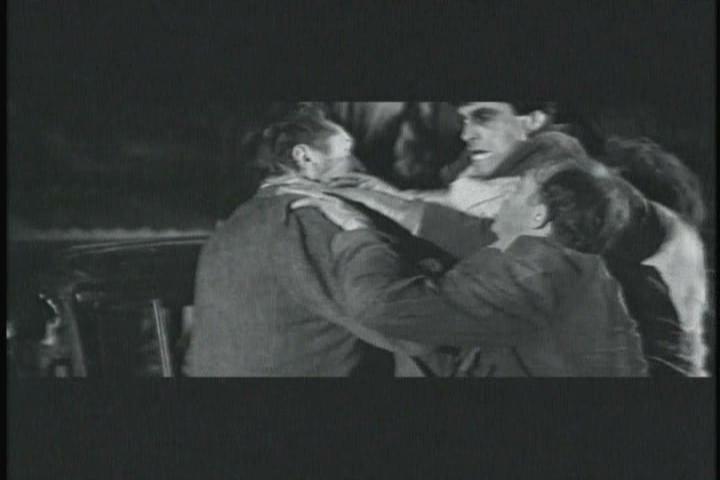
In the city he gets petrol from an abandoned tanker and then takes the bodies from outside his home to The Pithunting a vampire, a vast landfill or corpses, still burning, that he feeds with flesh, petrol and more flame. He goes to a supermarket, there is a generator still running, presumably maintained by Morgan, and he keeps his garlic in the refrigerated meat locker. He takes more mirrors from another store and then he hunts. Methodically Morgan goes from house to house in the city, marking off each location as he searches out the hiding places of the dead.

When he gets home and barricades himself in, and the sun has set, the assault on his house begins. There have been some that have said that these vampires are more like zombies and complained that this is not a vampire movie. There are vast differences, yes they shamble and are of a lower level of reasoning, but they use tools, smashing at the house with sticks, they can speak and have memory. The main vampire outside the house calls for Morgan. He is Ben Cortman (Giacomo Rossi-Stuart), erstwhile friend and work colleague of Morgan. We should also remember that these vampires are the dead, they have died of plague and then have come back from the grave – as such they are reminiscent of the vampiric revenants of myth. We must further note that zombies do not fear their own reflection, are not stakable (in the heart at least) and are not repelled by garlic.

One of the problems with the film, as marvellous as Price is in his portrayal of unlikely action heroMorgan, is the fact that he seems an unlikely action hero. There is a sequence, when he is late back to the house having fallen asleep at his wife’s grave, where he fights through the vampires (who then smash his car through the night as it is not safely away in his garage). This highlights this problem, but it is only one of perception on my part as a viewer. Later we hear that individually they do not scare Morgan as they are ineffectual, it is their weight of numbers that frightens him.

We discover what has happened to the world through flashback. Morgan and Cortman were employed by a science institute, looking into a plague that was sweeping through Europe. That plague obviously travelled, the film indicating it was wind-born. As more and more fell to the plague a state of emergency was called, the dead burned in The Pit – the official reason being that it was for public health but some believing rumours that the dead were returning. Morgan’s daughter Kathy (Christi Courtland) fell to it first in his family, the army taking her away to The Pit. Virginia returnsThen his wife Virginia (Franca Bettoia) died. Morgan took her to the country and buried her, rather than have her thrown in The Pit. It is a marvellously haunting scene when he hears a whispering outside the house, and sees the door handle turning, then, as he opens the door, we see the horror on his face as Virginia comes to him her hands grasping forward.

Morgan doesn’t really know why he survived, but suspects that it had something to do with a bat bite he suffered in Panama years before. He has theorised that the bat carried a version of the disease and he became immune.

Of course, if you have read the book, you’ll know that there are not just the dead vampires. Morgan eventually finds Ruth (Franca Bettoia), a woman who walks in the daylight. He takes her in, but is suspicious of her and then discovers that she is infected, she has a serum that holds back the spread of the disease and her and others are rebuilding society. Unfortunately there is no place for a legendary monster like Morgan in this new world, a solitary creature who stalks the daylight killing indiscriminately – many of those he killed were alive.

The film spirals on to an end that, whilst having the same result of the book, reaches that ending via a much different route.

vampiric intrusionOther than the issues of seeing Vincent Price in action sequences there are other problems with the film. The direction, whilst competent, just doesn’t allow level of paranoia to reach the levels that perhaps the book attained and, on a more technical level, there are issues with day and night shots being annoyingly intermingled, so it is daylight when it should be night – but that is typical for the films of the time this was shot.

The greatest thing about the film, however, is Price, despite my action scene misgivings. He really acts his socks off and, given that he is the sole player for much of the film, the film is carried by his marvellous voice – mostly heard in voice-over. A scene, as he watches home movies, and is driven first to maniacal laughter and then to tears highlights perfectly just how good Price’s performance was. This should serve as a warning to anyone making a version of the book, you need a lead actor with the gravitas to command the screen, Price had that.

I am Legend is crying out for an accurate conversion to film, and it is all too apparent that the chances of that happening are remote. However, whilst we wait, this is the best adaptation you can see of the book. 7 out of 10.

The film is public domain and can be downloaded at The Archive. Note that the version available for download is not the widescreen print.
end of the last man
The imdb page is here.

A look at the colour re-master is here.
I’ll leave this with Morgan’s words at the end of the movie, as realisation finally dawns upon him all too late, “They were afraid of me.”

Tuesday, May 05, 2015

Honourable Mention: Ruddigore

It may seem odd, to those familiar with it, that I am giving a mention to the Gilbert and Sullivan opera Ruddigore – in the guise of the 1982 Barrie Gavin directed version. So, before I go into the production itself, we must turn to Roxana Stuart’s volume Stage Blood: Vampires of the 19th Century Stage.

Stuart looks at Ruddigore, first staged in 1887, within that volume and informs us that it was originally entitled Ruddygore, “The title was a major problem. “Ruddy” had become rather too close to “bloody,” and, amazingly, this was enough to prevent many “nice” people from attending.” (p170) So the title itself could be read as bloody gore. In many respects the opera was a parody of, or play on, melodrama – and of course the vampire had played its role in melodrama – and Stuart offers a convincing argument that it was (mostly in the second act) a direct skit of Boucicault’s The Vampire.

Probably most telling was the appearance of the character Sir Ruthven Murgatroyd – correctly pronounced in production as Riven. Of course Ruthven was the vampire from Polidori’s the Vampyre: A Tale and he had reappeared in various plays, operas and prose through the 19th century. Erik Butler also looks at the opera in his volume The Rise of the Vampire, referencing Stuart.

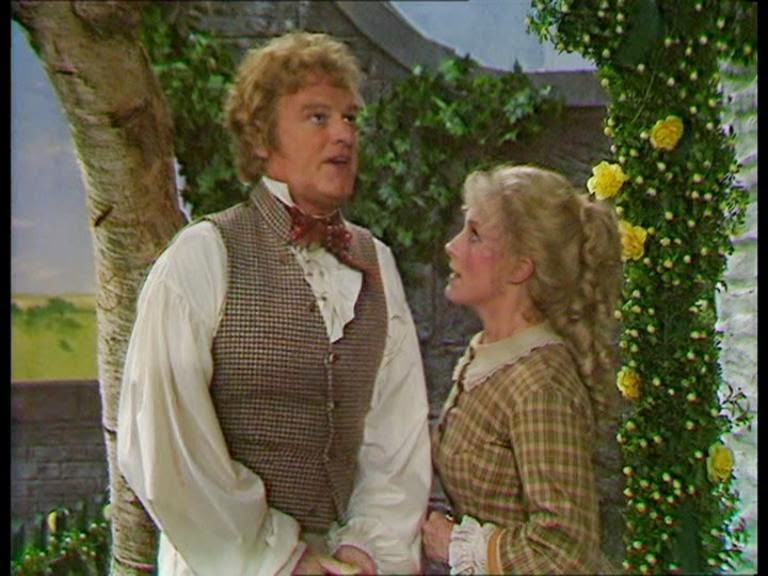
Robin and Rose
So we have an opera set in the town of Rederring, Cornwall, which sits in the shadow of Ruddigore Castle. The village has a cadre of professional bridesmaids (the chorus) who have been out of work as no one seems able to win the heart of the maiden Rose Maybud (Sandra Dugdale). Rose lives with her Aunt (Johanna Peters) and secretly wishes that Robin Oakapple (Keith Michell) will express a desire for her. Robin loves her but is too shy to say so. From her Aunt, who was once engaged to former Baronet Sir Roderic Murgatroyd (Donald Adams), we hear of the Ruddigore curse. Sir Rupert Murgatroyd, the first Baronet of Ruddigore, had been a witch hunter and one had cursed him whilst she was burnt at the stake – all Baronets of Ruddigore were cursed to commit a criminal act every day.

Vincent Price as Sir Despard
Robin has a dark secret – he was the eldest son and so should have been the next Baronet of Ruddigore. To escape that fate he has hidden away, changed his name and has been assumed dead; his younger brother Sir Despard Murgatroyd (Vincent Price, the Last Man on Earth, Madhouse, Scream and Scream Again , the Monster Club & Bud Abbott and Lou Costello meet Frankenstein) has taken the title and thus the curse. He also has a foster brother, a sailor just returned to England called Richard Dauntless (John Treleaven). Robin confesses his love for Rose to Dauntless who agrees to speak to her, falls in love himself and asks her to marry him rather than Robin.

getting a light
Rose is rather inconsistent and having said yes to Dauntless then breaks the engagement and plans to marry Robin. At this point we meet Sir Despard – a man aged by his criminal lifestyle he tries to outwit the ghosts of his ancestors (who haunt each Baronet to ensure their compliance with the curse) but who actually tries to do good, after committing the day’s crime. When we meet Sir Despard we see that he has powers, apparently; to light a cigarette he clicks his fingers and an arm emerges from a grave to strike a light and we also see him fly. We also see his costuming is somewhat vampiric, in the classic Lugosi way, or maybe just the apparel of a melodrama villain. Dauntless tells Sir Despard who Robin really is and, by doing so, allows the younger brother to pass the curse back to the elder and thus stops the marriage of Robin – now referred to as Ruthven – and Rose.

in a coffin
The second act takes place in Ruddigore Castle and Ruthven now dresses the part of a villain and, in a very vampiric twist, sleeps in a coffin. He has a false moustache, in order that he might twirl it, but is particularly bad at crime – he can be rude, but the heights of his crimes include disinheriting a son not actually born and forging his own will! When Dauntless and Rose visit him to ask for his permission for them to marry he does threaten them (weakly) but is held off by an apotropaic – in the form of the Union Jack (mentioned directly as such, rather than the Union Flag, and called such I assume because Dauntless is a sailor). He quickly caves and gives his blessing.

ancestors come from the paintings
His poor ability as a criminal brings down the ire of his ancestors whose ghostly apparitions emerge from their portraits. Stuart points out that this is lifted from Boucicault’s The Vampire. We then discover that the Baronet cannot die by any means – save by dying in agony should he not commit his daily crime. The day is eventually won as Ruthven realises that each Baronet has eventually given up their life of crime and thus died. This, he logically argues, is suicide and suicide is, of itself, a crime. Thus none of them should have died. This also allows him to commit a daily crime, without harming another, by refusing to commit a daily crime. Thus unencumbered of his “bad Baronet” persona, the fickle Rose returns to him!

held back by the Union Jack
So Ruthven can be argued to be, loosely, some form of vampire – but his life is extended by crime rather than devouring maidens. The ghosts of his ancestors might even be said, under the same argument, to be vampiric ghosts, again loosely. The intent of the satire was clear and I think – certainly as something that is of genre interest – this did deserve a honourable mention. Plus, of course, the version I looked at featured the great Vincent Price. The imdb page is here.

Monday, August 07, 2006

The Monster Club - review

Director: Roy Ward Baker

Release Date: 1980

Contains spoilers

Another film made up of shorts, the Monster Club has a place in my heart as one of my favourites from childhood, though looking at it now it was aimed at a younger market and replaced horror with black comedy – whilst the DVD is rated 15 I loved the film at a very tender age indeed. Unlike other such collections this contains only three main stories. These are the shadmock story (slow to start but with an excellent ending), the village of monsters (atmospheric but with a twist at the end you could see a mile away) and the vampire story. All the stories were based on shorts by R Chetwynd-Hayes who is actually portrayed in the film by John Carradine. Before we look at the vampire story, subject of this review, let us look at the film in total as there is vamp action aplenty.

Chetwynd-Hayes is looking in a display at his horror books when he is grabbed by a gentleman who states he is famished. Chetwynd-Hayes offers money for food but it is not food he wants and suddenly the author is bitten. Afterwards the assailant introduces himself as Eramus (Vincent Price), a vampire and fan of the author’s work. He assures the author that he will not become a vampire, he did not bite deeply, and to repay him takes him to the Monster Club. We also find out later that only blood taken directly from a victim will feed a vampire, which is why the bottled blood at the club will not suffice.

In the club we get our three tales, however we also get some very cheesy monster masks (when I say cheesy that is somewhat of an under-statement) and faux-rock pop songs written by BA Robertson and performed by various bands. We see several vampires, including the coat-room girl. However, we do get some great Vincent Price moments. At the end of the movie Eramus suggests that the author should have club membership and, after listing the various methods of killing and destruction that humans have invented, membership is granted. It is worthwhile watching this end scene if only for the vision of Price and Carradine boogying on the dance floor.

The vampire tale is the second piece we see and is a film shown in the club, rather than a story related by Eramus. The film is introduced by Lintom Bustosky (Anthony Steel) a vampire film producer (aren’t they all, quips Eramus) and, he states, is based on his own life. The segment is very much geared to black comedy.

We see a young Lintom (Warren Saire) being packed off to school by his mother (Britt Ekland). Never talk to strangers he is warned. That night his father (Richard Johnson), a “night worker”, rises from the cellar to play with his son. Unfortunately he has to go to “work”. Lintom asks if he is a waiter, he is in evening dress, which he denies. He explains that he lightens the burden of those with too much and that his motto is feed without greed. He also warns his bemused son to be on the lookout for the B-Squad (or the Beeny) and to beware of men carrying violin cases.

At school the next day we see that Lintom is bullied and this is observed by a priest, Pickering (Donald Pleasence). That night his mother tells him not to mind the bullies, he is better than them. In the old country his father was a Count, which makes Lintom a viscount. Lintom uses this the next day but it makes the bullying worse. He is rescued by the priest who tries to engage him in conversation, Lintom tries to be tight-lipped, as he has been taught, but perhaps reveals too much about his home life. Pickering suggests that Lintom visit his father during the day, in the cellar – when his mother is out. Pickering then looks over at a van, in which sit three men with violin cases, and gives a nod.

Lintom’s mother goes to the shops, leaving him at home. She is observed by Pickering who has ditched his priest outfit and is now suited like the men from the van. Lintom decides to follow the advice and go and see his father. His father is in a coffin and Lintom runs from the house straight into Pickering. He and his men go in, telling Lintom that they are the B-Squad, fighting blood crimes. Lintom’s father has been Pickering’s toughest case. They drag him to the cellar and Pickering is about to stake the father when the mother comes in and screams. Unperturbed Pickering gets on with his job, but the father, as he dies, grabs Pickering and bites him.

Pickering asks for an ambulance but the mother laughs, her husband has bitten deep and he is now a vampire and must be staked by his own men, to which they concur. He protests, he is Pickering, a legend, he has staked 2000 vampires but the men ask him to lie down whilst they stake him. He tries to run but eventually he too is staked. His men carry him out of the house, whilst the funeral march plays; the music gets stuck as they struggle with the gate in a black humoured gag.

Mother and son go back to the cellar, having watched the B-Squad leave. The father sits up and pulls the stake out. He explains that he always wears his stake proof vest filled with tomato ketchup.

It is a comedy piece and as such we can forgive the stake proof vest and it is an amusing watch. The cast are generally good and, unusually for such a short, we actually get to know a little about the characters. The soundtrack in this segment is excellent, wild violins abound playing traditional Transylvanian folk music. All in all I’m giving the vampire story 6 out of 10. As for the film as a whole, if you can get past the cheesy club scenes it is definitely worth a watch.

The imdb page is here.

Wednesday, July 04, 2007

Fright Night – review


Directed by: Tom Holland

Release date: 1985

Contains spoilers

Well, it’s about time that I got to this one. A classic vampire movie from the eighties I defy any fan of vampire films generally not to adore this film for the plentiful homage that refer to predecessor vampire movies, and indeed general horror movies, of yore. And they are there, the film brims with them so apologies if I miss your favourite reference.

Am I being overly generous already, well let us just see…

In a bedroom somewhere in America we hear the sound of a vampire being staked, from the TV, as
‘teenagers’ Charley Brewster (William Ragsdale) and Amy Peterson (Amanda Bearse) make out. The host of the TV show, Fright Night, is introduced. Now let us stop here for a second as one of the most obvious references is in the name, Peter Vincent (Roddy McDowall), being a composite of Vincent Price and Peter Cushing – indeed the look of the character owes much to Cushing.

Anyway, Amy tries to distract Charley, and his wandering hands, with the TV as he is a big Peter Vincent fan but teenage frustration kicks in and he wonders, after a year together, why they are not more intimate. Amy is scared but decides then and there to go all the way. Charley is distracted however; he has noticed two men carrying what looks distinctly like a coffin into the house next door. Ignoring Amy, he manages to upset her. Downstairs the news, watched by his mother (Dorothy Fielding), mentions a murder.

The next day Amy is giving him the cold shoulder and he notices a prostitute (Heidi Sorenson) entering the newly occupied house. During the night he hears a scream. The day after that, when Amy is trying to make peace, he notices the woman’s face on TV. She has been murdered and his friend Evil Ed (Stephen Geoffreys) says that the police band mentioned both murder victims being decapitated. Charley has managed, again, to honk Amy off.

Charley goes to the house after school and is looking towards the cellar when a man appears,
Billy Cole (Jonathan Stark), and intimidates him away. Instead Charley keeps a vigil, watching the house from his bedroom, but falls asleep. When he awakens he sees a woman disrobing in the opposite window. Of course, being a teenage boy, he finds this most enthralling. The owner of the house, Jerry Dandrige (Chris Sarandon), stands behind her and then reveals fangs. He looks over towards Charley and pulls the blinds with long talon tipped fingers.

Charley wakes his mum but can’t get any sense and so goes outside, where Billy is placing something that looks like a body in the car. Something swoops overhead and then Dandrige steps out of the shadows. Charley is spotted when his mother shouts him. He tells her that the new neighbour is a vampire, but is not believed and the next day tells Amy, to the same effect. He goes to the police who investigate until he mentions vampires, though whilst in the house he notices a portrait that looks like Amy. The use of a portrait was nice as a referential to plots of other movies/shows, most notably Dark Shadows/Dracula (1973), but they didn’t play on this too much. Indeed Dandrige himself calls it a similarity without getting bogged in the melodrama of reincarnation.

When he realises that the sun is due to set, Charley goes to Evil for tips on how to defend himself from vampires. Here we get the first lore, though most of the lore is standard to general vampire movies. A cross can ward, if you have faith, holy water and garlic work. A vampire cannot enter your house without an invite.

When he gets home Dandrige is in the house, invited by his mother. Later there is a night invasion, where Charley is given a choice – to forget Dandrige and the vampire will forget him. This is not taken and so Dandrige goes to kill him but a judicial pencil through his hand causes him to let the boy go and enter monster form. Mrs Brewster awakens and Dandrige scarpers. On the TV Peter Vincent mentions that he believes in vampires.

Charley goes to see Vincent, not separating movie fantasy from reality, and Vincent – who has just been fired – treats him like a nut. By the time Evil and Amy get to Charley his room has become a vampire killer’s lair and he intends to get Dandrige. They tell him to wait whilst they see Vincent and, after Amy pays the man, he agrees to do a vampire test on Dandrige.

This is pre-arranged and he will give Dandrige tap water, say it is holy water and convince Charley that his neighbour is not a vampire. Things go slightly wrong when Dandrige recognises Amy and Vincent notices that Dandrige has no reflection – something Dandrige realises has happened. With Evil turned, Amy in mortal danger and Vincent revealing himself to be a coward, can the day be saved?

Other vampire lore we get is turning into a bat, turning into a wolf, eye mojo and mist form. Dandrige is stronger than a human and, whilst Vincent can use a cross against Evil, faith is needed for a cross to effect the master vampire. The vampire casts no reflection and a stake through the heart or sunlight will kill a vampire. If a head vampire is killed by sunrise (or just a little after) then those he has turned the night before can be saved.

I mentioned references and we get scenes on the TV from Scars of Dracula and zombie flick ‘Children shouldn’t play with dead things’, as well a portrait of Lugosi and memorabilia that look like they came from Nosferatu (1979). This is to name but a few, and many of the references are in the actions of the characters rather than props that we see.

The acting is spot on. Sarandon oozes arrogance in a role that he glides through with consummate professionalism. Geoffreys is both hilarious and tragic as Ed. Ragsdale plays his role well and McDowall is a pleasure to watch. In atypical Hammer style Bearse takes her character from coy girl to wanton, blood hungry hussy.

The effects are great, for the time this was made, with a nice mix of animatronix, makeup and matted effects. I often mention crap bat syndrome and this escapes it by having the bat so outlandish that it works. The climax looks a little dated now but is still spectacular. The soundtrack is very eighties but the tracks work well, and are referential lyrically to the subject matter. You’ve got to love Dandrige whistling ‘Strangers in the Night’ as he creeps around the Brewster house.

There really isn’t a bad thing I can say about this movie, it mixes horror, with some low level gore, great acting, lighting and direction. It throws a genuinely amusing comedy level in and stirs the whole thing with a big dollop of nostalgia and a genuine love for the films it is referential to.

8.5 out of 10.

The imdb page is here.

On DVD @ Amazon US

On DVD @ Amazon UK

Saturday, October 30, 2021

Use of Tropes: Tales of Terror


I was contacted by Leila who wondered if I had given thought to the potential vampire aspects of the segment Morella in the 1962 Roger Corman vehicle Tales of Terror. In truth it was one of Corman’s Poe themed films I had not seen and so it seemed like a mighty fine excuse to watch it, if nothing else. After all this was a film with an exceptional genre cast – with Vincent Price front and centre in all three segments and Peter Lorre (M) and Basil Rathbone (Queen of Blood, the Magic Sword & Madhouse) supporting in a segment each. The screenplay was by Peter Matheson.

However, before I look at the film I wanted to just touch on interpretations of Poe’s story, which was published in 1835. In the Forlorn Demon (1953) Allen Tate made an observation regarding “Poe's heroines—Berenice, Ligeia, Madeline, Morella, {who} with the curious exception of the abstemious Eleanora—are ill-disguised vampires”. Indeed, I have looked at the Fall of the House of Usher, from whence Madeline comes, for it’s play with vampire tropes. Twitchell likens Morella to a lamia (which he ties into the vampire myth) mentioning her cold hands and almost mesmeric eyes.

Locke's House

The story has Morella die, in childbirth, leaving the unnamed narrator with a child who he does not name (until the story climax) but who, as she grows, looks more and more like her mother. It is clear in the original that the narrator was tied to his wife but not in love (indeed she repulsed him eventually) but doted upon his daughter. Not so in the film, which begins with the now adult (26-years old) daughter, Lenora (Maggie Pierce), returning to the family home to visit her father Locke (Vincent Price). She arrives at night and the coachman has to return to Boston, so she dismisses him thinking her father’s servants will help with her luggage.

Lenora arrives

However, no-one answers the door and she lets herself in. The inside of the mansion is festooned with cobwebs and no-one answers her calls. In the dinning hall the remains of a feast are buried in the dust of years and cobwebs aplenty (and a large spider to make the heroine scream). The kitchen is in marginally better shape. She finds her father and we hear that he has had no contact with her, bar paying for her tuition, having sent her away. She wanted to see him and he retorts that she has and should leave. On his own he speaks (to Morella (Leona Gage)) and says that her murderer has returned.

Morella mumified

Eventually truths start to emerge. The mummified corpse of Morella lies upon a bed – Locke unable to bear the thought of her buried in the earth. It also transpires that Lenore is dying, hence wanting to reconcile and her father quickly softens. In the story the narrator gives the child Morella’s name at baptism, when she is ten, and the child dies as he seems to hear the mother, from her tomb, say “I am here!” He then carries her to the vault to find the corpse of Morella gone. Tate suggests, “that the daughter is no real daughter but, as Morella's empty "tomb" reveals, Morella herself come back as a vampire to wreak upon her "lover"”

spectral touch

In this film, as father and daughter reconcile and Locke says “You have come home at last”, we hear the spectral voice of Morella say “At Last!” and see the complexion of the corpse change from mummified to something more lifelike. Lenore goes to bed and we see a shadowy spectral form of Morella leave her corpse and move through the house. I was reminded of the folkloric theory of the vampire actually remaining in its grave and its spirit wandering the neighbourhood. It reaches out to Lenora who screams. When Locke gets there she dies, but then breaths again after a moment, only to pass again. He covers her up but she makes a noise, he moves the sheet but the blonde Lenora is now the brunette Morella. Running back to the room where Morella’s corpse had lain, he sees Lenora now mummified on the bed…

Locke and Morella

It is easy to see, given the connection previously made by academics between Poe’ story and vampirism, how some tropes could stray into this. In this Morella has waited to return to avenge herself – not only on the child she blamed for killing her but also Locke, who she strangles as the house burns around them – as Tate suggested the returned Morella “{wreaking} upon her lover” though the narrator survives and Locke is killed. In this, it should also be noted, Locke adored his wife, she went unburied as he couldn’t bear to be parted and rather than doting on the child, he sent her away hating the one who had murdered his wife. Thus, Morella is the restless dead and she appears to need Lenora’s life to come back. Whilst she seems to possess the body, it does physically transform (and swap clothing, it should be noted) and the corpse takes on Lenora’s form – one might argue she has literally taken her daughter’s life so she might live. This lasts until her revenge is wreaked and she falls, becoming Lenora once more.

hypnotised at the point of death

I also want to mention the segment The Case of M. Valdemar, where Price plays the titular character – a dying man who has turned to the sinister Carmichael (Basil Rathbone), a mesmerist, to help manage his pain on condition that he allows Carmichael to hypnotise him at the point of death. This occurs and then Carmichael holds him in a state between life and death (despite the voice of Valdemar begging for release). I mention this because this reminded me of the Bloodthirsty Doll, which was released in 1970, in which the vampire is created by hypnotising her whilst dying.

ambulatory and rotting

The other thing to mention is that in this the state is kept for some time (we have an establishing shot showing a passage from rain to snow), though in Poe’s The Facts in the Case of M. Valdemar (1845) we are told directly that death had been arrested for nearly 7 months. In the film, however, Valdemar is able to get up and attack Carmichael to defend his widow (Debra Paget) rotting as he moves towards him. In the story, released by the mesmerist, we graphically get, “within the space of a single minute, or even less, shrunk -- crumbled -- absolutely rotted away beneath my hands. Upon the bed, before that whole company, there lay a nearly liquid mass of loathsome -- of detestable putridity.” A literary prototype for vampiric rapid decay in cinema, well over a century later.

The imdb page is here.

On Demand @ Amazon US

On Blu-Ray @ Amazon UK

Saturday, April 05, 2008

Fright Night Part 2 – review


Director: Tommy Lee Wallace

Release Date: 1988

Contains spoilers


I reviewed Fright Night some time ago and promised that I would dig out the Fright Night Part 2 DVD some time soon… Hmm… taken a while. But, having posted more recently on the proposals for a Fright Night remake, a post that led to some good discussion, I realised that it was high time I got my backside into gear and dig out this sequel to the original classic film.

Our two main vampire hunting characters from part one are back. We have film icon Peter Vincent (Roddy McDowall), whose name was referential to Peter Cushing and Vincent Price. We also have Charley Brewster (William Ragsdale), who in this film has progressed from High School to college. He has a new girl, Alex (Traci Lind), and I remember thinking when I first watched this – too many years ago – why did Charley go through all the trouble of saving Amy in film number 1 to end up with a new girl?

The answer probably lies in the beginning of the film. We see edited highlights of the first film and then realise that Charley is with an analyst. He has been in therapy for three years and has got to the point where he believes Jerry Dandridge was a serial killer and the vampiric parts of his memories were as a result of mass hypnosis. His fear now is facing Peter Vincent again. He goes home and throws out his hunting paraphernalia and then cuts his neck shaving.

Peter Vincent is still hosting Fright Night, though he is want to go off script, much to the chagrin of the director. Charley and Alex visit him on set and then go back to Peter’s apartment. Peter is an old ham, loving to talk about his past film career. It is clear that he still believes in what happened to him and Charley. Charley, for his part, is diplomatic. When Peter takes Alex to see something, Charley looks out of the window and sees crates being delivered to the building. It is analogous to the beginning of the first film but Charley dismisses it.

Taking their leave, they take the elevator down to the lobby of the building. Alex goes off (presumably to a toilet?) and Charley is sat there when the new building occupants arrive and a strange bunch they are. The main person, Regine (Julie Carmen), is both beautiful and fascinating. They vanish upwards in the lift. Charley drives Alex and stops the car. We see Regine land on the roof and start tracing it with her finger as Charley gets amorous, too amorous really. This seems like a vampiric control. Alex leaves the car.

We then get the activities of our new bunch of vamps and henchmen, I’ll look at them closely soon. However, Regine targets Charley. She turns up at his dorm room, looking for Charley – but with a different surname, so as not to arouse suspicion – and then asks for a light, getting an invite in. She kisses Charley and then gently opens his neck wound with a fang before biting. In the morning Charley wakes with a scream – but was it a dream?

Our new characters are mainly vampires. Regine, herself, is the sister of Jerry Dandridge and after revenge. She is posing as a performance artist and we can guess at her age as she tells us that her brother was 1000 years old. She has come, as I said, for revenge. For Peter Vincent it seems to be a case of wanting to destroy his career and then taking his life – a minor revenge in the grand scheme of things as she recognises that he is a coward at heart. Charley she wants to turn and then torture for eternity.

Belle (Russell Clark) is the least explored character. A transgendered, roller skating vampire, I would have liked to hear more about him. Certainly, in the look and attitude, he seemed referential to Grace Jones’ character in Vamp, indeed he out-vamped Jones. Allegedly there is a deleted scene, not on DVD, that shows Belle turning Regine.

Bozworth (Brian Thompson, a perennial favourite turning up in many a sci-fi/horror series/film) is the daylight servant. Shown to be strong, he is analogous to Renfield and enjoys nothing more than catching a bug, giving its Latin name and then eating it. We discover later that his innards are fully made up of bugs in one of the, many, nice set pieces that litter the film.

Louie (Jon Gries) is one of the best characters of the film, certainly a comedy character. He became the subject, in the post I mentioned, of discussion with regular blog reader Anthony Hogg. Louie likes nothing more than turning into wolf form and, as Anthony points out, this leads to the regular misconception that he is a werewolf. He is not, he is most definitely a vampire. There are clues littered around.

In one of the set scenes, which I’ll mention later, he drinks a foaming glass of blood. He is constantly berated by Bozworth for not biting on the neck. He can just develop fangs. The film series already established that wolf form is possible, as Evil Ed (whose actor, Stephen Geoffreys, turned down the opportunity of reprising his role in this) took that form. Most importantly, having read Stoker, Alex realises that roses are a vampire apotropaic and thrust one in his mouth, causing it to burst into flame.

I mentioned set pieces and there are some stand out ones. I wish to mention a bowling alley scene, where Louie drinks the mug of blood. In many respects this felt like a low grade version of the bar scene in Near Dark, analogous but not having the same level of violence and sheer nastiness and replacing it with a comedy air. The scene with Louie pumping blood from a victim by compressing his chest, filling his pint glass, and the head of the victim ending up in Bozworth’s hand via the bowl return mechanism making the scene shine.

I was also most impressed with the capture of a vampire in holy vestments. Held within them the vampire began to melt and the effects were really well done. This underlines just how much the effects were ramped up from the first film and is one of the best done of such, well I would say decaying scenes but it really was melting, in genre films generally.

The general vampire traits are there. They can morph, vanish, turn to mist and so on. Eye mojo and mind control is evident. They are effected by all the general vampire wards and killing implements. One must question why, when Regine is trapped in a lift, she starts to tear at the floor. Why not turn to mist and get through a crack, or even through the first tiny hole she rips in the floor? Probably due to the need for hunting characters to get into position script wise.

I did like one point, which defended genre fans. Alex’s taste is somewhat cultured and highbrow and she accuses Charley of enjoying “low grade melodrama”. Charley defends himself and she mentions a Peter Vincent movie, Bloodsuckers from Beyond. It becomes clear she is judging without having seen it. Charley mentions what a good book Dracula is. Alex does read it and admits that it is a great book, then, of course, it saves her life. The point; the genre might have highs and lows, but there is some truly artistic endeavours out there that are dismissed because they are genre and, somehow, thought unworthy.

The acting is great. Ragsdale and McDowall work well together, forming a real chemistry and the rest of the cast support that dynamic. Gries makes for a great surfer/rocker comedy character and is a joy on screen. Carmen is exotic and seductive as Regine but, if I am to be picky, whilst she plays a great character she is not as charismatic as Sarandon was in the first film – though Carmen is much more pleasing to look at from this reviewer’s point of view!

As for the story? It does nicely follow the first film but , it does rehash it somewhat. Vampires arrive, rather than one, however this time it is Charley, rather than Vincent, who needs convincing. Not entirely true, Charley’s belief vacillates and he faces self doubt between belief and rationale. It is Charley that needs rescuing from a fate of undeath, by Vincent and his girlfriend, rather than his girlfriend by Charley and Vincent. All told, however, the plot runs fairly parallel.

As such it perhaps does not hit the same height of the first film, but it is still a great film and a worthy addition to the vampire cannon. The DVD, however, leaves a lot to be desired. Only available as region 1, it seems to have fallen to some obscurity and, I noticed, is now being sold for silly money. The print is poor, a direct video transfer it would seem and certainly not cleaned up in any way, and there are no extras to speak of. The extras don’t bother me so much but a nice print of the film would be wonderful.

For the film itself. 7.5 out of 10.

The imdb page is here.


On DVD @ Amazon US

On DVD @ Amazon UK