Director: Jonny Campbell, Paul McGuigan and Damon Thomas
First aired: 2020
Contains spoilers
So, the pre-amble. I was sorely vexed over how to review this but am afraid to say there will have to be spoilers aplenty (including cliffhangers and twists), for two reasons. Firstly, what the creative minds of Mark Gatiss and Steven Moffat have given us are essentially three films. Each episode was 90-minutes and each self-contained (though interconnected) with three distinct story parts. The issue with this is that the first and second episodes were incredibly good takes on aspects of the novel – not direct builds, mind you, these were more inspired by. The third episode was (almost fatally) flawed and it was a story issue, where Gatiss and Moffat fell back on narrative shortcuts, stereotypes and lazy devices.
The second reason for spoilers aplenty was the fact that they came up with some marvellous ideas, which I want to explore, and also some meta moments worth touching upon. This occurred in all three episodes, plus I want to occasionally touch on contrasting moments from the
the novel. The review therefore is more a case study and is to be structured into examining the three episodes separately. My vexed state of mind was over just how to score this. What I have decided to do is score each episode individually with an overall score from the average of the three.
Episode 1: The Rules of the Beast
 |
| John Heffernan as Harker |
The episode starts in Hungary 1897 and we see a disfigured man; bald, gaunt with sores on his head. He watches a fly, looking like he wants to catch it. This is not, as the thought might have occurred, Renfield. Rather it is Jonathan Harker (John Heffernan). In turn he is watched by a nun, Sister Agatha (Dolly Wells) – she enters the room, asking if he is hungry, her words distracting him from the fly, and also asking if the sunlight is too bright. A pack of papers are put on the table, his account of his time in Transylvania. They are joined by a chaperone (Morfydd Clark) and Agatha asks him why he is still alive?
 |
| Dolly Wells as Sister Agatha |
In their interaction Agatha reveals that she is probably more cynical about God than Jonathan, who feels that the convent offers protection by being a house of God. During this a fly lands on his eye – seemingly unnoticed by Harker, it is pointed out as “something” in his eye. The fly crawls behind the eye and then we see it moving beneath the surface of the eye. Agatha explains to Jonathan that she wishes to hear the whole story of Transylvania, suggesting he might have left out aspects to spare Mina, his fiancée – and asking directly whether he had sexual intercourse with Count Dracula (Claes Bang). This all occurs before the first credit. Agatha, of course, is a minor character in the novel – here she takes on a major role as will be revealed through the review.
 |
| finding the feast |
After the credits, the scene moves to the Carpathians and Harker is being abandoned by his coach in a storm. A peasant woman gives him a cross and he is told the Count will find him. A coach, of course, does come with the usual taciturn driver and, on the trip to the castle, he reads a farewell letter from Mina – notable for the fact that he is referred to as Jonny (only she refers to him as that) and for changing the Arthur character into Doctor Holmwood (he does not actually appear in film). Harker is left at the castle entrance – and it’s worth noting that the filmmakers used Orava Castle in Slovakia as Castle Dracula – which was also the castle used in
Nosferatu, eine Symphonie des Grauens. After some harassment by bats, he enters the castle and finds a room with food and wine laid out.
 |
| I am Dracula |
Our first view of Dracula is, with a tense chord playing across the soundtrack, a shadow moving. We then see his hand on the stone bannister – his nails sharp and long. When we see his full form, we see an old man with long, white hair. The look reminded me of Kinski in
Vampire in Venice and we get, almost immediately, the “
I do not drink… wine” line. This will be revisited a couple of times in the series, with the inquiry “
you said you didn’t drink”, and him reminding that wine is the stipulation (each time with blood in his cup). As he converses with Jonathan, Dracula accuses the locals as being without flavour. This is corrected, suggesting he meant the word character – leading to the insistence that Harker stay a month to assist with his English. Interestingly Dracula says that Harker will not need to teach, he will absorb what the Englishman has to offer. This is, of course, telling and important to the entire story premise.
 |
| blood reaction |
The castle is labyrinthian – there is a sub-storyline about a map of the castle, which I don’t intend to go into in, but when showing Jonathan his room Dracula breaks the lawyer’s mirror and Harker cuts himself on a shard. The Count reacts as one would expect, but quickly regains control. He mentions Mina’s name, confusing Jonathan who hasn’t mentioned it and one change here is the declaration that “
Blood is lives”, rather than life – something that will run through the series. In the conversation between the flashbacks, Agatha picks up on the plural and also suggests to Jonathan that it was not telepathy being displayed, but Dracula being able to sniff out his details from his spilt blood.
 |
| glimpse of a bride |
After Dracula leaves him, Jonathan hears scratching at the windows and, pulling back the curtains, sees something roughly etched into the glass. Looking out he sees fingers at the upper lip of the window that vanish. Leaning out he sees a fleeting face hanging out of a window above, and he almost falls down the sheer wall and cliff. This is our first glimpse of a bride – named as such by Dracula (and noting that the novel never called the vampire women 'brides'), and we’ll come back to the brides later. In the morning Jonathan sees the sun casting shadows through the etching, which reveals it says “help us”. Agatha picks up on a strangeness here, which Jonathan doesn’t – that it was written in English – this leads to the wonderful line, “Y
ou are an English man, a combination of presumptions beyond compare.”
 |
| Claes Bang as Count Dracula |
Even on the first night it seems that Dracula feeds on Jonathan. He recalls dreaming of Mina, sexually, and then she becomes the Count who vanishes as though a nightmare. What we see, as Jonathan tries to find his way through to the mysterious woman asking for help, is that Jonathan weakens, he starts to fall apart – for instance losing nails – whereas Dracula becomes younger, urbane and loses his accent – he is literally absorbing Jonathan, his life but also his memories, his use of language, his accent, his mannerisms even. Dracula starts to call him Jonny and, at one point, Jonathan seems to have forgotten Mina altogether – this is underscored later in the episode when it is revealed that the chaperone with Agatha is Mina and he never realised.
 |
| undead-in-a-box |
Jonathan continues to search the castle for the mysterious woman. At one point he finds a room full of crates and, when he opens them, revenant (my description) creatures appear – victims of Dracula, still animate and undead – there is a very strong distinction between vampires and lesser undead that we’ll touch on again. Though they are rotting, the idea of the victims being boxed resonated with
the Hunger And Miriam’s lovers being confined when they started to age. Dracula admits later that most of those he feeds off just die, few become Revenants, fewer still become vampires.
 |
| a bride |
Of course, there is the bride in the castle, one of three, all boxed but she can get out of her box (which she doesn’t believe Dracula knows). She calls Jonathan the Count’s friend and suggests that for the undead language ceases to be a barrier as, once you are his friend, all languages are the same (this is challenged to a degree, in episode two, when the Count needs to refresh his German but, in this sequence, the bride does say that English tasted funny – indicating either she fed from Jonathan or there is a symbiosis between the brides and Dracula and they can pick up on some of what he absorbs). An important note here is that the Bride does not fear the cross that Jonathan wears.
 |
| vampire baby |
Having attacked Jonathan, the bride places him in the box but there is something in there with him – a vampire baby. Dracula rescues Jonathan and has staked the bride. The Count is fascinated, he had never seen it work (vampirism) with a baby. He admits to only ever having three brides at a time – and suggests he is trying to reproduce. The incident with the bride immediately precedes Jonathan’s death – by having his neck broken. He resuscitates and Dracula is astounded at how quickly that occurs and the will he displays – asking him to stay as “
you could be my finest bride”, and bringing a definitive queer element to the story. (Agatha suggests he is undead but not yet a vampire meaning he has held out for quite some time.) Jonathan’s escape occurs when sunlight is reflected from the cross he wears – Agatha is certain it was the cross and not the reflected light, but the filming suggests otherwise – causing the Count to fall back, whilst Jonathan takes the opportunity to fall from the top of Castle Dracula.
 |
| nuns with stakes |
The remainder of the episode sees Dracula assaulting the convent. We get a scene with nuns armed with stakes, which honestly looked dodgy in the series' trailer but worked in the episode as it was clear that these were actually frightened women and not some crack vampire hunting squad born from some fever dreamed anime. Dracula approaches the convent as a wolf but when he reveals himself, he literally bursts out of the inside of the wolf – as though wearing its body.
 |
| emerging from a wolf |
We discover that staking doesn’t work if one does it to oneself, therefore the undead cannot commit suicide. Dracula does need an invitation to enter a place. The other thing to spoil is that Agatha’s surname is Van Helsing and, of course, this means that the character from the novel has been gender-swapped. This works marvellously and it is the repartee from both her and Dracula, through the episode, that makes it, along with a fine performance by John Heffernan as Jonathan. Indeed, through all three episodes the performances by Claes Bang and Dolly Wells are excellent. The reinventions were unique at times, interesting and look to play with the genre.
Memory being an integral part of the undead state has been done many times, carried often in blood, but this took the idea further with the utter absorption of the individual. Plenty for the genre fan. Score for
The Rules of the Beast is 8 out of 10.
Episode Two: Blood Vessel
 |
| an invitation |
Episode One ended with a cliff-hanger. Dracula had quite literally worn Jonathan Harker (still undead after being staked, as he did it to himself) and tricked Mina into inviting him into the refuge that she and Sister Agatha had taken. What was interesting about this was that a barrier had been formed by using communion wafer but an invitation could override that and allow passage. The ending saw a bloodied Dracula, having ripped Jonathan away, revelling in his victory before the two women. This seems to then be ignored as this episode opens with Dracula and Agatha (now without wimple) conversing in what looks like Dracula’s castle and then play chess, their conversations interspersing the flashbacks.
 |
| the Demeter |
In actual fact this episode is focused entirely on the voyage of the Demeter. The story of what happened on that doomed voyage has been relayed in prose,
by Doug Lamoreux and in
graphic novel but the oft-promised film has never been produced. This feature length episode then becomes our filmic Last Voyage of the Demeter and it weaves itself somewhat differently to the novel due to taking passengers and how its ultimate fate is handled. There are some nice Easter eggs and some lore discussions but the exploration of this shouldn’t take as long as the first episode as the primary story is that someone is killing passengers and crew – and we know who.
 |
| the undead |
The episode first introduces us to some characters. The Captain, Yuri Sokolov (Jonathan Aris,
Being Human), dreams of a disembodied hand and then a monstrous form of the ship’s cook (Youssef Kerkour) looking for it – the cook lost his hand during the previous voyage. We then meet passenger Dr Sharma (Sacha Dhawan) in a clinic where he takes receipt of a coffin. It is one from a grave that children have complained about and where weeping has been heard. As he examines the scratched inside of the lid a revenant rises and attacks the men who brought it. Corpses can, it appears, randomly become revenants and, as mentioned, this does not necessarily make them vampires. Finally, we meet new deckhand Piotr, deceased, and another lad (Samuel Blenkin) who takes his name and place on the ship.
 |
| Adisa, Dorabella and Ruthven |
The other passengers on-board are a mysterious passenger in room 9, who is sick and not to be disturbed, plus Duchess Valeria (Catherine Schell), Sharma’s mute/deaf daughter Yamini (Lily Kakkar) and Lord Ruthven (Patrick Walshe McBride), correctly pronounced and of course referencing
the Vampyre. Ruthven is travelling with his new bride Dorabella (Lily Dodsworth-Evans), named after the Supernatural episode
of the same name I assume, and his man Adisa (Nathan Stewart-Jarrett) – as the episode moves forward we discover that Ruthven has married for money and he and Adisa were lovers. Dracula is travelling openly with the passengers – something astounding to Agatha but, he retorts, that it is four-weeks to England and he wasn’t just going to lie in a box.
 |
| crewmates |
As I mentioned, the premise of the episode is fairly simple but there is some great character building – the cook and Piotr work really well – and this is not a whodunnit but who’s going to get it next. There are some lore moments to examine, however. On the first evening we see Dracula exhaling mist and that mist stays with the vessel – and allows him daytime deck access. We also get more detail about his absorption of people. When Valeria speaks German to him, he is rusty and so excuses himself and drinks from a Bavarian sailor to regain the tongue. It is suggested that taking traits can cause one set to overbear another.
 |
| Dorabella's fate |
He even suggests that his fear of the cross (remembering that the bride had no such fear) is due to a diet of superstitious victims who all feared the church and him absorbing that fear (thus he yearns for atheist victims) – but Agatha doesn’t buy it. What we do discover is that he can make people see things in a mirror – he gives Dorabella a view of the family she might have had, in the reflection in a water barrel, before he kills her. As he attacks he can make victims see other things – appearing as a seductive Dorabella in one attack – and also put them into a dream state as he feeds (perhaps even longer than that).
 |
| creating mist |
The episode does reveal part of what happened to Mina and Agatha in the convent – the full story emerging in episode three – and provides a twist at the end. However, this was a marvellous episode, decent character building being at the heart of it. It has proved once and for all that a Demeter film can be done and can be very good.
Blood Vessel gets 8 out of 10.
Episode three: The Dark Compass
 |
| landing at Whitby |
The twist at the end of Blood Vessel, involves the Demeter being sunk by explosion and Dracula subsequently emerging from a box of Earth in the North Sea and walking the seabed to Whitby – to discover that it is 2020 and that Doctor Zoe Van Helsing (also Dolly Wells) is waiting for him with armed mercenaries and a helicopter. Therefore, episode three has us in the here and now and suffers – not because of the time shift but due to some very sloppy concepts.
 |
| vomiting cancerous blood |
This episode shows us the full escape of Mina from the convent in episode 1, before moving us to Dracula who has managed to escape the welcoming committee, steal clothes (from a Whitby shop) and get into a house in the countryside. The lady of the house is awakened by him and he tells her that Bob let him in. Bob is folded up and tied inside a box (actually a fridge). However the welcoming committee from the beach catch up with him and – by threatening to literally tear the roof from the house and let the sun in – capture him and place him in a sealed box of earth. During this sequence, as well as a recap of what exactly happened on the beach, he bites Zoe and immediately vomits – she has cancer and it is like drinking the blood of the dead, something he cannot do.
 |
| Quincey and Jack |
We then meet junior Doctor Jack Seward (Matthew Beard) who is obsessing over Lucy (Lydia West). She, in turn, just wants to party and play the field. Ignoring a call from Jonathan Harker (which seemed odd when viewing, given his demise over a century before, but was eventually explained) Seward goes clubbing with her, as does rich American Quincey (Phil Dunster). (Note, from a novel perspective, that the spelling is for Jonathan and Mina’s son, not the crew of light’s Quincy). Having just confided in friend Zev (John McCrea) that she doesn’t want to get married (and Seward is too clingy, after all they’ve only had a bit of fun), Quincey pops the question and Lucy says yes.
 |
| Jonathan Harker Foundation HQ |
A car is waiting for Seward and he is taken all the way to Whitby were the Jonathan Harker Foundation are based (so it was the Foundation, not the man, calling him). The Foundation is based in Cholmley House, apparently – actually part of the Whitby Abbey visitor centre in real life. He has been called up as part of a ‘trial’… essentially, he and several others are to be food for Dracula – but it’ll be perfectly safe he is told. The Foundation was set up by Mina, when she inherited her father’s wealth, with the cooperation of the Van Helsing family. Ostensibly a medical research foundation their primary goal is to study Dracula if he ever emerged.
 |
| Lucy and Zev |
So here we have issues one and two. One is the “bright young things” sequences that seemed all too soap opera and just didn’t gel. Lucy is painted poorly, making her unsympathetic, appearing both a vacuous and arrogant user of people. Quincey has less dimension than his book counterpart, which is really saying something, and Jack is poorly developed and used more as a plot device to move the story forward than anything else. The second issue is this Foundation, which seems all secret society, and yet is essentially pointless as we’ll see.
 |
| taking a finger |
Dracula was discovered by Foundation divers in a state of suspended animation, however they wrongly assumed him dead but perfectly preserved – till he bit the finger off one. They replaced his lid and let (super)nature take its course and it took 10 hours for him to fully revive and hit landfall. When we see him caged in their labs, with them using the sun to control him and Zoe taking a blood sample (that he has to provide by cutting his own skin as a needle won’t penetrate), I did think perhaps we’d go a tad
Demon Under Glass. Alas not, as Dracula has other plans and suddenly his lawyer shows up!
 |
| Mark Gatiss as Renfield |
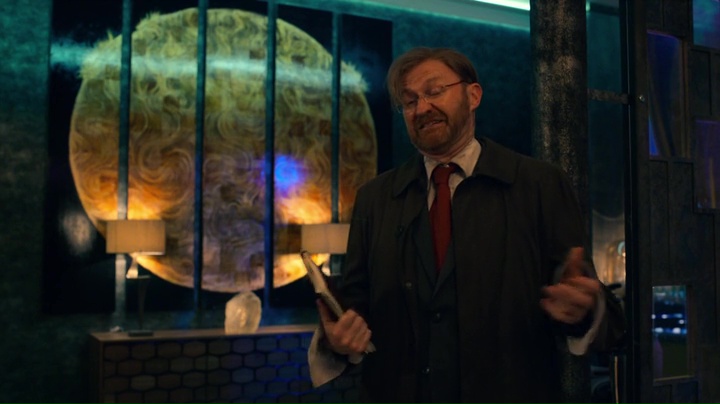
His lawyer is Renfield (Mark Gatiss,
Being Human &
the League of Gentlemen Christmas Special) and at this point we go from the sublime to the ridiculous. They have given Dracula an electronic pad with books on it. Apparently, he then used this to skype his law firm (originally engaged in the 19th Century) after easily getting on the wifi because they used Dracula as a password. All this with an armed guard outside his transparent cell. Renfield has got into the Foundation and will whistle-blow if Dracula is not released. Now, this is an organisation funded by somewhat dubious means, we later discover, and with many a mercenary in employ yet it meekly acquiesces. It makes no sense and is sloppy writing.
 |
| blood sample |
So, Dracula is released and steals Jack’s phone on the way out, which introduces him to Lucy – a willing bride. The dark money behind the Foundation do nothing and so they just vanish from the story (again, it makes no sense). Zoe resigns from them, to go and die of cancer – until Jack gets her to intervene, with some persuasion from Agatha, who she can now see as she drank Dracula’s blood sample (this, incidentally, was a nice touch – he cuts his wrist with his nail and then she drinks from the sample tube but it is an equivalent of cutting his chest and making Mina drink in the novel). Jack and Zoe find Dracula’s home with apparent ease and it’s passed off with a quick bit of dialogue but contains no sense of reality. At this point things are looking grim for the episode. But there are saving graces.
 |
| biting Lucy |
Despite the fact that the *yoof* characters are desperately in need of some character, what happens with Lucy is interesting. She is being fed on, willingly. She trades her blood for the peace he can give her in the dreams he implants. The character is shallow, she hates everyone looking and smiling at her because she is beautiful and he gives her a dream of being “
somewhere beautiful, where no one can see me or I don’t have to smile”. The other thing with Lucy, it seems, is she does not fear death.
 |
| hello blooferlady |
When she meets Dracula, it is always in a graveyard and, in the encounter that we see, he warns her not to be cremated – it hurts, he says. To explain he places her hand upon the soil and allows her to hear the undead (or sufferers, as he calls them) in their coffins knocking and crying for help - these become this vehicle's Children of the Night, making music. They also encounter an undead child, apparently sometimes they slip from their graves, the child calls her a blooferlady – quite a turn around from the book where it is the undead Lucy who gains that name from living children. Dracula warns her not to engage him as he’ll follow her home. However, he does follow her and, despite her bravado, she is rather scared. Dracula kills him by stake.
 |
| cremation |
Lucy, of course, dies and is then cremated. This made very little sense as the funeral seemed to be fairly rapidly after death but, given her youth, she would have had to be autopsied as a sudden death (and given her conscious-in-death state this should have been covered). Her body awakens in her casket, screaming as she burns. Later a worker hears clattering and finds the oven open before its cycle has finished (it takes approximately three hours to cremate a body). He is attacked and we do not see her, only her reflection – with her stating she is beautiful. Of course, when we do see her, she is a charred, burnt thing and it is only through a photograph that she sees the truth. Jack stakes her and she explodes into charred ashes. Lucy's fate is almost a mirror image of the novel, which makes her beautiful in repose.
 |
| charred |
One friend has suggested that this is inconsistent within the story. However, she is destined to be a bride and each bride seems to be more than the last, with the castle bride showing resilience and resourcefulness and Jonathan turning quickly, holding off vampirism for some time, believing himself to still be alive and exercising willpower. Therefore, to me, her being able to fight her way from the oven is possible, though the longer she was in the oven the more unlikely – her funeral was in bright daylight but her escape is likely by night, she certainly could not have walked the streets during the day in her state.
 |
| Dracula's reflection |
The other issue is that her reflection does not match Dracula’s. She looks beautiful in the mirror, projecting her own body image rather than the reality (Dracula does say mirrors have strong magic, in episode 2). Dracula on the other hand sees a corrupted undead when he looks in the mirror – but this is consistent with Van Helsing’s discovery that I’ll mention very soon. It should be remembered that Stoker’s notes suggest that the undead cannot be photographed, and I am aware that Gatiss knows this and has chosen to not use the device for a reason. To me the reflections are showing them something their subconscious demands, which is why the photograph – technology not magic – shows Lucy the truth. As an aside, I do want to mention Renfield filling in a crossword and giving the answer as “
Dracula is my God”. This matches Harker in episode one when we look at his actual manuscript and, instead of writing his story, he has written such phrases over and over. It is the flip side of the absorption.
 |
| fear of the sun |
So, it is through Lucy that Van Helsing (now, it appears, an amalgam of Zoe and Agatha) discovers what it is that scares Dracula and that gives her an insight into the truth behind the rules of the beast. In a moment that references
Horror of Dracula she runs the length of a table and pulls his (rather flimsy looking) drapes down. He falls to the floor screaming and writhing and much to his consternation doesn’t burn. Of the other rules, the need for invitation is mentioned and dismissed as not being a curse but a habit that he believes to be a rule – a little like the sun. The mirror, of course, is showing his fear, as projected by his subconscious, and that fear is what Lucy was not afraid of. Her lack of fear of death is what kept Dracula coming back to someone who, in all other ways, was uninteresting. The cross works on him but not on other undead because it symbolises the courage it takes to die (presumably bible pages and communion wafers, both used to hold him at bay, work because of habit, however).
 |
| Dracula in contemporary times |
So, an interesting idea around the reason the apotropaic items work and a very interesting work around the blooferlady. The very end scene is poetic, with a symmetry that works really nicely, but you really have to accept that things would end that way and I don’t think the narrative did anything to convince us (and we have to think of the rule set out in episode 1 regarding undead suicide). Unfortunately, this episode’s failings threaten to overbear the good. Again, Claes Bang and Dolly Wells are fantastic, but they are swimming against the tide of narrative short-cuts, stereotyped one-dimensional characters and leaps of faith that don’t work (around both the Foundation and its actions, Renfield’s activities, and the youngsters).
4 out of 10 for the Dark Compass is actually generous but the nice moments and good performances helped.
Therefore, averaging out the scores, the series gets an official TMtV score (rounded up) of
7 out of 10, and you, dear reader, get the longest review I think I have written.
The imdb page is
here.
On DVD @ Amazon UK