Sunday, June 28, 2015
The Vampire Almanac vol. 1 – review
First published: 2015
Contains spoilers
The Blurb: Stories by Matthew Baugh, Nathan Cabaniss, Matthew Dennion, Win Scott Eckert, Brian Gallagher, Martin Gately, Rick Lai, David McDonald, Frank J. Morlock, Christofer Nigro, Catherine Robert, Dola Rosselet, Frank Schildiner, Michel Stéphan and Artikel Unbekannt.
Featuring Alinska, Elizabeth Bathory, Captain Vampire, Carmilla, Nadine Carody, Dracula, Koschei, Lenore, Orlok, Ruthven, the Vampire City and the Vampires of Mars.
This dual nature of the vampire, stretching between love and death, creates a moral ambiguity which is omnipresent in its literary treatment, incorporating and contrasting seduction and horror, heroism and villainy. It only reflects the nature of life after death, and how it is perceived by its surrounding culture. Is it a desirable dream, or a hateful abomination? A reward or a punishment? And what price must one pay for such survival?
The stories contained in this collection, featuring some of the most famous vampires in literary history, incorporate all of these contradictions; in them, vampires can be both super-human and sub-human, sexual predators and impotent, romantic and passionate, and yet devoid of soul. Ultimately, the vampire is our own face, reflecting in the mirror of our beliefs, the incarnation of our spiritual choices.
The review: Blackcoat Press rapidly became one of my favourite publishers due to the obscure 19th century text they release (for me, of course, especially those centred on the vampire) making translations available often for the first time.
They also publish original material and I have had their annual anthology series, Tales of the Shadowmen, on my wishlist for some time. Whilst I haven’t yet read those, this collection (the first of two) dedicated to the vampire and reimagining many of the Blackcoat stable and others was irresistible. Actually, some of the stories herein were first seen in the Shadowmen series.
There is a wide variety of vampires captured from Lenore (who was not originally imagined as a vampire and, indeed, was not in a vampire poem – but who appears in Matthew Dennion’s Hope for Forgiveness, as a vampire, alongside the Scarlett Pimpernel and Captain Kronos Vampire Hunter) to Dracula himself. I’ve captured in the review some of my favourite moments.
Nathan Cabaniss wrote the story Schodinger’s Blood and features the vampire Alsinka from the Virgin Vampire but it is the clever premise of Alsinka’s curse that captured me, as she avenges the wronged woman, devouring her victim’s blood through Quantum Mechanics as she reaches from the past and drains his blood in the future.
Whilst the book is split into sections based on the primary character that character might also appear in other tales (and very few of the tales follow on one from another so continuity is not an issue). There were three Carmilla orientated stories. Martin Gately’s the Moon Hag needs mention for not only telling the story of Lafontaine’s cousin as mentioned in the original story (“Mademoiselle related that her cousin, who was mate of a merchant ship, having taken a nap on deck on such a night, lying on his back, with his face full in the light on the moon, had wakened, after a dream of an old woman clawing him by the cheek, with his features horribly drawn to one side; and his countenance had never quite recovered its equilibrium.”) but also for the creation of a vampire living in utero, which would emerge from the mother only to feed before retreating back into the womb.
However it was Dola Rosselet’s To Die For that stole the show of the Carmilla tales, for me at least, which makes a beautiful coda to the Carmilla story.
Those who have read Paul Féval’s Vampire City will be aware of the interesting lore of dividuality, where a vampire can absorb a victim and then make them a duplicate of themselves or change their appearance generally, whilst making them part of their collective whole. Brian Gallagher’s City of the Nosferatu interestingly takes this concept and then makes Graff Orlok an abandoned aspect of Count Dracula. Gallagher also has it that if one takes the heart of a vampire and burns it before it is dead (not all the vampires die due to heart removal) you can put the ashes into a bullet to make it a devastating anti-vampire weapon. Later on, in a section introduction, the editor’s describe the Orlok of Nosferatu as an anti-hero, which I think is a stretch – to me he is most definitely a villain.
It is not, however, just 19th century (and very early twentieth century) characters that get a look in. I mentioned the appearance of Kronos and Win Scott Eckert’s Les Levres Rouges is based on Daughters of Darkness. The story Blood and Fire, by Artikel Unbekannt, is based on Vampyros Lesbos and is probably my favourite story in the collection, simply because of the beauty of the prose.
I have barely scratched the surface, there are tales of vampiric possession and there are tales that connect in to the Lovecraft mythos. There are stories of love and stories of hate. This is a fine collection of stories that are based on the characters created by others but that are strangely refreshingly original because of this. 9 out of 10. The Blackcoat Press page for the volume is here.
Posted by
Taliesin_ttlg
at
2:03 AM
2
comments
Labels: alien vampire, Carmilla, Dracula, Erzsébet Báthory, nosferatu, undead, vampire, vampire in utero, vampiric possession, vampyre, Vlad Ţepeş, wurdulac
Tuesday, March 11, 2014
Interesting Shorts: The Black Vampyre: A Legend of Saint Domingo
Cappy replied recently, having done some research and discovering the volume The Best Vampire Stories 1800-1849: A Classic Vampire Anthology, edited by Andrew Barger. In it is the story The Black Vampyre: A Legend of Saint Domingo. Credited to Uriah Derick D’Arcy it was published in 1819 and Barger makes the case – in an introductory piece – that the author was actually Robert C Sands. The story was republished, via a friend of the Sands’ estate, in 1844 within the Knickerboker magazine.
It is clear that the author was aware of Polidori’s The Vampyre: A Tale as according to Barger, the introduction mentions “The White Vampyre,” in reference to Polidori’s story. Unfortunately the original introduction, coda poem and mention of the vampire as a symbol of capitalism, which are all mentioned in Barger’s introduction, are stripped out of Barger’s volume. He does keep the stanzas from Byron’s the Giaour in place, and there is a line at the end of the substantive story that deliberately apes the last line of Polidori’s story.
Taking it at face value the story itself is a bit of a mess, indeed it seems to be more an introduction to a longer tale that never was than its own standalone story. It introduces us to a character, Mr Anthony Gibbons, through his ancestors. This ancestor, who is the primary character of this story, is never referred to by name but is one of a group of slaves taken from Guinea to St Domingo. All the slaves died, shortly after arrival, of yaws, bar one who was not deemed fit for work; and so the plantation owner, Mr Personne, “charitably knocked out his brains; and the body was thrown into the ocean.” The African resurrected – now in this scene the moon is described as “shining bright” but a direct causation between moon and vampiric resurrection is not specifically mentioned and later vampyres are dying and resurrecting under their own steam in a subterranean cavern.
Eventually, having killed him several times (and rising, at one point, “without bending a joint” in a moment of imagery that pre-dates Nosferatu), Mr Personne decides to cremate the African but ends on the pyre himself. Badly burnt, no more notice is taken of the slave, but when he gets back home he discovers that his infant son has been killed or is missing (with only skin, nails and hair in the boy’s cot). This kills Mr Personne.
Mrs Personne then remarried twice, seeing both these husbands to their graves. After the third husband passed away she meets an African Prince (yes, the very same African who was brought over as a slave) and his page, a European boy named Zembo (who we discover is actually her lost son). She is wooed by the Prince and then marries him, despite the remonstrations of the family chaplain. Now remember, this is a story from 1819 and so, to many reading the story, the idea of an interracial marriage would be shocking.
After their wedding he takes his wife, in a daze, to her family graveyard. He digs up the corpse of one of her sons. The body is somehow still fresh and “bending over the corse; he scooped out the heart, with his long and polished nails”. He squeezes blood into a chalice, mixes it with grave dirt and forces her to drink it whilst swearing not to reveal the rite she has been forced into. Having witnessed the dead being summoned from their graves, she passed out and woke again at midnight the next night and, “by a certain carnivorous craving in her maw, and by putting this and that together, she found she was a—vampyre!!!”
She causes her first husband to rise as a vampire. We see husband two and three (raised by the Prince) fight a duel and then be subsequently staked by the Prince and Zembo. Personne and his wife are then told to head for Europe but first they go to a cavern filled with vampyres and human slaves. There follows a long passage of a speech that speaks of vampirism and has the following lovely section, “immortal bloodsuckers! –To ourselves—whether Gouls,—or Afrits,—or Vampyres;—Vroucolochas,—Vardoulachos,—or Broucolokas; —To ourselves—the terror of the living and of the dead, and the participants of the nature of both,” This shows a lovely range of various names for the restless dead had transported over to the US.
The meeting moved on to a call for emancipation, which Barger suggests makes it the earliest known anti-slavery story. We discover (as well as claiming Prometheus as the first vampyre) that the only way to kill a vampire is by stake or through a vial of liquid that will cure the vampyre and comes directly from the Obeah mysteries. Attacked by soldiers (who are instructed in how to kill vampyres by Zembo) we see the slaves sneak from the cavern and all the vampyres killed bar the Personnes and Zembo, who use the liquid to become human again. Mr Personne ends up some sixteen years younger than his wife (who doesn’t mind the attentions of a younger man).
However, Mrs Personne is pregnant by the Prince and the child is both a “mulatto” (an archaic term, which is now offensive, for a person of mixed race) and of “Vampyrish propensities”. Having used all the liquid they cannot cure him of that and it is from his line Anthony Gibbons will be born – though his story remains hidden.
This story then is one of many a first and some we have already mentioned. It is the first American vampire story I am aware of, it is the first instance of a black vampire, it is apparently the first story to argue universal emancipation, it is the first story to suggest a definitive cure for the vampire (rather than destruction) and it is the second published English language vampire story. As such I was rather cynical about the authenticity of the story but whilst an online search didn’t reveal a facsimile of the original pamphlet reproduced online (though I did find one of the 1844 printing) it did reveal the title and author (D’arcy) referred to in journals from 1819.
Posted by
Taliesin_ttlg
at
1:00 AM
2
comments
Labels: Afrit, Broucolokas, classic literature, Goul, vampyre, Vardoulachos, Vroucolochas
Wednesday, November 10, 2010
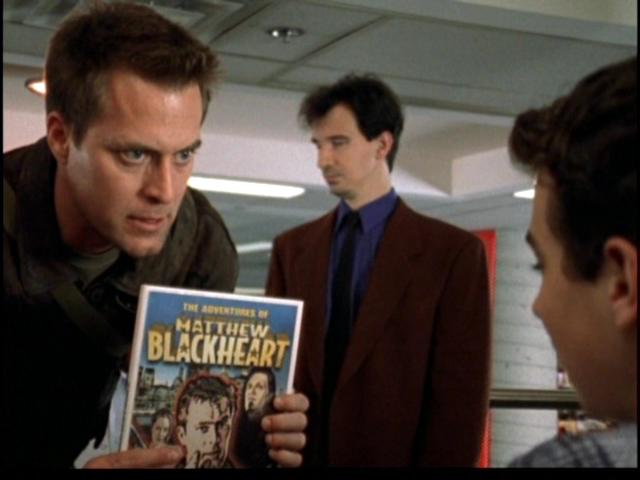
Matthew Blackheart Monster Smasher – review
Release date: 2002
Contains spoilers
This was a strange one. Created (in part) by Robert Engels who was responsible for writing several episodes of Twin Peaks, the film actually bit off much more than its budget would allow it to comfortably chew.
As such it fell back on a camp level that, whilst the film was never going to be spectacular, actually made the entire thing an enjoyable experience – its tongue wedged firmly in its cheek.
![]() |
| my life as a comic |
![]() |
| Mortas' zombie creation |
![]() |
| another monster |
![]() |
| a bogie |
![]() |
| faux vampire |
![]() |
| boss vampire |
![]() |
| burning in the sun |
![]() |
| comic book moment |
Better than the sum of its parts. 4.5 out of 10.
The imdb page is here.
Posted by
Taliesin_ttlg
at
1:24 PM
0
comments
Sunday, October 11, 2009
Vamp or Not? Pulse
I mentioned the blood drinking cult and I was attracted to this because of it. However it is almost incidental – in a way – due to the fact that the concept is glossed over and so taken for granted that it is almost ignored right through to almost the end and so I decided that ‘Vamp or Not?’ was the way forward with this as it contained some (potentially) faux-supernatural elements also.
It begins with an eye and then blood on it. It is a car crash, the car is overturned and the man cannot feel his legs. We hear paramedics, the other person in the car has been thrown clear but is dead, they talk to the man and give him something for the pain but, as more lights and sirens approach, they cover his mouth with tape, drag him out of the car and race off into the night.
Senga (Madeleine Stowe) and her daughter Nat (Mischa Barton) are driving the six hours from Nat’s father’s home. It is clear, as the film progresses, that Senga has problems. She seems addicted to prescription pills, she is bitter regarding her husband, she has work problems and is overly protective of her daughter but in a way that smothers and comes across, to the girl, as unloving. On the other hand Nat also comes across as spoilt, she manipulates her parents for her own ends and shows her mother no respect. Despite the flaws of the two characters, or perhaps because of them, they become excellent focal points for the film.The world around them, on the midnight highway, becomes rather surreal. They pass by the crash, with traffic being controlled by a cop (Jenny Jules). There are a vacationing couple (Gary Parker and Amber Batty) taking pictures of the wreck (and Senga as she passes). Further down the highway Senga starts falling asleep at the wheel and wakes to swerve around a baby on the highway, which turns out to be a doll. They stop in a rest stop and many of the weird folks are in there.
Senga sees a motivational speaker (Martin McDougall) on TV who seems to speak to her directly, then suddenly basketball is on again and it all serves to create an odd dreamscape with just a tinge of nightmare. Outside it appears that Nat has offered a lift to a hitchhiker (Bijou Phillips, who was in Hostel Part 2), a girl who claims to have just returned from India and plays them some really hypnotic, trance type music. They eventually drop her off (she leaves her CD) and then Nat gets a call from her dad (Samuel Fröler) – he forgot to give Nat her birthday present.They end up waiting at the next rest stop for him, but the present is tickets to a festival that Senga had refused Nat permission to go to. He leaves, the tickets get ripped up and Nat storms off. We see her getting in an RV with the holiday couple and the backpacker and drive away before Senga can get to them. In a state, Senga speaks to a cop – the one who directed traffic – who says she will go after them but Senga decides to follow her, sees her meet up with them and discovers that she is involved in the conspiracy and a false cop. She breaks into the RV and inside are tapes of girls – one she watches depicts a girl called Christine (Sarah Drews) – and flasks of blood, as well as false ids, paramedic uniforms and other such paraphernalia.
We then enter a nightmarish thriller where everyone seems to be conspiring against Senga as she tries to find her daughter. Nat, in the meantime, is partying in the converted tank area of a tanker with the hitchhiker and a joyrider (Leo Gregory, later in Perfect Creature) both of whom speak about the man who ‘set them free’ the leader of their cult known as the father (Jonathon Rhys Meyers). For her trouble Senga is forced off the road, where she meets her only ally.
The ally is a tow-truck man (Norman Reedus, who was in Blade 2), though Senga doesn’t realise it and thinks he is part of the group that have taken her daughter. She cannot convince the real police, not helped by the fact that they phone Nat’s father and he is, by then, dead and the Father has his cell phone and tells them that Senga is delusional. So far not very vampiric, there are flasks of blood and a cult of personality. However, in the end, we discover a lot more, beyond the mechanical blood draining we later see.
Tow-Truck Man is using Nat and Senga to track the cult. They took his sister (Christine) and made her a creature whose only purpose was to kill for blood. He makes it very much sound that they are completely changed by the actions of the Father and that he felt he had no choice but to kill her and put her out of her misery – very much a Van Helsing-esque act except he used a bomb rather than a stake. But there are other reasons this is very much of the vampire genre and that all centres around the Father.
He is in the process of seducing Nat, in a car factory that they have taken over and killed all the security in, and part of the seduction involves cutting his tongue with a razor and getting her to drink of his blood. This is prevented by Senga but his subsequent taunting of her as she tries to get away indicates aspects that he could not have known, one feels.
One thing he does do is tell Nat that Senga was going to abort her – and tells Senga that this is when she let him in. Putting aside that this suddenly pro-life thread appeared (her sin of contemplating/attempting abortion let the evil in), which had no place in the film and also seemed an odd dialogue choice for a character who represented hedonism, we wonder how he knew? He actually also seems to mesmerise Senga and give her a replacement child – a crash test dummy – and seems to transform into the motivational speaker for Senga also.
He is killed by fire (kind of, it’s by bomb) that the tow-truck guy has in his jacket, detonated by Senga, when the Father is biting tow-truck guy’s face off. The entire scene looks incredibly vampiric. There is also the age of the Father, despite his patriarchal name and his control over others he is very young, a nod towards being eternally young? The ending at first seems saccharine, with Senga and Nat driving off together but then we see a car with blacked out windows going past Nat as she waits in a gas station. The windows open and, whilst we don’t see the occupant, Nat is clearly scared. The camera focuses on a razor blade hanging in Senga’s car that is identical to the Father’s.
Does this indicate that he survived being blown up and is still out there? The film ends at this point and it has been a strange and tense ride (or at least tense when it concentrated on the excellent Madeline Stowe). The film takes elements of the traditional vampire genre and weaves them into this, the sharing of blood to seduce/turn, preying on people for their blood, hypnosis and even (given the way they pose as cops and paramedics, as well as the Father becoming the motivational speaker) shapeshifting. There is a hint of eternal life and certainly an indication of mind reading. It’s a pity the film didn’t pull all this together as well as it could of but it was still an interesting watch and should be classed as Vamp.The imdb page is here.
Posted by
Taliesin_ttlg
at
12:45 AM
4
comments
Labels: belief in vampires, vampyre
Monday, April 27, 2009
Honourable Mentions: South Park – The Ungroundable
Posted by
Taliesin_ttlg
at
1:21 PM
0
comments
Labels: belief in vampires, vampyre
Sunday, February 22, 2009
Nash Bridges – Superstition – review (TV Episode)
First aired: 1999
Contains spoilers
I must admit I never really watched Nash Bridges. I had heard of it – some cop show with Don Johnson in the titular role – but never watched it. This has changed, for one episode anyway, when FX recently aired the fourth season episode “Superstition” – that seemed to have a vampire connection.
As the opening credits rolled I was struck by some of the names appearing. Cheech Marin was in this, for goodness sake, who played not one but three roles in From Dusk till Dawn. The credits showed Jodi Lyn O’Keefe, who wasn’t in this episode but plays Nash’s daughter I understand, who I knew from Vampires: Out for Blood. Then there was Yasmine (run, Yasmine, run... run like the wind) Bleeth who was, without doubt, my favourite Baywatch gal.
And vampires... ish... what struck me about the show was that it came across as off-beat and I assume that is what they were aiming for, but the attempt failed and it straddled drama and comedy uncomfortably in a way that shouted of TV for the masses. Perhaps it was only seeing one episode in isolation but, generally, it didn’t do too much for me. Anyway there are sub-stories about Joe (Cheech Marin) trying to get a car for his wife, Nash and Caitlin (Yasmine Bleeth) nearly getting it together and some cop or another walking a dog to score with the ladies. Meaningless drivel in the background... oh, and for some reason the SIU offices turn into a disco.
So Nash and Joe are driving along when a limo streaks past them pursued by a patrol car. Of course the patrol car crashes and it is up to Nash to bring the chase to a halt, not before they have seen the vampire driving it. I mean fangs, makeup on face (including red streak to imitate blood), cape etc. The Limo crashes up and the vampire legs it. Nash finds a woman, Finn (Jenny McShane), tied up in the trunk – the body of her bodyguard is in the back seat.
He has been stabbed with a replica of Vlad the Impaler’s dagger (I didn’t know they had them but according to this show over 2 million have been produced!), the neck bite marks were superficial. Finn is a singer and says she might recognise the vampire from a Goth club she used to play as her first CD was Goth... fickle thing aren’t you, when we see you singing it is a country version of Desperado. They go to the Goth club and spot the guy. Leaving Finn to fend for herself, they give chase and he tries to leap from an overpass onto a garbage truck – he misses.
His name was Damian Kenso, he had fake fangs and someone else’s blood in his stomach – “I guess that’s what happens when lawyers marry,” Joe quips – and the investigation eventually leads them to the vampire’s leader, Lothar (Matt O’Toole). Of course he denies any knowledge of Finn, but vampires are still trying to get her (more cutting with their fake English accents than with the knives they carry) and eventually she is kidnapped.
Don’t worry, Nash is there to work out what is going on. By looking at some random books, he had another cop pick up by subject matter alone, on vampirism, immortality and white witchcraft Nash has worked out that Lothar and his vampires have cobbled a cult together out of aspects of vampire lore, Celtic lore, paganism and Wicca – which makes no sense – and they have taken Finn for the Quickening (strange, he didn’t mention they were using Highlander terms...) Seems they think she is a white witch (I guess because she said so on one track off her first album) and will bleed her on a specific night (that night) to gain immortality... sheesh...
There is so much that would be offensive within this to vampire genre fans, vampyre lifestylers, Wiccans and generic pagans... were it not so much drivel. In fact the parody is so caricatured that the caricatures almost become unrecognisable. On a genre level, these might be vampyre lifestylers but there clearly is a supernatural belief, if not element. I said vampires get everywhere, they do but sometimes they shouldn’t! As a vampire piece this was exceptionally poor. 1 out of 10.
The imdb page is here.
On DVD @ Amazon US
On DVD @ Amazon UK
Posted by
Taliesin_ttlg
at
12:43 AM
4
comments
Labels: belief in vampires, vampyre
Saturday, June 21, 2008
Honourable Mentions: CSI: Crime Scene Investigations – Suckers (TV Episode)
As I am often want to repeat, vampires get everywhere and yes they made an appearance in CSI – in series 4, episode 13 to be precise, an episode directed by Danny Cannon and first aired in 2004. CSI being what it is though, we know that we are not going to be dealing with supernatural vampires but instead plunge into the vampyre scene.
It is fairly standard that there are at least two storylines ongoing in a CSI episode. In this case there was one concerning a casino heist and Japanese antiquities. The secondary story concerned our vampyres and the CSIs investigating were Warrick Brown (Gary Dourdan) and Catherine Willows (Marg Helgenberger). This, of course, meant no Grissom in the vampyre storyline – which, for me, was slightly disappointing.
It is less the fact that we are dealing with vampyres (especially as our criminal believes himself to be the real deal it seems) and more the fact that this was a secondary story that has led to this being dealt with under ‘Honourable Mentions’.
Catherine and Warrick are called to an abandoned building as a body, belonging we discover to Angela Somerville (Sam Doumit), has been found. A neighbour heard a scream and called the police. The building was previously the scene of a couple of suicides. In the building is medical examiner David Phillips (David Berman) who has spotted a couple of wounds on the victims neck puncturing the jugular vein.
He points out to the CSIs that the space between the wounds is consistent with the space between human eye-teeth. When Catherine points out that they aren’t human teeth marks he counters with the idea of fangs and opens the victim’s mouth and reveals the fangs inside. The victim was bled out and hasn’t been moved but there is no blood splatter. Catherine doesn’t know – she admits – much about vampires but she does know that bites equal spit equals DNA. Also in the house is ritual grafitti.
Back in the morgue Dr Robbins (Robert David Hall) has discovered that the fangs are clip-on caps and that Angela had cut marks in her shoulders. A visit to her parents reveals that she had got into the Goth scene and vampyres. Her parents had tried to ride out the phase but had insisted on an HIV test. The room contains a shrine with the picture of an unknown man and a statue of an incubus. Now, lore wise, this was either interesting or confusing. We are told that incubi would seduce girls in their sleep (myth accurate) and drink their blood. I haven’t really seen any reference to incubi and blood drinking before.
Having questioned Angela’s court (a coven of vampyres, in this case being three young Goth girls) and discovered that Angela’s tox-screen showed ingestion of absinth, Warrick and Catherine end up going to an underground Blood Bar. Sharp eared viewers will have noticed Marilyn Manson playing and later Bahaus’ classic Bela Lugosi is Dead. In the bar they meet Lazarus Kane (James Haven), the man from the shrine. Angela was his donor and he has an ampoule with her blood. More lab tests show that his DNA is not the same as that on the bite but a compound is in the blood ampoule consistent with one added to blood taken for HIV tests.
To the testing centre where they meet Bobby Jones (Joel Bissonnette) who just so happens to have a tub of Angela’s blood in his fridge. ‘He done it governor’. He had stalked Angela, convinced he was looking over her; attacked her, convinced she invited him to; collected her blood in a jar and is convinced her spirit lives within him still. He is also convinced that he was born with his fangs. He’s as nutty as a fruitcake to be honest.
However, as a secondary storyline the case is simple and Bobby’s delusions are not that deeply looked into. Nether-the-less we have a vampire storyline in CSI. Props to the little moment where (at this point of the series) lab technician Greg (Eric Szmanda) passes a stake and a cross to Warrick and Catherine but it was, in my opinion, a miss to not have Grissom involved in this case.
The imdb page is here.
Posted by
Taliesin_ttlg
at
12:04 AM
0
comments
Labels: clinical vampirism, fleeting visitation, vampyre
Saturday, January 26, 2008
Quantum Leap: Blood Moon – review (TV Episode)
Director: Alan J. Levi
First aired: 1993
Contains spoilers
When it first aired I used to watch Quantum Leap religiously. The show had a simple premise that allowed them to keep drawing the audience back in. For those who never saw it the idea was the Dr Sam Beckett (Scott Bakula) had theorised that a man could time travel in his own lifetime. He stepped into the project’s ‘accelerator’ and leaped. The series eventually explained that it was Sam’s mind and body that leapt but wherever he leapt an aura surrounded him giving the appearance and voice of another (who was displaced to Sam’s own time).
Sam had no control over the leaps but he was always somewhere he was needed, compelled to stop something bad happening. Once his mission was complete he would leap to another time frame. His companion through this was Al (Dean Stockwell), an observer from his own time whose image was projected to Sam as a hologram only he could see.
Some of the episodes were a little schmaltzy at times but the premise ensured that you always came back to see what would happen next and the show had a virtually unlimited license when it came to plots. The fifth and final series seemed, as I watched it, to become darker and more daring in its premises and during this season we had a vampire episode, which began with Sam awakening in a coffin and his perennial catchphrase after a leap of “Oh Boy.”
Normally Sam would look into a mirror, so that he could see what he looked like in the time he found himself in, however this time there were no mirrors. He was in a castle in England and a rather Hammer-esque setting it was too. When Al appears he discovers that he is Nigel Corrington, an artist. However Al is convinced the Corrington is a vampire.
As he puts it, Corrington looks like a cross between Bela Lugosi and a sick corpse. He explains that he has a pale complexion, beady eyes and a lusful stare – which Sam points out could well describe Al as well. As Al appears through the episode we note that he starts wearing a cross and garlic – much to Sam’s disgust as he does not believe in vampires.
Al has worked out that Sam has to save Alexander (Shae D’Lyn), the recently married wife of Corrington. History shows that she was found murdered a couple of days later, drained of blood. Sam knows that it couldn’t have been Corrington, as he is in his place, and thus it must have been one of the guests at the castle, Victor Drake (Ian Buchanan) or his companion Claudia (Deborah Moore).
As things move along we hear it is the night of the Blood Moon and Corrington has invited the two to participate in a planned ritual. Drake has brought a gift of a silver dagger that belonged to Count Báthory (I’ll get to that in a sec) and it becomes clear that it was (or will be) the murder weapon. We have an idea of what Corrington looks like as there is a portrait of his ancestor that is his spitting image. Al even has Sam open the ancestor’s grave as he believes that Corrington and his ancestor are one and the same – though the opening is not completed.
Other vampire myth that Al introduces is the fact that as well as drinking blood, vampires are known to be highly sexed and lustful creatures – again Sam states that it sounds like Al. We do see Al try to ward a vampire with a cross, amusing as he is a hologram that only Sam can see.
Al also discovers that the ritual of the Blood Moon (a ten yearly event) is one that sees a sacrifice to the memory of the most famous vampire, Báthory. The background on Báthory is historically accurate, killing of maidens and being walled up, mixed with artistic licence – surviving the walling for three years by drinking his own blood and, more drastically, a sex change from female to male. Why they felt the need to make Báthory male is beyond me. As Corrington is, in their eyes, acting weak the guests turn on him and Sam finds himself tied up, to be part of a double sacrifice.
It is Claudia that will take Corrington and she goes at him with fangs – a definite “I told you so moment” from Al. However, when Sam escapes his predicament he checks her mouth and discovers that the fangs are fake. These are false vampires, though their murderous intent is very real.
As the series continues It isn’t too much of a spoiler to mention how Drake dies, as it is genre interesting. He is holding up the Báthory dagger, whilst on the roof, when it is hit by lightening. This is obviously referential to Scars of Dracula, in which Dracula suffers a similar fate. However, whilst the guests were not real vampires, doubt is cast on Corrington when Sam looks into a silver tray and sees no reflection, just before he leaps again.
The series as a whole was made, to a great extent, by the on screen chemistry between Bakula and Stockwell, as well as the camaraderie despite their obvious personality differences of their characters that really allowed the actors to spark off each other. This holds true in this episode. The episode also has a great, Gothic atmosphere born straight out of Hammer studios. The supporting cast ham it up with as much melodrama as they can muster.
For me it was a highlight episode in a highlight series and an example of a vampire episode that didn’t loose its story or become bogged down in issues from the main series' story arc. 7 out of 10.
The episode’s imdb page is here.
Posted by
Taliesin_ttlg
at
6:53 AM
3
comments
Labels: acting as vampire, belief in vampires, vampire, vampyre