Showing posts with label Ruthven. Show all posts

Tuesday, March 17, 2026

Guest Blog – Why are Vampires Erotic? – TMtV 20th anniversary


I’d like to welcome David MacDowell Blue to TMtV. I met David through Leila’s forum and we have corresponded on and off since. David has produced an Annotated Carmilla, to which I provided the preface and has written plays based on both Carmilla (twice) and Dracula. David has produced a blog to celebrate twenty years of TMtV, based on a paper he wrote for the World Dracula Congress.

Not everyone finds the undead even remotely sexy. Plenty are baffled by those who do. But denying plenty of people do feel exactly that way? Denial, pure and simple. The sheer number of porn sites and adult movies as well as hardcore erotic novels on this subject make up a thing called “evidence.”

But...why? To be sure nearly anything can be erotic to someone. But what in English culture latched onto the vampire, generation after generation?

Here’s my own theory. Part of this is probably the simple fact that for many pleasure and pain bleed into each other at times, not least during foreplay and especially at the moment of climax. Biting is erotic, a vampire bites, plus the aura of submission, the pleasures many feel entwined with losing control, etc.

There must be more, though. Begin with timing. By the 1800s, specialization and mass production had begun to impact lives in a way the Renaissance never did. Cities in Europe had begun to swell far beyond what they had been. Among other things, this meant people had less to do with basic processes of life. Increasing numbers no longer grew their own food, baked their own bread, and perhaps more importantly, never slaughtered their own meat. This last seems vital because to slice open the throat of a creature with a face, a creature to which we might well have given a name, that is a profound experience. And it reminds us we share something in common with that goose, that pig, that bull. We too will die. This period also saw increasing isolation from the processes of death. Doctors now took care of the very sick. Morticians took over preparing the dead for burial. It took generations, but it happened.


In this milieu The Vampyre by John Polidori emerged, followed by more literary vampires which—unlike their folkloric counterparts—engaged in temptation, seduction, betrayal. But all—from Varney to Carmilla and Dracula—embodies DEATH not as force but a character, someone with whom victims and others had a relationship. A relationship we no longer have with that part of life.

As death itself became repressed, shut aside, pushed down, so the Vampire in art became a forbidden but alluring figure of power. Perhaps more importantly, this was also a time as the idea of sexuality changed, echoing the same suppression about death. Just as we no longer killed our Christmas goose, so we were not supposed to “enjoy” pleasure from our bodies, at least not that kind of pleasure. Especially women. In the Middle Ages, a woman could ask for a divorce—and get it—if her husband did not give her enough orgasms. By the time Victoria had been on the throne for awhile, the idea of women enjoying sex became seen as an unhealthy deviancy! Small wonder as the Vampire became an avatar of forbidden lore of one kind it became associated with another, given the timing. Certainly both Carmilla and Dracula used such themes, exploring taboo desires often in an effort to “cure” such.
 
Carmilla as portrayed in The Vampire Lovers


By the time the twentieth century arrived, and as it progressed, all this became wound up with other aspects of life in some sense forbidden. Church and medical professionals as well as dozens of other institutions portrayed efforts to avoid death as unnatural, as much so as deviant forms of lust (including but not limited to dominance/submission, same sex attraction, fascination with pain or darkness in general). Small wonder then the centers of culture so often seen as “decadent” created many of the most memorable vampires which continue to haunt us. Weimar Germany gave us Nosferatu, while Hollywood turned Bram Stoker’s Count into a sinister sex symbol, and the same country from which the Beatles emerged also brought heaving bosoms as well very bright red blood into a whole slew of cult classic movies. Likewise, it makes such perfect sense New Orleans was the original home of Anne Rice, whose first novel took place in that beautiful, decaying, sensual city!

The pattern I see is how vampires remain entwined across the decades with whatever our culture wants rejected. Addictions, sexual excess, same sex love (all of Anne Rice), polyamory, cults (i.e. alternate spirituality a la Count Yorga or The Strain), interest in shadows and death (Dark Shadows), rebellion against the status quo in so many forms (including Twilight interestingly), power given to women, acceptance of the part of us that is animal (see 30 Days of Night for example), everything our teachers and parents and others insist we don’t “really” feel, at least not unless we are flawed (shades especially of Owen in Let Me In).

We aren’t supposed to feel a connection between ecstasy and agony, between feeling life ever more acutely in the presence of death, the primitive nature of so many of our desires (including the ones which cannot help pervade our lives). Jung called all these things our SHADOW, an archetype within our unconscious minds, the embodiment of all we have been taught to suppress. A figure of repulsion and attraction. Something we fear yet somehow know we need, and which being a part of us cannot be amputated without disfiguring or crippling ourselves.

Orlok as shadow in Nosferatu

Vampires have become one incarnation of that Shadow. Our isolation from death, from death as part of life, from the processes humans now have done by proxy in order to survive, the sexual repression that emerged in the rise of the middle class, the specific shape of female repression and its frankly terrible consequences for all genders—plus maybe a little bit of our acquired idealization of biting into delicious red meat, tasting what seems like blood on the tongue (it isn’t really, but we’re talking visceral impressions here). All these combined into shaping this image—a seductive creature of sensual power, combining life and death, offering horror and freedom, slavery and excess, pleasure side by side with torture. It might not be handsome, although certainly most of the men cast as Dracula have been very good looking, and the voluptuous vampire woman in a translucent gown revealing a lot is an icon in her own right. It might be ugly, like Orlock or the spawn of Barlow in Salem’s Lot. But it remains in some sense attractive, often in the same way a toxic significant other may be, or the thrill of a very dangerous habit like heroin, or simply a temptation to power in one way or another. Achieving it, wallowing in it, or giving it away, releasing oneself into sensation and submission.

It could have been something else. The Hunger in some other timeline might have been about djinn. Abigail could have been a werewolf. Sinners could have been about zombies. From Dusk Till Dawn might easily have been about Minotaurs or Mermaids or even Elves!

Yet in the specific cultural stew of England in the early 1800s, the ingredients took the folkloric Vampire and simmered for centuries with the sexual neuroses of the Victorian Age into what we have today--a version of Jung’s Shadow within us all, tempting with danger and sin and truths we’ve been told are lies.

Saturday, July 09, 2022

Dracula: Into the Mouth of Death: The Legend of Dracula Book 4 – review


Author: Perry Lake

First Published: 2022

Contains spoilers

The Blurb: Featuring the greatest names in vampire literature...

The beautiful vampiress Carmilla seduced the daughters of the noble houses of Europe. Lord Ruthven did the same. What happens when they meet?

On their latest vampire-hunt, Baron Vordenburg and his son find themselves the guests of a Serbian baron, Latos. More guests are due to arrive, but whom? And from where?

The Lady Lenore, searching for the source of a telepathic blast, becomes the muse for a drunken poet. Will she drain him dry or turn him into a vampire?

When Lenore returns to Europe, she finds herself in the clutches of ghouls... and forced to submit to their demands!

A new Baron Vordenburg takes up his family's crusade—but what is he to do when all of Europe erupts in revolution? Is Dracula behind the chaos?

Mircalla has found a charming playmate. She hopes to transform her into a vampire. What will she do when Dracula refuses her?

At long last, Dracula is prepared to face his greatest enemy in the blood-soaked streets of Paris. Is he nuts? How can he hope to defeat the deadliest and most powerful vampire of them all?! Watch Dracula take on LILITH, the Blood Goddess!

Every king requires a queen... or three. How will Dracula go about assembling a trio of brides with which to rule the Night?

In the foggy streets of London's slums lurks a vile murderer. Behind him is a fiend even darker and deadlier, guiding his every move. What unholy conspiracy can they have in mind?

And finally, the action and horror leads right up to the minute when Dracula meets Jonathan Harker! See how it all came together!

Dracula, Elizabeth Báthory, Carmilla, Lord Ruthven, Lenore, Countess Dolingen... All of them, together at last, in the pages of The Legend of Dracula, Book IV: INTO THE MOUTH OF DEATH!

The review: So this is the fourth in Perry Lake’s recently revised series (you can look at my review for book 3 and that links to the other two reviews). This is, by far, the strongest of the series. The author’s style really strengthened from the last volume to this, with a confidence evident that carries the reader. For the early parts of the book, Dracula is more a shadowy figure pulling strings whilst other vampires take centre stage. This makes for a satisfying dark overlord and then it shifts as the book develops, and whilst his presence is fleeting in the story that runs parallel to Le Fanu’s Carmilla, following that he becomes more front and centre in the volume generally, as we approach the timeframe of Stoker’s novel.

One nagging doubt I had about the series was the power imbalance between Lake’s Dracula and Stoker’s especially given his many minions but the author deals with that neatly and logically within the strictures of his worldview and, rather than running a story parallel to Stoker he offers a brief synopsis of the Dracula plot (with a suggestion of reading the novel if you haven’t already). With some Lovecraftian overtones, this is the best of the series thus far. 8 out of 10.

In Paperback @ Amazon US

In Paperback @ Amazon UK

Monday, May 30, 2022

Dracula: Plots & Schemes: The Legend of Dracula Book III – Review (& Revisit)


Author: Perry Lake

First Published: 2021 (2nd Edition)

Contains spoilers  


The Blurb: Dracula and his vampire hordes plot and scheme to enslave the world and rule the Night!

Dracula hacks and slashes his bloody way to the top of the undead hierarchy as he wages his final battles against the seductive Nycea, and the cunning Erlik Iblis, and the slithering Sethos. Plus the origins of Varney the vampire, Lord Iorga, Lady Lenore, and Countess Dolingen. Will Dracula be able to stop any of them?

There's further clashes with the Vordenburg family in the tale of the son of Dracula—a dhampire! Can the heroic Vordenburgs trust a man in whose veins flows the blood of Dracula?

Then in a novella-length trilogy, set on the eve of the French Revolution, Dracula allies himself to the sorcerer Cagliostro—whose powers are equal to his own! But how long will the alliance last when Dracula sets his sights on Cagliostro's beautiful young wife? Can even the powerful Cagliostro stop Dracula's plans?

Find out in these seventeen stories.

The Review: The revision of Lake’s Dracula Arisen in this volume, like book 1 and book 2, there is modification, changing of order and new stories – a volume in which Dracula perhaps appears less (at least in some stories), becoming more the shadowy force manipulating the board.

The writing in this is Lake’s strongest thus far, with a pleasant crispness to the prose. He throws the kitchen sink concept wise and the blurb above covers a lot of these but doesn’t mention the inclusion of Frankenstein also. The use of Lenore adjusts Gottfried August Bürger’s Lenore (1773), which was quoted within Dracula, and makes it a vampire story, indeed making Dracula the embodiment of death portrayed within.

One aspect I particularly liked was the description of the internal changes when someone is turned, of the growth of a parasitic other within the body (particularly the heart) taking the personality and memories of the victim from the brain but dislodging the soul.

I do need to mention the essay the author has put in the rear of the book, which argues the idea that Stoker was much more aware of Vlad Ţepeş than current thinking suggests, and based the character on him (rather than simply borrowed a name and a paragraph of biography). My own thoughts are in detail here and align with those of the late Elizabeth Miller and there is nothing within the thesis that would shift that position. Ţepeş is a part of the Dracula megatext and thus it is legitimate to use the character within the author’s contribution to the megatext, ie the stories, but the coincidence he focuses on as evidence (between an aspect of Ţepeş’ life and the broad brush of the novel) is more pareidolia than alignment I’d say (sorry Perry) and – in honesty – neither enhances nor detracts from what Lake did with his prose. For that prose (and not impacted by my view on the essay conclusion), a solid 7.5 out of 10.

In Paperback @ Amazon US

In Paperback @ Amazon UK

Saturday, January 11, 2020

Sacred Blood – review

Director: Christopher Coppola

Release date: 2015

Contains spoilers

Christopher Coppola is no stranger to the vampire genre, directing the 1988 film Dracula’s Widow. This film suffers for lack of budget and some spotty performances but makes up for it in vision and a sense of hankering back to Italian horror of yore.

I felt the narrative could be tightened up also, but I’ll cover that as we go along and so, after the opening credits, we see images of the ocean, hear a storm until the scene calms into the safe haven of San Francisco harbour.

Natia arrives
Out from under the Harbour sign walks a woman; pale, pained and almost ill looking – Natia (Anna Luca Biani). As she walks past the window of a coffee shop/art gallery she is seen by resident struggling artist Luke (Bailey Coppola) who chases after her and then follows her on his pushbike until eventually losing her. Elsewhere a woman called Lilly (Bai Ling, The Breed, Three Extremes & Dumplings) is in an eatery when she too spots Natia.

Lily and Natia
She also follows her, but keeps much closer than Luke did. When Natia confronts her, Lilly reveals that she knows what she is, suggests that Chinatown is her turf and she won’t be so nice if Natia returns. However, the girl seems vulnerable, new to being the vampire that Lilly recognises, and so Lilly then offers her pointers for money. Natia has none and Lilly suggests she attend to some business with her. They go to a bar where a business man (Steven Wiig) drinks alone. Lilly takes the casually racist man back to a room – with Natia – where it soon descends to a feed.

eurohorror
What struck me here was the use of off-kilter camera work – especially when Lilly and Natia meet, which had a nice feel but was perhaps sparingly used through the full film. Also the lighting/filters in Lilly’s room was highly effective, giving a Eurohorror, perhaps more specifically an Italian feel. When Natia attacks she sounds and looks feral, a sense we don’t get from Lilly who feels under control.

circus act
The film then moves to the country of Georgia and we get a little of Natia’s past – however I felt the narrative structure failed to distinguish the geography and the time-gap as well as it might. This is perhaps amplified by Anna Luca Biani whose Natia feels like a different person in these scenes, a fact that speaks highly of their acting ability but doesn’t help the narrative. Natia is running the family circus and performing as a sharp shooter but the circus is failing. In desperation she gives a job to Sasha (Konstantin Kryukov, Vurdalaki), a dog trainer with a single dog.

sisters
What we then get is, in flashback, a backstory of a family in crisis – the father is an alcoholic after the death of the mother in an accident. This has a nice symmetry with a primary storyline as I’ll mention but, symmetry aside, adds little to the primary narrative. Sasha is a vampire and his dog is too – able to jump unnaturally high. He is on the verge of turning Natia’s sister, Dedika (Natalia Diasamibze), when Natia bursts in with a gun and the dog, protectively, bites her. Natia turns, her sister does not but the Georgia story ends there with Natia fleeing to protect her family.

Michael Madsen A bRENNAN
In the States we discover that Luke followed her as he was inspired to paint her portrait and, of course, they fall in love. Natia manages to slaughter a pimp and his brother (plus heavies) so that she can both protect some prostitutes and get money (to send home). She also slaughters a couple of muggers. The mayhem brings her to the attention of detective Brennan (Michael Madsen, the Bleeding, Vampires Anonymous, 42, the Tomb & Bloodrayne) – Luke’s alcoholic father who turned to the bottle after his wife developed dementia and who is disconnected from his son, not understanding his desire to be an artist. This is the symmetry I mentioned.

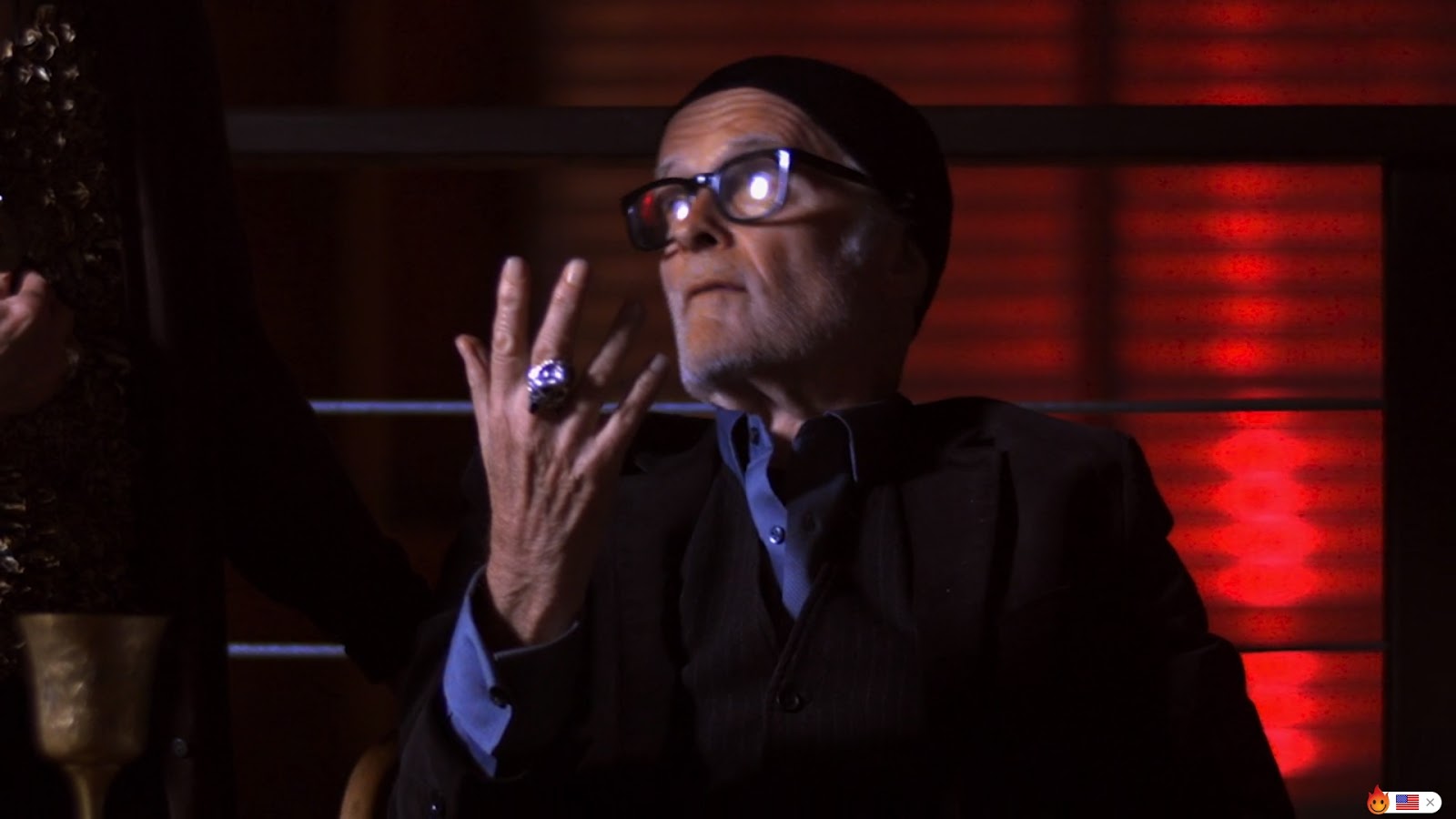
Rob Nilsson as Ruthven
She also comes to the attention of the top vampire, Ruthven (Rob Nilsson), who insists she works for him. There is an odd moment that suggests a psychic attack when she resists but is not spelt out and Ruthven (pronounced incorrectly, as normally happens to be fair) is apparently Scottish (he’s lost his accent) and obsessed with wine making. This then leads to the film’s tagline “From the Vine to the Vein”, which is not explored in any meaningful way but a vampire’s obsession with wine does riff nicely on “I do not drink… wine”.

Bailey Coppola as Luke
There are issues as this becomes a mood and character piece (which are the strength of the film) but doesn’t quite pick up on any horror (despite the feral growling and butchering of villains) and the storylines fail in the main to go anywhere. That is not true of the central romance but the police investigation and the winery (even the circus to a great degree) just feel like they are hanging. The acting seems uneven. I mentioned Anna Luca Biani being very different before and after turning and Bailey Coppola is great in the role. Madsen and Bai Ling have their moments, as one would absolutely expect, but much of the supporting cast are less impressive and I thought Nilsson miscast.

blooded
The action, I think, is lost in budget and more could have been done around the gore (the first feed is impressive due to filters/lighting but perhaps other attacks are lacking). I did think the guns sound lost and hollow in the soundscape and whilst we know shooting at a vampire will have no impact it will impact the clothes at least. The character studies/mood could have been a massive plus to a strong narrative, but the narrative needed tightening up. Yet it isn’t all bad, far from it – aspects like the symmetry between Bailey and Natia worked well, the mood was there and there were good performances and the visual atmosphere worked. 6 out of 10.

The imdb page is here.

Thursday, September 19, 2019

Vampires: First Blood – Volume 1: The Vampire Lords – review

Editor: James Grant Goldin

First Published: 2019


The blurb: Before Edward…

Before Lestat…

Before Dracula…

These vampires set the stage for all the rest…

Arnold Paul… The ‘real’ vampire of 18th Century Serbia…

Lord Ruthven… the first multi-media vampire star…

Varney… antiheroic prince of the penny dreadfuls…

Count Kostaki… Terror of the Carpathians…

Meet then… and their brothers in blood…

The review: I was contacted by editor James Goldin to see if I wanted to review this volume and the companion volume that focuses on female vampires (and will be subject to a separate review). This volume gathers a variety of 19th century vampire stories (along with a couple of 18th Century entries in reportage and poetry). Of course, all have been in other volumes (indeed these are specifically drawn from public domain). However, gathering them in another volume is not necessarily a bad thing.

Goldin bookends each tale with a commentary, often about the story (or author) specifically and points out some interesting factoids. The shame with this is these are not referenced, for a student of vampire media that would have been useful, and the story's source is not referenced. This is important as these stories can shift and change a little – especially those translated, so if you take the Family of the Vourdalak, I have a Skal translation that says (as per the version in this volume) that a vampire must be staked using aspen but I have a Nikanov translation that suggests ash. What is really useful is the glossary at the end of each entry, which explains words and phrases perhaps unfamiliar to the twenty-first century reader.

The stories included are all important in the genre but I might have put a little less of Varney the Vampire (21 chapters) and actually jumped through the book more (perhaps including the first chapter, the mob scene from early in the series, something from the London Hotel sequence, something from the continental stories and the turning of Clara – though the latter is included in the second volume). I then might have used some of the volume space to add in, perhaps, Karl Heinrich Ulrichs’ Manor or one of the more unusual Le Fanu stories (taking the point that they do not necessarily explicitly involve blood). It was a shame that Tolstoy’s Upir had only a brief excerpt, but also understandable as the editor had been unable to find a public domain translation.

The criticism on content is a personal taste thing, however, and references aside (and to be fair, most compendiums do not reference source/facts), this was worthwhile. It was fun re-reading some of these classics and I always love it when I discover something new and I had not heard of the comedic verse the Thirsty Vampires (1765) by William Hayes. 7 out of 10.

In Paperback @ Amazon US

In Paperback @ Amazon UK

Sunday, October 21, 2018

The Vampire: a New History – review

Author: Nick Groom

First published: 2018

Contains spoilers

The blurb: An authoritative new history of the vampire, two hundred years after it first appeared on the literary scene Published to mark the bicentenary of John Polidori's publication of The Vampyre, Nick Groom's detailed new account illuminates the complex history of the iconic creature. The vampire first came to public prominence in the early eighteenth century, when Enlightenment science collided with Eastern European folklore and apparently verified outbreaks of vampirism, capturing the attention of medical researchers, political commentators, social theorists, theologians, and philosophers. Groom accordingly traces the vampire from its role as a monster embodying humankind's fears, to that of an unlikely hero for the marginalized and excluded in the twenty-first century. Drawing on literary and artistic representations, as well as medical, forensic, empirical, and sociopolitical perspectives, this rich and eerie history presents the vampire as a strikingly complex being that has been used to express the traumas and contradictions of the human condition.

The review: I came across Nick Groom as the beset expert in The Luke McQueen Pilots: Britain's Hidden Vampire Crisis, however I had also read an essay in the Cambridge Companion to Dracula and, unfortunately, I found that the weakest of the chapters. However, one piece of work does not cover a body of work and – free of the confines of a chapter – Groom’s work here excels.

Groom explores the vampire from the 18th Century panics – arguing that these were the first vampires, and that revenants, spectres etc. are not vampires as emerged in the panics, indeed cutting the vampires from other blood drinking mythological creatures. It is a position that I can accept as an argument basis (as much as I can recognise the folkloric tropes that are common). He then draws a thorough socio-political history that allows us to see the context.

He carries this through the panics into the 19th century literature that developed (and I must say I always appreciate finding new pieces, and Groom covers pieces I’d not considered before). He skirts around Christabel suggesting that she appears vampiric, if not actually a vampire (I subscribe to it not being a vampire piece but, again, Groom dealt with this even-handedly.

The final chapter then moves on to Dracula (a brief view beyond Dracula is found in the conclusion but Dracula is seen as the loci between the developing vampire from the panics into the modern phenomena). To concentrate on this, for a moment, as it was where I was less positive about his previous essay; where the author drew a direct line between Ţepeş and the Count previously, in this it is less concreate a connection that is drawn (and then only briefly). I perhaps would still want a recognition that there is a strong view against the connection but it felt less “In Search of Dracula”.

One thing I did enjoy was how he drew the view of female hysteria with the figure of Lucy (and her subsequent healing, through the stake). There was mileage to connect this back to Varney the Vampire and Clara Crofton. Another thing I enjoyed was his vampire/vampiric reading of Frankenstein and I will, at some point, look to explore that here – with all due credit, of course.

But it is the historical context… the politics, the religious contentions, the societal views that he explores and ties into the development of the vampire as a figure up to, and including, Dracula that makes this such an important book. Highly recommended. 9 out of 10.

In Hardback @ Amazon US

In Hardback @ Amazon UK

Sunday, April 08, 2018

The Living Dead: A Study of the Vampire in Romantic Literature – review

Author: James B. Twitchell

First Published: 1987

The Blurb: In his Preface to The Living Dead: A Study of the Vampire in Romantic Literature, James Twitchell writes that he is not interested in the current generation of vampires, which he finds "rude, boring and hopelessly adolescent". However, they have not always been this way. In fact, a century ago they were often quite sophisticated, used by artists varied as Blake, Poe, Coleridge, the Brontes, Shelley, and Keats, to explain aspects of interpersonal relations. However vulgar the vampire has since become, it is important to remember that along with the Frankenstein monster, the vampire is one of the major mythic figures bequeathed to us by the English Romantics. Simply in terms of cultural influence and currency, the vampire is far more important than any other nineteenth-century archetypes; in fact, he is probably the most enduring and prolific mythic figure we have. This book traces the vampire out of folklore into serious art until he stabilizes early in this century into the character we all too easily recognize.

The Review: For context sake, this book must be one of the most oft-quoted books in vampire academia and yet a friend who read it found it overblown and seeing vampires where there are none.

How could that be, I thought, in such a respected volume – but one must critically read these things for oneself, and so I did. And it is overblown, seeing vampires where none actually are (thanks Ida). Not in all things, I actually completely agree that there is a vampire undertone through Wuthering Heights, indeed I probably believe it more marked than Twitchell suggests. Yet in other things I am not so convinced.

There are problems that I would overlook just because of the age of the volume. The conflation of Vlad III and Count Dracula had not been thoroughly debunked in 1987, nor had the conflation of vampirism with Porphyria. Unfortunately, Twitchell’s sources for the former had a vested interest in stretching the truths around the historic Dracula. However, looking at material “quoted as vampire but not” and we get the old faithfuls of Bürger’s Lenore and Coleridge’s Christabel.

With the former I can think of no reason (other than Stoker quoting it over a hundred years later in Dracula) to connect the poem to vampirism. With the latter, well it was the work of Nethercott that suggested that Chrsitabel was a vampire poem (and, flimsily, that Carmilla was a reworking thereof) and I have never bought the argument. Actually, if an argument was made for psychic vampirism I might be more convinced. Twitchell brings little extra to the party but does decide to gender swap the character Christabel (suggesting that she represent Coleridge himself and falls into a pattern of young men seduced by older lamia). I remain unconvinced of both the vampirism and now of the gender swap. There are works examined that I feel I must revisit to investigate the alleged vampirism – mostly around the Poe works that Twitchell ties to vampirism.

Probably the most interesting part of the book was that of the artist/art as vampire. There is a Poe piece here in the form of the Oval Painting. It feels a shame that with regards this section that Twitchell did not include (and possibly did not know) the Vampire by Jan Naruda, which has vampiric artistry/artwork as its basis. Though out of his field of study George Sylvester Viereck’s the House of the Vampire would have added much to this chapter.

So, without going into a very long critical evaluation, what I can say is that there are aspects to this I find very flawed (and clumsy errors, such as suggesting Harker was married when he encountered Dracula’s vampire women) but other aspects that are food for thought or I agree with. It is still an oft-quoted tome and necessary if only for that reason. 6 out of 10.

Monday, May 09, 2016

Dracula Arisen: The Legend Of Dracula: Book 3 – review

Author: Perry Lake

First Published: 2015

Contains spoilers

The Blurb: All know Dracula as the king of the vampires. But how did this come to be? How did a man, a warlord of an obscure province, rise to rule the Night? DRACULA ARISEN answers that question, showing the origin of Dracula, beginning with the young Prince Vlad, detailing his rebellion against the Sultan, and his reanimation as a creature of the Night—only to find himself a slave to the wizard who drew him forth. After turning the tables on his would-be master, Vlad Dracula strikes out to build his Empire of the Night. These fifteen stories lead up to the climactic events of Bram Stoker’s novel, “Dracula”. And beyond. Forget wimpy, apologetic vampires, afraid to draw blood. DRACULA ARISEN makes vampires scary again!

The review: For reference, I have already reviewed Book 1 and Book 2 of Lake’s series. A pdf of the book was provided for review.

The first book had flaws – not to denigrate it too much and the depths of ideas and references was mind boggling, the second book felt more like the collection of short stories it was and held together better because of this. The author offered the volume much more focus. This third book again feels like it has more focus – following the way Vlad became a vampire and how his desecrated corpse was found and reborn into undeath through the actions of Faust. The book follows the turning of tables on Faust, making him a slave to the vampire Prince and then through to dovetail into the story laid out in Stoker’s Dracula.

There are quite a few stories within where the focus is not Dracula but rests on mortals and this was refreshing. I liked the Scholomance section (which could stand expanding but is a satisfactory section as stands), and the connection between the Vordenburgs (the family of vampire hunters we follow through this and previous volumes) and Van Helsing was interestingly done. The cod-medieval language is still there and is still distracting but, like volume 2, it is used in a more sparing way and it is a feature that the author and I will never agree on.

One piece of lore worth picking up on is that there are different bloodlines of vampire. Whilst (older) members of Dracula’s line can walk in sunlight (albeit sparingly) other bloodlines disappear at dawn and reappear in their graves. Vampires are corpses possessed by demons in this. A rather interesting concept was that a werewolf believes him/herself to become a wolf and, though they are still human when they are under the delusion of transforation, the illusion is shared by other humans observing them – the vampires just see a man as they are a supernatural creature.

This satisfactorily closes the trilogy and is probably the stronger volume. Dracula seems somewhat less all-powerful, which is great. He is, of course, dangerous but the power seemed more in line with that described by Stoker. 6.5 out of 10.

Friday, March 18, 2016

The Universal Vampire: Origins and Evolution of a Legend – review

Editors: Barbara Brodman & James E Doan

First published: 2013

Contains spoilers

The blurb: Since the publication of John Polidori’s The Vampyre (1819), the vampire has been a mainstay of Western culture, appearing consistently in literature, art, music (notably opera), film, television, graphic novels and popular culture in general. Even before its entrance into the realm of arts and letters in the early nineteenth century, the vampire was a feared creature of Eastern European folklore and legend, rising from the grave at night to consume its living loved ones and neighbors, often converting them at the same time into fellow vampires.

A major question exists within vampire scholarship: to what extent is this creature a product of European cultural forms, or is the vampire indeed a universal, perhaps even archetypal figure? In this collection of sixteen original essays, the contributors shed light on this question. One essay traces the origins of the legend to the early medieval Norse Draugr, an “undead” creature who reflects the underpinnings of Dracula, the latter first appearing as a vampire in Anglo-Irish Bram Stoker’s 1897 novel, Dracula.

In addition to these investigations of the Western mythic, literary and historic traditions, other essays in this volume move outside Europe to explore vampire figures in Native American and Mesoamerican myth and ritual, as well as the existence of similar vampiric traditions in Japanese, Russian and Latin American art, theatre, literature, film, and other cultural productions.

The female vampire looms large, beginning with the Sumerian goddess Lilith, including the nineteenth-century Carmilla, and moving to vampiresses in twentieth-century film, literature, and television series. Scientific explanations for vampires and werewolves constitute another section of the book, including eighteenth-century accounts of unearthing, decapitation and cremation of suspected vampires in Eastern Europe. The vampire’s beauty, attainment of immortality and eternal youth are all suggested as reasons for its continued success in contemporary popular culture.

The review: I do like books like this but they come with two problems. One is the price tag – though I understand that an academic piece is not going to sell as well and that influences the tag. The second is a variance of quality between contributors’ pieces and the Universal Vampire is no exception when it comes to that.

Looking at the blurb, for a moment, the premise of the book is looking for universal roots within the vampire genre. The book doesn’t actually do that, in totality at least, though it does take us on an international journey.

However the first chapter, Draugula by Matthias Teichert, certainly did this and I find the exploration of both Draugr and Revenant myths and legends fascinating. It is clear that there are heavy similarities to the vampire myth that developed amongst the Slavic nations. The biggest difference was the vampire seemed to have a fixed focus on blood drinking (often, it seems, assumed due to the corpse state when exhumed) and the other types not so much. Blood drinking and flesh eating do appear within some of the myths, but not so much in this essay, which nonetheless was informative and thought provoking.

Flying to the other end of the spectrum, the piece Biomedical Origins of Vampirism by Edward O. Keith could have been left out of the book altogether. A tired re-hash of the discredited porphyria theory (with an almost embarrassed admission that the theory does not fit) is followed by equally tired looks at Pellegra and Rabies. This misses the point that illness as a source of the myth does not rest with a condition suffered by the accused vampire (as they are dead by the time an assumption of vampirism is reached) rather it is with the victims. As such this chapter managed to completely avoid tuberculosis – a disease that we know certainly did influence folk opinion in the 19th century American panics. It was amusing, therefore, that the next chapter, Evidence for the Undead by Leo Ruickbie, shot down Keith’s chapter in a couple of paragraphs. The Keith Chapter also showed a lack of remembrance or knowledge of Dracula with suggestions that the Count avoided daylight (he certainly was abroad in daylight and one of the supporting quotes for this assertion is misattributed to the Count when it was Van Helsing’s dialogue) and only preyed on women prior to their marriage (Mina was married before she attracted the Count’s nightly visitations).

If that chapter is the low point in the book there was a Lilith chapter that was pretty light and a view that Stoker (and subsequently Dracula scholars) got details of Transylvanian society and cuisine wrong was met with a mighty shrug of the shoulders as it is clear that Stoker only used travel books to research that setting. In honesty the argument was very sound but the point of the debate was lost on me.

As well as the Draugula chapter and Ruickbie chapter particular favourites included a chapter by Ridenhour comparing Carmilla and Let the Right One In and Ruthner’s look at Visum et Repertum, the report of the Arnold Paole case.

All in all, for the full volume 7.5 out of 10.

Saturday, August 22, 2015

Dracula’s Guest: A Connoisseur’s Collection of Victorian Vampire Stories – review

Editor: Michael Sims

First published: 2010

Contains spoilers

The blurb: Before Twilight and True Blood, vampires haunted the nineteenth century, when brilliant writers indulged their bloodthirsty imaginations, culminating in Bram Stoker's legendary 1897 novel, Dracula.

Acclaimed author and anthologist Michael Sims brings together the finest vampire stories of the Victorian era in a unique collection that highlights their cultural variety. Beginning with the supposedly true accounts that captivated Byron and Shelley, the stories range from Aleksei Tolstoy's tale of a vampire family to Fitz James O'Brien's invisible monster to Mary Elizabeth Braddon's rich and sinister widow, Good Lady Ducayne. Sims also includes a nineteenth-century travel tour of Transylvanian superstitions, and finishes the collection with Stoker's own Dracula's Guest - a chapter omitted from his landmark novel.

Vampires captivated Victorian society, and these wonderful stories demonstrate how Romantic and Victorian writers refined the raw ore of peasant superstition into a whole vampire mythology of aristocratic decadence and innocence betrayed.

The review: I am always looking for interesting vampire stories from the 19th Century though, I must confess, that had I not found this volume for a penny on Amazon I probably wouldn’t have bothered. That’s not to say that it is poor – far from it – just that I have so many different anthologies and most of the stories within it. But a penny it was and so I ordered it.

Many of the usual suspects are within this book that isn’t quite what it says on the tin. In a section called Roots, it interestingly carries an extract from Calmet and obvious stories from the Georgian period. The final section, Fruit, is in the Edwardian period. However there are a good number of stories from the Victorian era. Not all are what I would call vampiric. Sim’s may be correct in his thought that Fitz-James O’Brien’s story What Was It? foreshadowed and maybe inspired the Horla but (unlike the latter story) it had no hallmarks of vampirism (bar strangulation – but that isn’t a common hallmark of the literary vampire).

Probably the most interesting couple of stories, for me, came out of the Fruit section as they were new ones on me. Luella Miller by Mary E Wilkins-Freeman is a fantastic energy vampire story that comes out of Massachusetts during the period when exhumations of corpses, as vampires, was still practiced. However Alice and Claude Askew's Aylmer Vance and the Vampire seemed hurried – a whole novel could have been built from the story – but was an interesting tale of vampiric spirit possession.

If you see this cheap or don’t have the stories inside then this is a fine collection. 7.5 out of 10.

Sunday, August 16, 2015

Vampire Evolution: From Myth to Modern Day – review

Authors: E R “Corvis Nocturnum” Vernor and L E Carruba

First Published: 2015

Contains spoilers

The blurb: Vampires are beings of myth: folkloric creatures who live off the blood of the living and have been recorded in nearly every culture around the world since the beginning of man. This work traces the evolution of the vampire, from its roots in ancient mythology to obscure folk tales and legends, leading up to when these foul beings transformed into the suave Byronic heroes that continue to influence the world’s view of the vampire today. It also examines key individuals in history involved in reshaping our concept of the creature. Popular culture is explored, along with the development of the vampire into the protagonist in plays and poems and novels. Sixty-one frightening images bring the topic right to your front door. Will you invite the visitor in?

The review: Save me from ill-researched reference books.

When this arrived (and it was sent as a review copy) I was taken by the embossed hardback cover with the red bat but as I opened it I inwardly groaned. The fancy font suggested it may be content light and the book was packed with pretty pictures (which, in fairness, are very pretty).

However I noticed a bibliography, though no index, and a reference to Anthony Hogg, which perked me up as it boded well for good research. Sadly the referencing left much to be desired (there are at least three improperly referenced bits from Anthony but only one bibliography entry) and the content proved to be one which had me shouting at the book. This took three forms – bad research/supposition, bad writing and errors. I will cover some of my (least) favourites.

Discussing Thomas Aquinas and his belief that the Devil could cause metamorphosis of men to animal the authors suggest “This might be the origin of Bram Stoker’s Dracula becoming a wolfish creature and mention in future stories of vampires shifting into bats and mist.” Now re-read the sentence, this suggests that Dracula (in Stoker’s original) didn’t turn into a bat or mist, and that lore came in later stories, but it was part of Stoker’s lore. On the next page there is a supposition that nightmares symptomatic of the Black Death inspired Dracula communicating to Renfield telepathically – which is really plucking connections out of thin air.

Mention is made of Ludovico Fatinelli – of his “Treatise on Vampires” and suggesting the gentleman was burned at the stake… Except the gentleman did not exist and the treatise is a hoax volume.

Vampire poems are mentioned such as Christabel by Coleridge, and Keats' La Belle Dame sans Merci and Lamia. True, later authors have tied Lamia and vampires together, and many claim that Christabel was an influence on Le Fanu’s Carmilla, however none of the three poems are vampire poems (and Lamia is not a poem about Lilith either, as the authors further suggest).

One of the authors (I assume Vernor) tells us the Michelle Belanger told him a lot about Byron but the quote (I assume of her) was a mismatch of half-truths, bad research and myth and stated, “he identified as a vampire”. Not one single scholarly tome I have read on Byron suggests this; indeed Byron stated, whilst repudiating authorship of Polidori’s story, “I have, besides, a personal dislike to ‘Vampires’ and the little acquaintance I have with them would by no means induce me to divulge their secrets” (The Gentleman’s Magazine, Vol 125 1819 p633). The authors suggest Byron’s fragment (which we know Polidori expanded upon) was published before Polidori’s story – it was published after to prove Byron wasn’t the author of Polidori’s work and contains no vampire aspect. Its only real impact on the genre was the fact that Polidori used it as a base for his work.

Whilst talking of Planche’s The Vampire, or Bride of the Isles (1820), the author says that “Not since Varney did a vampire so clearly introduce the dualism of intellectual man and mindless, killing predator…” except of course that it predated Varney by twenty five years!

On Dracula it is suggested that the “phantom-like ship, Demeter was based off a real story of a boat by the same name” – except that the real shipwrecked vessel was called the Dmitry and the crew landed safely. The authors revive the suggestion that Van Helsing was based on Robert Roosevelt (except the author states Theodore Roosevelt) and Dracula was based on Walt Whitman (taking on “his attributes” even though we know the character’s appearance came from the Baring-Gould description of a werewolf) and the book was some sort of psychodrama of homophobia due to Stoker’s syphilis – despite the fact that the belief he had died of this comes from as late as 1975 and Daniel Farson (his grand-nephew) and has no corroborating evidence. In other words there is little evidence to support the suppositions. Vernor quotes himself as saying “Washington Irving—the very same man Stoker had in mind to play the character Dracula on stage”, err that would be Sir Henry Irving. The normal inflated conflation with Vlad Tepes occurs and later, discussing other books, the authors suggest that Dracula needs his “native earth” though this is from the movies and the book had different lore, being “in soil barren of holy memories it cannot rest”.

Whilst talking about books, the authors cover Anne Rice and quote Louis’ opening narrative… except (as well as not being referenced) it isn’t from the book but from the film – which itself is covered in the next chapter – hence why it talks of the death of his wife, which as an event replaced the death of his brother from the book.

When it comes to films apparently Lugosi “starred in Dracula sequels” – actually he only played Dracula one other time. In the Munsters Marilyn is called a “fairly normal teenage daughter” – she was the niece. Apparently in Black Sunday Asa uses “the Elizabeth Bathory method of attaining youth and beauty through virgin blood.” Well there isn’t a bath of blood in sight and she is revived by the blood of an older (and presumably non-virginal) male doctor and actually acts as an energy vampire when attacking her doppleganger.

Calling Dracula (1992) “the first faithful cinematic retelling of the source material” is a push, to say the least, and suggesting it introduced “other elements hinted at, but not fully explained in the novel, like the growing relationship between Count Dracula and Mina Harker” is nigh on fraudulent as that relationship was not hinted at! Blade (as in the Marvel character) is described as African-American, in the original comics he is British. Also, it might have just been really badly written but “trying to find the next True Blood, television networks adapted other vampire book series to television, like author Tanya Huff’s Blood series became the show Blood Ties (2007)”. Now, given the authors correctly date True Blood to 2008 earlier in the paragraph one has to either worry at the clunky writing or the time machine involved.

Adding in a section about Self-Identified Vampires I suppose was inevitable, though it is so thin as to not over-egg the pudding, but not necessarily welcome in a reference work on vampires in folklore and media.

So, there we have it. I have barely touched on the issues I had with it. The volume does look very pretty though. 2.5 out of 10 for the pretty pictures.

Friday, July 10, 2015

The Vampire Almanac volume 2 – review

Edited by: J-M & Randy Lofficier

First published: 2015

Contains spoilers

The blurb: Featuring Alsinka the Virgin Vampire, Captain Vampire, Carmilla, Countess Carody, Dracula, the Gyaos, Nosferatu, Lord Ruthven, Princess Asa Vajda, the Vampire Brothers, the Vampire Countess, the Vampire City and the Two Orphan Vampire Girls.

The appeal of the myth of the Vampire is surely due to the fact that it deals with the resurrection of the dead, something that lies at the core of most of the world’s religions. The stories contained in this collection feature some of the most famous vampires in literary history. Some predate Dracula, whilst others are modern incarnations of the myth. Writers from all over the world bring a diversity of points of view to this potpourri of vampiric lore and legends.

The myth of the vampire, from all the poetic manifestations of the World Beyond, is one of the most endearing… …To try to piece together a history of vampirism is a dubious enterprise; it is much better to enjoy vampire stories! I do not believe in vampires. I believe in what inspired their creation. Roger Vadim (from his foreword).

The review: Following on from The Vampire Almanac Vol. 1 this was another collection of original tales based on pre-existing vampire characters. Having read the foreword, which was a piece written by director Roger Vadim in 1960, I was most impressed to discover that the first tale – Matthew Dennion’s Hercules in the Shadow of Evil – was one that mashed Hercules with the Japanese monster vampire Gyaos from Gamera Vs Gyaos. Indeed it was a Gamera origin story.

Micah Harris added some interesting concepts into the Ruthven story May the Ground Not Consume Thee by suggesting that “his kind draws strength from holy ground” and further suggesting that it was actually the Orthodox Church’s actions that created vrykolakas. Brian Gallagher added in mention of the alleged vampire Jure Grando in his Carmilla and the Witch.

So Much Loss by Anthony R. Cardno was probably my favourite story in the volume, looking into the Dracula aftermath, specifically around the victims of the Bloofer Lady. I should mention Steven A Roman’s story as a favourite also, bringing Graf Orlock and Irma Vep together.

Matthew Dennion did a further tale, Soul Sisters, with Asa from Black Sunday aiding the Salem witches (though how she escaped from her cross warded coffin is not explained) and Countess Carody from Vampyros Lesbos appears again in a trilogy of stories by Win Scott Eckert. There is a nice conceit in Henri Bé’s the Girls of Midnight when the Two Orphan Vampires meet Jean Rollin.

It would also be remiss not to mention the story the Vampire of New Orleans by Jared Welch, which features Paul Féval’s Vampire Countess, as Jared is a regular visitor to, and commentator on, the blog. In it he ties a little tighter the connection between the vampire genre and the Faust legend, also connecting in the Comte de Saint-Germain.

All in all I thought that the volume, whilst superb, didn’t quite match the first volume but it did keep me glued to the page and it is well worth being in your collection. 8.5 out of 10.

The Blackcoat Press page for both volumes is here.

Wednesday, June 24, 2015

Brides of Dracula: the legend of Dracula: Book 2 – review

Author: Perry Lake

Release date: 2014

Contains spoilers

The Blurb: Vlad the Impaler was once the most fearsome ruler in Europe. His armies marched against both Turks and Saxons until his enemies assassinated him. But Vlad Dracula rose from the dead, ready to wrest control of a new kingdom, that of the undead legions of the Night.

To his surprise, he discovered the Undead of Europe to be bestial, scattered, and nearly mindless; more akin to zombies than vampires. So he set out to replace them with a new breed of Undead, borne of his blood and taken from only the finest noble houses. Thus Dracula became the sire not of warriors, but elegant and seductive noblewomen whom no man could resist: Lady Katya, Countess Elizabeth Báthory, Countess Mircalla Karnstein, Lady Lenore, Countess Ulrica Dolingen, and others.

You've read Bram Stoker's “Dracula”. Now see how Dracula assembled the most powerful and famous members of his entourage. As part of THE LEGEND OF DRACULA trilogy, this book contains thirteen short stories about the infamous Count and his seductive children of the Night.

Vampires are scary again!

The review: If I came across as harsh when I reviewed book 1 of Perry Lake’s Dracula series then I have to say that it is because I see much potential within the series and hoped by being constructively critical that I might help the author tap that potential.

I have to say that, as a collection of shorts, this volume held itself together more than the first volume. I think the narrow focus on the various brides helped. Indeed one short section, Immortal Love, was impressive as Lake changed voice and showed to advantage the skill in prose that the author is capable of. That’s not to say that I don’t still think that some of the stories suffer from brevity, they do, but many are fleshed further and has allowed Lake to develop the characters in a much stronger way and some sections felt more like longer prose than shorts, which was positive.

I am still not impressed with the cod-mediaeval dialogue that we occasionally get (much less in this volume I thought) but the author commented on my previous review that they are to stay and that is the author’s prerogative.

The volume explores Carmilla’s background, which was done in an interesting way and it is worth looking at the volume for this section alone. The cornucopia of references and borrowed characters continued apace.

The improved characterisation and the more focused knitted plotlines pushed this ahead of book 1 in my opinion and made it a more satisfying read. 6 out of 10.

Wednesday, May 27, 2015

Vampire Wars – review

Author: Perry Lake

First published: 2014

Contains spoilers

The Blurb: For thousands of years, ancient vampire lords ruled the Night. Their queen, the coldly beautiful, immortal, and all-powerful Lilith, ruled them distantly, ignoring their squabbles over territory and victims. Then came Vlad the Impaler, once history's most bloodthirsty fiend, now reanimated as an undead creature of the Night. Facing the vampire legions of the brutish Vardalekos, the loathsome Viy, the diabolical Jhiang-Shi, the monstrous Mmbyu, the cunning Erlik, and the seductive Nycea, Vlad Dracula seeks out allies, be they undead or lycanthropic or mortal.

You've read Bram Stoker's “Dracula”. Now see how Vlad the Impaler fought and struggled to become Dracula, the King-Vampire. A part of THE LEGEND OF DRACULA trilogy, this book is a collection of twenty short stories about the infamous Count and his undead legions as he strives for the ultimate goal—the throne of the supreme King of the Vampires!

The Review: It’s frustrating when I read a book like Perry Lake’s Vampire Wars. In the first instance I have to say it was filled with fantastic ideas but I also felt it a little lacking in the prose style – though I trust my criticisms are constructive.

The book itself is made up of vignettes, shorts if you will, which cover an expanse of time from Dracula’s resurrection through to the nineteenth century. Being shorts (and the book being one of three, which I am assured can be read in any order) there is some degree of narrative repetition but that is to be expected.

It runs on the ‘Vlad Ţepeş was Count Dracula’ premise (calling the castle “Castelui de Vlad Ţepeş” jarred as the man wouldn’t have referred to himself by the sobriquet Ţepeş) but how did he become a vampire? The beginning of the book suggests he was resurrected by Faust and held as a slave for over a decade until he seduced Gretchen, turned her and became dominant over Faust who was turned also. I liked the idea, and I do like drawing Faust into the vampire realm – a trend (I believe) begun by Paul Féval in the book the Vampire Countess. Then a later story mentioned he was turned in the Scholomance and these separate origin stories appeared to jar until I realised that he was killed post the Scholomance and it was his vampiric form that was brought back by Faust – the full story isn’t within this volume.

The vampires in this are burnt by the sun (mostly) though they can stand some exposure as they age. I liked the fact that they died during the daylight hours. There was an interesting lore around reflections, that the true state of the vampire was seen – Gretchen seeing a decaying corpse, Vlad seeing a ghostly skeleton and the reflection fading to nothing as their true form completely decayed. The invitation rule is deemed not to hold true if the house bears the vampire’s blood (ie if it is held by their mortal family). The ability to transform is not something all vampires can do and also relies on their true form to be sufficiently decayed to allow the dissolution of their body.

Holy items burn but it is not denominational – the Ganges, being a sacred river, would burn a vampire. Vampiric resurrection is achieved by applying human blood (preferably virginal and certainly not undead) to the remains under the light of the full moon. If a victim is preyed upon by a vampire and that vampire is destroyed, an occult law prevents the victim being further predated by another undead for seven years.

As well as these ideas – all of which I was impressed with – there are a cornucopia of vampires from myth, legend, literature and movies. Mostly this extended cast works, some of whom are active characters and others who are mentioned in passing. We get Ruthven, Carmilla, Erzsébet Báthory, Viy and Lilith (who is the vampire Goddess Strigoica, also called Kali). In passing we get such characters as Angelus (from Angel) and Mamuwalde (from Blacula). We get different vampire types mentioned including a vampire horse, vetal, and penanggalen. Most of the cornucopia worked well – though the tying in of Lord of the Rings was perhaps a conceit too far.

However, I said I had issues. Firstly it was within some of the language used. Lake deliberately chose to use thee and thou’s in the dialogue and, to be honest, they didn’t work, were inconsistent with the other language used for dialogue and just felt forced. Better to have avoided them in my opinion. I think the greatest failing of the book was, however, based within the short story style.

It was clear that many of the stories could and, more importantly, should have been expanded on. There was, because of the brevity of the prose, a dearth of descriptive prose and even more so a lack of characterisation. Some characters appeared to only die again in the same vignette, unfortunately still two dimensional. Others died off page (such as Faust). But there was an inability to really care as there was never a connection built with the characters. Of course they are all villains (the vampires are not good guys) but expanding the story and characterisation within the vignettes, indeed expanding the book to several volumes, would have made the reader care. At times I felt I was reading an extended summary rather than the final prose.

This is unfortunate because, as I said, there are fantastic ideas in volume and Perry Lake has a lot of story to tell… I just think he needs to take his time and tell those stories more fully. 5 out of 10 balances great ideas with a need for expansion (and the need for the loss of the cod-archaic dialogue). The homepage with an excerpt is here.

Tuesday, May 05, 2015

Honourable Mention: Ruddigore

It may seem odd, to those familiar with it, that I am giving a mention to the Gilbert and Sullivan opera Ruddigore – in the guise of the 1982 Barrie Gavin directed version. So, before I go into the production itself, we must turn to Roxana Stuart’s volume Stage Blood: Vampires of the 19th Century Stage.

Stuart looks at Ruddigore, first staged in 1887, within that volume and informs us that it was originally entitled Ruddygore, “The title was a major problem. “Ruddy” had become rather too close to “bloody,” and, amazingly, this was enough to prevent many “nice” people from attending.” (p170) So the title itself could be read as bloody gore. In many respects the opera was a parody of, or play on, melodrama – and of course the vampire had played its role in melodrama – and Stuart offers a convincing argument that it was (mostly in the second act) a direct skit of Boucicault’s The Vampire.

Probably most telling was the appearance of the character Sir Ruthven Murgatroyd – correctly pronounced in production as Riven. Of course Ruthven was the vampire from Polidori’s the Vampyre: A Tale and he had reappeared in various plays, operas and prose through the 19th century. Erik Butler also looks at the opera in his volume The Rise of the Vampire, referencing Stuart.

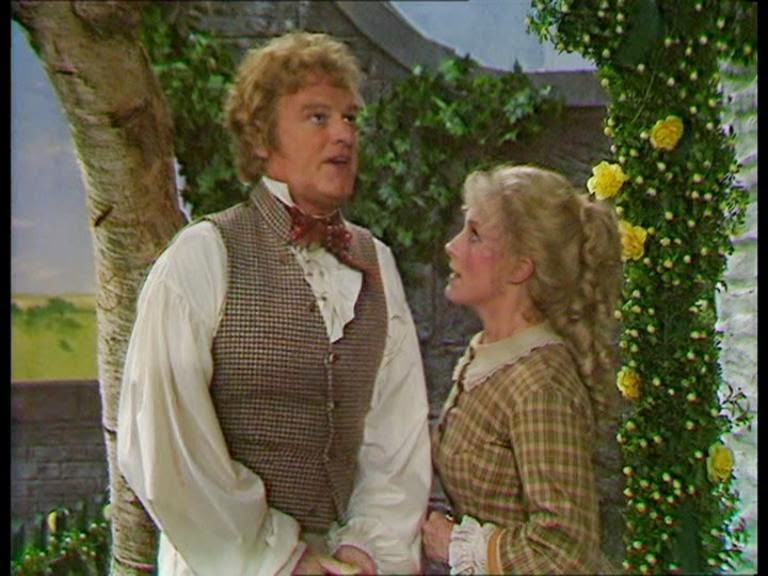
Robin and Rose
So we have an opera set in the town of Rederring, Cornwall, which sits in the shadow of Ruddigore Castle. The village has a cadre of professional bridesmaids (the chorus) who have been out of work as no one seems able to win the heart of the maiden Rose Maybud (Sandra Dugdale). Rose lives with her Aunt (Johanna Peters) and secretly wishes that Robin Oakapple (Keith Michell) will express a desire for her. Robin loves her but is too shy to say so. From her Aunt, who was once engaged to former Baronet Sir Roderic Murgatroyd (Donald Adams), we hear of the Ruddigore curse. Sir Rupert Murgatroyd, the first Baronet of Ruddigore, had been a witch hunter and one had cursed him whilst she was burnt at the stake – all Baronets of Ruddigore were cursed to commit a criminal act every day.

Vincent Price as Sir Despard
Robin has a dark secret – he was the eldest son and so should have been the next Baronet of Ruddigore. To escape that fate he has hidden away, changed his name and has been assumed dead; his younger brother Sir Despard Murgatroyd (Vincent Price, the Last Man on Earth, Madhouse, Scream and Scream Again , the Monster Club & Bud Abbott and Lou Costello meet Frankenstein) has taken the title and thus the curse. He also has a foster brother, a sailor just returned to England called Richard Dauntless (John Treleaven). Robin confesses his love for Rose to Dauntless who agrees to speak to her, falls in love himself and asks her to marry him rather than Robin.

getting a light
Rose is rather inconsistent and having said yes to Dauntless then breaks the engagement and plans to marry Robin. At this point we meet Sir Despard – a man aged by his criminal lifestyle he tries to outwit the ghosts of his ancestors (who haunt each Baronet to ensure their compliance with the curse) but who actually tries to do good, after committing the day’s crime. When we meet Sir Despard we see that he has powers, apparently; to light a cigarette he clicks his fingers and an arm emerges from a grave to strike a light and we also see him fly. We also see his costuming is somewhat vampiric, in the classic Lugosi way, or maybe just the apparel of a melodrama villain. Dauntless tells Sir Despard who Robin really is and, by doing so, allows the younger brother to pass the curse back to the elder and thus stops the marriage of Robin – now referred to as Ruthven – and Rose.

in a coffin
The second act takes place in Ruddigore Castle and Ruthven now dresses the part of a villain and, in a very vampiric twist, sleeps in a coffin. He has a false moustache, in order that he might twirl it, but is particularly bad at crime – he can be rude, but the heights of his crimes include disinheriting a son not actually born and forging his own will! When Dauntless and Rose visit him to ask for his permission for them to marry he does threaten them (weakly) but is held off by an apotropaic – in the form of the Union Jack (mentioned directly as such, rather than the Union Flag, and called such I assume because Dauntless is a sailor). He quickly caves and gives his blessing.

ancestors come from the paintings
His poor ability as a criminal brings down the ire of his ancestors whose ghostly apparitions emerge from their portraits. Stuart points out that this is lifted from Boucicault’s The Vampire. We then discover that the Baronet cannot die by any means – save by dying in agony should he not commit his daily crime. The day is eventually won as Ruthven realises that each Baronet has eventually given up their life of crime and thus died. This, he logically argues, is suicide and suicide is, of itself, a crime. Thus none of them should have died. This also allows him to commit a daily crime, without harming another, by refusing to commit a daily crime. Thus unencumbered of his “bad Baronet” persona, the fickle Rose returns to him!

held back by the Union Jack
So Ruthven can be argued to be, loosely, some form of vampire – but his life is extended by crime rather than devouring maidens. The ghosts of his ancestors might even be said, under the same argument, to be vampiric ghosts, again loosely. The intent of the satire was clear and I think – certainly as something that is of genre interest – this did deserve a honourable mention. Plus, of course, the version I looked at featured the great Vincent Price. The imdb page is here.