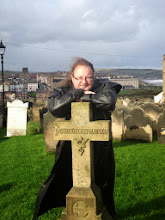
Author: Asa Bailey
First Published: 2012
Contains spoilers
The Blurb: Kathy is an innocent – an outsider – who longs to belong somewhere. Anywhere.
When Kathy starts having vivid dreams of her lost sister, Amber, she finds herself called from her New York home to London – Amber’s last known whereabouts. Convinced that Amber’s disappearance is entwined with the legend of the Highgate Vampire, Kathy begins a deadly search to uncover the truth about her family’s past, little realizing that she is being drawn in to the final resting place of London’s most ancient and powerful vampire…
Inspired by actual events that took place in and around London’s Highgate Cemetery, The Vampire of Highgate is a bone-chilling tale of dark secrets and deadly intentions.
The review: Whether you believe a vampire did haunt London’s Highgate Cemetery (and the testimony of one or the other of the main protagonists of the real world claims) or you think it a load of old tosh that was either cynically manipulated by sensationalists or simply the delusion of fantasists, the fact of the matter is there is precious little in the way of literature and films that have been directly inspired by the accounts/myths of the Highgate Vampire.
This book is part of the ‘books with bite’ range, a children’s series from the publishers Hodder and, perhaps, the blurb’s sensationalist “inspired by actual events” might have been toned down to “alleged events” given the target audience.
Now I do not mind, as an adult, reading books aimed for a younger audience, but I did find this one particularly unchallenging, perhaps even bland, in its language, which was a shame. I also wondered at the heroine’s casual use of anti-anxiety medication and considered whether I was being a little too prissy thinking that it was a wee bit too blasé – though I was glad to see a positive portrayal of someone with mental health issues and the association of such issues with the heroine of the piece. Negatively I found some of the character motivations under-explored – for example a character, Antwain, who seemed to have been around since at least 70 AD was still only half vampire, was subservient to a vampire created in the nineteenth century and was a little too eager to help the mortal Kathy (who we discover is from a race born to be vampire slayers). This might have worked if the motivation of characters had been explored in depth. Many other characters were little more than line drawings they were so thin.
The author did look to explore the alternative history of the vampires and whilst the vignettes through time certainly worked (adding, at least a little, much needed depth to the narrative) I found my suspension of disbelief challenged by the aforementioned 70 AD section that seemed to confuse gospel writers with disciples (that may have been purposeful and in need of narrative expansion) and suggested Muslim involvement some five hundred years before the birth of Mohammed.
When it came to vampire lore the author drew in Christian mythology and suggested that the vampires (or at least one) attended the Last Supper, with a further inference that several of the disciples may have been vampires but shying from a full blown ‘Christ the vampire’ line. By not exploring this in depth I was left wondering at the connections. Vampirism is passed through a bite and yet the vampires are also described as a separate race – indeed the hunters are “a race of people related to the vampires… …our races have been fighting each other since the dawn of time.” Vampires and hunters seem to have access to magic to one degree or another – the Highgate Vampire held in the cemetery by glyphs. Lore-wise, it was all a bit of a confused mess to be honest, though I liked the idea that the Highgate Vampire could move from one host to another and thus had to be trapped rather than slain.
Asa Bailey has done something positive in that the Highgate Vampire deserves to be the subject of stories and films. Whether one believes is irrelevant, there is a marvellous core tale to be exploited. There are also good ideas within this book but it is let down by under exploration within the narrative and uninspired prose. 4 out of 10.
First reviewed on Amazon UK as part of the Vine Programme.
Showing posts with label highgate vampire. Show all posts
Thursday, September 13, 2012
The Vampire of Highgate – review
Posted by
Taliesin_ttlg
at
11:12 AM
0
comments
Labels: highgate vampire, separate species, vampire, Vlad Ţepeş
Thursday, November 01, 2007
Real Vampires – review – TV
Director: Daniel Richler
First aired: 2007
Contains spoilers
Last night, as many channels showed the usual Halloween horror movies, Discovery Channel gave an alternative by showing this two hour (including ad-breaks) documentary on real vampires.
Presented by Dr Timothy Taylor and Dr Kathryn Denning, the show covered many of the usual suspects of this type of documentary. Dracula, of course, was present and correct – as in Tepes and not Stoker’s creation – but it was in this section that some of the superiority of this documentary can be identified, as information not normally looked at was shown. I didn’t, for example, know about the sheer logistical difficulty involved in impalement – or more precisely how much man power it took up. The show also suggested that his atrocities were, perhaps, exaggerated but in doing so gave statistical information to back this up.
Báthory was present and correct also, although I was not convinced by their attempt to suggest that her crimes were more a frame job by political enemies. The documentary never mentioned her alleged diary of kills, which would, to me, be compelling evidence and needed to be addressed. They again, statistically, showed that the Hollywood imagery of the blood bath is more than probably unlikely, and I couldn’t help but be amused with the actress’ face when Bathory found clots in the bath!
The show went through several of the infamous vampire killer stories, most interestingly looking at the case of the vampire of Niteroi – as I was largely unaware of the case and was fascinated by the killer's claims that he was influenced by the Christian church to do what he did. There was also the obligatory look at the Goth and vampyre scene – though it was a very small part of the whole.
There were some serious attempts to analyse what could have made people think that they were plagued by vampires. Consideration was given to undiagnosed rabies (we also got a brief but interesting look at vampire bats, talking of rabies). The misunderstanding of the decay process was also looked into, as we shall see.
More interesting, however, were the real cases associated with vamires. The programme looked at the Arnold Paole case in depth – concluding that it was more than likely a misunderstanding of the decay process. The programme did mention the fact that Paole had claimed, whilst alive, to have been attacked by a vampire but didn’t really tie that claim heavily into the conclusions.
Another really interesting section was the recent case (2004) of Peter Toma. This case made world headlines when the suspected vampire was dealt with by traditional methods. The family members involved were prosecuted by the Romanian Courts but their sentences were commuted. The programme actually interviewed people from the village and Toma’s alleged victim. There is a really good, in depth report on this, by Taylor, located here - many thanks to Crabstix, who emailed the article, which alerted me to the documentary itself.
Also interesting was the section surrounding the Highgate vampire and the case seemed to have a real impact on Denning as she realised that she had interviewed a man, Seán Manchester, who truly believes (or maintains he believes) that he has hunted and slayed a vampire. This wasn’t someone following the traditions of their peasant village but a Western European who got out his slayers kit and explained the techniques and also described a rapid decay after staking.
I may not have agreed with all their conclusions – whilst the figures of those Báthory killed may have been inflated I have not been convinced that she was the victim of a frame – this was a worthwhile documentary with impressively high production values in respect of the illustrative film sequences. 7 out of 10.
At the time of review there is no IMDB page.
Posted by
Taliesin_ttlg
at
11:25 AM
8
comments
Labels: Erzsébet Báthory, folklore, highgate vampire, Vlad Ţepeş
Subscribe to:
Posts (Atom)