Showing posts with label vourdalak. Show all posts

Friday, July 12, 2024

Le Vourdalak – review


Director: Adrien Beau

Release date: 2023

Contains spoilers

Based on Tolstoy’s the Family of the Vourdalak, this is a really rather interesting French take on the story. It keeps the film in a period setting and puts some twists into the story to keep the audience guessing, adds in a neat moment of lore and then tops it all by having the antagonist represented by a puppet – this should take the viewer out of the film but, as one accepts it, the conceit works really well making the vourdalak creepy and unheimlich.
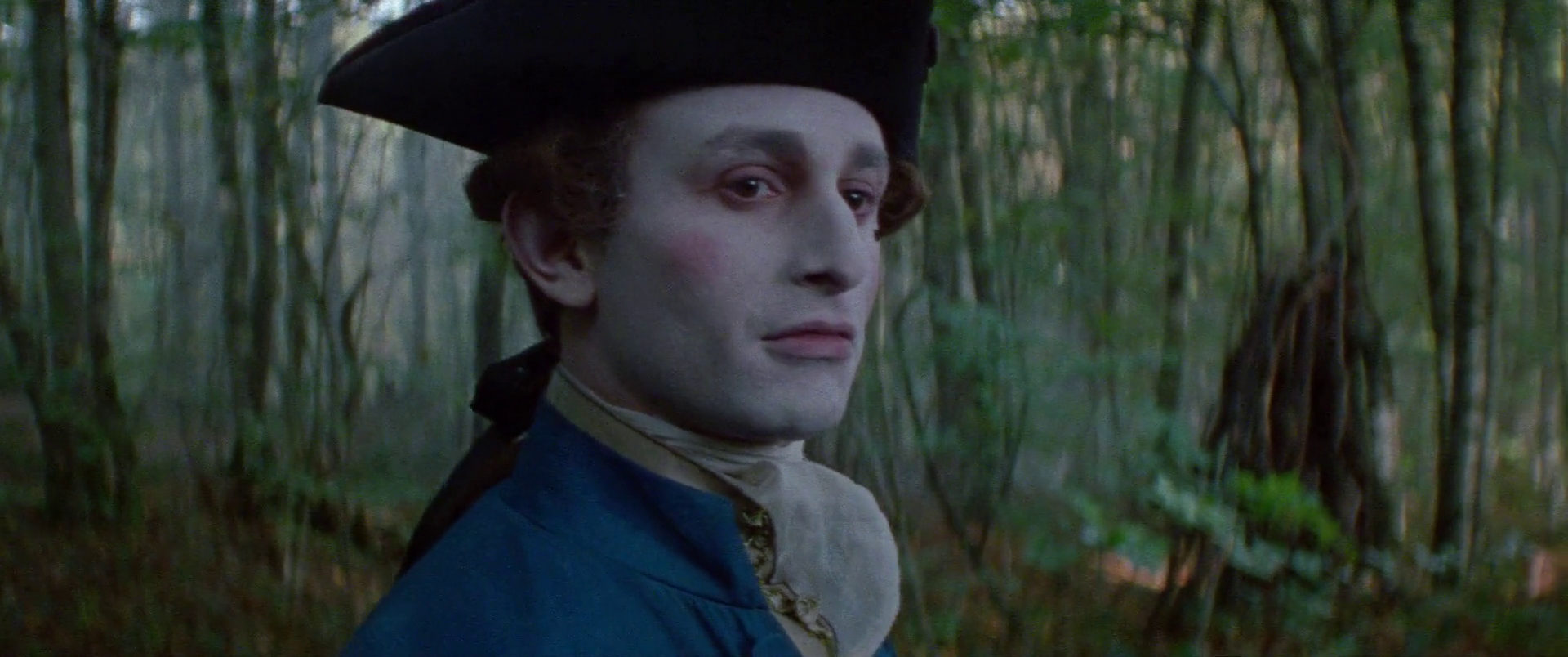
Kacey Mottet Klein as d'Urfé 

It starts with the Marquis Jacques Antoine Saturnin d'Urfé (Kacey Mottet Klein) banging on a door in the dark. He is a French envoy and his escort has been killed by bandits. The occupant (Erwan Ribard) tells him the door will not be opened (whether due to fear of Turks or the supernatural one can only guess at). D'Urfé is advised to go through the woods, recognised as dangerous, until he gets to the house of Old Gorcha (Adrien Beau) – there he might find help and a horse.

spying on Sdenka

As day breaks, we see that d'Urfé is a “powdered courtier” and the look, with powder, wig and beauty spot, serves as a nice contrast against the more rustic family especially through the lens of a more modern sensibility when exploring the film and the undercurrent themes of toxic-patriarchy and queerness. He hears singing and spies a maiden, Sdenka (Ariane Labed) but she becomes aware of him when he stands on a twig and she quickly vanishes into the woods.

Ariane Labed as Sdenka

Continuing through the woods something growls in the undergrowth but, when it appears, it is a friendly dog that runs ahead. He reaches a woman, or so is presented through clothing and accessories, but is revealed to be the male Piotr (Vassili Schneider) who, though taciturn, guides him past a skeleton festooned attacked wagon, graves and to a house. D'Urfé picks up a dropped earing that the young man had been wearing. In the house is Sdenka, Piotr’s sister, Anja (Claire Duburcq), their sister-in-law, and the latter’s son Vlad (Gabriel Pavie).

the family

Soon Anja’s husband, Jegor (Grégoire Colin), returns. Recently the area was raided by Turks and, after defending the house, Jegpr and a few others pursued them. He suggests they killed ten Turks but the leader, Alibek, escaped. He asks where Gorcha is and is told that he went out alone to pursue the Turks and left message that, should he not return by six on the sixth day to forget he was their father. Jegor, convinced Gorcha will return, orders a feast to be cooked.

d'Urfé & Sdenka

Having spoken to Anja, who mentions Sdenka’s disgrace as she fell in love with a stranger, d'Urfé goes out to help Sdenka pick blackberries. Now I write notes as I watch films and did mention in my notes that Ariane Labed’s performance brought the stylised works of Jean Rollin to mind. At one point she almost lures him off a cliff, she explains it is the place where she will finally end it, and shows him the grave of her lover – shot when their love was discovered, we assume by Gorcha. For his part, d'Urfé attempts to replicate both toxic masculinity and class privilege, attempting to pressure her into sex. It does become apparent that this isn’t what d'Urfé genuinely is, coding as bisexual and a romantic later.

Gorcha revealed

The clock strikes as the family eat and, unlike the story, Gorcha does not knock. Rather they eat al fresco and he is spotted collapsed nearby. He is swaddled in coat, scarf and hat at first and orders the barking dog killed. It becomes apparent that the cruelty he displays is not down to being vourdalak but (and foreshadowed with the murder of the lover) actually part of his enduring character. He shows the head of Alibek, which he took, and is revealed as a cadaverous dead thing. Jegor, his manly son and inheritor of Gorcha’s toxic patriarchy, cannot see him for what he is. Piotr, being gender fluid and therefore outside the patriarchal pecking order, sees things for what they are.

folk cure

The story follows the original, mostly, with Gorcha preying first on Vlad, the vourdalak preying on those they love. As I mentioned there are some twists to this I won’t spoil. We get a nice folk horror moment of an attempt to exorcise Vlad and the necessary components for dealing with a vourdalak are hawthorn, garlic and an aspen stake. Neatly added into the tale is the idea of the chewing dead, the shroud-eater, which allows for a nice tell.

stake

The photography is, generally, beautiful and the costuming works really well. All the performances are strong and the film really does draw you in, to the point that the puppet Gorcha (and the fact that no-one seems to recognise it as cadaverous) does not undermine the experience. Regular readers will be aware that the Family of the Vourdalak is a favourite vampire story of mine and I love to see adaptations, this one put in enhancements to the patriarchy themes that are dimly there in the original and certainly did not disappoint. 8 out of 10.

The imdb page is here.

Wednesday, May 18, 2022

A.K. Tolstoy’s “A Taste of Blood” – review


Director: Santiago Fernández Calvete

Release date: 2020

Contains spoilers

Let me be clear from the off-set this is a review of the Western (US/UK) release of this Argentinean film and may not reflect the film in its original form, released as Sangre Vurdalak. Certainly, the film is listed as Spanish language – whereas the release I have seen is (partially) dubbed and, I suspect, the soundtrack has been changed (though that is an educated guess) and both things bring issues to the release.

However, first things first, the film is based on Tolstoy’s The Family of the Vourdalak and that (excellent) short story from 1843 was most famously filmed by Mario Bava as a segment of Black Sabbath. The film sticks to the broad brushes of the story well, despite being transplanted to Argentina and the modern day.

Alfonsina Carrocio as Natalia

So, the film opens with a car driving and a goth soundtrack. This is issue number one. I really like Goth – in fact the soundtrack CD that ships with the US Blu-Ray is a great collection. However, I suspect this was not the original soundtrack as the distributor is Cleopatra – famous as a Goth music label – and I suspect that they have picked up the distribution rights and retro-fitted a soundtrack from their artist roster and, whilst not necessarily an issue in the opening scene, the Goth rock and darkwave soundtrack actively undermines the atmosphere and fails to fit the mood of the direction and photography. It is, in short, distracting.

Tomás Carullo Lizzio as Alexis

The car gets to a building and the pair in the car, Natalia (Alfonsina Carrocio) and Alexis (Tomás Carullo Lizzio), enter the home of Alexis’ parents. Their appearance causes questions; where did they get the car; will they have trouble from Natalia’s family? They are told they can’t just turn up, they don’t appear to be eating and Natalia suggests that they can answer the questions as they have all the time in the world – and that’s the ending broadcast, with the film being the story that led them to this point and the aftermath following the story. But that broadcasting of the punches is not the biggest issue this scene shows us.

Germán Palacios as Aguirre

Both Natalia and Alexis are dubbed into English, and it is poor dubbing. His father and mother are not dubbed but hard-subtitled. This carries forward to the main film where Natalia’s father Aguirre (Germán Palacios) remains in the original Spanish and is subtitled. I don’t get it. OK over-dubbing is rarely great and can be distracting but, for the most part, once in the mode of watching a film that way there is some acceptance as you watch. However, to part dub a film and, in the same scenes, have some in the original language and some dubbed is just distracting – there is no other word for it. It is also nonsensical – if you are paying for voice-over actors then pay for it all, if paying for subtitling, subtitle it all. Give an option of either to the viewer. But this was just rubbish.

Carmela Merediz as Malena

So, Aguirre runs a country vet practice that only opens during the day and has a household that includes Natalia, his son Miguel (Lautaro Bettoni), Miguel’s girlfriend – I think – Eva (Naiara Awada) and her sickly daughter Malena (Carmela Merediz). He is strict, preventing them from going out after sunset and stopping Natalia from meeting new people generally. When he discovers that she snuck out to meet Alexis he grounds her and locks her in her room. So she uses bedsheets to get out and run away that night.

stalking Natalia

She gets to a cantina in a nearby town, where Alexis works. However, he seems none too pleased to see her and so she leaves. A man, Mesojedec, from the cantina follows her in his car and offers her a lift. He tells her he is related to her father but she has been told they have no family and so is suspicious but he offers details that a family member would know. He is driving her home when he stops and seems to collapse against the steering wheel. He convulses and then looks up with his vampire face, which seems plague ridden. She is rescued by Alexis, though it seems Mesojedec actually lets her go.

Mesojedec vamps out

At home Aguirre explains that the family, in the past (19th century by the photos, or very early 20th century) moved to Argentina from Slovakia to escape the vurdulak – blood eaters who were drawn to prey on family and loved ones. Natalia spots Mesojedec in the photos. Aguirre says he will hunt him down but the vurdulak are cunning hunters and if he does not come home in daylight then they must kill him. He comes home before dawn – seen because Miguel turned on Alexis and chained him outside in case he was a vurdulak and Natalia sat outside with him.

turned

Now this was a bit difficult. The kids believe the story of the vurdulak immediately (ok, Natalia had seen one but Eva and Miguel had not). However when he is there before dawn they do not kill him, as instructed, and allow him entry before the sun comes up. The issue here is tying in the sunlight myth. In the original story the father warns against him returning after a certain period of time and returns right on the stroke of the hour (which leads to confusion). Here they should have either just shot him as instructed or barred his entry; their acquiescence makes no sense (especially given their on-running suspicions).

the vourdalak

That logical flaw aside, one could see how this would be atmospheric enough, if the soundtrack was not misplaced, and it built at least some tension (not is he a vurdulak but when will he reveal himself). However the film had already broadcast the ending, unfortunately, and the dubbing/subtitle mixed economy was not only distracting but also prevented suspension of belief – which buying their actions necessitated. I really want to see a subtitled version of this with no dubbing and, I would hope, a more appropriate soundtrack. However Tolstoy is a favourite, the broad-brush of the story followed the short (bar the sunlight) and I find myself torn. 5 out of 10.

Edit: The Blu-Ray does have a Spanish language version of the film on it (as an extra but accessed through the language menu). However it is not subtitled. I can confirm though that the Goth soundtrack was added to the English dub as the Spanish language version forgoes it.  

The imdb page is here.

On Blu-Ray @ Amazon US

On Demand @ Amazon UK

Monday, December 17, 2018

Vurdalaki – review

Director: Sergey Ginzburg

Release date: 2017

Contains spoilers

This review comes with a health warning, as it were. I managed to stumble over a stream of this Russian film online. I then managed to find English fan-subs (with much searching). Those didn’t work but a bit of dibbling with the coding on the srt got them working (though I had to put a seven second delay on them). At first they seemed reasonable but as the film progressed it became obvious that some were literal translations and some simply gibberish. There was enough to get a fair grasp of what was going on but I will re-review this when I eventually find a DVD with properly constructed English subtitles.

vampire
The other reason that this was recognisable – in part at least – was that the film was loosely based on the Alexis Tolstoy short story the Family of the Vourdalak and whilst the lore and events were dibbled with it was still there. Of course that is where the original title of Vurdalaki comes from – it has also been released under the monikers of Prince of Darkness (Fürst der Finsternis) and Ghoul.

Lavr slays the vampire
It starts with a graveyard and a woman stands next to a grave marker that seems to bear her likeness. A monk, Lavr (Mikhail Porechenkov), walks to her and asks whether she cannot sleep. She suggests she has a troubled soul and asks him to pray for a family member. He recites the Lord’s Prayer and, as he concludes, drops a stake from his sleeve and lunges just as she vamps out. He stakes her but as she dies she announces that the Master is coming. Her corpse disintegrates.

Igor Khripunov as the servant
A carriage is driven through the village and people seem to avoid it. At the rear we can see it carries a coffin. As night falls the carriage is in woodlands and a bat flies by the worker that the driver (Igor Khripunov) has paid to help him. The worker calls the carriage to a halt and suggests the road will take the driver to his destination but he will go no further. He scurries off but the driver seems to move with unnatural swiftness (he isn’t a vampire, rather the vampire’s servant). He mentions the payment the worker is owed and also the carriage’s load. The worker didn’t know it contained a coffin.

tree hugging vampire
The driver opens the coffin and a colony of bats explode out, killing the worker (who’ll be soon up and about as one of the undead). The vampire Master – the Baron – appears old and withered but touches a tree (the tree changing from silvered bark to a brown bark) and becomes younger, declaring himself home. They go up to a castle and he uses a rod to open up an arcane, coffin-shaped contraption that reveals a goblet of blood. His plan is to bring about the resurgence of the vampires through a ritual involving a village girl Milena (Aglaya Shilovskaya) in a few days as there is a rare celestial alignment and an eclipse.

Aglaya Shilovskaya as Milena
Milena, the next day, is speaking to her little nephew as they watch the goats, and he asks for a story that night. She realises that a goat is missing and rides into the forest, finding it on a gravemound, where it seems to have partly sunk into the earth. She tries to pull it out but a bat buzzes her. The goat is sucked fully into the grave. She rides to Lavr to tell him – it is the grave of a young girl Marica, who died recently and the grave’s cross has gone.

Gorcha
A Tsarist official, Lyubchinsky Andrej Vasilevich (Konstantin Kryukov), arrives at the monastery with his servant Paramon. Lavr was exiled to this place but he is being summoned back to the city. He refuses to leave, intent instead on making stakes. As the officials leave they pass a lake that Milena is bathing in and she injures Paramon as he tries to spook her. They take him to her home that she shares with her father, Gorcha, brother Georges and Georges’ wife and son. Almost the same family unit as in Tolstoy’s tale (only another brother is missing) it won’t come as a surprise that Milena and Andrej quickly fall in love.

Marica throws Georges
The lore is very different, however… as well as summoning bats (and transforming into them, it appeared), the vampires burn in sunlight and avoid religious items. When Marica returns from the grave we see that they are super-strong (and later we get some vampire warriors who seem supernaturally ripped with extensive veins showing). The need to feed on immediate family is either gone or not mentioned and the fate of the family is dealt with very swiftly. The big change is that Milena is a moroi – Bane suggests that “The rarer moroi {is a} (“living male vampire”)” and is the child of a vampire. In this the Baron attacked her mother whilst she was in the womb and she has been born half-vampire (ala Blade). She has no vampiric traits (bar absorbing bat’s blood if touched with it) but the ritual will convert her to a full, daywalking vampire.

the Baron in repose
The parting with the lore and story offered by Tolstoy allows the film to move to a more action/adventure stance and it doesn’t necessarily suffer for this. There was a chemistry between the leads and Lavr reminded me of Brother Sandor from Hammer’s almost namesake film Dracula, Prince of Darkness. However, the action adventure side does mean the horror aspect is underwhelming – a shame as some of the night photography is rather atmospheric. The parts around the vampire warriors were confusing – but that I think was due to poor subtitling and this overall is a nice slice of action vampire flick. 6 out of 10.

The imdb page is here.

Saturday, August 22, 2015

Dracula’s Guest: A Connoisseur’s Collection of Victorian Vampire Stories – review

Editor: Michael Sims

First published: 2010

Contains spoilers

The blurb: Before Twilight and True Blood, vampires haunted the nineteenth century, when brilliant writers indulged their bloodthirsty imaginations, culminating in Bram Stoker's legendary 1897 novel, Dracula.

Acclaimed author and anthologist Michael Sims brings together the finest vampire stories of the Victorian era in a unique collection that highlights their cultural variety. Beginning with the supposedly true accounts that captivated Byron and Shelley, the stories range from Aleksei Tolstoy's tale of a vampire family to Fitz James O'Brien's invisible monster to Mary Elizabeth Braddon's rich and sinister widow, Good Lady Ducayne. Sims also includes a nineteenth-century travel tour of Transylvanian superstitions, and finishes the collection with Stoker's own Dracula's Guest - a chapter omitted from his landmark novel.

Vampires captivated Victorian society, and these wonderful stories demonstrate how Romantic and Victorian writers refined the raw ore of peasant superstition into a whole vampire mythology of aristocratic decadence and innocence betrayed.

The review: I am always looking for interesting vampire stories from the 19th Century though, I must confess, that had I not found this volume for a penny on Amazon I probably wouldn’t have bothered. That’s not to say that it is poor – far from it – just that I have so many different anthologies and most of the stories within it. But a penny it was and so I ordered it.

Many of the usual suspects are within this book that isn’t quite what it says on the tin. In a section called Roots, it interestingly carries an extract from Calmet and obvious stories from the Georgian period. The final section, Fruit, is in the Edwardian period. However there are a good number of stories from the Victorian era. Not all are what I would call vampiric. Sim’s may be correct in his thought that Fitz-James O’Brien’s story What Was It? foreshadowed and maybe inspired the Horla but (unlike the latter story) it had no hallmarks of vampirism (bar strangulation – but that isn’t a common hallmark of the literary vampire).

Probably the most interesting couple of stories, for me, came out of the Fruit section as they were new ones on me. Luella Miller by Mary E Wilkins-Freeman is a fantastic energy vampire story that comes out of Massachusetts during the period when exhumations of corpses, as vampires, was still practiced. However Alice and Claude Askew's Aylmer Vance and the Vampire seemed hurried – a whole novel could have been built from the story – but was an interesting tale of vampiric spirit possession.

If you see this cheap or don’t have the stories inside then this is a fine collection. 7.5 out of 10.

Sunday, June 22, 2014

V-Wars – review

Editor: Jonathon Maberry

First Published: 2013

Contains spoilers

The Blurb: They are already here.

They hide among us.

They hunt us.

They feed on us.

They ARE us.

V-Wars is the chronicle of the first Vampire War. From the savage murders committed by the patient zero of the plague to full-out battles with vampire terrorist cells, these are the stories of the most terrifying war mankind has ever faced!

The review: With a comic book currently available and a potential TV series, I thought it time I finally got around to V-Wars. The original book is a collection of shorts edited by (and contributed to by) Jonathon Maberry but the authors all had a common world and backstory to stick to. This backstory is shown to us by Maberry in a story entitled Junk. In Junk a b movie actor named Michael Fayne starts having blackouts. Fayne was patient zero for a flu virus known as ice flu (or I1V1), one that had been trapped in ice and released through global warming and that Fayne had contracted whilst filming on location in Alaska.

The blackouts occur as Fayne mutates, the virus causing junk DNA to activate and turn him into a vampire – he is caught because of the trail of decimated bodies he leaves behind but, of course, he is only the first. I would suggest that there is nothing supernatural about the vampires in V-Wars but that wouldn’t be strictly true. Whilst they are mutated individuals, and living rather than undead, they take on the vampiric form that their ancestry correlates with. We get a wurdulac, the woman being of Russian extraction, who can only feed on those she cares for and can turn victims, we get a snake vampire, we get a Jiangshi (Kyonsi) who has to do stretches each day to stop his tendons from becoming taut (the kyonsi is drawn folklore accurately; covered in white hair and has a monster face) and a Hsi-Hsue-Kuei that takes the form of a green haired ogre. Essentially every vampire type is catered for in this universe. As well as this some turn into Loup-Garou and others more traditional werewolves that are natural enemies of the vampires.

The transformations I mentioned (that do obey the law of mass and thus the mass remains constant) seem more supernatural (or praeternatural at least). When it comes to feeds we have similar. Whilst the wurdulac’s feeding seems almost a hard-wired psychological imperative, the kyonsi’s energy draining ability is again much more supernatural. The majority of vampires are blood drinkers, however, though some are flesh eaters and many have a need for human blood/flesh specifically.

Many of the stories are split into parts and the stories intermingle as we jump to just before the V-event to sometime after. We see the reaction of Government, US Homeland Security and the electorate. We see towns become lawless, or controlled by gangs. What we don’t see, I don’t believe, is all out war – but we see the start of such an event and the universe really does have legs enough to go on and on.

There isn't a bad story in the collection, and there isn’t any bad prose. It is all crisp, powerful stuff. Some of the vampires do become guilt-ridden but others revel in their condition. The only real shame of this volume is the time it has taken me to get to it. It is highly recommended and makes me really look forward to the release of the graphic trade paperback and the potential TV series. 9 out of 10.

Thursday, January 30, 2014

The Vampire in Slavic Cultures – review

Editor: Thomas J Garza

First published: 2009

Contains spoilers

The Blurb: Eight hundred years before Bram Stoker gave us the West's most memorable vampire in Dracula (1897) and long before the exploits of Vlad "the Impaler" Tepes horrified Europe (1431-46), the Russian Primary Chronicles write of a Novgorodian priest as Upyr' Likhij, or Wicked Vampire (1047). The Slavic and Balkan worlds abound in histories, legends, myths and literary portraits of the so-called undead, creatures which draw life out of the living in order to sustain their own. These stories of the vampire simultaneously fascinate and horrify, as they draw the reader closer to an understanding of death and the undead.

This unique volume brings together a wide variety of historical, critical, and literary texts that reveal and explore the origins, growth, and development of the vampire myth from its beginnings to the 21st century. These texts explore the vampire within the region of its origin in Western cultures: the lands of the Balkans, Eastern Europe and Russia. From the earliest recorded tales to the recent offerings of Russian vampires on film, this volume gives the reader a dynamic perspective on one the world's most enduring cultural phenomena, the vampire.

The Review: Normally I try to avoid comment on price when doing a review – content is more important, and I’d expect a higher price for an academic reference book. However I must mention that (at time of review) the new volume price for this book, on Amazon UK, has only just (for the first time) dipped below £100. On Amazon US it is still over $115.

Now, trusting I didn’t spend anywhere near that for my used copy, and despite the fact that it is a large tome, the contents of this would seem to be problematic given the price. Firstly it is made up of extracts from other works (all accredited) as well as having a section of literary offerings. There are extracts ranging from the great – for example Keyworth’s Troublesome Corpses – to the not so great – I still have no love for Konstantinos’ Vampires: the Occult Truth. However extracts from books such as Dundes’ The Vampire a Casebook and just about anything by Perkowski were noticeable by their absence. Perhaps permission to reprint couldn’t be gained, however missing these when including some of the lower quality extracts seemed at best a mistake.

The first section contains several definitions of vampires. Pulling these together from a variety of sources was a great idea. It allows the student to see several variants. However it has absolutely no commentary and this is a problem. So, when we get mention of vampires taking the form of a monstrous bat, Garza does not inform the reader that the primary association of bats and vampires comes from the novel Dracula. Given this is a reference book I would have expected some commentary but the book contains no primary commentary on the extracts, hence suggesting that Garza is an editor rather than author at the head of the review (he does translate a couple of pieces).

Worst still is that the reference for each extract dates the extract to the publication Garza used. Thus, when we read the definition of vampire from Dudley Wright’s Vampires and vampirism it offers the date of 2001 (the date the specific publication it was lifted from was reprinted) but the reader may be unaware that the original publication date is 1914. Looking at the date enables us to track changes in genre/folklore thoughts (to be absolutely fair some of the literature, later in the volume, carries an original publication date at the end).

Worse comes with the referencing and footnotes from the extracts. Some have them intact, some don’t – and we know some should have footnotes because the footnote’s citation number is still in the text but the foot (or end) note is nowhere to be seen. At the best this was lazy and unhelpful.

There are sections on both Vlad Ţepeş and Erzsébet Báthory. In the introduction Garza admits that neither was Slavic but suggests that “the geographic proximity of their dominions to the lands of the Slavs clearly had an effect on the development of the vampire myth in those neighbouring countries,” No evidence is offered for this by Garza, though he does suggest that both figures were given the “moniker of ‘vampire’”. Certainly that never occurred until post-Stoker for Ţepeş. Then again, given the cover of the volume I shouldn’t have been surprised by this content. Anyway, the sections themselves carry little in the way of balanced extracts. Though I personally suspect Báthory was guilty (at least to a degree) of the crimes accused (though they were used by her enemies to their advantage) I would have liked to have seen a “she was innocent and framed” article as a balance. As for Ţepeş an extract from Dracula: Sense and Nonsense or similar was sorely needed to offer a balanced viewpoint.

I was mystified as to why an essay on The Golem was included – again commentary would have explained Garza’s thinking, perhaps he expected readers would only be people with his lesson plan? I was also mystified as to why an extract from Blavatsky’s Isis Unveiled was included, only to be followed by a Montague Summers’ extract that contained the very same extract!

I was rather excited about the literature section. Though I have read the Night Watch (there is an extract from this), Viy and the Family of the Vourdalak there were others included that I had been unaware of and wanted to read. Positively I discovered Jan Neruda’s The Vampire and Iván Turgénieff’s Phantoms (even if I had to find the date of publication from other sources).

I was bemused at the inclusion of the extract from Dracula and the full text of the Vampyre: A Tale. Let us look at the title of the book again – In Slavic Cultures – as important as these two works are, they are not from Slavic culture (though some of the lore used by Stoker is). Other inclusions that were actually from Slavic culture (primarily Russian, it has to be said) bemused me just as much. Karamzin’s the Island of Bornholm is certainly gothic but may not even have a troublesome corpse, never mind a vampire (and is deliberate in its obfuscation). There were four Pushkin poems included – ish. I say ish because The Bridegroom was included twice. A commentary explaining why the different translations were included would have been useful. More useful would have been an explanation why The Bridegroom (x2) and Evil Spirits were included as neither contains any hint of vampirism. At least Pushkin’s the Drowned Man has a troublesome corpse in it, though whether it was a vampire in the strictest sense of the word is highly debatable.

Pelevin’s A Werewolf Problem in Central Russia is fantastic – but has no vampire aspect (so why not an extract from his (currently untranslated) vampire novel Empire V?) Indeed why not two extracts (the vampire parts obviously) from the Probratim: A Slav Novel by Prof. P Jones (1895)? (If you are interested, my reference book, The Media Vampire, covers this work pp136-144!) Indeed why not an extract or the full text of Milovan Glišić’s Posle Devedeset Godina or 90 Years Later – unfortunately not available yet in English but based on pure Slavic vampire lore and the legend of Sava Savanović. The volume’s final section contained vampire lyrics in Russian popular music, which is fair enough if you want that sort of thing.

To be fair, the interesting sections were interesting, but the book has one more sin that needs to be recounted. It doesn’t have an index, so its academic use becomes further limited. In total honesty the book confounded my expectations as I expected a fresh reference work that explored the Slavic vampire rather than a regurgitation of other books, many of which I had. If you see it cheap you might want it, if you are in Garza’s classes then it expect it becomes much more useful but at full price it comes with a health warning. 5 out of 10.

Wednesday, January 22, 2014

Daddy, Santa Claus is Dead – review

Director: Yevgeny Yufit

Release date: 1991

Contains spoilers

Family of the Vourdalak (1843) by Count Alexis Tolstoy is a classic 19th Century vampire tale. Most famously it was made into one of three short films in Mario Bava’s anthology Black Sabbath and was the source for the film Night of the Devils. Both were blooming marvellous films but neither could prepare you for the surreal Papa, umer ded moroz.

That isn’t to say that the film is a bad film, it certainly isn’t. But it is most definitely strange. Tolstoy’s story is recognisable in the film and the vampiric elements are hiding in plain sight. If you dislike arthouse films then you are probably better looking away now. However the film has a way of catching a hold of you and drawing you into its eerie landscape – made all the more sparse for the lack of musical score.

trap
It begins with a man underground – possibly in a sewer or water logged bunker. He trips and falls head first into a wire noose, the trap killing him. A young boy with dead eyes and a one legged man go to him. His watch is stolen, his suitcase emptied of the metalwork contents and filled with the clothes stripped from his body. His naked corpse is wheeled away on a trolley and disposed of in fast flowing waters. The trap, it is clear, was constructed by this pair.

on the train
A biologist is investigating a rodent, a shrew-mouse he says. He plans to stay with his cousin in the countryside whilst working on his paper about the mouse and so takes a train out to the country. As they travel, the passenger next to him peaks around a curtain and announces, “Forest” and then “Lake”. When the biologist disembarks he sees a group of men in black suits, stood in a field, crowded around what is clearly a body. They finish wrapping and leave. The biologist approaches and removes some of the shroud bindings. It is a woman, still alive.

silent reunion
Having helped her he goes to his cousin’s house. A woman (his cousin's wife) lets him in and his cousin, on hearing of their familial bond, hugs him fiercely and then sits with him in silence. The wife returns and also sits in silence. Their young son eventually makes an appearance. The film deliberately sits with them, the silence pregnant, the dialogue sparse throughout the film, and yet somehow you are pulled into this sordid, dirty world with peeling wallpaper and muddy clothes.

vourdalak takes the grandson
A man enters the house, the boy calls him grandfather and we recognise this from Tolstoy. The biologist later sees the old man and the boy outside and, later still, clears grasses away to find the boy left languid and deathlike, softly imploring his grandfather to bestow more kisses. Later we see the father with an axe, sharpening a long trunk of wood into a stake. When the mother deliberately throws it into the river the father is angered and inconsolable – the son, of course, has died and the stake is lost, while the dreamlike quality of the film means that the idea of simply sharpening another stake is not appropriate.

Mother with the stake
With strange rituals from the men in the fields, homosexual lust hidden behind a closed door, an existential dentist who stuffs the mouth with cotton and a child’s suicide; this film guides us along rare paths. The film, to some degree, reminded me of Vampyr in timbre and in that the actors seemed chosen for their faces as much as anything, and I wouldn’t be surprised to hear that they were chosen because the director felt they looked the part. Yet the film achieves an hallucinatory cohesiveness because of this.

carrying the coffin
This works so well because it is a dreamscape (or should that be a nightmare), because it might be purgatory or worse, because it refuses to explain but forces speculation and because it is undoubtedly Tolstoy’s story. The Grandpa is most definitely a vourdalak, his grandson the first victim. Of course, there is also the joy of being able to post about a film called Daddy, Santa Claus is Dead. 7 out of 10, with the health warning that it is arthouse, with all the entails.

The imdb page is here.

Saturday, March 03, 2012

Verdilak – review

Story & Script: Bo Hampton & Mark Kneece

Art: Bo Hampton

First published: 1996

Contains spoilers

Regular readers will know that I am a huge fan of the short story from 1843 by Count Alexis Tolstoy, “the Family of the Vourdalak”. It was thus inevitable when friend of the blog Halek drew my attention to this graphic novel that I would have to get it.

art in detail
The graphic is indeed based upon the short and also on Mario Bava’s imagining of the tale in the segment the Wurdalak from the film Black Sabbath. Indeed the book is dedicated to Bava but this novel forges its own path, as well as using its own variant of the word vourdalak. The story has recognisable aspects from the original story and from Bava; the art work owes much to the look of Black Sabbath.

Hampton and Kneece expand the story with interesting back story, change characters and actually answer one point that is glossed over in the original and the film – how did Gorka become infected with vampirism, having hunted down the bandit vampire, if vampires only feed on those they love. I have always assumed accidental infection or infection whilst the vampire defended itself. In this the mystery is solved in ways you might not expect.

One part I really liked was the burial of a young boy killed by a vampire. Because the mother wouldn’t allow the corpse to be desecrated, stakes were placed in the earth of the grave so it would impale itself as it rose from the grave. Of course, what is the chance that one of these stakes would pierce his heart?

Absolutely beautiful to look at and a must have graphic novel for the vampire fan. 8.5 out of 10.

Saturday, September 26, 2009

Vampires – Stories of the Supernatural – review


Author: Alexis Tolstoy

Volume published: 1969

Contains spoilers

When I featured the story Family of the Vourdalak as an interesting short, friend of the blog Olliemugwump mentioned this volume, a rare volume from 1969 that collects that short with three other tales.

The first story is “The Vampire”, penned by Tolstoy in 1841. This is a rollercoaster of a tale. We get the vampires or oupyr, who can be destroyed by ramming a stake between their shoulder blades, reveal themselves to each other with clicks of the tongue and, in the case of at least one, feast on their immediate family. We also get familial curses, hallucinations, ghostly visitations, intrigue, devil worship and a lamia. It is a story that deserves a film, and as I read it I imagined it as a Roger Corman production – at his peak – perhaps with a Masque of the Red Death sensibility.

Next is the erstwhile mentioned “Family of the Vourdalak” and that is followed by “The Reunion After Three Hundred Years”. Whilst this is a ghost story it is more than interesting as it prequels Vourdalak – indicating what occurred between d’Urfé and the Duchess de Gramont that set him on his course to Moldavia.

The final story is “Amena”, a story of pagan Gods, the Roman attack on Christianity and a cursed man. The curse is bestowed upon him by Amena and whilst there is no definitive vampiric activity it is bestowed by a bite and renders the man immortal.

The volume has occasional but glorious illustrations by Mel Fowler and the stories were translated by Fedor Nikanov.

Of course Vourdalak is the story that has had the most defining impact on the genre but this is a must have collection of 19th Century stories for the discerning vampire fan. 7.5 out of 10.

Thursday, September 03, 2009

Interesting Shorts: the Family of the Vourdalak


A short story from 1843 by Count Alexis Tolstoy, this sometimes makes an appearance under the title “the Curse of the Vourdalak” and has been adapted twice for film. It was one of the three stories in the Mario Bava anthology film Black Sabbath and then produced as a feature length in its own right as Night of the Devils.

The story itself is interesting for a turn around it displays in sexual aggression. The narrator of the story immediately lets us know that he is a bit of a lothario by saying that he has to speak of his love affairs. Feeling teased by one potential conquest he goes on a diplomatic mission and ends up, due to icy weather, taking shelter with a family. They were awaiting the return of their father, Gorcha, who had gone off hunting the Turkish brigand Ali Bek. He had told them that if he was not home by a certain time to bar his entry, he would be vourdalak.

Vourdalaks are described as “dead bodies who rise from their graves to suck the blood of the living. To this extent, their habits are of all vampires, but they have another trait that renders them even more fearsome. The vourdalaks, Mesdames, prefer to suck the blood of their closest relatives and most intimate friends…” They can be killed by stake through the heart but it must be an aspen stake. One little extra bit of lore was the (physical) admonishment of the grandchildren for asking for grandfather as they wait for the ‘old man’s’ return – if he is vourdalak then naming him might call him.

Of course Gorcha is a vampire and he tries to predate on his family. In the meantime the narrator is trying to sexually predate on Sdenka – the youngest daughter of the family. He is rebuffed by her fear of what her family might say and, when he leaves, it seems that Gorcha has been dealt with.

He returns home, 6 months later, via the village and is warned that it has been plagued by vampires. Be that as it may he decides to return to see Sdenka (who is said to have gone mad) and discovers that it is now she who is the sexual predator (and ultimately a predator after his blood as she has become vourdalak). However it was this turn around that made the story for me – as well as the fact that the village situation remains unresolved, though he escapes by the skin of his teeth. This is helped in part by a cross which he wears and stabs him in the chest whilst with Sdenka. Normally the cross wards off the vampire, but in this case it allows him to see her as the cadaverish creature she has become, rather than the pale beauty trying to seduce him.

The story was adapted (shall we say) into the opening scene of They Thirst by Robert McCammon and this underlines the fact that, whilst perhaps not very well known itself, it has had a seditious influence on the genre – especially as one of cinema’s great horror directors adapted the story.

Monday, January 07, 2008

Night of the Devils – review


Director: Giorgio Ferroni

Release date: 1972

Contains spoilers

Some of you may recall the Mario Bava film Black Sabbath, in which one of the stories was based on the Alexis Tolstoy story The Family of the Vourdalak. Some 9 years later Giorgio Ferroni took that story, set it in a contemporary time frame and made a feature length film of it.

Unfortunately this is always going to be subject to comparison with Bava’s film and it does fall short. Firstly the Bava version was a lot shorter and seems snappier because of it. This film can drag a little in places. Next, Bava had Karloff in the lead role and enough said really. Finally, of course, Bava was one of the master filmmakers of his time and there is no way this could compete with Bava’s direction and wondrous lighting and atmosphere. That said it doesn’t do a half bad job, in its own right.


The film begins with a man, Nicola (Gianni Garko), obviously injured and stumbling through the countryside. He passes out. Suddenly we are hit with flashes of horrific (mainly) and erotic images and then we realise that he is in hospital and undergoing an EEG. He is non-responsive to questions, they are not even sure whether he can speak and surmise that he might have amnesia.


An inspector calls and has arranged to have his photo circulated. The doctor tells the inspector that though the man seems passive, when night falls he becomes restless and agitated. A girl, we later discover she is called Sdenka (Agostina Belli), calls at the hospital that night. She claims she knows Nicola; in fact he stayed with her a week earlier. He never seemed odd, though he was fairly obsessed with work – work being arranging a lumber shipment. When she is taken to see him he reacts violently and is placed in a straight jacket and sedated. She vanishes, leaving an empty purse behind.

We then go into the story that occurred. Strangely this seems to be portrayed as his memories though we see certain aspects he simply couldn’t know about – but there you go. He was driving through the countryside and took a shortcut when a woman appeared on the road. Swerving to avoid her he crashed, breaking down in the process. He cannot find the woman and starts walking through the woods.


He is watched by a man, Jovan (Roberto Maldera), who goes back to digging the grave he was working on. Also digging the grave is his father Gorca (Bill Vanders) and the rest of the adult family, Sdenka, Elena (Teresa Gimpera) and Vlado (Luis Suárez), watch as mourners. The grave is for Gorca’s brother (and Elena’s husband) and it becomes clear the family killed him. As well as burying the corpse they bury a statue and crutch.


Having come across an abandoned house at first, Nicola finally finds the family’s cottage. It appears that no one is home until he spots two kids, Irina (Cinzia De Carolis) and Mira (Sabrina Tamborra), in a window. They pointedly ignore him until the family return. Nicola is offered shelter for the night and Jovan promises to try to fix his car in the morning. The house is like a veritable prison with all doors and windows barred shut. In the night we see the woman – referred to as a witch (Maria Monti) – spooking around and digging at the uncle’s grave – on which she spills blood (though that doesn’t appear to be plot significant).


The next day Gorca insists that he will rid the region of the evil curse and steps off into the woods with the warning that if he is not back by 6 PM the family will assume the worst. We see Gorca looking for the witch, sharpening a stake. As the clock moves towards 6 Jovan starts to sharpen a stake of his own but Gorca returns right on the stroke of 6. At the urging of the women he does not kill his father – much to Nicola’s relief.


The story then follows the core plot, as given in Black Sabbath, fairly accurately. Obviously Gorca has been turned despite bringing the witch's hand as proof of her death – and a point here that it was an awfully fake looking prop and not nearly as iconic as Karloff holding a severed head aloft in the corresponding scene. Despite the horror occurring around them love blossoms between Sdenka and Nicola.


The Vourdalak seems to mix witch and vampire myth. We hear the original referred to as a witch but that is about as far as it goes. They can travel in day time, we saw the witch in the woods, but they tend to come out at night. They specifically feed on those they love, for companionship in their deathly misery, and through this we get a wonderfully disturbing attack by the undead little girl. During this attack we see that they tend towards biting the neck.


They can be killed only be piercing the heart. Whilst the effects aren’t brilliant this does lead to a fairly up close staking scene. Other than that they take injury well. We see one lose fingers and continue to laugh and mock their victim. During this scene we have the vampire children watching and laughing in a most disturbing manner.


When they are dead they corrupt. Whilst the effects are again a little amateurish the idea was marvellous as, before the face starts to slowly bubble and sink in on itself, they bleed profusely from the eyes as though releasing the poison blood within their system.

The acting is okay, but we have been spoilt by the performance offered by Karloff in the earlier film and nothing in this can match that, I’m afraid. The direction can seem languorous, almost dreamlike at times, fitting as this seems to be in the memories of Nicola. The film does have a marvellous twist at the end.


The Family of the Vourdalak is a marvellous story and this does do it justice, as does the Bava version. Part of me would, very much, like to see a modern remake with modern, high quality effects… that said I doubt a modern studio could be bothered developing the atmosphere that these two films added in to the mix. Well worth a watch, but difficult to find. 7 out of 10.

The imdb page is here.